Showing posts with label museums. Show all posts

Sunday, May 31, 2020

The Future Can't Wait

Photo by Matthew Abbott for the New York Times

I wrote this piece in the first week of January. It appears in the just-published Summer 2020 edition of Design Journal from the Smithsonian Design Museum, Cooper Hewitt, in New York. It’s hard to believe how long ago the start of this year feels, and how quaint my obliviousness, stuck in amber, to the string of crises that have unfolded since — the COVID-19 pandemic, oil market chaos, historic levels of unemployment, and in the past week, demonstrations across the United States. Our context has shifted again and again, but I think the argument is reinforced by all this change.

***

Eden is burning.

A small coastal town in Australia has become a household name in the past twenty-four hours, besieged by raging bushfires colouring land and sky a surreal martian red, and causing residents to flee for the ocean, the safest refuge in a world aflame.

Today, under unprecedented emergency orders from the Prime Minister, the navy arrives to help with evacuation. The fires in Eden and dozens of other places have already torn through an area the size of Switzerland.

This is all a few hundred miles northeast of where my wife and I, both Australian, are on our annual pilgrimage back from the United States. Right now our family group is standing on the deck of another navy vessel, a World War II minesweeper, long ago decommissioned and turned into a small maritime museum. Normally the backdrop would be a spectacular Melbourne skyline. Instead we see a grey curtain that looks like fog, but isn't. The smell of smoke is unmistakeable. The ongoing catastrophe is at once bodily present and utterly remote from our pleasant after-lunch walk.

A museum guide leads us to the crew quarters, pointing out a framed black-and-white photo of grinning sailors crammed into this space. I try to picture daily life during the war: dozens of servicemen eating, arguing, and playing Mahjong endlessly, spending their nights in hammocks strung from the low ceiling. The central purpose of the exhibit is of course to help visitors connect to this earlier time - but even standing here, surrounded by historical paraphernalia and listening to stories from our knowledgeable guide, one struggles to imagine the lived everyday reality of a vanished era.

As with the present-day experience of others, especially in circumstances very different or distant from our own, so too when it comes to history. Considering it from afar is one thing; really comprehending it is another.

Thinking about the future confronts this same problem, intensified. No one knows exactly what the future holds, so unlike the past or present we have no direct evidence to compare with what is in our minds.

Yet the collective task of properly engaging alternatives is among the most important we face. Fortunately we now have more effective ways to do it than ever before.


Prompted by the Second World War and the Cold War that followed, a pragmatic set of approaches for navigating large-scale change and uncertainty has arisen over the past few generations. The near-unthinkable stakes of nuclear conflict forced governments to develop big-picture "what if" scenarios, and investigate how they might influence events toward preferred futures, and away from nonpreferred ones.

In the 01970s, oil companies and other organisations started exploring the advantages of an institutional capacity to think ahead. Parallel to these developments in the corridors of power, a more grassroots and humanistic tradition of futures workshops and education was also emerging, studying the "images of the future" held by individuals and groups, and how to understand, critique, and create them.

"Future" singular became "futures" plural. A new transdisciplinary field was born, known variously as strategic foresight, futures studies, or simply "futures." Now, paying intellectual attention to possible futures is a positive step, but it does not in itself guarantee an appropriate impact on present-day decisions. The bushfires blazing in southeastern Australia are a case in point. They have captured global attention as a kind of postnatural disaster: something long foreseen, and shaped directly and indirectly by collective choices, but for years not taken seriously in a political sense. This long-fuse, seemingly far-fetched scenario, well outside of anyone's lived experience, has now burst forth and is wreaking havoc in real time.

How then can we connect to possible, probable, and preferred futures viscerally, such that they feel real enough to make a difference, now? This vital question has become a focus for a community of practice building on foresight's foundation. At conferences and festivals, in classrooms and city streets, we are learning and using whatever it takes to bring futures to life, from physical artifacts, photo illustrations, and videos to online games and simulations, street art, guerrilla interventions, immersive theatre, and live-action roleplaying. In recent years in the design world, speculative design and design fiction (an analogue to science fiction, but oriented to physical rather than literary creations) have surged to prominence.

This whole array of strategies is called experiential futures. If one wants to bring potential realities to life, and have them register with the body and make a dent in current choices, then all experiences that help achieve that are part of this design space. They can be used to explore any question or topic, bring any world to life. Here are a few examples of projects we've done on the themes at hand:

For the International Federation of Red Cross and Red Crescent Societies biennial strategy meetings, future artifacts dramatised a potentially changed landscape of humanitarian need. What if displaced coastal populations began to mobilise politically, across culture and language barriers, around their common plight?

For the World Bank's Climate Investment Funds, and Institute for the Future, we imagined far-reaching changes in the US federal response, creating a future advertising campaign around it. What if, in the late 02020s, climate inaction gave way to large-scale military mobilisation? Strange echoes now of the deployments just announced in Australia.

For the Hawaiian state legislature, to support public engagement with a sustainability planning process, we placed hundreds of policymakers and constituents in a quartet of parallel immersive scenarios for the islands, set in 02050. In one room, governance had been restructured around precolonial values and traditions; in another was a naturalisation ceremony for climate refugees. And so on.

These are not predictions, but "what ifs" in four dimensions, aimed at improving the quality, accessibility, and impact of futures conversation. Miscellaneous approaches are coalescing into a systematic set of ways for humans to play productively with possibilities, and ranging beyond the standard technological questions by bringing life to often neglected social, cultural, economic, and environmental dimensions.

Becoming common practice brings the opportunity for deep impact. As well as spending time in the imaginary worlds of comic book heroes, for instance, we might spend time in potential future realities. We might debate and decide less on the basis of ideology and slogans, and more on the basis of collectively explored pathways and policies designed to shape them.

The museum has emerged as an indispensable platform for helping these developments along. If you haven't already encountered a major hybrid design/futures exhibition, at an institution like the Museum of Modern Art, New York, or the Victoria and Albert Museum, London, chances are you soon will. New facilities - essentially cultural institutions of foresight - like the Museum of Tomorrow in Rio de Janeiro, the ArtScience Museum in Singapore, MOD in Adelaide, and the Museum of the Future under construction in Dubai, have lately been established to let visitors encounter what could come to be, as much as what has been.

Museums have always enabled the cultures they are embedded in to remember what matters; but memory and imagination are two sides of one coin. In a volatile era, we need all the help we can get to bring both into currency. What of the past should we hold on to - but also, how might things be otherwise, in better and wiser times to come, and what role can we each play in finding our way there? The rise of experiential futures is fueled by cultural need, and though the need is different everywhere it shows up, it shows up everywhere.

An important societal transition is just getting underway. Collections of speculative future artifacts are a promising start, but wider horizons of experiential futures - immersive, generative, participatory, and large-scale - remain to be explored, growing the collective capacity for foresight through our cultural institutions.

Today, Eden is burning. As the smoke clears, this moment will pass from headlines into history, a newly minted past to learn from to the best of our ability. Already apparent among its lessons to take to heart is our urgent need to get much better at thinking and feeling through what might lie ahead, too.

The good news is: we can.

***

A full-text PDF of the article can be downloaded here. This Design Journal issue also includes contributions from climate and science writer Tatiana Schlossberg, Native Renewables executive director Wahleah Johns, and atmospheric scientist Katharine Hayhoe, and it can be found in its entirety here. My thanks to Pamela Horn for the invitation to contribute.

Update 01june20: Top image changed and introductory note added to mirror the post on Medium.

Related:
> Always Tomorrow Now, an interview with the Curator of the Museum of Tomorrow, Brazil
> Experiential futures in The Economist
> Ghosts of Futures Past
> Experiential Futures: A Brief Outline
> Integrating Foresight at the World’s Largest Humanitarian Organisation, a forthcoming piece on experiential futures at the international Red Cross/Red Crescent; this project was also discussed in a recent interview for IFTF's Foresight Talks (video)

Tuesday, August 16, 2016

Always Tomorrow Now


Logo via MuseumNext / photo via The Rio Times.

***

I recently spent a month as an artist in residence at the newly opened Museu do Amanhã (Museum of Tomorrow) in Rio de Janeiro.

Housed in a spectacular building from Spanish neofuturistic architect Santiago Calatrava, the Museum attracted half a million visitors within six months of opening in December 02015.

As we'll see, this institution has a resonant rationale and an intriguing approach to what a museum can be.

It's an honour to have been selected earlier this year as the Museum's inaugural Fellow.

Back in 02011 I'd been invited to a gathering in Rio to help generate exhibition concepts, but couldn't make it. So it was a source of delight and curiosity to spend several weeks in situ this June and July, and learn all about how this noble experiment in engaging diverse publics in diverse futures has unfolded so far.

There's more to say in a later post about the project I did while in residence, hosted by the Museum's wonderfully energetic Laboratory team.

But today I want to share a conversation with Luiz Alberto Oliveira, a physicist with a PhD in cosmology, a former lecturer in the history and philosophy of science, and the Chief Curator of Museu do Amanhã.

The following is an edited transcript of a conversation we had in Rio on July 6th. I am grateful to the Museum for hosting me, and of course to Dr Oliveira for taking the time to speak.

***

Stuart Candy: What attracted you to this project?

Luiz Alberto Oliveira: It was daring. It had none of the usual boundaries or limitations, and it could have very important consequences for the practice or diffusion of science in Brazil.

We wanted to develop something from scratch, to discuss how a new kind of science museum could be devised.

We wanted to bring to the Museum of Tomorrow a different concept of time: the idea that in the present, you prepare, you make a different path to different possible futures. It’s not a river in the sense that you have one source and one end. You have, in fact, a delta of possibilities.

This is the main concept of the Museum, that tomorrow is not a date on the calendar, tomorrow is not a place where you will arrive. Tomorrow is a construction. Tomorrow is open to be built.

Image via MuseumNext.

SC: And how does the organisation of the Museum impart this concept to visitors?

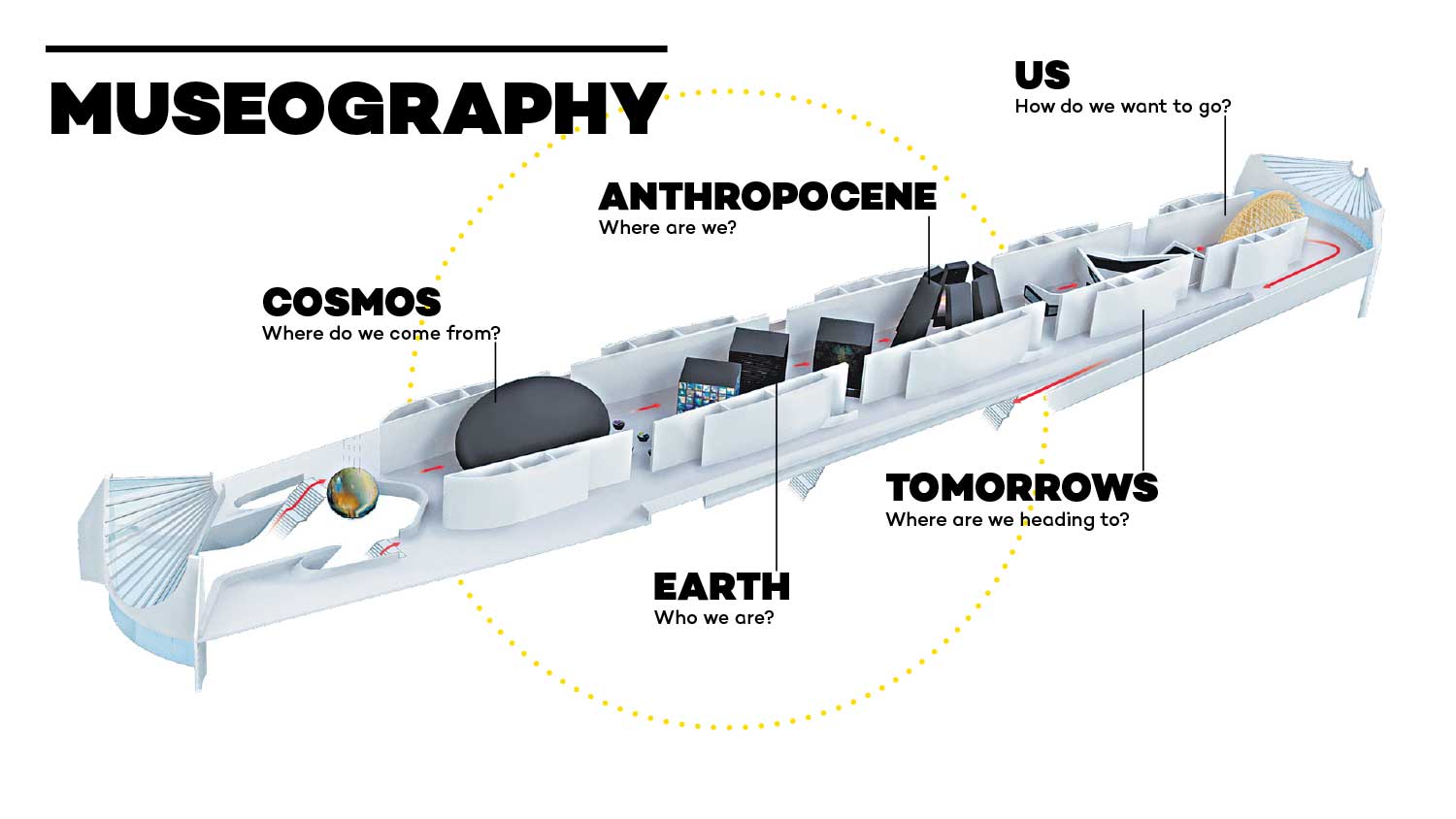
LAO: We settled on telling a story organised in five great areas. Why five? It is a dialogue with the architecture. Calatrava provides us with five roof undulations that roughly define the areas in which we set our museography.

So we came to the idea that the story should be made up of a sequence of great questions that mankind has always asked itself, so we could say in a very real sense that our content is questions.

Where do we come from?
Who are we?
Where are we?
Where are we heading?
How do we want to go; which values do we want to convey to the future?

This is the spinal column of the museum.

We use science content to illustrate these great questions, and the idea is that people come to realise that the future is not done, the future is in the making. It is in their hands, at least in part –– to collaborate in this future-building.

Image via MuseumNext.

SC: This idea of a museum that isn’t about the past but is about the future, about choice, about ethics, does it have any precedents or parallels elsewhere in the museum world?

LAO: As far as we know, no, it doesn’t.*

SC: You made a very deliberate choice in naming this institution, “The Museum of Tomorrow”. Can you speak to that?

LAO: In the common sense, the future is far away.

But tomorrow is always here. Somewhere, at this precise moment, the sun is rising in the east. All the time, it is tomorrow somewhere.

This idea that tomorrow is always inside every now was what convinced us that it’s a “museum of tomorrow”, not a “museum of the future”.

SC: A museum about things that haven’t happened yet faces certain challenges. What are those challenges from a curator’s standpoint?

LAO: We established some trends which will shape the future some decades ahead: what science tells us about the possible scenarios for the climate, the changing of biodiversity, the growth of the population, the number and complexity of cities.

From all these you can forecast some reasonable scenario. But what about the unexpected that this cannot and will not take into account?

We did not want to become a museum of prophecy. That was the greatest challenge, the greatest danger, because people would come here and say, “Well, you’re telling us that the future will be this.” That’s not what we want to do. We want you to understand that the present is this, and the future? Well, there are many. This is the point; the futures are plural.

SC: A museum of questions rather than a museum of answers.

LAO: Yes, yes, precisely.


Image via MuseumNext.

SC: When you talk about wanting to have a certain emotional impact on visitors, what’s the goal? 

LAO: You want to take people away from their everyday perspective so they can understand that the world in which we live is much more complex, varied, surprising, full of wonderment, than everyday life which uses you, trains you, and tames you to become a useful citizen, a working citizen.

We want to provide a sort of entertainment; entertaining in the sense that it distracts you from your usual ways of thinking. To have different ideas, different perspectives. They just cannot become indifferent! If they leave the museum just as they came into it, we have failed completely. But if they are disturbed, well, that’s okay.

SC: What about the Brazilian context, and Rio in particular? Are there any special challenges or affordances for this project?

LAO: First, perhaps the fact that we are a museum open to the future, but we are sitting in the very heart of Rio de Janeiro’s history. You can see all the landmarks of centuries around us. This heart of the city was abandoned for decades. So we are in a way a flagship of this new moment, of this new period of the city’s story.

I think the Cariocas, the people of Rio, understood that. They took possession of the renewed plaza, because you know, it’s theirs.

On the other hand, we have the very difficult condition of the country at the moment. The legitimate government was overthrown by a parliamentary coup, and a bunch of gangsters took power for themselves. So we are in a struggle for democracy itself, the very core of democracy, which is election.

But many people tell us that the museum is a counterpoint to this situation. This is something inspiring. We wanted to inspire people––but I did not know that it would be in this sense, that we became a symbol of a better future for the country.


Image via MuseumNext.

SC: The invitation to regard the future as shapable and as plural is a deeply political position.

LAO: Certainly. You cannot deal with conviviality, with living together, without politics. It’s impossible. So in fact, we are a political museum. We cannot say that as a slogan of the museum, because people would not understand in that sense. They would think that we are engaging in this or that political party, which is not our intention.

SC: I see vast potential not just in this institution, but in this category of institution, a kind of museum that is needed everywhere. There is a need for effective invitations to people, to draw out their vision for how things could be different.

LAO: I understand and I agree completely, because I think this is a path for renewing democracy itself.

* We'll revisit the question of the Museum of Tomorrow's conceptual cousins in posts to come.

Related:
> Dreaming together
> Whose future is this?
> The technology of public imagination

Monday, August 04, 2008

Future watch

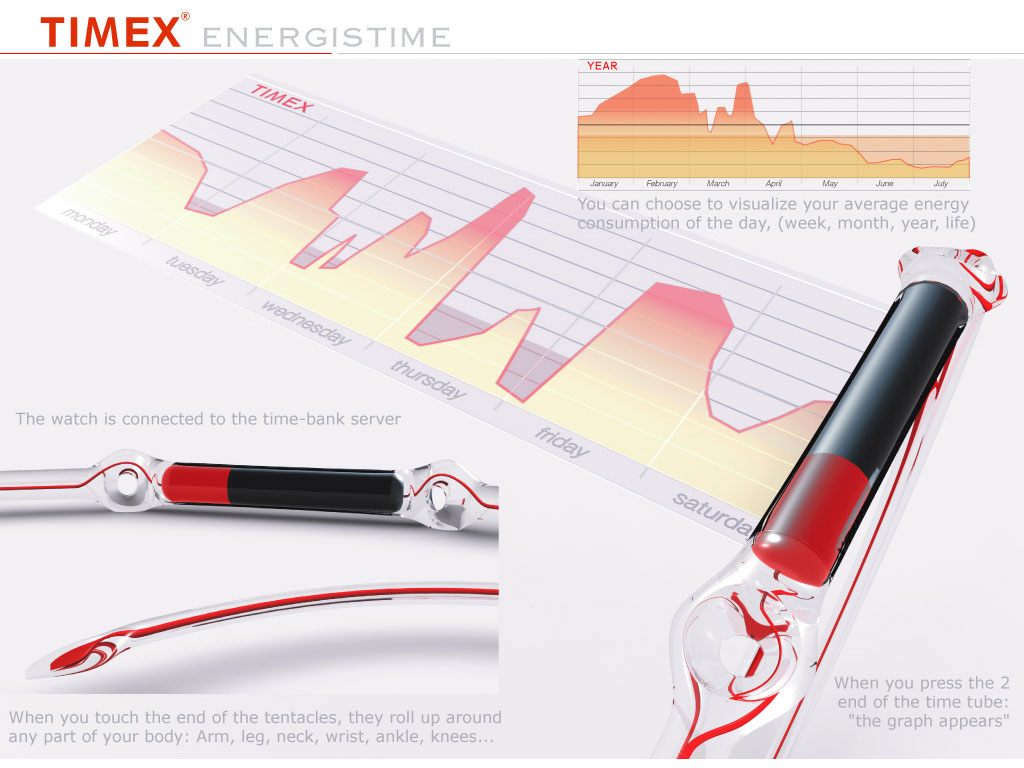
"Energistime" | Winner, Timex2154: conceptual category (02004)
Photo: the sceptical futuryst

"Energistime" | Design by Francois Gustin / Francois Laine / Nicolas Montabone
"In 2110 was voted [sic] a new law by every country: 'An ecological behaviour makes people earn free time.'"

In 02004, to mark its 150th anniversary, American watch manufacturer Timex partnered with industrial design magazine Core77 (previously mentioned here) to stage a global design competition, Timex2154, envisioning concepts for watches another 150 years hence.

From the competition's design brief:

The essence of time has many interpretations. Some revere time as a regulator, providing context to actions and order to schedules. Others deem it as a checkpoint device that invites accomplishments and permits life to be enjoyed to the fullest extent.

The capture of time is also ripe for investigation. Some people respond to the precision of the digital, while others welcome the tradition of the analog. Some are fascinated with the march of time, while others are liberated by its constant rhythms. Whether too much or too little, most are constantly referencing time's metric, and portioning out attention, energy and lives by its metronome.

Watches in the year 02154. As a basis for a design competition, it's an interesting combination of theoretical contemplation, on the one hand (uh, no pun intended) and commercial savvy on the other (get designers around the world to sketch out some long-range product development ideas, on the cheap). The panel of judges included, notably, Paola Antonelli, MoMA's curator of architecture and design, and the woman behind the exhibition SAFE: Design Takes on Risk (02005) as well as Design and the Elastic Mind (02008), the latter previously blogged here.

So when I learned last week that the company was founded in nearby Waterbury, Connecticut, and that the Timex Museum there (Timexpo) included an exhibition of the winning designs, I had to check it out, and was able to make the journey there Saturday afternoon.

The Timex Museum, Waterbury CT | Photo: the sceptical futuryst

Now, it's not necessary to visit Waterbury in order to see the designs, which have been available online for some time (e.g., blogged at We Make Money Not Art in October 02004). However, one thing that appeals to me is that the winning entries in each of the three categories (wrist-based, wearable and conceptual) have been prototyped in tangible form and are on display at the museum.

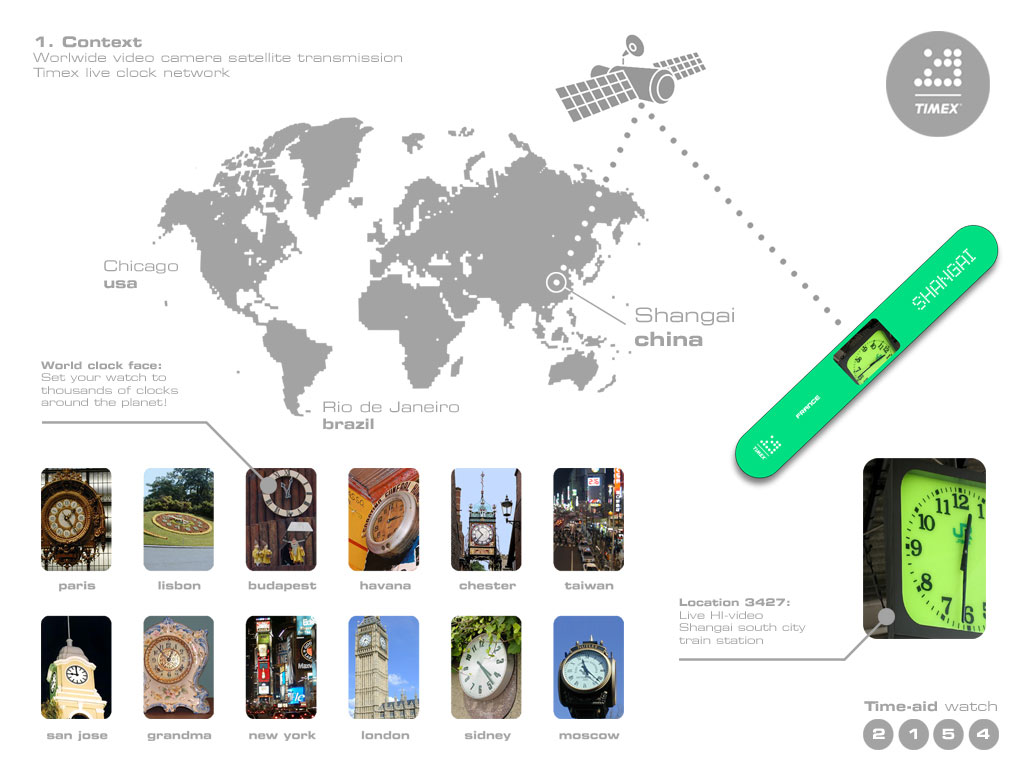
"Time-aid" | Winner, Timex2154: wrist-based category (02004)
Photo: the sceptical futuryst

"Time-aid" | Design by Christophe Koch / Lea Kobeli
"Intelligent watch to display all the clock faces around the world."

"Time-aid" | Photo: the sceptical futuryst

Timex2154 wearable category display | Photo: the sceptical futuryst

"Sticker Watch" | Winner, Timex2154: wearable category (02004)
Design by Alexey Koptev

"Sticker Watch" | Photo: the sceptical futuryst

"Notable entries" which didn't earn a place at the museum can be browsed online, and are also worth a look. A couple of examples:

"Krikos" | Timex2154: notable entries (02004)
Design by Breanna Guidotti
"The word Krikos is Greek for circle, a never ending path. [...] Krikos is a way for people to adopt a built in sense of time. As users grow accustomed to the cues Krikos gives them about time they will also take cues from their environment and will acquire the ability to feel time."

"Epidigital Patch" | Timex2154: notable entries (02004)
Design by One & Company Team
"The epidigital patch leaves the user with an animated topographic timekeeping image on his/her skin. [...] Composed entirely of organic matter, the nanobots dissolve after several days at which point a new patch can be applied."

There's much more to the museum than the Timex2154 entries -- indeed, most of it is history-oriented, but I found it illuminating to learn about the industrial past of the state of Connecticut, to see the home of the phenomenally popular (and ubiquitous even in my childhood) Mickey Mouse Watch [photo] and to find how photography and portable timepieces were used for ingenious cross-promotion in their early days [photo].

But, getting back to the futures: unsurprisingly, many of these concepts do not appear to be grounded in compelling society-level scenarios that would provide plausible in-world parameters. (For in fact the world as we find it shapes industrial design efforts in the present, providing key affordances and constraints that make a product not "plausible", but "useful".) To me, richer and more interesting than the technological marvels presumably enabled by a century and a half of time's passage -- and many of these ideas project, at best, a decade or two into the future, let alone fifteen -- are the possible social shifts which would be embedded and embodied in the artifacts of that distant era.

What would be really shocking is if most people needed or used (other than as a romantic, antique affectation) anything remotely like the quintessentially 20th-century watch in 150 years' time. Already, fewer and fewer of us wear them today, because of the ubiquity of other devices that tell time, and a whole lot else besides. Timex, and other watch manufacturers, must be concerned that their time is running out, and I find myself wondering if that's what prompted the comp in the first place.

At least they were astute enough to abstract from the concept of "watch"; "personal and portable" "timekeeping devices". (From the design brief: "**IMPORTANT** Regardless of category, all entries must embody two key criteria: Personal and Portable. Entries in this competition should examine ways to embody and communicate time on an individual level.") "Future of X" exercises are intrinsically hazardous because they take for granted the continuity of conceptual categories, objects, values and practices which are themselves bound to be subject to important historical shifts. Although I'm always interested in futures concepts which can be physically crafted and thus encountered, I also recognise that artifacts are only a poor proxy for the future -- like the past -- and there is a very great deal about our lifeworlds that simply cannot be conveyed in stuff.

Wednesday, March 05, 2008

Sometimes it doesn't belong in a museum


On one street corner in Lower Manhattan, the World Trade Center is still spoken of in the present tense, confusing some passers-by, enlightening many others.

"Now, every weekday, 50,000 people come to work in 12 million square feet of office, hotel and commercial space in the seven buildings in this city within a city," says the seven-foot-high Heritage Trails New York sign at Church and Cortlandt Streets, opposite ground zero.

The Alliance for Downtown New York, which maintains the 11-year-old Heritage Trails markers, has deliberately left this one untouched since 9/11 as an authentic — and poignant — remembrance of the trade center’s astonishing vitality.

But in recent days, the sign has been imperiled by construction crews working on the Fulton Street Transit Center.
[...]
It will be donated to the National September 11 Memorial and Museum at the World Trade Center, which is now under construction.
[...]
"We’re just honored and delighted to be the permanent custodians," said Jan Seidler Ramirez, the chief curator of the museum.

"The sign has been doing wonderful service — as it was intended — up until the last precarious few weeks of construction," she said, "because many visitors never knew the towers, never saw Lower Manhattan with the towers intact. I saw lots of people beginning to come up and read it and, for themselves, begin to process the present-tense description of the animation of the World Trade Center campus."

Ms. Ramirez said many passers-by "totally grasped the fact that this was a survivor artifact" and that foreign visitors whose command of English was not all that strong would probably not have been bothered by the anomalous verb tenses.

But she also said, "Others might have thought they were in on one of the biggest editorial gaffes of all time."

~The New York Times, Friday 29 February 02008 [p. C11, Business section, print edition]


It's impressive that this sign has been preserved in situ for so long -- 11 years total, and seven six and a half years after 9/11, 02001. That is, it's been a "survivor artifact" in its present position for longer than it stood in the shadow of the WTC towers. These aren't huge timescales, of course, and little wonder that reconstruction at the site is finally relegating the object to a museum. The wonder is that, given the sensitivity of many Americans to painful reminders of the loss that day has come to represent, the sign has taken so long to be harvested and processed by the nostalgia machine.

And yet, I would venture, this fascinating anachronism is (or was? -- perhaps by the time you read these words, the past tense will be necessary) infinitely more interesting in the street where it stands (stood) than it will ever be in a museum, its future (present) home. That change of context is bound to render it safer and -- to precisely that extent -- more dull; just one historical relic among many, an occasion of cognitive dissonance and enlightenment no longer. Contra Indiana "That belongs in a museum" Jones, sometimes the valuable artifact does not belong in a museum, but can serve as a more effective and arresting portal to another time in its original environs; without extraneous explanation (or, in the words of Steven Johnson, "flashing arrows").

The bemused tourist encountering this sign in the street post-9/11 is unwittingly cast as an archaeologist of the recent past. She is challenged to come to terms with a fragment of a world gone by that is, as much as any ancient civilisation, irretrievably lost. The cognitive (re)construction process that, we surmise, has to occur in order to make sense of this experience, is symmetrical (but not identical) to the moment of encounter with an "impossible" future object.

That is to say, this report describes the moment of an encounter with a puzzling object which I think functions similarly to certain artifacts from the future. What we call "found futures" -- scenarios made manifest, then left lying around to seed such unexpected encounters -- are as this article says, "confusing" to some, and "enlightening" to others.

All of which leads me to the next concept in our nascent series about designing future artifacts.

One of the ways we think about the task of designing future artifacts is the idea of "reverse archaeology". After an archaeologist digs up an artifact of a past civilisation -- an urn, let's say, or a clay tablet -- they set about trying to deduce from its features things about the society which produced it (rituals, social structure, economy, and the like). When we design future artifacts, we almost always start from a written scenario of the future in question, the building of which provides the opportunity to consider its internal cohesion, its coherence with the present and with history, and so on. Therefore, whereas the archaeologist must deduce the "world" from the "fragment", we as multimedia futurists deduce the "fragment" (or fragments) from the "world" expressed in the scenario. (This is not quite the same as what Dator refers to as "deductive forecasting", which has more to do with the prior step of crafting the scenario around the structural features of one of the four "generic images of the future".)

The embodiment or encoding of the scenario thus accomplished allows the artifact finder to decode or deduce something about the world from which the artifact "came". But the encoding or mediation of possibility space at the design stage can be thought of as "reverse archaeology".

Now, another word about the puzzle posed by this (type of) sign. I want to suggest that, as described in the previous post, this disjuncture between the present tense of the sign and that past tense of what it describes is a "disturbing hole" (and we're not talking about the big one in the ground where the twin towers used to be). It may be tempting to assume that in communicating foresight, clarity is all-important; that an artifact which confounds is one which fails to communicate. On the contrary, we believe that such puzzlement is invaluable, a pedagogically priceless moment, a conundrum which the audience needs to struggle (ideally, only for a few moments) to resolve. To put such an object in a museum, where pieces of our other "worlds", previous times, are each designated their little soapboxes from which to declare their once-upon-a-time reality, all but neutralises their power to confuse as well as their power to enlighten. The two are inseparable.

Now, the trick is not to confuse permanently: we want to stop people in their tracks, but only for a moment or two. This is one place where the art of artifact design comes in. And inevitably, however well thought out the design, it won't function equally well for all comers. Comically improbable as it may seem, I have little doubt that some of the passers-by did indeed imagine, on seeing the WTC sign, that they had discovered some monumental "editorial gaffe".

I'm reminded of the bronze memorial plaque we installed on a Honolulu street corner late in 02007, a testimony to the resilience of the Chinatown community, and that of the island of O'ahu at large, in the face of a (hypothetical) tragic bird flu epidemic in 02016.


One of our favourite responses through the entire process of FoundFutures:Chinatown was from a woman who came across this sign in the street, and stood before it for a good few minutes, taking it all in -- the fresh leis; the scale of the tragedy outlined in the inscription (the likes of which the city has not seen since the 19th century); and the occasion of the memorial's supposed dedication 02017 date (almost ten years forward, to the day). "Ha!", she snorted, "They got the date wrong!" And she trundled off down the street.

To appropriate a quote attributed to Lincoln, you can't get through to all of the people all of the time.

But you can have a lot of fun trying.


Correction 16/05/09: So, maybe we didn't get the future date 'wrong', but my arithmetic on the post-9/11 lifespan of the sign was off by a year. Poetic justice: life's favourite brand of irony.

Friday, March 02, 2007

Pearl Harbor redux

One Sunday last month, I took a trip to the USS Arizona visitor centre at Pearl Harbor. It was my third visit there in twenty years, and my second within 24 hours. The first time, I was about six years old, returning with my family to Australia after two years of living in Vancouver. Visiting the Arizona was one of only a handful of things I vaguely recall from this childhood stay on the island of O'ahu (along with taking hula lessons at a hotel on the north shore, and browsing an extensive selection of tapes -- yes, I'm talking audio cassettes, kids -- at a music shop). The second time, in February just passed, was to prepare for a volunteer session there the following day, working with the United States National Park Service. During that orientation visit to the site, I had an opportunity to take the audio tour of the facility (narrated by Ernest Borgnine), visit the memorial (which involves a short boat trip on a vessel run by Navy personnel) and view the introductory film which all memorial visitors must watch beforehand.

The Pearl Harbor visitors' center is located on shore, near where the USS Arizona lies in forty feet of water. As many readers would know, the Arizona was an American battleship sunk in a surprise attack by Japanese bombers on the morning of December 7, 01941, dubbed by President Franklin Roosevelt "a day that will live in infamy" -- a sort of self-fulfilling prophecy which accompanied the United States joining the second world war. Pearl Harbor is an iconic location, a stand-in for the seven military bases on the island which were all attacked on that "day of infamy", so the memorial stands in tribute not only the 2,000 lives lost on the boat itself. (Despite the largest marine salvage operation in history, many of the bodies remain entombed in the sunken vessel on top of which the memorial is built.) And, the painful cinematic efforts of Ben Affleck notwithstanding, it remains one of the most visited tourist attractions in Hawaii.

So why redesign it? In fact, the number of visitors has long exceeded the intended capacity, with the all the frustrations of long waits, oversubscribed bathrooms, and so on, which go along with that. Moreover, engineers have determined that, in a slow-motion recapitulation of the ship's fate, the visitors' building is sinking: it has an life expectancy of under ten years. Hence the National Parks Service, having run the site since 01980, has engaged a museum design firm, AldrichPears Associates (coincidentally, headquartered in Vancouver) to help re-envision this historic location.

What occasioned my involvement was stumbling across a presentation on museum and exhibit design one evening at the UH-Manoa art department, which included a call for assistance in gathering public input. A small number of graduate students were duly recruited on a voluntary basis to head out to Pearl Harbor and survey visitors about their reasons for coming, their background knowledge, and their responses to the proposed content and format of certain exhibits. There are some promising ideas on the drawing board -- interesting artifacts, multimedia presentations, and a historical walk-through beginning with pre-war life on O'ahu. Whatever eventuates, it is certainly being informed by an innovative, systematically thought-out design process. Indeed, the original reason for my curiosity related to the pedagogical challenge of designing an experience to communicate complicated information, which I saw as possibly helpful for our work on developing immersive scenarios. But I found there's rather more to it than that, as I'll explain.

In addition to the capacity issue, and the sinking problem, another motivation for rethinking the facility is that for an increasing number of people, it introduces events that took place in an earlier era. Whereas for an earlier generation of visitors it served as a reminder of historic events many of them had experienced more or less first-hand, with the passage of time, the details are bound to be only vaguely familiar, if not totally new, for more and more people. At bottom, then, there's a challenge in the rebuilding process that's less architectural or structural in nature than historical, cultural, and political. How are these stories to be told? How are events like this to be remembered? Who speaks for whom, and what do they say? An anthropology professor who specialises in the politics of representation is involved in this process, to help the designers grapple with such questions. And even though it is the visitors' center rather than the memorial itself which is to be redesigned, the significance of the exercise is further underscored by the fact that -- as I heard on several occasions, including from Ernest Borgnine -- many visitors regard the memorial as a sacred place.

But having now had a hand, however small, in this process, I am compelled to consider for myself a few of the questions it raises. What, after all, is or should be the purpose of this, or any, memorial?

I used to live just a few hundred feet from the Australian War Memorial in Canberra, and frankly I find my feelings are divided on this. On the one hand, the tragedies and triumphs, heroism and sacrifice that occur in wartime are crucial part of human experience, as well as individuals, families and communities. On the other hand, I don't think it in any way impugns the contributions of people at those levels to state that, in my view, no one should have to experience war, and the purpose of such memorials, if we are to keep building and maintaining them, ought principally be to show anyone who comes to look, exactly how insane the whole institution of warfare actually is. There's a fine line between the "never again" that renounces systematic bloodshed, and the "never again" that buttresses military spending and a defensive outlook which turns offensive when cornered.

In reflecting on this, I'm reminded of an insight shared by a colleague and alumna of the Manoa School of futures, who works as an archivist at the University of Hawaii's Hamilton Library. She has an interesting view of archiving in a whole-chronology context; and she looks both forward and back down the "time tunnel". Borrowing this idea, when I look down the time tunnel towards the past, as far as the eye can see stretches a litany of atrocities that establishes beyond any doubt that the problem goes beyond any particular culture or country -- the old devil violence seems deeply ingrained in humanity. But when we look down the tunnel towards the future we discern an opportunity to be relieved of history's more ignoble legacies, because what happens to last (or what is chosen for preservation) today is raw material for the historical record of the future. We can't avoid the need to decide, somehow, what of the past to preserve, to emphasise, to discard, to treasure -- in short, we set the stage for how the future will remember us. And at the risk of sounding like a refugee from the idealistic late-'60s (which in sensibility I probably am in many ways, despite having missed them by more than a decade) in my opinion war should go the way of slavery, and we should think seriously about how to treat war-related historic locations in that light. I am not advocating amnesia, but a wiser way of remembering; one that does not chain us unduly to repeating past tragedies out of respect for the people who enacted them.

Lest I should seem unappreciative of the sacrifices of generations before me, I fully understand that my own position (with others in my highly fortunate age group) is a great rarity in the historical perspective -- a male who reached adulthood without having to fight in a war, lose any close family members to one, or even seriously contemplate being drafted was, until recently, a very rare phenomenon. Even so, from a lifetime of films, literature, documentaries, the study of history, and a year spent in the former Yugoslavia a few years after the conflict of the 01990s came to an end, I have fully internalised that "war is hell". This however was not the principal message I received at Pearl Harbor. "The loss of American life in military situations is a tragedy" would be closer to the mark. And, while a message in the latter form may be part of a suitable tribute from the point of view of those who experienced the attack as a personal tragedy, as history goes on, the contestation of the broader meaning of the site comes into focus. And the appropriation of those stories of personal loss for the dangerously warlike purposes of national myth-making becomes a risk that ought not to pass unremarked.

Now, as I indicated, the representation issues that arise in selecting and telling the next round of war stories are being carefully considered by the designers and their advisors, so I am not criticising anyone concerned of lacking anything in the way of sensitivity or good intentions. One of the questions we volunteers asked of visitors related to their feelings about augmenting the Japanese perspective on the circumstances and events around 7 December 01941. Not surprisingly, responses were mixed. But in the bigger picture I'm addressing here, frankly, that question is a red herring. The Pearl Harbor visitors' facility is located on an active US Navy base, so how can it possibly represent anything other than a mourning of losses (as opposed to wins), in accordance with the unwritten rules of the war game which obtain on all sides in the nation-state era? In my eyes, the greatest tragedy lies not with this attack, or even with this war in particular, but with the human habit of war itself. And what of this burning question, found only at the next metalayer up from the tallies and tales of one side or another, about the ethics of the whole military enterprise? No, if it's literally built upon and surrounded by the same thinking and practices that made the second world war possible (and hundreds of basically similar conflicts, on a smaller scale), whatever explicit message is proclaimed, this facility inescapably serves a fundamentally past-oriented view of the world that is in varying degrees nationalistic, narrow, aggressive, and self-pitying -- and therefore irretrievably tragic.

So here's an idea to run up the proverbial flagpole (meanwhile, giving national flags a much-needed break): why not let the visitor center sink, after all? Let it slowly tilt and bubble and disappear into the mud. Let us not lose any sleep, or 34 million US dollars, rebuilding anything -- except perhaps, eventually, a boardwalk for future generations to stroll past its crumbling passages and peeling interpretive panels. The former Pearl Harbor visitor center could become a meta-monument; embodied historical testimony to the way we used to embrace militarism while turning our faces away... how we would shed a tear for each of "our" dead, while rounding "theirs" off to the nearest thousand, or ten thousand, or million. It could serve as a fallen landmark to the belated passage to maturity of humanity, when in the early 21st century, we finally acted on the knowledge that war was an institution which we had to bring to a complete end, or it would do so to us. We might go further. Instead of O'ahu remaining the enormous military outpost that it has so long been, we could lay down arms, close the military barracks, and aim sincerely to make the whole of Hawai'i a living monument to sustainability in human relations, as well as in ecology. So, like the Arizona, might we leave the visitor center undisturbed for time and the elements slowly to reclaim, and when finally it's no longer visible, maybe we will have learned the bigger lesson. If perchance we haven't by then, it probably won't matter anyway.

Because, forgive my naivete, but where in all this are the monuments to futures we want to create? Where, for instance, is the statue honouring the (perhaps as-yet unborn) person who cures AIDS? Our space consecrated for silent reflection on the so far undrafted treaty that will abolish war? The grand architectural gesture towards the future dismantling of the world's last nuclear weapon? The city square adorned with messages in a thousand languages prefiguring the erasure of the last international border? In my opinion there is a far stronger case for planting these seeds of joy, hope and aspiration in our public buildings and spaces than there is for eternal, solemn remembrance of yet another sad story from the bloodstained era of guns and bombs.

Folks, our civilisation has a problem. We could start by acknowledging that fact; and if we must build public monuments, and flank them with interpretive centres (which incidentally, at this point in the human story might be better conceived as virtual/electronic spaces anyway) let them be to celebrate peace, creativity, and the honest work of collectively imagining and constructing something far more inspiring, at the global level, than the tradition of "international" violence and domination that has been our inheritance.

Kurt Vonnegut, The Nation, 7 January 01984 (reproduced here):

If Western Civilization were a person, we would be directing it to the nearest meeting of War Preparers Anonymous. We would be telling it to stand up before the meeting and say, "My name is Western Civilization. I am a compulsive War-Preparer. I have lost everything I ever cared about. I should have come here long ago. I first hit bottom in World War I".

Western Civilization cannot be represented by a single person, of course, but a single explanation for the catastrophic course it has followed during this bloody century is possible. We the people, because of our ignorance of the disease, have again and again entrusted power to people we did not know were sickies.

And let us not mock them now, any more than we would mock someone with syphilis or smallpox or leprosy or yaws or typhoid fever or any of the other disease to which the flesh is heir. All we have to do is separate them from the levers of power, I think.

And then what?

Western Civilization's long, hard trip back to sobriety might begin.

Tuesday, May 30, 2006

Tombstone and the future of history

"The town too tough to die." That's the proud slogan of Tombstone, which perches in splendid isolation at the eastern fringe of the Sonoran desert, an hour's drive southeast of the city of Tucson, Arizona, and about 30 miles north of the Mexican border. I've come to Tucson for the weekend, and since my friend mysteriously failed to pick me up at the airport two days ago, I've had to improvise an alternative agenda. So it is that I find myself sharing a rental car with four other young travellers, hailing from Bermuda, Liverpool and Utrecht, all fellow denizens of a hostel a short walk from downtown Tucson. Unlike me, all are in their early twenties and in the midst of their respective trans-continental quests to "see America". Today, Tombstone is our chosen day-trip destination.

As no visitor to the area can fail to notice, this settlement, which some 1,600 souls call home, prides itself on being an icon of the Wild West. As a tourist attraction, it taps into that lucrative cultural reservoir of collective memory, part history and part myth, which has been immortalised -- or, to those inclined to emphasise the latter ingredient, generated -- by a thousand movies. The town's excellent name is perhaps one of the most effective imaginable evocations of hardbitten frontiersmen and devil-may-care gunslingers (possibly outdone only by the town of Truth or Consequences, New Mexico -- although in point of fact that town was actually named after a radio show in the 1950s). Tombstone's real claim to fame, however, is that it was the site of the infamous gunfight at the O.K. Corral in 1881. Though the original event has long since passed, thankfully you can enjoy a re-enactment any time you care to visit: "Gunfight daily!" cry the billboards scattered en route.

Probably like many others unfamiliar with these parts, what I know about the actual history of the colonisation of the West by European Americans could fit comfortably on the back of a postage stamp, and despite my passion for cinema, the western is surely the genre of American film with which I'm least familiar. Even so, the look and feel, the sensibility, or mythos invoked here is so familiar from culture (and yet so remote from my own experience) that in my mind it is the very essence of B-movie cliche: hard stares, bold moustaches, stray bullets, and dust.

Why did I come here? I have no satisfactory answer to that question. I don't know what to make of the fact that I am spending time and money in this bone-dry, baking hot place in the middle of nowhere. But while pondering that I'm put in mind of an interesting comparison. While I was studying at the University of Melbourne at the turn of the century, part of my family lived in Ballarat, Victoria, an hour and a half away; a town founded during southeast Australia's gold rush. Ballarat has a major tourist attraction named Sovereign Hill, a recreated 01860s gold mining settlement and so-called "living museum". There are certain historical and aesthetic similarities -- both places are recreated frontier towns in the New World (albeit on different continents, though you'd be hard-pressed to pick that from appearances only) and owe their existence to the mid-to-late 19th century mad dash of prospectors seeking precious metals. Both are filled with wooden buildings, have walls adorned with ersatz parchmenty official looking posters, and have horses regularly clopping past, carts and passengers in tow... But whereas Sovereign Hill is a paid-admission only, privately owned attraction in its own right, near but not integrated with the modern city of Ballarat with its 80,000 inhabitants or so, the town of Tombstone, which is a place where people actually live and work in the early 21st century, is itself the attraction. Here ordinary life overlaps with the historical streetscape that is maintained by dint of tight local regulations, and which has made it a nationally listed attraction since the 01960s. Sovereign Hill is at pains to provide some kind of sense of life in the era (it has a working mine set up, you can pan for gold, there are educational programs including a school in which children can experience the classroom of a bygone era, writing out lines with a quill and inkwell). In Tombstone, by contrast, there are no fences between the dusty street and the desert -- the centre of the original town is itself the attraction -- but as a result, modern life keeps intruding. There are Harley Davidson motorcycles parked everywhere. You have to pay to get into the OK Corral. Every store is jammed full of souvenirs. (Oddly, visiting the town, and commemorating -- or commodifying -- your visit for future reference are merged, so seeing all those souvenirs and witty posters through every doorway inevitably becomes one of the main recollections you take away.) It's a place where people live, but to seems to operate almost entirely at the level of appearances and legend, throwing back to the Hollywood-made mythos. This creates a kind of paradox: the real town of Tombstone contrives to deliver a far more crassly commercial and less authentic experience of history as it might have been than the thoroughly controlled simulacrum at Sovereign Hill.

So, the weekend we're here, as it happens, the United States marks Memorial Day, which is an opportunity to celebrate the sacrifice of servicemen in the country's growing list of wars. But it's "Wyatt Earp Days" in Tombstone. This makes it one of two occasions annually when people descend on Tombstone to stroll around dressed gloriously in 01880s style -- the other is the 26 October anniversary of the O.K. Corral showdown. It is impossible to say in most cases which of these elegantly dressed are locals pandering to tourists, and which are tourists indulging their own eccentric hobby. I overhear one woman, elaborately dressed in heavy dresses, gleefully declaring that "We came here once and keep coming back!" At first I'm puzzled as to what the attraction could be -- wandering around in an overheated costume for a weekend. However, my fellow hostellers can't resist having their photos taken with a dapper couple in Wild West regalia who turned out to be repeat visitors from Michigan, and I begin to see how this role play could be fun: authenticity might be much less of a concern than the thrill of participating in the illusion, like actors on the stage.

What a place to visit! But what must it be like to live here? Evidently there are certain costs to living in a museum. I meet a bright eyed young lady behind the counter at a wild west outfitter. She's perhaps 16 or 17 years old, wearing a black dress recalling Jody Foster in "Maverick". I ask her about what it's like to live here. She explains that she didn't grow up in this town, but is originally from California, and her mother had decamped here in pursuit of her dream home -- a 01904 Victorian. Clearly, for a young woman, though, it's almost unbearably boring. "I'd love a skyscraper here," she says wistfully. "Or a McDonald's, a drive-in theater... anything!" Earlier this year, it seems the streets were restored to their unpaved state by the Tombstone Restoration Committee, because the asphalt may have endangered its coveted designation as a National Historic District. It's an interesting situation when an American town reverts to stones and dust in search of authenticity. And it is not unanimously appreciated, either. One of our group spotted a flyer in one of the store windows alluding to this, evidently an ongoing dispute in the town -- should the dust stay, or should it go?

What keeps these streets dusty in 02006 is a myth that is too tough to die. We feed the myths with our attention. The poet Muriel Rukeyser once wrote, "The universe is made of stories, not of atoms." What then of the future of Tombstone? Well, if Rukeyser is right, then as long as its stories persist, it seems Tombstone's viability as a place to visit, its existence in our universe, is assured. The most recent contributions to this corpus of storytelling, as far as Tombstone is concerned, are the movies Wyatt Earp (1994, starring Kevin Costner) and Tombstone (1993, with Kurt Russell and Val Kilmer). As one storekeeper remarked to me, there was a major resurgence of tourist interest in the area after these films came out. In fact, many of the souvenir posters and t-shirts for sale here feature those stars' faces rather than the less recognisable ones of the town's real historical inhabitants.

I asked my travelling companions whether they could think of anything interesting or special going on in our own era that people might see fit to devote their lives to preserving in this fashion in 130 years' time. We couldn't think of anything offhand. (Maybe, with our emerging ironic postmodern sensibilities, the real story in the future will be the idea of people dressing up their bodies, and dressing down their streets, to "recreate" the surface layer of a long-gone past.) Perhaps Michael Crichton's 1973 sci-fi movie Westworld had the right idea: the tourist attraction of the future could be a theme park which faithfully recreates the favourite, most highly mythologised times and places in the popular imaginary -- history's greatest hits. In Crichton's story, a whole Wild West theme park is populated with human-looking robots that can, at least in theory, be safely exploited by the (human) guests who pay a premium to satiate their appetites for realistic brothels and gunfights.

I picture that young lady from the clothing store getting her wish: a skyscraper in Tombstone -- now that would be worth seeing! You could put the whole town's population inside, with a spectacular, towering view of the surrounding landscape, and let the tourists amuse themselves by tussling with robots in the dust below. If our stories shape our world, we should choose them wisely. There are surely some sacrifices associated with making a living off the past, and this shrine to a past that I suspect in many ways never really existed, though fascinating, raises a lot of questions. Among them: what might a settlement be like that evinced as much devotion to its futures as Tombstone, Arizona does to its history?