Showing posts with label prototyping. Show all posts

Thursday, November 06, 2008

Design led futures

MARK: a digital feedback "biomarker" to manifest internal bodily processes
Image by Michael Fyfe for Kardia Project, Design-Led Futures 02007
(see Kardia workbook, pp. 132-154)

A fabric-based, personalised interface for music collections
Image by Dan Scudder for Stitch Project, Design Led Futures 02007
(see Stitch workbook, pp. 17-25)

X-POSE: diagnostic imaging plaster for user-friendly sports medicine
Image by William Carlson for Velvet Project, Design Led Futures 02007
(see Velvet workbook, pp. 47-56)

Each year, students in the School of Design at the Victoria University of Wellington, New Zealand, have an opportunity to apply their design training to dreaming up future product lines for a partner company.

The Design Led Futures (DLF) program was established at Victoria University of Wellington’s School of Design in 2004. ... The DLF program offers companies visions of the future. It explores possible scenarios for ten years into the future. It attempts to expand the range of possibilities that a company can see by challenging what the company currently does. It entices companies to take risks by offering believable future scenarios. Partner companies have included Fisher & Paykel and Methven from New Zealand, and currently DLF is working with Nike.

Companies have seen DLF as an opportunity to develop visions of the future with two main purposes in mind. The partners do not expect to develop intellectual property out of the projects. Rather, they use them to challenge their own teams into thinking beyond their comfort zone. Secondly, the concepts proposed by DLF are used by companies as promotional tools. The concepts serve the same function as 'concept cars'. They are not intended to go into production, but they help companies create an image of themselves for the public. This is useful in the sense that the company can express a sense of innovation without necessarily producing the concepts.

~Edgar Rodríguez Ramírez, Ross Stevens, and Simon Fraser, 02007, "Design-Led Futures: Emotional and Behavioral Response to Radical Future Concepts" [pdf], paper presented at Connecting '07, the World Design Congress, San Francisco

In March last year, Pantopicon's Nik Baerten succinctly described the three projects DLF had produced up to that point (a post reproduced at experience design consultancy Experientia):

  • Domestic Bliss: students were required to create a new understanding of the role that appliances (such as fridges, washing machines and cookers) might play in the architecture and culture of the home [link; set in 02014; working with appliance company Fisher & Paykel]

  • Inside-Out: project on the theme of outdoor living and the role that appliances might play in making this possible and pleasurable [link; set in 02016; again with Fisher & Paykel]

  • Energising Water: project to explore and create a new understanding of the base material of water by creatively applying existing or new, specifically developed technologies [link; set in 02015; partnering with Methven, a shower and tapware manufacturer]

Each of these resulted in a string of Flash-animation presentations (reachable via the project links above) describing a series of hypothetical product lines. There's a lot of content in total, and it's well worth exploring.

However, I want to highlight the most recent project completed through DLF, a collaboration with the sports-brand giant, Nike. The 02007 cohort's collective output has its own self-contained website, hello_cybernetics, which at the time of writing seems to have received startlingly little attention online.

The three sets of design concepts offered up for Nike's future are called Stitch (based on digitally-responsive fabrics), Velvet (based on projecting images on the body), and Kardia (which, I'm delighted to see, goes way beyond the usual ten-year horizon to a post-Singularity vision for the brand, as far as 02087). Each project has a short introductory film wherein the product concepts are shown off and explained, and a downloadable (pdf) "workbook" (presentation booklet of sorts) is also available for each of the three. The production values are great, and some of the ideas are quite ingenious. (Images at the top of this post come from the workbook documents for which I couldn't find separate URLs, because they're linked from a Flash page.)

I very much like the fact that the students seem to have seized the opportunity to elaborate their personal ideals for what the brand could become, which importantly, allows room to deviate from the corporate vision. This makes it a particularly interesting case of inerweaving commercial and educational agendas; it's certainly far more enlightened than simply using trainee designers as a low-cost source of labour, toiling to legitimate the conceptual confines of an Official Future. And it makes learning possible on both sides of the partnership. From the Design-Led Futures initiative's website:

On the one hand, we want to empower students. As course coordinator Ross Stevens says, "If we cannot demonstrate to students that they can initiate meaningful change – then, as educators, we have failed".

On the other hand, we want to help industry to harness this creative energy and direct it into commercially successful business infrastructures and outcomes. In this respect, we are committed to an active leadership role – one of collaboratively developing industry, rather than the traditional role of simply serving industry by following its directives.

On his profile page, Stevens adds:

I personally believe that design fills a unique role here, first by generating creative, diverse and challenging possibilities, and then making these visible and tangible to others outside of the design profession. Through this process, a broader debate is created that draws people with different skills and perspectives together to create answers that are economically, socially and ecologically considered.

Resonant sentiments.

Overall I'm impressed by what strongly comes across as a highly resourced, pedagogically thoughtful, and institutionally well-connected program. For an initiative named "Design Led Futures", of course, from my point of view it would be great to see a deeper awareness of the futures dimension -- concepts and methods from the futures field that could be extremely useful in this setting -- and there are other aspects of the program that I'd like to look at more closely another time (such as its organisers' research on emotional engagement through future artifacts). But for now, it's great to have found another active player at the intersection of futures and design practice.

Check it out.

Related posts:
> Future-jamming 101
> Object-oriented futuring
> Greener Gadgets
> London after the rain
> The MacGuffin Library

Wednesday, November 05, 2008

Manifesting vision

In addition to the exploratory role of future artifacts frequently described here -- adding experiential dimensions to our map of alternative futures -- they can also be applied in a more targeted way, to persuade an audience of the credibility and desirability (or otherwise) of a particular vision, within a company for example. Not a huge conceptual leap, of course, but this post is about an example of precisely such an application.

The story comes from graphic designer Michael Bierut, partner at Pentagram and author of Seventy-Nine Short Essays on Design, and was recounted by Ryan Freitas (formerly at Adaptive Path, now with Plinky), at his blog second verse back in April 02006:

Having been charged with naming and creating the identity for United Airlines' low cost operator ("LCO" in industry jargon), Pentagram created a presentation that walked the client through their creative process and arrived at their recommendations on the name and brand direction. The deck was intended to get "everyone nodding at the same time," according to Michael, and included something I thought was brilliant:

They actually mocked up FAKE articles from the WSJ and put them in the deck. The first was a reminder of just how late United was entering into the market against established LCOs like Southwest and Song. The second was after they'd presented their recommendation - an article lauding United for it's [sic] bravery in pursuing a compelling and unique identity in the LCO space.

Those articles were almost as compelling as the direction itself, and I’m certain they had quite a bit to do with how well the idea sold within the organization.

Not long thereafter, in an email conversation with Adaptive Path president Peter Merholz, Bierut elaborated on the mockup strategy:

Being able to make vivid counterfeits is one of the joys of being a graphic designer, and one that we don’t take enough pleasure in. One of my partners in London once mocked up a whole issue of Fortune to help a client see his business differently.
...
I never talk about "educating the client." I hate that phrase. Almost always it's the designers who need the education, not the client, not the audience. Yet designers and clients both tend to recede into their areas of expertise, and it takes work for us to wrench each other out of it. Making prototypes that help people imagine the effects that design decisions will have in the real world can be a very potent tool. Those fake Wall Street Journal articles were supposed to do exactly that: remind a client who had spent six months showing themselves Powerpoint presentations that there was a real world out there filled with people who didn’t share their fascination with their business strategy or, actually, care at all whether they succeeded at all. It's a good reality check, and it helps to shift the design work from an internal exercise that’s done for management approval, to work that’s done because you’re seeking results with real people in the real world.

Apart from a slight distaste for the phrase "the real world" (probably my own sensitivity owing to hanging around universities, a category of institution widely thought to be entirely unrelated to said reality), I think this point is marvellous and bears repeating: Making prototypes that help people imagine the effects that design decisions will have in the real world can be a very potent tool.

Yes indeed. I'd be interested to hear from anyone with similar experiences to share.

A parting thought: curious how it takes a "fake" artifact to bring the "real" back into view.

Related posts:
> Object-oriented futuring
> Findability features FoundFutures
> Reality prototyping

Sunday, November 02, 2008

Object-oriented futuring

Designer and researcher Julian Bleecker of The Near Future Laboratory and Nokia is currently airing some interesting ideas under the title "Design Fiction" (a Bruce Sterling coinage that t.s.f. readers may recall previously seeing here and here). In the past month this has included variant presentations at Design Engaged in Montreal, Shift08 in Lisbon, and most recently, Moving Movie Industry in Amsterdam -- the last of which I discovered via Sterling's twitter feed.

Bleecker's Design Fiction slideshow, from the Shift08 version of his presentation, appears below.


(Those interested may compare it to the earlier version given at Design Engaged.)

The general burden of his argument (quoting from the introduction -- see Slideshow Transcript, Slide 2) is that design can be considered or used

as a kind of story-telling practice, crafting material visions of different kinds of possible worlds and through those visions doing more than presenting an inert, lifeless object. Rather, design can turn ideas into material, but also insert that material into a larger setting with broader social contexts and consequences, and through that create a compelling story about a possible future. In this way, the design object becomes an important property of the world. And its [sic] this notion of a property in a larger narrative-based context that I will ultimately highlight in this talk. A prop, to borrow from film and theater production — that helps move a story forward.

In his presentation Bleecker references the work of David A. Kirby, a lecturer in Science Communication at the University of Manchester, who offers a very interesting way of framing the real-life usefulness of sci-fi movie props:

for Hollywood technical advisors cinematic depictions of future technologies are actually "diegetic prototypes" that demonstrate to large public audiences a technology's need, benevolence, and viability. I show how diegetic prototypes have a major rhetorical advantage over true prototypes: in the diegesis these technologies exist as "real" objects that function properly and which people actually use.

[From Kirby's forthcoming paper, "Screening Technology: Technical Advisors, Diegetic Prototypes, and the Cinematic Creation of the Future", quoted at Material Beliefs blog, 21 May 02007.]

The notion of diegetic (in-world) prototypes rhymes with much of the thinking at this blog around communicating alternative futures, and in particular the importance of diegetic integrity as expressed in our experiential scenario mantra, Don't break the universe.

I agree completely with Bleecker about the use of design "to create a compelling story about a possible future". Storytelling through concept design can be so effective that in fact to provide a literal narrative set in the future to go with it may actually be unnecessary, if the in-world design elements properly invite immersion in their own right. Such was the case with architect Bryan Boyer's provocative thesis project of redesigning the U.S. Capitol building.

"Design fiction" sits at the intersection of storytelling and design. From a design point of view, it makes sense to recruit storytelling techniques to render a design more compelling. But the relationship can work in the other direction; indeed the point of film props is that they help tell the story. It seems useful to admit that from a designer's point of view, design fiction is principally a way of extending engagement with a design problem space, while for a futurist, by contrast, the same tools are regarded as a means to a larger end; namely, to help people (usually their clients) explore the various "worlds" (or contexts) in which they may find themselves several years or decades, or longer, from today.

The two are not mutually exclusive, but they are in tension. Not long ago, I oversaw a project in which our team was producing future-images -- say, two to ten years out, for argument's sake -- for a client developing a prototype application (details of which we won't go into here). The agreement was that we would use visual "artifacts from the future" to suggest how the world could eventually look to a user blessed with the functioning app. We found that, having iterated on the design once or twice, and upon delivering a completed scenario-exploring image, the client would (as hoped and expected) identify a range of second- and third- order design issues that had not been on the table until the initial image became available to "think with". One curious finding was that to evoke the social and personal impacts of a relatively distant-future application, at a general level of abstraction helpful to investors and project managers for instance, tended to require a certain suspension of disbelief; the use of an evocative artistic licence at the expense of literal "accuracy". Subsequent iterations, which the client requested to address more of the concrete, granular design and engineering issues, became less clear and impactful; though they were more useful for the day-to-day project implementation level, they were also somewhat more prosaic in their details.

So, design fictions (or diegetic prototypes) intended to advance technical implementation and those oriented to advancing systemic or social understanding are not quite the same species. In the case described above, we found ourselves doing what designers usually do (assuming a range of continuities to enable and elaborate a single preferred scenario for the product), rather than what we as futurists were more accustomed to doing (systematically exploring possible discontinuities in order to produce a more robust strategic stance).

For a futurist, or at any rate for me and my colleagues, future artifacts themselves are like so many forward-facing MacGuffins, heuristic devices carefully crafted to help tell engaging stories. They enable and animate deeper exploration of the various relationships and values at stake in a particular future scenario, and (I argue with monotonous regularity, from various angles, in this space) their value for that purpose is multiplied many times over when artifacts "from" different future worlds can be devised and explicitly brought into conversation with one another (as in our postcards intervention, among others). This blog contains abundant testimony to the process of futurists discovering that this exploratory function (traditionally abstract -- verbal, textual, and statistical) can be carried out much more effectively when an immersive, experiential, radically multimedia approach is adopted.

From the design side, too, the same connection is being made. For instance, Adaptive Path's Peter Merholz recently described the gradual integration of futures thinking into their company practice. Last month we learned about experience designer Nathan Shedroff's take on futures thinking. Similarly, Bleecker's Near Future Laboratory colleague Nicolas Nova has spotted the connection between their work and that of FoundFutures, our series of multimedia public art interventions to make alternative futures experientially available to people in their everyday lives ("guerrilla futures").

Yet despite these promising signs of mutual discovery and learning, there remains something of a disconnect between design and futures discourse. In part this arises from the fallacy of monofuturism (held not only by many designers, but plenty of others also, including some self-described futurists). I am referring to the fundamental yet distressingly widespread misconception that engaging the yet-to-be means trying to predict "the future" rather than exploring alternative futures. (See for example the slideshow from Nova's recent Design Engaged presentation; "inflated deflated future(s), or... why futurists fail to predict futures".†) To use Bleecker's imagery, it's my observation that almost all design tacitly assumes a single, linear future, and evinces nothing remotely like the complexity of Latour's manifold conception of imagined futures. (Gibson's "unevenly distributed" aphorism is often misused as a stand-in for a more multi-dimensional theory of how change happens -- i.e., the future is X, but not everyone catches on at the same time -- a mere variation on the monofuturist's theme).

To bridge this gap, as I picture it, would probably involve designers mastering the foundations of futures studies,∞ and collaborating with futurists in experientially manifesting genuinely diverging future scenarios, on an ongoing basis, both for instrumental design-improving purposes and for broader world-exploring ones. Futurists ought to learn as much as they can about design, too -- but let me be clear. Good storytelling is a necessary precondition for good design: with or without the involvement of designated "futurists", the rigorous elaboration of alternative futures is the sine qua non of meaningful choice.

As we've seen above, "design fiction" sits at the intersection of storytelling and design. Turning this theory object over in our contemplation, we see that not only can storytelling help designers (as suggested by the design fiction story in Sterling's 02006 collection, Visionary in Residence), but also, flipping it around, that design can be deployed in the service of stories addressing bigger topics, such as future scenarios for our industries, communities, cultures, and planet.

The values-laden, story-driven, aspirational design and pursuit of alternative futures among which we may choose more wisely is among the most urgent challenges we collectively face.

[Updated Sept 19, 2015 to fix embedded slideshow.]

Related posts:
> Don't break the universe
> The MacGuffin Library
> Future-jamming 101
> Architectural time travel> Findability features FoundFutures

† Nicolas Nova presentation via Overmorgen.
∞ If the existence of a field of study called futures is news to you, dear reader, then futurist and political science Prof Jim Dator's article "The future lies behind! Thirty years of teaching futures studies" may be a useful starting point.

Friday, August 08, 2008

Cheap prototypes, valuable insights

Ran across a very interesting pair of guest posts about "Prototyping on the cheap" by Sean Howard, at Experience Matters, the experience design blog of Calgary-based interactive marketing agency Critical Mass.

There are many stages in a development (and research) process where I believe prototypes are highly effective and powerful parts of our arsenal. However, more than one person has brought up the costs associated with building prototypes and that this cost can preclude their use.
...
Rather than focusing on prototyping the device or service directly, we can prototype a manual, quick start guide or even a magazine article about the product. Clients, stakeholders and even audience members can then use this to envision and grasp the final product without a prototype having ever been built.

~Sean Howard, "Prototyping on the cheap - Part I", Experience Matters, 20 May 02008.

This way of thinking about prototyping; simulation via a "second-order" representation that evokes a much larger reality than you can feasibly build, is very much in alignment with the "tip of the iceberg" principle of future artifact design that we've developed in the course of our various FoundFutures projects. It helps explains why, for example, in-scenario news reports are such a useful way of evoking a future scenario.

The more effective-yet-cheap a prototype can be, the more efficient and pared-down a model it is for the scenario in question.

Howard goes on to describe a number of approaches to low-cost, high-impact prototyping, including storyboards/comics, short video user scenarios, "re-enactments" (which would include wearable simulators like this), DIY construction, and software-enabled mockups (for example, using Axure RP).

I'm reminded of the day-long seminar I took last July in San Francisco with information design expert Edward Tufte. His mantra; "Whatever it takes". That is, be prepared to deploy all necessary communicative means to convey information clearly and accessibly. This formula, though he uses it in a somewhat different context, helped to crystallise my already ecumenical preference for using whatever it takes, media-wise, in communicating futures for the enhancement of foresight. I've lately gravitated towards "experience design" as a broad, medium-neutral substrate on which to build the practice of communicating scenarios ("experiential futures"). Many of us are still learning from Marshall McLuhan that the medium is the message, and therefore that any and all media are fair game. I don't mean to suggest that anything can be communicated in any old way, because budget, time, politics and aesthetic preferences together provide plenty of constraints.

It may be interesting, in light of this idea of futures communication as prototyping exercise, to revisit some of the posts appearing here over the past several months, at the intersection of concept design and future artifacts.

Related posts:
> Future watch
> Reality prototyping
> Design fiction is a fact
> Warning: This product might not actually exist
> Greener Gadgets
> Public service and self-promotion meet on the adaptive path
> Morphing art and design into advertising

Monday, August 04, 2008

Future watch

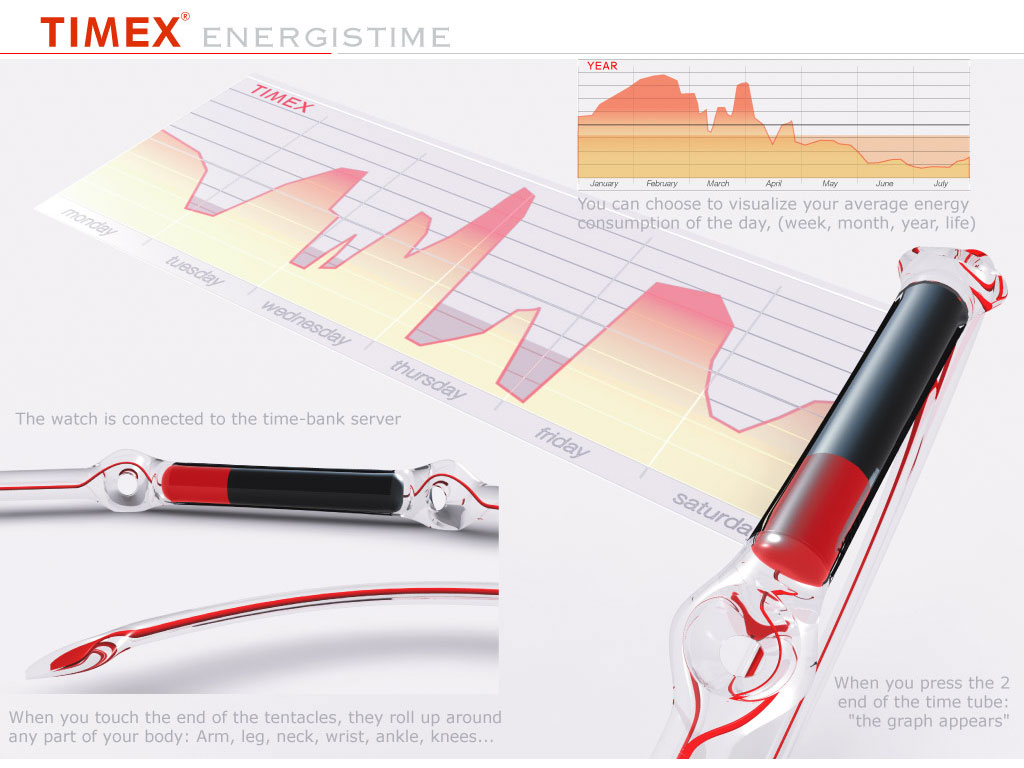
"Energistime" | Winner, Timex2154: conceptual category (02004)
Photo: the sceptical futuryst

"Energistime" | Design by Francois Gustin / Francois Laine / Nicolas Montabone
"In 2110 was voted [sic] a new law by every country: 'An ecological behaviour makes people earn free time.'"

In 02004, to mark its 150th anniversary, American watch manufacturer Timex partnered with industrial design magazine Core77 (previously mentioned here) to stage a global design competition, Timex2154, envisioning concepts for watches another 150 years hence.

From the competition's design brief:

The essence of time has many interpretations. Some revere time as a regulator, providing context to actions and order to schedules. Others deem it as a checkpoint device that invites accomplishments and permits life to be enjoyed to the fullest extent.

The capture of time is also ripe for investigation. Some people respond to the precision of the digital, while others welcome the tradition of the analog. Some are fascinated with the march of time, while others are liberated by its constant rhythms. Whether too much or too little, most are constantly referencing time's metric, and portioning out attention, energy and lives by its metronome.

Watches in the year 02154. As a basis for a design competition, it's an interesting combination of theoretical contemplation, on the one hand (uh, no pun intended) and commercial savvy on the other (get designers around the world to sketch out some long-range product development ideas, on the cheap). The panel of judges included, notably, Paola Antonelli, MoMA's curator of architecture and design, and the woman behind the exhibition SAFE: Design Takes on Risk (02005) as well as Design and the Elastic Mind (02008), the latter previously blogged here.

So when I learned last week that the company was founded in nearby Waterbury, Connecticut, and that the Timex Museum there (Timexpo) included an exhibition of the winning designs, I had to check it out, and was able to make the journey there Saturday afternoon.

The Timex Museum, Waterbury CT | Photo: the sceptical futuryst

Now, it's not necessary to visit Waterbury in order to see the designs, which have been available online for some time (e.g., blogged at We Make Money Not Art in October 02004). However, one thing that appeals to me is that the winning entries in each of the three categories (wrist-based, wearable and conceptual) have been prototyped in tangible form and are on display at the museum.

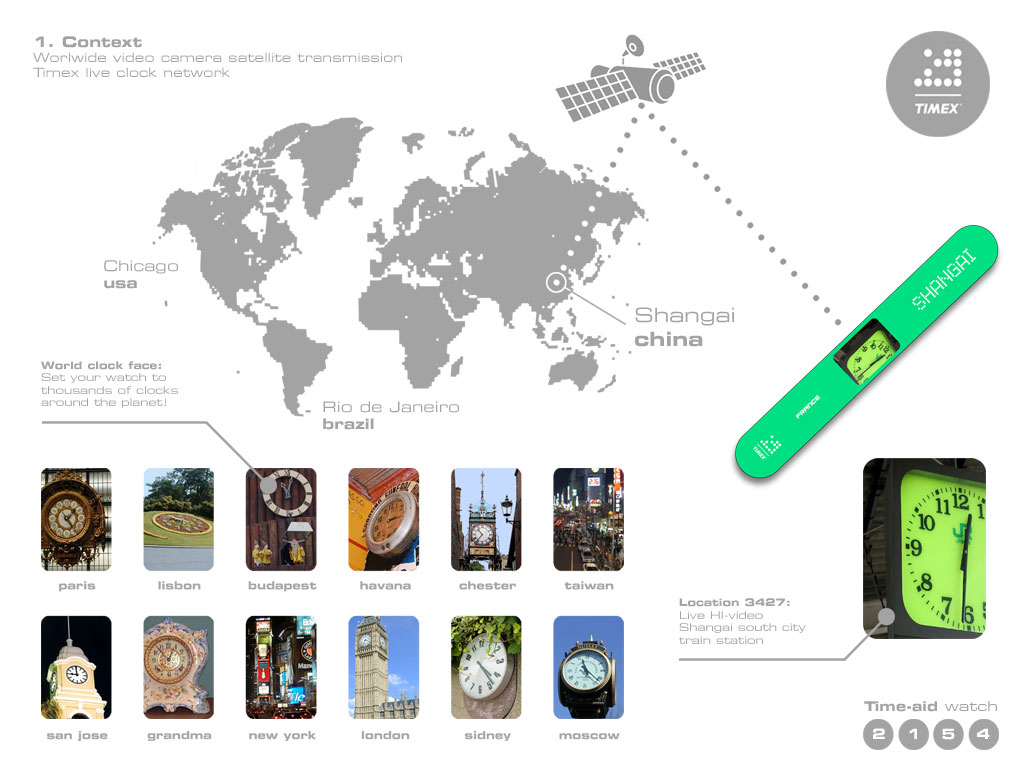
"Time-aid" | Winner, Timex2154: wrist-based category (02004)
Photo: the sceptical futuryst

"Time-aid" | Design by Christophe Koch / Lea Kobeli
"Intelligent watch to display all the clock faces around the world."

"Time-aid" | Photo: the sceptical futuryst

Timex2154 wearable category display | Photo: the sceptical futuryst

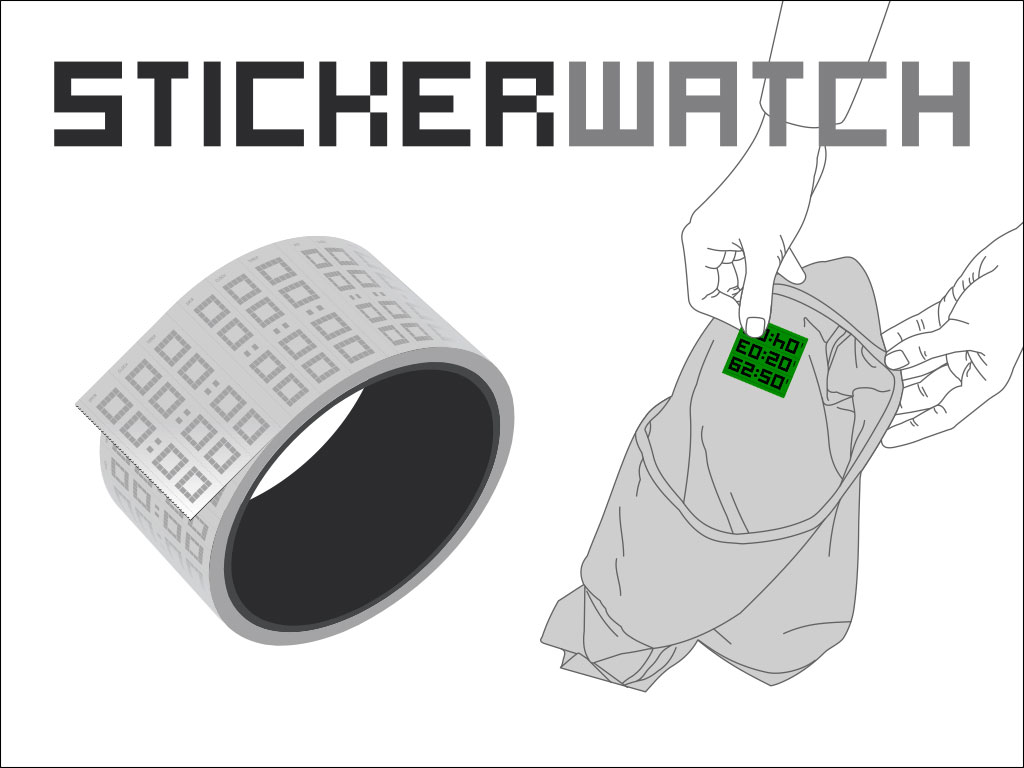
"Sticker Watch" | Winner, Timex2154: wearable category (02004)
Design by Alexey Koptev

"Sticker Watch" | Photo: the sceptical futuryst

"Notable entries" which didn't earn a place at the museum can be browsed online, and are also worth a look. A couple of examples:

"Krikos" | Timex2154: notable entries (02004)
Design by Breanna Guidotti
"The word Krikos is Greek for circle, a never ending path. [...] Krikos is a way for people to adopt a built in sense of time. As users grow accustomed to the cues Krikos gives them about time they will also take cues from their environment and will acquire the ability to feel time."

"Epidigital Patch" | Timex2154: notable entries (02004)
Design by One & Company Team
"The epidigital patch leaves the user with an animated topographic timekeeping image on his/her skin. [...] Composed entirely of organic matter, the nanobots dissolve after several days at which point a new patch can be applied."

There's much more to the museum than the Timex2154 entries -- indeed, most of it is history-oriented, but I found it illuminating to learn about the industrial past of the state of Connecticut, to see the home of the phenomenally popular (and ubiquitous even in my childhood) Mickey Mouse Watch [photo] and to find how photography and portable timepieces were used for ingenious cross-promotion in their early days [photo].

But, getting back to the futures: unsurprisingly, many of these concepts do not appear to be grounded in compelling society-level scenarios that would provide plausible in-world parameters. (For in fact the world as we find it shapes industrial design efforts in the present, providing key affordances and constraints that make a product not "plausible", but "useful".) To me, richer and more interesting than the technological marvels presumably enabled by a century and a half of time's passage -- and many of these ideas project, at best, a decade or two into the future, let alone fifteen -- are the possible social shifts which would be embedded and embodied in the artifacts of that distant era.

What would be really shocking is if most people needed or used (other than as a romantic, antique affectation) anything remotely like the quintessentially 20th-century watch in 150 years' time. Already, fewer and fewer of us wear them today, because of the ubiquity of other devices that tell time, and a whole lot else besides. Timex, and other watch manufacturers, must be concerned that their time is running out, and I find myself wondering if that's what prompted the comp in the first place.

At least they were astute enough to abstract from the concept of "watch"; "personal and portable" "timekeeping devices". (From the design brief: "**IMPORTANT** Regardless of category, all entries must embody two key criteria: Personal and Portable. Entries in this competition should examine ways to embody and communicate time on an individual level.") "Future of X" exercises are intrinsically hazardous because they take for granted the continuity of conceptual categories, objects, values and practices which are themselves bound to be subject to important historical shifts. Although I'm always interested in futures concepts which can be physically crafted and thus encountered, I also recognise that artifacts are only a poor proxy for the future -- like the past -- and there is a very great deal about our lifeworlds that simply cannot be conveyed in stuff.

Saturday, April 19, 2008

Reality prototyping

Two IDEO folks advocate the application of design thinking to management challenges in a book I came across tonight:

We read everywhere about rapid and constant change and, therefore, the increasing unpredictability of the future. And yet, we have seen little in the way of tools and methods to manage that change effectively and proactively. The tools of traditional business planning start with the assumptions that maintaining the current state is the best strategy and that incremental growth is a satisfactory outcome. What if we can no longer base our future business on what has happened in the past? This essay suggests that organizations might look to tools from the field of design. [p. 188]
[...]
Below, we describe three tools in the designer’s toolbox that we have found effective in helping businesses to manage change. These tools include contextual observation, human-centered frameworks, and rapid prototyping. [p. 189]

Rapid prototyping helps people to experience a possible future in tangible ways. These include rough physical prototypes of products or environments, or enactments of processes and service experiences, as well as the internal infrastructure and business plans that will be required to deliver them. It allows a very low-risk way of quickly exploring multiple directions before committing resources to the best one. Prototyping is commonly used in design development to explore details of how a product, service, or experience will be manifest. It externalizes the project team’s thinking, allowing for quicker convergence and more useful feedback from stakeholders. This feedback is based in the reality of an experience, rather than in an interpretation of a description of that same experience. [p. 191]

While design continues to be seen as a specialized expertise, we have found that the tools of design are learnable and applicable to challenges that business managers face every day. When we couple design process experts (with no vested interest in perpetuating the current way of doing things) with business content experts (who are looking for ways to think differently about their area of expertise), we create a capacity to envision and realize futures that are both desirable for people and viable for organizations. The challenge remains for business schools to find ways of integrating design thinking into their curricula and for design schools to expand the purview of design to include not only products, services, and experiences, but the organizational means by which they are created and supported. [p. 192]

Quotes from Peter Coughlan & Ilya Prokopoff, "Managing Change, by Design", in Richard J. Boland Jr. & Fred Collopy (eds.), Managing as Designing, Stanford Business Books, 02004, pp. 188-192.

This chapter was hit number two in a google search this evening for the phrase "experience a possible future". The phrase "reality prototyping" was cooked up a couple of months ago by our design collaborators, Nathan Verrill and Matt Jensen.

Monday, April 14, 2008

Design fiction is a fact

For the past two weeks, the intro to politics class I'm lecturing at UH-Manoa this semester has been doing a public art project generating artifacts from the future jointly with a digital imaging class.

I briefed my students to keep an eye out for interesting visuals along these lines, and last week one of them forwarded me a chain email he'd received which seemed to fit the bill. It's reproduced below (original spelling, etc):

Fwd: Awesome, to say the least!!!

You will not be able to know what is ahead of you, until you have seen at least 4 pictures and read the explanation of what they are,our future is here ,incredible!! what an age we live in.
(Kind of scary, in a way)


Look closely and guess what they could be...


Are they pens with cameras? ..... NOPE:)


Any wild guesses? No clue yet?

Ladies and gentlemen... congratulations!
You've just looked into the future... yep that's right!

You've just seen something that will replace your PC in the near future.

Here is how it works:


In the revolution of miniature computers, scientists have made great developments with bluetooth technology...

This is the forthcoming computers you can carry within your pockets.


This 'pen sort of instrument' produces both the monitor as well as the keyboard on any flat surfaces from where you can carry out functions you would normally do on your desktop computer.


Can anyone say, 'Good-bye laptops!'
Looks like our computers are out of date... again!!!

Seeking a source for this unlikely bit of breaking news, I found an entry on Snopes, the "Urban Legends Reference Pages", which alternately validate or debunk Internet rumours. Their entry on this ("Pensonal Computer", a pun so bad, it's almost good) features an email archived at the site more than two years ago, with exactly the same sequence of photos as above, and almost identical text.

The Snopes verdict on the claim in question ("Photographs show a conceptual pen-sized personal computer system") is "Partly true". They refer to Japanese technology company NEC's 02003 trade show presentation of the concept, which is called P-ISM (huh?). See this technology briefing in WAVE, dated 20 February 02004, where most of the above images appear. As Snopes points out, the last two have been appropriated from somewhere else, which adds somewhat to the confusion.

Now, apart from the oddly anachronistic carnival sideshow tone to the email -- step right up, marvel at the amazing bearded lady, and the fabulous pensonal computers carried within her pockets! -- the other thing that's strange to me here is that, in such a fast-moving arena of innovation, the same ideas and images are bouncing around the Net four or five years after their first appearance. I'm not just referring to the chain email from my student -- which, like any meme worth its salt, clearly has a sort of electronic bottom-feeder's life of its own -- but at the time of writing, I can find the P-ISM (with the natty subtitle, "A Pen-style Personal Networking Gadget Package") and the same illustrations, featured together with other concept designs -- "not planned to be commercialized at this point" -- at NEC's website. They're under the heading Resonantware: "Next Generation Ubiquitous Networking Devices Visualized By Designers". Others include the "gumi" -- edible, gummy-coated RF-ID chips containing usage rights to images and music; the malleable communication device "tag" (which looks a lot like the Morph); and the "dew" Life Recording Interface (which appeared in PC Mag's 25th anniversary feature on "Future Concept Designs" in January 02008).

In recent months, in pursuit of future artifacts and an understanding of what makes them tick, we seem to have stumbled into a design twilight zone where notion, concept in development, prototype and fully-fledged gizmo are all fluidly in play (and at work) in the ideascape. A few posts ago, I thought aloud as follows:

With increasing numbers of people turning increasingly sophisticated (CG-enabled) design ideas loose in the mediascape, in some settings, the virtual (or hypothetical, or future) artifact and the real one have become exceedingly difficult to tell apart. Playful design concepts like the iRing [link] seem to appear more and more often in my meanderings around the web. Real or not? At a glance, there's no way to tell.

Even on closer inspection, the development -- or, if you prefer the philosophical take, ontological -- status of many gadgets is ambiguous, which for me highlights the interesting and complex state of affairs in which our technoculture finds itself, stewing in a semi-concrete imaginary technobubble. It's a bit trippy. It also brings home with some force, I think, proto-futurist Fred Polak's point (which serves, more or less, as the starting assumption for the field of futures studies) that the images of the futures that we entertain are the key ingredient in the future our culture creates. In the technology domain, all manner of bits and pieces of possible futures hang around -- increasingly well-dressed -- waiting to be transmogrified from concept to reality. But that transition is a difficult one to track.

In that same post recalled a moment ago, I also cited Bruce Sterling's use of the term "design fiction", which I think may describe this whole nebulous genre rather well, including concept designs (and concept videos), hypothetical products, future artifacts, and visual depictions of alternative futures (venturing finally beyond the gadgetry to evoke more of the technocultural/scenaric context).

So: the "fictions" -- a word with weight, seen from here -- that we entertain, and that entertain us, however well-designed or ill-conceived, are social facts which serve in no small way as drivers of the world we co-create. These ideas matter, and they appear to lead lives of their own. Here, then, I want to call for design fiction that ranges beyond the playful next generation gizmo, and ventures gamely into the further reaches of yet-to-be-lived experience; the communities and myths, rituals and habits, heavens and hells of tomorrow's Joe and Josephine Sixpack.

Well, I know that's a tall order. But the students in my class, most of them in their first year of university, are currently grappling with the beginnings of it, crafting interventions to speak alternative futures (set in 02038) through public art installations. Stay tuned for more on their efforts, and let's see what we can see about expanding the horizons of the imaginable.

(Thanks for the email, Shane!)

Wednesday, April 09, 2008

Warning: This product might not actually exist

This evening I was reading an article in Harper's Magazine from February 02008, "The Next Bubble: Priming the markets for tomorrow's big crash", by Eric Janszen.

Then I saw this ad on the back cover:

The body text begins:

Imagine: A daily commute without using a drop of gas.* The extended-range electric vehicle is no longer just a rumor. We have put tremendous design and engineering resources in place to make this vehicle a reality.

However, the fine print at the bottom of the page comes clean: "Concept Chevy Volt shown. Not available for sale."

The Volt was officially unveiled in January 02007 at the Detroit Auto Show, and since then, despite remaining more idea than reality, has been plugged, every which way but literally, around the world...

The Chevy Volt is still at least three years away from start of production and a good four to six months from real running prototypes. However none of that is slowing down General Motors from using the car to charge up its image.

[B]anners and billboards are turning up in high-visibility locations. [...] Many magazines over the last six months have also featured the image of the range-extended EV and now there is a TV ad as well.

(Quote and ad from "Three years before Job 1 and GM is already advertising the Volt", Autoblog Green, 13 September 02007.)

Here's what the Vehicle Line Director for the Volt, Tony Posawatz, says about it at the Chevrolet website:

Although we haven't said exactly when the Chevy Volt will come to market, we've set our internal targets to complete the vehicle by the end of 2010. The specific date depends on the results of rigorous battery testing that's going on right now.

Now, I don't own a car, although I do occasionally drive borrowed or hired vehicles: the expenses, hassles of traffic and parking, and (not least) environmental problems all associated with car ownership -- particularly in Hawaii -- have so far provided an overwhelming deterrent. So, I don't typically pay much attention to developments in automotive technology. However, that enormous industry's response to American society's comparatively sudden awakening to concerns of fuel sustainability and the like is too striking to go unnoticed, even by me.

I recently saw the 02006 documentary Who Killed the Electric Car?, a sort of policy whodunit about the mysterious fate of General Motors' EV1 which briefly flowered in the 01990s, before being withdrawn amid a cloud of suspicions and a flurry of angrily pointed fingers. Among the elements that make a strong impression in that film is the existence of a very committed core of car buyers who want to see automotive technology go green, and the success of the Toyota Prius has no doubt helped auto manufacturers to take this market segment much more seriously. The Volt has a sort of fansite (operated by a full-time physician who claims no affiliation with General Motors), which aims "to help make sure it does arrive!"

While the circulation of images and ideas about greener vehicles, similarly to the abundance of ideas about Greener Gadgets, is encouraging from a certain limited point of view, it leaves unscathed the underlying patterns and passions of consumption which arguably drive the gravest threats to our collective well-being. Still, I certainly join others in wishing great success to GM's hard-working battery of battery testers.

Meanwhile I find it a curious and fascinating strategy to advertise a concept car years ahead of its actual availability. I suppose in this case it's a long-term -- and I use that phrase without irony in this context -- branding strategy, as no one wants to be left behind if the vehicle market continues to migrate towards "greener" versions of existing products.

* These folks appear not to have heard about bicycles.

Thursday, April 03, 2008

Greener Gadgets

The line between thought-provoking artifacts from the future and actual technological developments sometimes becomes oddly blurred -- as noted, for instance, last month in a comment to this post, in relation to bionic contact lenses.

Bruce Sterling at Beyond the Beyond (31 March, 02008) enthusiastically points out this cool entry from a recent design competition, Greener Gadgets...


The competition was co-organised by design blog Inhabitat, and sustainability consultancy Mark Alt + Partners, in cooperation with longstanding (since 01995) online magazine of industrial design, Core77. The comp launched on 26 December 02007, and culminated on 1 February at a conference in New York City. The design brief was as follows:

Core77 is inviting designers to explore the concept of "Greener Gadgets." Designs should seek to minimize the environmental impact of consumer electronic devices at any stage in the product lifecycle. Areas of sustainability to consider include:

1. Energy
2. Materials / Lifecycle / Recycling
3. Social & educational development

Participants are encouraged to consider their designs as part of the entire product ecosystem, and should think as holistically as possible. Designers may choose to focus their entries on a particular area of human enterprise (learning, playing, communicating, etc.), or a particular context (work, home, school, etc.), a particular material, or a specific device. Entries may also seek to create new paradigms for products and services.

Ultimately, we are looking for "great gadgets" of the greener kind.

As it happens, the first prize winner, EnerJar, an energy monitoring device, was among "not 'products' that can be purchased — but [...] a handy, downloadable DIY design that can be put together using a jam jar and other household objects."


Many of the other top entries selected, however, were not much beyond illustrated ideas. For example, the "Gravia" Gravity Based Kinetic Energy Lamp, second place getter, was described at the Inhabitat blog as "a fantastic concept - but one that has stirred up some debate across the blogosphere recently in regards to whether or not it is possible to build such a lamp right now with the technology that exists today."


Interesting, I think, that the comp's organisers used no categories differentiating the already here, from the near, from the way out. As a result, the entries range from witty branding ideas, through ambient reminders of environmental impact, to fully-blown sci-fi invention.

(Click through to Notable entries page for the sources of these selected images...)


(I'm reminded of the Forum for the Future's "Low Carbon Living" images, which spring from a comparable aspiration to think greener.)

The reality-fantasy spectrum collapses here, in a way I find quite delightful, I should add, juxtaposing products that seem immediately feasible at one end, through to ambiguously futuristic -- and perhaps impossible -- "design fiction" (Sterling's useful term) at the other.

Which is to say that, for most of the successful entries, this competition essentially comprised an ideational exercise. The stated evaluation criteria were: innovation, clarity of design, originality, form and presentation. I hope I can be forgiven for supposing (at first) that a "greener gadgets" design competition would involve submitting a feasibility statement, if not a functioning prototype. But as it turns out, entries required only three jpg images, telling the product's "story" at different levels (context, object, and details), plus a 500-word project description.

Now, I mention this not as a criticism, but simply as an observation which, may point to some implications for how we apprehend and experience technological (and, hot on its heels, social) change.

I'll explain.

With increasing numbers of people turning increasingly sophisticated (CG-enabled) design ideas loose in the mediascape, in some settings, the virtual (or hypothetical, or future) artifact and the real one have become exceedingly difficult to tell apart. Playful design concepts like the iRing (below) seem to appear more and more often in my meanderings around the web. Real or not? At a glance, there's no way to tell.

iRing | Design by Victor Soto | via Geekologie, 22 January 02008.

Not only are freelance designers engaging in this sort of public domain product development, but consultancies and big brands do too. The Nokia Morph and Adaptive Path's Charmr device are both examples recently blogged here.

A weird upshot of all this simultaneous availability of vividly imagined "future" products, in a context where rapid change has been normalised, is the subliminal (and occasionally, outright) confusion it can generate. When it comes to gadgetry, to someone without inside information, there can be a very blurry line between idea, concept, prototype, and fait accompli. Unless you pay close attention to what's happening at the cutting edge of technology -- and, to be fair, most people have enough other things going on in their lives that they don't -- it's pretty easy to mistake a hypothetical product for a real one. (The reverse is probably also true.)

For instance, a viral video temporarily set (certain excitable portions of) the geek community alight in February, because it appeared to herald the imminent arrival of an exciting new Ultra-Mobile PC (UMPC) from Samsung, the Korean electronics giant:


Tech news sites hastened to correct the misperception. In point of fact, the video had been produced by a college student in India for a class project.

We've been getting tipped all morning on a supposed Samsung P9 UMPC. Sorry Charlie, it's not the P9. It's not even from Samsung. As sleek and sexy as this crazy, detachable slider is, no amount of wishful thinking is going to make it more than a university design project.

~Engadget, 21 February 02008.

This ambiguity seems especially apt to occur with images (still or video) of stand-alone gadgets -- as opposed to their social or user contexts which may contain many more "moving parts", literally and figuratively. I'm referring here to the difference between depictions of gadgets themselves, and the evocation of how they change (or are changed by) their social context. As much as I rejoice in what seems to be increasing availability of ingenious possibilities, fodder for our collective imagining, compellingly and realistically portrayed -- especially when imbued with this "bright green" sensibility -- I have to say there seem to be a lot more of the former than the latter floating around.

The tendency to focus on technology itself is understandable: it's a complexity-reducing strategy for thinking about change that also plays well with our object-focused, consumption-driven economy. But "stuff" is not, I think, the true stuff of experience. Picking up on an trend noted by Allison Arieff (quoted in this recent post), I'd expect that over the coming years, the increasingly holistic, integrative, values-oriented efforts of designers -- particularly those concerned with user experience and interaction design -- will result in deeper engagement with evoking what change feels like, not just how its putative protagonist-objects look; as well as how it might occur, connecting outwardly, in complex contexts such as communities and families, as well as inwardly, addressing our interior or emotional states.

Product-centric -- and more particularly gadget-centric -- thinking surely affords some insight into the landscape of alternative futures, providing possible fragments of preferred (presumably sustainable, i.e. non-self-destructive) scenarios. But the key word is fragments; whereas the design challenge before us is systemic, complex, multi-dimensional, and massively distributed. No amount of gadgetry, however green, can substitute for addressing futures systemically.

Wednesday, March 19, 2008

Public service and self-promotion meet on the adaptive path

While doing some research on the use of concept designs, I encountered this video from San Francisco design consulting firm Adaptive Path...


Basically, they set about redesigning the daily treatment system for diabetics, and this design concept called the "Charmr" was the result. Says the blurb accompanying the video:

Blogger Amy Tenderich posted her "Open Letter to Steve Jobs" in April [link], pleading with the Apple CEO to apply some of that company's design expertise to improving the lives of the 20 million American diabetics who rely on technology to manage their condition every day. Amy asked for better products for diabetics, but we recognized that those products had to add up to an experience that would satisfy their emotional and psychological needs. So we set out to develop an experience design concept that addressed user behavior and psychology as well as current technological trends to project how insulin pumps and glucose meters might work five years from now.

The company blog contains has a pretty comprehensive rundown of the whole design process, the driving motivation of which was "to generate enthusiasm for human-centered thinking and thus inspire broader change throughout the medical device and design industry". And, says Adaptive Path Interaction Designer Alexa Andrzejewski, reflecting on the process:

The result of this project was not a polished product, but a vision — a vision of what the diabetic experience could look like in a few years if considered from a user-centered perspective.

Now, a few possible points of interest:

1. The video uses a combination of documentary and TV commercial codes, lending it (what I've heard my political science colleague Ashley Lukens describe as) a "texture of truth". It has a number of the qualities of an artifact from the future, presenting vividly imagined piece on a plausible future world (albeit one whose social dimension is limited by dint of its gadget focus).

2. Apart from the opening title cards, the video content presents itself in-scenario; that is, it's not set in the present day talking "about" the hypothetical future in which the product is available, but comes to us "from" that future, so to speak. The former could be called the "inside-out" approach to presenting a scenario; the latter "outside-in".

3. This research and development project was done on spec, i.e., on nine weeks of the company's own time (and money). This makes it an interesting combination of self-promotion -- showcasing the design talents of the team -- and public service. There's an important lesson in that hybridity, of which we recently saw a more commercial, but no less interesting, variation in the Nokia Morph video.

4. I'm reminded of an earlier t.s.f. post which dealt with the contrast between marketing tangible products, versus marketing ways of thinking. This virtual product, particularly insofar as it represented a project of passion for the Adaptive Path design team, plays interestingly with the line between those two categories. Their efforts embody and enact an extension of their type of design thinking to a genre of medical products that typically lack it; products that are poorly designed from a user experience standpoint. By envisioning and demonstrating an improvement in the experience of treatment for sufferers of diabetes, there emerges a synergy of selling the way of thinking (design), and selling the thought (changing that aspect of life for that particular group of disease sufferers) -- to the tune of 17,573 views at YouTube to date. Which is quite admirable, really.

This is part of a broader trend in design thinking, according to IDEO's Allison Arieff, who blogged on the Charmr at NY Times on 14 January 02008:

Could a refrigerator be designed to last longer? Could fewer materials or a smaller carbon footprint be used in manufacturing it?

These are the sorts of questions that smart companies (and the designers, engineers and marketers who work for them) are beginning to address.
[...]
The recently launched Designers Accord was founded by my IDEO colleague Valerie Casey as a sort of voluntary Kyoto Treaty for design and innovation firms focused on working together to create positive environmental and social impact. [...] By collectively agreeing to initiate a dialog about environmental impact and sustainable alternatives with each and every client, designers will be able to change the way things are designed, and that will change the way business works.
[...]
Consumers are also getting into the act, pushing companies to tackle the products, improvements and functions that we truly need as opposed to those they think we’ll desire. I recently came across the writer Amy Tenderich’s open letter to Steve Jobs on Tenderich’s blog for people with diabetes.
[...]
The sort of design innovation that Tenderich is after is about much more than aesthetics or styling; it is really about improving quality of life. No one needs much convincing that this is a huge potential growth area for the health and medical care industries. Certainly Adaptive Path didn’t. The San Francisco-based design consultancy contacted Tenderich and agreed to accept her challenge; their prototype, called the Charmr, is not in production but may help guide future design improvements...
[...]
The list of products for such reimaginings is infinite.

Encouragingly, it seems, companies prepared to share their "reimaginings" with the wider world -- preferred futures , in the form of ideal design concepts -- stand to do well, and also to do good, at the same time.

Friday, March 07, 2008

Morphing art and design into advertising

Image: "The Morph Concept", Nokia

Image: "The Morph Concept", Nokia


The above six-minute clip (and its abridged 3 1/2-minute counterpart, also posted at YouTube) is a fascinating hybrid of artwork, corporate advertisement, and conversation piece. In some respects, it's very much like the work we at HRCFS have recently been doing, producing scenario images for a client that is developing prototypes of ICT gadgetry. The role that "design concepts", as expressed in visual media, play in the -- inherently iterative -- design process is a topic we'll take up another time. Meanwhile, one notable contrast between this project and ours is that the imagery we've been producing has to remain under wraps, at the client's request, while Nokia has taken the interesting step of making the idea for the "Morph" concept device, along with what appears to be quite a bit of the user interface development, generally available.

Without assuming anything about the payoff from a design perspective of "open sourcing" the Morph idea, to my mind there's a suggestion that from Nokia's point of view, the perceived value in being "generous" with future visions lies in managing and maintaining the association of those visions with the brand. As a commercial strategy, there is probably great value in associating a beyond cutting-edge, over the horizon technology with an existing product. Sort of like product placement and branding directly into the futures imaginary, which might be compared with the more roundabout method of product placement in TV and movies with a future setting.

From the Nokia press release, 25 February 02008:

Morph is a concept that demonstrates how future mobile devices might be stretchable and flexible, allowing the user to transform their mobile device into radically different shapes. It demonstrates the ultimate functionality that nanotechnology might be capable of delivering: flexible materials, transparent electronics and self-cleaning surfaces. Dr. Bob Iannucci, Chief Technology Officer, Nokia, commented: "Nokia Research Center is looking at ways to reinvent the form and function of mobile devices; the Morph concept shows what might be possible".

Dr. Tapani Ryhanen, Head of the NRC Cambridge UK laboratory, Nokia, commented: "We hope that this combination of art and science will showcase the potential of nanoscience to a wider audience. The research we are carrying out is fundamental to this as we seek a safe and controlled way to develop and use new materials."

Professor Mark Welland, Head of the Department of Engineering's Nanoscience Group at the University of Cambridge and University Director of Nokia-Cambridge collaboration added: "Developing the Morph concept with Nokia has provided us with a focus that is both artistically inspirational but, more importantly, sets the technology agenda for our joint nanoscience research that will stimulate our future work together."

The partnership between Nokia and the University of Cambridge was announced in March, 2007 - an agreement to work together on an extensive and long term programme of joint research projects.

This collaboration of research science and commercial enterprise is nothing new, but it's fascinating, I think, that the chosen outlet for bringing their joint effort to the world is the MoMA (Museum of Modern Art) in New York City.

The current exhibition "Design and the Elastic Mind" is attuned to many of the current preoccupations of this blog and its writer:

Over the past twenty-five years, people have weathered dramatic changes in their experience of time, space, matter, and identity. Individuals cope daily with a multitude of changes in scale and pace—working across several time zones, traveling with relative ease between satellite maps and nanoscale images, and being inundated with information. Adaptability is an ancestral distinction of intelligence, but today’s instant variations in rhythm call for something stronger: elasticity, the product of adaptability plus acceleration. Design and the Elastic Mind explores the reciprocal relationship between science and design in the contemporary world by bringing together design objects and concepts that marry the most advanced scientific research with attentive consideration of human limitations, habits, and aspirations. The exhibition highlights designers’ ability to grasp momentous changes in technology, science, and history—changes that demand or reflect major adjustments in human behavior—and translate them into objects that people can actually understand and use.

Of particular interest is a strand called "Design for Debate", described at the MoMA website as follows:

Design for Debate is a new type of practice that devises ways to discuss the social, cultural, and ethical implications of emerging technologies by presenting not only artifacts, but also the quizzical scenarios that go with them. These projects shamelessly place the human being at the center of the universe and seek to take into account scientific and technological progress while respecting and preserving our essence as individuals.

Expect more on this topic as time permits exploration of the site, and, I hope, the exhibition behind it also, since I'm planning to visit New York in a couple of weeks.