Saturday, September 23, 2006

Seeing Red

On Thursday evening, HRCFS colleague Jake Dunagan and I were privileged to help out at the opening of a powerful and innovative new art exhibition, Seeing Red, in Honolulu's Chinatown.

YOU ARE NOT HERE TO MERELY MAKE A LIVING.

This quote from Woodrow Wilson emblazons the literature explaining the purpose of Seeing Red, which is to provide graphic designers with a rare and much needed outlet for their political passions and social concerns. Three talented young designers, friends of ours affiliated with Wall to Wall Studios here in Honolulu (Jesse Arneson, Chris Thomas, and Julia Zimmerman) conceived and curated the project, and as they describe it; folks in the graphic design profession are constantly being called upon to use their skills to communicate other people's messages, many of them formulated with nothing more profound in mind than simple commercial promotion. So why not invite designers to use those same skills to raise public awareness about issues deserving wider or closer attention; the things that make them angry? Hence the title.

The screenprinted posters designed for Seeing Red are simple, vivid and exceptionally striking, and all are black and red on a white background, lending strong aesthetic consistency despite enormous variation in styles and messages across the 35 contributions. Many Hawaiian artists are represented in the mix, as well as a number of internationally recognised designers, such as Milton Glaser, creator of the iconic "I love New York" logo. (The poster featured above, which so eloquently addresses the danger of mixing religion and politics, is "WARNING", by Chaz Maviyane-Davies in Harare, Zimbabwe.)

All proceeds from poster sales go to the artist's nominated charity, so the activist theme goes deeper than mere appearances. As the Seeing Red website states: "Our attempt is to create more than a dialogue. We are attempting to create a tangible method of bettering the world." In my view this project is a great example of conscientiously and usefully "marketing a way of thinking", as discussed at The Sceptical Futuryst in this earlier post.

There is also an exhibition of posters produced by sixth-grade students at a local school, using the same design parameters, and the chaotic energy of these youngsters at the opening on Thursday was stupendous. If you thought children, art, and politics wouldn't mix, there's another reason check out this show. Seeing Red will be at the Pegge Hopper Gallery in Honolulu until 26 October, before touring to Pittsburgh (and possibly other cities). You can contact the organisers, and make a donation to help cover their costs, through the project website.

Tuesday, September 12, 2006

My first Burn

Back in Honolulu, it's hard to describe the Burning Man experience in a way that doesn't seem slightly unhinged -- although it all makes perfect sense when you're there.

After amassing a long list of items to buy for the expedition, and plenty of friendly but puzzling advice from people I knew, who for various reasons were taking a break this year, I gathered everything I could manage during a busy afternoon of shopping in San Francisco -- items included ski goggles, hat, baby wipes, dust masks, and copious quantities of beef jerky and sports bars. I then found that my ride plans to get out to Black Rock City had fallen through, so resorted to that wondrous staple of early 21st century networking, Craigslist, to find someone to take me to the event. I took a phone call at about 11:30pm on Tuesday evening, a day and a half after arriving in town, and the fellow on the line said he was planning to leave in an hour's time, drive through the night, and set up camp at the playa on Wednesday morning. Sorted.

Mark, the guy who had responded to my ad on Craigslist, rolled up at about 1am in a blue sedan, and a trailer, both groaning with provisions, in contrast to which my two backpacks seemed absurdly minimalist. He was a Bay Area native and an entrepreneur between projects (which, a friend back in Honolulu astutely remarked, is San Francisco's answer to LA's ubiquitous unemployed actors). We made our way through the night toward Reno, and after sunrise, beyond into the Nevada desert, and the road-trip provided a good opportunity to exchange stories about our lives, and for Mark to entertain himself by asking me what I expected of the event, knowing that however well researched, my expectations could be but two dimensional sketches that were bound to be shredded by the blooming, buzzing confusion of the experience itself. (I noticed a gleam in the eye of almost any regular participant, or Burner, who discovered a Burning Man virgin in their midst.) As a four-time Burner, he took a certain pride in being prepared for any eventuality that might befall him in the desert, and was pleased to maintain the highest possible level of hedonism in the face of an extremely inhospitable environment. He also brought extras of pretty much everything, which was an unqualified blessing, because -- there's no two ways about it -- like most first timers, I was underprepared.

What can prepare you for Burning Man? I've been wondering about that, and although there are answers I could give, my conclusion is that if you could fully prepare for it, by definition, it wouldn't be as thoroughly worthwhile as it is. The scale and energy of the whole thing are so stupendous that, if they don't take you by surprise the first time, you're probably clinically dead.

That, it turns out, points to one of the signature themes underlying the event. Not indulgence, exactly, but joyful, artistic excess -- a half-million dollar wooden sculpture that looks like an architectural-scale Billy Idol hairstyle -- why the hell not? Three hundred cars, golf buggies, go-karts, school buses, and sailboats made up to look like pirate ships, dragons, UFOs, giant illuminated turtles, etc, most of them pounding out music, while cruising around a giant dustbowl? Naturally. 40,000 people celebrating life in a desert environment where ordinarily, no life survives? Now there's something you have to see to believe.

It's difficult to put in words, but if you combined a pagan feast; the Las Vegas strip; Disneyland reimagined by Dalí; Amsterdam; Woodstock; Mad Max; and the biggest rave you can imagine, you'd still be nowhere near it, but you would at least enjoyed the challenge of trying to mentally blend all that together. The day and night contrast sharply, not just in temperature (one's too hot, the other too cold) but in tone -- there's a shift from carnival to dance party, and each mode has its charms. Sleep, for me a necessary evil, was an agenda item which some participants appeared to find the wherewithal to forego for the duration.

I first heard about the phenomenon -- and it is a phenomenon -- two or three years ago from a splendid book called Breaking Open the Head (mentioned in this earlier post). The author, Daniel Pinchbeck, gives a great description, including the following observations: "Black Rock City is the psychedelic vision made visceral. [...] The event is a highly evolved, brilliantly organized follow-up to the Be-Ins and Happenings of the 1960s." (p. 81) Pinchbeck does well in his account, which I recommend highly, to capture the energy and intensity of the experience, but no number of written descriptions, photo essays or documentaries could possibly substitute for being there. Even so, it's an interesting challenge to try to cram into language the richness of it all. Burning Man is a spirited, as well as spiritual, celebration of life in all its variety and strangeness, with dazzling displays of artwork in every possible medium, ranging from the unmissably huge to the very understated, and shot through with experimentalism, irony, humour and surrealism.

There may be other places where you can awaken to your neighbours hula-hooping naked atop an enormous RV and singing "The Star Spangled Banner"; where you can watch hand puppets doing beatboxing and singing hip-hop; where you can breakfast for free on freshly shucked oysters beneath a canopy in the desert sun; where you can find a thousand pingpong balls with coloured lights inside them, arranged in 3D spokes so you lie underneath in the dark and have rainbow patterns shower onto your retina; where a serpent as long as 30 people spurts out synchronised bursts of flame; where 1,000 fire dancers put on a half-hour show followed by the ignition of a giant neon-lit effigy of a man, out of whose fiercely burning carcass emerge whistling dervishes of dust created by the heat... but if there are such places, I don't know about them.

Black Rock City is a marvel. While it exists, it is the fourth largest city in the state of Nevada. It's a vast camp arranged in a near circle, as on a clock, with each "hour", from 2:00 around to 10:00, a dusty road radiating from the centre; crossed by eight concentric streets (this year, in keeping with the designated art theme; Anxious, Brave, Chance, Destiny, Eager, Fate, Guess, and Hope). The Esplanade is the inner circle, where most of the larger art camps and villages (collections of camps) can be found. In the middle is a vast alkali dustbowl called the playa, with The Man in the middle, and populated by an ever-changing array of odd, mostly mobile art installations to explore day or night. Every corner and every road is populated with tents, vehicles, shade structures, and other temporary edifices housing all kinds of bars, clubs, stalls, shows, and creatively dressed, or undressed, people doing interesting things to, for and with each other for the hell of it.

It is impressive that the whole thing has managed to reach the scale it has -- about 39,000 people this year -- and yet it's still managed largely invisibly. The actual provided infrastructure and list of enforceable rules are minimal, but highly effective, and rely heavily on the "orgware" of the participants; a solid commitment to the evolved culture, which has its reasons and works exceedingly well. It occurred to me that this would be impossible to implement, fully realised, from scratch; but it's because it has been evolving for 20 years, and a core of returning participants seeds a strong sense of continuity and obligation to do the right thing for the community, that the event is able to keep running. For instance; apart from coffee, tea and ice sold at the Center Camp, money does not change hands on the playa. I was shocked to learn that this actually works -- that the gift economy can be, at least for a while, a reality. I was no less shocked to find that, unlike every other fair, concert or similar community event I've ever attended, where copious amounts of garbage appear underfoot within hours, after a week of outrageous partying, there was hardly any "matter out of place" in evidence: the ideal of "pack it in, pack it out" actually functions amid all the apparent chaos. The notion of "radical self-reliance" which BM proudly manifests of course depends on lots of consumption in advance, since you need to bring everything with you; and the event could be -- and is, by some -- roundly criticised for its profligate use of resources (especially the gas used for the art cars and pyrotechnics). Having weighed those criticisms, though, it seems to me a petty complaint in light of the broader purpose of the event. What feast, party or other worthwhile human celebration is fundamentally "sustainable" in its own right. That this could not continue all year round is beside the point. It isn't intended to continue year round.

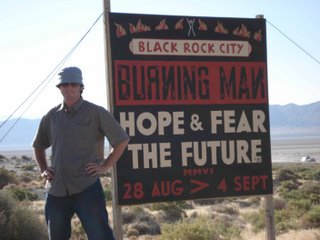
Now, the art theme this year, which played no small part in my getting organised to actually attend, was "The Future: Hope and Fear". My colleagues at HRCFS and I had talked about staging a guerrilla campaign to pluralise every singular instance of the term "future" -- making it "futures" -- under the team name "S-cargo", with a logo somehow involving a snail. Yeah, well we thought it would be clever. But our duties to "Hawaii 2050" won out, so that didn't happen, although I did inexplicably find myself having lots of conversations on the playa about studying futures, and what that meant, and didn't mean, and so forth. An interesting question asked more than once was whether I thought the gifting economy could provide a viable model for a future society, or an element thereof. This is a topic I'll surely return to at some stage, because it's a really interesting thought. My reaction at the time was, it would be great to think so, but practically the reason it can work is because it's temporary, and everyone's pretty much on holiday from their "ordinary" lives. Currency -- the medium of exchange, whatever it may be -- evolves independently in different societies because barter is simply too inefficient to get everyone what they want. Money's an indispensible middleman. I'm still thinking about it, though, because what really counts here is the contrast between a spirit of mainly selfish accumulation of wealth, which prevails where most of us live, most of the time, and the largely selfless habit of gifting, and "paying it forward " which prevails at Burning Man. Speaking to someone this morning about this remarkable aspect of the experience, she speculated that the bigger idea of BM, in which people establish experimental communities operating on different values, may well become more common as they grow tired of the exploitation of mainstream capitalist culture. I think she may be right.

Now, despite the art theme, which gave rise to some very cool stuff, it is the conceptual and community level at which the Burn was most interesting from a futurist perspective, rather than the details of the art per se: I don't have other years to compare, but my impression was that the chosen theme didn't make a huge difference to what people produced; it tended to provide a loose inspiration, or a final gloss. The event is therefore likely to be equally interesting in any other year, and I urge futurists who haven't been to make it a priority -- if you're interested in being exposed to other ways to be, Burning Man is an inspiring and overwhelmingly energetic place to do that.

And as I reflect on the experience., there are two other ideas that stand out for me more than the "Hope and Fear" of the official theme. The first is serendipity. There is no much going on, all the time, that a saner strategy than trying to dart between scheduled events is simply to go with the flow of whatever you might stumble upon. There's plenty I missed that I would have liked to see (a thick program of scheduled events I barely glanced at all week), but each person's experience there is uniquely their own, and embracing that is one of its pleasures. (This is also true of life generally, but a heightened awareness of that fact is among the interesting lessons Burning Man gave me.)

The second theme is impermanence. On the playa, almost everything is moving, albeit at different rates. Most people get around on bikes, which are extremely useful in view of the scale of the event, but when you're exploring you need to be careful to park your wheels near some kind of landmark that looks like it might be there for at least an hour or two. Impermanence also comes through at a broader level, though, and there is a palpable life cycle to the build up and winding down of each day and night, and of the Burn as a whole. Mark stayed on several more days to volunteer with the cleanup, so I had to hitchhike back to civilisation, and shortly after being picked up by three kind souls in an RV, we were each given a parting gift through the window by a fellow Burner: a small purple box containing some of the ashes from The Man, and the salutary inscription:

Ashes to ashes
dust to dust
The Man
2006
RIP
Death is
the only
certainty

It boggles the mind to consider that this whole community springs forth in the wasteland of the playa each year, and that much of the art -- including vast installations representing thousands of hours of work -- are designed and produced specifically for the enjoyment of participants. And The Man himself is not the only ritual burning; many other artworks are also ceremonially sent off in the same way. The end of a particular art piece in this way is deliberately and appropriately celebrated with not a whimper, but a bang. For all we might say to bemoan the instant gratification ethos of disposable consumer culture, an equally insidious syndrome in our common experience is arguably a reluctance or inability to let go of things whose day is done. A life lived to the full is lived in recognition of its inevitable ending, and I liked the fact that there this was (implicitly) celebrated, eyes wide open, deepening rather than lessening the joy of the experience.

But overall, I think the best thing about this experience was that I used to feel sometimes like I was born too late, missing out on the major cultural shifts, experiments and innovations of the sixties and seventies. I don't feel that way quite so strongly anymore, because there is indeed a vibrant, growing group of cultural creatives looking for new ways to see, to express themselves, and develop in their lives and communities. It was inspiring and exciting to be a part of it in this case; and having completed what I now see as a reconnaissance mission, I'm looking forward to the chance to get back to the next incarnation of Black Rock City, and more fully engaging the Burning Man creed of active participation.

Tuesday, August 29, 2006

"Hawaii 2050" kicks off

Last Saturday, 26 August saw the kickoff event for the state's futures-oriented public discussion process, "Hawaii 2050", at the Dole Ballrooms, Honolulu. About 530 participants from across the islands were in attendance. I am still recovering from the monster effort involved in staging four "futures rooms", which allowed participants to experience, about 130 at a time, two of the four scenes (from among countless possible futures), as a catalyst to further discussion about the possible, probable, and preferable paths that change could take in Hawaii between now and 02050. See this earlier post for more background. In each case, a colour name was attributed for logistical reasons (to put on people's nametags and room signage), not to imply anything about the contents of the scenarios, which were kept secret from participants until they stepped in the door. The photos below, taken by HRCFS graduate student Cyrus Camp, provide a little of the flavour of each.

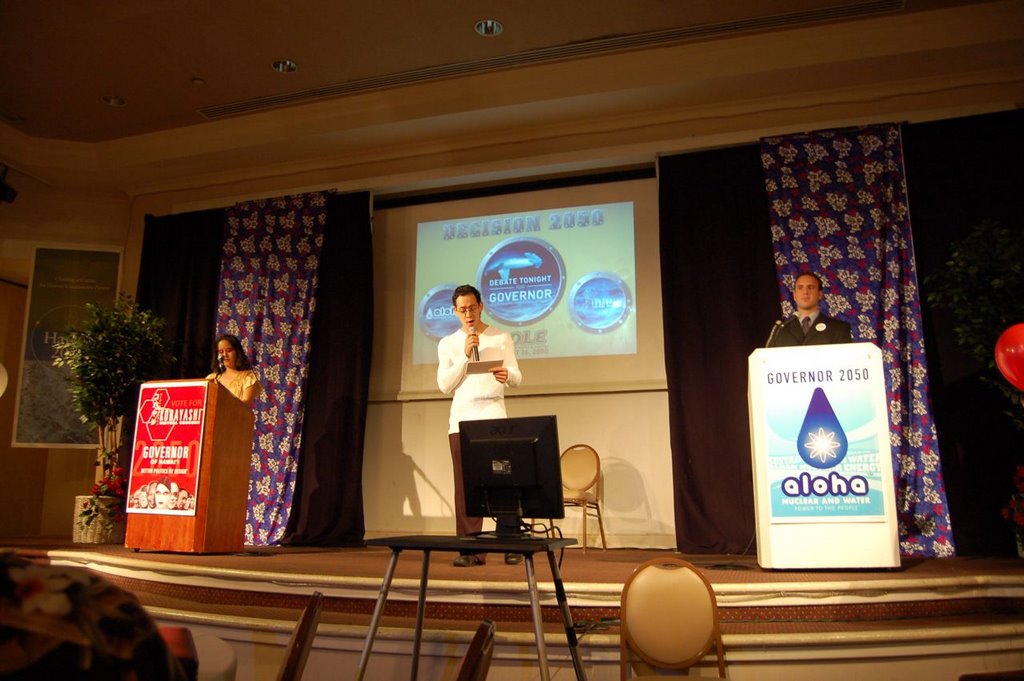
In the "Orange" version of Hawaii circa 02050, two corporations -- "Aloha Nuclear and Water", and "Kobayashi Virtual Concern", vie for the Hawaiian Governorship in a political debate staged at the Dole Underwater Hotel and Casino.

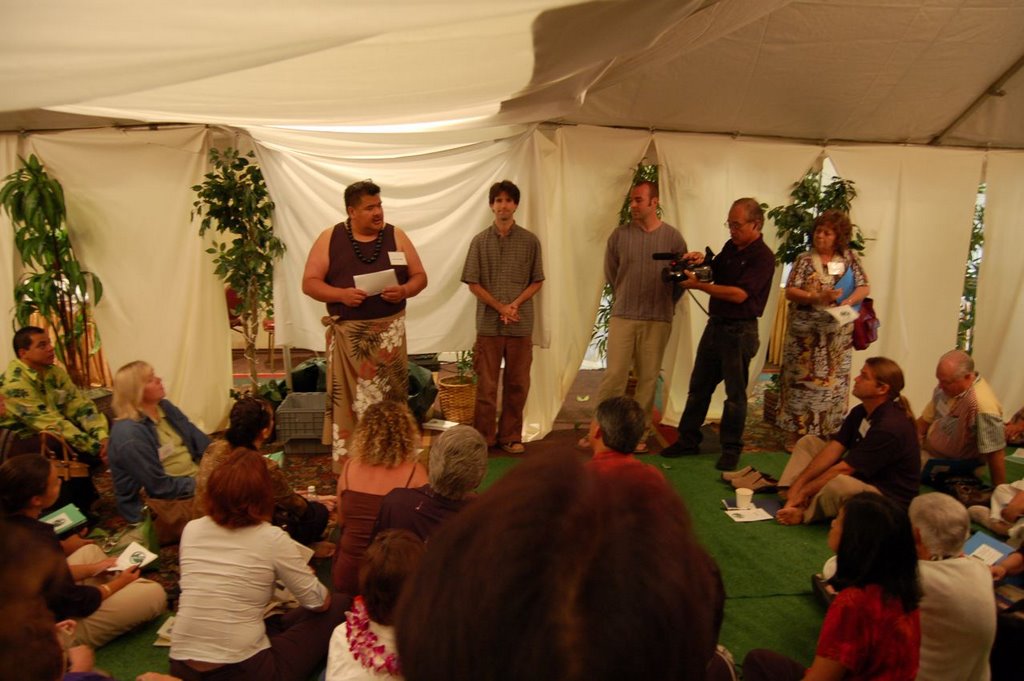
For "Maroon" Hawaii, participants are cast as attendees at a compulsory -- like jury duty -- civic education program, in the Honolulu ahupua'a. At this "introductory session", presentations are made about the abundant and versatile hemp crop grown in this future Hawaii, and about the role of do-it-yourself biofuel in a renewable energy portfolio.

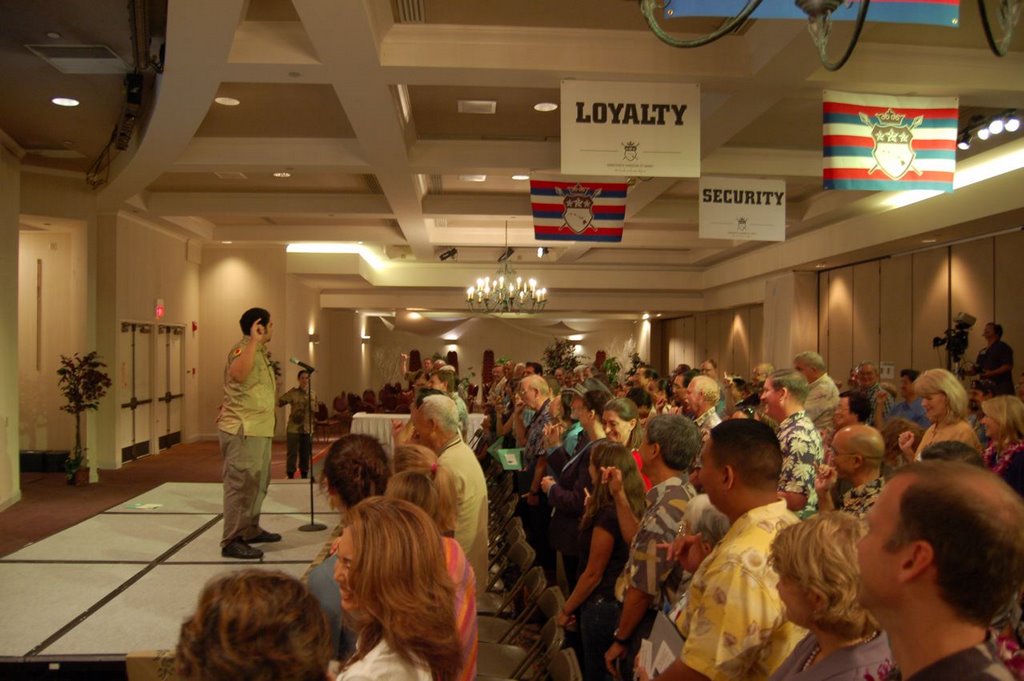
In the "Silver" scenario, a post-"peak oil" global economic collapse has led to the rise of a military-run society, overlaid with a puppet Hawaiian monarchy. Participants entering this scene are cast as refugees from smaller Pacific islands disappearing under rising oceans, and inducted as citizens and subjects of the so-called Democratic Kingdom of Hawai'i.

"Blue" Hawaii posits a sort of technological Singularity, after which the meaning and status of ordinary humanity is transformed. Here participants are a group of "premods" (PSEs -- persons sans enhancements; homo ludditis; naturals) being addressed by staff at MBED, the "Mind Body Enhancement Depot". They are offered a free technological upgrade paid for by the World Council in order to raise the GHI, or Global Happiness Index.

Now, none of these was intended to be taken as either advocating or predicting a particular path; the aim was instead to promote a broadened sense of what the possibilities could be. From that perspective, this part of the event seems to have succeeded. People were highly engaged by the exercise, and responded energetically and thoughtfully to the ideas presented therein.

This article from Sunday's Honolulu Advertiser says some more about Saturday's program, and this piece by futurist Jamais Cascio (our guest presenter at last week's futures salon) provides a highly thoughtful response to the whole "Hawaii 2050" effort, as well as the Immersive Futures themselves. Details of the scenarios can be found here. All feedback on any aspect of this event, or the broader endeavour of which it is part, would be most welcome.

I will be out of action for the next few days, attending Burning Man for the first time, in Nevada, but there will be more on "Hawaii 2050" -- as well as Burning Man -- in postings to come. Thanks to all those who volunteered their time both in the leadup and on the day to make this event possible, but mahalo especially to my futures colleagues Jim Dator and Jake Dunagan for being absolutely terrific to work with on this ambitious experiment in making futures thinking more real.

Related posts:
> Immersive futures for Hawaii 2050
> Experiential scenarios on video
> The Futures of Everyday Life
> A history of experiential futures
> The Bird Cage

Friday, August 25, 2006

Honolulu Futures Salon: Jamais Cascio

This evening, HRCFS ran its sixth Futures Salon, hosted by Jackie Ward at the fabulous Ward's Rafters in Honolulu, with guest Jamais Cascio. Jamais, a futurist and scenario specialist based in the San Francisco Bay Area, presented and went on to lead a great discussion about the historical development of the scenario methodology in futures, the current state of play, and emerging varieties of immersive scenarios, including "artifacts from the future". Their crucial role in improving futures thinking, he suggested, lay in offering "provocation and evocation": encouraging us to think more deeply and creatively about our options. Rather than trying to predict the most likely future, they instead (at their best) describe plausible, compelling, internally coherent visions of, and stories leading from the present into, potential future worlds in which we could find ourselves. He offered some excellent insights into the "democratisation of futures", which is what he sees as the gradual supplanting (or supplementing) of broadcast-model "genius forecasting" with collaborative exploration.

An interesting method Jamais used to illustrate the useful application of this collaborative approach was a "futures mash-up", in which we each wrote down, on separate post-it notes, a trio of the next decade's possible trends, or events in the social, environmental, economic, political -- and yes, technological -- realms, then partnered with another participant to brainstorm on a fourth piece of paper some interesting possible consequences of matching any random pair. The future, he pointed out, is both exhilarating and frightening to consider, but, like the exercise, is best seen as a synthesis -- the result of what we do together.

All this is, not coincidentally, highly relevant to the "Hawaii 2050" kickoff happening in Honolulu on Saturday 26 August, where HRCFS is staging four alternative immersive futures, reflecting divergent possible paths for change in Hawaii, out to the year 02050, for participants to use as a basis for more meaningful discussion about decisions in the present day. At this event, Jamais (together with 500 of our closest friends) will have an opportunity to witness a Hawaiian take on the cutting edge of immersive future scenarios, as a provocation aimed at improving our collective futures conversation. More on this to come, but for now, mahalo nui loa to Jamais for joining us in Hawaii to share his ideas.

Thursday, August 17, 2006

Barbershop futures

A couple of months ago, I got a haircut, for the first time in over a year. (Stay with me now, there's a perfectly good reason why I'm opening with that piece of pure trivia.)

The gentleman who did the deed, who introduced himself as Wally, was originally from Hong Kong, and having come to America as a young man, had spent the past 25 years cutting hair in San Francisco. He was, he hastened to add, still poor -- but he cheerfully told me about his ambitions, his life, and the likelihood that he would keep cutting hair for many years to come.

We got around to talking about what had brought me to the city, and the fact that I was a student of futures -- no, not the financial kind, but "the future" plural -- alternative possibilities.

Wally's eyes lit up. "You study the future!" he cried. "Tell me about the future!"

Now, while his response was uncommonly enthusiastic, the misunderstanding that my interest in the future meant I would be willing or able to forecast what would happen in the news the following day, or the appearance of the next customer to walk through the door, was not at all unusual. It happens to me all the time. People hear that I'm in futures and, depending on some combination of how credulous they are, and how silly I seem (maybe it's the hair?), frequently an assumption is made that I'm about to make an outrageous claim arising from some cursory crystal-ball based research. They don't know anything about me at that point, so the ridicule is at least pre-emptive (sheesh! at least give me a chance to show how ridiculous I am). There's often a dash of hope mixed in there with the ridicule, too, which is interesting, like there's a private wish that I'll be able to let them in on some secret to predicting the future, even if they're already 95% sure I'm full of shit.

In any event, Wally's interest was genuine, and I was able to explain that my work in the field is not in fact oriented toward predicting The Future, but rather toward helping people consider a range of possibilities relevant to their situation, and thus perhaps to choose more wisely between them. I told him that I and my colleagues work with governments, communities, businesses -- any group interested in thriving in conditions of change -- dealing with process more than content. This is because first, even the broad themes can vary hugely depending on the client or topic in question, and as for the "content" of the future itself -- well, it varies hugely depending on a whole lot of things.

Wally was insistent. How could any of this apply to his business? Ah. This certainly got me thinking. I knew, and still know, nothing about the hair industry. But I ventured that something could happen suddenly to affect the viability of his business. He pointed out that people had been cutting hair professionally for six thousand years, and they weren't likely to stop next week. Touché, Wally.

I ruminated, partly aloud, partly internally, about things that could affect Wally's modest barbershop on Van Ness Street. Fashions could change; people might decide to cut their own hair, or not to cut it at all. Shaved heads, do-it-yourself style, could develop a mass appeal. Military conscription might consign a proportion of his clientele to standard issue, regulation-length buzzcuts. A widespread health problem, such as a lice outbreak, could have the same effect. On a longer timescale, humans might evolve hairlessness -- or elect to disable our follicles through some kind of chemical or electronic therapy. Wally remained unperturbed.

I noticed that he had posted a sign advertising scalp and face massage -- here, then, an alternative business model. We agreed that if, perchance, circumstance should pose an unforeseen disruption to his hair-cutting activities, he'd always have the massage to fall back on.

I left, 45 minutes later, hair a couple of inches shorter than intended (the added toll of engaging your barber in a conversation he wants to prolong) not entirely sure that I had demonstrated to his satisfaction, or to my own, the strategic usefulness of futures thinking for those in the haircutting trade. But he had, apparently, been persuaded that it was worthwhile, interesting and -- importantly -- possible to think about alternative futures. It could open up new avenues of exploration; not all of them, thankfully, based on catastrophic lice infestations or burgeoning military engagements. (Damage control and risk management are merely among the more easily grasped practical applications of futures thinking.)

What this encounter made me realise was, really, two things. The first is that I need to be careful not to become the proverbial hammer looking everywhere for a nail to strike. What Wally really needed after 25 years of steady but unspectacular business was not a futurist, but maybe a bit of local advertising and a more realistic price schedule (charging just $12 a haircut, in San Francisco, no wonder he wasn't getting rich). The second realisation, in contrast, was that futures can indeed be helpful, for almost anyone, in clarifying where they may be able to make a difference, and where they are less likely to do so.

To explain: that occasional dismissive reaction to my chosen specialisation, which I described above, is one end of a spectrum, the "you can't predict the future" end. The other end of the spectrum is the "future is self evident" end. It's possible for people to believe both these things simultaneously, and what's more, to be right. If they believed the former today about the price of oil per barrel in 2020, I'd have to agree. But if they believed the latter about the likely fate of a drunk stumbling on to a busy highway, I'd be inclined to share that view also. There are lots of layers of change occurring simultaneously, and to make sense of them requires sensitivity to the relative momentum and internal dynamics of each. To me, this field is in large part about exploring the massive grey area between the white of complete predictability and the black of complete unpredictability -- which are both categories, I would argue, of phenomena for which one can refuse to take responsibility. No wonder people rely on them so much.

Most change does not occur at these extremes, however. There's a certain amount of regularity in how things operate, and persistence in the patterns of change they adopt, and a certain amount you can do to influence them one way or another. And you might as well act consistently with what you'd like to see happen. As Wally put it; "If you plant roses, it doesn't come up vegetables". This was his own rather beautiful and profound expression of the principle that as ye sow, so shall ye reap. (He was elaborating his karmic philosophy that if he ripped his customers off, he wouldn't be able to sleep so well at night; which was reassuring.)

As to many of the things that matter to us, we can do something about them. The something (or various alternative somethings) we can do, and why and how, and to what possible ends -- identifying and acting upon these is, to my mind, the purpose of futures thinking.

Maybe I should get my hair cut more often.

/Barbershop futures revisited/

Wednesday, August 09, 2006

Immersive futures for "Hawaii 2050"

My opportunities to post to The Sceptical Futuryst have lately become few and far between, in the labour-intensive lead up to the "Hawaii 2050" event in Honolulu on August 26th. This day-long summit, initiated by a committee of the Hawaii State Legislature, the "Hawaii 2050 Sustainability Task Force", is to launch a public consultation process revolving around the question of how to make Hawaii sustainable; ecologically, socially, and economically. It is planned as a kickoff for a series of community discussions about what I and my futures colleagues describe as possible, probable and preferable futures for the islands, all of which should culminate in A Sustainability Plan for Hawaii. (Woody Allen: "If you want to make God laugh, tell him your plans." Couldn't resist.)

A recent article from the Honolulu Advertiser puts the event in context, and this response by an alumnus of the futures program highlights some of the challenges and limitations of using "sustainability" as a concept. My own views on sustainability lead me to wonder if an "alternative futures" frame isn't perhaps a better starting point for productive conversation around potentially massive social change than a straight-up "green" one. I have no quibble with the honourable intentions informing the language of sustainability, but for the most part it already has its ideological adherents and detractors, whereas a discussion of futures more broadly may be better able to transcend predefined political divisions, more accommodating of different perspectives.

Anyway, the Hawaii Research Center for Futures Studies is part of a University of Hawaii team that has been contracted by the Task Force to organise this event. Although there will be a dose of speech-giving and other ceremonial malarkey, the HRCFS team's role is to bring a futures twist to the discussion.

I don't want to give too much away at this point, as a degree of secrecy will help maximise the impact for those in attendance, but what we are contributing is the staging of four rooms -- Immersive Futures Workshops -- in which participants will get a taste of four radically different versions of Hawaii, nominally set in the year 02050. This project is, then, part of our Center's effort to concretise usefully and interestingly the various conceptions of the future that people might have, through the use of design thinking, artifacts from the future, and an experiential version of scenaric storytelling.

Our divergent "future scenes" have been elaborated using (HRCFS Director) Jim Dator's four generic images of the future -- each one being a different shape of change, based on different assumptions about how the historical process could play out. The four are continued growth, collapse, discipline, and transformation, and we're preparing spaces at the Dole Cannery Ballroom for actors and presenters to populate in what amounts to a kind of parallel theatrical presentation, where each group of summit participants is also cast in a future role when they walk through the door.

Stay tuned for more -- this promises to be very exciting!