Showing posts with label sustainability. Show all posts

Tuesday, August 02, 2016

The People Who Vanished


Update 01aug17: The journal article excerpted below, 'Designing an Experiential Scenario', has been named a 02017 Most Significant Futures Work at the annual Association of Professional Futurists (APF) Awards, in the Advancing Methods and Practice category. We are grateful to the APF and jury for this honour.

***

The People Who Vanished is a transmedia narrative project dealing with the prehistory of the Phoenix area, staged at the inaugural Emerge Festival hosted by Arizona State University in March 02012. Jake Dunagan and I designed and led a two-day workshop in which we produced an experiential scenario with 20 festival participants.

Although we had been doing Design Fiction and Experiential Futures for five or six years already by that time, we were excited about the challenges of co-creatively involving a group this size, and especially of the compressed production timeline, both highlighting the need for a shared mental model and clear framework for collaboration.

What follows in this post is a written snapshot of that design process. It's an excerpt from an article we recently published in the peer-reviewed journal Futures.† (File under: better late than never.) The article, or this lightly edited bit reproduced below, can certainly be read alone, although for a sense of the originally intended effect watch this video first; the tale as revealed to a live audience at Emerge (18 min).


† S. Candy, J. Dunagan, Designing an experiential scenario: The People Who Vanished, Futures (2016), http://dx.doi.org/10.1016/j.futures.2016.05.006.

***

The name Phoenix invokes the bird of Greek myth which would periodically burn up and rise again from its own ashes. It is a striking but little known fact that the city was so named precisely because it was built atop the ruins of a lost civilisation.

Beneath the streets and sidewalks of today’s Phoenix of four million inhabitants lie the remnants of the Hohokam, a society which flourished from around 0CE to 1400CE; “from Christ to Columbus”.

The Hohokam were expert canal engineers and irrigation agriculturalists. They built a thriving civilization in the desert lasting almost one and a half millennia. They farmed the land and channeled water through massive canals without any of the modern tools and equipment we have today. However, about a century before the arrival of Europeans in North America, they suddenly disappeared, for reasons that are unknown, and that are still debated by archaeologists.

The name Hohokam is an O’odham word meaning “the people who vanished”. Being an oral culture, it is unknown what they called themselves.


A question which we hoped to evoke for participants at Emerge became: “could the people of today’s Phoenix be the next to vanish from the valley?”

In order to push the boundaries of experiential futures, to do justice to the scope of the historical (and future) questions at hand, and to create a unique and fun learning experience for our workshop participants, we were drawn to the idea of executing a project at a monumental scale. We wanted to create something big; something that demanded attention; something that would appear suddenly and without warning — and that could carry deep meaning for the attendees. In our practice we and others often create hypothetical “artifacts from the future”, but in this case thought it could be interesting to create a fictional artifact from the past, in order to enable a reperception of present and future.

Throughout history, there have been breakthrough moments when we humans have been forced to confront our own ignorance and reimagine our collective story about who we are and where we came from. The unearthing of dinosaur fossils revealed a strange and diverse lifeworld on Earth long before human existence, overturning earlier thinking about natural history. Similarly disruptive were cultural discoveries such as the Dead Sea Scrolls, the Rosetta Stone, the city of Pompeii, and ancient technologies such as the Antikythera machine. The rediscovery of ancient philosophy, architecture, or artifacts from time to time has not simply added to a trove of curiosities from the past; but has heralded revolutionary change in society’s self-understanding. The Renaissance, the Enlightenment, and other epochal transitions have been initiated or accelerated by such archaeological moments.

There are always bound to be, this line of thinking suggests, possibility grenades beneath our feet, primed to explode our fragile certainties and platitudes about the story of our world. As U.S. President Harry Truman once said, “The only thing new in the world is the history you don’t know.” 

What could this “new” and transformative –– if hypothetical –– slice of history be for Phoenix?

Examining the map pieced together by 20th century archaeologists of the extensive network of ancient canals spanning the area... yielded what turned out to be an essential insight: in addition to their obvious practical uses, the Hohokam canals could have had some previously unsuspected symbolic functions.

An idea emerged: towards the end of their tenure, the Hohokam may somehow have manifested a distinctive symbol in the archaeological record – one also appearing in the pre-collapse periods of other cultures. … Now we could recount the fortuitous “discovery” of a transcultural, transhistorical symbol of impending civilisational collapse. It would not be necessary (and in the circumstances would also not be desirable) to try to explain the precise means by which this harbinger of disappearance had cropped up around the world throughout history; the sheer “fact” of apparently concrete evidence of the mystery itself could provide the desired archaeological moment.


We would tell the following story: In puzzling out the fate of the Hohokam, our group had spotted this curious anomaly on the map, and had then been inspired by the thought of a symbolic, and not merely functional, role for the canals. One of our number then had the idea to do a google image search for this pattern and see what turned up (still true –– sort of). Shockingly, this search showed up a range of other instances of the same ‘glyph’ in diverse archaeological records elsewhere: the Harappan of the Indus Valley, the Anasazi, the Nazca, the Polynesian peoples of Rapa Nui, aka Easter Island. All this part was of course completely simulated; photoshopped into found photographs from these places. We would also be able to show how the glyph had turned up subtly but unmistakeably, inscribed in the patterns on Hohokam pottery too. And the kicker: the sole common characteristic discernible across all these disparate cultures, from wildly different eras and geographies, was that they had all disappeared. They were all collapsed civilisations.


***

Bruce Sterling in Wired: "When one walked outside the auditorium afterward, there was a huge mystic glyph installed on the side of a local mountain."


***

Project Credits:
- The People Who Vanished were: Carlo Altamirano, Michael Baran, Rachel Bowditch, Chris Danowski, Tyler Eglen, Erik Fisher, Paul Higgins, Gordon Knox, Oscar Lopez, Blakely McConnell, Julie Rada, Matt Ragan, Reed Riner, Joya Scott, D.A. Therrien, Trish Yasolsky and Bobby Zokaites
- Special thanks: David Abbott, Tain Barzo, Joel Garreau, Jerry Howard (Arizona Museum of Natural History), and Cynthia Selin

See also:
- Aisling Kelliher and Daragh Byrne (Carnegie Mellon University) in Futures journal
- Cynthia Selin (Arizona State University), one of the organisers, situating this work in Futures
- A trove of documentation (still images and timelapse video) from our workshop, via Carnegie Mellon
- Post about the Emerge exhibition featuring The People Who Vanished and other projects at ASU Art Museum
- A terrific design fiction video created by a group led by Near Future Laboratory's Julian Bleecker and Nick Foster in another workshop taking place at the same time


***

The paper excerpted above goes on to describe a framework that we devised during the workshop and have kept developing and using since as a conceptual model for scaffolding experiential scenarios and design fiction; the Experiential Futures Ladder. Implications for the foresight field of this multi-scalar mode of thought, as well as of the experiential turn more broadly (towards design, media, games and performance) are outlined.

The full text of the article in press, "Designing an Experiential Scenario", can be found in pdf here.

The journal permalink is here.

Related:
> The Experiential Turn
> On the eve of Emerge
> Dreaming together
> A History of Experiential Futures 2006-2031
> Experiential scenarios on video

Wednesday, July 01, 2009

The inverted sublime

Watching the DVD of the 02006 documentary Manufactured Landscapes about the work of Canadian photographer Edward Burtynsky, I was struck by an observation he makes in relation to one particular image...

Edward Burtynsky (01983) Kennecott Copper Mine #22, Bingham Valley, Utah
Image via iCollector

So I decided to do mining as a theme. This particular photograph is Bingham Valley Canyon, just outside of Salt Lake City. My research took me to the largest, I was always looking for the largest mine. What I was hoping to find was something that spoke to scale, that spoke to the fact that we as a species are now dwarfed by our own creation, that the sublime has inverted itself. So, at one point we were kind of fearful of nature -- it's like the Turner with the ship going off to sea in a storm* -- and that nature was the omnipresent fearful force, and the sublime force. What I was trying to do with these images was to say that force has shifted, now we are a force within the planet, or on the planet, and it is our own creations that dwarf us.

~Edward Burtynsky, Manufactured Landscapes, Stills Gallery with Commentary (DVD extra), 'Manufactured Landscapes' series, commentary to slide #3

Here, the photographer pinpoints, and distils into a symbolically-laden encounter with the unseen fruits of our collective industry, a historic, even mythic, transition point with which we are still, ever so slowly, coming to terms. Did we do that?

Recently we seem to be discovering inconvenient truths everywhere we look, Frankenstein's monsters around every corner.

This evening, when I dug up the link for the Seminar About Long-term Thinking that he did for the Long Now Foundation in July 02008, I noticed that chapter 15 of the video of that seminar was dubbed "Future Responses to Images of Today". The first remark made by Long Now impresario Stewart Brand introducing the post-presentation Q&A session: "It's going to be interesting to see what these images look like in a hundred years' time, a thousand years' time, ten thousand years' time... I have a feeling this kind of imagery -- you're dead right -- is exactly the kind of thing to launch through time."

Coincidentally, I'd been entertaining an almost perfectly symmetrical line of thinking. One of the things I sometimes consider in relation to future artifacts -- Strategic Anachronisms -- is the following thought experiment: If I had to send a time capsule of the present back to the past, say 100 years ago; which objects, images, elements of today might I pick out as most surprising, instructive, evocative, or characteristic of our times? Burtynsky's stuff could well find its way into my capsule selection: I find these images bear a kind of historic weight; they document something profound about What's Going On Here.

That is: we have inverted the sublime, and awaken with awe to the scale and import of what we have wrought. Yet, as terrible as many of the consequences of our industrial transformation have been, this moment of recognition seems to portend the taking of a new level of responsibility commensurate with that power. Or, as Stewart Brand put it in another context: "We are as gods and might as well get good at it."

* This may be the Turner painting that Burtynsky had in mind.

Monday, December 01, 2008

Viridian is dead. Long live Viridian!

Last week I ran across Bruce Sterling's "Last Viridian Note", dated 19 November 02008, and declared by the scifi-writing design Pope-Emperor himself to be the final edition in his decade-long series of bright green missives, collectively aimed at "creating irresistible demand for a global atmosphere upgrade".

It's no feeble "Thanks folks, I'm outta here", either, but a thoughtful, quietly powerful, personal manifesto -- a summation of where he's come from, in terms of his thinking and habits around sustainable design, and where he aspires next to go. So rarely is that wise dictum of the stage "always leave them wanting more" not overshadowed by the temptations of corporate, governmental, or brand immortality, that it's astonishing when any kind of human enterprise both deliberately and gracefully quits a still-viable role in affairs (though easier, no doubt, when it's a one-man show rather than a body of many parts ossified by time in the habits and expectations of thousands). In any case, kudos to Sterling for taking the less travelled if more dignified road of shutting down Viridian in its current form, before it outlives its usefulness, and chancing the move on to, as it were, greener pastures.

Those familiar with his work will not be surprised to learn that it's a terrific read. Sterling, more than most anyone, understands the intimate and essential connections between design, futures, and whatever you're doing right now. His thoughts here resonated deeply with me, so for those who don't plan to read the whole thing, at least check out the following excerpts.

Hairshirt-green is the simple-minded inverse of 20th-century consumerism. Like the New Age mystic echo of Judaeo-Christianity, hairshirt-green simply changes the polarity of the dominant culture, without truly challenging it in any effective way. It doesn't do or say anything conceptually novel – nor is it practical, or a working path to a better life.
...
What is "sustainability?" Sustainable practices navigate successfully through time and space, while others crack up and vanish. So basically, the sustainable is about time – time and space. You need to re-think your relationship to material possessions in terms of things that occupy your time. The things that are physically closest to you. Time and space.
...
The items that you use incessantly, the items you employ every day, the normal, boring goods that don't seem luxurious or romantic: these are the critical ones. They are truly central. The everyday object is the monarch of all objects. It's in your time most, it's in your space most. It is "where it is at," and it is "what is going on."

It takes a while to get this through your head, because it's the opposite of the legendry of shopping. However: the things that you use every day should be the best-designed things you can get.
...
You will need to divide your current possessions into four major categories.

1. Beautiful things.
2. Emotionally important things.
3. Tools, devices, and appliances that efficiently perform a useful function.
4. Everything else.

"Everything else" will be by far the largest category. Anything you have not touched, or seen, or thought about in a year – this very likely belongs in "everything else."

You should document these things. Take their pictures, their identifying makers' marks, barcodes, whatever, so that you can get them off eBay or Amazon if, for some weird reason, you ever need them again. Store those digital pictures somewhere safe – along with all your other increasingly valuable, life-central digital data. Back them up both onsite and offsite.

Then remove them from your time and space. "Everything else" should not be in your immediate environment, sucking up your energy and reducing your opportunities. It should become a fond memory, or become reduced to data.

It may belong to you, but it does not belong with you. You weren't born with it. You won't be buried with it. It needs to be out of the space-time vicinity. You are not its archivist or quartermaster. Stop serving that unpaid role.
...
You are not "losing things" by these acts of material hygiene. You are gaining time, health, light and space. Also, the basic quality of your daily life will certainly soar. Because the benefits of good design will accrue to you where they matter – in the everyday.

Not in Oz or in some museum vitrine. In the every day. For sustainability, it is every day that matters. Not green Manhattan Projects, green moon shots, green New Years' resolutions, or wild scifi speculations. Those are for dabblers and amateurs. The sustainable is about the every day.
...
You should be planning, expecting, desiring to live among material surroundings created, manufactured, distributed, through radically different methods from today's. It is your moral duty to aid this transformative process.
...
So. This approach seems to be working for me. More or less. I'm not urging you to do any of this right away. Do not jump up from the screen right now and go reform your entire material circumstances. That resolve will not last. Because it's not sustainable.
...
That discipline is not as hard as it sounds. As the design of your immediate surroundings improves, it'll become obvious to you that more and more of these time-sucking barnacles are just not up to your standards. They're ugly, or they're broken, or they're obsolete, or they are visible emblems of nasty, uncivilized material processes.
...
[Y]ou may be interested in my next, post-Viridian, project.
...
Viridian "imaginary products" were always a major theme of ours, and, since I'm both a science fiction writer and a design critic, I want to do some innovative work in this space – yes, the realm of imaginary products. Conceptual designs; imaginary designs; critical designs; fantastic and impossible designs.

This new effort of mine is a scholarly work exploring material culture, use-value, ethics, and the relationship between materiality and the imagination. However, since nobody's easily interested in that huge, grandiose topic, I'm disguising it as a nifty and attractive gadget book. I plan to call it "The User's Guide to Imaginary Gadgets."

(via Worldchanging)

Wednesday, August 13, 2008

Dreaming the home of the future


versus

A scene from PATH Concept Home video (part 3 of 4: "Flexibility").
Top: a scene from Disney Innoventions video
Following a post here recently about Disney's new Tomorrowland attraction, a different take on the same topic...

A "House of the Future," a concept of what tomorrow holds for cutting-edge living, usually tells us more about the dreamers than the dream.

In the mid-1950s, Disneyland, with the help of Monsanto, cooked up its "House of the Future," nearly all of it made of plastic... This was pretty radical stuff, but it was also a vision of living in the future that was based on extending our reliance on cheap oil into infinity.
...
This summer Disneyland opened a new version of living in the future in its "Tomorrowland"... Like the Monsanto house of 50 years ago, this latest Dream Home is a big ad.
...
All of our old habits cultivated in a gluttonous energy culture are given free rein in Disney's version of tomorrow. You can't make a move without consuming kilowatts. This Dream McMansion preserves the suburban model that $4-a-gallon gas has made into a nightmare.

If anything, Disney ought to change the story line: "This is how people in the most resource-consuming nation on Earth dreamed they'd still be living in the future without environmental and economic consequences."

There's another Dream Home out there. It hasn't gotten a fraction of the attention lavished on Disneyland, but it offers a future that we might actually be able to live with. Last year the U.S. Department of Housing and Urban Development unveiled its "Concept Home."

The ideas behind the home try to come to terms with the energy mess we're in.

~Michael J. Crosbie, "Real House Of The Future Is No Disney Dream", Hartford Courant, 3 August 02008.

Restated in terms of Dator's generic images of the future, we have in these two houses (Disney's and HUD's) a pretty clear contrast between two embodied future scenario types: "continuation" (business-as-usual) and "discipline" (self-restraint on resources).

I'm very sympathetic to the point that Crosbie, an architect and professor, is making: HUD's so-called PATH (Partnership for Advancing Housing Technology) Concept Home is practicable, sustainable, and ethical in a variety of ways that Disney's immersive advertisement for energy decadence isn't, and yet comparatively, the former seems to have been all but ignored.

What gives? That's a question the Crosbie piece doesn't discuss at all; in other words, why this unjust situation might be so.

Well, I'm currently reading NYU media prof (and recent HRCFS futures salon guest) Stephen Duncombe's book Dream: Re-imagining Progressive Politics in an Age of Fantasy. And I think it might help us out here (pp. 8-9):

Spectacle is our way of making sense of the world. Truth and power belong to those who tell the better story.
...
If we want our ideas to lead and not trail the politics of this country, then we need to learn how to think and communicate in today's spectacular vernacular.

With that in mind, check out their respective websites (PATH; Disney) and take another quick look at the photos above. I know, I know, it's not at all a fair comparison -- the multimillion dollar dream machine going up against the the do-gooding public-private partnership -- but humour me. Words don't cost much to write; let's see how they look side by side. Here are the opening lines of the two projects' press releases:

HUD Unveils America's First Efficient, Sustainable, Affordable Concept Home

PATH Concept Home represents the New American Dream during National Homeownership Month

[6 June 02007]

Omaha, NE -- The U.S. Department of Housing and Urban Development today announced the completion of America's first PATH Concept Home featuring more than 60 efficient, sustainable and flexible products and systems all in one affordable home.

HUD Assistant Secretary Darlene F. Williams speaks prior to the Concept Home ribbon cutting on June 6. She is joined (left to right) by Omaha Mayor Mike Fahey, builder Fernando Pages, and HUD Regional Director Macie Houston."With the PATH Concept Home, HUD has created a blueprint for the future of the American Dream by using innovative housing technologies that support our goals of sustainability, efficiency and flexibility in an affordable home," HUD Assistant Secretary Darlene F. Williams told the gathering of community and industry leaders. "June is National Homeownership Month and we are excited to showcase a home that is affordable to purchase, maintain and renovate as families and their needs change over time."

[link]

versus

IT'S THE HOME OF YOUR DREAMS! INNOVENTIONS DREAM HOME INVITES GUESTS TO EXPERIENCE THE FUTURE TODAY

New Tomorrowland Attraction at Disneyland Resort Combines State-of-the-Art Technology with the Latest in Disneyland Immersive Storytelling

ANAHEIM, Calif. - June 16, 2008 - Imagine a home so perfectly attuned to the needs of a family that it can anticipate and fulfill them, virtually without anyone lifting a finger. Now imagine that the home offers family members high-tech connectivity, not just with one another but with people, entertainment and information in the world at large.

Guests at Disneyland can soon do more than imagine it. Beginning June 17, the Innoventions Dream Home in Tomorrowland is bringing that world to life as a limited number of guests have the opportunity to preview the home.

[link]

So here's the Pepsi challenge, kids. Who's telling the better story?

Hint: Dream Home (Disney) vs Concept Home (HUD).

I feel a little bad saying it, but in this light, the attentional gulf separating the pair isn't all that surprising.

And lest I should be accused of overlooking or devaluing it, there is indeed far more substance, thought, rigour and ethical engagement in evidence in the concept home's presentation than in Tomorrowland's pile of eye-candy -- but that's just my point. In America today, the nutritious meal that doesn't taste good doesn't get eaten. (Yeah, thought that was a pretty neat analogy too.)

So, *brow furrowing, eyes narrowing*, doesn't Duncombe's dream prescription mean selling out progressive high-ground to crassly commercial ways of operating? In fact he's intensely aware of that risk, and notes (pp. 16-17):

Between arrogant rejection and populist acceptance of commercial culture lies a third approach: appropriating, co-opting, and, most important, transforming the techniques of spectacular capitalism into tools for social change.
...
The challenge for progressives is to create ethical spectacles.

If Crosbie is right, and the "House of the Future" tells us more about the dreamers than the dream, one of the things it may be telling us about the sustainability-oriented dreamers is that we're still learning to dream aloud in a compelling way. It seems to me that creating ethical spectacles that recast the -- perhaps necessary -- austerities of a "discipline" future as more "dream" than mere "concept" is where it's at, for building futures that are both practically inhabitable and aesthetically appealing.

That's where I'd prefer to live, anyway.

Related posts:
> Today at Tomorrowland: yesterday's future
> Sponsors of Utopia
> If they buy in, are you selling out?

Sunday, July 06, 2008

Feel that sting?

That's pride, f**kin witchoo.


A world without bees...

Today I glimpsed an advertisement for this in the Guardian's Saturday magazine, Weekend [print p. 54], and wondered: some lame entomological ripoff of The World Without Us?

Guess again.

Jane McGonigal's next alternate reality game? (ilovebees + World Without Oil = ?)

Nope.

In fact, it's no hypothetical entertainment, but a sort of latter-day Silent Spring, published in Britain last month, which sounds the alarm on a very real ecological crisis in the making.

A Guardian article by the book's co-author, Alison Benjamin, explains:

Since [November 02006], close on two million colonies of honeybees across the US have been wiped out. The strange phenomenon, dubbed colony collapse disorder (CCD), is also thought to have claimed the lives of billions of honeybees around the world. In Taiwan, 10 million honeybees were reported to have disappeared in just two weeks, and throughout Europe honeybees are in peril.
...
UK farming minister Lord Rooker [...] warned last year that honeybees are in acute danger: "If nothing is done about it, the honeybee population could be wiped out in 10 years," he said. Last month, he launched a consultation on a national strategy to improve and protect honeybee health.

People's initial response to the idea of a bee-less world is often either, "That's a shame, I'll have no honey to spread on my toast" or, "Good - one less insect that can sting me." In fact, honeybees are vital for the pollination of around 90 crops worldwide. In addition to almonds, most fruits, vegetables, nuts and seeds are dependent on honeybees. Crops that are used as cattle and pig feed also rely on honeybee pollination, as does the cotton plant. So if all the honeybees disappeared, we would have to switch our diet to cereals and grain, and give our wardrobes a drastic makeover.

According to Albert Einstein, our very existence is inextricably linked to bees - he is reputed to have said: "If the bee disappears off the surface of the globe, then man would only have four years of life left."

Bees are a barometer of what man is doing to the environment, say beekeepers; the canary in the coalmine. Just as animals behave weirdly before an earthquake or a hurricane, cowering in a corner or howling in the wind, so the silent, empty hives are a harbinger of a looming ecological crisis. But what is causing them to vanish - pesticides, parasites, pests, viruses? No one knows for sure.

~Alison Benjamin, "Last flight of the honeybee?", The Guardian, 31 May 02008.

These culprits are considered in turn, and the interlocking factors of monoculture (both the crops and the honeybees used to pollinate them), vulnerability to disease, chemical interference in biological processes, and overwork -- that's right, overwork -- amount to a pretty grim picture.

One thing I'd never thought about or realised before is quite how reliant agricultural industry is on the services of honeybees, for far more than just honey. The article notes, "In 2007, honey production was worth $160m to the US economy, compared with pollination services that have been estimated at $15bn."

The industrial-age model of production, and its ideological counterpart, the conception of nature as a machine, are still very much with us. And with those come systemic weaknesses, threats to our survival, in a renovated global ecology that we have barely begun to understand.

I'd certainly recommend the full article; the book is probably worth a look too. You may also like to read this: Jim Dator, 02002, "Assuming 'responsibility for our rose'".

Thursday, April 10, 2008

Ignore global warming

...and the WWF might kick your ass.


On the last trip I took from Hawaii to the mainland U.S., at the end of February, I took the above snapshot of an ad in the inflight magazine -- airline passengers being a worthy target audience indeed for awareness-raising around the underappreciated risks of fossil fuel consumption. The WWF (World Wildlife Fund, Canada) here uses heavily ironic images to make the point that (as their slogan has it) "Ignoring global warming won't make it go away."

Upon investigation, it turns out there are three images in the print campaign, each based on a photo set in a disastrously disruptive, climate-chaos future where people are carrying on business as usual -- sporting upper lips of almost British levels of stiffness -- regardless:


(These compare interestingly with the Diesel "Global Warming Ready" fashion ads seen here not long ago.)

There's also a TV spot along the same lines (via glossy):


Insight into the purpose of the campaign -- launched back in late 02006, although my own encounter with a current print ad was just a couple of months ago -- comes from a Canadian marketing and advertising industry magazine:

WWF posted the spot on YouTube with a call-to-action to participate in a Toronto-area event last month. The post attracted dozens of comments from interested users, and at least 5,000 people showed up to the demo. At press time, the YouTube posting was averaging 1,000 views a day.

The campaign, which also includes OOH, print, radio and a microsite, www.saveourclimate.ca, aims to broaden the WWF's image from simply an animal rights group to that of a "world security guard" of sorts, says [copywriter Chris] Taciuk. It's running across English-speaking Canada in donated media space.

~Annette Bourdeau, "WWF goes beyond wildlife to take on broader remit", Strategy Magazine (Canada), December 02006.

It's enlightening to find that the goal here is not simply to promote issue awareness, but also to signal the Swiss-founded WWF's interest in ecological concerns beyond just wildlife (since 01986, outside North America, WWF's official name has been the less issue-specific World Wide Fund for Nature). Layers.

I also find myself pondering this use of grim futures imagery in pursuit of the duties of a "world security guard", for two reasons. First, that's an intriguing and somewhat unsettling phrase -- though perhaps not officially a label the organisation itself would use? Second, as regular readers may have anticipated, I'm curious about the substantive strategy here, which entails questions about what kind of impact on people's thinking and behaviour are sought or anticipated by WWF, as a result of such an intervention. There's a copy of the same clip on YouTube -- although note that the "glossy" version posted above has better audio -- with 1,068 views, but only one comment, from user "rhode74", which from an eco-activist standpoint seems almost too good to be true:

I saw this commercial the other night while I was using my hair dryer.

I couldn't understand what was going on at first since I couldn't hear it. But after seeing the hurricane; then the firestorm; I shut off my hair dryer and heard Mr.Rogers' song, "Please won't you be my neighbor".

Then I saw, "Ignoring Global Warming won't make it go away"

That had an impact on me.

I will now try to recycle what I have.


Call me sceptical, but to me it's a safe bet that meanwhile, others saw the clip, noted that was a WWF joint, thought to themselves "hippie fuckers", and went back to clubbing baby seals with renewed vigour -- buoyed by a fresh wave of contempt for what they might (were they to pause momentarily, exchange club for pen, and commit an opinion to writing) describe as the outlandish fantasies of conservationist ideologues.

Some people dismiss An Inconvenient Truth because they don't like Al Gore.

However much good faith is brought to one's position, single-minded advocacy in the face of uncertainty (a tendency closely related to monofuturism) is all too easily caricatured and ignored. The habit of thinking in alternative futures cultivates simultaneous consideration of divergent lines of scenaric logic side by side.

I'm not arguing for considering "alternative" futures in which global warming doesn't hit. Quite the opposite. I'm suggesting that this style of advertising -- parodying denial -- may not win over many new converts. Instead, promoting a range of viable responses -- various different scenarios which all assume global warming, and some of which show us thriving anyway -- may now be a more powerful strategy.

Wednesday, April 09, 2008

Warning: This product might not actually exist

This evening I was reading an article in Harper's Magazine from February 02008, "The Next Bubble: Priming the markets for tomorrow's big crash", by Eric Janszen.

Then I saw this ad on the back cover:

The body text begins:

Imagine: A daily commute without using a drop of gas.* The extended-range electric vehicle is no longer just a rumor. We have put tremendous design and engineering resources in place to make this vehicle a reality.

However, the fine print at the bottom of the page comes clean: "Concept Chevy Volt shown. Not available for sale."

The Volt was officially unveiled in January 02007 at the Detroit Auto Show, and since then, despite remaining more idea than reality, has been plugged, every which way but literally, around the world...

The Chevy Volt is still at least three years away from start of production and a good four to six months from real running prototypes. However none of that is slowing down General Motors from using the car to charge up its image.

[B]anners and billboards are turning up in high-visibility locations. [...] Many magazines over the last six months have also featured the image of the range-extended EV and now there is a TV ad as well.

(Quote and ad from "Three years before Job 1 and GM is already advertising the Volt", Autoblog Green, 13 September 02007.)

Here's what the Vehicle Line Director for the Volt, Tony Posawatz, says about it at the Chevrolet website:

Although we haven't said exactly when the Chevy Volt will come to market, we've set our internal targets to complete the vehicle by the end of 2010. The specific date depends on the results of rigorous battery testing that's going on right now.

Now, I don't own a car, although I do occasionally drive borrowed or hired vehicles: the expenses, hassles of traffic and parking, and (not least) environmental problems all associated with car ownership -- particularly in Hawaii -- have so far provided an overwhelming deterrent. So, I don't typically pay much attention to developments in automotive technology. However, that enormous industry's response to American society's comparatively sudden awakening to concerns of fuel sustainability and the like is too striking to go unnoticed, even by me.

I recently saw the 02006 documentary Who Killed the Electric Car?, a sort of policy whodunit about the mysterious fate of General Motors' EV1 which briefly flowered in the 01990s, before being withdrawn amid a cloud of suspicions and a flurry of angrily pointed fingers. Among the elements that make a strong impression in that film is the existence of a very committed core of car buyers who want to see automotive technology go green, and the success of the Toyota Prius has no doubt helped auto manufacturers to take this market segment much more seriously. The Volt has a sort of fansite (operated by a full-time physician who claims no affiliation with General Motors), which aims "to help make sure it does arrive!"

While the circulation of images and ideas about greener vehicles, similarly to the abundance of ideas about Greener Gadgets, is encouraging from a certain limited point of view, it leaves unscathed the underlying patterns and passions of consumption which arguably drive the gravest threats to our collective well-being. Still, I certainly join others in wishing great success to GM's hard-working battery of battery testers.

Meanwhile I find it a curious and fascinating strategy to advertise a concept car years ahead of its actual availability. I suppose in this case it's a long-term -- and I use that phrase without irony in this context -- branding strategy, as no one wants to be left behind if the vehicle market continues to migrate towards "greener" versions of existing products.

* These folks appear not to have heard about bicycles.

Thursday, April 03, 2008

Greener Gadgets

The line between thought-provoking artifacts from the future and actual technological developments sometimes becomes oddly blurred -- as noted, for instance, last month in a comment to this post, in relation to bionic contact lenses.

Bruce Sterling at Beyond the Beyond (31 March, 02008) enthusiastically points out this cool entry from a recent design competition, Greener Gadgets...


The competition was co-organised by design blog Inhabitat, and sustainability consultancy Mark Alt + Partners, in cooperation with longstanding (since 01995) online magazine of industrial design, Core77. The comp launched on 26 December 02007, and culminated on 1 February at a conference in New York City. The design brief was as follows:

Core77 is inviting designers to explore the concept of "Greener Gadgets." Designs should seek to minimize the environmental impact of consumer electronic devices at any stage in the product lifecycle. Areas of sustainability to consider include:

1. Energy
2. Materials / Lifecycle / Recycling
3. Social & educational development

Participants are encouraged to consider their designs as part of the entire product ecosystem, and should think as holistically as possible. Designers may choose to focus their entries on a particular area of human enterprise (learning, playing, communicating, etc.), or a particular context (work, home, school, etc.), a particular material, or a specific device. Entries may also seek to create new paradigms for products and services.

Ultimately, we are looking for "great gadgets" of the greener kind.

As it happens, the first prize winner, EnerJar, an energy monitoring device, was among "not 'products' that can be purchased — but [...] a handy, downloadable DIY design that can be put together using a jam jar and other household objects."


Many of the other top entries selected, however, were not much beyond illustrated ideas. For example, the "Gravia" Gravity Based Kinetic Energy Lamp, second place getter, was described at the Inhabitat blog as "a fantastic concept - but one that has stirred up some debate across the blogosphere recently in regards to whether or not it is possible to build such a lamp right now with the technology that exists today."


Interesting, I think, that the comp's organisers used no categories differentiating the already here, from the near, from the way out. As a result, the entries range from witty branding ideas, through ambient reminders of environmental impact, to fully-blown sci-fi invention.

(Click through to Notable entries page for the sources of these selected images...)


(I'm reminded of the Forum for the Future's "Low Carbon Living" images, which spring from a comparable aspiration to think greener.)

The reality-fantasy spectrum collapses here, in a way I find quite delightful, I should add, juxtaposing products that seem immediately feasible at one end, through to ambiguously futuristic -- and perhaps impossible -- "design fiction" (Sterling's useful term) at the other.

Which is to say that, for most of the successful entries, this competition essentially comprised an ideational exercise. The stated evaluation criteria were: innovation, clarity of design, originality, form and presentation. I hope I can be forgiven for supposing (at first) that a "greener gadgets" design competition would involve submitting a feasibility statement, if not a functioning prototype. But as it turns out, entries required only three jpg images, telling the product's "story" at different levels (context, object, and details), plus a 500-word project description.

Now, I mention this not as a criticism, but simply as an observation which, may point to some implications for how we apprehend and experience technological (and, hot on its heels, social) change.

I'll explain.

With increasing numbers of people turning increasingly sophisticated (CG-enabled) design ideas loose in the mediascape, in some settings, the virtual (or hypothetical, or future) artifact and the real one have become exceedingly difficult to tell apart. Playful design concepts like the iRing (below) seem to appear more and more often in my meanderings around the web. Real or not? At a glance, there's no way to tell.

iRing | Design by Victor Soto | via Geekologie, 22 January 02008.

Not only are freelance designers engaging in this sort of public domain product development, but consultancies and big brands do too. The Nokia Morph and Adaptive Path's Charmr device are both examples recently blogged here.

A weird upshot of all this simultaneous availability of vividly imagined "future" products, in a context where rapid change has been normalised, is the subliminal (and occasionally, outright) confusion it can generate. When it comes to gadgetry, to someone without inside information, there can be a very blurry line between idea, concept, prototype, and fait accompli. Unless you pay close attention to what's happening at the cutting edge of technology -- and, to be fair, most people have enough other things going on in their lives that they don't -- it's pretty easy to mistake a hypothetical product for a real one. (The reverse is probably also true.)

For instance, a viral video temporarily set (certain excitable portions of) the geek community alight in February, because it appeared to herald the imminent arrival of an exciting new Ultra-Mobile PC (UMPC) from Samsung, the Korean electronics giant:


Tech news sites hastened to correct the misperception. In point of fact, the video had been produced by a college student in India for a class project.
We've been getting tipped all morning on a supposed Samsung P9 UMPC. Sorry Charlie, it's not the P9. It's not even from Samsung. As sleek and sexy as this crazy, detachable slider is, no amount of wishful thinking is going to make it more than a university design project.

~Engadget, 21 February 02008.

This ambiguity seems especially apt to occur with images (still or video) of stand-alone gadgets -- as opposed to their social or user contexts which may contain many more "moving parts", literally and figuratively. I'm referring here to the difference between depictions of gadgets themselves, and the evocation of how they change (or are changed by) their social context. As much as I rejoice in what seems to be increasing availability of ingenious possibilities, fodder for our collective imagining, compellingly and realistically portrayed -- especially when imbued with this "bright green" sensibility -- I have to say there seem to be a lot more of the former than the latter floating around.

The tendency to focus on technology itself is understandable: it's a complexity-reducing strategy for thinking about change that also plays well with our object-focused, consumption-driven economy. But "stuff" is not, I think, the true stuff of experience. Picking up on an trend noted by Allison Arieff (quoted in this recent post), I'd expect that over the coming years, the increasingly holistic, integrative, values-oriented efforts of designers -- particularly those concerned with user experience and interaction design -- will result in deeper engagement with evoking what change feels like, not just how its putative protagonist-objects look; as well as how it might occur, connecting outwardly, in complex contexts such as communities and families, as well as inwardly, addressing our interior or emotional states.

Product-centric -- and more particularly gadget-centric -- thinking surely affords some insight into the landscape of alternative futures, providing possible fragments of preferred (presumably sustainable, i.e. non-self-destructive) scenarios. But the key word is fragments; whereas the design challenge before us is systemic, complex, multi-dimensional, and massively distributed. No amount of gadgetry, however green, can substitute for addressing futures systemically.

Tuesday, December 04, 2007

Fragments of a low carbon future


The UK's Forum for the Future has released a project called Low Carbon Living 2022. Its rationale:
A low carbon Britain doesn't have to mean cutbacks and sacrifice. Climate change is an enormous challenge. But if we respond in the right way, many of the changes we make could improve our quality of life.

Based on a literature review, and interviews with people campaigning for carbon reduction, they developed a series of visions -- scenario sketches depicting aspects of everyday life -- set in 02022. The selected date is, admirably, "far enough in the future for some new technologies to have become available and for progressive policies to be put in place, but similar enough to today to be recognisable".

I'm especially taken with some of the hypothetical products developed alongside the visions, and which feature throughout them -- nine new goods and services that could enable low carbon lifestyles. For instance, the Kinetica generates electrical current from body movement, to be used to power personal electronics or charge batteries. U-Grow provides equipment and training for growing produce in the small spare spaces in urban environments, and aggregates any surplus for sale to local customers.

The parting question posed under each product or service outline, to solicit public feedback, is "If this was a real service [or product], would you be interested?" This is an interesting approach, sort of a hybrid of focus-group product testing and scenario workshopping. This seems a useful way of doing long-range product planning -- and open sourcing promising elements -- for preferred futures. However, I'd be tempted to use more visual material ; some of the nine concepts are described in text only, while others have a pictorial counterpart, in the form of mocked-up advertisements, several of which appear at the top of this post. Concepts with an accompanying image appear to have attracted more feedback to date.

This seems to me a very constructive and carefully thought out project. It would be great -- though logistically difficult, perhaps -- to track whether and how these initiatives (together with others developed at the Low Carbon Living workshop) lead to development of actual products and services for a low carbon future.

Friday, November 16, 2007

It was the pest of times...

During the Bird Cage installation for FoundFutures:Chinatown, we ran into some difficulty finding a property owner willing to have our bird flu memorial plaque mounted on their building. After the controversial reception of McChinatown, one party who had agreed earlier changed her mind, citing concerns about the impact that being associated with even a hypothetical disease could have on business.

Shortly before our deadline, we were referred to Oren Schlieman, a local graphic designer and owner of the company Info Grafik. Not only was Oren highly encouraging, but he saved the day by allowing us to install the plaque on his Chinatown building (as seen here). He also noted that the "artifacts from the future" and hypothetical products design memes, though increasingly visible as the decade wears on, have been around a while. So saying, he referred to a public awareness campaign for Hawaii's CGAPS (Coordinating Group on Alien Pest Species) produced by Info Grafik a decade ago, employing a similar approach.

CGAPS was created in 01995 (as explained in this pdf), and its public awareness effort, Silent Invasion, launched two years later (love those old time websites!). The images below are scanned from the print version of that campaign.


Invasive species is an issue of particular concern to ecologists in the Hawaiian islands, and in recent years its importance has been increasingly recognised in political decision-making. Says the website of the state government's Hawaii Invasive Species Council:
The legislature finds that the silent invasion of Hawaii by insects, disease-bearing organisms, snakes, weeds, and other pests is the single greatest threat to Hawaii's economy and natural environment and to the health and lifestyle of Hawaii's people.

So what's the role of these quasi-futures artifacts in all this?

They aim to elevate concern for and visibility of the invasive species issue to an appropriate level, by embodying an undesirable, near-term future (note the 01999 use-by date on the malaria pills), implicitly seeking to arouse and galvanise the concerned reader around this risk. They serve to warn of the adverse impact of invasive species, by exemplfying them -- envisaging the aesthetic and ecological costs thereof. The postcard below employs a familiar strategy...


...very similar to the Sierra Nevada mountains campaign blogged here earlier.

Now, a few weeks ago the President of the Hawaii chapter of the Sierra Club, Jeff Mikulina, presented a seminar at the East-West Center (sponsors of my doctoral studies here at the University of Hawai'i). Jeff has been trained by Al Gore to give the Inconvenient Truth presentation on climate change, but one of the additions he made was to point out that risks which tend to receive attention are "soon, salient, and certain" (quoting Helen Ingram, a University of California-Irvine professor of planning, policy and design.) The point was that difficulty meeting these criteria (and hence motivating an appropriate response) is inherent in the nature of climate change -- a slow, distributed and ambiguous process, albeit one with massive risk implications.

We can surmise that the human brain developed risk management criteria along the lines Ingram suggests as a sort of prioritisation heuristic. Clearly, though, that filter might not serve us so well in facing less visible/immediate, and more distributed/long-term risks.

So it seems to me that one of the functions of monitory artifacts (and images of artifacts) from the future, such as the above, is to assert a claim on our attention that cuts the mustard on Ingram's scale. By manifesting a feared future now, tangibly or visually, we are forced to take account of a risk that might otherwise be dismissed as remote, irrelevant, or improbable.

Like invasive species. Or bird flu. Or earthquakes.

Monday, October 01, 2007

Waikiki, Waterworld

It is just over one year ago that the kickoff was held for the Hawaii state legislature's effort to engage people in an evaluation of its ecological, economic and social sustainability. Last weekend, on 22 September, the "Hawaii 2050" draft plan was unveiled -- in no less aupicious a setting than Hilton Hawaiian Village resort's opulent Coral Ballroom.


The image shown above comes not from that occasion (which consisted largely of a procession of well-meaning pep talks) but from a Honolulu Star-Bulletin article on climate change, titled "The drowning of Hawaii", which appeared -- whether by coincidence or design, I don't know -- the day after the "2050" show. It's a map of Hawaii's iconic tourist magnet, Waikiki beach, projected 100 years hence, with 39 inches (one metre for non-imperialists) of sea level rise added by researchers at UH-Manoa's School of Ocean and Earth Science and Technology. I've added in the location of the "2050" venue on the map, which you can click to enlarge. Here, the Hilton's lavish conference centre becomes an island.

For comparison, Waikiki today looks like this (captured from Google Maps):


Now, I don't recommend taking simple extrapolations at face value. Doing so is assuredly one of the deadly sins of futures thinking; and the warmer, wetter Waikiki assumes no preventive or mitigatory measures (such as sandbagging, levee construction, or strategic retreat from an advancing coastline) which we might reasonably expect to crop up over a century of slowly rising seas. That is, supposing the scientists' projected sea level rise were to prove entirely accurate, even then, their visual forecast would not be correct. However, the correctness of the image is not its point here. Rather, it's a heuristic device for bringing attention to a risky situation, a changing circumstance, that needs to be thought about and managed. It could also have been a relevant topic to address before an audience of almost 1000 citizens (who were sufficiently concerned to spend $20.50 a head and a Saturday morning) attending a public meeting officially culminating an 18-month long consultation about the long-term challenges facing the Hawaiian islands.

This species of Inconvenient Truth-like climate change visualisation is an increasingly familiar -- yet, we may hope, no less sobering for that -- harbinger of the sort of major change which we may well face in the coming decades. But to the futures-minded observer, it is also the type of discomfiting possibility the discussion of which was conspicuously absent from the event.

/To be continued.../

Thursday, August 09, 2007

Futures found in Brussels


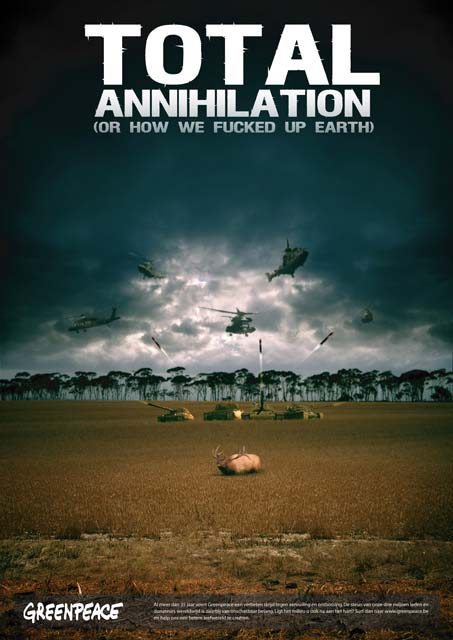
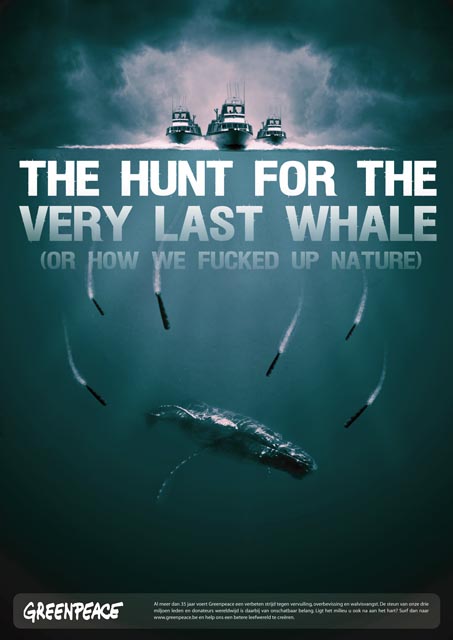
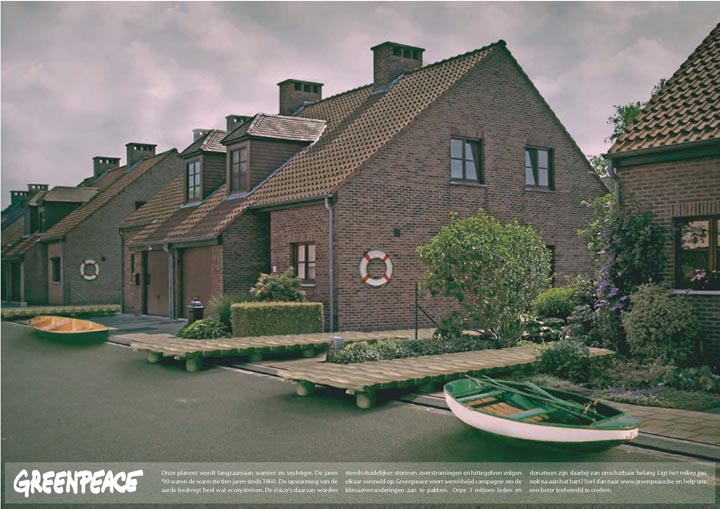
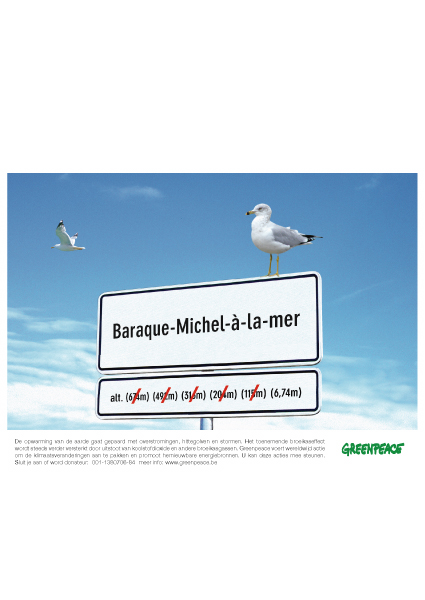
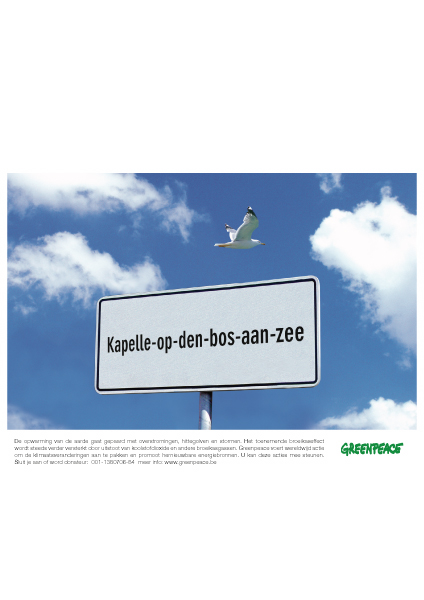
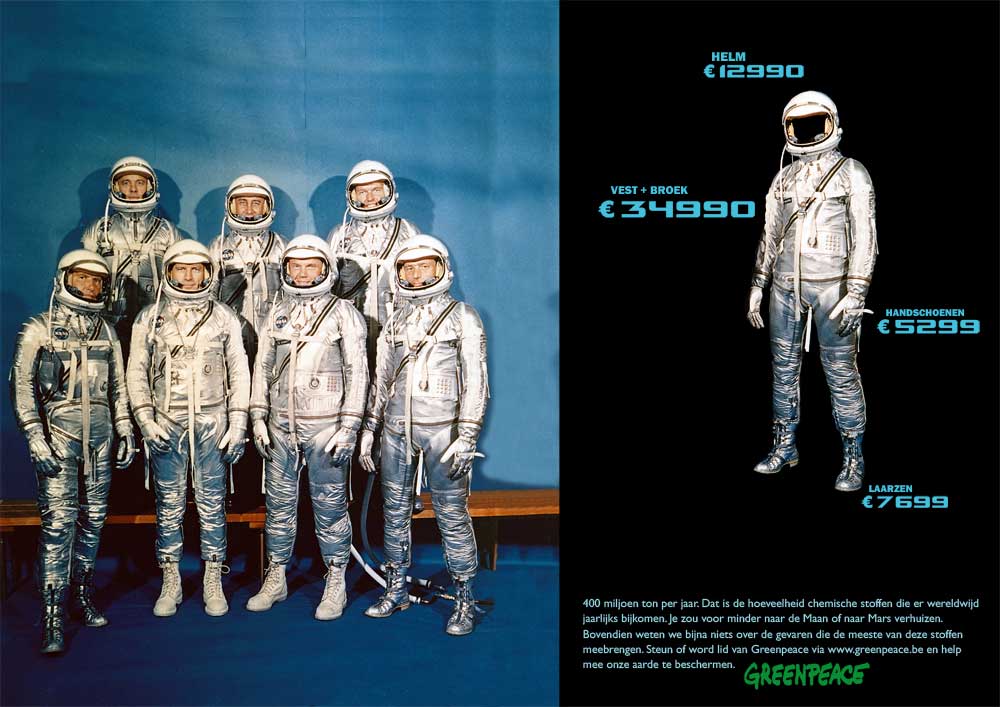
These images were produced by students in the advertising department at Sint-Lukas College [English site] in Brussels in the first term of 02006. Their assignment was create a visual awareness-raising campaign around Greenpeace themes, i.e., environmental activism. Many of the results are quite striking; and some highlights appear here with commentary [in italics] courtesy of Belgian futurist Maya van Leemput, who passed these along (regular readers of t.s.f. have met her before). Thanks, Maya!

Hello futures finders,

Found some futures for the collection.

"John-from-Ghent" is the name of seagull type bird, the obituary states:"With great sadness we announce the passing away of john-from-ghent. Seabird at the beach of Mar de Fora. Born in Sagres on May 25 1995 and suddenly deceased in Mar de Fora on November 21st 2002 following an oil spill. To testify your sympathy, you can transfer money to the accountnumber...."
An ordinary residential street in Belgium, prepared for rising sea-levels:


Two signs with the names of small towns in Belgium:
"Baraque Michel" is the highest point in our little low country.

"Kapellen-in-the-Wood" becomes "Kapellen-in-the-Wood-at-Sea".

The price of space-suits:

The text below says: "400 million tons a year, that is the amount of chemicals added globally every year. You would move to Mars or the Moon for less."

Most of [these are] just images, except for the first two which count as (film) posters (like a postcard is an object, something other than merely the actual image on its front). The death notice might count as an object also if it was presented and sent in an envelope or printed among the obituaries in the newspaper (which it wasn't). Anyway, some of the other images show objects that in 3-D would count as future artifacts, others just show images of what a future might be like.

The archive from which these images are drawn can be found here (N.B. text in Flemish).

So, a few thoughts. As Maya suggests, none of these function strictly as future artifacts. The "Greenpeace" branding immediately breaks the fourth wall, so to speak, in all these cases, and there is a certain lack of diegetic coherence -- e.g., even were it not for the brand name, the savage irony of the film posters belies their ostensible status as actual posters for future films, so the viewer is deprived of space to make the connection between the supposed artifact and the disturbing conclusion. The dots are, forcibly, joined up for us.

Still, features they could be said to have in common with such artifacts are: futures orientation expressed through an implicit future setting (except the obituary); evocation of some relevant issue or trend; and dissonance in the design (something impossible, unfamiliar, or futuristic that doesn't "fit" today).

The talented artists who produced these, I hasten to acknowledge, were briefed to make a visual campaign, not "artifacts from the future" per se, so lest these comments seem gratuitously critical, my aim is merely to think with these examples (and others of their ilk) about how best to use design to provoke futures thinking. Still, it's interesting, I think, that future artifacts of this sort are not uncommon as a strategy in environmental awareness-raising (compare with these previous examples). Both raising and acting on our awareness are things we need to get very good at -- the sooner, the better.