Showing posts with label theatre. Show all posts

Thursday, October 09, 2025

Building Time Machines at California Institute of Technology

I haven’t posted here for ages – a story for another time.

Today, I’m writing to share something I’m focused on right now.

This weekend I’m starting a stint as Artist in Residence at Caltech Theater. This is tremendously exciting to me – a chance to bring experiential futures, worldbuilding, and high-speed co-creation to a remarkable and storied institution. For example, one of the spaces we’ll be working in is the Feynman Room, named for the legendary bongo-playing Caltech physicist and Nobel laureate who was active in the theatre community there.

Our first event coming up is called “Immersive Futures Jam” – IFjam for short.

With a select group of participants, including undergraduates, graduates, alumni and staff from Caltech, as well as folks from NASA Jet Propulsion Laboratory and the wider community, we’ll be embarking on an ambitious co-creative process; producing immersive, you-are-there experiences of various futures, at the scale of a room, over the span of a weekend.

In a hat-tip to H.G. Wells, I call such room-scale future immersions “Time Machines”. Without quite meaning to, we essentially piloted a highly adaptable format two decades ago in Hawaii, and I’ve since modularized and sharpened it through numerous iterations – in Canada, Mexico, the UK, Singapore, and various parts of the US – with hundreds of students, colleagues, and intrepid volunteer time travellers. This is the first time I’m running it in California.

The very possibility of this edition of IFjam comes down to the vision and will-to-experiment of the unique creative force that is Brian Brophy, Caltech’s long-serving director of Theater Arts. We got to know each other over the past few years while working together on the NASA JPL show Blended Worlds; JPL’s contribution to the most recent instance of Getty Museum’s once-a-decade initiative PST.

A fuller treatment of Time Machines is in the pipeline. But for a sense of how they can look and something of the underlying process, a few starting points: A Pecha Kucha talk given years ago in Chicago. A short piece from The Futurist (the periodical of the World Future Society, as was). And another one from The Economist.

Stay tuned.

Related:
> Experiential Futures for NASA JPL (Library of Possibilities)
> A Time Traveller's Story
> Experiential Futures in The Economist (pdf version)
> Time Machines in The Futurist (pdf)
> Bringing futures to Stanford d.School
> Futures for Bristol
> Ghosts of Futures Past (Hawaii 2050)
> Time Machine / Reverse Archaeology (pdf)
> Using the Future at NASA (pdf version)

Wednesday, September 30, 2020

Theatre in Pandemic

"Historically, pandemics have forced humans to break with the past and imagine their world anew. This one is no different. It is a portal, a gateway between one world and the next." — Arundhati Roy

***

A group of Theatre in Pandemic participants test out a new streaming platform


This summer, together with my colleague Nica Ross from Carnegie Mellon's School of Drama, we staged an experimental research course called Theatre in Pandemic.

It took place against the backdrop of not only the COVID-19 crisis but also a national and global effort to confront police violence and structural racism.

Both call for radically different approaches to theatre, but seem to pull in different directions. The former made working in the same physical space impossible. The second demanded heightened attention to questions of power and consent; the terms of co-creation between artists as well as the terms of encounter between artists and their publics. In other words, one set of conditions militated against building the strong connections and trusting relationships that are central to theatrical art-making, while the other brought the importance of those same connections and relationships into the sharpest possible focus.

The result of our grappling with that challenging contradiction was one of the most experimental and exciting classes I've ever taught.

The syllabus started as a skeleton that we deliberately left under-specified so as to enable adaptation and emergence in the fleshing out. It included Fluxus scores, online larp, ritual design, transmedia ideation, critical examinations of media and their enabling constraints, and a whole lot of play.

That is, we put aside the temptations (and hazards) of trying to replicate on Zoom any kind of theatre as we knew it before. Instead, we set out in search of new possibilities through experimentation and games, resulting in a set of design briefs and performances for a pandemic-prompted "playable theatre".

An outline of our six half-day sessions or 'episodes' perhaps gives a sense of the arc.

Episode 1: This is Theatre Now
• In-Class Action: Pass Around a Shared Object
• Weeklong Action: Create a Score

Episode 2: Building Worlds Together
• In-Class Action: Play a Live Action Roleplaying Game
• Weeklong Action: Design a Ritual

Episode 3: Mediums and Media
• In-class Action: Research and Experiment with online tech/art projects
• Weeklong Action: 60 Second Play

Episode 4: A Play and a Project
• In-Class Action: The Thing From The Future
• Project Launch: The Final Action

Episode 5: Studio Time

Episode 6: Final Action

Gratifyingly, and as hoped, the three projects produced by our dozen participants were wildly different from one another.

Queerantine 2020 by Lyam Gabel, Lenora Gant, and Petra Floyd
A user-navigated web-based archive with mixed media content, both contextualising and telling the story of a triad of people trying to navigate the criminal justice system, queerness, academia, and life in a pandemic.


PBC by Zeja Copes, Sean Leo, Maggie McGrann, and Carey Xu
A live-streaming, 360-degree cut-up play incorporating the words of James Baldwin, Michelle Tea, Hua Chunying, and CNN to create a conversation at the intersection of diverse lives, conflict and care.


S.99520 by Davine Byon, Major Curda, Rachel Kolb, and Cynthia Xu
An online larp (or live action online game, aka ‘laog’) in which United States Senators and industry lobbyists persuade, bribe and cajole each other in the closing minutes before the crucial vote on the Bill for the Green New Deal. Hosted on the web-based virtual space and conferencing platform gather.town that stylistically emulates an 8-bit video game, the participants navigate their way around the game space to find each other, activate video chat, and engage in high-stakes negotiations.


Thanks in part to the interest that folks showed in what we were doing when I tweeted about the course a few months ago, we've open-sourced the Theatre in Pandemic syllabus, complete with all reading and media resources, in-class and weekly 'actions' or assignments, plus additional links and commentary, as well as a demo reel of the participants' efforts (see below).

My experiential futures practice and classes have for many years drawn on theatrical modes, including immersive theatre, live action roleplaying, and guerrilla performance –– and as it happens my first ever pay cheques, at 13, came from being in a professional production of an Andrew Lloyd Webber musical. But this was the first chance I've had to collaborate with the School of Drama. It was a blast.

Our hope is that others might find some leads or inspiration in these documents of our struggle to connect, co-create, and reimagine collaborative art in a very challenging time.

Meanwhile, much gratitude to Nica and to all our participants.


Related:
> Theatre in Pandemic: An Experimental Syllabus at Medium
> Impacting the Social [pdf]: A conversation with Candy Chang and Bryan Boyer
> The Time Machine [pdf]: Immersive futures assignment brief
> Experiential Futures: Stepping into OCADU's Time Machine [pdf]
> Designing for Emergence / Why Christchurch Should Not Plan for the Future [pdf]
> The Long Now course at CMU
> Future Documentary course at SAIC
> American Futures course at SAIC
> Adopt-a-Vision / Experiential Futures at OCAD
> The Futures School at NUS [video]
> Strategic Foresight course at CCA
> Intro to Politics course incl. Guerrilla Futures at UH
> In Memoriam / Guerrilla Futures intervention at SXSW
> Design is Storytelling
> When Reality Outruns Imagination
> Immersive scenarios for Hawaii 02050 in 02006 and revisited a decade later

Monday, February 16, 2009

Refugee Run


Invitation to Refugee Run, Davos 02009 | via Aid Watch

Late last month, NYU economics professor William Easterly blogged about an invitation he received for an unusual event in Davos, Switzerland, from the United Nations High Commissioner for Refugees. From the invitation text:

During this year's Annual Meeting of the World Economic Forum, we would like to invite you to an experience unlike any other on the agenda: an opportunity to step into the world of conflict and experience life as a refugee.

Just five minutes' walk from the Congress Centre, you can enter a simulated environment that will thrust you into a war zone. You will meet a rebel attack, navigate a mine field and battle life in a refugee camp. (Spoiler alert: No harm will come to you!)

Sounds pretty interesting to me.  But Easterly, a noted foreign aid and development expert, was unequivocal in his disdain:

Can Davos man empathize with refugees when he or she is not in danger and is going back to a luxury banquet and hotel room afterwards? Isn’t this just a tad different from the life of an actual refugee, at risk of all too real rape, murder, hunger, and disease?

Did the words "insensitive," "dehumanizing," or "disrespectful" (not to mention "ludicrous") ever come up in discussing the plans for “Refugee Run”?
...
Of course, I understand that there were good intentions here, that you really want rich people to have a consciousness of tragedies elsewhere in the world, and mobilize help for the victims. However, I think a Refugee Theme Park crosses a line that should not be crossed. Sensationalizing and dehumanizing and patronizing results in bad aid policy – if you have little respect for the dignity of individuals you are trying to help, you are not going to give THEM much say in what THEY want and need, and how you can help THEM help themselves?

To be fair, it does seem wise to question the bona fides of such an unusual attempt to bridge the world of the high-paid executive to that of the global refugee underclass, 42 million strong. Perhaps portions of the ("VIP event") invitation's wording lent it to misinterpretation as a "dehumanizing" exercise. Certainly, the WEF's annual invitation-only gathering of global business leaders at a Swiss alpine resort is not infrequently accused of complicity in the large-scale problems it purports to address, and indeed one could go further along these lines, taking the "development" paradigm in general to task, for selling to the world's poor a tissue of "used futures" (the memorable term of futures scholar Sohail Inayatullah).

So, no doubt the concerns Easterly voices are sincere, but based on the additional information I've been able to find, such as this description by the event organisers, Refugee Run doesn't seem in any way to deserve such unsparing criticism. Like him, I didn't attend the simulation, but I have done some background research (an approach the critics appear to have eschewed) and it comes off looking quite different on closer inspection.

It was not designed solely for the Davos audience, but is in fact one of several "Life X-perience" role-playing simulations developed by the Crossroads Foundation, a nonprofit organisation based in Hong Kong. Their Crossroads Global Village facility regularly stages a range of activities in this vein -- AIDS X-perience, Blind X-perience, Level Playing Field, and others -- intended to "allow participants to walk in the shoes of those who battle global need". Refugee Run, along with Slum Survivor, is given an Intensity rating of ten out of ten.

Check out this news clip (~4 mins) from the Wall Street Journal...


(See also this Bloomberg report via YouTube.)

My own impression is that an experiential taste of refugee life, if combined with a genuine will to compassion -- a key ingredient which cannot be simulated -- could be highly thought provoking in the best sense. It's no substitute, to be sure, for actual lived experience in fear of violence, disease, rape, starvation and pervasive alienation; but by the same token, is bound to be much more effective than any number of speeches, statistics, or videos.

It's interesting to me that some find this bold initiative to be in such poor taste (check out the numerous comments to the original post, which include plenty of readers scandalised on the strength of Easterly's description of the event, as well as some thoughtful replies by folks who have actually taken part in it).

I find myself wondering whether simulation and role play can seem unequal to the task of engaging consideration of serious issues, and thus attract easy scorn, in the minds of those for whom, for adults, at least, they remain peripheral and undervalued forms of learning; especially in some academic settings. For them, perhaps, on hearing about an experiential or immersive scenario, the most readily available analog is what they consider frivolous entertainment; yielding, in this case, the sadly dismissive notion of a "Refugee Theme Park", which, it follows, "crosses a line that should not be crossed".

The net effect is a misunderstood, and so missed, opportunity. As I see it, that opportunity is to address, not just rhetorically but actively, a profoundly important question -- posed by Easterly and quoted at the start of this post -- about the limits of empathy.

Related posts:
> Where every day is career day
> Experiential scenarios on video
> Today at Tomorrowland: yesterday's future
> Visit Venice, see Baghdad

(via Perspective 2.0, "Taking experience design too far?")

Friday, February 06, 2009

The mosquito incident

Bill Gates opens a jar of mosquitoes at TED2009
Image: James Duncan Davidson / TED via MSNBC

At the prestigious annual TED (Technology, Entertainment, Design) conference held this week, billionaire software mogul-turned-philanthropist Bill Gates presented at a session called "Reboot". His topic wasn't tech, however, but instead the efforts currently being made through his charitable foundation to "reboot" social problems including malaria, a fatal but preventable disease spread by parasite-carrying mosquitoes. Malaria is the scourge of poor countries in warm areas, and according to Gates has 200 million sufferers, with one million lives lost per year.

To help underline his point about the disease being largely ignored by medical researchers because it affects mainly impoverished populations, the man who founded Microsoft took an unusual step to engage the attention of TED's high profile, invitation-only audience. Yahoo! News reported:

"Malaria is spread by mosquitoes," Gates said while opening a jar onstage at a gathering known to attract technology kings, politicians, and Hollywood stars.

"I brought some. Here I'll let them roam around. There is no reason only poor people should be infected."

Gates waited a minute or so before assuring the audience the liberated insects were malaria-free.

The stunt has generated some controversy, reports Wired blog Epicenter. While some want to accuse him of terrorism, others praise his showmanship, but since the difference between the two is more ideological than intrinsic, either way we may conclude that Gates found a powerful way to make his point.

Still, the misquotation given above, which can easily be read as thoughtless and irresponsible, has added fuel to the fire. Watch the video (embedded at the bottom of this post); five minutes in, here's what Gates actually says:

Now malaria is, of course, transmitted by mosquitoes. I brought some here [opening jar] so you could experience this; we'll let those roam around the, uh, auditorium a little bit [audience laughs]. There's no reason only poor people should have the experience [more laughter, applause]. Those mosquitoes are not infected, but, uh...

I would suggest that some of his critics are either wilfully missing the point, or spoke up before they had seen the clip.

In any case, why -- you may well ask -- is this appearing here at t.s.f.?

Well, the question posed in Gates's presentation is, "How do you stop a deadly disease that's spread by mosquitoes?" An important part of the answer to that question lies in drawing active attention to the problem. His talk was calculated to do that. As far as I can tell, it worked.

To generate experiential, immersive and affective (as opposed to purely verbal, propositional, or cognitive) vectors for opening alternative futures up to exploration is right at the heart of my current work as a futurist. Gates's stunt is one of the simplest, most ingenious, low-tech ways to spice up a conference talk that I've ever heard of, and it instantly elevates to prominence a cluster of pertinent questions about the relationships between disease, socioeconomic class, and the medical establishment. Naysayers nothwithstanding, the "scare" factor here was minor or non-existent, while the gesture was sufficiently bold, and symbolically potent, to have been newsworthy (although whether it would have been quite as widely reported if instigated by someone other than a former "World's Richest Man" titleholder remains uncertain). In an age of increasingly ubiquitous video recording and web-access, not only TED, but many other events have both a primary audience (those present at the time) and a secondary audience (those who hear about it later and watch online, etc). An effective experiential intervention will actually reach many more people in anecdotal or secondary form (via accompanying metacommentary and distortions), and that's the case here. I (and probably you too) became aware of this speech, and devoted some portion of my attention to as part of the secondary diffusion of a novel primary performance. That's the sense in which it "worked".

Now, just to be clear; this is not to say that I think people should release bugs left, right and centre whenever disease is the topic du jour. Anything that might be (mis)taken, even momentarily, for a hoax, must be handled very carefully indeed. But in any event, novelty is part of the design context, and future duplication of this intervention would almost certainly be a worse idea, not a better one.

The experience must always be tailored to the specific circumstances: topic, audience, location, resources, etc.

Here's another great example, shared on the WFSF listserv last year by a futurist colleague from the Netherlands, Andreas Ligtvoet:

[There] was an exhibition during the Floriade (World Horticulture Fair) 2002 by Hogeschool Larenstein (a higher education institution in the NL). They not only showed a multimedia presentation about the potential flooding of parts of the NL (due to climate change and ice melting), but actually flooded (!) the floor that the viewers were standing on. On the floor was a map of the Netherlands, and the flooding only took place in the western (lower) part. Of course the visitors had to crowd together on the smaller surface of the exhibition hall or get wet feet.

I have tried, so far unsuccessfully, to locate photos or video of this event; but the concept is splendid, and directly confronts the psychological difficulties we face when engaging long-term change processes.

It would be great to hear from anyone else with cases where a future (or otherwise absent, remote, or hard-to-imagine) scenario has been rendered available here-and-now, whether the setting be a conference, theme park, or classroom. But the cheaper, simpler and more ingenious the approach, the better. To my mind, whether the issue is malaria, climate change, or any other significant threat -- or, for that matter, opportunity -- in need of our sympathetic attention and concerted realignment of collective priorities, these techniques themselves are also ideas worth spreading.


(Thanks Jake!)

Friday, October 31, 2008

Death of an ex-President

Tragedy today, as former President Gerald Ford was eaten by wolves.


Here, master impressionist Dana Carvey (Wayne's World) plays news anchor Tom Brokaw in a 01996 sketch for Saturday Night Live -- to my knowledge one of the finest moments the show has produced in over 30 years on the air.

It starts with a brilliant comic premise: the newsman is pre-recording a bunch of alternative future headlines so he can take an extended vacation in Barbados. Carvey's Brokaw covers a variety of contingencies in which former U.S. President Gerald Ford meets his maker, through a series of bizarre and increasingly unlikely scenarios. (Ford was still alive in '96, and had the good fortune to live another ten years, wolf-free.)

The sketch works not only because of Carvey's fabulous characterisation -- like any great caricature, whether drawn or performed, you don't actually have to be familiar with the original in order to recognise it -- but also because of the splendid absurdity of the premise, which naturally is stretched as far as humanly possible.

One take-home message from a futures standpoint (hey, you knew we had to go there) is that, although life -- and death -- unfold in infinite specificity, to anticipate and plan for such unforeseeable concrete particulars is inherently absurd.* Another thought that occurs to me is that while any useful statement about the future should appear to be ridiculous (per Dator's second law), it doesn't follow that any or all ridiculous statements about the future are necessarily useful.

They can, however, be very funny.

[via Nerve.com | embedded clip from Break.com | transcript here]

Related posts:
> Death of a President
> Future news-flash: your vote counts
> A death foretold

* Update (01/11/08): I just remembered a classic sketch by British comedy duo Stephen Fry and Hugh Laurie in which Stephen's doddering old man character is trying to buy a get well card from Hugh's shopkeeper, but all the pre-printed messages in the cards are incredibly specific [video; transcript]. Great sketch, parallel concept.

Wednesday, October 22, 2008

Historical preenactment

An emerging trend?

Artwork by Aaron Diaz | via preenactment.org

At Burning Man this year I was intrigued to see in the schedule a theme camp called "Time Colony", featuring some sort of collective named The Historical Preenactment Society.

Now, historical re-enactments have long smacked to me of the thoroughly bizarre. It could be a result of exposure at an early age to Monty Python (see for example the unforgettable Reenactment of the Battle of Pearl Harbor, by the Batley Townswomen's Guild). Pre-enactment, however, while no less bizarre, is admittedly something of a preoccupation of mine (exhibit A, exhibit B).

My search for Time Colony around the advertised intersection was a bust, because (I later found out) the camp had been relocated at the last minute, so I missed their scheduled events. When I did eventually find it, I was pleased to make the acquaintance of one Nick Ernst, the camp's affable coordinator who in real life is an undergraduate student in maths and physics at UC Santa Cruz. Nick told me all about what they had been up to. He's just recently posted a description of their efforts at his blog...

The cyborg leader made to untie the robot at that point. Someone in the audience held up a gun and fired twice. The robot and cyborg leader fell. After a silence, a cyborg yelled "Murder! Double Murder!" And fighting ensued.
Everyone stopped for the end narration: The audience member who had shot the cyborg and robot was charged with two accounts of murder in the first degree. The robot was thus recognized as an entity with the right to life, and so this tragic event spurred a big step forward in the fight for robot rights.

This was, as far as Nick knows, the first instance of future performance to travel under the name of "historical preenactment". The concept for the Historical Preenactment Society was borrowed, he explains, from Dresden Codak, a webcomic by Aaron Diaz that will thrill anyone equally interested in manga-style artwork and The Kurzweilian Singularity. (Check out the comic's instalments featuring the Society's first and second mentions, but note they're both part of a longer story that starts here.) Nick has also set up a Facebook group for his version of the Society (296 members and counting -- and there are four or five other chapters, too). Meanwhile, someone else has (independently?) created a website for Society activities, the first instance of which is apparently a concerted group involvement in Superstruct, the massively multiplayer forecasting game set in 02019, which is currently underway. The entrepreneurial artist Diaz has also put HPS t-shirts on sale here.

While we eagerly await news of the group's next intervention, here's another bit of gleefully anachronistic entertainment, sent to me today by Zander Rose at the Long Now because "it reminded me of your projects but in reverse": Tweet Capsule is a twitter feed by Amos, "time twittering" from exactly 100 years ago with Blackadderesque snarkiness.  For instance, 6 October 01908:

Happy Birthday Carole Lombard! She turns 0 today!
http://tr.im/carole


Related posts:
> Humans have 23 years to go
> In memoriam
> Experiential scenarios on video
> My first Burn

Friday, September 12, 2008

In memoriam

A priest pays tribute to Dirk Diggler (Eddie Adams) at his memorial service, 11 March 02025
[Image via coquedesign2000's Flickr photostream]

On 11 March, Jake Dunagan and I staged one of four experiential scenarios set in the year 02025 for the annual South by Southwest Interactive (SXSWi) festival in Austin, Texas. A trio of fellow future-mongers, Jamais Cascio (Open the Future), Wayne Pethrick (Pitney Bowes), and panel coordinator Michele Bowman (Global Foresight Associates), each devised and presented their own immersive fragment of a different 02025 in the same session. Thus was the audience for "Futurists' Sandbox" serially bombarded with a quartet of alternative futures exploring possible directions for social networking technology.

Together, the five of us had sketched out four very different settings to ensure maximum diversity in the ideas we would present. Jake and I chose to breathe life into the one dubbed "mobilisation", which resembled the generic image of the future that we usually call "discipline" at Hawaii Research Center for Futures Studies. Back in March, Jake posted a detailed description of the scenario and its theatrical translation at the HRCFS blog, in two segments, and the quotations below are his:

Combining our concern with expanding IP [intellectual property] rights and their impact on expression and freedom, we decided to integrate elements of the aesthetic economy, IP expansion, and surveillance culture--thus creating a disturbing totalitarian corporate-state.
...
[W]e chose to tell the story of the locked-down Dream Society through a eulogy for Eddie Adams, aka Dirk Diggler from P.T. Anderson's film Boogie Nights [i.e., the central character played by Mark Wahlberg].

Our experiential scenario, a memorial service for pornstar-turned-copyfighter Dirk Diggler, was advertised at SXSW with "in-world" flyers...
[Photo: Stuart Candy]

...dated 02025.
[Design: Eliot Frick]

There was no indication in the SXSW festival materials that our group would be 'performing' scenes from our scenarios, and, after some debate, we decided not to preface the panel with an explanation of the method. This was a risky choice, and with access to the active twitterati and audience members commenting live on the SXSW Meebo chatrooms, we could see that the reaction to the panel was mixed, but passionate. Still, for what might be risked in subverting audience expectation, we feel this performative, immersive technique is much more effective at engaging the audience at both emotional and intellectual levels—creating an unusual, thought-provoking and memorable event.

For those who haven't seen Boogie Nights (01997), the movie chronicles, with documentary plausibility, the rags-to-riches story of a surburban LA busboy whose astonishing endowment in the trouser department leads him to become a 01970s porn icon. Our scenario picked up Diggler's tale where the movie leaves off in the mid-80s, with the protagonist battling alcoholism and impotence. In our hands, his career then weathers a fallow period, during which he sells the rights to the image and likeness of his famous 13-inch member to a dildo company. Years later, in the 01990s, thanks to Viagra he revives his flagging fortunes and re-enters the porn movie business. Things seem to be going swimmingly, until the early 2010s when the long-anticipated technology of teledildonics (virtual sex) comes of age, and his attempt to market the virtual experience of sex with the enviably well-hung Dirk Diggler runs aground. These entrepreneurial efforts are met with a lawsuit by Disney, the company which (in our *hypothetical scenario*) has, via a series of mergers and acquisitions, come into possession of property in his penis. The case drags on for years, eventually finding its way to the U.S. Supreme Court, where Diggler/Adams fights it with everything he's got. Ultimately, he loses the case, as the court's expansionist reading of the rights he signed away for dildoes in a moment of weakness are deemed also to cover the haptic experience of sex with the "Diggler" character, as well as revenue from his post-contract comeback catalogue of pornographic performances. Eddie Adams, dispossessed of his very manhood by the ubiquitous corporate surveillance and lockdown of intellectual property, dies in 02025, beaten but unbowed. He is a hero of the embattled "copyfight" movement in an America where market logic has come to infuse every social transaction.

It was a lot to try to convey all this experientially in 15 minutes (one quarter of the hour-long session), but we figured it as an interesting twist on a story and character that many in the audience would recognise. By no means was it the stand-and-deliver panel discussion format that many had expected.

So, when people entered the auditorium, they were greeted by sombre organ music, a suitably reverential arrangement of ELO's "Living Thing", from the Boogie Nights soundtrack (arranged and prerecorded by our talented friend John Maus). This was the first element of immersion in our memorial service for Eddie Adams, to be followed by impassioned eulogies by his priest (me), lawyer (Jake), and erstwhile co-star, Rollergirl (the incomparable Sandy Stone, who lives in Austin and graciously agreed to be involved).

The presentation was six months ago yesterday, and this post is long overdue (mea culpa). One reason for that is I'd been hoping, at first, for some video of the panel to surface, since the material shot on an ancient Hi-8 camera by our friends at the back of the hall didn't turn out. We do however have components from the slideshow we produced to accompany the Diggler eulogies, to provide a little more flavour...


Above: some nostalgic shots from Rollergirl's Polaroid archive
[Images: Captured
from Boogie Nights by Stuart Candy, composited by Matthew Jensen]

An automated copyright protection system prevents unauthorised / unpaid glimpses of the Diggler jewels
[Image: Stuart Candy, captured from
Boogie Nights]

Copyfight Protesters turn out in droves supporting the Adams/Diggler bid to ressert rights to his famous appendage
[Round placards design: Melissa Jordan, Pinkergreen
Found image: Stuart Candy | Compositing: Eliot Frick]

Outside the Supreme Court, Eddie Adams reflects on the judges' decision
[Found image: Stuart Candy, via Caroline Bonarde Ucci's Flickr photostream
Aged by Melissa Jordan, Pinkergreen]

Eddie Adams, copyfight hero, at the sunset of his life
[Image captured from Shooter by Stuart Candy
Aged by Melissa Jordan, Pinkergreen]

The other three presentations were wildly different, both from ours and from each other.

Wayne's was a slick corporate presentation by Datapoints.net, a shadowy, all-seeing data aggregation enterprise (with a real website that you can find here):

Screenshot from Datapoints.net, a successful personal data aggregation and marketing site in 02025
[Design: Wayne Pethrick]

Michele's took the form of a charity auction benefiting the "Make A Friend Foundation" (for kids who can't afford to join Facebook), featuring a number of coveted future products and services on which attendees could bid.


Some of the items under the charity auctioneer's hammer of Michele Bowman in 02025
[Designs by Pinkergreen | Images via FringeHog]

Finally, Jamais staged an other-worldly ultimatum from a hive-mind called "The Chorus". The question for audience members: will you join, or will you opt out?

Screenshot from "The Chorus"
[Performed by Jamais Cascio
Audio available in full [mp3, 6.4Mb) here, via Open the Future]

Looking back six months later, what Jamais wrote at Open the Future on the day of the show still resonates:

The futurists' panel was... weird.

No, scratch that. It was freaking bizarre.

Indeed it was. From my point of view, that's partly because of the frenzied preparation which took up the entire time from flying into Austin until going onstage. Combined with which, of course, the content was somewhat surreal (twenty-four hours before the panel, our shopping list included dry ice, a 13-inch dildo, and a priest's outfit). Also, more poignantly, although we had decided long beforehand on the memorial setting for this experiential scenario, in the previous week both Jake and I had been obliged to attend funeral services in the wake of real bereavements.

Life's ironies can be pretty extraordinary.

In any case, thanks are due to all who made this possible, including our hosts in Austin; our talented designer friends who helped bring the story to life; guest star Sandy Stone (for her compelling portrayal of Rollergirl, at ridiculously short notice); and of course our fellow futurist panelists who boldly agreed to immerse the audience in these four 02025s, FoundFutures guerrilla-style.

It made for an experience that I, for one, won't ever forget.

Related posts:
> Experiential scenarios on video
> Found futures> More found futures
> McChinatown

Thursday, February 21, 2008

My big fat alternate reality wedding


I was excited this evening to hear of a long-running theatrical show, called Tony n' Tina's Wedding, which has some of the characteristics Jake and I have sought to incorporate into our experiential futures interventions. (See for instance, photos and videos from the "Hawaii 2050" kickoff staged in August 02006; or posts about FoundFutures:Chinatown.)

At Wikipedia, it's described as follows:

Tony n' Tina's Wedding is one of the longest-running comedies in American theatrical history. Credited as the originator of the "environmental theatre" craze, Tony n' Tina’s Wedding stages a traditional Italian-American wedding and reception with the warm and intrusive stereotypes pushed to the limit. Audience members are treated as guests at the wedding by the interactive, improvisational comedy cast.

Tony n' Tina's Wedding opened February 14, 1988 [wow -- 20 years ago last week], in New York City and has expanded its run to over 100 sites worldwide, including cities in Canada, Japan, Germany, United Kingdom, and Australia.

The show's website explains:

At Tony n' Tina's Wedding, audience members actually play the roles of Tony n' Tina's family and/or friends. These are roles we have all been practicing, every time we go to a real wedding. This universal familiarity with the union of two individuals from 2 distinct families, regardless as to where you are from, will take you back and forth between fantasy and reality throughout the entire evening. For the ultimate experience... eat, drink, dance, converse and allow yourself to be caught up in the activities. This all inclusive evening of entertainment will be something you and your friends will be talking about for many years to come.

All prices are in lieu of a gift to the happy couple and include the show, dancing, and dinner although menus may vary depending upon the specific venue in which you are attending.

Its origins:

The idea for Tony n' Tina's Wedding was originally conceived at Hofstra University while Mark Nasser and Nancy Cassaro (the original Tony n' Tina) were undergraduates. Both in the drama department from 1977-1981 they made up these characters and would often improv with each other, acting out the roles of two Italian boyfriend-girlfriends from Queens, just for fun. As their professional relationship continued (after both moving to New York), after graduating from Hofstra, their characters continued to develop as well. Soon after the idea to present an interactive wedding, where the audience played the guests, was proposed and in 1985, was acted upon. Three performances were planned, actors invited their friends and family, and at this point it became clear to Joe Corcoran that this was an "event "that would appeal to an audience, well beyond traditional theater goers. Well, the rest is history.

Not at all surprising, really, that it started life as improv. All creativity seems to spring from the process embodied by improvisational theatre. Its cardinal principle, which we have adopted in our scenario and design development process, is "Yes, and..." That is, to cultivate a reflex for building on whatever you're given.

I gather that the Tony n' Tina experience begins as early as the purchase of tickets, which are issued as invitations (naturally!), and, once at the venue, it carries on seamlessly even into the restroom, where you might find yourself drawn into conversation (in-world) by your "host family". Almost as scary as cool, which is a great sign.

Being something of a scenario purist, sensitive to diegetic consistency, I guess I wish the website (tonylovestina.com) managed to maintain the story, rather than blowing its wad and quoting Joel Siegel -- don't break the universe, dammit! -- but in any case, environmental theatre (which I don't recall encountering until now) -- is clearly a genre of performance that I ought to research.

Many thanks, Nancy, for the lead!

Thursday, March 08, 2007

Experiential scenarios on video

These four short video clips are from the experiential scenarios designed and staged by HRCFS staff for the Hawaii 2050 kickoff on 26 August 02006. Each one is about two minutes long.


"Orange" Hawaii in 2050 is a result of continued economic growth.


The "Silver" alternative suggests possible conditions in 2050 some years after a socio-economic collapse.


The "Maroon" future exemplifies a disciplined or self-restrained society.


"Blue" depicts a society that has undergone a high-tech transformation.

Each of these clips is pared down from experiences lasting about 20 minutes, that ran concurrently in four rooms at the Dole Ballrooms in Honolulu. The 530-or-so attendees were split up and given no clues as to what kind of future they would be entering, but facilitated discussions were held afterwards to draw out people's views about the possible, probable and preferable elements of each scenario.

Some technical challenges delayed their release until now, but at HRCFS it's our hope that these clips can serve as conversation fodder in the futures community, encouraging further improvement in the emerging practice of experiential scenarios (and "immersive futures" more broadly). Feedback from participants at the August kickoff was overwhelmingly positive and has encouraged us to continue developing other ways to communicate and provoke the consideration of alternative futures... I'd be interested to hear from anyone who has undertaken, or knows about, comparable efforts.

(A longer version of this article has been posted at the Hawaii Futures blog.)

Update 4may2011: The link to the Hawaii Futures blog may be dead, but the Internet Archive's Wayback Machine comes to the rescue.
Update 12march2012: Video re-embedded with original aspect ratio.

Tuesday, August 29, 2006

"Hawaii 2050" kicks off

Last Saturday, 26 August saw the kickoff event for the state's futures-oriented public discussion process, "Hawaii 2050", at the Dole Ballrooms, Honolulu. About 530 participants from across the islands were in attendance. I am still recovering from the monster effort involved in staging four "futures rooms", which allowed participants to experience, about 130 at a time, two of the four scenes (from among countless possible futures), as a catalyst to further discussion about the possible, probable, and preferable paths that change could take in Hawaii between now and 02050. See this earlier post for more background. In each case, a colour name was attributed for logistical reasons (to put on people's nametags and room signage), not to imply anything about the contents of the scenarios, which were kept secret from participants until they stepped in the door. The photos below, taken by HRCFS graduate student Cyrus Camp, provide a little of the flavour of each.

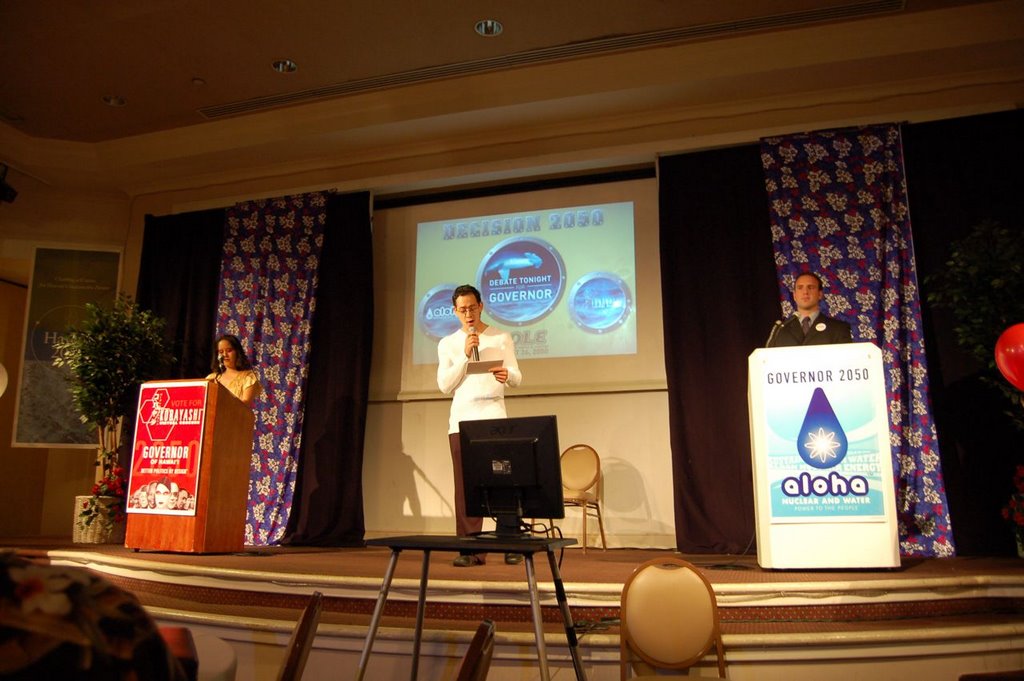
In the "Orange" version of Hawaii circa 02050, two corporations -- "Aloha Nuclear and Water", and "Kobayashi Virtual Concern", vie for the Hawaiian Governorship in a political debate staged at the Dole Underwater Hotel and Casino.

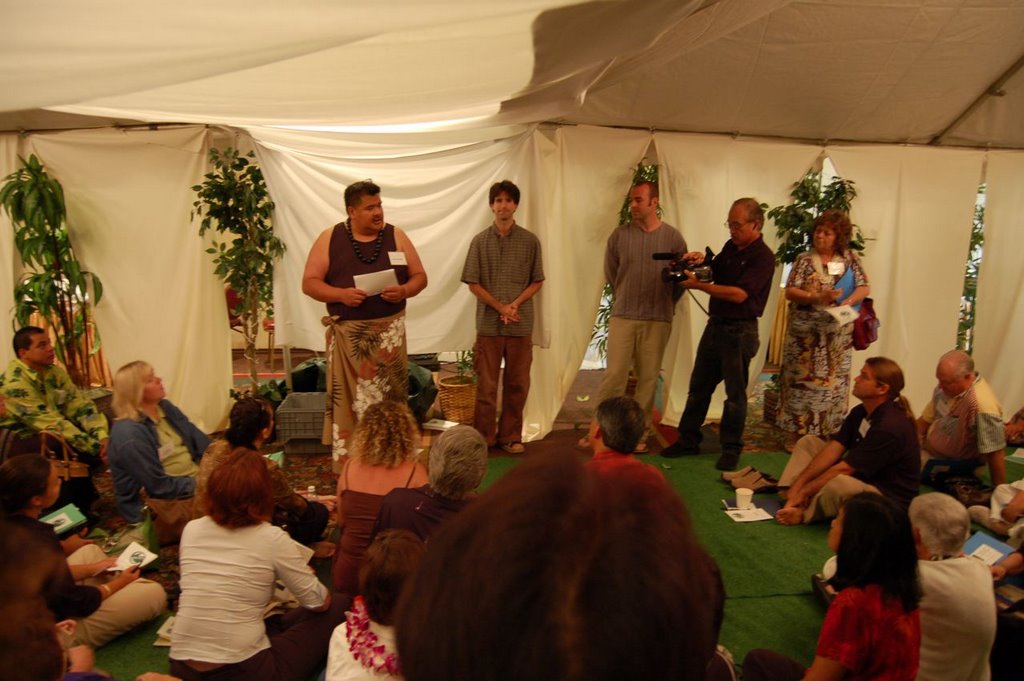
For "Maroon" Hawaii, participants are cast as attendees at a compulsory -- like jury duty -- civic education program, in the Honolulu ahupua'a. At this "introductory session", presentations are made about the abundant and versatile hemp crop grown in this future Hawaii, and about the role of do-it-yourself biofuel in a renewable energy portfolio.

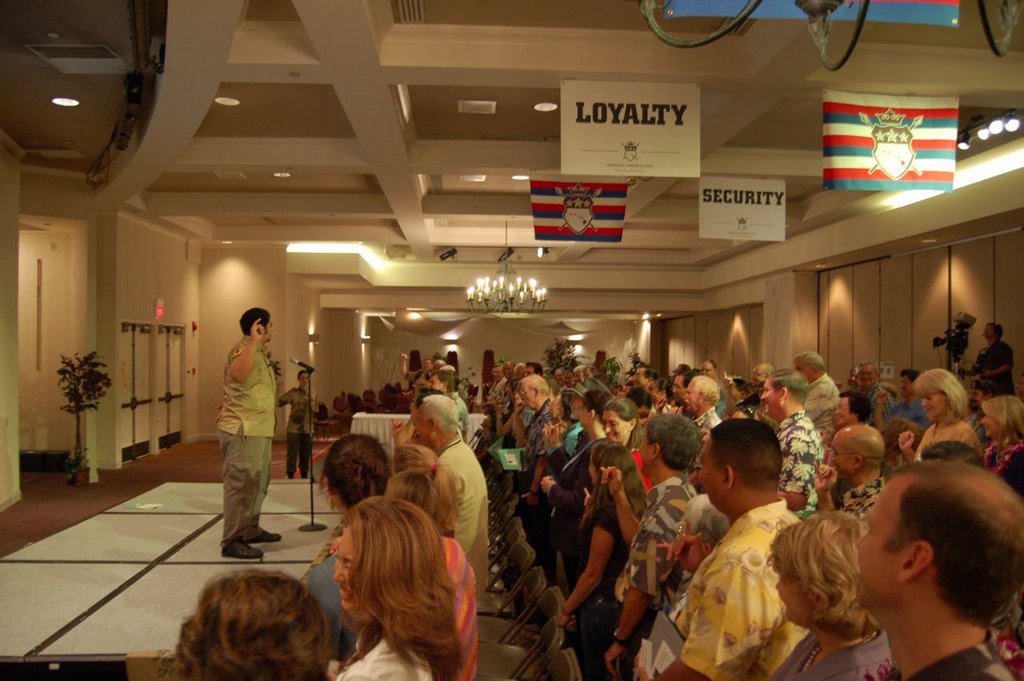
In the "Silver" scenario, a post-"peak oil" global economic collapse has led to the rise of a military-run society, overlaid with a puppet Hawaiian monarchy. Participants entering this scene are cast as refugees from smaller Pacific islands disappearing under rising oceans, and inducted as citizens and subjects of the so-called Democratic Kingdom of Hawai'i.

"Blue" Hawaii posits a sort of technological Singularity, after which the meaning and status of ordinary humanity is transformed. Here participants are a group of "premods" (PSEs -- persons sans enhancements; homo ludditis; naturals) being addressed by staff at MBED, the "Mind Body Enhancement Depot". They are offered a free technological upgrade paid for by the World Council in order to raise the GHI, or Global Happiness Index.

Now, none of these was intended to be taken as either advocating or predicting a particular path; the aim was instead to promote a broadened sense of what the possibilities could be. From that perspective, this part of the event seems to have succeeded. People were highly engaged by the exercise, and responded energetically and thoughtfully to the ideas presented therein.

This article from Sunday's Honolulu Advertiser says some more about Saturday's program, and this piece by futurist Jamais Cascio (our guest presenter at last week's futures salon) provides a highly thoughtful response to the whole "Hawaii 2050" effort, as well as the Immersive Futures themselves. Details of the scenarios can be found here. All feedback on any aspect of this event, or the broader endeavour of which it is part, would be most welcome.

I will be out of action for the next few days, attending Burning Man for the first time, in Nevada, but there will be more on "Hawaii 2050" -- as well as Burning Man -- in postings to come. Thanks to all those who volunteered their time both in the leadup and on the day to make this event possible, but mahalo especially to my futures colleagues Jim Dator and Jake Dunagan for being absolutely terrific to work with on this ambitious experiment in making futures thinking more real.

Related posts:
> Immersive futures for Hawaii 2050
> Experiential scenarios on video
> The Futures of Everyday Life
> A history of experiential futures
> The Bird Cage