Showing posts with label video. Show all posts

Sunday, June 30, 2024

Sharing Experiential Futures with governments around the world


I was recently honoured to deliver a virtual masterclass seminar to a global audience of public sector futurists, through the OECD’s (Organisation for Economic Co-operation and Development) Government Foresight Community, or GFC for short.

The seminar was called Whatever It Takes: Supporting Strategic Conversation by Design. Briefly:

In order to be effective, foresight practitioners need to adopt a multidimensional approach to foresight. This means being able to distinguish and use what I posit as the three dimensions of foresight – difference (which is basic to thinking about change over time), diversity (essential to all scenario generation processes and to the field’s core philosophical shift from “future” singular to “futures” plural), and depth (often neglected in the field, but now addressed by the family of approaches known as Experiential Futures, or XF). XF practices are about providing immersive, interactive, embodied and emotionally engaging glimpses of alternative futures through design, media and the arts: whatever it takes. With this powerful set of methods, we are better equipped than ever to engage foresight in all its dimensions, for strategic and dialogic decision making, public policy, collective imagination, and cultural transformation.

The OECD has just posted video of the presentation, and it’s embedded above. My title “Whatever It Takes” is a nod to Yale information designer Edward Tufte’s philosophy of achieving communicative goals by hook or by crook (see The Futures of Everyday Life p. 110).

A lively conversation followed, but since their policy is to protect the possibility of open dialogue via the Chatham House Rule that part wasn’t recorded. 

This was the second masterclass to be offered in the series, the first having been given late last year by my friend Aaron Maniam from Singapore, now at Oxford’s Blavatnik School of Government. 

It’s a significant opportunity they’ve spotted and initiated here; convening folks around big foresight questions and best practices from government and beyond. For those interested, the GFC was described to me by its OECD organisers as:

a network of public sector foresight practitioners from around the world. It includes OECD Member countries, but also non-OECD governments as well as some experts and practitioners from other international organisations, civil society, academia and the private sector. The purpose of the Community, and the speaker series, is to improve the practice of foresight within governments.

My sincere thanks to Rafał Kierzenkowski and his team for hosting me, as well as for this series in general, which is now several months and several more contributors further along. I place great value on the chance to demonstrate for such an audience not only the importance-in-principle, but also the possibility-in-practice, of producing more multidimensional, compelling, and impactful futures work in the public sector – where I started my career.

I'm told that this whole series, together with supporting materials, will soon be available via a new webpage for that purpose, and I'll update this post when that happens.

(Update 08aug24: The Government Foresight Community site is now live. My talk “Whatever It Takes”, including a PDF version of the presentation deck, can be found here. For links to all the talks in the series, scroll down here.)

Related:
> Experiential Futures: A Brief Outline
> On Getting Started in Experiential Futures (for The Omidyar Group)
> Adding Dimensions to Development Futures with UNDP
> Exploring Technology Governance Futures with the World Economic Forum
> Introducing Experiential and Participatory Futures at the BBC
> Bringing Futures to Stanford d.school
> Participatory Futures for Democracy 
> Three Dimensions of Foresight (for Columbia University DSL)
> What Is the Value of Futures and Foresight? (for RSA)
> What Is Futures Studies? (for WEF – external)

Tuesday, January 31, 2023

The Power of Utopia

One of my favourite engagements of the past year was a panel about The Power of Utopia with accomplished artistic activists Terry Marshall (co-instigator of Intelligent Mischief, a creative studio dedicated to “unleashing Black imagination to shape the future”), and Cory Doctorow (bestselling science fiction author and journalist whose work includes How to Destroy Surveillance Capitalism and Walkaway, among many other titles).

The Center for Artistic Activism (C4AA) hosted the event as part of its Revolutionizing Activism series, a brilliant resource for agents of change to practise infusing radical imagination into present action. Afterwards, the organisation shared some key takeaways from the event under the title How to strengthen the vision of your advocacy.

Video of the full conversation is embedded below.

Related:
> Imagination Is a Commons: An experiential futures project for UNDP (02021)
> Ethnographic Experiential Futures / EXF (02017)
> FoundFutures: Chinatown: Green Dragon (02007)
> Critical activism: An interview with Anab Jain (02019)
> The New York Times Special Edition (02008)
> Future documentary (02016)
> Guerrilla Futures: Strategic foresight meets tactical media (02014)
> Dreampolitik: On the political importance of impossible dreams (2008)
> The Tao of Steve (02011)
> Guerrilla Futures C4AA webinar (02017)
> The School of Worldbuilding (02019)

Thursday, April 23, 2020

Three Dimensions of Foresight

As the covid-19 crisis unfolds, many of us are looking to an extravagantly uncertain future with anxiety, as well as a new appreciation and appetite for whatever brings confidence and clarity to prospection.

How might concerned citizens engage in more effective futures thinking and storytelling?


Columbia University's Digital Storytelling Lab (DSL), led by a veteran experimental storyteller, my friend Lance Weiler, has responded to the pandemic by offering ingenious, collaborative, and free opportunities for hundreds of folks in quarantine and isolation all around the world to come together, imagine alternative futures, and manifest them through co-created digital story artifacts.

The project is called From the Futures. With this effort, Lance, Columbia DSL and team are tending a welcome oasis of collective creativity for our moment.

They invited me to help kick things off with an introduction to a framework related to the experiential futures space that the project inhabits and plots out. The slides embedded above distil that talk, "Three Dimensions of Foresight".

The three dimensions can be seen as corresponding to various manoeuvres or methods in the futures repertoire that typically require quite a bit of practice to master. But even for those trying experiential futures for the first time (which would include many From the Futures participants), they can also be mobilised right away via a series of practical moves towards storytelling more different, deep, and diverse than it might otherwise be:

• Difference : let us seek seeds of change in the present that could be really transformative if they were to grow.
• Depth : let us try to not just think, but also feel, our way into these imagined conditions by devising specific future artifacts and diverse media to bring the imagined possibilities to life as if they came to pass.
• Diversity : let us operate generally in terms of plural futureS, but even if constructing a single scenario or possibility for a particular project, find what is fresh and uncommon for the ecology of thinkable and feelable futures, since a new story may be dramatically more valuable than yet another telling of one that we have already heard many times before.

The framework has its origins in my doctoral project on experiential futures. There I ventured an arguments about the need to build on, and systematically range beyond, the most common practices and methods of previous generations of futurists. I wanted to show that foresight practitioners could and should embrace a range of "experiential" (a deliberately big umbrella) approaches, in pursuit of the requisite realism and resonance to affect how we think and what we do in the present. Often this would mean seeking and evoking depth; making a future's details and implications available and graspable –– tangibly, sensorially, viscerally –– in ways usually lacking from the even most carefully researched, well written horizon scans or scenarios. This approach includes an assumption or acknowledgement that things at later points in time are bound to be as real, complex, and full of contradictions as the present. We should strive then to get "under the skin" of the futures we face, and engage them not in the abstract as intellectual constructs, but through evocative concrete experiences, as potential realities in waiting.

In this connection I wrote about the need for a "mundane turn" in futures practice (The Futures of Everyday Life, 02010, pp. 89–94), by analogy with an important shift of orientation that had already taken place decades earlier in cultural history, tying this quest for modest but evocative fragments, details and textures of worlds to come, to design and discussion in the present of artifacts or experiences that might exist in those futures (hence the phrase "futures of everyday life"). Among other contributors, Nick Foster's perceptive essay The Future Mundane, and Tony Dunne and Fiona Raby's influential book Speculative Everything (both 02013) carried these sorts of ideas further among design audiences. It has been satisfying to see the spread of futures-curious, design-led practices like design fiction and speculative design summoning new explorers and fellow travellers to this terrain.

The three dimensional lenses on futures practice came into sharper focus soon after the dissertation work, and they helped frame our first run of the Strategic Foresight course in the Design Strategy MBA program at California College of the Arts (02010). That course is outlined here. Since then, and refined thanks to audiences and student groups over the years, 3D foresight has become one of the main ways I introduce futures to newcomers.

For those who might like a more methodologically detailed overview of 3D foresight, with additional examples, I recently gave a lecture across campus at Carnegie Mellon's Human Computer Interaction Institute, How to think about the future.

Our video of the talk to From the Futures participants (via Zoom) has already been shared, and Lance's written accounts of the initiative so far can be found in the posts Designing for immersion in Zoom and From the Futures: experiments in collaborative art and collective wayfinding in a time of ambiguity.

A wonderful sense of the swarming, emergent, hive-mind creativity that this process has helped to unleash, and to guide, is captured visually in the timelapse below. If interested in receiving updates or taking part yourself, head here.


Related:
> The Futures of Everyday Life (pdf)
> About the first Strategic Foresight course at CCA (pdf)
> A Brief Outline of Experiential Futures
> Design for the Next Context (Closing Keynote at 02010 AIGA Conference)
> The Experiential Turn (with Jake Dunagan)
> On Getting Started in Experiential Futures
> Design is Storytelling

Tuesday, December 11, 2018

An artifact from Australia's future

The apology to the Nauru Generation, November 02068.


It may not always be obvious in the writing here –– apart from my favoured spelling –– but I was born and grew up in Australia, and despite spending most of my adult life outside the country, have never lost the accent.

In my view there are two great and lamentable stains on the Australian polity, a pair of relationships between the official centres of power in the settler society, and their Others.

The first is the foundational and ongoing dispossession and genocide of the country's indigenous peoples. The second is the callous and inhumane treatment of undocumented immigrant arrivals by boat.

These tragedies have in common a disregard of the basic interests and humanity of both groups. They are symmetrical horrors, but any resemblance is not purely coincidental. The two are joined at the root.

Any country founded on colonial imposition harbours at some level unaddressed and sublimated guilt on the part of settlers, especially the "first" white ones, starting with the very fact of their/our presence and carrying through a monstrous historical litany. Policies today punishing people who want in, but don't look like us, can be seen as an ugly and pernicious case of referred pain in the body politic, or as the vernacular has it, kicking the cat.

Australia is not the only country in the world with this kind of baggage. But perhaps it is becoming more obvious there, or more publicly so, how these pathologies are related.

At the start of last month a performer named Sammy J released a short video through the website of the national broadcaster, ABC. Although he is best known as a comedian, this three-minute clip was not in any sense comical. It showed him taking the role of a future Australian Prime Minister, and apologising in Parliament in the year 02068 to the victims of the (longstanding, since 02001) zero-tolerance policies towards asylum seekers arriving by boat, and the offshore detention facilities established to hold them on the island of Nauru, in the South Pacific.

Just about any Australian citizen or semi-interested observer is bound to recognise right away the analog in recent history to this imagined future event. The 'Nauru Generation' mentioned here is heard as a parallel to the indigenous Stolen Generations of all-too-recent Australian history, and the premise of a belated official apology unmistakeably points back to the long-awaited apology to indigenous peoples delivered in Parliament in 02008 by then Prime Minister Kevin Rudd.

We've previously seen here at The Sceptical Futuryst many cases of future documentary fragments, and for that matter feature-length treatments of political prospects. We've come across near-future newspapers making near-utopian developments tantalisingly tangible; and also the specific strategy of using future artifacts to dramatise potential regret in an effort to prompt world leaders to take effective climate action at the COP 15 summit in Copenhagen in 02009 (apparently it didn't work, though the Paris Accord has since taken steps in the right direction). We've even seen change at the scale of a whole country spurred by an transmedia experiential scenario, bringing an aspirational possibility to life, in Tunisia's Arab Spring campaign #16juin2014 (which seemed to succeed, up to a point). And we've looked at artwork imagining an Australian Aboriginal monarch on the national currency.

I don't recall previously seeing this particular approach; a stand-alone video fragment of the political process (if you're in the U.S., think C-SPAN) to comment on present controversies.

People often ask about whether hope or fear, preferred or perilous, is the more strategic and effective type of future to dramatise or discuss.

I don't think there is a one-size-fits-all answer. Speaking generally, for one thing it isn't always clear whether a certain eventuality is positive or negative. Those describing or portraying it may feel one way, and find that others see it in an altogether different light.

Actually, for any posited changes there might be a range of responses. (This was deliberately the case for the changes explored via our recent experiential scenarios NaturePod and NurturePod, for example.) Embedded ambivalence can be a useful approach when using the lenses of possible futures to look at people's various present-day perceptions and values around changes unfolding now. Whether expected or not, divergent reactions to a scenario, experiential or otherwise, may be instructive.

Leaving aside the question of what happens to trigger it in any given case, one might still ask which of the two responses as elicited is the more effective; is hope (and similar) or fear (and similar) the more useful emotional territory? This is a slightly sharper question, but again, I find it more fruitful to see different moods as a palette of conversational or deliberative affordances, than to try categorising certain registers as better or worse overall on some universal yardstick.

I've written this partly to sort out some of my own thinking, without having looked at any commentary on the video, so I don't know how it has been received. However the version posted here has logged over 850,000 views to date (and it's not the only one online), which for Australian political commentary suggests a decent level of resonance and virality.

What I had already seen and read of Australia's offshore detention centres left me aghast, and for readers unfamiliar with the backstory here, the New York Times reported just yesterday that a lawsuit has been filed against the Australian federal government, claiming that the migrant detention camps amount to a crime against humanity.

But I think the perspective offered in this future video artifact might conceivably be useful regardless of where one sits on this issue, or on the political spectrum.

An official apology from the year 02068 invites viewers today to consider how future people, two generations from now, might regard the policies of the present. Asking this type of question could be a helpful reflex in relation to many current cultures and policies, wherever and whenever you may be in the world; not only in Australia, not only on this issue, and not only at this moment.

I want to add that fifty years seems a much longer period than we need in order to reasonably picture political regrets coming home to roost in this case, although I expect the choice of a distant temporal vantage point was likely meant to underline how slowly the current (conservative) government is catching on to the moral and historical import of these policies.

Still, especially with that generous time horizon, it's disappointing that the incidental glimpse of Australia's Parliament in half a century is noticeably less diverse than today's (a white bloke again at the helm, but no visible minorities in view), and nothing else in the scene seems to hint at changes in the national political landscape. Even if this were meant as a broader comment on institutional inertia and how infuriatingly slow to change the governance layer can be, this seems a missed opportunity. (My guess is that it's just a standard instance of Cascio's first rule for how not to write scenarios: change only one variable.)

But to return to the question of specific emotional charge: part of what is interesting to me about this future video is that, as someone who wants to see the harms of these policies acknowledged, stopped, and remedied without delay, this particular scenario comes as a complex mix of awful and hopeful.

It portrays the right thing being done, but after waiting far too long.

(Many thanks to Eddie Harran for the tip.)

Related:
> Dreaming together (external website)
> On the money
> A Climate of Regret
> Foresight is a Right
> Future documentary
> Guerrilla futurists combat war on terror
> An experiential scenario for post-revolution Tunisia 

Saturday, June 09, 2018

A Time Traveller's Story


This talk provides a short introduction to the experiential futures practice of designing and staging what I call Time Machines - immersive scenarios of possible worlds at 1:1 scale.

I've now run the Time Machine as an assignment with many groups in cities around the world – Singapore, Mexico City, and Toronto, among others. A short piece which appeared in The Economist describes several Time Machines created in experiential futures courses. A longer article from The Futurist provides a bit more background, although there have been four more years of experience and iteration since then.

Background to the talk: I spent last year as a visiting professor at the School of the Art Institute of Chicago, and this presentation was given at the 40th edition of the city's PechaKucha Nights in March 02017. (As some readers may know, PechaKucha is a format in which 20 slides are shown for 20 seconds each, advancing automatically, which keeps things nice and brisk.) Why am I blogging this now? I received this video months ago, but it had an audio issue that I finally had a chance to fix yesterday before posting.

Background to the topic: Time Machines have their roots in the four parallel experiential scenarios which we created for the Hawaii 2050 kickoff back in 02006. The process was subsequently modularised through teaching, first via a guerrilla futures experiment with undergrads at the University of Hawaii at Manoa in 02008, then projects in the Strategic Foresight course of the Design MBA at California College of the Arts in 02010 and 02011, and then a prototype assignment culminating the intensive futures course at National University of Singapore in 02012. In mid-02013, I contributed an assignment to a published collection about the cutting edge of art and design teaching, and first used the Time Machine framing there. Later that year, having started as a professor in OCAD University's Master of Design program in Strategic Foresight and Innovation, we introduced Time Machines as an end-of-semester studio project, where it became a staple. At SAIC last year, I ran two design/futures courses; one was on making documentary films from the future, and the other concluded with the 02016 election-related guerrilla futures project that's described in the talk (it went on to win an award from the Association of Professional Futurists last summer). I've had the privilege of being in something like 50 Time Machines to date, most recently at Carnegie Mellon School of Design during the academic year just ended.

A proper effort to capture the practical lessons from all this for design and futures is on the way.

Special thanks to PechaKucha Chicago organisers Peter Exley, Sharon Exley, and Thorsten Bösch. An alternative recording for the same talk, focusing on the slides, is at the official PechaKucha website. My previous PechaKucha talk, from 02012 in Melbourne, is posted here.

Related:
> Build your own Time Machine
> Time Machines in The Economist
> American Futures
> The Futures of Everyday Life
> Future documentary
> Travelling without moving

Tuesday, February 28, 2017

Adopt-a-vision: WikiLeaks edition

Could this be the future of WikiLeaks?


***

Many organisations claim some larger purpose, although not that many offer a specific vision for the future they wish to bring into existence. As it turns out, even fewer make explicit such visions as they purport to follow by actually showing how the world could look, feel or work differently if they succeeded.

One technique I've developed for teaching experiential futures practice in recent years is to have students identify and adopt an existing vision –– as publicly stated, when available, or inferred, when it's not –– of an organisation they deem worthy of closer attention. The students can then draw on the whole range of experiential futures approaches and their cognates (strategic foresight, transmedia storytelling, design fiction, live action roleplaying) to bring that vision to life in the present, while in a sense reflecting the organisation's aspirations and assumptions back to it in a more detailed form.*

This is a way to interrogate existing futures discourse with greater rigour, and to prepare to hold our own investigations to a deeper level of consideration. As a side effect, it can also produce materials that a wider audience may find useful.

Adopt-a-vision: think of it as a sort of guerrilla consulting engagement; a service to the public imaginary; a contribution to the future as a commons.

Last year, a team in my Experiential Futures course adopted a vision for WikiLeaks and devised a guerrilla futures project around it, set a generation from today.

Check out the project video (1 1/2 mins):


The group that made this comprised five graduate students hailing from the Inclusive Design and Strategic Foresight programs at OCAD: Abid Virani, Anna Colagrossi, Chad Lesch, Courtney Cooper and Laura Mills. They lay out the story below (edited statements from project documentation).

***

Where did the future scenario driving the project come from?

Our final challenge was to select a vision of the future to materialise and enact for unsuspecting passersby [in downtown Toronto]. We thought about topics from ethical supply chains to creative commons, open source to democracy and accountability.

We tried to articulate the vision of Anonymous, but it was challenging to nail down a vision for such a decentralised and varied group.

In the end, we settled on WikiLeaks because we share the belief that transparency can help the public make better decisions and hold organisations and governments accountable for their actions. We chose 02040 as our time horizon.

What future vision did you uncover for WikiLeaks?

In this preferred future, people expect transparency from their governments, corporations and NGOs. Technology is ubiquitous and the public is highly educated and informed. People realise the power of their spending habits and wield that power to stand up against corruption and exploitation.

How did you arrive at a concrete situation from there?

Once we had a clear scenario in mind, we scouted locations. We noticed many empty storefronts and were inspired by the DineSafe signs on all the restaurants, then brainstormed how the role of WikiLeaks could develop and how companies might signal their transparency in the future.

We imagined that a transparency agency might emerge that would issue a well-known certification similar to Organic or Free Trade. We decided to call this organisation WikiAudits.

For the live portion, we decided to film a WikiAudits representative being interviewed by a local news station. The scene started with a WikiAudits Representative hanging a closure notice on a storefront and a news crew arriving for an interview. Our hope was to spark the curiosity of bystanders and engage them in a conversation about transparency and corruption.

How did things go on the day?

The day of the intervention was much colder than expected. We met at 10am and set up our home base at Little Nicky’s [a café near campus]. We spent the majority of the day filming and performed the intervention three times.

The biggest challenge was attracting attention. The biggest takeaway was that creating an experience in an open setting requires very compelling signals to provoke participation. What can often be missed in an open setting is an activation (a prompt, if you will) that can transport the participant into your designated future.

Despite some of the setbacks, we feel we built a well thought out and executed experience.

***


***

I was recently in contact with the group's videographer, Abid Virani, who observes that the scenario they developed, six months before the U.S. presidential election, is eerily on track –– starting with the footage incorporated into their video of the Boston Globe's monitory "front page from the future" set in April 02017. (This was an unusually creative attempt on that newspaper's part to warn of the possible adverse consequences of a Trump win, published in April 02016.)

"The newspaper depiction of deportations from America, riots amongst increased policing and gold curtains all look plausible for Sunday, April 9th, 2017," says Abid. But it's not all grim: "The idea of WikiAudits was plausible to us as well and the entire project reflects what I now see as an optimistic outlook of the future."

Turning to the lessons of the project more broadly, he adds: "The mere act of considering a possible future and documenting it allows us to understand the present with greater nuance, and it can inform us of how to navigate forward."

"There is no shortage of possible futures, but I suspect there is a shortage of energy put towards imagining them."

***

In a sense, Adopt-a-vision is an effort to generate and channel some of that missing creative energy towards public imagination.

It also seems to be a relative of political activist duo The Yes Men's signature move, Identity correction, described by Yes Man Andy Bichlbaum as "exposing an entity’s inner workings to public scrutiny". A key property that Adopt-a-vision has in common with Identity correction is a kind of ventriloquism; a tactic of assuming the mantle of an organisation, speaking in its voice.

But there are differences too. Identity correction often (not always) draws its potency from statements being mistakenly identified as coming from the target organisation. For Adopt-a-vision, the target org's public persona and statements are just a starting point; the intervention need not be taken to be authoritative in order to resonate.

A form of culture jamming, Identity correction has a critical agenda at heart, being usually applied to "some entity running amok". This can be immensely valuable, and some of my favourite guerrilla projects do precisely that (the Yes Men's New York Times Special Edition is a beautiful, multifaceted example; and their Dow Chemical intervention on BBC World in 02004 is simply staggering).**

Adopt-a-vision is not necessarily critical in the sense of requiring an entity running amok, or jamming in the sense of subversive. The approach is flexible: you might choose an organisation that worries you, or one with an agenda you wholeheartedly share. The point is not necessarily to propagandise for or against, but rather to use designed objects, performance, and film to ramify that entity's preferred future into a more granular hypothetical to think and feel with. In this way, you can aim for even greater depth of exploration of a future vision than the organisation itself might offer.

None of this, of course, guarantees any particular outcome. The ingenious future fragment created by Abid and colleagues, portraying a WikiLeaks spinoff that works locally to make companies ethically transparent at street level, may or may not be a likely trajectory.

But whereas a tactic like Identity correction is about revealing what is true, Adopt-a-vision is about probing what is possible. It's not a matter of prediction –– it's a matter of thinking through the possibility space by generating more detailed reference points within it, to see where those in turn could lead.

***

My thanks to Abid, Anna, Chad, Courtney and Laura for their work on this, and courage to vision adopters and future explorers everywhere.

* For more on using experiential futures to "hand an audience's assumptions back to them", see The Futures of Everyday Life, p. 103, note 224.
** For more on culture jamming and guerrilla futures projects, see TFOEL Chapter 5.

Related:
> Impacting the Social

Wednesday, November 30, 2016

Future documentary

Image via The History Blog.

I'm currently in the School of the Art Institute of Chicago's Department of Architecture, Interior Architecture and Designed Objects as Mitchell Visiting Professor, and I've been very excited to have the chance to put together a brand new course on my choice of topic for the Spring semester.

Future documentary has been an interest of mine for quite a while (some links below). Check out the draft outline –– thoughts welcome.

***

AIADO 954 001, Spring 2017
School of the Art Institute of Chicago

FUTURE DOCUMENTARY
Investigating and making media from alternative futures

‘Future Documentary’ is a class about the worldbuilding required to imagine and immerse ourselves and others in possible universes. Intended to challenge and amplify the skills of designers, storytellers, performers and makers of all kinds, the course will explore and use the power of films, audio, and other media “from” alternative futures to summon compelling new realities in tangible form.

Intended themes and activities include:
● Critical viewing of future documentary and related genres, cf. science fiction, mockumentary, design fiction, future journalism, and Alternate Reality Games
● How futurists think; possible, probable and preferable futures
● Use of frameworks for generating future scenarios and worldbuilding
● Creation and actual deployment during semester of future documentary media
● Guerrilla interventions, ethics of media activism, and the art of the hoax

Indicative filmography (NB not all are documentary, not all deal with futures, and not all are films):
● Black Mirror (02011-present) (UK) [TV series] Charlie Brooker
● The Blair Witch Project (01999) (USA) Daniel Myrick, Eduardo Sanchez
● Bye Bye Belgium (02006) (Belgium) Isabelle Christiaens, Philippe Dutilleul
● Children of Men (02007) (UK) Alfonso Cuarón
● Cloverfield (02008) (USA) Matt Reeves
● Český sen (Czech Dream) (02004) (Czech Republic) Vít Klusák, Filip Remunda
● The Day Britain Stopped (02003) (UK) Gabriel Range
● Death of a President (02006) (UK) Gabriel Range
● District 9 (02009) (USA) Neill Blomkamp
● Ever Since the World Ended (02001) (USA) Calum Grant, Joshua Atesh Litle
● F for Fake (Verites et mensonges) (01975) (France) Orson Welles
● Hyper-Reality (02016) (Colombia/UK) Keiichi Matsuda
● If… (02004-02005) (UK) BBC
● The Institute (02013) (USA) Spencer McCall
● Menstruation Machine (02010) (Japan/UK) Hiromi Ozaki
● The Office (02001-02002) (UK) [TV series] Ricky Gervais, Stephen Merchant
● Oil Storm (02005) (UK/USA) James Erskine
● Punishment Park (01971) (UK) Peter Watkins
● Radiolab: War of the Worlds (02008) (USA) [audio] Jad Abumrad
● Series 7: The Contenders (02001) (USA) Daniel Minahan
● Smallpox 2002: Silent Weapon (02002) (UK) Daniel Percival
● The Swiss Spaghetti Harvest (01957) (UK) BBC
● Tetra Vaal (02004) (South Africa) Neill Blomkamp
● Wanderers (02014) (Sweden) Erik Wernquist
● The War Game (01966) (UK) Peter Watkins
● War of the Worlds (01938) (USA) [audio] Byron Haskin

Related:
> Death of a President
> Journalism from the Future
> Strategic Foresight Meets Tactical Media
> A film from the future
> In Praise of Children of Men
> Revisiting The Catalogue
> Amusing Anachronisms

Tuesday, August 02, 2016

The People Who Vanished


Update 01aug17: The journal article excerpted below, 'Designing an Experiential Scenario', has been named a 02017 Most Significant Futures Work at the annual Association of Professional Futurists (APF) Awards, in the Advancing Methods and Practice category. We are grateful to the APF and jury for this honour.

***

The People Who Vanished is a transmedia narrative project dealing with the prehistory of the Phoenix area, staged at the inaugural Emerge Festival hosted by Arizona State University in March 02012. Jake Dunagan and I designed and led a two-day workshop in which we produced an experiential scenario with 20 festival participants.

Although we had been doing Design Fiction and Experiential Futures for five or six years already by that time, we were excited about the challenges of co-creatively involving a group this size, and especially of the compressed production timeline, both highlighting the need for a shared mental model and clear framework for collaboration.

What follows in this post is a written snapshot of that design process. It's an excerpt from an article we recently published in the peer-reviewed journal Futures.† (File under: better late than never.) The article, or this lightly edited bit reproduced below, can certainly be read alone, although for a sense of the originally intended effect watch this video first; the tale as revealed to a live audience at Emerge (18 min).


† S. Candy, J. Dunagan, Designing an experiential scenario: The People Who Vanished, Futures (2016), http://dx.doi.org/10.1016/j.futures.2016.05.006.

***

The name Phoenix invokes the bird of Greek myth which would periodically burn up and rise again from its own ashes. It is a striking but little known fact that the city was so named precisely because it was built atop the ruins of a lost civilisation.

Beneath the streets and sidewalks of today’s Phoenix of four million inhabitants lie the remnants of the Hohokam, a society which flourished from around 0CE to 1400CE; “from Christ to Columbus”.

The Hohokam were expert canal engineers and irrigation agriculturalists. They built a thriving civilization in the desert lasting almost one and a half millennia. They farmed the land and channeled water through massive canals without any of the modern tools and equipment we have today. However, about a century before the arrival of Europeans in North America, they suddenly disappeared, for reasons that are unknown, and that are still debated by archaeologists.

The name Hohokam is an O’odham word meaning “the people who vanished”. Being an oral culture, it is unknown what they called themselves.


A question which we hoped to evoke for participants at Emerge became: “could the people of today’s Phoenix be the next to vanish from the valley?”

In order to push the boundaries of experiential futures, to do justice to the scope of the historical (and future) questions at hand, and to create a unique and fun learning experience for our workshop participants, we were drawn to the idea of executing a project at a monumental scale. We wanted to create something big; something that demanded attention; something that would appear suddenly and without warning — and that could carry deep meaning for the attendees. In our practice we and others often create hypothetical “artifacts from the future”, but in this case thought it could be interesting to create a fictional artifact from the past, in order to enable a reperception of present and future.

Throughout history, there have been breakthrough moments when we humans have been forced to confront our own ignorance and reimagine our collective story about who we are and where we came from. The unearthing of dinosaur fossils revealed a strange and diverse lifeworld on Earth long before human existence, overturning earlier thinking about natural history. Similarly disruptive were cultural discoveries such as the Dead Sea Scrolls, the Rosetta Stone, the city of Pompeii, and ancient technologies such as the Antikythera machine. The rediscovery of ancient philosophy, architecture, or artifacts from time to time has not simply added to a trove of curiosities from the past; but has heralded revolutionary change in society’s self-understanding. The Renaissance, the Enlightenment, and other epochal transitions have been initiated or accelerated by such archaeological moments.

There are always bound to be, this line of thinking suggests, possibility grenades beneath our feet, primed to explode our fragile certainties and platitudes about the story of our world. As U.S. President Harry Truman once said, “The only thing new in the world is the history you don’t know.” 

What could this “new” and transformative –– if hypothetical –– slice of history be for Phoenix?

Examining the map pieced together by 20th century archaeologists of the extensive network of ancient canals spanning the area... yielded what turned out to be an essential insight: in addition to their obvious practical uses, the Hohokam canals could have had some previously unsuspected symbolic functions.

An idea emerged: towards the end of their tenure, the Hohokam may somehow have manifested a distinctive symbol in the archaeological record – one also appearing in the pre-collapse periods of other cultures. … Now we could recount the fortuitous “discovery” of a transcultural, transhistorical symbol of impending civilisational collapse. It would not be necessary (and in the circumstances would also not be desirable) to try to explain the precise means by which this harbinger of disappearance had cropped up around the world throughout history; the sheer “fact” of apparently concrete evidence of the mystery itself could provide the desired archaeological moment.


We would tell the following story: In puzzling out the fate of the Hohokam, our group had spotted this curious anomaly on the map, and had then been inspired by the thought of a symbolic, and not merely functional, role for the canals. One of our number then had the idea to do a google image search for this pattern and see what turned up (still true –– sort of). Shockingly, this search showed up a range of other instances of the same ‘glyph’ in diverse archaeological records elsewhere: the Harappan of the Indus Valley, the Anasazi, the Nazca, the Polynesian peoples of Rapa Nui, aka Easter Island. All this part was of course completely simulated; photoshopped into found photographs from these places. We would also be able to show how the glyph had turned up subtly but unmistakeably, inscribed in the patterns on Hohokam pottery too. And the kicker: the sole common characteristic discernible across all these disparate cultures, from wildly different eras and geographies, was that they had all disappeared. They were all collapsed civilisations.


***

Bruce Sterling in Wired: "When one walked outside the auditorium afterward, there was a huge mystic glyph installed on the side of a local mountain."


***

Project Credits:
- The People Who Vanished were: Carlo Altamirano, Michael Baran, Rachel Bowditch, Chris Danowski, Tyler Eglen, Erik Fisher, Paul Higgins, Gordon Knox, Oscar Lopez, Blakely McConnell, Julie Rada, Matt Ragan, Reed Riner, Joya Scott, D.A. Therrien, Trish Yasolsky and Bobby Zokaites
- Special thanks: David Abbott, Tain Barzo, Joel Garreau, Jerry Howard (Arizona Museum of Natural History), and Cynthia Selin

See also:
- Aisling Kelliher and Daragh Byrne (Carnegie Mellon University) in Futures journal
- Cynthia Selin (Arizona State University), one of the organisers, situating this work in Futures
- A trove of documentation (still images and timelapse video) from our workshop, via Carnegie Mellon
- Post about the Emerge exhibition featuring The People Who Vanished and other projects at ASU Art Museum
- A terrific design fiction video created by a group led by Near Future Laboratory's Julian Bleecker and Nick Foster in another workshop taking place at the same time


***

The paper excerpted above goes on to describe a framework that we devised during the workshop and have kept developing and using since as a conceptual model for scaffolding experiential scenarios and design fiction; the Experiential Futures Ladder. Implications for the foresight field of this multi-scalar mode of thought, as well as of the experiential turn more broadly (towards design, media, games and performance) are outlined.

The full text of the article in press, "Designing an Experiential Scenario", can be found in pdf here.

The journal permalink is here.

Related:
> The Experiential Turn
> On the eve of Emerge
> Dreaming together
> A History of Experiential Futures 2006-2031
> Experiential scenarios on video

Wednesday, May 11, 2016

NaturePod™


What if you could reap the health benefits of spending time in nature––for productivity, creativity, and stress relief––without even leaving your office?

All this is coming soon to a cubicle near you.

Canada's largest architecture and design trade show recently saw the global launch of a new product called NaturePod™.

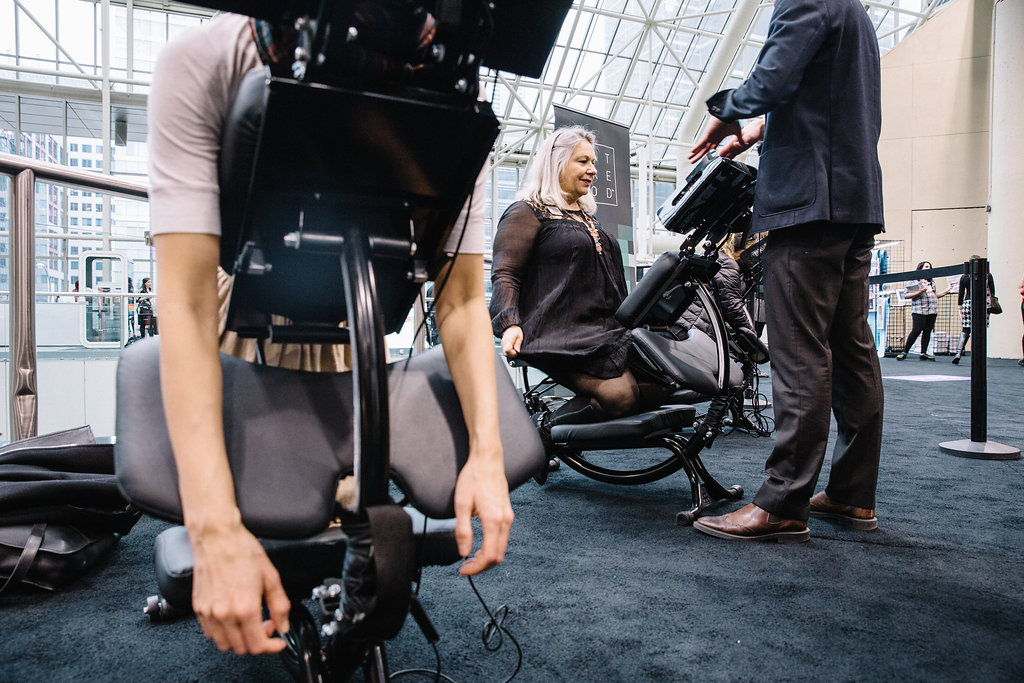
Each unit provides intensive personal exposure to sounds, imagery, and (selectively) smells of various natural environments. The system gently guides the user through its Natural Resonance Imaging® technology, which maps the brain's real time responses to specific stimuli. A helpful Relaxation Status Display appears in the field of view throughout.

Capitalising on the latest findings in environmental neuroscience, the product's Toronto-based creators claim that their patented personal wellness system brings restorative benefits equivalent to, or even greater than, nature in the raw.


At IIDEXCanada, all a new user had to do to get started was adjust the Pod Body to their particular dimensions, and calibrate the Pod Headset's stereoscopic display to their personal IPD (interpupillary distance), before immersing in one of three demo environments: a lush valley mid-summer, snow-covered mountains in winter, or a temperate forest in spring.

Of thousands in attendance at this annual design exhibition and conferences––which included summits on Healthcare, Wellness, and Accessibility in the built environment––many who got to try NaturePod™ first hand were immediately enchanted, and prepared to buy or lease the devices on the spot.

But frankly, reactions were mixed. A few declared their horror at the idea that anyone might try to substitute a new gadget for the experience of forest.

Even so, no one appeared to have any difficulty believing that this was a real product being offered to mitigate the chronic disconnect of modern urban dwellers from the experience of nature.

In fact NaturePod is design fiction––for now.

It's an experiential foresight project in the public interest; a scenario set five years into the future but brought to life today, created by a team of graduate students from OCAD University's Strategic Foresight and Innovation program, and led by me under Situation Lab auspices.

Neither a prediction nor a preference, but a provocation, we wanted to use design and performance to invite consideration of how our relationship to nature in cities is changing, and contribute to a dialogue about potential differences between our current direction, and what we might collectively want.

The people in the video above are responding to a direct experience, not to a hypothetical question.

***

"Powerful critical design does not present itself as critical design. Powerful design fiction does not present itself as fiction."
- Matt Manos

***


***

A few hints about the future setting were planted, including a full-page advertisement in the Show Catalogue announcing the release of the product in Fall 02021, but we were shooting for present-day realism in the encounter. The aim was to let folks come to their own genuine conclusions about the whole idea before the hypothetical status was revealed. The story told in the video has the same structure.

This unusual project grew out of a Time Machine, an Experiential Futures module that I created in 02013 and have taught each semester for the past three years at OCAD University.

That particular run of the Foresight Studio course, just over a year ago, was co-taught with the marvellous Suzanne Stein. One group of our students––Bergur Ebbi Benediktsson, Nourhan Hegazy, Jennifer McDougall, and Prateeksha Singh––spent the semester exploring the futures of humanity's relationship with the environment. When it came to the Time Machine, their response was ingenious; they created a "Nature Deficit Disorder Clinic" from 02040. In this experiential scenario set a generation from today, daily contact with nature is rare. The deficit is both ubiquitous and medicalised. People try to mitigate it with oxygen supplements and exposure to simulated forest, gauging their progress via brain scans.

A top Canadian environmental advocacy organisation, the David Suzuki Foundation, had served as this group's external partner throughout the class, and at their request we re-staged the NDD Clinic on Earth Day 02015 for the Foundation's employees and industry partners. Among the attendees was Canada's head of marketing for Interface, Inc.

Interface is a rather remarkable company. (You might know them from the documentary The Corporation, and especially the influential voice of their late founder Ray Anderson.) They're the world's leading carpet tile manufacturer, and also a global trailblazer in corporate sustainability. By no means is this a typical combination.

They engaged Situation Lab to create an experiential scenario to nudge their customers and others towards a deeper conversation about humanity's changing relationship to nature in the built environment. The same highly talented group of four graduate students came aboard to adapt the original concept for a totally different context: instead of a room-specific, 20-minute immersive installation for a captive audience of 20-30 members, we were to make this experiential scenario available to thousands of people over two full days at one of the largest expositions of its kind in North America.

Now, in the architecture and interior design world, it turns out that there is already lively discussion underway about (E.O. Wilson's term) "biophilia" in a design context, for instance in the 02015 report, Human Spaces: The Global Impact of Biophilic Design in the Workplace.

Biophilia refers to the "instinctive bond between human beings and other living systems"; a bond variously accommodated or cheerfully ignored by present urban and building designs. We designed NaturePod as an experiential contribution to both broaden and deepen the conversation. What are the implications for our wellbeing of trying to close the nature gap using increasingly sophisticated imitations? Where might that lead?

While evidently exercising a degree of creative licence to prototype possibilities from half a decade out, our imaginings were tied to real research. Readers curious about the current science behind these developments in nature simulation and related themes can find plenty of material for further investigation (for example: de Kort et al, 02006; Kahn et al, 02008; Kahn et al, 02009; Kjellgren and Buhrkall, 02010;  Valtchanov, 02010; Valtchanov et al, 02010; Valtchanov and Ellard, 02015).

What I love about the project is that this visionary company took such an unusual step, sponsoring a guerrilla futures intervention to urge industry and public engagement with issues that matter and affect everyone. (To the extent that corporate entities have engaged in experiential futures or speculative design previously, the results have tended toward the shamelessly commercial and trite, as Noah Raford has persuasively argued.)

NaturePod™ comes almost a decade after the first experiments in what we've come to think of as a special strand of publicly-oriented foresight work. Guerrilla futures combines strategic foresight and tactical media to produce unexpected encounters with possible worlds (see FoundFutures, for instance). Injecting possibilities into the present lets us think and feel new potentials, not "merely" hypothetical, in a mode of exploration squarely located where serious investigation meets play. (See Chapter 5 of The Futures of Everyday Life for more.)

This may be a first for corporate use of experiential futures / design fiction in guerrilla mode, and it is our hope that it provides a bracing contribution to design conversation far and wide.

Thanks and bravo to Interface, and to our marvellous design team: Berg, Jennie, Nour, and Prat! Huge thanks to all participants, assistants, volunteers and supporters; full project credits appear beneath the video.


Stills by Connie Tsang.
Videography by Filip Vukcevic.

Related:
> Strategic Foresight meets Tactical Media
> The Futures of Everyday Life
> Guerrilla futures performance at South by Southwest
> FoundFutures: Chinatown

Monday, December 08, 2014

The technology of public imagination


A remarkable short called Wanderers has been going around online in the past week. It's a captivating vision of space exploration, channelling Carl Sagan's cosmic outlook (literally; it's his voiceover) with an aiglatson we seem to find it hard to muster these days.

This you-are-there take on spacefaring – in timely resonance with Christopher Nolan's recently released Interstellar – has rightly earned admirers in various quarters. But what's most exciting to me here is the fact that the piece seems to have been produced by a handful of individuals (one or two dozen at most, to judge from the credits), led by a very talented and determined CG artist, Erik Wernquist.  My point doesn't rest on precisely how many people were involved; it is simply to contrast the resource commitment required for this sort of thing now with what could be done less than a generation ago, say, when Terminator 2 came out (prompting my eleven year-old self to write a letter of appreciation to Industrial Light and Magic). Loosely speaking, the difference is one of orders of magnitude.

Wanderers is a fabulous calling card. It's also part of a significant trend. Let's think for a moment about what it means, this new situation where such things are possible –– photorealistic, far-flung futures, on a shoestring.

Short videos are constantly appearing online (e.g. last year YouTube reported 100 hours of video uploads every minute). These go variously viral, or not, and some proportion of these deal with possible futures, and of those, a few are sufficiently artful to be somehow genuinely curiosity-fuelling, or mind expanding, or alarming, or whatever. Like all successful media, they add their bit to the reservoir of what we can know or imagine together, to "the future as a commons" in Shiv Visvanathan's wonderful phrase. Also, and crucially, such vivid, 1:1-scale contributions to the shared imaginary no longer need to involve hundreds of crew and millions of dollars.

I have in mind for instance Neill Blomkamp's Tetra Vaal clip (02004) about robot peacekeepers, produced years before he was Hollywood-empowered to make District 9: https://www.youtube.com/watch?v=VTnxP7e7-YA I'm also thinking of Bruce Branit's almost entirely CG World Builder (02007): http://vimeo.com/3365942 And this sardonic glimpse of augmented reality gone mad, by Keiichi Matsuda (02010), which has launched a thousand conversations: http://vimeo.com/8569187 Or, in a more modest, geek-culture-tribute way, Mike Horn's (02008) video that puts the Death Star over San Francisco: https://www.youtube.com/watch?v=AfqDVP_0O0c (I'm sure there are dozens –– please feel free to add to the list.)

As I say, these specific images and artifacts are often striking and masterfully made.

Meanwhile, however, there's another story here; a layer up, in the spread of the means and modes of production. The tools are giving stunning new power to diegetic (in-world) storytelling idioms –– artifacts from the future, design fictions, and other experiential futures –– that help us visit these places. Wernquist's imagery is based on actual locations in our solar system. For many viewers, this is the first time we'll have been invited to regard and contemplate these locations as real places one might conceivably visit. This is a remarkable (because until recently, impossible) gift for a group of Swedish geeks to be able to give the online world.

Powerful technologies of public imagination are hitting the street. They are fast infiltrating society's main stream. And as they go, we find ourselves living out a dictum something like McLuhan meeting Polak: "We shape our images of the future, and meanwhile, they shape us."

Related:
> Death of a President
> The Futures of Everyday Life
> Neill Blomkamp, visual futurist
> Death Star Over San Francisco
> In praise of Children of Men
> A History of Experiential Futures