Showing posts with label Long Now. Show all posts

Thursday, October 10, 2019

Teaching The Long Now


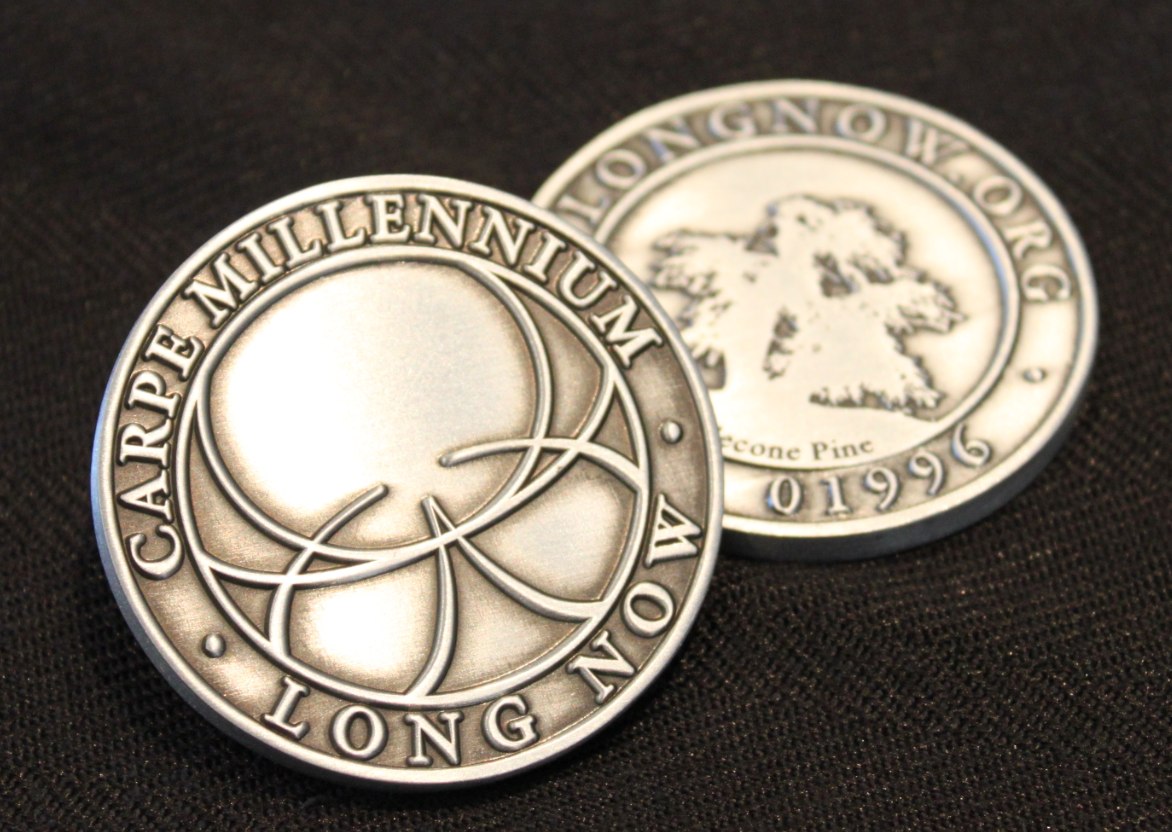
I've been involved with The Long Now Foundation, a nonprofit organisation dedicated to fostering long-term thinking and responsibility, since 02006. Then a year into grad school for futures, I spent a memorable summer at the office in San Francisco, working on various initiatives including Long Bets, as well as a proposal put together with my friend Camron Assadi for something we called Long Shorts; short films about long-term thinking (an idea subsequently adopted at the Foundation as a way of introducing many of its monthly public lectures). I suggested what has since become a Long Now motto, Carpe Millennium. And at the end of that first stint, executive director Alexander Rose invited me to become the Foundation's first Fellow, an association that continued happily over two more summer residencies, and onward through almost a decade and a half to date, spanning many developments in the organisation and its projects, and periodic collaborations.

As it turns out though, this semester, Fall 02019, marks the first chance I've had, after more than ten years of teaching futures, to put together a class on the topic of long-term thinking more broadly. How does it work in different domains? How can we render it accessible and useful? What difference does or should it make to designers? While just a prototype seven-week 'mini', a half-semester course at Carnegie Mellon School of Design, the topic has sparked lots of interest among folks I've discussed it with, so for this post I'm sharing our syllabus (shorn of admin and school policy bits and with links added where possible), in case others may get something out of it.

A few points of context:

• This is my personal and maybe idiosyncratic take on things, rather than an official Long Now Foundation course, but I've made use of some of the rich material the organisation has amassed over the years. For example, we've been using Stewart Brand's version of 'pace layers' (see the diagram below) as a structuring and sequencing heuristic for the curriculum, starting at the longest and slowest register of nature, with a deep time walk spanning the 4.5 billion years of Earth's history, and proceeding upward through the layers of culture, governance and infrastructure, so that by the end we're dealing with the kinds of faster-moving concerns the students are accustomed to thinking about day to day: a lot of design seems to operate on a rapid temporality somewhere near the top. The idea behind this order is to use that exposure to the longer-term early on, to help de-familiarise the familiar short-term, and re-perceive the mundane everyday, by the end.

• I call the classes 'episodes' and the segments within them 'acts', a format idea borrowed from the brilliant long-running public radio series This American Life. Signposting classes this way turns out to make the time easier to plan and pace out, and more legible to students and guests, while also adding a dash of theatricality to typically prosaic matters of course structure and lesson planning. We kick off each episode punctually with a selected 'long short', an intellectual and creative appetiser of sorts, and also partly an encouragement to people to arrive on time, which is helpful when you're scheduled for an 8:30am start in the fall, with days getting shorter and mornings colder. Each week's long short is a surprise beforehand and is added into the syllabus afterwards for reference.

• A monthly series of seminars about long-term thinking (SALT), curated by Brand, has been running since 02003. By this point, the SALT talks represent a large collection of thought-provoking explorations; hundreds of lectures, freely available online, dealing with topics from linguistics and politics to space travel, philosophy and geology. At the start of the course I asked each participant to pick one to add to the syllabus. This touch of curricular co-creation helped tilt the content towards their interests, better than my guesses would, and incorporated deeper involvement by having them run a discussion or activity around their chosen talk. (We have the good fortune in this case to have an intimate class size of eight students, mostly grads, from across the university; some elements would be set up quite differently if the group were much larger.) In case you haven't come across the SALT series before, you might start with the same one that our class did; geologist Marcia Bjornerud's remarkable talk from July this year, Timefulness.

***

The Long Now
Thinking, Storytelling and Designing with Long Timespans

School of Design, Carnegie Mellon University
Instructor: Stuart Candy, Ph.D. (he/him)
Fall 02019 // Fridays 8:30–11:20am
Course no. 51819 // Graduate level // 6 units // Aug 30–Oct 11

Description

“Civilizations with long nows look after things better. In those places you feel a very strong but flexible structure which is built to absorb shocks and in fact incorporate them.” –– Brian Eno

The Long Now is about what becomes possible when we engage with longer timespans. We will deal with experiential scenarios and time-based media to enable new perspectives on the anthropocene and beyond; drawing on diverse sources and views from history and foresight, geology, physics, cosmology, indigenous studies, and design – including the design of legal, political and economic systems. You'll never look at time the same way again.


Pace Layers by Stewart Brand (01999), The Clock of the Long Now, p. 37 | Diagram via.

Approach

This course takes inspiration from the work of the Long Now Foundation, a cultural organisation dedicated to fostering long-term thinking and responsibility, where the instructor, a professional futurist, has been affiliated for many years.

We examine territory seldom covered in other university courses due to the rarity of long-term thought in the wider culture, with the aim of offering intellectually adventurous students from diverse programs a set of interdisciplinary perspectives to challenge, deepen and enrich whatever else they may be doing.

Learning Outcomes

By the end of this course students should be able to:
• See further: Engage with diverse temporalities and patterns of perception at different scales
• Travel more widely: Research, understand and synthesise insights from disparate disciplines
• Be critical: Make the present strange, discerning key ethical, philosophical and cultural dimensions of our era and society
• Be constructive: Use various media to convey and elicit longer-term perspectives

Course Overview and Schedule

Here is an outline of the arc of the course and topics covered week by week.

1. Welcome to the Long Now
2. A Walk Through Deep Time
3. Seven Generations in the Anthropocene
4. Stories and Timespans
5. Design for the Long Run
6. Living in a Material World
7. Creation Crit

There are seven classes in this course, with 3+ weekly reflections, one SALT-based presentation / activity (student selections marked ∆ below), and a final project per student. Guests will be joining us most weeks, from a range of disciplinary and organisational perspectives.

Episode 1: Welcome to the Long Now
Activity: Intro to course
Reading & Media before class: N/A
Long Shorts:
• American Museum of Natural History, Human Population Through Time
• Charles Eames and Ray Eames, Powers of Ten

Episode 2: A Walk Through Deep Time
Class-led presentations begin (25%)
Activity: Field trip –– bring water bottles, comfortable shoes, and a snack
Guest: Professor Mark Baskinger, CMU School of Design & MoonArk
Long Short:
• Chris Stenner, Arvid Uibel and Heidi Wittlinger, Das Rad / The Wheel
Reading & Media (**optional):
• Brand, The Clock of the Long Now [pdf book excerpt]
• Walker, The Art of Noticing [pdf book excerpt]
• Sterling, Pace Layering [pdf chapter]
• Bjornerud, Timefulness ∆ [online audio/video]
• Bjornerud, Timefulness** [pdf book excerpt]

Episode 3: Seven Generations in the Anthropocene
Activity: Field trip –– bring water bottles and comfortable shoes
Guest: Dr. Nicole Heller, Carnegie Museum of Natural History
Long Short:
• Claire L. Evans, The Evolution Of Life in 60 Seconds
Reading & Media:
• Matza & Heller, Anthropocene in a Jar [pdf chapter]
• Nixon, The Anthropocene: The Promise and Pitfalls of an Epochal Idea [pdf chapter]
• Brannen, The Anthropocene is a Joke [online article]
• Davis, The Wayfinders ∆ [online audio/video]
• Pinker, A New Enlightenment ∆ [online audio/video]
Class-led presentations continue

Episode 4: Stories and Timespans
Final assignment launches (25%)
Guests: Acharya Adam Lobel, Point Park University; Michelle King, Learning Instigator
Long Shorts:
• Donolinio Studio, 100 Years in 10 Minutes
• Helixaeon Inc., Helix
Reading & Media:
• brown, Emergent Strategy [pdf book excerpt]
• Haraway, Staying With the Trouble [pdf book excerpt]
• Fallows, Civilization’s Infrastructure ∆ [online audio/video]
• Mahbubani, Has the West Lost It? Can Asia Save It? ∆ [online audio/video]
Activity: Meditations on the long now
Class-led presentations continue

Episode 5: Design for the Long Run
Guest: Professor Jo Guldi, Southern Methodist University, author of The History Manifesto
Long Shorts:
• Schich et al., Charting Culture
• Heal the Bay, The Majestic Plastic Bag
• Önduygu, The History of Philosophy [interactive web tool; explore in your own time]
Reading & Media:
• Brockman et al., Possible Minds ∆ [online audio/video]
• West, Why Cities Keep on Growing, Corporations Always Die, and Life Gets Faster ∆ [online audio/video]
• Guldi, The Designer’s Role [pdf]
• Guldi & Armitage, The History Manifesto [pdf book excerpt]
Activity: Co-creation in class
Class-led presentations continue

Episode 6: Living in a Material World
Guest: Professor Jonathan Chapman, CMU School of Design, author of Emotionally Durable Design
Long Shorts:
• Madsen, Into Eternity (Trailer)
• Kalina, Noah Takes a Photo of Himself Every Day for 12.5 Years
Reading & Media (**optional):
• 99% Invisible, Ten Thousand Years [podcast]
• Sandia National Laboratories, Expert Judgment on Markers to Deter Inadvertent Human Intrusion into the Waste Isolation Pilot Plant** [pdf report]
• Christian, Algorithms to Live By ∆ [online audio/video]
• Chapman, Emotionally Durable Design [podcast]
• Powers, The Overstory [pdf book excerpt]
• Urban, Your Life in Weeks [blog post]
Activity: ‘Mattering’ workshop
Class-led presentations conclude

Episode 7: Creation Crit
Activity: Reviews of final project submissions

A few billion years into deep time with Mark Baskinger | Photo: Stuart Candy

Assessment

25% Participation and engagement in class
25% Presentation and leading discussion
25% Weekly reflections (minimum three required; due the Monday after each class by 5pm)
25% Final project

Selected Bibliography

• Bjornerud, Marcia. (2018). Timefulness: How thinking like a geologist can help save the world. Princeton, NJ: Princeton University Press.
• Borrows, John (Kegedonce). (2010). Drawing out law: A spirit’s guide. Toronto: University of Toronto Press.
• Boulding, Elise. (1990). Building a global civic culture: Education for an interdependent world. Syracuse, NY: Syracuse University Press.
• Brand, Stewart. (1994). How buildings learn: What happens after they’re built. New York: Viking.
• Brand, Stewart. (1999). The clock of the long now: Time and responsibility. New York: Basic Books.
• Brannen, Peter. (2019, August 13). The Anthropocene is a Joke. The Atlantic.
• Brannen, Peter. (2019, October 11). What Made Me Reconsider the Anthropocene. The Atlantic.
• brown, adrienne maree. (2017). Emergent strategy: Shaping change, changing worlds. Chico, CA: AK Press.
• Carse, James. (1986). Finite and infinite games. New York: Free Press.
• Chapman, Jonathan (2015). Emotionally durable design: Objects, experiences and empathy (2nd ed.). London: Routledge.
• Chatwin, Bruce. (1987). The songlines. New York: Viking.
• Collins, Jim and Jerry I. Porras. (1994). Built to last: Successful habits of visionary companies. New York: HarperBusiness.
• Cullinan, Cormac. (2011). Wild law: A manifesto for earth justice (2nd ed). White River Junction, VT: Chelsea Green.
• Delanda, Manuel. (1997). A thousand years of nonlinear history. New York: Zone Books.
• Escobar, Arturo. (2018). Designs for the pluriverse: Radical interdependence, autonomy, and the making of worlds. Durham, NC: Duke University Press.
• Ghosh, Amitav. (2016). The great derangement: Climate change and the unthinkable. Haryana, India: Penguin Books.
• Gleick, James. (1999). Faster: The acceleration of just about everything. New York: Pantheon Books.
• Global Business Network. (2003). Looking Forward To Learn: Future Scenarios For TestingDifferent Approaches To Managing Used Nuclear Fuel In Canada. NWMO Background Papers 8–5. Toronto: Nuclear Waste Management Organization.
• Griffiths, Jay. (1999). Pip pip: A sideways look at time. London: Flamingo.
• Guldi, Jo and David Armitage. (2014). The history manifesto. Cambridge, England: Cambridge University Press.
• Haraway, Donna. (2016). Staying with the trouble: Making kin in the Chthulucene. Durham, NC: Duke University Press.
• Haskins, Caroline. (2019, May 6). AirPods Are a Tragedy. Vice.
• Hora, Stephen C., Detlof von Winterfeldt and Kathleen M. Trauth. (1991). Expert Judgment on Inadvertent Human Intrusion into the Waste Isolation Pilot Plant. Sandia Report SAND 90–3063. Albuquerque, NM: Sandia National Laboratories.
• Johnson, Steven. (2006, October 8). The Long Zoom. New York Times Magazine.
• Kohlstedt, Kurt. (2018, January 26). Beyond Biohazard: Why Danger Symbols Can’t Last Forever. 99% Invisible.
• Krznaric, Roman. (2019, March 19). Why We Need to Reinvent Democracy for the Long-term. BBC.
• Macleod, Joe (2017). Ends: Why we overlook endings for humans, products, services and digital. And why we shouldn’t. Closureexperiences.com.
• Manaugh, Geoff. (2019, April 18). Move Over, San Andreas: There’s an Ominous New Fault in Town. Wired.
• Matza, Tomas and Nicole Heller. (2018). Anthropocene in a jar. In: Gregg Mitman, Marco Armiero, and Robert S. Emmett (eds.). Future remains: A cabinet of curiosities for the anthropocene (pp. 21–28). Chicago: University of Chicago Press.
• Morin, Edgar and Anne Brigitte Kern. (1999). Homeland Earth: A manifesto for the new millennium (trans. Sean M. Kelly and Roger LaPointe). Cresskill, NJ: Hampton Press.
• Morton, Timothy. (2019). You never know how the past will turn out. Journal of Futures Studies, 23(4): 97–100. doi: 10.6531/JFS.201906_23(4).0009
• Nixon, Rob. (2018). The anthropocene: The promise and pitfalls of an epochal idea. In: Gregg Mitman, Marco Armiero, and Robert S. Emmett (eds.). Future remains: A cabinet of curiosities for the anthropocene (pp. 1–18). Chicago: University of Chicago Press.
• Ozeki, Ruth. (2013). A tale for the time being. Edinburgh: Canongate.
• Powers, Richard. (2018). The overstory: A novel. New York: W.W. Norton & Co.
• Rao, Venkatesh. (2011). Tempo: Timing, tactics and strategy in narrative decision-making. Ribbonfarm, Inc.
• Sardar, Ziauddin (ed.). (1999). Rescuing all our futures: The future of futures studies. Westport, CT: Praeger.
• Spier, Fred. (2015) Big history and the future of humanity (2nd ed.). Chichester, England: Wiley Blackwell.
• Stapledon, Olaf. (1930). Last and first men. London: Methuen.
• Stephenson, Neal. (2008). Anathem. New York: William Morrow.
• Sterling, Bruce. (2014). Pace Layers. In: Susan Yelavich & Barbara Adams (eds.). Design as future-making (pp. 214–224). London: Bloomsbury.
• Tabet, Michelle. (2013, January 22). The scale of tomorrow: Architects as agents of change. ArchitectureAU.
• Trauth, Kathleen M., Stephen C. Hora, and Robert V. Guzowski. (1993). Expert Judgment on Markers to Deter Inadvertent Human Intrusion into the Waste Isolation Pilot Plant. Sandia Report SAND 92–1382. Albuquerque, NM: Sandia National Laboratories.
• Walker, Rob. (2019). The art of noticing: 131 ways to spark creativity, find inspiration, and discover joy in the everyday. New York: Alfred A. Knopf.

Some Other Media and Resources

• Long Now Foundation, Seminars About Long-term Thinking (SALT) lecture series (audio and video)
• Godfrey Reggio, Koyaanisqatsi (documentary)
• Jonathan Blow, Braid (video game)
• Randall Munroe, xkcd (webcomic), various timelines
• Ben Robbins, Microscope (tabletop game)
• Lasse Lundin, A Trip Through Time Seen Through The Eyes of a Fir Tree (tabletop game)
• Thomas King, The Truth About Stories. The 2003 CBC Massey Lectures (audio)
• Situation Lab, The Thing From The Future (card game)
• Michael Madsen (dir.), Into Eternity: A Film for the Future (documentary)
• Ainscow, Rae, Woodward et al., Deep Time Walk (app)
• Brian Eno, The Microsoft Sound (composition): original; slowed 4000%; Q&A in SF Chronicle
• Dash Marshall, Very Slow Movie Player (video/design)

***

Much gratitude to my students, to our fabulous guest informants and colleagues, and to the Long Now Foundation for the inspiration.

Do get in touch with any questions, suggestions, or tales of experiments of your own that this may feed into.

Update 11oct19: Added to the bibliography Peter Brannen's piece published in the Atlantic today; revisiting and reconsidering his previous, sceptical discussion of the Anthropocene, maybe the most controversial reading covered in the class.

Related:
> Design is Storytelling (includes a kind of overview of a decade's teaching)
> Bringing Futures to Stanford d.school
> American Futures (SAIC project)
> Future Documentary (SAIC course)
> Guerrilla Futures (OCAD course)
> Adopt-a-vision (OCAD project)
> Killer Imps (RCA visit)
> Future-Jamming 101 (UH Manoa project)
> Some . early . posts .  written . while . at . Long . Now (02006–08)

Monday, April 09, 2012

Future food for thought

Our friends over at Institute for the Future in Palo Alto recently released a report to help people think about possible futures of food for the next decade.


Four Futures of Food serves up a quartet of scenarios plotting out alternative descriptions of how America, as well as the wider world, could be eating in the year 02021. Each is based on a different trajectory that change could describe — Growth, Constraint, Collapse, or Transformation.

In the Growth scenario, 'Consumers can get practically anything they want, whenever they want, and without much concern for cost.'

In Constraint, a food poisoning outbreak triggers massive loss of confidence in internationally traded food and meat, as the global rallying cry becomes "Know your farmer. Eat local. Eat plants."

Collapse is a future in which previously ignored stresses on pollinator bee populations cross a critical threshold to cause widespread crop failure and scarcity.

In Transformation, people embrace lab-grown meats and domestic 3D-food printers which are networked to share recipes. Much as social media and blogging have upended the mediasphere, in this future, food supply chains and restaurants are suddenly reinvented.

The narratives are recounted in just enough detail to help readers see how they could really happen, and further thought is invited by accompanying vignettes of a typical dinner in each world. The plausibility of the Four Futures is further underlined by examples, from the history of food, of each of the four classes of change.

This set of alternative stories about the future describes a wide range of outcomes, yet each clearly grows out of specific seeds of change that can readily be found in the present, if we know how to look.

Overall it is a really interesting, accessible, and usefully provocative piece of work from IFTF, shedding light on a critical subject; the viability and vulnerability of food systems. This appears to be a topic of great public interest and concern, as attested by the works of Eric Schlosser and Michael Pollan, as well as by recent popular documentaries including Food Inc, King Corn, and The Future of Food.

The Long Now has also made a contribution to long-term public thought and discussion around these issues, notably through Jim Richardson’s recent SALT talk 'Heirlooms: Saving Humanity’s 10,000-year Legacy of Food' and Pollan himself on 'Deep Agriculture'.

But I want to take a moment to comment on the story behind the stories that IFTF puts forward in its food futures briefing.

As the report indicates, the framework used for generating these four ‘generic’ or ‘archetypal’ scenarios originated with Jim Dator, a Professor at the University of Hawaii at Manoa. It was brought to IFTF in 02008 by their Technology Horizons director Jake Dunagan, an alumnus of the graduate program in Futures Studies which Dator has run in Hawaii for the past four decades. (I know this from having studied alongside Dunagan and Dator in that same program.)

Through working extensively with student and community groups in the then-embryonic field of futures since the ’60s, Dator’s key insight, which he published in the late 1970s, was that the countless disparate notions about the future could be grouped into these four categories. This made possible a different kind of conversation. From the chaos of incommensurate notions about possibilities emerges a way of characterising both the landscape of future narratives and individual elements in it.

Similarly, devotees of the analysis of storytelling have long realised that although the specific narratives presented in various media are innumerable (plays, books, movies, TV, comics, etc), underpinning that huge set is a very small number of basic plots.

The four futures can be used not only descriptively, but also generatively, Dator realised. Starting from the generic descriptor, such as Transformation, you can creatively 'deduce' specifics of a hypothetical future that tells a Transformation story. That’s not all you need, of course; to craft a premise for the story and details that are suitably thought-provoking, and then to express these compellingly, all are elements of a scenario-producing artform. But what the four futures offer is a valuable starting point for testing our thinking across the widest conceivable array of potential outcomes.

Dator was among the first to develop curriculum around futures studies. Until the early ’70s, there was no such thing as a university program that taught thinking systematically about the ways the world could change. Since that time, a small yet lively and internationally distributed community of futures scholars and practitioners has emerged — although in many ways it has been disconnected from mainstream public discussion of 'the future'.

There’s a profound irony here: a critical starting point for futures thinking is rejection of the artificially siloed way in which university disciplines produce and share knowledge, and yet until recently, the silo of academia itself prevented insights from the field from making their way into the wider culture.

The net result is that even after almost half a century of futures studies, mainstream thinking about the future remains tragically shallow. Perhaps its principal shortcoming is an obsession with prediction (THE singular future), which the field of futures studies has recognised from the outset as a fatal limitation.

Which brings us back to the excellent contribution of the Four Futures report. As the introduction notes, "When imagining the future, we often assume things will keep moving in the direction they have been in the recent past." It goes on to use Dator’s four generic futures to create four radically divergent stories about the future of food, as a basis for encouraging the reader’s further exploration.

Many ways other than this are of course available for generating scenarios (such as the well-known 2×2 matrix developed by Jay Ogilvy and his colleagues at GBN), and many methods other than scenarios for thinking both rigorously and imaginatively about possible futures. The point is that wherever such methods are used engagingly, competently and transparently for a public audience, there is some possibility of collective learning.

The usefulness of mainstreaming methods such as Dator’s archetypal futures is that it moves towards a futurist equivalent of teaching people to fish, rather than feeding them fish already caught -- scenarios mysteriously cooked up somehow behind the scenes.

Thus, both this IFTF report, and its coverage in mainstream journalism (by the always excellent Ariel Schwartz over at Fast Company, for example) can be seen as small but significant signals, not only for the future of food, but for the future of futures. They are small steps in a gradual cultural process of open-sourcing deeper, longer, and wiser thought processes -- or so we may hope.

Originally posted at The Long Now Foundation blog, 27 March 02012.

Related posts:
> Humans have 23 years to go
> The Futurist banquet

Thursday, August 21, 2008

An artifact for the future

Fifty to ninety percent of the world's languages are predicted to disappear in the next century, many with little or no significant documentation.
~Rosetta Project website

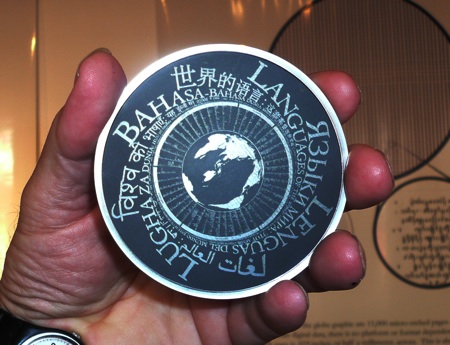
The Long Now's Rosetta Disk | Photo by Kevin Kelly

On Tuesday evening at The Long Now Foundation in San Francisco, we marked a milestone in a project conceived to celebrate and preserve linguistic diversity for the long-term future. It was inspired by the famously trilingual "Rosetta Stone", discovered by Napoleon's troops in 01799 at Rashid (which they referred to as Rosetta) in Egypt, and helped 19th-century linguists decipher hieroglyphic writing.

Kevin Kelly explains:

During a Long Now field trip to a southwest archeological site, the idea of a modern Rosetta Stone came up — a backup of human languages that future generations might cherish. At a winter retreat in 1999 [make that 01999], Long Now board member Doug Carlston [link] suggested that for the parallel common text of this modern Rosetta Stone we should use the book of Genesis, since it was most likely already translated into all languages already. We hatched a plan to produce a 3-inch non-corroding disk which contained at least 1,000 translations of Genesis and other linguistic information about each language.

Following the archiving principle of LOCKS (Lots of Copies Keep ‘em Safe) we would replicate the disk promiscuously and distribute them around the world with built in magnifiers. This project in long term thinking would do two things: it would showcase this new long-term storage technology, and it would give the world a minimal backup of human languages. We thought it might take a year to do.
...
All this took eight years because [at first the] technology could not handle the size of our library, and there was in fact, contrary to our assumptions, no library of already completed Genesis translations. There was no central depository of language information, either. So in order to gather 1,000 translations of Genesis and related linguistic information for those 1,000 language, Long Now created the Rosetta Project. [link]

An earlier version of the disk has since 02004 been hurtling through space on the European Space Agency probe Rosetta, bound for a 02014 rendezvous with a comet where it is to be deposited and will spend the next several hundred million years touring the solar system. The completed Disk unveiled on Tuesday is, however, intended for a terrestrial audience. Kelly:

One side of the disk contains a graphic teaser. The design shows headlines in the eight major languages of the world today spiraling inward in ever-decreasing size till it becomes so small you have trouble reading it, yet the text goes on getting smaller. The sentences announce: "Languages of the World: This is an archive of over 1,500 human languages assembled in the year 02008 C.E. Magnify 1,000 times to find over 13,000 pages of language documentation."
...
The Rosetta disk is not digital. The pages are analog "human-readable" scans of scripts, text, and diagrams. Among the 13,500 scanned pages are 1,500 different language versions of Genesis 1-3, a universal list of the words common for each language, pronunciation guides and so on.

The disk distils and embodies a tremendous amount of effort and dedication on the part of many people. It's a remarkable technical, social and scholarly feat, and a thought-provoking piece of farsighted communication. (The closest parallel that springs to my mind is the 10,000-year nuclear waste warning concepts commissioned by Sandia National Laboratories.) It highlights a facet of futures thinking less frequently addressed (at this blog, at least), which has to do with designing a suitable historical archive (more prosaically, "data storage") for future generations whose specific circumstances are impossible for us to anticipate.

Characteristically for Long Now folks, the wonderful Laura Welcher, director of the Rosetta Project, even while announcing her team's marvellous achievement, keeps looking forward:

So… if the Rosetta Disk is a prototype and facet of the Library of Ages (companion to the 10,000 Year Clock), what goes into the fine print next?

Good question.

Monday, July 28, 2008

Today at Tomorrowland: yesterday's future


Joel Garreau, writing in the Washington Post last weekend, points out the nostalgia of Disneyland's recently unveiled Innoventions Dream Home, which (according to a press release) "invites guests to experience the future today"...

What's interesting about Tomorrowland's newest future is its focus on what doesn't change. This Dream Home future at 360 Tomorrowland Way in Disney's original California park is intentionally reassuring.
[...]
But this is absolutely not the future in the research pipeline. No genetically modified critters here that eat carbon dioxide and poop gasoline. No nanobots smaller than blood cells, cruising our bodies to zap cancer. No brain implants that expand our memory. No cellphones that translate Chinese. No dragonfly-size surveillance bots, no pills that shut off the brain's trigger to sleep, no modified mitochondria sustaining our energy while making obesity as quaint as polio.

Apparently that tsunami of change doesn't sell. That disturbing but dazzling future rumbling our way is distinctly different from the soothing one Disney thinks we crave.

What does this disconnect say about us?
[...]
"Americans feel very little connection to the future anymore," says Danny Hillis.

Hillis is in a singular position to make this statement. He has long been a deity of the computer age, having pioneered massively parallel processing -- now the basis for most advanced computers. Then he was a Disney Fellow, and vice president for research and development at Walt Disney Imagineering. He is now co-chairman of the Long Now Foundation, which fosters long-term thinking and responsibility for the next 10,000 years.
[...]
"What I think it says is that we are nostalgic for a time when we believed in the future. People miss the future. There's a yearning for it. Disney does know what people want. People want to feel some connectedness to the future. The way Disney delivers that is to reach back in time a little bit to the past when they did feel connected.

"It's a bit of a cop-out. There was a time when the future was streamlined jet cars. Rather than create a new sense of the future, they say, 'Ah, remember when we believed that the future was streamlined jet cars?' It's a feeling of connection to the future, rather than connection to the future."

So: one reason for the retro-orientation of Tomorrowland seems to be that the qualities of the futures that now confront us are alienating. A second reason the article suggests is that, against a backdrop of accelerating change, they're just really difficult to imagine.

"It's much harder to astound people today, " says Marty Sklar, the former principal creative executive of Walt Disney Imagineering, who in 2001 was named a "Disney Legend" for his work going all the way back to Walt's era in the '50s. "They see the speed of change all around them."
[...]
Keeping up is a problem. A major Disney attraction has to last a long time to recoup its investment. To be serious about the future in Tomorrowland, one would have to be constantly vigilant for change, lest you wake up one day and whoops, what's that rotary-dial phone doing on the set? That's one of the reasons Orlando's Tomorrowland has dropped back to the last resort: irony. It's inspired by a change-proof 1920s and '30s Buck Rogers-Flash Gordon nostalgia future. Tomorrowland in Paris -- called Discoveryland -- is a tribute to European seers of previous centuries, like Jules Verne. The antidote to rapid change in Hong Kong -- one of the most futuristic cities on Earth -- is for much of Tomorrowland to be set in an intergalactic space port.

~Joel Garreau, "The Future Is So Yesterday", Washington Post, 20 July 02008.

This quandary reminds me of another insightful comment by Danny Hillis, in his 01995 essay "The Millennium Clock" (which called for the ten thousand-year clock now being pursued by The Long Now Foundation):

When I was a kid, three decades ago, the future was a long way off - so was the turn of the millennium. Dates like 1984 and 2001 were comfortably remote. But the funny thing is, that in all these years, the future that people think about has not moved past the millennium. It's as if the future has been shrinking one year, per year, for my entire life.

Nearly a decade after the turn of the millennium, oddly enough, the trend Hillis spotted has continued unabated. It seems that for many, the horizon of the future, incapable of shrinking any further, actually receded into the past. There's been a surge of interest in the way the future used to be, ranging from the scholarly to the satirical: retro-futurism has become a fully-fledged aesthetic genre of the early 21st century. See books like Yesterday's Tomorrows (01996, accompanying a Smithsonian Institution exhibition*), Where's My Jetpack? or Exit to Tomorrow (both 02007). On screen, there's Matt Groening's sharp animated series Futurama (since 01999), and movies like Sky Captain and the World of Tomorrow (02004) or The League of Extraordinary Gentlemen (02003). Indeed, consider the whole literary-genre-cum-subculture of Steampunk which has emerged in the last decade into mainstream consciousness. (Incidentally, the Long Now Foundation's recent event Mechanicrawl taps this aesthetic trend. ) Online, I suspect Matt Novak's excellent blog Paleo-Future -- about "the future that never was" -- pulls in a bigger readership than a lot of current writing about futures that may still have a shot at being realised.

I've written before at t.s.f. about "lost futures", so won't retread that ground here. But clearly, it's not just Disney that is increasingly (whether inadvertently or disingenuously) mining the past in an effort to envisage the future. Ironic, postmodern play with retro-futuristic tropes is well and good. What intrigues and to some extent concerns me is that we seem to have so much difficulty envisaging hopeful futures without immediate recourse to the past -- way back when, we seem to be telling ourselves, such hope was sincere.

Image: Carlos Puma/Washington Post
"In the Innoventions Dream Home, a futuristic device can render designs in 3-D, but it is surrounded by nostalgia: Lionel trains, an ocean liner, vintage books and candles."
[Caption from slideshow accompanying article]

(Thanks to Chris Jones for posting the article to the HRCFS listserv.)

* This is the most recent active version of the website at the Internet Archive, dated 9 February 02006.

Monday, June 09, 2008

The biggest long bet


Big news today at The Long Now Foundation as we join Fortune magazine in announcing the largest "long bet" yet: a million-dollar wager between investment guru Warren Buffett and New York money management firm Protégé Partners LLC. Buffett, a critic of expensive financial services, is betting that the returns of the market over the ten years from 02008 through 02017 (as reflected by the S&P 500, a widely used stock market index containing the stocks of 500 large, publicly held companies) will exceed the payout of the expert hedge fund investors after their fees, costs and expenses are subtracted.

Long Now board member Kevin Kelly elaborates:

Buffett's million dollar bet was made on Long Bets, the accountability mechanism founded in 2002 by Stewart Brand and myself, and operated by Long Now Foundation. The intention of Long Bets is to encourage responsibility in prediction-making (by keeping a public roster of predictions), to encourage long-term thinking (by offering a opportunity to shape a long-term bet), and to sharpen the logic of forecasting (by recording the logic of predictions and bets.)
[...]
The hope of Long Bets is that these public wagers will prompt people to consider the implications of current developments in the near-distant future -- and then to keep their attention on what happens.

Buffett's bet is an ideal Long Bet. It makes a huge difference to anyone who invests in stocks (as do a large percentage of the US, either directly or indirectly) whether a boring index fund yields as much as fancy private hedge funds. The answer either way would be a huge influential signal. When economist Julian Simon won the famous bet against biologist Paul Ehrlich (Simon betting that the long-term prices of commodity minerals would decrease over ten years; Ehrlich betting they would increase), his win essentially eradicated the argument of resource scarcity from the environmental debate. Environmentalists then shifted their concern to the many other issues needed to foster a healthy environment.

This bet has a similar potential. But as in all great bets, its outcome is uncertain.

At stake is not just the money -- all of which goes to charity regardless of who wins. The true currency of Long Bets is reputation, and real-name accountability has been a core principle from day one. As Kelly suggests via the Simon-Ehrlich comparison, if Buffett were to win, not only would the opinions of the folks at Protégé be called into question, but so too would their business model.

Which would, of course, be equally true even if the bet didn't exist: the performance claims of hedge fund managers can, in principle, be tracked and evaluated on whatever timeframe and against whatever criteria one likes, big bet or not. What this bet does is the same thing they all do: it puts a symbolic frame, and specific, tangible stakes, around an existing (or potential) debate, with the specific intention to put it to the test, and to learn from that process in a public way. This fact highlights what Long Bets is really all about. In a sense, everyone makes hundreds of bets per day: in an uncertain world, everything we do, or don't do, is loaded with some degree of risk. These bettors, along with many investors like them (and by extension, millions of others on whose behalf they act) have billions of dollars riding on their decisions already. However, putting a frame around this aspect of their effort creates a focus for discussion. It's a tool for directing attention in a particular way, and fuel for the type of conversation that we ought to be having more often.

What else is long-term thinking but the cultivation of an underdeveloped mode of attention?

I've been working with Long Now, and especially Long Bets, since 02006, and am delighted to see an unprecedented big bet draw attention to a worthy forum. Also, as concerned as I may be about the long-term fate of the hedge fund manager, I'm particularly looking forward to seeing what other -- perhaps even more momentous -- issues may follow this into the limelight.

(Here's the Fortune article, and the bet.)

Wednesday, December 05, 2007

Further long views


Long Views, the blog of the Long Now Foundation, tracks news, art and ideas related to large-scale and long-term thought and action. As Research Fellow of the Foundation I contribute occasionally, and am grateful for feedback as well as leads to interesting stories in this vein.

My recent posts:

Other regular contributors include Alexander Rose, Kevin Kelly, and Stewart Brand.

There is some worthwhile reading here for anyone concerned not only with cultivating the forward (futures) view, but with developing sensitivity to our macrohistorical context, the "long now" -- an antidote to the short now in which we otherwise tend to become trapped.

Wednesday, July 25, 2007

So long, for now

Today is my last day at the Long Now Foundation office for this summer. I'll be back in Honolulu at the Hawaii Research Center for Futures Studies within a week, and continuing to work on renovating Long Bets from a distance, and writing for Long Views, while gearing up for PhD dissertation territory (here be dragons) in the Manoa futures program.

My most recent Long Now blog contributions (since those linked earlier):
Art in geological time (24 July)
The watch of the long now (19 July)
Thinking long, building big (11 July)

Many, many thanks to Alexander, Danielle, Ben, the recently departed office manager Simone (not dead, just pining) and other Long Nowers who welcomed me back to the Bay Area in general, and the Fort Mason office in particular, allowing me -- again! -- the best seat in the house (view of the Golden Gate bridge etc). It's been a pleasure. This stint began a month ago , just as Long Now was in the throes of setting up Brian Eno's 77 million paintings: tranquil to experience, but tumultuous to organise -- congratulations again to all concerned. Not unexpectedly, things have remained busy, interesting and enlightening here throughout my stay. I look forward to seeing you all again soon!

Also today, in the general spirit of creative destruction, we bid farewell to the remarkably beige design of the sceptical futuryst which has served for more than a year. Out with the old:


...and in with the new:


Some of the basic features hitherto lacking (a blogroll, links to a representative selection of archival posts, and a tag list) now appear in the sidebar at right. Plus I think this colour scheme is a little bit easier to read. Of course, feedback and suggestions are always welcome.

Monday, July 09, 2007

The Blog of the Long Now

I've recently started contributing to Long Views, the Long Now Foundation's weblog about long term thinking, art, and ideas. There you can find Stewart Brand's excellent summaries of the monthly Seminars About Long-Term Thinking, as well as other news and insights from what may the only organisation in the world specifically dedicated to fostering long-term responsibility.

My first few posts:
The Long You (3 July)
"The Iraq Gamble" (4 July)
Catastrophe a good bet? (6 July)
Slow Art (9 July)

Like the above, future posts from me are likely to revolve mainly around the Long Bets project (my current focus as Research Fellow at Long Now), and media, notably Long Shorts -- films exemplifying long-term thinking or a longer perspective.

Monday, July 31, 2006

If they buy in, are you selling out?

While at The Long Now, I had an interesting conversation with one of my colleagues there about the curious nature of the organisation's mission, which is to encourage long-term thinking and responsibility. There aren't too many places with such a bold, and yet abstract underlying goal. The long and the short of it was, we agreed, that we were ultimately in the business of marketing a way of thinking -- about time, change, history, responsibility, and other things.

Now, consider the conventional understanding of what marketing is and does. It tends to begin with a product (a dish soap, a pair of jeans, a drink, a make of car...) and the marketing aim for the company producing it is to figure out a strategy for associating a way of thinking, behaving, looking and so on, which taps into what people want, so they'll decide to buy the product as a result of their attraction to the associated image. This much is basic, even trite knowledge, in that field.

But what happens when you invert or reverse that process? When you start with a desire to promote a way of thinking, rather than a physical product? This is the situation at The Long Now Foundation (re. long-term thinking) and certainly, at the Hawaii Research Center for Futures Studies, we have a similar aim (re. pluralistic, alternative futures thinking). Here the challenge might be seen as how to embody that thinking in a product, how to make it tangible or real to people, how to give them something to buy, touch, do, experience -- which both expresses and elicits that kind of thinking. This is what the Clock of the Long Now does (as an article in today's San Francisco Chronicle explains). This is also what, in a sense, what we've been doing at HRCFS through our efforts to develop experiential scenarios -- watch this space for more on that -- and futures audio tours; trying to make futures thinking compelling to people, with something they can really get their teeth into. Concretising an abstraction, if you will, rather than abstracting from the concrete; or inventing a product to promote a message, instead of the other way around.

Now, in today's New York Times Magazine, there was an interesting article entitled "The Brand Underground", by Rob Walker, focusing on the current phenomenon of sometimes highly profitable and prestigious microbrands, typically founded by trendsetting twentysomethings who regard themselves as anti-corporate, even while embracing the practice of making and selling products (notably, but not exclusively, clever t-shirts).

These enterprises can be seen as Internet-commerce-era answers to the question, phrased by Walker: "How do I turn my lifestyle into a business?" Which we could easily paraphrase as, "How can I make a living doing what I care about?" or "How can a live a life in harmony with my values?" A central question for anyone who cares to examine the life they lead.

Some quotes from the article:

One reason an underground brand sounds nonsensical is that countercultures are supposed to oppose the mainstream, and nothing is more mainstream than consumerism. But we no longer live in a world of the Mainstream and the Counterculture. We live in a world of multiple mainstreams and countless counter-, sub- and counter-sub-cultures.

[M]ost of us think of branding as a thoroughly mainstream practice: huge companies buying advertising time during the Super Bowl to shout their trademarked names at us is pretty much the opposite of authentic or edgy expression. But branding is more complicated than that. It is really a process of attaching an idea to a product. Decades ago that idea might have been strictly utilitarian: trustworthy, effective, a bargain. Over time, the ideas attached to products have become more elaborate, ambitious and even emotional. This is why, for example, current branding campaigns for beer or fast food often seem to be making some sort of statement about the nature of contemporary manhood. If a product is successfully tied to an idea, branding persuades people — consciously or not — to consume the idea by consuming the product. Even companies like Apple and Nike, while celebrated for the tangible attributes of their products, work hard to associate themselves with abstract notions of nonconformity or achievement. A potent brand becomes a form of identity in shorthand.

Of course, companies don't go into business in order to express a particular worldview and then gin up a product to make their point. Corporate branding is a function of the profit motive.

Many of [the microbranders] clearly see what they are doing as not only noncorporate but also somehow anticorporate: making statements against the materialistic mainstream — but doing it with different forms of materialism. In other words, they see products and brands as viable forms of creative expression.

For them, there is something fully legitimate about taking the traditional sense of branding and reversing it: instead of dreaming up ideas to attach to products, they are starting with ideas and then dreaming up the products to express them.

Perhaps the first lesson of the brand underground is not that savvy young people will stop buying symbols of rebellion. It is that they have figured out that they can sell those symbols, too.

This is the quintessence of the postmodern brand rebel, hopscotching the minefield of creativity and commerce, recognizing the categorization, satirizing it, embracing it and commoditizing it all at once.

When [one such entrepreneur] declares that his project is part of a "revolution against branding," what he really means is not the snuffing out of commercial expression but an elevation of it.

Even in a world where the mainstream is less than monolithic, every subculture sooner or later has to reconcile itself with the larger cultural forces around it.


The author dwells on the apparent paradox of advancing a counterculture, or at any rate a self-consciously mainstream-rejecting subculture, through so thoroughly a conventional avenue as branding. And he makes a good point, for there is surely there a risk of compromising certain values the business ostensibly intends to represent. (That's got to be a risk, if you happen to regard corporate identity-building, and particularly, the commodification of dissent, as problems.)

And frankly, I'm not particularly interested in or compelled by the worldviews of a bunch of t-shirt jockeys. Although some of them may have really deep messages to convey, my feeling is that were he alive today, strangely enough the t-shirt might not have been Voltaire's chosen medium. The bigger question resonating beneath all this is, for me, where ought any serious challenger of the prevailing paradigm to begin -- completely outside the box, and let the box come to you; or is it better to work for your hoped-for changes from within the existing framework, using its structures, living on its dime? Here's a fundamental dilemma for anyone interested in promoting social change, or even thought about social change. Do you try to beat them outright, or do you join them, in the hope of beating them from the inside? To use the tools of a morally bankrupt money-driven corporate culture to comment subversively on that culture; is that knowingly postmodern ironic genius, or just selling out?

Depends on what you're trying to challenge, of course. But it's a basic dilemma if you're interested in having people entertain the possibility of deeper, longer stories of the future that go beyond corporate and capitalistic models concordant with prevailing assumptions and social arrangements. You don't have to have a single-minded prior ideological commitment to bringing down the system no matter what (I don't) in order to see the tremendous value in being capable of perceiving its dimensions and tendencies, and questioning its longevity, usefulness, and ultimate worth (I do). But who will pay you to think about problems, or solutions to problems, that don't yet exist, and might never exist? Who will pay today for you to entertain doubts about the "hard realities" of nation states, corporations, and other well established interests?

Such are the bigger questions about the commercial viability of "critical futures" that I've struggled with, and that this article touched off in my mind. For to speak of the commercial viability of an idea, is another way of talking about whether you can survive while living out its values.

A good friend of mine insists that money is the best measure of someone's commitment to something. Words are cheap, he would say, but when a person pays for something -- ah, you know they really value it, you find out what it's worth to them. His reasoning in this area leads him to the conclusion that an enterprise that can't turn a profit is, by definition, not valuable, not worthwhile.

I have a problem with that. It seems to me that the "messages" of foresight and long-term thinking being "marketed", so to speak, by organisations such as The Long Now Foundation and the Hawaii Research Center for Futures Studies, are something like the advice of a wise older relative to a headstrong teen. It may not be seen as useful (may in fact be largely perceived as irritating and irrelevant) at the time, and might take a while to sink in; but eventually its value will become apparent. The fact that long-term or divergent futures thinking is not universally recognised as useful right now does not preclude it from planting seeds that may germinate and bear fruit in due course.

(Incidentally, I would have liked to make the above point without the patronising tone suggested by this old-young analogy; but I can't. I think a culture, corporate or otherwise, that rejects foresight, is actually immature, and will probably have to learn the hard way that the assumptions propping up its current interests and successes are not set in stone.)

Meanwhile, we continue to search for ways to embody and concretise those messages, and to make the long-term value we're betting on, capable of being appreciated, and thus acted upon, and to some modest extent rewarded, today. Wisdom has probably always been a tough sell, but it's no less valuable because of that.

Monday, July 17, 2006

Time too short at Long Now

Today is my last day in San Francisco. After two and a half months of life in the Bay Area, on summer break from the University of Hawaii at Manoa, I'm flying back to Honolulu this afternoon, to prepare for the "Hawaii 2050" event we're planning for next month, and to resume my studies of alternative futures.

I have immensely enjoyed working with the Long Now Foundation, which during the short time I've been here has somehow turned a musty warehouse into a gleaming public exhibition space at Fort Mason; staged a group visit to the intended 10,000-year Clock site in the desert in Nevada; and hosted no fewer than three intriguing Seminars About Long-term Thinking (Chris Anderson & Will Hearst, Will Wright & Brian Eno, and, last Friday, John Rendon). Working on renovating Long Bets has been an educational and stimulating experience, and encouragingly, looks likely to bear fruit, in the form of an improved, deeper and more subtle design, before long. There are some other interesting projects in the pipeline which shall make an appearance here as their time comes. That mountain in Nevada has an uncanny track record of eliciting big ideas from visitors.

It has also been a very great pleasure to work, and socialise, with the exceptional Long Now posse led by Alexander Rose: Ben Keating, Chas Warner, Laura Buszard-Welcher, JD Ross Leahy, Simone Davalos, and others who have favoured the office with their presence from time to time. Presenting to the Board of LNF in mid-June was one of the very few official agenda-driven meetings that I have ever actually enjoyed. Their energy, alertness to connections, and quickness to alight on and explore new ideas was stunning. Some of the Board members I met in other settings, but they struck me in the same way. I look forward to interacting with these remarkable people again.

And so, while I'll continue to be involved with Long Now's work, and contribute from a distance across the Pacific, it's with mixed feelings that I leave these fine people to their 10,000-year devices. I'll be back to San Francisco at the first opportunity.

Meanwhile, thanks to all who made this the exceptional experience it has been, professionally as well as personally -- you know who you are.

Carpe Millennium, my friends.

Tuesday, June 27, 2006

Prediction will eat itself

Since early May, I have been working with the Long Now Foundation, a nonprofit organisation dedicated to encouraging long-term thinking and responsibility, as research fellow on the Long Bets project. Long Bets is based on an ingenious, simple idea. If people want to make predictions about matters of long-term social or scientific importance, let them put their money where their mouth is. Stakes placed on bets, involving two contrary views of the future running head to head, are held in a long term investment fund, and when the matter is settled, perhaps years, decades or more down the track, the money goes to the winner's chosen charity. Money is also put up in support of predictions (one person's statement about the future, no opposing view necessary), which goes towards maintaining the service. The point is that all this behooves participants to think carefully about how posterity will judge their prognostications, and their audience benefits from the availability of relatively well thought-out, succinct supporting arguments.

Four years after the project was launched, the key to what I've been trying to do at Long Now recently is to take what is clearly a long-standing human interest in prophecy -- call it a predilection for prediction -- and leverage it into a more complex and nuanced appreciation of multiple possibilities. (Hence my preferred title for the field I'm in: futures. The "s" is for plurality, multiplicity, unpredictability. This condition is what makes choice possible.) Why would I want to do a thing like that? Because I believe prediction, without more, to be an inherently limited, and often erroneous, if not dangerous, stance towards the future.

A London Financial Times article (subscription required) was sent around at Long Now by Board of Directors member Peter Schwartz last week, on a recent book called Expert Political Judgment. Author Philip Tetlock is a psychologist "who has spent 20 years asking pundits to predict who will win elections, what countries will acquire nuclear weapons or enter the European Union and how the first Gulf war would end. He has tested 30,000 predictions from 300 experts against outcomes. Mr Tetlock finds that his respondents are not very good. They do better than a chimp who answers at random, but not much, and worse than simple forecasting rules based on extrapolation" (John Kay, "The world needs more foxes and fewer hedgehogs", Financial Times, 20 June 02006; see also this excellent review of Tetlock's book by Louis Menand, "Everybody's an Expert", The New Yorker, 5 December 02005).

For those who expect the future to be predictable, assuming that in principle it can be known but that they simply don't quite have the expertise, tools or funding to get at it, this conclusion may come as a surprise. GBN's Jay Ogilvy has made the point well: "modern planners have often assumed that, with enough Enlightenment science in the budget, the future can be predicted and/or controlled. Scenario planning is based on a contrary assumption, that the future cannot be predicted..." (Creating Better Futures, 02002, p. 12). And it's not just "modern planners" who hold this mistaken view; in my experience it's far more widespread than that. Yet, for many of the things that are most important to us -- social, human-level things like our families, communities, workplaces, and countries -- the future is in principle and by definition unpredictable; partly because the predictions themselves feed into the change process.

Tetlock's findings, which indicate that even experts aren't much good at prediction -- that those who ostensibly know the future best, in fact know no more than the rest of us -- are, however, very much in accord with one of the main lessons taught by a long-time academic futurist, Professor Jim Dator at the Hawaii futures program, where I study. Dator's First Law of the Future is, "The future" cannot be "predicted" because "the future" does not exist.

Now, if you're convinced that the future is predictable, you're not going to change your mind here (...I, er, expect). Fine. But stay with me for a moment. Assuming for the sake of argument the basic contention here is sound, what would this mean for Long Bets, and predictive discourse generally? Based on many, many conversations I've had on this point, at this stage quite a few people start to wonder what the hell is going on with a self-proclaimed futurist who believes there's no future to study. As well they may. What we look at, since the future itself is perpetually unavailable for comment, is images of the future. These are the beliefs, hopes, fears, desires, intentions, fantasies, expectations and, yes, actual images of one sort or another, that people carry around in their heads, and express in their art, stories, and above all their decisions; thereby bringing "the future" into being from among the countless possible futures that might have been. Returning to the question above, what this means for predictive discourse is that predictions can make a useful, interesting point of access into futures-oriented discussion (constituting, as they do, a major example of images of the future, albeit a conspicuously overconfident variety). It also means that predictions should not be mistaken for statements of fact about things that have not happened yet. Simply put, what people predict is a useful guide to what they believe and how they plan to act, but one of the dangers of prediction is that, while you're arguing over what the future will be, you're missing the more important discussion about what it could be, and other people may be making the crucial decisions without you.

What this means for Long Bets, as I see it, is that there's an important challenge in diverting some proportion of the prodigious amount of energy that people seem to devote to figuring out what the future "will be", and redirecting it into the exploration, invention and pursuit of what they would like it to be. Dator again: "The point is not to try to predict a better future, but to strive to create one." Similarly, sci-fi writer Bruce Sterling once said in an interview, "Future is not a noun, it's a verb." Long Bets version 2.0 should, then, be a useful broad-based resource featuring all sorts of different images (predictive expectations) of the future, which at first exploits the apparently timeless allure of "the future will be thus and so", but which deepens the discussion unexpectedly and problematises the predictive stance. People may come expecting a noun, but will end up getting verbed.

Sunday, June 04, 2006

Wikipedia and the questionable wisdom of crowds

The aggregation of individual opinions, and the collectivisation of many small efforts, is a massive lever for -- and site of -- social change to which our culture is just now awakening, thanks to the evolving affordances of ICT. Wikipedia is the highest profile example at the moment. Its founder, Jimmy Wales, recently provided a very interesting take on this for the Long Now Foundation's Seminars about Long-term Thinking.

Now, in Chicago on 7 June there is a Summit about Prediction Markets -- another testing ground for the principles of collective wisdom (see this example run by the World Economic Forum). The Summit organisers have been distributing some interesting reading matter to delegates via a Prediction Markets google group.

Virtual reality doyen and film director Jaron Lanier's Edge.org article Digital Maoism: The Hazards of the New Online Collectivism, argues that the "hive mind" of the collective works exceedingly well for some things, and very poorly for others, but that the current fad for "wikitopian" thinking overlooks or denies the latter. Among the adverse consequences of what Lanier describes as "inappropriate uses of the collective" are compromises on the quality of information (both the content and how it's expressed), and a culture of avoiding individual responsibility. Whether or not you're inclined to agree, it's a very well written and thought-provoking article.

And either way, it's also helpful to develop a vocabulary for the huge amount of activity going on in this area. A possibly useful new term in this connection is "Crowdsourcing" -- Wired magazine's coined buzzword alluding to the latest examples of the ancient idea that many hands make light work. Could there be a more appropriate way to learn more than through this this Wikipedia article?