Showing posts with label Carnegie Mellon. Show all posts

Tuesday, April 06, 2021

Exploring Technology Governance Futures with the World Economic Forum

A snapshot from the Influence 2035 experiential scenario

This week, the World Economic Forum is hosting its first ever Global Technology Governance Summit (GTGS), convening some 3000 leading technologists, academics, businesspeople, policymakers and political representatives to discuss the sprawling array of fast-moving challenges in this space.

From privacy breach scandals to the Trumpian rise of batshit-crazy conspiracy thinking, the chaotic gaming of stock prices, to misinformation-fuelled mob lynchings, and the weaponisation of online platforms for campaigns of xenophobia or personal vengeance (the latter was the subject of today's feature story on the New York Times Daily podcast)... These are just some recent examples that spring to mind. The pattern is the point. Countless spot-fires, zoomed out, start to look more like a full-blown conflagration.

Anyone who has paid even the scantest attention to such developments might discern a phenomenon also noted long ago by a founding figure both in speculative fiction and in the futures/foresight field*, H.G. Wells, in a BBC radio broadcast from 01932:

“All these new things, these new inventions and new powers, come crowding along; every one is fraught with consequences, and yet it is only after something has hit us hard that we set about dealing with it.”

To shift from a reactive stance to a more proactive or anticipatory one requires changes that are not just political or institutional in nature, but cultural and psychological as well. This is no less true in relation to technology governance than any other topic. As Wells was arguing almost a century ago, collective forethought is essential –– but broadly, it is not a habit we seem to have cultivated with much care or success.

The GTGS event gets underway today, technically hosted from Japan, but taking place entirely online, thanks again of course to the continuing Covid pandemic.

As it does so, a group of graduate designers in our Experiential Futures (XF) class at Carnegie Mellon University have just launched a special set of digital experiential scenarios –– websites and media from the futures to shed light and open up horizons of the topic to explore.

Each site created by XF participants offers a playful rabbit-hole delving into how the world could look decades from now –– in the 02030s, 40s or 50s –– and a provocatively high-resolution glimpse of how some key issues in technology governance might play out.

The usual caveat bears repeating: experiential scenarios should not, unless they are actually offered as such, be treated as predictions or preferences, but instead approached as possibilities to think and feel with. What new questions, potentials, or vantage points can they help us consider?

The storylines and themes contained in these particular projects all build on and respond to the Technology Futures report published yesterday by the World Economic Forum and Deloitte, which was shared with us in draft last month.

***

Tech Tea
Tech Tea, a podcast hosted by AI-wrangler Willow and dark web journalist Melanin, focuses on the darker side of the metaverse. Join them as they dive into the recent controversy surrounding powerhouse Global Virtual School.

This podcast from the year 2050 expands on Maiah’s story from the education LEnS of the Technology Futures report.

by Alice Chen, Karen Escarcha, Amrita Khoshoo & Hannah Kim

Influence 2035
Influence 2035 is an event bringing together panelists to discuss the gig landscape. Join us for candid stories from full-time content creators to data providers and robot admins. Click “Attending” on our event to learn more.

This project explores the extreme trends of gig-economy and influencer work appearing in the story of Maple featured in the Technology Futures report.

by Jianzhe Gu, Sanika Sahasrabuddhe & Catherine Yochum

After-Math
After-Math is a global consultancy committed to helping individuals, teams, and organizations regain independence from virtual influence and data-toxicity in order to rediscover the world around us.

This website for a speculative consultancy in the 2040s synthesizes trends, personas, and artifacts from all four scenarios in the Technology Futures report.

by Adam Cowart & Russell Singer

Wikipolicy
Wikipolicy is the policy arm of Wikimedia. Our 2032 Year-in-Review Report shows how we manage accountability, transparency, and logics of care in algorithmic and participatory policymaking advancements.

Seeking to right past wrongs, in this future Wikipolicy is headed by Frank, a former technology executive and character featured in the Technology Futures report.

by Rachel Arredondo, Kylon Chiang, Esther Kang & Jack McClain

Outliers Data Talent
Every company is a data company. Outliers Data Talent connects yours with the data providers you need, from providers of biometrics to location history and more. Top providers are booking fast, so reserve your data talent today.

This hypothetical agency builds on the story of Maple / information LEnS scenario, where job-seekers provide a vast array of personal data around the clock to interested companies in exchange for pay.

by M Kuznetsov, Alex Polzin & Maddy Sides

***

Well done indeed to all these Experiential Futures students! Many thanks to the World Economic Forum's Ruth Hickin (Strategy Lead, Centre for the Fourth Industrial Revolution) for the opportunity to contribute to the conversation in this way. Finally, much appreciation to our recent guest respondents, Michelle King, Leah Zaidi and Jake Dunagan, for incisive and sensitive pre-launch project feedback. 

We hope these digital experiential scenarios will be of interest and value both to event attendees, and to many others invested in these important topics. If you find them useful, whether individually or as a set, please feel free to share.

***

Update 06apr21: I had mistakenly recalled the number of event participants as being around 1000; the Forum tells me that the correct number is closer to 3000.

* This is the same broadcast popularised by futurist Richard Slaughter as Wanted! Professors of Foresight.

Wednesday, September 30, 2020

Theatre in Pandemic

"Historically, pandemics have forced humans to break with the past and imagine their world anew. This one is no different. It is a portal, a gateway between one world and the next." — Arundhati Roy

***

A group of Theatre in Pandemic participants test out a new streaming platform


This summer, together with my colleague Nica Ross from Carnegie Mellon's School of Drama, we staged an experimental research course called Theatre in Pandemic.

It took place against the backdrop of not only the COVID-19 crisis but also a national and global effort to confront police violence and structural racism.

Both call for radically different approaches to theatre, but seem to pull in different directions. The former made working in the same physical space impossible. The second demanded heightened attention to questions of power and consent; the terms of co-creation between artists as well as the terms of encounter between artists and their publics. In other words, one set of conditions militated against building the strong connections and trusting relationships that are central to theatrical art-making, while the other brought the importance of those same connections and relationships into the sharpest possible focus.

The result of our grappling with that challenging contradiction was one of the most experimental and exciting classes I've ever taught.

The syllabus started as a skeleton that we deliberately left under-specified so as to enable adaptation and emergence in the fleshing out. It included Fluxus scores, online larp, ritual design, transmedia ideation, critical examinations of media and their enabling constraints, and a whole lot of play.

That is, we put aside the temptations (and hazards) of trying to replicate on Zoom any kind of theatre as we knew it before. Instead, we set out in search of new possibilities through experimentation and games, resulting in a set of design briefs and performances for a pandemic-prompted "playable theatre".

An outline of our six half-day sessions or 'episodes' perhaps gives a sense of the arc.

Episode 1: This is Theatre Now
• In-Class Action: Pass Around a Shared Object
• Weeklong Action: Create a Score

Episode 2: Building Worlds Together
• In-Class Action: Play a Live Action Roleplaying Game
• Weeklong Action: Design a Ritual

Episode 3: Mediums and Media
• In-class Action: Research and Experiment with online tech/art projects
• Weeklong Action: 60 Second Play

Episode 4: A Play and a Project
• In-Class Action: The Thing From The Future
• Project Launch: The Final Action

Episode 5: Studio Time

Episode 6: Final Action

Gratifyingly, and as hoped, the three projects produced by our dozen participants were wildly different from one another.

Queerantine 2020 by Lyam Gabel, Lenora Gant, and Petra Floyd
A user-navigated web-based archive with mixed media content, both contextualising and telling the story of a triad of people trying to navigate the criminal justice system, queerness, academia, and life in a pandemic.


PBC by Zeja Copes, Sean Leo, Maggie McGrann, and Carey Xu
A live-streaming, 360-degree cut-up play incorporating the words of James Baldwin, Michelle Tea, Hua Chunying, and CNN to create a conversation at the intersection of diverse lives, conflict and care.


S.99520 by Davine Byon, Major Curda, Rachel Kolb, and Cynthia Xu
An online larp (or live action online game, aka ‘laog’) in which United States Senators and industry lobbyists persuade, bribe and cajole each other in the closing minutes before the crucial vote on the Bill for the Green New Deal. Hosted on the web-based virtual space and conferencing platform gather.town that stylistically emulates an 8-bit video game, the participants navigate their way around the game space to find each other, activate video chat, and engage in high-stakes negotiations.


Thanks in part to the interest that folks showed in what we were doing when I tweeted about the course a few months ago, we've open-sourced the Theatre in Pandemic syllabus, complete with all reading and media resources, in-class and weekly 'actions' or assignments, plus additional links and commentary, as well as a demo reel of the participants' efforts (see below).

My experiential futures practice and classes have for many years drawn on theatrical modes, including immersive theatre, live action roleplaying, and guerrilla performance –– and as it happens my first ever pay cheques, at 13, came from being in a professional production of an Andrew Lloyd Webber musical. But this was the first chance I've had to collaborate with the School of Drama. It was a blast.

Our hope is that others might find some leads or inspiration in these documents of our struggle to connect, co-create, and reimagine collaborative art in a very challenging time.

Meanwhile, much gratitude to Nica and to all our participants.


Related:
> Theatre in Pandemic: An Experimental Syllabus at Medium
> Impacting the Social [pdf]: A conversation with Candy Chang and Bryan Boyer
> The Time Machine [pdf]: Immersive futures assignment brief
> Experiential Futures: Stepping into OCADU's Time Machine [pdf]
> Designing for Emergence / Why Christchurch Should Not Plan for the Future [pdf]
> The Long Now course at CMU
> Future Documentary course at SAIC
> American Futures course at SAIC
> Adopt-a-Vision / Experiential Futures at OCAD
> The Futures School at NUS [video]
> Strategic Foresight course at CCA
> Intro to Politics course incl. Guerrilla Futures at UH
> In Memoriam / Guerrilla Futures intervention at SXSW
> Design is Storytelling
> When Reality Outruns Imagination
> Immersive scenarios for Hawaii 02050 in 02006 and revisited a decade later

Thursday, October 10, 2019

Teaching The Long Now


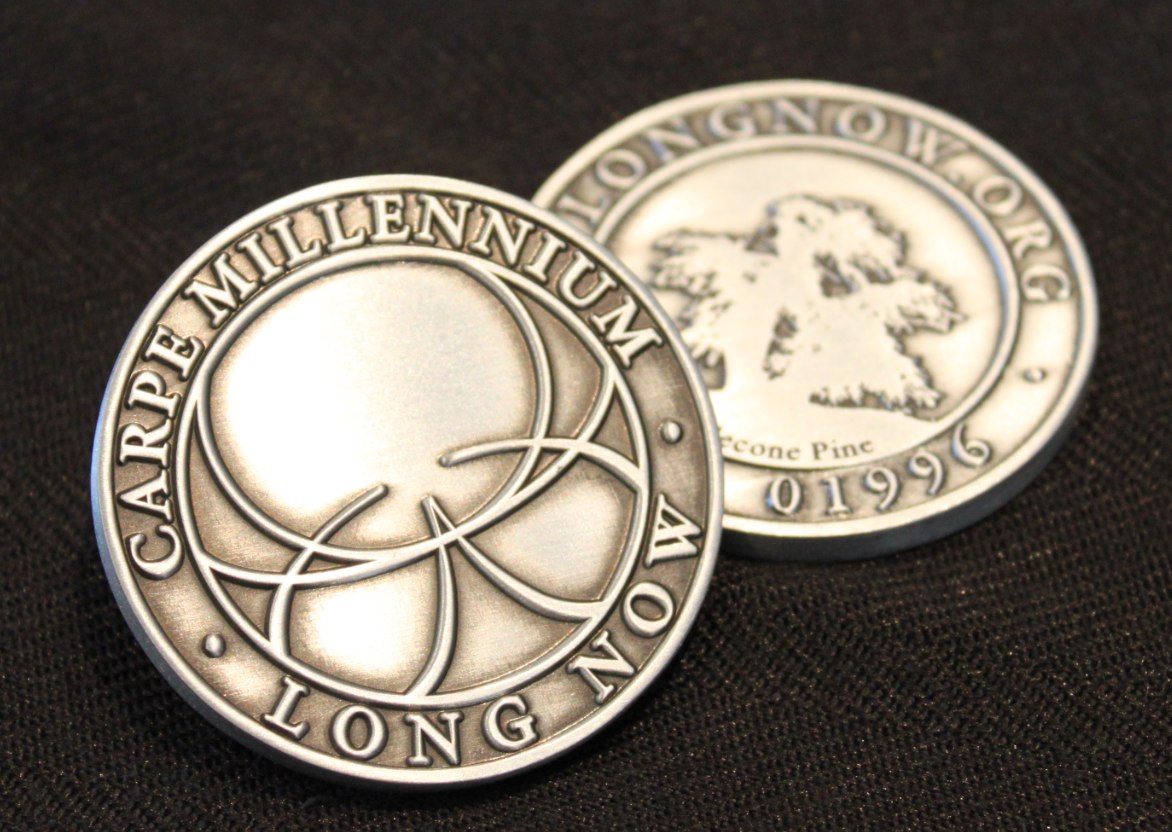
I've been involved with The Long Now Foundation, a nonprofit organisation dedicated to fostering long-term thinking and responsibility, since 02006. Then a year into grad school for futures, I spent a memorable summer at the office in San Francisco, working on various initiatives including Long Bets, as well as a proposal put together with my friend Camron Assadi for something we called Long Shorts; short films about long-term thinking (an idea subsequently adopted at the Foundation as a way of introducing many of its monthly public lectures). I suggested what has since become a Long Now motto, Carpe Millennium. And at the end of that first stint, executive director Alexander Rose invited me to become the Foundation's first Fellow, an association that continued happily over two more summer residencies, and onward through almost a decade and a half to date, spanning many developments in the organisation and its projects, and periodic collaborations.

As it turns out though, this semester, Fall 02019, marks the first chance I've had, after more than ten years of teaching futures, to put together a class on the topic of long-term thinking more broadly. How does it work in different domains? How can we render it accessible and useful? What difference does or should it make to designers? While just a prototype seven-week 'mini', a half-semester course at Carnegie Mellon School of Design, the topic has sparked lots of interest among folks I've discussed it with, so for this post I'm sharing our syllabus (shorn of admin and school policy bits and with links added where possible), in case others may get something out of it.

A few points of context:

• This is my personal and maybe idiosyncratic take on things, rather than an official Long Now Foundation course, but I've made use of some of the rich material the organisation has amassed over the years. For example, we've been using Stewart Brand's version of 'pace layers' (see the diagram below) as a structuring and sequencing heuristic for the curriculum, starting at the longest and slowest register of nature, with a deep time walk spanning the 4.5 billion years of Earth's history, and proceeding upward through the layers of culture, governance and infrastructure, so that by the end we're dealing with the kinds of faster-moving concerns the students are accustomed to thinking about day to day: a lot of design seems to operate on a rapid temporality somewhere near the top. The idea behind this order is to use that exposure to the longer-term early on, to help de-familiarise the familiar short-term, and re-perceive the mundane everyday, by the end.

• I call the classes 'episodes' and the segments within them 'acts', a format idea borrowed from the brilliant long-running public radio series This American Life. Signposting classes this way turns out to make the time easier to plan and pace out, and more legible to students and guests, while also adding a dash of theatricality to typically prosaic matters of course structure and lesson planning. We kick off each episode punctually with a selected 'long short', an intellectual and creative appetiser of sorts, and also partly an encouragement to people to arrive on time, which is helpful when you're scheduled for an 8:30am start in the fall, with days getting shorter and mornings colder. Each week's long short is a surprise beforehand and is added into the syllabus afterwards for reference.

• A monthly series of seminars about long-term thinking (SALT), curated by Brand, has been running since 02003. By this point, the SALT talks represent a large collection of thought-provoking explorations; hundreds of lectures, freely available online, dealing with topics from linguistics and politics to space travel, philosophy and geology. At the start of the course I asked each participant to pick one to add to the syllabus. This touch of curricular co-creation helped tilt the content towards their interests, better than my guesses would, and incorporated deeper involvement by having them run a discussion or activity around their chosen talk. (We have the good fortune in this case to have an intimate class size of eight students, mostly grads, from across the university; some elements would be set up quite differently if the group were much larger.) In case you haven't come across the SALT series before, you might start with the same one that our class did; geologist Marcia Bjornerud's remarkable talk from July this year, Timefulness.

***

The Long Now
Thinking, Storytelling and Designing with Long Timespans

School of Design, Carnegie Mellon University
Instructor: Stuart Candy, Ph.D. (he/him)
Fall 02019 // Fridays 8:30–11:20am
Course no. 51819 // Graduate level // 6 units // Aug 30–Oct 11

Description

“Civilizations with long nows look after things better. In those places you feel a very strong but flexible structure which is built to absorb shocks and in fact incorporate them.” –– Brian Eno

The Long Now is about what becomes possible when we engage with longer timespans. We will deal with experiential scenarios and time-based media to enable new perspectives on the anthropocene and beyond; drawing on diverse sources and views from history and foresight, geology, physics, cosmology, indigenous studies, and design – including the design of legal, political and economic systems. You'll never look at time the same way again.


Pace Layers by Stewart Brand (01999), The Clock of the Long Now, p. 37 | Diagram via.

Approach

This course takes inspiration from the work of the Long Now Foundation, a cultural organisation dedicated to fostering long-term thinking and responsibility, where the instructor, a professional futurist, has been affiliated for many years.

We examine territory seldom covered in other university courses due to the rarity of long-term thought in the wider culture, with the aim of offering intellectually adventurous students from diverse programs a set of interdisciplinary perspectives to challenge, deepen and enrich whatever else they may be doing.

Learning Outcomes

By the end of this course students should be able to:
• See further: Engage with diverse temporalities and patterns of perception at different scales
• Travel more widely: Research, understand and synthesise insights from disparate disciplines
• Be critical: Make the present strange, discerning key ethical, philosophical and cultural dimensions of our era and society
• Be constructive: Use various media to convey and elicit longer-term perspectives

Course Overview and Schedule

Here is an outline of the arc of the course and topics covered week by week.

1. Welcome to the Long Now
2. A Walk Through Deep Time
3. Seven Generations in the Anthropocene
4. Stories and Timespans
5. Design for the Long Run
6. Living in a Material World
7. Creation Crit

There are seven classes in this course, with 3+ weekly reflections, one SALT-based presentation / activity (student selections marked ∆ below), and a final project per student. Guests will be joining us most weeks, from a range of disciplinary and organisational perspectives.

Episode 1: Welcome to the Long Now
Activity: Intro to course
Reading & Media before class: N/A
Long Shorts:
• American Museum of Natural History, Human Population Through Time
• Charles Eames and Ray Eames, Powers of Ten

Episode 2: A Walk Through Deep Time
Class-led presentations begin (25%)
Activity: Field trip –– bring water bottles, comfortable shoes, and a snack
Guest: Professor Mark Baskinger, CMU School of Design & MoonArk
Long Short:
• Chris Stenner, Arvid Uibel and Heidi Wittlinger, Das Rad / The Wheel
Reading & Media (**optional):
• Brand, The Clock of the Long Now [pdf book excerpt]
• Walker, The Art of Noticing [pdf book excerpt]
• Sterling, Pace Layering [pdf chapter]
• Bjornerud, Timefulness ∆ [online audio/video]
• Bjornerud, Timefulness** [pdf book excerpt]

Episode 3: Seven Generations in the Anthropocene
Activity: Field trip –– bring water bottles and comfortable shoes
Guest: Dr. Nicole Heller, Carnegie Museum of Natural History
Long Short:
• Claire L. Evans, The Evolution Of Life in 60 Seconds
Reading & Media:
• Matza & Heller, Anthropocene in a Jar [pdf chapter]
• Nixon, The Anthropocene: The Promise and Pitfalls of an Epochal Idea [pdf chapter]
• Brannen, The Anthropocene is a Joke [online article]
• Davis, The Wayfinders ∆ [online audio/video]
• Pinker, A New Enlightenment ∆ [online audio/video]
Class-led presentations continue

Episode 4: Stories and Timespans
Final assignment launches (25%)
Guests: Acharya Adam Lobel, Point Park University; Michelle King, Learning Instigator
Long Shorts:
• Donolinio Studio, 100 Years in 10 Minutes
• Helixaeon Inc., Helix
Reading & Media:
• brown, Emergent Strategy [pdf book excerpt]
• Haraway, Staying With the Trouble [pdf book excerpt]
• Fallows, Civilization’s Infrastructure ∆ [online audio/video]
• Mahbubani, Has the West Lost It? Can Asia Save It? ∆ [online audio/video]
Activity: Meditations on the long now
Class-led presentations continue

Episode 5: Design for the Long Run
Guest: Professor Jo Guldi, Southern Methodist University, author of The History Manifesto
Long Shorts:
• Schich et al., Charting Culture
• Heal the Bay, The Majestic Plastic Bag
• Önduygu, The History of Philosophy [interactive web tool; explore in your own time]
Reading & Media:
• Brockman et al., Possible Minds ∆ [online audio/video]
• West, Why Cities Keep on Growing, Corporations Always Die, and Life Gets Faster ∆ [online audio/video]
• Guldi, The Designer’s Role [pdf]
• Guldi & Armitage, The History Manifesto [pdf book excerpt]
Activity: Co-creation in class
Class-led presentations continue

Episode 6: Living in a Material World
Guest: Professor Jonathan Chapman, CMU School of Design, author of Emotionally Durable Design
Long Shorts:
• Madsen, Into Eternity (Trailer)
• Kalina, Noah Takes a Photo of Himself Every Day for 12.5 Years
Reading & Media (**optional):
• 99% Invisible, Ten Thousand Years [podcast]
• Sandia National Laboratories, Expert Judgment on Markers to Deter Inadvertent Human Intrusion into the Waste Isolation Pilot Plant** [pdf report]
• Christian, Algorithms to Live By ∆ [online audio/video]
• Chapman, Emotionally Durable Design [podcast]
• Powers, The Overstory [pdf book excerpt]
• Urban, Your Life in Weeks [blog post]
Activity: ‘Mattering’ workshop
Class-led presentations conclude

Episode 7: Creation Crit
Activity: Reviews of final project submissions

A few billion years into deep time with Mark Baskinger | Photo: Stuart Candy

Assessment

25% Participation and engagement in class
25% Presentation and leading discussion
25% Weekly reflections (minimum three required; due the Monday after each class by 5pm)
25% Final project

Selected Bibliography

• Bjornerud, Marcia. (2018). Timefulness: How thinking like a geologist can help save the world. Princeton, NJ: Princeton University Press.
• Borrows, John (Kegedonce). (2010). Drawing out law: A spirit’s guide. Toronto: University of Toronto Press.
• Boulding, Elise. (1990). Building a global civic culture: Education for an interdependent world. Syracuse, NY: Syracuse University Press.
• Brand, Stewart. (1994). How buildings learn: What happens after they’re built. New York: Viking.
• Brand, Stewart. (1999). The clock of the long now: Time and responsibility. New York: Basic Books.
• Brannen, Peter. (2019, August 13). The Anthropocene is a Joke. The Atlantic.
• Brannen, Peter. (2019, October 11). What Made Me Reconsider the Anthropocene. The Atlantic.
• brown, adrienne maree. (2017). Emergent strategy: Shaping change, changing worlds. Chico, CA: AK Press.
• Carse, James. (1986). Finite and infinite games. New York: Free Press.
• Chapman, Jonathan (2015). Emotionally durable design: Objects, experiences and empathy (2nd ed.). London: Routledge.
• Chatwin, Bruce. (1987). The songlines. New York: Viking.
• Collins, Jim and Jerry I. Porras. (1994). Built to last: Successful habits of visionary companies. New York: HarperBusiness.
• Cullinan, Cormac. (2011). Wild law: A manifesto for earth justice (2nd ed). White River Junction, VT: Chelsea Green.
• Delanda, Manuel. (1997). A thousand years of nonlinear history. New York: Zone Books.
• Escobar, Arturo. (2018). Designs for the pluriverse: Radical interdependence, autonomy, and the making of worlds. Durham, NC: Duke University Press.
• Ghosh, Amitav. (2016). The great derangement: Climate change and the unthinkable. Haryana, India: Penguin Books.
• Gleick, James. (1999). Faster: The acceleration of just about everything. New York: Pantheon Books.
• Global Business Network. (2003). Looking Forward To Learn: Future Scenarios For TestingDifferent Approaches To Managing Used Nuclear Fuel In Canada. NWMO Background Papers 8–5. Toronto: Nuclear Waste Management Organization.
• Griffiths, Jay. (1999). Pip pip: A sideways look at time. London: Flamingo.
• Guldi, Jo and David Armitage. (2014). The history manifesto. Cambridge, England: Cambridge University Press.
• Haraway, Donna. (2016). Staying with the trouble: Making kin in the Chthulucene. Durham, NC: Duke University Press.
• Haskins, Caroline. (2019, May 6). AirPods Are a Tragedy. Vice.
• Hora, Stephen C., Detlof von Winterfeldt and Kathleen M. Trauth. (1991). Expert Judgment on Inadvertent Human Intrusion into the Waste Isolation Pilot Plant. Sandia Report SAND 90–3063. Albuquerque, NM: Sandia National Laboratories.
• Johnson, Steven. (2006, October 8). The Long Zoom. New York Times Magazine.
• Kohlstedt, Kurt. (2018, January 26). Beyond Biohazard: Why Danger Symbols Can’t Last Forever. 99% Invisible.
• Krznaric, Roman. (2019, March 19). Why We Need to Reinvent Democracy for the Long-term. BBC.
• Macleod, Joe (2017). Ends: Why we overlook endings for humans, products, services and digital. And why we shouldn’t. Closureexperiences.com.
• Manaugh, Geoff. (2019, April 18). Move Over, San Andreas: There’s an Ominous New Fault in Town. Wired.
• Matza, Tomas and Nicole Heller. (2018). Anthropocene in a jar. In: Gregg Mitman, Marco Armiero, and Robert S. Emmett (eds.). Future remains: A cabinet of curiosities for the anthropocene (pp. 21–28). Chicago: University of Chicago Press.
• Morin, Edgar and Anne Brigitte Kern. (1999). Homeland Earth: A manifesto for the new millennium (trans. Sean M. Kelly and Roger LaPointe). Cresskill, NJ: Hampton Press.
• Morton, Timothy. (2019). You never know how the past will turn out. Journal of Futures Studies, 23(4): 97–100. doi: 10.6531/JFS.201906_23(4).0009
• Nixon, Rob. (2018). The anthropocene: The promise and pitfalls of an epochal idea. In: Gregg Mitman, Marco Armiero, and Robert S. Emmett (eds.). Future remains: A cabinet of curiosities for the anthropocene (pp. 1–18). Chicago: University of Chicago Press.
• Ozeki, Ruth. (2013). A tale for the time being. Edinburgh: Canongate.
• Powers, Richard. (2018). The overstory: A novel. New York: W.W. Norton & Co.
• Rao, Venkatesh. (2011). Tempo: Timing, tactics and strategy in narrative decision-making. Ribbonfarm, Inc.
• Sardar, Ziauddin (ed.). (1999). Rescuing all our futures: The future of futures studies. Westport, CT: Praeger.
• Spier, Fred. (2015) Big history and the future of humanity (2nd ed.). Chichester, England: Wiley Blackwell.
• Stapledon, Olaf. (1930). Last and first men. London: Methuen.
• Stephenson, Neal. (2008). Anathem. New York: William Morrow.
• Sterling, Bruce. (2014). Pace Layers. In: Susan Yelavich & Barbara Adams (eds.). Design as future-making (pp. 214–224). London: Bloomsbury.
• Tabet, Michelle. (2013, January 22). The scale of tomorrow: Architects as agents of change. ArchitectureAU.
• Trauth, Kathleen M., Stephen C. Hora, and Robert V. Guzowski. (1993). Expert Judgment on Markers to Deter Inadvertent Human Intrusion into the Waste Isolation Pilot Plant. Sandia Report SAND 92–1382. Albuquerque, NM: Sandia National Laboratories.
• Walker, Rob. (2019). The art of noticing: 131 ways to spark creativity, find inspiration, and discover joy in the everyday. New York: Alfred A. Knopf.

Some Other Media and Resources

• Long Now Foundation, Seminars About Long-term Thinking (SALT) lecture series (audio and video)
• Godfrey Reggio, Koyaanisqatsi (documentary)
• Jonathan Blow, Braid (video game)
• Randall Munroe, xkcd (webcomic), various timelines
• Ben Robbins, Microscope (tabletop game)
• Lasse Lundin, A Trip Through Time Seen Through The Eyes of a Fir Tree (tabletop game)
• Thomas King, The Truth About Stories. The 2003 CBC Massey Lectures (audio)
• Situation Lab, The Thing From The Future (card game)
• Michael Madsen (dir.), Into Eternity: A Film for the Future (documentary)
• Ainscow, Rae, Woodward et al., Deep Time Walk (app)
• Brian Eno, The Microsoft Sound (composition): original; slowed 4000%; Q&A in SF Chronicle
• Dash Marshall, Very Slow Movie Player (video/design)

***

Much gratitude to my students, to our fabulous guest informants and colleagues, and to the Long Now Foundation for the inspiration.

Do get in touch with any questions, suggestions, or tales of experiments of your own that this may feed into.

Update 11oct19: Added to the bibliography Peter Brannen's piece published in the Atlantic today; revisiting and reconsidering his previous, sceptical discussion of the Anthropocene, maybe the most controversial reading covered in the class.

Related:
> Design is Storytelling (includes a kind of overview of a decade's teaching)
> Bringing Futures to Stanford d.school
> American Futures (SAIC project)
> Future Documentary (SAIC course)
> Guerrilla Futures (OCAD course)
> Adopt-a-vision (OCAD project)
> Killer Imps (RCA visit)
> Future-Jamming 101 (UH Manoa project)
> Some . early . posts .  written . while . at . Long . Now (02006–08)

Thursday, January 31, 2019

The latest

Lots going on at the moment, and so I've posted a persistent /now page, to update every so often as a snapshot of what we're getting up to around here!

Obama Foundation Design Workshop, Hawaii, 6 January 02019
Photo courtesy of The Obama Foundation

Some recent highlights...
  • VERY EXCITINGLY we concluded a series of workshops for the Obama Foundation held in Honolulu, Hawaii in January, to help design and launch a new Foundation program supporting the efforts and initiatives of emerging leaders from across the Asia-Pacific region (pic above!!!)
  • Situation Lab has begun exploring with NASA Jet Propulsion Laboratory ways to support and enable the imaginative forays of folks that formulate new space missions (pic below!!!)
  • We've completed an experiential futures project on climate action with the World Bank Climate Investment Funds and Institute for the Future, and look forward to sharing more soon...
  • The long-gestating Journal of Futures Studies Special Issue on Design and Futures, co-edited by me and Cher Potter from the V&A Museum, is coming out in a bumper two volumes. We're thrilled at a lineup of contributors that includes philosopher Timothy Morton, curator Paola Antonelli, designers like Anab Jain, Dan Hill, the Decolonising Design collective, and a wide range of academic and practitioner contributors, both established and emerging.
  • Building on our collaboration with the United States Conference of Mayors –– together with Civic I/O and Governance Futures Lab at Institute for the Future: last year Jake Dunagan and I introduced futures thinking to mayors from across the USA at South by Southwest in Austin, Texas, and followed up at the 88th annual mayoral conference held in Boston, Massachusetts. This March we're back at SXSW to keep futurising American mayors. 
  • In the coming weeks and months I'm heading to invitational workshops at the Santa Fe Institute (New Mexico) and the Lorentz Centre (Leiden, Netherlands), and running engagements at the Skoll World Forum (University of Oxford), North Carolina State University, and Stanford d.School. With lots of exciting experiential futures action in the offing there are more details at /now –– and further news to follow. Stay tuned!

Situation Lab visit to the NASA Jet Propulsion Laboratory in Pasadena, 28 January 02019
(right, USC Sitlab Director Jeff Watson)

Wednesday, October 31, 2018

Experiential Futures: A brief outline

From hypothetical to hyperthetical...


I recently wrote a short intro to Experiential Futures (XF) for designers interested in transition-oriented practice. XF is a big topic, so other approaches and formats have their place – a plain-language one-pager from The Economist; a book-length treatment in The Futures of Everyday Life; an interview from earlier on in its development – but this post gives a more up-to-date brief encapsulation of the overall concept, and the evolving design space it refers to, with pointers to further reading.

***
To design is to grapple with the future. To design for civilisation-scale transition, even more so. The trouble with ‘the future’ is that it doesn’t exist. It’s a construct, a stew of more or less examined assumptions and interpretations carried over from the past, blended with extrapolations of trends and emerging issues in the present, inflected through hope and fear to produce fantasies and imaginaries projected into various quarters of the possible, probable, preferable, and their opposites. 
It turns out that the troubling nonexistence of the yet-to-be is also an opportunity. Pages unwritten await their authors. The futures in our minds may sometimes pretend to us that they simply reflect on and respond to the outside world, but they are a technology of discourse and agency, a special subset of imaginative storytelling. While seeming merely to be inspired by observed change, they are in fact covertly shaping it. 
Experiential futures refers to a set of approaches to make alternative futures present. The juxtaposition of ‘experience’ and ‘future’ is a deliberate contradiction: the here and now, the impressions of senses and mind, 1:1 scale reality as we experience it moment to moment; all this set against an inherently abstract notion of the to-come, by definition absent, forever at a temporal remove. XF seeks to make productive use of that contradiction, and harness the energy of its friction, by collapsing the distance, rendering absent and abstract futures cognitively and culturally tractable. 
An experiential scenario is a future brought to life. It’s a tangible ‘what if’, more textural than textual, and a way of thinking out loud, materially or performatively, or both. Seeking to collapse temporal distance and offset our habitual discounting of future events (Ainslie, 2001), XF angles for ‘what ifs’ real enough to trick the body into taking them seriously. Its contours are generous, taking in “the gamut of approaches involving the design of situations and stuff from the future to catalyse insight and change” (Candy, 2015, p. 18). XF “involves designing and staging interventions that exploit the continuum of human experience, the full array of sensory and semiotic vectors, in order to enable a different and deeper engagement in thought and discussion about one or more futures, than has traditionally been possible through textual and statistical means of representing scenarios”. (Candy, 2010, p. 3) 
As a lens, it is an invitation: how might you take your idea –– any idea –– of a future and bring it concretely to life, now? This move may be motivated by a wide diversity of agendas from the exploratory to the evangelical, the entertaining to the educational (Candy, 2010, p. 114). Any reason to think or feel into any future is a reason to mediate it, make it experiential. The matter of interest is not the design of artefacts per se, but the design of circumstances for thought (which may manifest as or incorporate artefacts). Less contents than context; less stuff than situations; less the things themselves than the conversations, insights and actions they enable. In each case, the latter implies and includes the former as appropriate.
"We must make our freedom by cutting holes in the fabric of this reality, by forging new realities which will, in turn, fashion us. Putting yourself in new situations constantly is the only way to ensure that you make your decisions unencumbered by the inertia of habit, custom, law, or prejudice--and it is up to you to create these situations." (Graeber, 2015, p. 96) 
Some experiential futures examples from among many (for more see Candy, 2010; Candy & Dunagan, 2017):
• A product that immerses its user in a simulation of natural environments, apparently promoting the health of stressed-out urban office workers in the early 2020s, launched and demonstrated in the midst of a large (real, present-day) interior architecture trade show (Alter, 2016).
• A technology for babysitting infants in a virtual pod, presented in a present-day art museum, but surrounded by the accoutrements of a commercial sale context (product specifications, price banners, brochures), as one might find them in an electronics store in the next decade (Furness, 2017).
• A special future edition of the New York Times, reporting from the following year and embodying a fulfillment of progressive/liberal fantasies, handed out to commuters in the streets of Manhattan (Lambert, 2009). 
The view through this lens is the capacity to regard the effective engagement with futures as about the generation or construction of scaffolding to think and feel with. The entire sensory and semiotic context of the body is the relevant canvas – and not just for the individual, but also for groups. ‘The Time Machine’, a room where you can inhabit a pocket of (say) the year 2040 for (say) 20 minutes, is one example of a pattern for immersive scenario creation that becomes possible through this lens (Candy, 2013; 2014). 
Consider the philosophical concept of the ‘extended mind’ (Clark & Chalmers, 1998; Dunagan, 2015): thought isn’t contained exclusively inside our skulls, but it occurs in and with our environments. This view could be adopted as a frame for examining all sorts of ordinary, existing practices, but it can also be taken further. If a notebook or whiteboard is a convenient prosthesis for memory, an experiential scenario is a prosthesis for imagination. It is a provisional, localised, and made-to-order ‘mental ecology’ (Bateson, 1972). The manifestation an imagined future context (see Imaginaries*) variously in forms tangible, material, interactive, playable and performative, provides a wealth of opportunities to think and feel with beyond producing the most eloquent report. Experiential futures uses the idioms of reality to mediate hypothetical as hyperthetical, something more than just a thesis; an almost-real place. 
Media theorist McLuhan’s concept of the anti-environment may be useful here. The anti-environment relates to the environment in a sort of dialectical figure/ground relationship whereby the former highlights the unnoticed or taken-for-granted properties of the latter (the fish out of water realises with a jolt, at last, what it has been swimming in). “It is useful to view all the arts and sciences as acting in the role of anti-environments that enable us to perceive the environment.” (McLuhan, 1967, p. 42) 
So: all possible futures (literally an unimaginably vast space of stories one might tell) multiplied by all possible situations and stuff from within each. This represents a dazzling astronomical superabundance of theoretical design possibility. It is both wildly transdisciplinary and transmedia in character. That does not mean that the result or the ideal is an all-encompassing, extravagant gesamtkunstwerk: it is simply a medium-agnostic design opportunity. Simplicity will often be best, but it is perhaps the “simplicity on the other side of complexity” (reputedly prized by Oliver Wendell Holmes). It’s more a matter of producing circumstances than a report, a video, or a telling artifact: any one of those things may indeed turn out to be the best thing for the job, but noting and avoiding unjustifiably mediumist assumptions is key. 
All of the above brings into focus the critical need for thoughtful and critical attention: what futures to choose to manifest in this way, when we consider transitions? Prototyping or performing something random that is purportedly ‘from the future’ might seem worth it as a lark, the first time or two, but sooner or later the mere conceptual novelty of long-range prototyping for its own sake has to wear off (Candy, 2018, p. 243). What is left is perhaps a closer attention to which futures, in whose interests, with what effects. Deeper questions. More critical questions. Opportunities to do better.  
References:
• Ainslie, G. (2001). Breakdown of Will. Cambridge: Cambridge University Press.
• 
Alter, L. (2016, 9 May). Get your hit of nature inside your home or office with NaturePod. Treehugger.
• Bateson, G. (1972). Steps to an Ecology of Mind. San Francisco: Chandler.
• Candy, S. (2010). The Futures of Everyday Life: Politics and the Design of Experiential Scenarios. PhD dissertation, University of Hawaii at Manoa. doi:10.13140/RG.2.1.1840.0248

• Candy, S. (2013). Time machine / reverse archaeology. In C. Briggs (Ed.). 72 Assignments: The Foundation Course in Art and Design Today. Paris: PCA Press, pp. 28–30.

• Candy, S. (2014). Experiential futures. The Futurist, 48(5): 34–37.
• Candy, S. (2015). The thing from the future. In A. Curry (Ed.). The APF Methods Anthology. London: Association of Professional Futurists, pp. 18–21.

• Candy, S. (2018). Gaming futures literacy: The thing from the future. In R. Miller (Ed.). Transforming the Future: Anticipation in the 21st Century. London: Routledge, pp. 233–246.
• Candy, S., & Dunagan, J. (2017). Designing an experiential scenario: The people who vanished. Futures, 86, 136–153.
• Clark, A., & Chalmers, D. (1998). The extended mind. Analysis, 58(1), 7–19.

• Dunagan, J. (2015). Who owns the extended mind?: The neuropolitics of intellectual property law. In M. David & D. Halbert (Eds.). The Sage Handbook of Intellectual Property. Los Angeles: Sage, pp. 689–707.
• Furness, D. (2017, 1 August). Here's a baby VR headset for the parents of the future. Vice Creators Project.
• Graeber, D. (2015). The Utopia of Rules: On Technology, Stupidity, and the Secret Joys of Bureaucracy. Brooklyn, NY: Melville House.
• Lambert, S. (2009.) Best case scenario. Fillip 9.
• McLuhan, M. (1967). The relation of environment to anti-environment. In F. W. Matson & A. Montagu (Eds.). The Human Dialogue: Perspectives on Communication. New York: The Free Press, pp. 39–47.

***

Designers are increasingly turning attention to designing for transitions –– in contrast to a traditional focus on the adjacent possible.

This piece is part of an article I wrote with my colleague at CMU School of Design, Dan Lockton, aiming to highlight a range of terms and practices that could be useful for designers keen to work on bigger issues and longer time horizons. More specifically our focus was on existing approaches that might help with the "vision" aspect of transition design; imagining and articulating how things could be otherwise, later in time.

(Dan's brilliant research and scholarship deals often with questions of how design relates to imagination, metaphors, and mental models – check out his work here.)

Our article, "A Vocabulary for Visions in Designing for Transitions," assembles a sort of preliminary lexicon; seven entries each introducing an existing "lens" to invite the designer to approach the vision/transition space differently, with a short "why have we included this?" rationale appended. The other concepts outlined are Backcasting, Circularity, Dark Matter, Imaginaries[*], Lenses, and New Metaphors.

The full article appears in slightly different forms in Proceedings for DRS 2018 (the text above comes from here; the Design Research Society Conference held in Limerick, Ireland in the summer), and in a special transition-flavoured edition of the Argentinian design journal Cuadernos del Centro de Estudios en Diseño y Comunicación, edited by Terry Irwin, and featuring splendid work by many of our colleagues on related themes.

See also:
> Dreaming Together (from the book Made Up: Design's Fictions)
> Experiential Futures in The Economist
> Interview: Imagining Transitions
> Ethnographic Experiential Futures
> Foresight is a Right
> The Futures of Everyday Life

Monday, July 02, 2018

Imagining transitions

An interview by Transition Network founder Rob Hopkins for his upcoming book on imagination.

This yew tree in the grounds at Dartington in Devon, England, a stone's throw from where Rob Hopkins and I had our conversation, is thought to be around 2000 years old (Photo: Stuart Candy)

The week before last I was in Devon, England, to deliver the closing keynote for the Transition Together Symposium co-hosted by Schumacher College and Carnegie Mellon School of Design.

I was thrilled that the first evening's invited speaker was Rob Hopkins, founder of the Transition movement, which was well represented at the symposium. I'd first learned about transition towns many years earlier, attending the London premiere of a future documentary called The Age of Stupid where Rob's collaborator Shaun Chamberlin had launched a book about the movement. So I was well aware of Rob's work on transition towns, but he and I had never met before.

In his talk Rob had shared a few words about his exciting book in progress on the subject of imagination, and afterwards he asked if we could do an interview as part of that project. So the next morning, on a gorgeous summer's day at Dartington, we got together to explore our shared interest in the cultivation of public imagination.

The interview appears below, slightly abridged. A full transcript, together with the audio recording, can be found at Rob's website.

***

RH: What is a professional futurist?

SC: Someone who helps people think about things that haven’t happened yet. Usually on a longer timescale than tomorrow morning or next week or next year. More the systems that we’re embedded in, the industries, the organisations, the communities, the countries, the planet.

How would you evaluate the state of health of our collective ability to think positively and constructively about the future?

From my point of view, futures literacy is distressingly low. But the good news is that it’s learnable. The capacity to imagine, the capacity to narrate, and from there to live into alternatives, is actually very high.  Because we’re very plastic, humans are. But you have to put effort into it, and I don’t think that’s really what our institutions have been geared at. It’s not really what our schooling has been geared towards.

It’s not just in education. Our political conversations are paradoxically on the one hand very results oriented – like, “How do we know that this policy is working, or is going to work in order for us to want to pass it?” – then, on the other hand, extremely rhetorical, and gestural and not particularly evidence-based but more affinity-based. We tend to vote for the people who seem to be on our wavelength, rather than evaluating them on the quality of their ideas, or their ability to convincingly show us that those ideas might lead us in collective directions that we want to go. So, in short, there’s a lot of room for improvement!

[Related post: Quality in futures thinking]

One of the people that I interviewed was Henry Giroux, who uses the term, the ‘Trump dis-imagination machine’. He talks about the various ways from his perspective the Trump administration directly sets out to undermine and erode that sense of imagination. One of the ways he talks about it is about the past. He says that actually when you rewrite the past, and say well, the slaves all came here in pursuit of the American Dream, and you twist and change the past, you then change how we’re able to think about the future. What do you see that connection between the past and the future?

Orwell nailed it in 1984, that who controls the present controls the past, and who controls the past controls the future. That essentially the horizons that we’re able to imagine for ourselves in times to come correspond in a way to the ways that we read the present and the past that we’ve come from. So the manipulation of historical understandings, and the legislation, or the propagation of certain types of media who say, “there is no problem with racial inequality. That’s in the minds of the leftie malcontents.”

That has as a corollary a certain disdain – not just disdain, I need a stronger word than that – for progressive agendas that are looking to right past wrongs as a prelude to a future of equality and justice, and co-creative thriving.

[Related post: Foresight is a right]

If we want to bring a sense of the future as a delicious, nourishing, thriving, happy, connected, nurturing, beautiful possibility… If we want to give people a flavour of that in a world where that doesn’t even seem to be considered, certainly not in the mainstream media that people encounter… If we want to give people sips or a good drink or a feast of that …

A smorgasbord.

A smorgasbord of possibilities. From your thinking and research, where do we start?

The tradition I work in operates on the future as a plural space. So the fact that it hasn’t happened yet means that it could be many different things. And the opportunity that that affords us is the chance to imagine multiple alternative futures. Not just the delightful ones that you’ve referred to, but fearful ones, and concerning ones, and things we want to avoid as well.

But in a sense it’s a practice of mapping narrative alternatives in order to be able to navigate with them so that we have a vocabulary for the kinds of societal possibility that we seem to be moving towards or away from. So the way that this traditionally has been done is writing and discussing alternative scenarios. What kind of London, what kind of United States, might there be 20 or 50 years from now? And what are the kind of prospective historical logics, scenaric pathways that could unfold around us? And then in light in those alternatives, what can be done today to make more likely the things that we like, and less likely the things that we don’t?

The more recent addition to that perspective is the activation of the arts, of design, of theatre and performance, and in a way of materiality beyond the page in front of you, and the words on the page, to bring those futures to life.

So what my practice has been about, and the reason I’ve found my way to being a design professor, is bringing futures to life in the present, as a way of creating higher resolution mental models to think and feel with that inform our action today.

Could you give us a flavour of some of those?

This area of practice we call ‘experiential futures’ to highlight the addition of these dimensions of experience on top of the cognitive and intellectual engagement of a well-wrought thought experiment. One of the first projects that my colleagues and I did in this vein was for the state of Hawaii where I was a graduate student at the time. We put 550 people into four different versions of Hawaii in the year 2050.

[Related post: Ghosts of futures past]

So the rooms were created like a theatre set, almost?

That’s right. What I’ve been doing with my collaborators, and clients, and students for the last dozen years is designing and staging experiences of possible futures for all sorts of different contexts, and then also creating tools that help people do this for themselves, so that it isn’t just an expert undertaking. It’s democratising it.

[Related post: The Experiential Turn]

Once people had gone through the four scenarios, how did they then digest and reflect on what they’d experienced?

Great question, because the digestion and reflection part is as important as the experience itself. When one begins doing this type of thing it can be tempting to imagine that if you stage a sufficiently compelling and well thought out and polished and excitingly performed, etc., etc. immersion, that that somehow works its magic on people automatically and they’ll leave transformed.

And that’s not necessarily untrue. We’ve all been to plays or films where there isn’t a debriefing session afterwards but it still worked some kind of magic or some kind of change on us. Maybe we’ll process that with our friends or family members, or in the ambient cultural discussion around that cultural artefact later, but for these kinds of more localised interventions, where the people in the room – there may be 20 of them or there may be a couple of hundred – having a conversation which helps people process what’s just happened and notice some of the details that they missed and understand what was going on in the minds and in the bodies of the people next to them, as well as themselves, that becomes really important.

The project I describe was a prototype. In retrospect, it turns out to have been a prototype for a sort of modular design brief which I’ve been running with my students in various places around the world for the last six years or so, called ‘The Time Machine’. So the Time Machine is not a device. It’s a room that you turn into a future time. And the design task is to make the room feel like a seamless experience of the future that you’re trying to have a conversation about.

[Related post: A Time Traveller's Story]

So that’s just one single future?

One at a time, yeah, that’s right. You visit and spend time and immerse and, if you like, bathe in a particular future, and then you come back to the present and talk about it. So to answer your question about how do you debrief on this, half of the challenge is to create the experience that feels like you are time travelling, and then the other half is to have a high quality conversation about it where you surface the things that people were alarmed or excited by, where you ask them to cash out the lessons, whatever those might be, for action in the present.

That’s a facilitated conversation, and of course facilitating a quality conversation where you draw out the quiet ones and try not to have the loud ones dominate the room, that’s an art in itself but it’s a fairly well established art, whereas experiential futures are a bit more of a recent addition. But they pair well.

[Related post: NaturePod]

In the Transition movement it’s one of the things that really interests people, that question of how you bring the future out.  Is it something that requires extensive training or are there elements of it that actually anybody could do anywhere with a bit of thinking and a few people?

More the latter. Creating good immersive experiences does take a bit of practice, but it’s not necessarily expensive or that difficult. The first time we ran the Time Machine activity for a class was at the National University of Singapore. It was a week-long intensive course that I ran with some friends of mine, Aaron Maniam and Noah Raford, and we only had five days with the students and the first three days we spent orienting them in futures thinking and tools, including scenario creation, generating four alternative scenarios for whichever domain they were dealing with.

There were different groups. One dealt with the futures of love, sex and marriage in Singapore. One dealt with the futures of education. One dealt with the futures of – I want to say the judicial system – so they all had different domains, but we were providing the pedagogy, the underlying tools, and then the last day and a half, they had to take one of the stories they’d created during that week and turn it into an experience in the classroom. This is one of the reasons why the Time Machine, as a kind of modularisation, has been educational. Not just for the students doing it but for me and my co-instructors and so on, seeing dozens of these things being made, often in really short order.

[Related post: Introduction to Experiential Futures in The Economist]

They may have two or three weeks, if they’re lucky, of lead time, but if it’s a class, they’re only meeting once a week, and then however much they’re meeting outside of that, and then the scale of the experience is usually between twenty and thirty people. But what is interesting there is that twenty or thirty people multiplied by a couple of times a night … I’m jumping ahead a little bit here, but I want to tie this to the Transition discussion, I think basically in order to normalise the high resolution performance and materialisation of possible futures, we tend to think of doing this at multiplexes, or through cinema, but of course you can reach a lot of people through a theatrical mode.

If you have four or five Time Machines running simultaneously and people move from one to the next, then in an evening they’ve experienced four or five versions of their community. Let’s say they visit four or five versions of Totnes, set in 2040, and then they have a conversation about what this all means. In pretty short order you could get – particular at the scale of a place like Totnes – you could get a decent proportion of the population that has those as shared mental models. And they’re not drawing them from Hollywood or generic imaginaries that have been devised a long way away just for the purpose of entertaining them.

It’s rooted here.

Yeah, it’s rooted in those places based on the histories and cultures, and even the specific location where the Time Machine takes place. That’s the kind of futures thinking I think we need. So anyway, that’s a little bit of a glimpse of how I think something like this might scale, as a community based design practice.

[Related post: Ethnographic Experiential Futures]

But for a first step, well, I mentioned the projects that we work on that are about tools for others. So there’s a game that my colleague Jeff Watson at the University of Southern California and I designed a few years ago when we were both in Toronto, and it’s called ‘The Thing from the Future’. It’s a card game which is basically scaffolding for the imagination to enable and invite people to generate very diverse, but very specific ideas for things that could exist in possible futures. And they can tell stories about them, or if you have …

Objects?

Yes. Objects, or cultural fragments, actually. I’ll show you, I’ve got some cards here. But the first edition of the card deck was made as the ideation engine for a design jam, which we ran in Toronto for forty people or so. And for the first hour and a half they played a bunch of rounds of the game. Came up with hundreds of ideas for things from the future that could exist, and then spent the second chunk of time physically prototyping these things and then we filled up a vending machine with artefacts from the future all created in one day by the participants at this event. Some of whom had design backgrounds and many of whom did not.

So that’s a pointer towards a kind of practice that doesn’t have to be highly elaborate or resource intensive, but can lower the barrier to building a relationship. A non-fearful relationship with concrete alternative futures.

[Related post: The Thing From The Future, First Edition]

It’s a bit like what you do in improv.  There’s a lot of that sort of, ‘Yes, and’ about this.

Yeah, I heard a story recently about the jazz great Charles Mingus working on a film with psychonaut Timothy Leary. Mingus said, “You can’t improvise on nothing”. And this is an important point when we reflect on what our imaginations are doing, they are improvising on the materials that we feed them. And improvising often not particularly well on fairly worn and clichéd materials.

When we start to attend to imagination as something that can be cultivated and improved, like a muscle that we can get into shape by using it, that begins to suggest ways of working together, not just individually, to create more imaginative spaces, more imaginative conversations.

Limits are essential, and they’re always present even if we don’t realise they are. That’s where recognising that when we reach into our minds for an image of the future, particularly an image of the future that is different from what comes most readily, or what seems to be most likely, that we need to provide ourselves with the materials that let us create those images.

[Related article: Gaming Futures Literacy: The Thing From The Future]

A question I’ve asked everybody is if it had been you, and not the current incumbent who had been elected the President in the US a year and a half ago, and you had run on a platform of ‘Make America Imaginative Again’ and you had felt that actually what was needed was, rather than having an national innovation strategy, we needed a National Imagination Strategy, which said we need imagination to run through schools, through public life, through policy making, through everything, what might President Candy do in your first 100 days in the Oval office?

I think the instilling of imagination throughout a society doesn’t come from intervening in one spot. But the three main sites where things seem to be most lacking to me are in politics, media and education. Those are the three institutional areas of deficit. I think probably education is one of the most readily addressable because the whole point of education is to programme and prepare, instil in your emerging citizens the capabilities you think they’ll need.

I would probably start with an educational initiative that would put the ‘A’…  You will have heard of STEM, ‘Science, Technology, Engineering and Maths’, to STEAM, putting Arts in their rightful place right in the middle of that combination. But specifically, or more specifically than that, futures as a capability is learnable. I came across it myself first when I was 16 years old, in high school, and it wasn’t too late. But it would have been handy to have been exposed to it even earlier I think.

That is an education level intervention, requiring futures education, that could make a significant difference quite quickly. We’re doing it organically, on an opportunistic basis, at the moment. One of my jobs at Carnegie Mellon at the School of Design is to integrate futures into the design curriculum, with the underlying premise there being that if you’re going to be designing things, you should be capable of thinking well about the kinds of futures that you’re designing for, and against.

And those layers of temporal and systems context need to be fluidly navigable by a good designer at this moment in history, and perhaps in general. Maybe this is a sort of maturation. A growing into of the implications of our plasticity as a species as we realise that we are shaping the world around us, so let’s do it knowledgeably, and knowingly. That’s the first thing, the education.

Then the other two fronts, the media and politics, it might be tricky to do in the first 100 days, but requiring and encouraging – maybe modelling this – political candidates to demonstrate the futures that they are intending to bring about. Rather than hitting the campaign trail with just slogans and appealing to personality and identity, they have to create let’s say documentaries from the future that show how their policies would play out. That would be incredibly interesting and provide a much richer basis for evaluating the quality of the imagination and the systems thinking of the people who are appealing to us for our votes.

Then the media thing, well, that’s harder to intervene in and I’m not sure that legislating is the way to do that, but creating instances of the kind we were talking about earlier, the community level experiences of possible futures for the places where we live, that would be worth investing in. If it were the United States, the National Endowment for the Arts, which of course has been gutted and devalued systemically for quite a while. Investment in people’s ability to bring futures to life in the present to experience I think would be effort well spent.

[Related article: Dreaming Together: Experiential Futures as a Platform for Public Imagination]

Do you have any last thoughts around imagination and the future and anything you wanted to say on that that I haven’t asked you the question to set you off on?

My motivation is about encouraging and enabling a social capacity for foresight. I didn’t dream that up out of nowhere –– like I said, I work in a tradition that for over half a century has been specifically focused on how we can use the future, or use plural futures to make change more effectively. But also, I would add, more humanely and more justly, in a more enlightened fashion.

If we look at the terrain of intervention as being what Gregory Bateson called ‘a mental ecology’ – an ecology of mind – how do you create situations, which might be at a room scale, or might be at a city scale, how do you create situations that elevate people’s capacity and willingness and ability to be imaginative? And further, to deploy those towards imagining particular futures?  Alternative futures.

Not just the hopeful ones, because I don’t think we can live on a diet of hope alone. A healthy mental ecology, like other kinds of ecology, the index of that is its diversity. You need a diversity of alternative futures to be present and available to people as the materials with which to navigate their options. That’s a critical part of transforming governance in our lifetimes.

***

Thanks again to Rob Hopkins; and we'll be sure to keep up with news of the book as it progresses.

Rob's interview with another keynote speaker from the Transition Together Symposium, commons researcher and P2P Foundation founder Michel Bauwens, is here.

See also:
> The Futures of Everyday Life (PhD dissertation)
> Syrian refugee girls imagine their futures
> Designing Futures (Interview)
> The technology of public imagination
> Design is Storytelling
> Death of a President (Essay on future documentary)
> The act of imagination