Showing posts with label alternate reality. Show all posts

Tuesday, June 30, 2020

When reality outruns imagination


I wrote this reflection a few months ago, just after the COVID-19 pandemic was recognised as such. Now posting here to make it easier to find.

***

A key purpose of futures practice is to invest thought in possible contingencies, so that when something unexpected suddenly happens you are better prepared.

COVID-19 is a vivid illustration of both the importance and the limits of foresight. Let me tell you a story.

This story is about how the first serious game funded by the CDC came about –– a near-future pandemic simulation, back in 02009 –– and how it was overtaken by real events. And what we learned from that.

In 02007, my colleague Jake Dunagan (now at Institute for the Future) and I were both grads in the futures program at the University of Hawaii at Manoa. In our work there, at the Hawaii Research Center for Futures Studies, we had already designed and run immersive scenarios, set in the year 02050, to engage lawmakers and public in the state’s sustainability planning process.


We then started experimenting with other approaches we hadn’t seen in futures work before, but that seemed worth exploring too. One thing we tried was doing physical installations and encounters in public to bring possible worlds to life, which we called guerrilla futures. It drew inspiration from some early interventions by The Yes Men, tactical media and culture jamming à la Adbusters, Brazilian forum theatre pioneer Augusto Boal, some then-recent alternate reality games, and also, well before any of the above, Situationist détournement.

We developed scenarios for our favourite neighbourhood, Honolulu’s Chinatown, through conversations with residents, and then collaboratively translated these futures into experiences in the streets.

One was about the cultural changes gentrification might bring to the area.


Another explored the potential meaning for Chinatown of China’s geopolitical rise.


The last scenario was about a deadly flu outbreak. It came partly from our research into the history of the Chinatown district, which at the turn of the 20th century had been burned down after being struck by an epidemic of bubonic plague.


This experiential scenario was specifically designed to echo history, in order to help generate connection to and discussion about future possibilities. Outbreaks, like earthquakes, happen periodically. They can’t be completely avoided; only mitigated through effective anticipation, preparation and response.

The gentrification scenario landed our guerrilla project, FoundFutures: Chinatown, on the front page of the state's daily newspaper. It seems we had staged it plausibly enough that some people briefly thought Starbucks, TGI Fridays, and overpriced luxury lofts were really moving in.


But it was the pandemic scenario that caught the attention of the Hawaii Department of Health (DOH). They came to us and asked how experiential futures might help prepare the population. We started exploring, and the DOH set about the slow process of seeking grant funding.

A year on, they had received a grant from the federal Centers for Disease Control and Prevention (CDC) and still wanted to collaborate. By then, late 2008, I was working as a Game Master on Superstruct, “the world’s first massively multiplayer forecasting game,” an online social platform staged by IFTF and designed by Jane McGonigal, Jamais Cascio, and Kathi Vian. Superstruct was seriously groundbreaking, engaging thousands of players internationally in imagining themselves a decade later –– “real play rather than role play” –– telling stories collaboratively to extend humanity’s survival horizon in-world.


Especially with this successful alternate reality game (ARG) as a newly-minted reference point, the health department loved our pitch: an online pandemic flu ARG with added real-world discovery vectors on the ground in Hawaii; future artifacts installed in public places to boost awareness, participation, and ultimately, resilience.

The core design team set to work –– me, Matthew Jensen, and Nathan Verrill, with Jake Dunagan helping out as permitted by his new full-time job at IFTF –– and we quickly identified the overarching storytelling challenge at hand; one set to make or break the whole project: How could we help our audience with no living memory of a precedent, most anyone under 45, to connect viscerally to what it feels like to live through a pandemic? By this point, early in 02009, there had not been one in more than 40 years –– the 'Hong Kong Flu,' in 01968.

We constructed our in-game scenario around a hypothetical, peer-to-peer, Hawaii-based disaster response org called Coral Cross, which had been founded, in our telling, after a devastating hurricane hit the islands in 02011. This part was sort of modelled against the real example of Hurricane Katrina (02005), to help people connect to the stakes. But it posited a constructive, emergent use of social media –– still very new in 02009. We basically planned to have people roleplay online within that frame.


We also had to produce near-future media assets to put on the diegetic (in-world) Coral Cross website. These would be aimed at helping players grasp the strangeness, and seriousness, of being able to catch a deadly disease from a doorknob. The hypothetical pandemic was inherently challenging to us, too, because of course we hadn’t had that experience either.


So one day in April 02009, I'm at the East West Center directing a film shoot for the project: a press conference set in 02012, three years into the future, where the Hawaiian Governor’s office announces the WHO declaration of a fully-blown, level 5 pandemic of this imaginary in-game disease.

In the midst of filming, a text message appears on my phone from Matthew, then working from Chicago. One word: “Oink.” Plus a link to an obscure report about an emerging swine flu strain apparently showing up in Mexico and California.

Everyone agreed this was a very strange coincidence.

The disease spread. Within days it had graduated to the front pages of newspapers all over the world.

And the major push we had put in to making this unfamiliar experience of a pandemic more imaginable was instantly made redundant by reality.

For me and the project team, this was just about the most bizarre and unexpected conceivable turn. An elaborately constructed "what if" that we had spent months plotting out, unprecedented in the past 40 years, was now being outstripped by events in real time.

I was reeling.

We were still some weeks out from launch, and quickly realised: our plans, this project, absolutely had to change.

We contacted our clients at the health department, who at first tried to reassure us it would be fine to stay the course. We politely insisted otherwise. Fortunately, soon enough everyone was on the same page: it would not be responsible, or even make sense, to run a live social online game about an imaginary pandemic against the backdrop of an actual one.

We had to move quickly. What’s the only thing that can spread faster than a virus? Information.

Our elaborate hypotheticals went out the window. “Alternate reality game” morphed into “emergent reality game.” While still a playable pandemic preparedness campaign, we were now racing a real disease, H1N1 swine flu. The new plan: harness unfolding events to fuel engagement. We rebooted the whole effort to have it revolve directly around helping players learn how to avoid getting sick and spreading illness.

The new Coral Cross launched some weeks later. Players everywhere registered, earned “vigilance” for engaging the medical quiz content we had prepared with expert CDC guidance, and shared their views on the delicate, serious ethical dilemmas around allocating an eventual vaccine.


H1N1 marched on. However, it was gradually becoming clear that, thankfully, mortality rates were well below those feared at first.

This welcome news had a dark underside. Concern was activated, only to be followed by an experience for many no different than a regular flu season. The medical establishment, in good faith, had cried wolf, and the wolf duly arrived! –– technically it was a pandemic –– but instead of a terrifying monster, this toothless creature had limped into town. We were left wondering: was the net effect maybe in fact less preparedness?

Hawaii DOH and the CDC were awesome to work with. They were also incredibly happy with the project as, we were told, their first experiment with a "serious game". Many players showed impressive, genuine, heartening engagement.

And yet.

As you know, last week the WHO declared COVID-19 a pandemic. Not influenza, of course, but for our purposes, a similar enough breed of fiasco. I’ve been flashing back to Coral Cross the past few weeks, and I’ve been asked about the project and its lessons.

First, making Coral Cross was I think the first time I’d personally learned or thought much about the catastrophic 01918 Spanish Flu, as well as the best practices for avoiding sickness, etc. A decade ago, sneezing into cupped hands was still pretty standard polite practice.

Second, it is a genuinely humbling, quite surreal, and deeply ironic experience to have a well-meaning initiative that is all about thinking ahead and resilience get blown out of the water while it is diligently being set up. As ever, “The best laid schemes of mice and men…”

But I think the main lesson is this: Pandemic preparedness is not a one-shot proposition. Neither, for that matter, is community resilience. Nor is the capacity for foresight more broadly. These things require habit. Collectively, they are cultural. Society critically needs an ongoing, collective, plural, high quality forward view.

I look at it in terms of three dimensions: difference, diversity, and depth. We must address not just the difference of a single (however currently-likely-seeming) scenario, though that's as far as many folks go. We also need a diversity of alternative futures, constantly updated. And depth, reckoning with what these entail as lived experiences.

Granted, this is a tall order. But it is also what over half a century of futures/foresight practice and education are all about. Our community is worldwide, not just in one particular place, culture, or department. Many hands have helped to develop, hone and share these skills. (Note: not everyone with "futurist" in their bio necessarily knows about the field, history, methods, etc) If new to you, let me invite you to explore.

To be clear: current urgencies need urgent attention. In addition: we need to cultivate wiser, more farsighted and systemically-literate habits of mind, as individuals, as organisations, and yes, as whole societies; a distributed capacity that some of us call social foresight.

I know it can be done at those smaller scales, because I've spent more than a decade and a half doing it. Meanwhile, what we must do collectively is increasingly clear. Whether we will step up is currently an open question.

“History is merely a list of surprises. It can only prepare us to be surprised yet again.”
–– Kurt Vonnegut, Slapstick

***

(Originally shared on Twitter, then LinkedIn.)

Related:
> Three Dimensions of Foresight
> Hawaii 02050: Ghosts of futures past
> Coral Cross is coming / Coral Cross concludes
> Boing Boing post from back when this happened

Wednesday, May 11, 2016

NaturePod™


What if you could reap the health benefits of spending time in nature––for productivity, creativity, and stress relief––without even leaving your office?

All this is coming soon to a cubicle near you.

Canada's largest architecture and design trade show recently saw the global launch of a new product called NaturePod™.

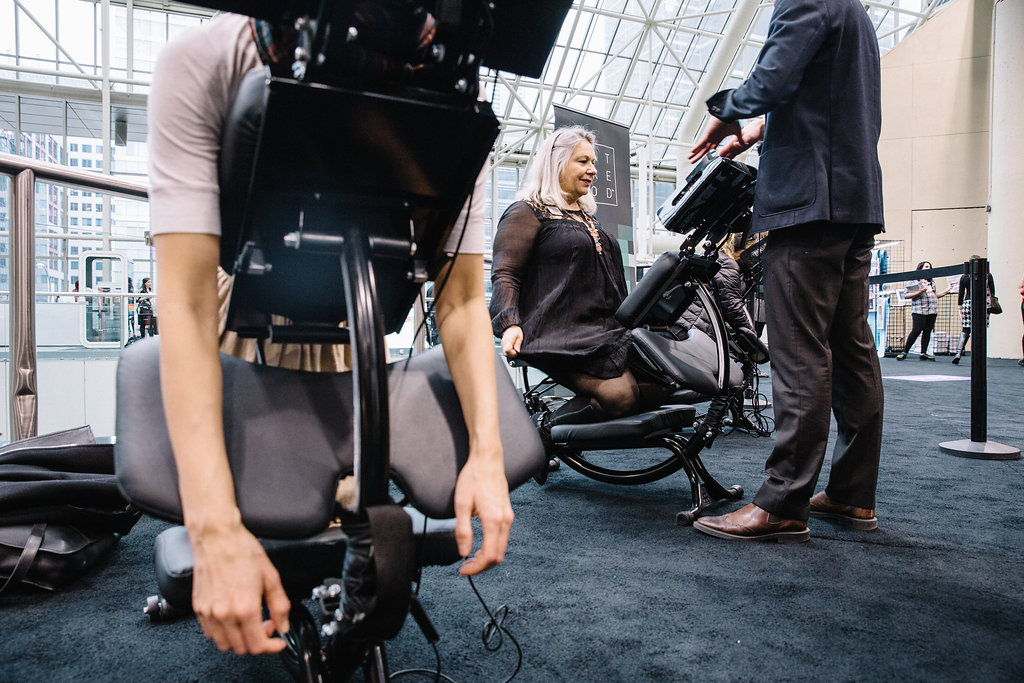
Each unit provides intensive personal exposure to sounds, imagery, and (selectively) smells of various natural environments. The system gently guides the user through its Natural Resonance Imaging® technology, which maps the brain's real time responses to specific stimuli. A helpful Relaxation Status Display appears in the field of view throughout.

Capitalising on the latest findings in environmental neuroscience, the product's Toronto-based creators claim that their patented personal wellness system brings restorative benefits equivalent to, or even greater than, nature in the raw.


At IIDEXCanada, all a new user had to do to get started was adjust the Pod Body to their particular dimensions, and calibrate the Pod Headset's stereoscopic display to their personal IPD (interpupillary distance), before immersing in one of three demo environments: a lush valley mid-summer, snow-covered mountains in winter, or a temperate forest in spring.

Of thousands in attendance at this annual design exhibition and conferences––which included summits on Healthcare, Wellness, and Accessibility in the built environment––many who got to try NaturePod™ first hand were immediately enchanted, and prepared to buy or lease the devices on the spot.

But frankly, reactions were mixed. A few declared their horror at the idea that anyone might try to substitute a new gadget for the experience of forest.

Even so, no one appeared to have any difficulty believing that this was a real product being offered to mitigate the chronic disconnect of modern urban dwellers from the experience of nature.

In fact NaturePod is design fiction––for now.

It's an experiential foresight project in the public interest; a scenario set five years into the future but brought to life today, created by a team of graduate students from OCAD University's Strategic Foresight and Innovation program, and led by me under Situation Lab auspices.

Neither a prediction nor a preference, but a provocation, we wanted to use design and performance to invite consideration of how our relationship to nature in cities is changing, and contribute to a dialogue about potential differences between our current direction, and what we might collectively want.

The people in the video above are responding to a direct experience, not to a hypothetical question.

***

"Powerful critical design does not present itself as critical design. Powerful design fiction does not present itself as fiction."
- Matt Manos

***


***

A few hints about the future setting were planted, including a full-page advertisement in the Show Catalogue announcing the release of the product in Fall 02021, but we were shooting for present-day realism in the encounter. The aim was to let folks come to their own genuine conclusions about the whole idea before the hypothetical status was revealed. The story told in the video has the same structure.

This unusual project grew out of a Time Machine, an Experiential Futures module that I created in 02013 and have taught each semester for the past three years at OCAD University.

That particular run of the Foresight Studio course, just over a year ago, was co-taught with the marvellous Suzanne Stein. One group of our students––Bergur Ebbi Benediktsson, Nourhan Hegazy, Jennifer McDougall, and Prateeksha Singh––spent the semester exploring the futures of humanity's relationship with the environment. When it came to the Time Machine, their response was ingenious; they created a "Nature Deficit Disorder Clinic" from 02040. In this experiential scenario set a generation from today, daily contact with nature is rare. The deficit is both ubiquitous and medicalised. People try to mitigate it with oxygen supplements and exposure to simulated forest, gauging their progress via brain scans.

A top Canadian environmental advocacy organisation, the David Suzuki Foundation, had served as this group's external partner throughout the class, and at their request we re-staged the NDD Clinic on Earth Day 02015 for the Foundation's employees and industry partners. Among the attendees was Canada's head of marketing for Interface, Inc.

Interface is a rather remarkable company. (You might know them from the documentary The Corporation, and especially the influential voice of their late founder Ray Anderson.) They're the world's leading carpet tile manufacturer, and also a global trailblazer in corporate sustainability. By no means is this a typical combination.

They engaged Situation Lab to create an experiential scenario to nudge their customers and others towards a deeper conversation about humanity's changing relationship to nature in the built environment. The same highly talented group of four graduate students came aboard to adapt the original concept for a totally different context: instead of a room-specific, 20-minute immersive installation for a captive audience of 20-30 members, we were to make this experiential scenario available to thousands of people over two full days at one of the largest expositions of its kind in North America.

Now, in the architecture and interior design world, it turns out that there is already lively discussion underway about (E.O. Wilson's term) "biophilia" in a design context, for instance in the 02015 report, Human Spaces: The Global Impact of Biophilic Design in the Workplace.

Biophilia refers to the "instinctive bond between human beings and other living systems"; a bond variously accommodated or cheerfully ignored by present urban and building designs. We designed NaturePod as an experiential contribution to both broaden and deepen the conversation. What are the implications for our wellbeing of trying to close the nature gap using increasingly sophisticated imitations? Where might that lead?

While evidently exercising a degree of creative licence to prototype possibilities from half a decade out, our imaginings were tied to real research. Readers curious about the current science behind these developments in nature simulation and related themes can find plenty of material for further investigation (for example: de Kort et al, 02006; Kahn et al, 02008; Kahn et al, 02009; Kjellgren and Buhrkall, 02010;  Valtchanov, 02010; Valtchanov et al, 02010; Valtchanov and Ellard, 02015).

What I love about the project is that this visionary company took such an unusual step, sponsoring a guerrilla futures intervention to urge industry and public engagement with issues that matter and affect everyone. (To the extent that corporate entities have engaged in experiential futures or speculative design previously, the results have tended toward the shamelessly commercial and trite, as Noah Raford has persuasively argued.)

NaturePod™ comes almost a decade after the first experiments in what we've come to think of as a special strand of publicly-oriented foresight work. Guerrilla futures combines strategic foresight and tactical media to produce unexpected encounters with possible worlds (see FoundFutures, for instance). Injecting possibilities into the present lets us think and feel new potentials, not "merely" hypothetical, in a mode of exploration squarely located where serious investigation meets play. (See Chapter 5 of The Futures of Everyday Life for more.)

This may be a first for corporate use of experiential futures / design fiction in guerrilla mode, and it is our hope that it provides a bracing contribution to design conversation far and wide.

Thanks and bravo to Interface, and to our marvellous design team: Berg, Jennie, Nour, and Prat! Huge thanks to all participants, assistants, volunteers and supporters; full project credits appear beneath the video.


Stills by Connie Tsang.
Videography by Filip Vukcevic.

Related:
> Strategic Foresight meets Tactical Media
> The Futures of Everyday Life
> Guerrilla futures performance at South by Southwest
> FoundFutures: Chinatown

Monday, April 13, 2009

Coral Cross is coming


By the end of May, the world will be six months into a deadly influenza pandemic that will take the lives of millions, wreak havoc with economies, and strain the social fabric, irrevocably transforming life as we know it.

Perhaps I should clarify that.

In May, web users everywhere will have an opportunity to take part in a bold experiment, an immersive and participatory "playable scenario" that tells the story of a hypothetical near future in which a flu pandemic takes place.

The project Coral Cross is named for a network of volunteers established in 02011 on the Hawaiian island of Oahu; a grass-roots organisation which in this scenario steps forward to aid islanders as they prepare to weather the crisis.

Coral Cross is being produced by the Hawaii Research Center for Futures Studies, for the state Department of Health, and I'm leading the game development team, an incredibly talented lineup of designers and futures thinkers.

A Honolulu Advertiser article last weekend announced the state's federally-funded pandemic preparedness project, of which Coral Cross is just one part, but we're now able to share a bit more about this piece of the effort. Michael Andersen of ARGNet (Alternate Reality Gaming Network) recently contacted me about the project to ask a few questions. The resulting report, which drew on the responses provided, appeared yesterday, but for the interest of other futurists, game designers, and pandemic flu watchers who may wish to know more, our email Q&A is reproduced in full below:

Michael Andersen: What made you and your team consider using ARGs to facilitate discussion?

SC: "Coral Cross" is a playable scenario about the first six months of a global flu pandemic, but with the focus on Hawaii.

The ARG-inspired format for this project grew out of two things.

First, for several years, the Hawaii Research Center for Futures Studies has been innovating in the design of objects and experiences that help people consider alternative future scenarios in a deeper way. We call this area of practice "experiential futures". In 02006, my colleague Jake Dunagan (until recently at HRCFS, now at Institute for the Future) and I staged a set of immersive scenarios to kick off a statewide project called "Hawaii 2050". Hundreds of people experienced four different versions of the year 02050 that we had created for them, to provide a wider context for discussing long-term sustainability in the islands. This approach worked so well that we independently founded a collaborative, public art collective, called "FoundFutures", dedicated to making futures experientially available to people in the midst of their everyday lives. Through FoundFutures we have produced several projects, most notably a series of guerrilla futures "exstallations" for Honolulu's Chinatown -- artifacts and images embodying alternative futures, strategically placed in public spaces. This unique futures-infused form of public art and provocation is an ongoing strand of work.

The second factor is that back when "World Without Oil" launched, we were becoming increasingly aware of the potential benefits of situating these future experiences in a gamelike structure. Subsequent discussions with WWO designers Ken Eklund and Jane McGonigal confirmed that our efforts to date had independently led us to many of the same conclusions as ARG designers about what makes for effective engagement with a scenario. Then, last year, as a Game Master on IFTF's "massively multiplayer forecasting game", Superstruct, I had an opportunity to consider more closely the similarities and differences between what we had been attempting to do as futurists, on the one hand, and what certain publicly-oriented ARGs aimed to do, on the other. Due in part to the example of FoundFutures Chinatown, an opportunity arose for us to create an experiential scenario about pandemic flu for the Hawaii Department of Health. At that point, the two strands clicked, and we knew we'd be doing something more explicitly ARGlike than we had tried before.

MA: What kinds of audiences are you hoping to attract with this game?

SC: Although we have approached the design in such a way that people can participate from anywhere, we will judge our own success mainly by the degree of engagement we can achieve in Hawaii, and especially on Oahu, the most populated island. In other words, anyone can play, but our core audience is here. A key limitation comes from the fact that fewer than one million people live here, because unlike national or international games, we're not drawing our core player base from a distributed pool of many millions of possible players. However, it also has two upsides. First, we can make use of the limited geography -- a captive audience, if you like -- by using more real-life elements to augment the storytelling. Second, as a member of our design team observed, the fact that we're tackling a global topic, pandemic flu, with a local tilt, not only gives it an interesting flavour, but it also helps focus the scenario. Instead of trying to evoke every last thing about how the world could transform as a result of a deadly disease sweeping across it, the island acts is a sort of microcosm in which, no matter where they're from, people will be able to see what's at stake more clearly and concretely, in how particular lives and communities are affected.

To render an abstract possible future concrete, and to have people participate in and be affected by this future, is perhaps the key principle behind "experiential futures". The last several years of work have been a very rich period of work in this area, and we're excited to see what Coral Cross can add.

MA: Can you give any hints as to what media you will be utilizing and how you will elicit interaction out of the participants?

SC: It is a cross-media effort, and I can't say too much more at this point, but the golden thread of the experience will be online, so anyone interested should go to coralcross.org and sign up.

MA: What is the timeline for the game? Approximately when can we expect to see a launch, and how long do you anticipate it to run?

SC: Coral Cross will run in the second half of May, an "event" which happens on a specific, shared timeline -- like pandemic flu itself. The story we're telling is on a scale of months, but the experience in real time will be short, on a scale of a week or two: one month per day. Once we're underway, it's really important for players to check back every day. Changes will happen very quickly!

MA: How do you see this project fitting in with your work at HRCFS?

This project is part of our effort to make foresight relevant and actionable to the public. Our mission is to inform and prepare the leaders and citizens of the State, the region, and the world, for possible changes on the horizon, such that better decisions will guide us away from negative outcomes, and toward preferred futures. ARGs are becoming a key tool in public futures practice and communication, and we need to experiment with this tool and learn how best to use it.

Let me know if I can clarify or elaborate on anything for you.

MA: Thank you for your time, and good luck on the project. Please let me know when it goes live, as I'm very interested in following the game's progress.

SC: Anyone can now submit their email at coralcross.org and they will be notified in May when things start to happen.


Folks, our next big experiential futures project is underway -- and you're invited to participate.

Many thanks to Michael Andersen and ARGNet for taking an interest in this effort.

Related posts:
> "Hawaii 2050" kicks off
> Experiential scenarios on video
> FoundFutures (series of posts)
> Humans have 23 years to go
> Gaming the end of oil

Monday, August 11, 2008

Humans have 23 years to go

Do not be alarmed. Continue swimming naked.

Image: NASA† (via astroThink)

Last month, the newly-quadragenerian nonprofit thinktank Institute for the Future in Palo Alto, California, announced an exciting upcoming project. Superstruct, billed as "the world’s first massively multiplayer forecasting game", is an ARG run by avant-gamer Jane McGonigal and future-opener Jamais Cascio, set to unfold over six weeks, starting in September. Here's an extract from the press release (drafted as an in-world artifact -- nice):

FOR IMMEDIATE RELEASE
SEPTEMBER 22, 2019

Humans have 23 years to go

Global Extinction Awareness System starts the countdown for Homo sapiens.


PALO ALTO, CA — Based on the results of a year-long supercomputer simulation, the Global Extinction Awareness System (GEAS) has reset the "survival horizon" for Homo sapiens - the human race - from "indefinite" to 23 years.

"The survival horizon identifies the point in time after which a threatened population is expected to experience a catastrophic collapse," GEAS president Audrey Chen said. "It is the point from which a species is unlikely to recover. By identifying a survival horizon of 2042, GEAS has given human civilization a definite deadline for making substantive changes to planet and practices."

According to Chen, the latest GEAS simulation harnessed over 70 petabytes of environmental, economic, and demographic data, and was cross-validated by ten different probabilistic models. The GEAS models revealed a potentially terminal combination of five so-called "super-threats", which represent a collision of environmental, economic, and social risks.
...
The spokesperson for United Nations Secretary General Vaira Vike-Freiberga released the following statement: "We are grateful for GEAS' work, and we treat their latest forecast with seriousness and profound gravity."

GEAS urges concerned citizens, families, corporations, institutions, and governments to talk to each other and begin making plans to deal with the super-threats.

Like last year's World Without Oil (McGonigal again, working with writerguy Ken Eklund), Superstruct is a serious game predicated on *real play rather than role play; people remain themselves in the scenario and bring their own resources to the table, making it a psychologically and socially meaningful simulation rather than an escapist diversion. So Superstruct is designed to be not only a source of future-oriented entertainment, but also, and more profoundly, an innovative distributed research strategy for IFTF's 02009 Ten-Year Forecast.

You can find a bit more about the game at the curiosity-piquingly brief FAQ, or this ARGNet article.

While awaiting its official beginning, prospective players and applicants for the gamemaster positions have been submitting short dinner-time vignettes to lead into the game. The scenario outline states: It's the summer of 2019. You are yourself, but 10 years in the future. Describe where you are having for dinner, what you're eating, and what you're thinking or talking about. How did you wind up there, compared to where you had dinner most often in the summer of 2008?

Here's mine:

To my left, the Taedong drifts by slowly. But I'm in a hurry -- for two reasons. First, it's raining like a sonofabitch, and second, I have places to be. So tonight, I'm having dinner at a McDonald's. For the first time in over twenty years.

Back in 01995, at age 15, I launched a personal boycott after seeing the golden arches on the Champs Elysees. It blew me away that the French, in all their gastronomic genius, could be wooed by such inglorious industrial tidbits. But, to be fair now, over the last decade, the company has reinvented itself. Completely. They faced a choice between a catastrophic erosion of customer base, as environmental and personal health came to the fore; or staying big by going local. In the summer of 2008, in New Haven CT, where I was staying with my very health-conscious girlfriend, every night we ate organic food we couldn't really afford, and avoided all foodstuffs deemed too "fast", for reasons that were sound at the time. However: that was the last summer of the old Mickey D's.

Early in 02009 -- just over ten years ago -- way ahead of legislation, and with rising transportation costs hot on their heels -- they were the first major fast-food concern to initiate a strategic five-year shift to a 200-mile limit for key suppliers. Where they led, others followed, pushing the development of hundreds, and eventually thousands, of micro-providers and farms within the radius of each branch. As inventory practices, and consumers, got more sophisticated, the actual carbon cost per item came indexed and included on the menu; as a result they now boast a cheeseburger footprint 20% lower than any other global provider. All-important signature condiments are still usually imported from further away, but the staple supplies come from close by. Of course, as a result, menus vary hugely from place to place; that's the model now. A few recognisable items remain -- the "Kun Mac" tasted more or less as before, though there's a popular animal-free beef option -- but the rice I'm eating tonight, declares the biodegradable package proudly, is from a farm just to the south, in the former DMZ; and my kim chee is made in a facility just a mile or so down the river.

All this is on my mind because of the project I came here to do. This is my first trip to Pyongyang, and with "Dear Leader" departed nine months ago at the ripe old age of 77, the transition to a more open era has been energetic. Many of the high-tech firms established in the south are in the midst of opening northern operations, and the whole peninsula is hungry for foresight expertise. I'm here with a delegation of futurists, many of them based in the lower half of the newly reunited country --- some I've known since we worked in Hawaii together over a decade ago. And now, in about an hour and a half, at the convention centre next door, we're staging an event that translates to English as "Food Court 02049". Executives from some of the biggest enterprises like Samsung and LG, and Daewoo Electric Vehicle Co. are interested in so-called smart- and nu-food technology (the intersection of agriculture, psychopharmacology and info science is a big deal at the moment -- they're touting "consumable software"). As a provocation to their "C-level" and "D-level" -- D for design -- teams, we're offering a series of meal options; some real, others simulated with help from master chefs and artists). There's a fish speakeasy (simulating endangered species that can't be consumed legally), a neo-aztec taco stand (culinary archeology is set to take off -- try the cuisines of an extinct civilisation!), an ayurvedically diagnostic, instant personal currymaker (which whips up a curiously neuroactive Saag Paneer), and just for fun, several bio-electrical charging posts for the possible post-singularity denizens of our imaginary 02049. We won't be serving Kun Macs at tonight's event -- that'll just be my no-longer-guilty indulgence at this newly opened branch. Sure, it would've been a stretch to imagine myself stooping to McDonald's ten years ago: but I figure, if McDonald's can change, then so can I.

My wife is no less health-conscious these days, but I've persuaded her to join me. Everyone says this is the best kim chee in town.

Related posts:
> Gaming alternative futures (anything but text)
> Gaming the end of oil (*See the comments to this post)
> World without oil photo essay

† Link not functioning at time of writing. If you're desperate to get to the original, try Internet Archive's Wayback Machine.

Sunday, January 20, 2008

Gaming the end of oil

What better way to breathe life into scenarios than to place life inside them? And what better way to explore and stretch our personal and collective capacity for coping with change than through games?
[...]
The freedom to engage in social experimentation and expression is surely the single most precious, fragile, and yet unrealised element of our democratic political mythos. Gaming the future, insofar as it implies the possibility of actually doing what we have for centuries only told ourselves we do, could be revolutionary.

~the sceptical futuryst, Gaming alternative futures (anything but text), June 02006

In our early 21st century stocktake of the global problematique, the ugly twin of climate change is peak oil. The former could be seen as the natural dimension of blowback from our foresight-free experiment in rapacious energy consumption from roughly the dawn of the industrial revolution onwards; the latter as its economic counterpart.

As readers of this blog are well aware, there are disturbing arguments in the wind about the potential for chaos arising from these tremendous forces (e.g. James Howard Kunstler's The Long Emergency), even if their plausibility is hotly disputed by some. Questions invariably arise in the course of this debate around the extent to which businesses, governments, and ordinary people are prepared for the magnitude of social disruption that could occur. I don't find it a difficult argument to swallow that our society is unprepared for any but the most sanguine, mild, and trivial of scenarios in this vein. To the extent the environmental doomsayers prove correct, in light of our individual psychological and collective political difficulties coping with risks of this type, social disruption would seem to follow with inexorable logic.

So to me it's interesting, and for obvious reasons encouraging, to see the emergence of popular simulations of the end of (cheap, readily available) oil.

One is the forthcoming video game, Frontlines: Fuel of War. Here's the trailer:


The narrative voiceover says (posted at Energy Bulletin, 27 August 02007):

Oil was running out.
It's what we grew up in.
Post middle east,
Post peak oil,
Post everything.
What they call the long emergency.
It started slow.
Little things at first.
Lines at the pump,
that hot summer of 2008 when the blackouts started lasting weeks.

They said it would get better.
Something would save us.

Biofuels, solar power, cleaner nuke plants, maybe.

The depression hit in 2012
Africa ran out of food, then we did too.

People stopped trying to do anything about the problem and just tried to survive.

We watched them starve for 40 years and it just didn't seem real. But pretty soon the scenes we used to watch on the news were happening just down the street.

It's been happening for years. Now we're at a tipping point.

I was 16 when the Chinese and the Russians figured out they'd rather fight us than each other. We didn't waste time forming the coalition.

Now, we're staring each other down over the last wells of the Caspian.

... This is where it's going to happen, in towns too small to have a name, built in two weeks by oil contractors.

It's 2024, the 21st century. People ask we how we let this happen. I tell them we always knew.

The storm is coming.

A pretty grim little poem.

This story serves as backdrop (or, if you prefer, pretext) for a military game of the shoot-em-up genre -- check out the game's website, complete with bombastic soundtrack that sounds just like a Hans Zimmer effort -- in short, it seems to be a thrilling Hollywood-style slice of apocalypse as entertainment.

Which begs the question, "what's the message players walk away with?", duly asked in a CNN article published yesterday about the new game:

While Frontlines: Fuel of War is one of the first video games to capitalize on the doom-and-gloom scenario of what might happen when the world runs out of oil, it's not the only video game focusing on energy as oil prices rise, developing nations use more and more crude, and the world grapples with global warming fears.
[...]
Most oil industry analysts say peak oil production is many decades, if not hundreds of years away, and a transition to other sources will likely be more orderly than the scenario depicted in Frontline.

But a small and growing number of experts -- some well-respected -- say peak oil production is close or has happened and the transition will be much more painful than mainstream analysts predict.

Either way, [Frank DeLise, general manager of Kaos Studios, the company behind the game] said he hopes people will get more out of the game than just an adrenaline rush.

"If they play this game they will walk away thinking 'wow, energy is a problem," he said.

Experts say video games can be fun as well as educational, although the outcome largely depends on the content.

"They could in fact lead to changes in attitudes, beliefs, and ultimately, changes in behavior," said Craig Anderson, a professor of psychology at Iowa State University who studies the effects of video games on people.
[...]
But Anderson, the psychologist, is concerned about the message that violent games like Fuel of War may send to players.

"It may well change attitudes towards the use of these tactics as a political tool," he said. Players may think "of course we have to use military tactics to go take oil."

~"The end of oil is just a game", CNNMoney.com, 19 January 02008


I'm interested to know what others think about this kind of game: does it seem more likely to teach people to expect (and submit to) the worst case, or, as the general manager of Kaos claims, to recognise -- and, presumably, take actions to mitigate -- such a nightmare scenario?

There is an interesting comparison to be made here with the alternate reality game, "World Without Oil" (WWO), which ran in mid-02007 and sought to engage a broad audience in a collective simulation or scenario exercise:

It's a "what if?" game.
What if there was an oil crisis?
[...]
Because an oil crisis has deep and subtle effects, we asked everyone to help us imagine what an oil crisis would really be like. That's how people played the game - first they read the official news and what other players were saying. Then they told the story of how a shortfall of oil was affecting their own lives, and what they were doing to cope.
[...]
Over 1900 people signed up as players of World Without Oil, and submitted over 1500 stories from inside the "global oil crisis of 2007." Their work comprises a rich, complex, and eerily plausible collective imagining of such an event, complete with practical courses of action to help prevent such an event from actually happening.


For example, HRCFS's own Jake Dunagan posted this contribution to help flesh out the story for the Hawaii region.

A very effective approach, according to the organisers of WWO:
For [participants] and over 50,000 active observers, the process of collectively imagining and collaboratively chronicling the oil shock brought strong insight about oil dependency and energy policy. More than mere "raising awareness," WWO made the issues real, and this in turn led to real engagement and real change in people's lives.

I wonder in which ways the two approaches are most effective in activating political concern, and beyond that, behaviour change: on the one hand, sophisticated imagery that, although interactive, is basically constrained to a pre-defined narrative; and on the other hand, a less richly pre-imagined, but more reality-integrated simulation?

Of course I don't presume that these types are pure, let alone necessarily or intrinsically separate. Indeed, it seems to me that elements of both types of game -- immersive narratives with an escapist, entertainment objective, and collective scenario-building with a broader social goal in mind -- will shortly be integrated in pursuit of greater effectiveness in bringing scenarios to life, and life to scenarios.

Assuming, of course, that peak oil doesn't get us first.

(Thanks to Ira Rohter for the CNN link. See an introductory QuickTime video about the WWO game here.)