Showing posts with label Situation Lab. Show all posts

Monday, October 21, 2019

Augmenting Cities

Augmenting Cities image via.

Niantic CEO John Hanke opens the event | Photo: Niantic / Knight Foundation

We were excited to take part in an invitational symposium a few weeks ago, Augmenting Cities, that brought together under one roof 150 game designers, artists and urbanists from a number of countries "to reflect on how people, cities, and technology will evolve and be shaped through augmented reality (AR)".

The gathering was convened by groundbreaking AR games company Niantic –– the folks behind Pokémon Go, Ingress and Harry Potter: Wizards Unite –– together with the Knight Foundation, a leading urban philanthropic fund. It was hosted at the Oakland Museum of California, itself part of a city that has recently seen rapid and far-reaching transformation through the Bay Area's latest tech boom.

As the event description notes, "Just as mobile communication and computing has altered the evolution of cities over the last 20 years, AR technology stands to fundamentally change how we connect with each other and experience communities for decades to come." But what might that fundamental change look like?

USC Situation Lab director Jeff Watson (centre) speaks on a panel with (left to right): Ina Fried (Axios; moderator), Gene Becker (Samsung), Ross Finman (Niantic), Ilana Lipsett (IFTF), and Kevin Slavin (The Shed) | Photo: Stuart Candy / Situation Lab

So on the back of two days of presentations and panel discussions by game and experience design luminaries, including Felix Barrett (founder of Punchdrunk), Sarah Brin (Meow Wolf strategic partnerships director), audio artist Duncan Speakman, game designer Katie Salen (UC Irvine), and Niantic founder John Hanke –– as well as our own Jeff Watson (director of USC Situation Lab) and Sitlab collaborator Jen Stein (creative lead at Experimental Design) –– we were asked to devise and run the culminating session, an afternoon's activity for all participants to explore possible futures in this area.

Our mission was to come up with a hands-on, playful, and collaborative intervention that would help develop not only deeper social connections among attendees, but also potentially actionable initiatives in this fast-changing urban AR design space. With around 150 participants and only two hours to get through generating, refining, selecting, and sharing out concepts, it was a worthy challenge.

I led process design and facilitation with a fantastic team made up of Stein, Watson, and CMU Situation Lab associate Ceda Verbakel. We realised that thanks to the venue's particular layout and the number of attendees, players would have to take these co-creative steps at the same time while sited in different locations. This helped to birth, at last, a project that had been gestating for some time; a self-contained facilitation kit.

Participant teams proceed through the Urban Playshop staged by Situation Lab at the Augmenting Cities symposium | Photo: Niantic / Knight Foundation


Photo: Niantic / Knight Foundation

Photo: Niantic / Knight Foundation

In teams of three or four players, future-artifact ideas were incepted using combinatorial prompts from a modified version of our game The Thing From The Future, with ideation rounds timeboxed at 3–5 minutes. This first phase allowed folks to explore in relatively open fashion to start with, and produced a wide variety of imaginative responses. In the second phase, each team selected two of their most promising ideas from the collection that they had generated together, surfacing some of their most thematically relevant concepts and provocations. They then partnered up with another team, to receive feedback and discover which of the two candidate concepts should be developed, in the third and home stretch of the Playshop, into a pitch or advertisement to share live on stage with everyone in the last session of the conference.

We at Situation Lab don't always have the time to write our projects up for sharing more widely, although we have featured at our website some of the gameplay approaches and variations developed over several years, and we continually partner with groups around the world, with a focus on values-aligned initiatives and organisations, to offer customised processes that scaffold rigorous imagination, co-creative exploration, and strategic conversation.

Last year for instance, we ran sessions or whole events in this design space with, to name a few, the Omidyar Group, Pennsylvania's Department of Education, Alaska's Cook Inlet Tribal Council, Mexico City's Laboratorio para la Ciudad, the Association of Professional Futurists, and Institute for the Future (IFTF) with the World Bank Climate Investment Funds. In 02019 so far, Sitlab has collaborated with, among others, the Skoll World Forum on Social Entrepreneurship at Oxford University, NASA Jet Propulsion Laboratory, Stanford d.school, the Obama Foundation, the British Broadcasting Corporation, the brand-new Pittsburgh high school City of Bridges, and (in collaboration with IFTF's Governance Futures Lab) United States Conference of Mayors gatherings in Austin and Honolulu.

This post is prompted by a desire to share a bit more of what we've been doing, and more particularly by the terrific energy generated in this initiative. For more information on Augmenting Cities check out the event webpage, overview (pdf), and recap.

Participants devise and share ideas using a specially adapted version of The Thing From The Future | Photo: Stuart Candy / Situation Lab


Photo: Stuart Candy / Situation Lab

Many thanks to our fantastic Playshop participants, to our awesome facilitation team, and to Niantic and Knight Foundation for spearheading the initiative.

We look forward to further developments in this exciting and fast-moving area, and find it hopeful that processes like these –– supporting rigorous imagining in emerging design spaces, as they are being explored and mapped –– are rapidly finding their way into many organisational and community toolkits, to help new ideas and their implications come into focus.

(Report also posted at Situation Lab website. This version updated 22oct19.)

Related:
> Bringing Futures to Stanford d.school
> On Foresight in Organisations
> On Getting Started in Experiential Futures
> The Thing From The Future / Sitlab project page
> Gaming Futures Literacy (article)
> Transforming the Future (book)

Friday, June 23, 2017

Ethnographic Experiential Futures

We shape our images of the future, and meanwhile they shape us.

A Field Guide to Ethnographic Experiential Futures, version 1.1, June 02017 (pdf)


(Update 03june19: This post and framework have attracted quite a bit of interest over the past couple of years. We've now published a peer-reviewed academic article, in open access, laying out EXF in the Journal of Futures Studies special double issue on Design and Futures. That full piece is available in pdf here.)

***

At the Design Develop Transform conference in Belgium last week, design researcher/futurist Kelly Kornet and I presented this framework we've been developing on and off for a couple of years.

Ethnographic Experiential Futures, or EXF, is a design-driven, hybrid approach to foresight aimed at increasing the accessibility, variety and depth of available images of the future.

It puts together two modes of futures research and practice which have grown up separately, for the most part, but which have complementary goals, and turn out to pair quite well.

Ethnographic futures research, EFR, is a protocol for surfacing and documenting existing images of the future. (Our starting point was the late Stanford anthropologist Robert Textor's formal EFR interview process, an overlooked contribution to futures literature which should be much more widely used.) Experiential futures, XF, is a family of approaches for vivid multisensory, transmedia, and diegetic representations of images of the future (a focus of mine for the past decade).

Put another way, ethnographic futures is more descriptive; looking for what's present but often hidden in people's heads. Experiential futures is more creative; rendering these notional possibilities visible, tangible, immersive and interactive, externalising and concretising representations of them for closer inspection and deeper discussion.

EXF offers a way to take the invisible and make it senseable.


We've suggested a series of steps for an EXF process:
1. MAP: Inquire into and record people's actual or existing images of the future (e.g. possible; probable; preferred; a combination).
2. MULTIPLY: Generate alternative images (scenarios) to challenge or extend existing thinking (optional step, but recommended).
3. MEDIATE: Translate these ideas about the future/s into experiences: tangible, immersive, visual or interactive representations.†
4. MOUNT: Stage experiential scenario/s to encounter for the original subject/s, or others (or both).
5. MAP: Inquire into and record responses to the experiential scenario/s.

The Field Guide explains the logic and highlights some of the main design choices available at each juncture.

Instead of starting from theory, this step-by-step process has been derived from already completed projects, carried out over a number of years, which turned out to have much the same structure under the hood. In our conference presentation we reviewed four project precedents dating back to 02007. While demonstrating very different goals, outcomes and contexts, they basically describe the same research arc.

A full article is forthcoming, which will include more detail to situate this work in the landscape of futures ethnography and experiential practice, including related methods and projects. However, since the one-pager refers to the specific projects from which we distilled or abstracted this framework, for reference those are briefly outlined below:

Candy and Dunagan, Foundfutures: Chinatown, 02007.

About ten years ago, Jake Dunagan and I started experimenting with the deployment of experiential futures in unscripted environments. We would send postcards from the future to the home addresses of community leaders around Hawaii, and 'droplift' future artifacts in local shops for people to stumble across during their lunch break, for example. However our most ambitious early guerrilla futures project aimed to be more systematic; more rooted in place and history. In Honolulu's Chinatown neighbourhood, we interviewed a range of residents and business-owners, and then devised a culture- and site-specific scenario set, incorporating a combination of future possibilities as described to us, and new ones calculated to resonate with what we had heard. With collaborators we created a set of experiential scenarios, producing a cross-section of fragments from each hypothetical future history, and installing these in the streets. Responses were captured via direct observation, at a free community futures workshop, and in the press.

Artwork by Matthew Jensen / Photo by Stuart Candy

Artwork by Mark Guillermo / Photo by Matthew Stits

Kornet, Causing an Effect, 02015.

For Kelly Kornet's culminating research project at OCAD University (which design professor Helen Kerr and I supervised), she spoke to several lifelong environmental activists, living in heavily polluted industrial areas, about the future hopes and fears motivating their efforts. She generated written scenarios based on these (using Textor's EFR interview format), then created a physical exhibition comprising artifacts from the futures that the research participants had described, and subsequently spoke with them again to capture responses to how their own private imaginaries had been brought to life. The project, which won a student award from the Association of Professional Futurists, is available in pdf here.


Designs & photos by Kelly Kornet 

Situation Lab/Extrapolation Factory, 1-888-FUTURES, 02015.

Jeff Watson and I (Situation Lab), together with Elliott Montgomery and Chris Woebken (Extrapolation Factory) designed and staged a series of design jams in 02014-15 called 'Futurematic'. The third of these, held at the University of Southern California, invited anyone interested, across North America, to call a toll-free number and record their future dream in a voicemail. On the day of the event, we had participants retrieve these voicemails, then create a "future present" –– a tangible artifact distilling (or, as Chris would put it, 'tangibilising') each dream. The maker/s then recorded a video about their making process and the correspondence between the artifact and the dream that inspired it, and boxed up the future present to send to whatever postal address had been left with the original voicemail. Thereafter, on social media, recipients responded to the future presents they opened up. The project is detailed here, and was covered by Core77 and Business Insider among others. Artifact documentation and videos are archived at 1888futures.com.

Photo by Stuart Candy

Photo courtesy Extrapolation Factory & Situation Lab

Greyson, Making the Futures Present, 02017.

Designer and interactive narrative professor Maggie Greyson, for her final MDes project at OCAD, created a "personal experiential futures" process. (Social entrepreneur Sarah Schulman and I supervised.) Maggie interviewed research participants, using Textor/EFR, about a range of futures they could imagine facing on a 20-year time horizon –– positive, negative, expected, and also unexpected. The 'unexpected' future is not a usual part of EFR, which traditionally has a strict descriptive intent; this was a deliberate addition to expand participants' thinking (see Step 3, 'Multiply'). She then worked with them to co-create rapid prototypes of artifacts from those futures, and went on to develop higher-resolution artifacts as a basis for deeper conversation in the next session. The project can be found in pdf here.


Photos by Maggie Greyson

Whether your aim is to dive deeper into the images of the future in a culture to which you belong (even your own personal 'futurescape'), or to facilitate a process for a client organisation, or to partner with a community group historically marginalised from meaningful futures conversations, the framework is intended to be capable of being customised and put to diverse uses.

As we noted in the conference presentation, purposes of projects to date have spanned the educational, documentary, activist, personal, and playful; and could readily be extended or adapted to the organisational, governmental, and cultural.π

EXF may be applied at the scale of a short workshop or design jam, up to a multi-year large-scale process involving thousands of people or more. It may be used as scaffolding for a robust, imaginative strategic conversation within a company, or as the basis for a public, guerrilla futures intervention at election time, or as a quasi-therapeutic support structure for examining an individual's options in life.

Most futures research is not as disciplined as it could be in its inquiry into how people currently think about and conceptualise futures: Ethnographic futures research can help with that. Meanwhile, most communicative or scenario-sharing interventions are likely not sufficiently vibrant to change or expand how people think: Experiential futures practice can help with that.

Putting them together entails bridging the descriptive and the creative (and potentially, though not necessarily, the normative).

Our hope is to make this work a bit easier and more common, by providing a flexible framework that has served diverse purposes before and could be put to many other uses.

Also, we note that this arc of activities, which in the original projects may have appeared linear, can be usefully recognised and imagined instead as circular. The first and last steps are the same. In principle, then, EXF could be used, where appropriate, in an ongoing, cyclical fashion.§

We've received a number of requests for a pdf of the draft Field Guide to Ethnographic Experiential Futures: you can download it right here.

We invite you play with this structure and share your variations, innovations and results!

***

Notes:
[†] Those new to experiential futures may find this recent peer-reviewed article published in Futures journal useful. There's an abridged overview for the especially time-pressed (downloadable pdf). The Experiential Futures Ladder, to help carry out Step 3, Mediate, is described there too.
[π] The Adopt-a-vision experiential futures class project recently outlined at this blog could very easily be tweaked towards an EXF cycle –– and the resemblance is not pure coincidental; it emerges from some of the same thinking.
[§] The insight that an ethnographic, grounded-in-place futures process could be usefully developed as a generic method owes an enormous amount to over a decade of conversation and collaboration with Jake Dunagan (whose background includes an MA in visual anthropology). Early in 02016 we developed a project proposal called 'Nextloop', which aimed to offer "a next step in a much-needed renovation of the conditions for public imagination. We wish to use this opportunity to demonstrate how forward-looking design research, pairing ethnography with tangible speculation, can enrich individual and collective consideration of our social, cultural and technical choices. We intend to close certain loops too often left open – bringing potential downstream consequences powerfully and concretely into awareness today, and to bring in certain other loops – diverse public involvement in those same discussions – too often left out."


Related:
> Adopt-a-vision (report from a recent XF class)
> 1-888-FUTURES (speculative design jam event overview)
> Foundfutures: Chinatown (XF /guerrilla futures project overview)
> Build Your Own Time Machine (classroom activity instructions)
> The Thing From The Future (card game)
> The Futures of Everyday Life (doctoral dissertation)

Wednesday, May 11, 2016

NaturePod™


What if you could reap the health benefits of spending time in nature––for productivity, creativity, and stress relief––without even leaving your office?

All this is coming soon to a cubicle near you.

Canada's largest architecture and design trade show recently saw the global launch of a new product called NaturePod™.

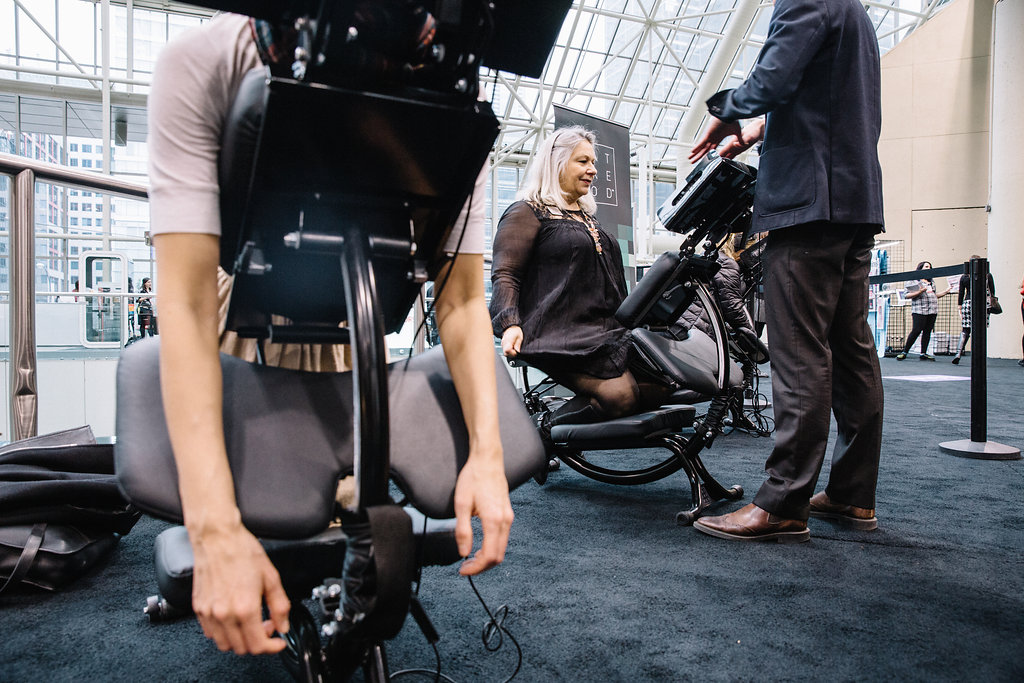
Each unit provides intensive personal exposure to sounds, imagery, and (selectively) smells of various natural environments. The system gently guides the user through its Natural Resonance Imaging® technology, which maps the brain's real time responses to specific stimuli. A helpful Relaxation Status Display appears in the field of view throughout.

Capitalising on the latest findings in environmental neuroscience, the product's Toronto-based creators claim that their patented personal wellness system brings restorative benefits equivalent to, or even greater than, nature in the raw.


At IIDEXCanada, all a new user had to do to get started was adjust the Pod Body to their particular dimensions, and calibrate the Pod Headset's stereoscopic display to their personal IPD (interpupillary distance), before immersing in one of three demo environments: a lush valley mid-summer, snow-covered mountains in winter, or a temperate forest in spring.

Of thousands in attendance at this annual design exhibition and conferences––which included summits on Healthcare, Wellness, and Accessibility in the built environment––many who got to try NaturePod™ first hand were immediately enchanted, and prepared to buy or lease the devices on the spot.

But frankly, reactions were mixed. A few declared their horror at the idea that anyone might try to substitute a new gadget for the experience of forest.

Even so, no one appeared to have any difficulty believing that this was a real product being offered to mitigate the chronic disconnect of modern urban dwellers from the experience of nature.

In fact NaturePod is design fiction––for now.

It's an experiential foresight project in the public interest; a scenario set five years into the future but brought to life today, created by a team of graduate students from OCAD University's Strategic Foresight and Innovation program, and led by me under Situation Lab auspices.

Neither a prediction nor a preference, but a provocation, we wanted to use design and performance to invite consideration of how our relationship to nature in cities is changing, and contribute to a dialogue about potential differences between our current direction, and what we might collectively want.

The people in the video above are responding to a direct experience, not to a hypothetical question.

***

"Powerful critical design does not present itself as critical design. Powerful design fiction does not present itself as fiction."
- Matt Manos

***


***

A few hints about the future setting were planted, including a full-page advertisement in the Show Catalogue announcing the release of the product in Fall 02021, but we were shooting for present-day realism in the encounter. The aim was to let folks come to their own genuine conclusions about the whole idea before the hypothetical status was revealed. The story told in the video has the same structure.

This unusual project grew out of a Time Machine, an Experiential Futures module that I created in 02013 and have taught each semester for the past three years at OCAD University.

That particular run of the Foresight Studio course, just over a year ago, was co-taught with the marvellous Suzanne Stein. One group of our students––Bergur Ebbi Benediktsson, Nourhan Hegazy, Jennifer McDougall, and Prateeksha Singh––spent the semester exploring the futures of humanity's relationship with the environment. When it came to the Time Machine, their response was ingenious; they created a "Nature Deficit Disorder Clinic" from 02040. In this experiential scenario set a generation from today, daily contact with nature is rare. The deficit is both ubiquitous and medicalised. People try to mitigate it with oxygen supplements and exposure to simulated forest, gauging their progress via brain scans.

A top Canadian environmental advocacy organisation, the David Suzuki Foundation, had served as this group's external partner throughout the class, and at their request we re-staged the NDD Clinic on Earth Day 02015 for the Foundation's employees and industry partners. Among the attendees was Canada's head of marketing for Interface, Inc.

Interface is a rather remarkable company. (You might know them from the documentary The Corporation, and especially the influential voice of their late founder Ray Anderson.) They're the world's leading carpet tile manufacturer, and also a global trailblazer in corporate sustainability. By no means is this a typical combination.

They engaged Situation Lab to create an experiential scenario to nudge their customers and others towards a deeper conversation about humanity's changing relationship to nature in the built environment. The same highly talented group of four graduate students came aboard to adapt the original concept for a totally different context: instead of a room-specific, 20-minute immersive installation for a captive audience of 20-30 members, we were to make this experiential scenario available to thousands of people over two full days at one of the largest expositions of its kind in North America.

Now, in the architecture and interior design world, it turns out that there is already lively discussion underway about (E.O. Wilson's term) "biophilia" in a design context, for instance in the 02015 report, Human Spaces: The Global Impact of Biophilic Design in the Workplace.

Biophilia refers to the "instinctive bond between human beings and other living systems"; a bond variously accommodated or cheerfully ignored by present urban and building designs. We designed NaturePod as an experiential contribution to both broaden and deepen the conversation. What are the implications for our wellbeing of trying to close the nature gap using increasingly sophisticated imitations? Where might that lead?

While evidently exercising a degree of creative licence to prototype possibilities from half a decade out, our imaginings were tied to real research. Readers curious about the current science behind these developments in nature simulation and related themes can find plenty of material for further investigation (for example: de Kort et al, 02006; Kahn et al, 02008; Kahn et al, 02009; Kjellgren and Buhrkall, 02010;  Valtchanov, 02010; Valtchanov et al, 02010; Valtchanov and Ellard, 02015).

What I love about the project is that this visionary company took such an unusual step, sponsoring a guerrilla futures intervention to urge industry and public engagement with issues that matter and affect everyone. (To the extent that corporate entities have engaged in experiential futures or speculative design previously, the results have tended toward the shamelessly commercial and trite, as Noah Raford has persuasively argued.)

NaturePod™ comes almost a decade after the first experiments in what we've come to think of as a special strand of publicly-oriented foresight work. Guerrilla futures combines strategic foresight and tactical media to produce unexpected encounters with possible worlds (see FoundFutures, for instance). Injecting possibilities into the present lets us think and feel new potentials, not "merely" hypothetical, in a mode of exploration squarely located where serious investigation meets play. (See Chapter 5 of The Futures of Everyday Life for more.)

This may be a first for corporate use of experiential futures / design fiction in guerrilla mode, and it is our hope that it provides a bracing contribution to design conversation far and wide.

Thanks and bravo to Interface, and to our marvellous design team: Berg, Jennie, Nour, and Prat! Huge thanks to all participants, assistants, volunteers and supporters; full project credits appear beneath the video.


Stills by Connie Tsang.
Videography by Filip Vukcevic.

Related:
> Strategic Foresight meets Tactical Media
> The Futures of Everyday Life
> Guerrilla futures performance at South by Southwest
> FoundFutures: Chinatown

Monday, November 02, 2015

La Chose du Futur à Paris


A special edition of The Thing From The Future was distributed to 500 delegates at the UNESCO Youth Forum in Paris last week.

Since 01999 the Youth Forum has been the institutional mechanism for youth (which in the UN system means people aged 15 to 24) to make recommendations to the UNESCO General Conference.


This 9th edition of the Youth Forum incorporated, for the first time, a process aimed at improving participants'  futures literacy, developed by UNESCO's head of foresight Riel Miller. The Future Literacy Knowledge Lab, or FKL, is described in outline here and in detail here [pdf].

From my perspective as an advisor and senior facilitator for the Forum, among the most notable elements of the experience was the juxtaposition of this process, aimed at exploration and emergence, with the formality and fixity of international diplomacy's default settings. Ingenious workarounds were required in order for delegates to be able to converse and co-create in small groups given the geometrically pleasing, but collaboratively disabling, furniture arrangements. The literally nailed-down meeting room configurations reflected a firm expectation of centrally managed, as opposed to open or peer-to-peer, conversations.


How does such an architecture shape what happens, and what doesn't? An instructive contrast may be found in the opening and closing circles of Open Space, a meeting format which both symbolically bespeaks and practically enables something very different; a fluid and participant-driven flexibility (see, for example, Harrison Owen, Expanding Our Now, pp. 82-83). Maybe someone has already compiled a pattern language of meeting spaces. There's much to learn from such cases.

In any event –– despite its best efforts, here the furniture's expectations were not allowed to triumph! Far-reaching futures discussions were had, assumptions were surfaced and questioned, alternatives were articulated, expressive future artifacts and prototypes were created.


And at the end of the Youth Forum futures workshop, a special bilingual English / French The Thing From The Future / La Chose du Futur * was distributed to all attendees, a concrete expression of the intention to democratise and distribute futures thinking far and wide. Now these hundreds of delegates have made their way home to communities all around the world, cards in hand.


Thanks to UNESCO, to Youth Forum delegates –– and especially to Riel Miller and team for their efforts to open space for possible futures, not only in the proceedings themselves, but through providing an experience and a tool to use again in days and years to come.

Of course distributing cards and rearranging spaces are fine ways to begin; meanwhile I wonder about working with the deeper cultural currents in play. How may we make a habit of inviting fuller versions of ourselves to show up in these formal and ritualised settings? How might we offer better hospitality to the unusual, the creative, the crazy and playful and magical and wild and unborn in each of us?  For when it comes to "serious" conversations about the future, these voices too seldom find any place at the table.

Related:
> The Thing From The Future
> The technology of public imagination
> Whose future is this?

* Very special thanks to Cedric Flazinski of N O R M A L S design lab, and to Sandra Coulibaly Leroy of the Organisation internationale de la Francophonie (OIF) for their invaluable translation assistance. And on a semi-related note: bilingual Emglish/French Playsheets for the game are available via the UNESCO website [pdf, A4].

Tuesday, October 20, 2015

The Thing From The Future


The Thing From The Future is an imagination game that helps players generate countless ideas for artifacts from the future; to amuse, delight, explore, and provoke.

Designed for play by individuals or groups, this hybrid party game and creativity tool has been compared to Cards Against Humanity and Oblique Strategies. It's easy to hack and customise, so can be used for exploration in specific domains, or in random-access mode as a gym for the imagination.

The game has been played in all sorts of contexts including:
- classes at Johns Hopkins, MIT Media Lab, and Parsons Mumbai;
- gatherings such as the World Future Society annual conference in San Francisco, 5D's transmedia "Science of Fiction" shindig in LA, and the United Nations Development Programme's annual strategy meeting in New York;
- festivals including IndieCade (LA), FutureFest (London), Hot Docs and Maker Festival (Toronto), Amplify (Sydney), and the Berlin Film Festival;
- design jams resulting in popup artifact exhibitions at OCAD University, NYU, and Stanford d.School;
as well as at any number of parties and kitchen tables, and inside countless organisations from community arts groups to Fortune 500 companies.

Co-designer Jeff Watson and I published The Thing From The Future through Situation Lab in March 02014, and we have been refining it continually since. A revised edition, containing four times as many permutations as the original, was released last October.

The project was recognised this year by the Association of Professional Futurists (APF) with a Most Significant Futures Work award.

I wrote an article about the game for the APF periodical Compass in April, and then revised that piece for an anthology on Methods which came out this month. The text looks under the hood at how the card deck's four-suit structure scaffolds players' imaginations.

Here it is:


To reiterate a key point made there: The Thing From The Future comes against a backdrop of increasing interest over the past five years in hybrid design/futures practices such as design fiction and experiential futures. The game takes a certain kind of intellectual and creative operation (viz. quickly moving from vague notions about alternative futures, to ideas and stories revolving around specific artifacts) that has so far been relatively specialised and unusual, and renders it accessible and fun, thereby in a modest way helping to demystify and democratise futures.

As the game becomes more widely known, the novelty of the "artifact from the future" premise will wear off. This is a good thing. People ought to be less apt to be impressed by that concept in itself, clearing the way for a more futures-literate interest to develop around the substance of the ideas themselves. It would be good for the field and its underlying goals if more of us were able to be curious, critical and demanding about what makes certain future narratives, and their experiential manifestations, worthy of attention.

Thus the practice shifts to its next level of maturity. A larger corpus means a proportionately larger number of projects with something to say. Meanwhile, the game provides a fun entry point, without requiring anyone to engage explicitly with such state-of-the-union practitioner concerns.

This post is prompted by two things that have happened in the past week or so.

First, we at Situation Lab have just launched a free, downloadable, print-and-play edition in Creative Commons (BY-NC-SA) that anyone in the world with a computer, web access and a printer can now use. The INK Conference in Mumbai provided an excellent platform from which to announce this news and bring the project to a wider and more international player base.

Second, we have put out two special online shufflers to support participants in the United States Department of Arts and Culture (USDAC) national grassroots campaign #DareToImagine, described here.

(Update 3 Nov 2015: A special bilingual edition of The Thing From The Future has been distributed to delegates at the biennial UNESCO Youth Forum in Paris.)

To download the inaugural Print and Play edition, including Playsheets, go here.

The revised edition of the game deck, containing over 3.7 million possible prompts, is still available for purchase here.

Finally, check out what's happening in the gameplay community via the hashtag #FutureThing on social media. Or better yet, why not play a round right now? :)

Related:
> 1-888-FUTURES
> Build your own Time Machine
> Designing futures

Saturday, September 19, 2015

1-888-FUTURES

"Dial a future, deliver a present."


Want to put systemic challenges on the radar of your local Congressman? Help a relative living on the opposite coast to prepare for climate change? Send a 30th anniversary gift to the couple just now celebrating their 10th? Share a dream for a brighter world with your kid?

1-888-FUTURES is a service that takes a future dream, vision or problem, renders it tangible as a "future present", and delivers it to a specific individual.

You, the visioner, call the hotline and place a request for delivery of a future present based on some image of the future that you describe in your message. Our dedicated staff retrieves the message, finds a way to make the dream into a specific artifact, boxes it up, and sends it to your chosen recipient.

The future present recipient – whether it's you the visioner, or someone else – may choose to keep the package as a mystery box until the stated opening date, or may instead open it sooner, and be duly delighted/horrified/provoked/touched/nonplussed by the contents. A transcript of the original dream recording will be posted together with the artifact inspired by it.


A lot of work in the design fiction / speculative design mould is created, it seems, for no one in particular. Even if produced only once (like an artwork), often in effect it's a mass consumption object rather than something made for one. So 1-888-FUTURES is a small experiment in making such future design more personal and personalised; a true gift, connecting the imagining and creation process to a named individual, an audience of one.

This is the third "Futurematic" design jam jointly run by Situation Lab (Jeff Watson and me) with New York-based design collective The Extrapolation Factory (Elliott Montgomery and Chris Woebken). Graciously hosting on this occasion is the University of Southern California's Visions and Voices series, with the priceless collaboration of Professor Jen Stein from USC's School of Cinematic Arts.

Futurematic events riff playfully on commercial and industrial making processes, while focusing on the very non-industrial, not-yet-massified design space of imaginary objects. At the first event, participants filled up a vending machine with future artifacts in a day last spring at OCAD U. For the second, last summer at NYU, people created and put future street merchandise on sale at Canal St and Broadway in Manhattan. Both those events used Situation Lab’s imagination-boosting card game The Thing From The Future as the creative engine. This time, the ideation engine is the public's imagination itself. With that as the driving force, workshop participants will send out as many "future presents" made to order as we can, from our temporary 1-888-FUTURES fulfilment center in Los Angeles to all over the country.

The whole thing is free: so long as the delivery address is in the U.S., callers from anywhere can participate by calling 1-888-FUTURES from skype.

But this offer is limited - so call now! The lines are open 24/7 until midnight on Saturday, September 19th.


Browse the catalogue of future presents, designed, sealed and delivered, at 1888FUTURES.com.

Thanks to Jen Stein, Jeff Watson, Danyel Copeland and Josh McVeigh-Schultz, and the rest of our hosts and helpers at USC. Thanks also to our Futurematic collaborators Chris and Elliott, aka The Extrapolation Factory, and not least to our wonderful workshop participants!


[Originally posted at the Situation Lab blog.]

Links:
> Project website: 1888FUTURES.com
> Feature at Core77
> Feature at Tech Insider
> Feature at Medium

Related posts here:
> Big shifts, small change
> Participatory cli-fi
> More found futures
> Design fiction, emerging
> Object-oriented futuring

Wednesday, February 12, 2014

Participatory cli-fi: the Making of FutureCoast

FutureCoast is an ambitious, just-launched collaborative cli-fi (climate fiction) storytelling game, created by the PoLAR Partnership at Columbia University and funded by the U.S. National Science Foundation (NSF).

IMG_9572

A central interest of ours at the Situation Lab* has to do with the design of participatory frameworks for storytelling at scale - also a central challenge for this project. So we asked the creative team behind FutureCoast, our friends Ken 'Writerguy' Eklund (World Without Oil) and Sara Thacher (The Jejune Institute), to tell us about what they have been learning from the making-of process. Here's what they said...

Stuart Candy: How do you describe the kind of work do you do, and what's the situation in that domain?

Ken Eklund: I am a creator of authentic fiction, by which I mean I create the attractive narrative vacuum that people fill up with their stories – playfully, yet with intention. I use game design behind the scenes, but often that's not apparent at all in the play itself. I help people find new ways to engage audiences, especially through collaboration. It's work that's more and more in demand, as old ways of communicating ideas and presenting issues lose ground to open, participatory experiences.

SC: What's the story behind FutureCoast? And the PoLAR Partnership?

KE: In fall 02008 the NSF convened a day-long symposium at The Exploratorium, in which innovative practitioners outside of science explained what they did to the NSF's advisory team. Afterward, Stephanie Pfirman, a chaired professor from Columbia, sought me out and we talked for two hours about game ideas set in the polar regions (her area of study). This is how my projects often begin...

Fast-forward to early 02011: Stephanie's back in touch. The NSF is calling for proposals for climate change education projects, and Stephanie thinks learning games are an exciting approach.

We learned we were chosen for funding in fall 02012; that's when the PoLAR Partnership was born.

The NSF has begun to focus on storytelling as a necessary part of climate change education, which maps exactly to how FutureCoast is played. So suddenly there's a lot of attention on our gameplay and methods.

SC: Some intriguing terms appear in the project description ("authentic fiction", ""de-abstractifies", and "veil of unreality") which seem to go to the heart of things. Where do these come from?

KE: Short answer: I made them all up.

As you know, I have trouble describing concisely what a game like World Without Oil is. After years of struggle I hit upon "authentic fiction" and like how it feels as a descriptor of my work. "Authentic" in this context means multi-authored, textured in the way only diverse minds can supply; but also reality-based, painting reality within a playfully fictional frame.

"De-abstractify" is my attempt to fill a hole in the language. There's a thing that happens with stories, when you stop observing the story and enter it. In real life, we say "the shit got real" but there's no equivalent in a storytelling context. Yet we all know there are those times when you're reading a book or watching a movie or, especially, playing a game, and the shit gets real and affective.

"Veil of unreality" comes from observation of the climate change discussion.

Sara Thacher: These are Ken's words. Words that I've also found very handy for discussing the project because they all touch on the personal nature of FutureCoast. The structure of a voicemail – one person calling another and leaving a message – is a hyperlocal thing. It's not a global phenomenon; it's about the connection between two individuals. Each of these words get at what happens when you start trying to think about climate change – something we generally hear about on a grand scale – on a much more individual level. It becomes something that's part of your neighborhood, something that impacts where you decide to buy a house, or the news you share with your parents.

 
IMG_9700

SC: The time horizon for players' voicemails from the future is 2020-2065. Can you walk us through the thinking there?

KE: Well, a software system in many of our futures has a leak in it. It's in the voicemail system, so voicemails are what's leaking through space-time. This software system comes online around the year 02020 in most futures, and they finally fix the leak around 02065. That's just what's happening, as near as we can tell anyway, so our thinking really doesn't enter into it.

Of course, this timeframe is probably a sweet spot, futurethinkingwise. It encompasses the lifespan of many people alive today and includes the adulthood of their possible children, so there's plenty of emotional engagement on offer.

SC: What comparable efforts have appeared before around climate change as a theme, and where does this project fit in? What challenges come with that territory?

KE: I don't know of any comparable approaches, but in a wider sense this project fits into the emerging genre of "cli-fi," climate fiction. Works of cli-fi tend to be single-authored stories about a single possible future, though; I don't know of any that are participatory or that explore the cloud of plausible futures.

The challenge with climate change as a subject is the polarized state of its discussion. It's made people wary of engaging with anything that has the global warming or climate change label. Less well recognized, it's also disefranchised people from the story – a scorched-earth war of talking points with no safe place left for the common person to venture hopes and fears or express what they know.

SC: As a "collaborative storytelling game" what precedents does FutureCoast build on? What perhaps has not been tried before (and why not)?

ST: Participatory storytelling happens around shared worlds – places where all of the participants generally know what the world is and then create their own space within that universe. These can happen with worlds that are anything from Harry Potter fanfic to people Tweeting as characters from The West Wing long after the show is over.

There are also participatory storytelling projects where the participatory part was explicitly planned for by the creators. Welcome to Sanditon let the fan community that had built up around their wildly successful web series, the Lizzie Bennett Diaries, have the opportunity to make their own characters in the fictional town of Sanditon (another Jane Austin adaptation).

What these projects and FutureCoast have in common is establishing a world that participants can share. Everyone participating agrees on two things: (1) the basic structure of the world – voicemails are appearing from the cloud of possible futures and (2) to the improv rule of "Yes, and . . ." where everyone's contribution is accepted as part of the world.

KE: This all very apt, and it made a connection for me that I've never made before:

I grew up in Arizona, in Phoenix, and my dad had this huge map of Arizona on our family room wall. On Friday nights we'd gather around that map and Dad would announce, "Well, we've never been HERE" and point to the map. (Some completely empty spot, like as not, as there are a lot of those in AZ.) And then on Saturday we'd pile some things into the family station wagon and go there.

Along those lines, as I grew up, as much as I admired Sherlock Holmes or Rivendell, I was even more captivated by Mycroft or Minhiriath – the unknown stories, the rabbit holes, curiouser and curiouser.

I think if you look at FutureCoast, World Without Oil etc. you can see there's an intention there to create as thin a narrative frame as possible, to make that "Yes, and..." as inclusionary as we can.

FutureCoast builds on the other works of authentic fiction I've done, most notably World Without Oil. It also builds on Sara's experience with The Jejune Institute and other geolocated experiences. But by design it's mostly experimental. I don't know of any other experience that uses in-game voicemails as the storytelling itself, or that embraces our level of multithreadedness, for example. We take a very positive approach, and that's noteworthy too, especially given the subject.

And it's rare to see game narratives that take their immersion as seriously as I do with mine.
 
IMG_2295-sm

SC: Tell us about the choice of media and other elements of structure you've created for players to plug into.

KE: The main media are the voicemails. We've really focused on that medium because:
  1. It's rich. It's the human voice; people are wired to glean meaning from it (both informational and emotional).
  2. It's familiar and accessible. People widely have experience with the vmail form itself and are comfortable with it.
  3. It's EZ Story. People use voicemails to tell and receive stories all the time. Very low barrier to entry!
Voicemails are compact. In voicemails, people get to the point. They are a breath of fresh air in the climate change discussion.

The main storytelling structure is: the voicemails leak out of the cloud of possible futures. What this means is: inclusiveness regarding the voicemails that people contribute. Your expression of the future is not only accepted, it's valuable and welcomed as such.

Structurally, there are two halves to FutureCoast: the immersive narrative centered on FutureCoast.org, and the behind-the-curtain participatory storymaking centered at FutureVoices.net. At FutureCoast.org, you play along with the game narrative, listening to voicemails from the future and collecting them into mixtapes ("TimeStreams"). At FutureVoices.net, you help create the game narrative: you call the FutureCoast hotline to record the voicemails that express your visions of the future. You also volunteer to geocache a chronofact, a secret mission to make it seem the chronofacts are mysteriously appearing from the future.

At FutureCoast.org, you interact with the game characters as though the fiction were real. At FutureVoices.net, you interact with the gamerunners to help move the game forward.

SC: What main lessons for practitioners (in transmedia, futures, or game design) have come from the "making of" process?

KE: One main lesson is about the power of storytelling to engage hearts and minds. From the time I proposed FutureCoast to now, I've watched it move steadily from a shot in the dark to the bullseye in terms of how to frame issues in a meaningful way.

Another corollary lesson is about making a narrative truly participatory. As a storyteller, as long as you keep it your story, your audience won't regard it as their story – and will be less affected by it. I think futures practitioners should be especially interested in this approach. In our playtests so far, we've seen the future take on a high level of reality for people, very quickly. We have a fascinating blend of seriousness and playfulness.

Last, this authentic fiction stuff is really hard. But do it anyway!

SC: What sorts of possibilities do you see for this kind of work in the medium to long term?

KE: The more analysis I read about the effects of an Everything Is Connected world, the more well-positioned this approach seems to be in terms of creating engagement engines for real-world issues. The challenge is to keep moving; today I murmured to myself, "I don't think I'm unlearning things fast enough".

ST: I think our perceptions around 'authorship' are going to continue to break down. The area for participatory storytelling that I'm most excited about is just how much our remix culture has changed what it means to participate. Appropriation is almost not the right word anymore, because there's already a feeling that stories/media belong to everyone. In this brave new world, the TV show 'Mean Girls' becomes an avenue for political commentary and The Hulk becomes an advocate for feminism. In the future ahead, I'm excited to see how this'll be applied as increasing numbers of storytellers realize that their creations are already participatory.

[Chronofact images courtesy of Ken Eklund and Sara Thacher. What's a Chronofact?]

*Originally posted at the Situation Lab blog.

More posts:
> Mapping c-change
> Superstruct
> Coral Cross
> A climate of regret