Thursday, January 19, 2017

How to move to Canada*

*Without leaving home

A surprising guerrilla futures intervention speaks to the current political moment.

All photos by SAIC American Futures class

For many progressives in the United States, Canada conjures a wistful ideal of multicultural harmony and civility. After three years in Toronto, followed by six months of electoral madness back in the U.S., I can understand the romanticisation of our neighbour to the north. Indeed, the fact that the Canadian immigration website crashed on election night was interpreted by many as a sign of widespread alarm at the prospect of a Trump administration, an impending reality to which people around the world are now adjusting.

The grass may or may not actually be any greener in the land of moose and maple, but as things take a turn for the disturbing in America, the more utopian the idea of "Canada" becomes in contrast.

This post is about a project created by my students in "American Futures", a special one-off experiential futures course at the School of the Art Institute of Chicago. I designed the curriculum to use the unfolding 02016 U.S. presidential contest as fuel for our collective imagination, and with the election itself taking place a month before semester's end, the culminating efforts of the class were conceived and staged in response to the incoming president's shock victory.

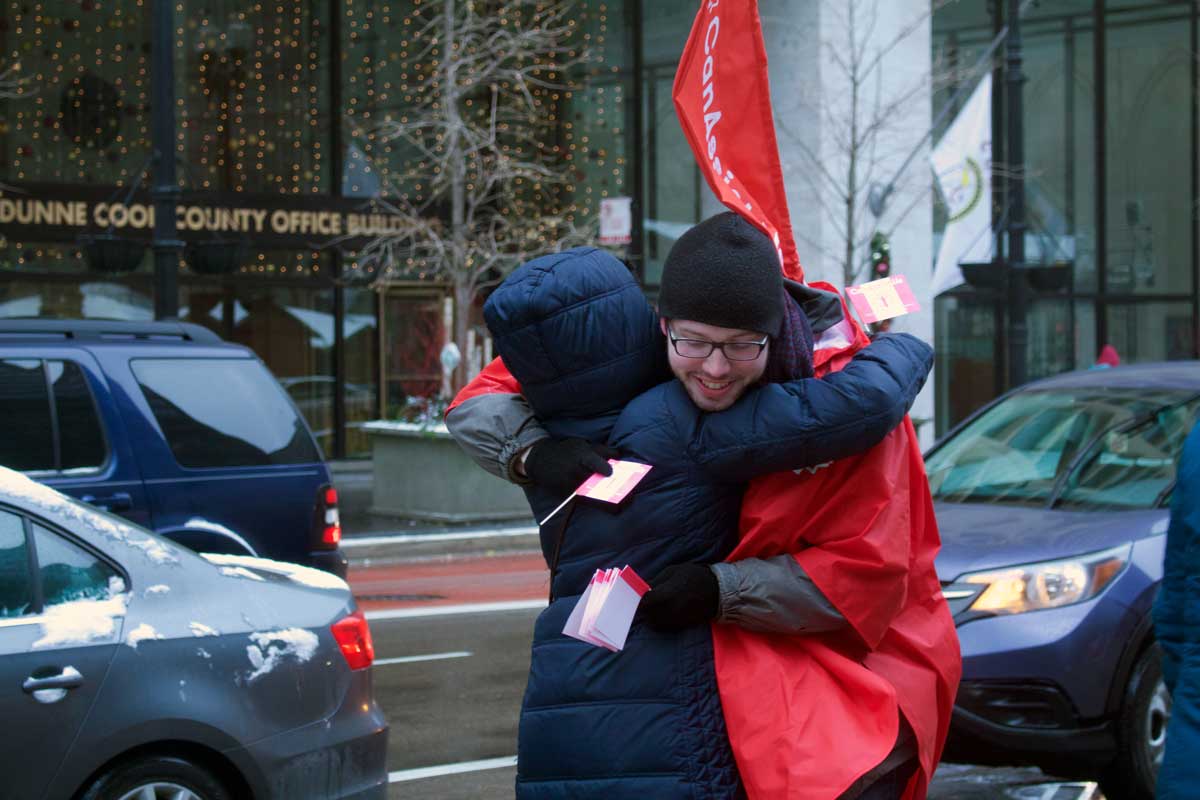
MFA student Cat Bluemke pitched this particular intervention, drawing on her Canadian background to imagine a near-future organisation called CanAssist.Us, and following her lead, the whole class worked together to bring it to life in the streets of Chicago. Below is an email interview with Cat (edited for length and clarity).

***

What is the premise of this project?

CanAssist.Us is a [hypothetical] private company that helps clients navigate the Canadian immigration system for Americans under President Trump. The project channels the anxieties driving this escapism into critical review of the individual’s responsibility within their community to challenge complacency in this reality.


What is the near-future situation you created for people to bring that scenario to life?

The initial ideas for the project were obvious once a few days had passed since the American presidential election results. CanAssist.Us is an absurd but potential reality from a near “post-truth” future (02018, perhaps). Using the familiar form of sidewalk canvassing, the performers offered the ultimate service to "get away from it all".

Once a member of the public engaged, the structure of this American future came into the picture: dehumanising "reform"; life-threatening retraction of health services; and destructive global relations; all promises of a Trump presidency.

[A short questionnaire quickly showed how simply quitting America might not be so straightforward; but to channel people's real concerns productively, and help them manifest the ideal of "Canada" locally,] suggestions for immediate action were presented as workshops the audience could take in their own communities. [These included Multicultural Awareness, Intersectionality, and Anger Management -- as well as popular intensive courses such as Poutine 101.]

How did the public react?

Satire is a great tool for starting a conversation, a united front can exist through a well-structured joke. Structuring that joke to include everyone -- consistent with our urge of a united, intersectional left -- was the difficult part. However, after establishing our position through humour, once we began working with the public, the conversations came easy. The reactions were overwhelmingly positive.


Where does this project sit in relation to other things you've seen that aim to deal with the emerging state of American politics and futures?

The Black Lives Matter movement deserves enormous credit for its accomplishments as a platform for multiple systemic injustices to enter public scrutiny.

CanAssist.Us was more explicitly influenced by artists like Eva and Franco Mattes or the Yes Men, whose public interventions disrupt the complacency that has become the norm.

Where does it sit with respect to projects that you personally have done before?

Both in concept and in execution, CanAssist.Us complements the project Tough Guy Mountain, a group project based out of Toronto, Canada; part art collective, part postcapitalist advertisement agency, and part fantasy table-top RPG.

How does the design of this intervention speak to and work with concerns of the present? How does it make use of the future?

CanAssist.Us uses experiential futures to demonstrate what realities could still be averted, and to encourage the will of the individual to unite under this goal. The situation of our American reality makes the future a particularly urgent tool to engage with.

What challenges did you discover working in a guerrilla futures mode?

I think the whole group could agree that next time, we’d rather guerrilla future on a sunny beach. Jokes aside, the participation of the group members was key in the project, and I’m so thankful that everyone shared in the passion. The kind of improvisation and confidence that is required of a guerrilla futures practitioner is really incredible, but this kind of dedication is desperately needed in order to create a future reality that benefits us all.


***

Many thanks to Cat and the whole of the American Futures class for all their creative contributions, and willingness to brave the Windy City winter to enliven public conversation with an experiential flash-forward.

I appreciate this ingenious effort to turn an understandable sense of alarm, and the potential impulse to flee or turn away, into constructive engagement with possibilities for action in our communities today, through exploring what it means to bring "Canada" (code for "a better place") to where we are.

Our thanks also to Jonathan Solomon, Helen Maria Nugent, and office staff in the design department (AIADO) at SAIC for wonderful assistance and support.

And best wishes to all concerned, as this troubling new chapter begins in the grand experiment that is the United States.

The class and project team comprised Cat Bluemke, Angie Gonzalez, Miiko He, Josh Leslie, Stella Shen, Clint Stayton, Alexander Wilson, and several other students who wish to remain anonymous.

Update 01aug17: This project has been recognised at the 02017 Association of Professional Futurists (APF) Student Awards, taking second place in the Alternative Formats category. Congratulations team!

Related:
> Impacting the Social
> Future documentary
> Introduction to Strategic Foresight
> The weight of alternatives
> Stephen Duncombe on the Art of the Impossible

Thursday, December 29, 2016

The Experiential Turn

How and why has foresight practice been turning towards design, media, arts and games –– and what does it mean for the future of futures?

Plastic Century: interactive installation at California Academy of Sciences. Project by Stuart Candy, Jake Dunagan, Sarah Kornfeld and Wallace J Nichols, San Francisco 02010. Photo by Mike Estee.

***

The Experiential Turn
by Stuart Candy and Jake Dunagan
Human Futures, Issue 01, December 02016

For futures studies to impact mainstream culture and contribute to civilisation-scale “social foresight” (Slaughter, 01996) it must be capable of bridging the “experiential gulf” between abstract possible futures, and life as it is directly apprehended in the embodied present.

The persistence of an experiential gulf in foresight work, an idiom given to abstraction because it is about things that do not exist, is one of the main reasons for what we would say has been the field’s insufficient impact on mainstream thinking about the future over the past half-century. By contrast, the grounding of forethought in both material and emotional reality very much increases its potential impact on thought and behaviour. (Candy, 02010, pp. 61ff.)

Enter experiential futures, the key motivation and rationale of which is to enable more effective foresight work, exploring and shaping change, by using the whole continuum of human experience as the palette of engagement.

Hawaii 2050: public event kicking off a statewide sustainability planning process. Project by Stuart Candy and Jake Dunagan with Hawaii Research Center for Futures Studies and collaborators, Honolulu 02006. Photo by Cyrus Camp.

Experiential futures, “the design of situations and stuff from the future to catalyse insight and change” (Candy, 02015), has a deliberately wide compass, including not only futures-inflected editions of conventional design outputs (print material, concept images, prototypes, physical artifacts, etc), but also installation, mail art, advertisements, immersive theatre, guerrilla intervention, digital simulation (VR/MR/AR), and games. Tangible, immersive, interactive, live, and playable modes are all in scope. [1]

The origins and early cases of experiential futures are described in detail elsewhere (Candy, 02010), but to provide a sense of how far and how fast this area has developed over the past decade, and with growing numbers of other practitioners experimenting in these modes, the authors have worked on projects ranging from immersive experiential scenarios for a group of 550 people at a public policy-oriented sustainability event, to guerrilla street art campaigns, to national-level museums of future possibilities. Partnering organisations have included local, state, and federal governments, community groups, educational and cultural institutions, private enterprises, and nonprofits. We have also developed the practice through teaching in the world’s first two futures programs offered at design schools, at OCAD and CCA.

The Experiential Futures Ladder: Most traditional futures practice, and certainly scholarship, operates on a high level of abstraction, above the experiential threshold, while experiential work explores more concrete manifestations of futures –– possible, probable and preferable.

What then are some of the challenges for futurists making, or contemplating, an “experiential turn”?

They include becoming transmedia producers as well as the transdisciplinary thinkers that we already try to be. This in turn entails not only participating in, but likely often facilitating, collaboration across even more diverse skillsets, and broaching new boundaries – such as those between the expressive/narrative arts and analytical scholarship – in addition to the disciplinary siloes which the field already habitually challenges. [2]

Enabling group thought and creative processes has been an important part of the futures field for years (Jungk and Mullert, 01987; Dator, 01993), and the stakes may be obvious to many already, but the affordances of group creativity and cognition using an experientially augmented toolset, and the details of what works best in what circumstances, are only now beginning to be worked out.
Here, then, we offer some suggestions for core skills and sensibilities that need to be developed further; among them certain competencies already widely accepted and understood, alongside others that may be less familiar.

Futurematic Vending Machine: design jam at OCAD University to fill a vending machine with future artifacts created by participants. Project by Situation Lab and Extrapolation Factory, Toronto 02014. Photo by Stuart Candy.

In order to become a good experiential futurist, you should: [3]

● Become a student of the history, culture, and present situation of the places and people with whom you are co-creating – in order to empathise with and build upon their knowledge and experience.
● Become a perceptive mindreader – in order to understand the mental models of participants or audiences, and then decide how to expand or challenge those models.
● Become a flexible thinker with the habit of long-zooming and scale-toggling – in order to venture, with your transdisciplinary readiness to roam, wherever the inquiry may need to go.
● Become a master of situations – in order to facilitate the co-creative processes of groups, which includes recognising what to nail down, what to leave open, and when and how to improvise changes in response to the needs of the moment.
● Become an engineer of experiences, bridging the gap between the ground of present sensation and islands of abstract possibility – in order to be prepared to use whatever it takes to catalyse heightened creativity, thoughtfulness, engagement, and action, in yourself and others.
● Become a fastidious documentarian – in order to capture the materials, feedback, and insights created during what is a singular, often ephemeral, experience.
● Become a willing collaborator with others you meet along the way – in order to be poised to join forces with those who have skills that you don’t, since no social foresight can be accomplished alone.

Time Machine CDMX: a student-created immersive scenario set in Mexico 02028. Class led by Stuart Candy and Jake Dunagan at CEDIM, Mexico City 02015. Photo by Stuart Candy.

Overall, perhaps the central emerging challenge for foresight practitioners has less to do with generating and broadcasting ideas about the future than with designing circumstances or situations in which the collective intelligence and imagination of a community can come forth. To design and stage experiences of the future(s) is one class of activity. To attend to the design of processes whereby such experiences are designed, making scalable structures of participation, is another. Both frontiers must figure in the unending quest toward “a truly ‘integral’ approach to inquiry” (Voros, 02008).

Finally, we emphasise that the outcome of all this is not simply to create interesting experiences; it is to make experiences that lead to the creation of better futures. To catalyse better futures is “the work” we futurists are called to do, and being willing to recognise the shortcomings of our existing conventions, as these become apparent, and to evolve towards new horizons in how we operate and cooperate––just as we urge and aspire to help our clients, audiences, students, and other constituencies to do––is a critical part of that duty.

Notes:
[1] The original article from which this shorter piece comes (Candy and Dunagan, 02016) deals in detail with the blossoming romance between futures and design, including parallel areas of practice such as design fiction and speculative design.
[2] See Ramos, 02006, for an earlier articulation of this line of argument. A decade of experiential futures work can be regarded as a decisive turn in the field towards meeting this challenge.
[3] The tremendous influence of Jim Dator on this part, and in general, is gratefully acknowledged. See the section titled “To Be A Good Futurist” in Dator, 01996. Our list supplements rather than replaces that one; although note the shift in emphasis between there and here, from mastery of content, toward mastery of process, in service of group intelligence and creativity.

References:
• Candy, S. 02010. The Futures of Everyday Life [doctoral dissertation]. University of Hawaii at Manoa, Department of Political Science.
• Candy, S. 02015. The Thing from the Future. In: Andrew Curry (Ed.). The APF Methods Anthology. London: Association of Professional Futurists.
• Candy, S. and Dunagan, J. 02016. Designing an Experiential Scenario: The People Who Vanished. Futures (In press).
• Dator, J. 01993. From Future Workshops to Envisioning Alternative Futures. Hawaii Research Center for Futures Studies.
• Dator, J. 01996. Futures Studies as Applied Knowledge. In: Richard A. Slaughter (Ed.). New Thinking for a New Millennium. London: Routledge, p. 105-114.
• Jungk, R. and Mullert, N. 01987. Future Workshops: How to Create Desirable Futures. London: Institute for Social Inventions.
• Ramos, J. 02006. Consciousness, culture and the communication of foresight. Futures, 38(9): 1119-1124.
• Slaughter, R. A. 01996. Futures Studies: From Individual to Social Capacity. Futures, 28(8): 751-762.
• Voros, J. 02008. Integral Futures: An approach to futures inquiry. Futures, 40(2): 190-201.


***

The full text of this piece can be found in pdf here.

It appears in the inaugural issue of Human Futures (December 02016), a publication of the World Futures Studies Federation.

The piece represents an edited excerpt (about 10%) of a full-length article and case study of an experiential futures project we did at Arizona State University’s inaugural Emerge festival. That article – excerpted previously at The Sceptical Futuryst here – appears in a special issue of the journal Futures on the theme of Experiencing Futures, guest edited by Cornelia Daheim and Kerstin Cuhls.

***

Update 01aug17: Our original article from Futures has been named a 02017 Most Significant Futures Work at the annual Association of Professional Futurists (APF) Awards, in the Advancing Methods and Practice category. We are grateful to the APF and jury for this honour.

Related:
> Ghosts of futures past
> The Futures of Everyday Life
> Foresight is a right
> A Question of Scale
> The People Who Vanished
> Emerge 02012

Wednesday, November 30, 2016

Future documentary

Image via The History Blog.

I'm currently in the School of the Art Institute of Chicago's Department of Architecture, Interior Architecture and Designed Objects as Mitchell Visiting Professor, and I've been very excited to have the chance to put together a brand new course on my choice of topic for the Spring semester.

Future documentary has been an interest of mine for quite a while (some links below). Check out the draft outline –– thoughts welcome.

***

AIADO 954 001, Spring 2017
School of the Art Institute of Chicago

FUTURE DOCUMENTARY
Investigating and making media from alternative futures

‘Future Documentary’ is a class about the worldbuilding required to imagine and immerse ourselves and others in possible universes. Intended to challenge and amplify the skills of designers, storytellers, performers and makers of all kinds, the course will explore and use the power of films, audio, and other media “from” alternative futures to summon compelling new realities in tangible form.

Intended themes and activities include:
● Critical viewing of future documentary and related genres, cf. science fiction, mockumentary, design fiction, future journalism, and Alternate Reality Games
● How futurists think; possible, probable and preferable futures
● Use of frameworks for generating future scenarios and worldbuilding
● Creation and actual deployment during semester of future documentary media
● Guerrilla interventions, ethics of media activism, and the art of the hoax

Indicative filmography (NB not all are documentary, not all deal with futures, and not all are films):
● Black Mirror (02011-present) (UK) [TV series] Charlie Brooker
● The Blair Witch Project (01999) (USA) Daniel Myrick, Eduardo Sanchez
● Bye Bye Belgium (02006) (Belgium) Isabelle Christiaens, Philippe Dutilleul
● Children of Men (02007) (UK) Alfonso Cuarón
● Cloverfield (02008) (USA) Matt Reeves
● Český sen (Czech Dream) (02004) (Czech Republic) Vít Klusák, Filip Remunda
● The Day Britain Stopped (02003) (UK) Gabriel Range
● Death of a President (02006) (UK) Gabriel Range
● District 9 (02009) (USA) Neill Blomkamp
● Ever Since the World Ended (02001) (USA) Calum Grant, Joshua Atesh Litle
● F for Fake (Verites et mensonges) (01975) (France) Orson Welles
● Hyper-Reality (02016) (Colombia/UK) Keiichi Matsuda
● If… (02004-02005) (UK) BBC
● The Institute (02013) (USA) Spencer McCall
● Menstruation Machine (02010) (Japan/UK) Hiromi Ozaki
● The Office (02001-02002) (UK) [TV series] Ricky Gervais, Stephen Merchant
● Oil Storm (02005) (UK/USA) James Erskine
● Punishment Park (01971) (UK) Peter Watkins
● Radiolab: War of the Worlds (02008) (USA) [audio] Jad Abumrad
● Series 7: The Contenders (02001) (USA) Daniel Minahan
● Smallpox 2002: Silent Weapon (02002) (UK) Daniel Percival
● The Swiss Spaghetti Harvest (01957) (UK) BBC
● Tetra Vaal (02004) (South Africa) Neill Blomkamp
● Wanderers (02014) (Sweden) Erik Wernquist
● The War Game (01966) (UK) Peter Watkins
● War of the Worlds (01938) (USA) [audio] Byron Haskin

Related:
> Death of a President
> Journalism from the Future
> Strategic Foresight Meets Tactical Media
> A film from the future
> In Praise of Children of Men
> Revisiting The Catalogue
> Amusing Anachronisms

Monday, October 31, 2016

The weight of alternatives

Image via.

"History has not reached a stagnant end, nor is it triumphantly marching towards the radiant future. It is being catapulted into an unknown adventure."

***

As the conclusion of the current U.S. election bears down on us, I find myself thinking about an aspect of foresight that doesn't seem to get a lot of attention: the weight of alternatives.

I'm not referring to something exotic about the futures profession, but something much more mundane and widespread, the experience we all have of facing uncertainty in life.

Keeping futures alive means a certain overhead or psychic cost, a subsistence level of care-and-feeding. If you have ever struggled to maintain a connection to the sense of a possibility associated with a job you've applied for, while institutional gears have creaked along for weeks or months, then you know what I am talking about.

Indeed, anyone who has striven to maintain hope in difficult circumstances is familiar with the burden. The greater the felt imperative that a future stay viable, the more it weighs.

This seems a bit different, somehow, from uncertainty's run-of-the-mill spiritual tax. It goes to the costs paid individually in activating or warding off particular critical possibilities.

The mental image this brings to me is a kind of archetypal fantasy-movie climax. It's the vision of some wizard exerting a herculean effort, fluorescent lightning fizzing from the fingertips, to keep open a portal to another dimension until the last critical moment, when the wave collapses and the hero, hopefully, makes good her escape/rescue/restoration of cosmic balance (or whatever).

That's pretty much exactly what it feels like to bear the weight of alternative futures. It comes into focus at some times more than others, but always takes significant human energy to escape the gravity of default settings. The further one's desires depart from the path of least resistance, the more psychic lightning one has to expend.

No doubt investment in imagination can pay off, but it is not without its costs, which may be unglamorous and unpleasant: sleeplessness, stress, depression.

As a case in point, for many at this moment; the internal battle to ward off the Trumpian dystopia threatening to bring tyranny to the United States and grim instability to the wider world (a probability put, at the time of writing, around 25%).

So I do wonder at times if our well-meaning professional arguments for pluralising the future take the human weight of alternatives seriously enough. In this light, declining to take on the burden of alternatives, as many seem to do by insisting on just one possible future, may be an understandable strategy of avoidance.

Keeping possibilities alive within us requires sustained and sometimes heroic effort.

It calls also for self-care, a regard to the personal and internal costs of waging battle with cosmic forces. Even wizards need time to recharge.

Related:
> Investment in imagination (Toward a Preemptive Social Enterprise)
> Journalism from the future
> If women ruled the world
> Questioning hyperopia
> Think about it
> The act of imagination
> Stumbling on foresight

Monday, September 05, 2016

What if unions were software?


On this day, Canada and the United States commemorate the contributions and hard-won rights of workers, which began to be recognised in the late 19th century.

Noting the significance of the annual Labour Day holiday (or Labor Day, if you insist), the former President of the Canadian Labour Congress once observed, "Lots of people lost their lives in order to establish the right to refuse unsafe work and the right to be treated fairly and without discrimination."

Still, today discrimination in hiring persists and equal pay for women remains elusive.

But what if the role and goals of unions were to be embedded in the algorithms pervading the operations of 21st century organisations? If, as Lawrence Lessig declares, "Code is law", what if unions were software?

This full-page advertisement from the year 02035 appears in the current volume of MISC, "a journal of strategic insight and foresight". The issue's theme is Women.


The ad copy reads:

In just a decade, Mortal Labour’s blockchain-certified algorithms have quietly revolutionised working conditions in North America. 
Since 2025, our automated hiring, teambuilding and compensation tools have brought Fortune 500 companies and government agencies across the continent to unprecedented levels of workplace equity and parity. So today, whatever your gender, appearance, or background, you can be confident of getting placed in the right role, at the right time, and with the right pay rate. Bye bye, bias. 
This is not your grandmother's Union. We're the original blockchain "Younion" – admired and copied around the world. With automated dues and dividends, you may not even realise that you're already a member.

This is the work of Christine McGlade, founder and creative director at Analytical Engine Interactive, and Ryan Taylor, a practising impact designer. Both are MDes candidates in Strategic Foresight and Innovation at OCAD University, and they cooked this up while taking my class in Experiential Futures last semester.

The following page in the mag's print edition explains:

In light of the trends currently unfolding in the fields of artificial intelligence, workplace culture, and social values, we hypothesize a version of the year 2035 in which gender equality in compensation, distribution of power, and recognition are realized – finally – by taking flawed human decision-making out of the equation. On this basis, we generated an office artifact from the year 2035: an advertisement for the Union of the Future. 
In this version of 2035, education, placement, recruitment, hiring, and team formation are all controlled by an algorithm. The “Younion” perfectly matches tasks that need doing with individuals who have demonstrated the competencies suited to doing them. Blockchain-certified, the Younion guarantees team diversity, optimum innovation, and absolute wage parity based on value and not gender. The Younion takes the bias of the bottom line.

The ad does indeed start to look like a fragment of a possible, and in some ways quite upbeat, future, considering the rapid rise in workplace automation reducing availability of human jobs; the integration of algorithms into hiring processes to offset human bias; the emerging use of blockchain technology to enable independent verification of a candidate's qualifications (such as university degrees); and the potential of labour organisations to accept the challenge of developing new models for protecting workers in the face of technological disruptions.

By the same token, we would be wise not to overlook the potential for these variables to net out the opposite way –– with more elaborate, technologically black-boxed bias, at least as opaque as analogue decision-making has ever been. The notion of a blockchain-enabled, bias-busting "Younion", then, is perhaps a positive vision of what law professor Frank Pasquale calls for under the banner of algorithmic accountability.

***


The choice of "Women" as the theme for this issue followed a widely read article in The Atlantic last year claiming a dearth of women in futures, which prompted a valuable discussion among members of the profession, and the appearance of at least two lists of female futurists practising around the world.

MISC is out now on newsstands, and available to order here.

A pdf of the special feature "The Future According to Women" can be found here.

***

Special thanks to Franz Steiner of Steiner Creative for permission to use the image appearing in the ad.

Much appreciation to Ashley Perez Karp and Emily Empel of Idea Couture for sharing the published material back with us.

And well done to Christine and Ryan for a deft and timely piece of experiential futures work.

I find it pleasing to contemplate the in-world (diegetic) advertisement as a next-generation twist on Wired's long-running and creatively inspiring feature Found: Artifacts from the Future, which sadly was consigned to the past in 02013.

Related:
> The Future of Church
> Wired artifacts gallery
> Found Futures
> Future jamming 101
> If women ruled the world

Thursday, September 01, 2016

A Question of Scale

Diagram by Daisy Ginsberg; original here.

How do you scale experiential futures?

If we're serious about infusing foresight into the culture at large, how can experiences of possible futures reach more people?

The Futures of Everyday Life concluded by connecting the promise of experiential futures to the prospect of social foresight, a distributed cultural capacity for thinking ahead.

This question of scale, then, has been a driver in much of my work over the past several years.

It is in the DNA of The Thing From The Future, a game we created to make concrete futures ideation (storytelling and design fiction) faster, easier and more widespread.

Itt's one of the main motivations behind the series of playful participatory design events that we -- Situation Lab and The Extrapolation Factory -- have run at OCAD [video], New York University [video] and the University of Southern California [post].

Scale via the classroom route has been at the heart of an experiential futures assignment I've developed over the past few years called The Time Machine, written up in 02013, then taught and iterated each semester since. (A Time Machine turns a room into an experiential scenario at 1:1 scale, immersing visitors in a possible future.)

And scale is also the central question I brought to the most recent Oxford Futures Forum, held at the University of Oxford a couple of years ago now. An abstract contributed for that event is reproduced below, by way of a prelude to sharing more here soon about experiential futures practice at scale.

In particular, we'll be taking a look at several dozen Time Machines created so far, as well as the Museum of the Future exhibition which I worked on for the World Government Summit held in Dubai earlier this year.

***

Scaling experiential scenarios 
In recent years a romance between foresight and design has blossomed, with much engaging and media-rich output emanating from the encounter (Antonelli 2008; Sterling 2009; Candy 2010; Haldenby 2013; Dunne and Raby 2013). Notably, hybrid practices such as "design fiction" and "experiential futures" have been entering common currency (Bleecker 2009; Raford 2012; Turney 2013).
I have collaboratively developed experiential futures (a broader term, encompassing design fiction) across wildly different contexts - public art installations, client workshops, massively multiplayer online games, and so on. Hybridising scenarios and design brings visceral engagement into a dry tradition that otherwise threatens to fall short of its culture- and history-catalyzing potential (Candy 2010). 
So what’s next? 
The task of putting design more impactfully in service of scenarios poses two complementary questions: 
* What kinds of scaled-up immersion are possible -- considering, for instance, a transmedia intervention during the Arab Spring whereby multiple Tunisian media - press, radio and TV - reported "from" 14 June 2014, three years into the future, for a whole day? (Candy 2011) 
* What structures of participation are most effective for scaffolding experiential futures design – e.g., what makes a successful brief for students translating textual scenario premises into tangible, immersive form? (Candy 2013, 2014; Candy and Dunagan forthcoming) 
Having been involved in the futures field since 1997 as (variously) a student, researcher, consultant, artist, and educator, my interest in these topics spans all these modes. The work has not always generated the expected results, but it has always been illuminating. 

References: 
• Antonelli, P. 2008. Design and the Elastic Mind. Museum of Modern Art, New York.
• Bleecker, Julian. 2009. Design Fiction: A Short Essay on Design Fact and Fiction. Near-Future Laboratory, Los Angeles. http://www.nearfuturelaboratory.com/2009/03/17/design-fiction-a-short-essay-on-designsciencefact-and-fiction/
• Candy, Stuart. 2010. The Futures of Everyday Life: Politics and the Design of Experiential Scenarios. Dissertation. Honolulu: University of Hawaii at Manoa Department of Political Science.
• Candy, Stuart. 2011. ‘An experiential scenario for post-revolution Tunisia.’ The Sceptical Futuryst. 1 April. http://futuryst.blogspot.ca/2011/04/experiential-scenario-for-post.html
• Candy, Stuart. 2013. ‘Time Machine / Reverse Archaeology: Create an experience or artifact from the future.’ In 72 Assignments: The Foundation Course in Art and Design Today. Chloe Briggs (ed.). PCA Press, Paris.
• Candy, Stuart. 2014. “Dreaming Together: Public Imagination and the Future of Governance”. In Made Up: Design's Fictions. Tim Durfee and Mimi Zeiger (eds.) JRP Ringier / Art Center Graduate Press, Zurich. Forthcoming.
• Candy, Stuart and Jake Dunagan. 2014. ‘The People Who Vanished: Co-creating an Experiential Scenario’. Futures. Forthcoming.
• Dunne, Anthony and Fiona Raby. 2013. Speculative Everything: Design, Fiction and Social Dreaming. MIT Press, Cambridge, MA.
• Haldenby, Trevor. 2013. Bringing the Future to Life: Pervasive Transmedia Scenarios and the World of Worlding. MDes Thesis. Strategic Foresight and Innovation Program, OCAD University, Toronto, ON.
• Raford, Noah. 2012. ‘From Design Fiction to Experiential Futures.’ In The Future of Futures. Andrew Curry (ed.) Association of Professional Futurists, Houston, TX.
• Sterling, Bruce. 2009. ‘Design Fiction.’ In Interactions 16, 3. http://interactions.acm.org/content/?p=1244
• Turney, Jon. 2013. Imagining Technology. Nesta Working Paper 13/06, March. www.nesta.org.uk/wp13-06


***

This contribution can be found in the full collection of abstracts from the Oxford Futures Forum, on this occasion dealing with the theme Design and Scenarios.

A recent special issue of the journal Futures guest edited by Thomas Chermack, Cynthia Selin, Rafael Ramirez and Yasser Bhatti features several articles arising from the Forum.

The edited collection called Made Up referenced above is officially no longer happening, unfortunately, but the piece I wrote for it has been posted here: Dreaming Together.

And the article co-authored with Jake Dunagan, listed as Forthcoming, appeared in Futures a few months ago under the title Designing an Experiential Scenario.

Related:
> Experiential Futures in The Economist
> Dreaming Together
> An experiential scenario for post-revolution Tunisia
> The People Who Vanished
> 1-888-FUTURES
> The Futures of Everyday Life