Showing posts with label speculative design. Show all posts

Tuesday, November 22, 2022

A new collection on Speculation in Design

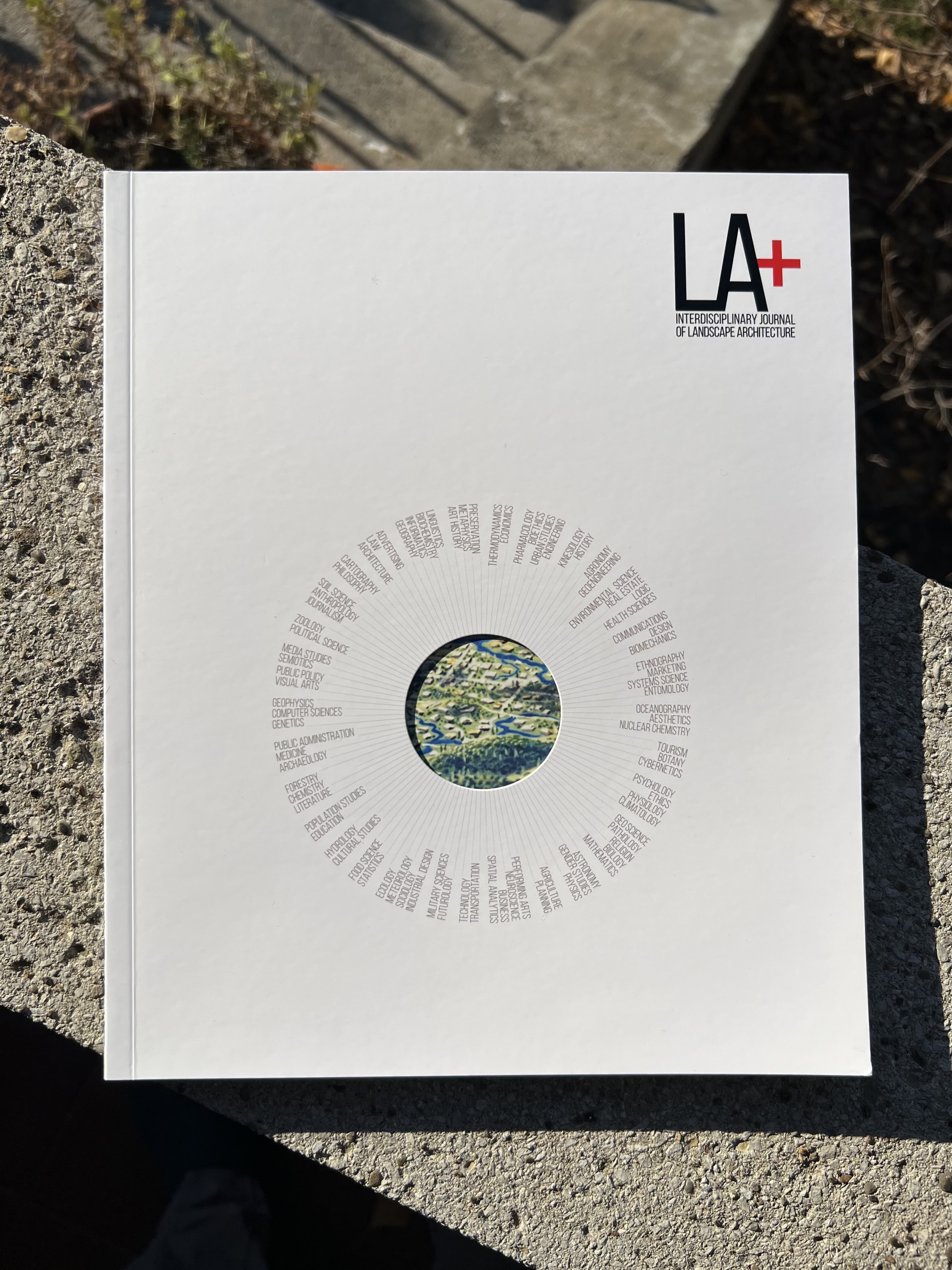
The University of Pennsylvania's Weitzman School of Design has published the latest edition of its periodical LA+, an interdisciplinary journal dealing with landscape architecture –– and more, as the name hints.

The topic and title this time out is SPECULATION, a multifarious and richly intersectional theme on which contributions appear from Alexandra Daisy Ginsberg, Javier Arpa Fernandéz, Min Kyung Lee, and Ytasha Womack, together with many others, all marshalled by the issue editor Christopher Marcinkoski and editor-in-chief Tatum Hands.

I had the pleasure of taking part in the project via a conversation with a wonderful transdisciplinary practitioner of landscape architecture and media arts, professor Aroussiak Gabrielian of University of Southern California's Architecture school. As a taste, below is one of my favourite questions posed by Aroussiak, and the thoughts it prompted.

***

AG: I’m wondering how you feel about the pitfalls in speculative design, given the criticism it has received for being speculation for speculation’s sake or that its focus has been very techno-scientific, or product driven – pushing forth the same capitalist system by inventing objects that we might consume in the future.

SC: Yeah, I think that those are definitely ways the work can fail to live up to its potential. Sometimes, especially early on, practitioners might find themselves using an excess of whimsy on one hand, or an excess of capitalist realism on the other. To me, both are ways of missing the mark, but I think it would be unfortunate if that were to lead some observers to think that the whole enterprise of using design and the arts to explore futures is without value. That would be a grand-scale throwing out of the baby with the bathwater. It’s possible to write bad poetry, too, but that doesn’t mean all poetry is bad.

I would say that some of the criticism drawn during the recent wave of speculation in design, while fair enough, is really responding to a sort of belated unleashing of creative energy that was previously stifled by a so-called human centered, but, let’s be honest, capital-centered, paradigm where the use of imagination is highly constrained, and aspirational only within tightly defined limits. You take those constraints off, and people go wild. That is actually kind of cool to watch, but is it the end state for the practice? I don’t think so. Once people have gotten some of that initial rambunctious energy out of their system, there is a sort of getting of wisdom in play. You can see this with [card game] The Thing from The Future. To start with, many players revel in the license to run free, be silly, and have fun. Then, after a while, they start to get a little bit more critical and search for ideas with more substance. The novelty of the very idea of something ostensibly coming “from the future,” perhaps exciting enough in itself to begin with, wears off, and players start to want to know more about what future it’s from, and how it might work, and how it’s different from what they’ve heard before, and whose interests it represents. This is part of why, having created the game, Jeff [Watson, cofounder of Situation Lab and professor at USC School of Cinematic Arts] and I kept adapting and modifying it, and using it with different groups to help push the general vogue for speculation past this initial flare-up of excitement and crappy ideas that we all tend to have when first invited to roam freely in the space of alternative futures.

To try to make the year 02050 matter right now is an important but difficult task. There’s no objective referent for a 02050 scenario – in contrast to trying to bridge into the shoes of someone historically or in the present, where you can at least partially ground-truth things. The inbuilt speculative challenge of futures is that they are not just epistemically but ontologically indeterminate. They are up for grabs. So we need to realize that when we’re making a hypothetical world specific enough to wrap our body-minds around, we’re making it artificially specific, just in order to be able to think and feel into it. We have to take the ability to inhabit this “what if” with a big grain of salt, because it’s not a question of getting it right or not, in a predictive sense; it’s a question of how rigorously and usefully we are deploying imagination to enable new perceptions and possibilities in the present.

***

If you're interested in the theme of speculation, as so many designers have been recently, check out the full piece (Futuring: A Conversation) and the collection as a whole (digital or print).


Related:
> Design and Futures (ebook and paperback)
> Critical activism: Anab Jain of Superflux
> I design worlds: Liam Young of SCI-Arc
> Using the future at NASA: David Delgado of NASA JPL
> Gaming futures literacy: The Thing From The Future (pdf)
> An experiential futures interview 
> Designing futures: An interview
> Design is a team sport
> Killer imps: Bringing futures to designers at the Royal College of Art

Tuesday, October 18, 2022

Welcome to The Futures Bazaar

The Futures Bazaar: A Public Imagination Toolkit is published by Situation Lab & the British Broadcasting Corporation

(Update 20dec22: The Futures Bazaar has been named a Most Significant Futures Work of the year by the Association of Professional Futurists! Winners of the 02022 #IFAwards were announced here. Many thanks to APF for this recognition in the Inclusive Foresight category, and gratitude again to our BBC collaborators and all who contributed to the project, listed in this post and also in the kit itself.)

Picture a wild and wonderful place where all alternative future possibilities co-exist at once, and can be physically encountered in real life; a kind of multi-dimensional exchange, where tangible objects are put on offer from countless possible worlds.

This crazy setting is not just an idea, but somewhere I’ve visited — twice, actually. And you can, too.

The Futures Bazaar: A Public Imagination Toolkit, created and written together with my fantastic design futurist colleague Filippo Cuttica, has just been released by the British Broadcasting Corporation and Situation Lab. It’s available to download for free from the BBC here.

Thinking concretely about times to come is harder and rarer than it should be. That’s why this is an open access public imagination toolkit. It’s designed to help make such thinking a bit easier and more common.

The Futures Bazaar toolkit is basically a turnkey framework for setting up a co-creative gathering or design jam where participants transform everyday objects brought from home into unique things “from” alternative futures, to provoke, amuse, and inspire each other. Every participant helps imagine and produce these future artifacts, and every artifact tells a story.

You know, the toolkit is itself a sort of artifact, with a story of its own.

A few years ago, before the pandemic, we staged the first Futures Bazaar for the away day of the whole design side of the BBC.

It was great. There was zaniness. There was creativity in spades. At the end, there was even beer on tap. More about this wild experiment we did with BBC designers can be found here.


Other things equal, perhaps that would have been the end of it. But soon afterwards, I ran a second iteration in my required design futures course at Carnegie Mellon. (This time, no beer.) It seemed like an appropriate way to introduce a roomful of undergrad designers to the idea that any item can mobilise an array of associations and tell a range of stories. Playing with the signs and sensemaking of material artifacts in this way proved a neat on-ramp to broader vistas of experiential futures practice.

Both bazaars went so well that the process seemed to be crying out to be shared with a wider audience. Then Covid-19 struck, and everything went on hold.

However, as time passed, and the pandemic wore on, the widespread need that prompted this project in the first place — the need to support shared spaces of imaginative engagement — has become only more obvious, and more urgent.

In order to adapt and distill the Bazaar design into a toolkit, Filippo and I spent months working on how to make organising one of these events as intuitive as possible, without us being in the room. Our aim was to enable any motivated gathering, equipped with a basic projector setup, some printouts, and ordinary household objects, to imagine countless possible worlds and bring them to life on the spot. 

The Futures Bazaar can now be run by anyone, anywhere. It is for players of all ages, in all fields. It is intended for use in public and private organisations, government bodies, schools, and nonprofits alike.

It offers a chance to expand horizons, explore new ideas, and develop capacities for foresight, creativity, and storytelling, all in just a few hours. It can be set up as a stand-alone event such as a company away day, or within a larger workshop, course, or event series.

Conceived in the traditions of experiential futures and participatory design, it might be part of a journey — as at the BBC itself — towards building foresight capability, engaging alternative futures in more open and creative ways, or it can be used more for fun — teambuilding through worldbuilding.

The toolkit is made up of three elements: Manual, Slides, and Printouts. The Manual (a complete guide for use in hard copy or on a tablet) helps you plan your own event, the Slides (to display on any large screen or projector) help you run it, and the Printouts (ready to go in either colour or B&W) are for distributing to participants on the day. All this has been packaged into a single zipped folder containing the full set of PDF documents for download here.


This project has been able to take advantage of some of the experiments and learning at Situation Lab, the creative research unit that I’ve run for the last nine years. The toolkit incorporates elements from our award-winning game The Thing From The Future, and it also builds on the participatory design events that we at Sitlab carried out with Extrapolation Factory; the Futurematic design jam series, held in the mid-2010s in Toronto, New York and Los Angeles.

The kit’s acknowledgements section tips the hat to the many folks who made this publication possible, but above all, The Futures Bazaar toolkit is dedicated to the memory of my dearly missed friend and longtime collaborator Jeff Watson of the University of California’s School of Cinematic Arts, co-creator of The Thing From The Future and co-founder of Situation Lab. The invention of openly available, playfully framed, creatively enabling frameworks and designs was among his great gifts, and an inspiration throughout the project.

Filippo and I, with our talented collaborators at the BBC, are delighted to be sending this toolkit forth into the world, hoping it will travel, and be taken up far and wide. We can’t wait to find out what people get up to with it.

If The Futures Bazaar sounds like something you might like to run, you can go ahead and download version 1.0 of the kit right now. If there happen to be folks in your world who might enjoy it, please share this article or the project link with them. We plan to make additional guidance available for those interested, so following Sitlab, Filippo or me on Twitter would be a good way to keep up with the latest news and announcements.

The world can be a frightening and unpredictable place. This project is not going to solve all its problems. But we are in earnest when we say that we think the capacity to imagine is key to shaping the futures, and this kind of collective play is key to imagination.

So get playing… we look forward to seeing you at the #FuturesBazaar! ✨ 

The Futures Bazaar invites you to expand horizons, explore new ideas, and transform everyday objects into things from the future

***

This article previously posted on Medium. A variant appeared at Situation Lab.

Related:
> Gaming Futures Literacy (article on The Thing From The Future)

Thursday, April 23, 2020

Three Dimensions of Foresight

As the covid-19 crisis unfolds, many of us are looking to an extravagantly uncertain future with anxiety, as well as a new appreciation and appetite for whatever brings confidence and clarity to prospection.

How might concerned citizens engage in more effective futures thinking and storytelling?


Columbia University's Digital Storytelling Lab (DSL), led by a veteran experimental storyteller, my friend Lance Weiler, has responded to the pandemic by offering ingenious, collaborative, and free opportunities for hundreds of folks in quarantine and isolation all around the world to come together, imagine alternative futures, and manifest them through co-created digital story artifacts.

The project is called From the Futures. With this effort, Lance, Columbia DSL and team are tending a welcome oasis of collective creativity for our moment.

They invited me to help kick things off with an introduction to a framework related to the experiential futures space that the project inhabits and plots out. The slides embedded above distil that talk, "Three Dimensions of Foresight".

The three dimensions can be seen as corresponding to various manoeuvres or methods in the futures repertoire that typically require quite a bit of practice to master. But even for those trying experiential futures for the first time (which would include many From the Futures participants), they can also be mobilised right away via a series of practical moves towards storytelling more different, deep, and diverse than it might otherwise be:

• Difference : let us seek seeds of change in the present that could be really transformative if they were to grow.
• Depth : let us try to not just think, but also feel, our way into these imagined conditions by devising specific future artifacts and diverse media to bring the imagined possibilities to life as if they came to pass.
• Diversity : let us operate generally in terms of plural futureS, but even if constructing a single scenario or possibility for a particular project, find what is fresh and uncommon for the ecology of thinkable and feelable futures, since a new story may be dramatically more valuable than yet another telling of one that we have already heard many times before.

The framework has its origins in my doctoral project on experiential futures. There I ventured an arguments about the need to build on, and systematically range beyond, the most common practices and methods of previous generations of futurists. I wanted to show that foresight practitioners could and should embrace a range of "experiential" (a deliberately big umbrella) approaches, in pursuit of the requisite realism and resonance to affect how we think and what we do in the present. Often this would mean seeking and evoking depth; making a future's details and implications available and graspable –– tangibly, sensorially, viscerally –– in ways usually lacking from the even most carefully researched, well written horizon scans or scenarios. This approach includes an assumption or acknowledgement that things at later points in time are bound to be as real, complex, and full of contradictions as the present. We should strive then to get "under the skin" of the futures we face, and engage them not in the abstract as intellectual constructs, but through evocative concrete experiences, as potential realities in waiting.

In this connection I wrote about the need for a "mundane turn" in futures practice (The Futures of Everyday Life, 02010, pp. 89–94), by analogy with an important shift of orientation that had already taken place decades earlier in cultural history, tying this quest for modest but evocative fragments, details and textures of worlds to come, to design and discussion in the present of artifacts or experiences that might exist in those futures (hence the phrase "futures of everyday life"). Among other contributors, Nick Foster's perceptive essay The Future Mundane, and Tony Dunne and Fiona Raby's influential book Speculative Everything (both 02013) carried these sorts of ideas further among design audiences. It has been satisfying to see the spread of futures-curious, design-led practices like design fiction and speculative design summoning new explorers and fellow travellers to this terrain.

The three dimensional lenses on futures practice came into sharper focus soon after the dissertation work, and they helped frame our first run of the Strategic Foresight course in the Design Strategy MBA program at California College of the Arts (02010). That course is outlined here. Since then, and refined thanks to audiences and student groups over the years, 3D foresight has become one of the main ways I introduce futures to newcomers.

For those who might like a more methodologically detailed overview of 3D foresight, with additional examples, I recently gave a lecture across campus at Carnegie Mellon's Human Computer Interaction Institute, How to think about the future.

Our video of the talk to From the Futures participants (via Zoom) has already been shared, and Lance's written accounts of the initiative so far can be found in the posts Designing for immersion in Zoom and From the Futures: experiments in collaborative art and collective wayfinding in a time of ambiguity.

A wonderful sense of the swarming, emergent, hive-mind creativity that this process has helped to unleash, and to guide, is captured visually in the timelapse below. If interested in receiving updates or taking part yourself, head here.


Related:
> The Futures of Everyday Life (pdf)
> About the first Strategic Foresight course at CCA (pdf)
> A Brief Outline of Experiential Futures
> Design for the Next Context (Closing Keynote at 02010 AIGA Conference)
> The Experiential Turn (with Jake Dunagan)
> On Getting Started in Experiential Futures
> Design is Storytelling

Monday, June 17, 2019

Critical activism

Anab Jain is a leading light of experiential futures practice. She is cofounder with Jon Ardern of the London-based "vanguard foresight and design organisation" Superflux, whose work has rightly earned attention and admiration far and wide, with projects like Mitigation of Shock (an installation), Instant Archetypes (a tarot deck), and Drone Aviary (a film, and more).

Image from Mitigation of Shock by Superflux, an installation at CCCB portraying a small London apartment adapted for climate change in 02050 (02017)

We first met in 02009, just a few years into our own first experiments with experiential futures, following a talk I gave on that topic at the Long Now meetup in London one evening during my time visiting 'Design Interactions' at the Royal College of Art. This was the highly influential MA program led for a decade by the wonderful Fiona Raby and Tony Dunne from which Anab had graduated back when it was still a degree in 'Interaction Design' –– prior to the 02008 landmark MoMA exhibition Design and the Elastic Mind, which contributed much to the visibility of the work of not only Dunne and Raby but also their mentees, in what they called at the time 'design for debate' and 'critical design', and well before 'speculative design' framing coalesced (as mentioned by Anab below), a development of the past five years or so.

Superflux got underway in 02009, a few months after we'd met in London, and Anab and Jon were among the first designers to set up shop in a way that engaged the tradition and practices of the futures field not just explicitly (using the language) but substantively too (really using the tools). For instance we recently collaborated on introducing foresight to International Federation of Red Cross and Red Crescent Societies (IFRC) via experiential scenarios deployed at IFRC's biennial strategy meetings.

This post is an abridged version of a conversation appearing in the recently published Journal of Futures Studies special issue Design and Futures, Volume I.

Anab's sense of the work as "slow critical activism" really resonates with me, and her candour here, talking about the behind-the-scenes challenges of maintaining a design/futures business that is both viable and principled, is super generous and helpful, I think, for the many newcomers eager to figure out how they can practically make this sort of thing a part of their work lives.

***

SC: How do you situate your practice in relation to futures and design?

AJ: I think we are situated somewhere in the middle. We have a two-pronged approach. We do foresight and horizon scanning – that big, meta-level stuff – but we simultaneously ground it with material explorations, ethnography, research, prototyping.

Obviously we come from a design/art background more than futures. Our schooling was often about what the implications of a certain technology on society might be. And over the years, we’ve studied the more traditional futures methods a bit, not quite as much as a futurist would.

SC: What are some projects or initiatives that you’ve been involved in that you consider exemplary of your approach?

AJ: Our approach has changed a lot. We often used to work around a technology, so we would pick something like quantum computing or optogenetics, and try and understand what its potential is, but also poetic implications that the scientists or the technologists might not have explored.

And we’ve moved from that to thinking more socially, politically. We’re very interested in the implications of living with climate change, so for a recent project, Mitigation of Shock, we really wanted to understand how to bring that future that is so abstract around climate change - especially in the Western part of the world - making it real and conceptually visceral, but also not dystopian.

SC: So you’ve been at it...

AJ: Nine years.

SC: I’m interested in how you imagine the work that you’re doing against the backdrop of an increasing number of people operating at this intersection. If there is a “you are here” point on a map of bigger activities going on, where do you locate yourself?

AJ: Oh, that’s a good question. We keep asking that ourselves.

'Speculative design' has become popular, the term; although we have never actively used that term so far. We are afraid of labelling the work we do within a specific discipline, because for us it’s changing all the time, and we want to have the freedom to change. So we just call ourselves designers, or artists even.

Where people are interested in our work, or want to commission us or hire us, they are not thinking about us as speculative designers or critical designers either. They’re thinking: "We need to think about the future, but we don’t know quite how to make it visceral enough to get people to understand the consequences."

Outside of the world of design, not so many people care whether we call what we do speculative design or not. Some people call us a think tank, some people call us a research unit, some people call us artists.

SC: What are you grappling with in relation to these practices at the moment?

AJ: Lots! We’ve gone from being tiny to growing quite a bit, and then, recently decided to consider more carefully where we go next, and stop just producing project after project after project. I think we are trying to understand what meaningful change looks like for us.

We keep getting emails from people, and we know that the work affects people and gets them to think differently, but how can we materialise it without using this language of evaluation and impact and measuring? Because these are not things that can be instantly measured. Something that you’ve done to provoke people could affect them and get them to think differently after years –– but how do we begin to surface that?

I see it as a form of slow critical activism. If our work becomes a catalysing force for people to imagine things they would not have been able to imagine otherwise, that’s powerful. But then what? We are at that stage right now.

Currently I think our work is moving in two directions: one, with people whose idea of the future we may not agree with personally, but who have a lot of power and influence to affect change at a large scale. Our work with them focuses on helping them consider broader, unintended consequences by enabling them to think differently and more broadly. Secondly, we work in the public sphere, triggering public imagination.

Organisations who have power and influence and can actually affect decisions around climate change or education, are so outcome driven, that their key question around any futures always seem to zoom in on: What are the outcomes we get, and what’s the impact, how will this affect our strategy?

SC: And what do you tell them?

AJ: We don’t really have a clear answer. We can say, okay, we did this with the UNDP, and that led to the opening of this completely new department where they’re thinking about alternative financing. Or we did this, where it affected a decision or policy change. Examples are few and far between where there is a clear, linear, obvious trajectory of 'impact'.

People want concrete stuff, and the thing is, there isn’t a concrete answer. There isn’t a concrete outcome, to be honest. The outcome is the process by which you will start shifting your thinking.

SC: What do you think are the most important things for people who are interested in this area of work to be aware of?

AJ: One of the questions I always get is, "How do you actually make money, and who are your clients?" and it’s like, it doesn’t seem plausible that we could even be doing work and be paid. We’re not set up to be making profit, but we are alright!

We could earlier this year have gone easily from eight to twenty people. But we realised that scaling in numbers is perhaps the wrong way of thinking about 'growth' for our studio, and the scale lies in the nature and ambition of each project, and the way it can influence a decision or change perception. The bespoke nature of our work means we cannot adopt a cookie cutter approach to our services. No brief is ever the same. And having a flexibility of staff and overheads to support such work is very important. We might have big ambitions, but it’s not dependent on the scale of our practice.

For a designer, it’s so tempting to have 20, 30, 40 employees, to become 'the office'. It is in the model. I am often asked: "How big are you? How many employees do you have?" And they will actually decide whether to give us work or not based on my answer. So yes, sometimes it’s tempting to scale because scale is a seen as a visible sign of success.

SC: I really like this unwillingness to settle for an inherited definition of success. Instead it’s striving for a certain quality of impact, or a certain kind of cultural presence.

AJ: We tried it, and we’re both not managers. Well, we do have to now, but we really enjoy the actual craft of storytelling, making, building, designing and all of that. So we want to find a way we can continue our practice.

SC: Have you ever done a futures process for your own organisation?

AJ: No! We should, shouldn’t we?

***

The full version of the conversation as published in JFS can be found here.

Thanks again Anab!

Related:
> Design and Futures, Volume I
> I Design Worlds (Liam Young in JFS)
> Experiential Futures: A brief outline
> On getting started in Experiential Futures
> An Experiential Futures interview
> Ghosts of futures past
> Killer imps (RCA Design Interactions)

Saturday, June 16, 2018

An Experiential Futures Interview

Unearthed from the archives...

Professor John Robinson (University of Toronto) playing The Thing From The Future with teammates at Utrecht University's Experiential Futuring Summer School (Photo: Stuart Candy)

For the past few days I've been in Leeuwarden, in the north of the Netherlands, for an 'Experiential Futuring Summer School' piloted by the Urban Futures Studio from Utrecht University. Last night we arrived in London, where the V&A Museum recently opened The Future Starts Here, a major exhibition that runs until November and showcases "more than 100 objects as a landscape of possibilities for the near future". Last week Jake Dunagan and I introduced city leaders from around the United States to futures practice, with a special Cities Edition of The Thing From The Future card game, in Boston at the annual US Conference of Mayors. (It followed a similar event we ran for American mayors at South by Southwest in March.) The weekend before last was spent with European civil servants in Brussels for the EC Joint Research Centre's conference FTA2018, who showed what seem to me unprecedented levels of interest in experimenting with design and games to support policymaking. Last month I gave the opening keynote at Primer, the second annual gathering drawing hybrid futures/design practitioners from around the world to the San Francisco Bay Area, on the back of a burgeoning series of 'Speculative Futures' meetups. (The word speculative is redundant here: certainly not all speculation is about the future, but all futures thought is necessarily speculative.)

Whatever it might be called, there's a flurry of activity at the intersection of futures and design. After many years of quiet gestation in mostly isolated pockets, and of bringing these ideas to the attention of countless previously uninitiated groups, it's exciting to find a growing number of folks experimenting and enthused; an increasingly networked awareness and momentum; a sense of emerging community.

At these events we often also find some amount of grappling with terminology and framing, which takes me to how these areas have evolved over the dozen years since we started working in this space –– before we had so many instances to think with, let alone a vocabulary for it. I'm reminded of an exchange from 02012, when futurist Trevor Haldenby interviewed me via email as part of his Master of Design research project at OCAD University, with the working title 'Transmedia Narratives and Experiential Scenarios'.

Our interview covered several topics that remain relevant, and seem useful to share given the growing interest in these spaces. A little context for the (lightly edited, links added) exchange below: this was the same year that Trevor and collaborators founded The Mission Business, with the focus of his MDes project – the final version is here – being their groundbreaking interactive theatre campaign ZED.TO. I didn't yet know that my next step would be to Toronto for a professorship at OCAD; at the time I was still heading up Foresight and Innovation for Arup in Australasia. The end of 02012 was two and a half years after The Futures of Everyday Life, and a year before Tony Dunne and Fiona Raby published Speculative Everything, at which point the frame of 'speculative design' really started entering currency.

TH: How do you refer to your work? What is the history of the term?

SC: I most often use the terms experiential futures and experiential scenarios. The former refers to the whole area of practice, as a methodology. The latter refers to particular projects or interventions based on specific stories. They bear a very similar relation to one another as do the terms sans 'experiential'; i.e., the second is a subset of the first.

There are plenty of cognate terms currently floating in the same semantic cloud. The term 'tangible futures' is useful because it's intuitive. 'Immersive futures' also. 'Critical design' seems mainly to be about stretching the intellectual legitimacy and contributions of design, a worthwhile aspiration that is associated with some very interesting work (Dunne & Raby and their protégés). 'Design fiction' turns out to be a semantic honeypot luring design-minded folk into a worthy mode of experimentation, combining speculative story with a designerly interface to materiality; although to date, in practice it has been excessively tech- and object-focused. It has also by and large not yet escaped the techy subject-matter preoccupations of its cousin, science-fiction prototyping. The scope of futures needs to be far wider than gadgetry; the rub's in the manifold rippling consequences of change, especially in the complex ineffable and multifarious nontechnical facets of life as we experience it. Imaginings that start with technical objects seem too easily also to end there, indulging a desire to oversimplify, so I suggest there's a reductive thinking here that we need to challenge ourselves to surpass. In any case for that narrower purpose, the evocative (if bulky) term 'artifacts from the future', borrowed from Wired magazine, is the one I tend to use.


There are also such polysyllabic options as 'object-oriented futuring' and 'diegetic prototyping', the former I've written about a bit and the latter having been picked up from David Kirby by #defi boffins Julian Bleecker and Bruce Sterling. To my mind, all of the above have their place while being less encompassing than 'experiential futures', which I prefer because a nascent practice - which is what I think this was when I was writing my doctorate on the subject; and in many ways still is - needs an overarching conceptual frame pulling it together. The reference to experience is a deliberate choice of an accommodating substrate or canvas incorporating designed objects, encounters in the flesh, etc. (I also appreciate and sometimes use other design terms like 'interaction design' and, even if it's much less common, 'situation design'.) But the choice of 'experience' is meant to include basically anything that you as a futures practitioner, artist or agent provocateur can cause or catalyse. It applies equally well to an object in hand, an advertisement in the newspaper, a role-playing game, a documentary snippet from the future, and more.


I don't know when I started using the term experiential futures but it would probably have been in conversations with collaborator Jake Dunagan in around mid-02006, and then 'thinking aloud' at my blog, as those ideas developed. It was in fact the blog's tag cloud that progressively (and somewhat to my surprise) demonstrated that my set of interests were gravitating towards art and design. A 02009 guide to communicating climate change for laypersons included the term 'experiential scenarios' as a key communicative strategy for simultaneously addressing both heart and mind, and yet oddly that guide neither explained the term nor provided any examples of it in action. Which suggested to me that this was an intuitive enough concept to resonate, but one without a lot of substance or examples assembled behind it as yet, so reinforcing a leaning towards using it as a master concept in my dissertation and elsewhere.

Who are you trying to reach with your work? Who is your intended audience?

Broadly I am interested in experiential futures as a way of addressing the culture at large. It is time to make deeper, more visceral and grounded thoughts and feelings about possible futures accessible to audiences wider than those that most traditional futures work has aimed or managed to reach.


That said, the answer really depends on the project. In a client relationship the client is generally the key audience (unless they are hiring you to try to reach some other constituency, and even then…). An intrapreneurial situation, ie where one is an internal change agent for a large organization, can probably be thought of as a special subset of the client-type relationship. For those more 'public' projects with broad access and impact as a goal, there might be a vaguer answer – 'whoever's open-minded or ready enough to notice'.

In any event as the above suggests it may be useful to recognise that for any project there's often more than one audience, and by this I don't refer only to the obviously variable demo- and psychographics of individuals on the receiving end, but rather to contexts of encounter. E.g. In the case of guerrilla futures interventions, there are primary and secondary audiences (e.g. see The Futures of Everyday Life p. 245). The secondary audience, who hears about it later rather than experiencing it first hand, will likely be affected in quite a different way. It's not the direct experience, but the 'story of the story', so to speak, which can reach a much wider audience and thus indirectly propagate ideas about the future well beyond the experiential encounter. Also note that a big difference exists between an expected/solicited and unsolicited/unscripted encounter. My 'favourite' audience, or the context of encounter that I find most interesting, is probably the audience of the guerrilla futures intervention, i.e., those who stumble across an unsolicited experiential scenario. This is because it is both the largest and least thought about, and so seems at this point to harbour the greatest untapped potential.

What effect do you hope your work will have on them?

This is the more important question. The ideal impact is to "recalibrate their sense of reality", in the phrase of Steve Lambert describing the New York Times Special Edition. (See dissertation p. 205)


In terms of the classic trio of possible, probable and preferable futures (popularised in and usually attributed to Amara's 01981 trio of articles, although it appeared in Toffler's Future Shock more than a decade before), the most basic, 101-level intervention is to challenge people's sense of the bounds of the possible.


To catalyse or kindle within someone an inquiry into their own understandings about the future – what they consider to be possible, probable or preferable within the system in question – is the goal. To pluralise their perception of what can be, and nudge them towards questioning and then acting into the future(s) they prefer. A futures-activated person develops an optimism of the will (to borrow Gramsci's term from another context) as opposed to optimism of expectation. It is about engagement with possibility and rather than passive acceptance of 'the future' provided by their cultural context (whatever it may be).

I don't presume that a single work or encounter can do that alone, but that's the current or course of development, individual and cultural, to which I'd like to contribute.


Could you describe the design process associated with your work?

I have done a brief diagram of it before (dissertation p. 170) but the reality is not necessarily as neat – a clean conceptual description is inevitably part wishful thinking.


The goal of the process is to put people in circumstances whereby they're invited and enabled to think and feel into the potential and implications of a putative reality that does not (yet) exist. They do not have to buy it hook, line and sinker; the point is more commonly to invite them to test it out. So, creating those circumstances means alternating between the conceptualisation of your creation at several levels of abstraction: the logic of the scenario, and the accessibility and comprehensibility of the experience provided (part of which is furnished by the context of the encounter which you may not be able to fully control, but which you can certainly try to co-opt). Aspects of this process are captured well by a phrase of futurist Riel Miller which he uses to describe scenario production: 'rigorous imagining'. The rigour that you need to bring to the imagining is increased when you're trying to manifest it palpably in experience, rather than leaving it in the splendid abstractions of text or statistics, which are the most common modes of scenaric representation.

When Jake Dunagan and I ran an experiential scenario co-creation process over three days for the Emerge event (at Arizona State University in March 02012), we used a typology of subject (theme), story (narrative and genre), situation (concrete experience, medium and encounter). By necessity this was hastily distilled for the event, based on six or more years of working together on similar projects over more generous timelines. We basically prepared a subject in advance: the experience was to be about a disruptive archaeological discovery in Phoenix, to do with the disappearance of the region's pre-Columbian inhabitants. We also had the rudiments of a situation organised; having secured permissions from the university to set up a (supposed) archeological dig on campus, in which some kind of monumental artifact (deliberately TBD) would be unearthed, and then turned into a video about that discovery. We didn't know what the story would be, however, or how it would tie the subject to the situation. We had some ideas (to do with paleogeoengineering, and previously undiscovered dimensions to the sophistication of the 'Hohokam' civilisation). But the process we went through during those three days proved a surprisingly successful compression of experiential scenario production, albeit one oriented at least as much to history as to the future, which for us was also a bit of an experiment.

[Dunagan and I went on to describe this project, The People Who Vanished, at length in an article finally published last year in Futures journal, including the layered typology which evolved into the Experiential Futures Ladder. The movie development analogy below is also taken up there.]

In film (at least Hollywood narrative feature film), there is generally a progression from general to specific through the following steps: treatment, story, script, film. Getting the story right generally means at some stage fairly early on writing out a treatment of some sort – but a statement of the state of the world, and how we got from here to there. I won't attempt here to map experiential scenario production on to this model exactly, but what it illuminates I think is that there's a nested series of increasingly detailed and reality-like (simulacral) representations, bridging the 'experiential gulf' so to speak (see dissertation Ch. 2), and the whole design involves a lot of running up and down the 'ladder of abstraction' (or across the bridge, perhaps?), tying the broad premise of the scenario to the details of the experience or interaction that they (the 'audience') have, and that you and your co-conspirators, the producers of the experience, can feasibly produce.

I consider a fundamental trick as being to maintain the integrity of the world you are trying to recruit people into imagining. 'Don't break the universe', as we like to say. (See dissertation ch 4 on this, and also the 'tip of the iceberg' design principle.)

What is the role of 'making' in your work?

I'm not primarily a maker and that's not an aspect I emphasise, because I think the sense in which it's usually used is distinctly secondary in this work. In short, 'making' (like hacking) is generally about the adjacent possible, while 'experiential futures' are usually about the not yet possible. (Similarly; 'simulation' usually refers generically to something that could happen at any time in the present, like a natural disaster, or a plane ride; in contrast experiential scenarios speak from potential historical situations that are yet to unfold.)

That said, aspects of the ethos of making – proactive experimentation through prototyping; action learning – are at the broadest level among the main reasons for producing experiential scenarios in the first place. Not to be too cute, but 'making' parts of possible futures to see what they feel like and what you can learn by doing so, is a central rationale for this whole strand of work.

What is the role of 'story' in your work? Do you think that stories play a significant role in helping people understand possible futures?

The role of story is critical in futures at large, but I think it is hugely undervalued. Many in the profession seem to be so keen to bolster their credentials in terms of analysis and plausibility (understandably, against the backdrop of a dominant scientific/managerial paradigm) that the fundamentally narrative and interpretive qualities of foresight work risk being sacrificed to these other concerns. The result is as simple as it is unfortunate: overwrought, poorly told, uninteresting and unimpactful storytelling – the fundamental problem with which is that it doesn't recognise itself as storytelling. There are fewer really good storytellers in the field than you might expect.

To put it another way, I suspect one of the main reasons for the field's lack of mainstream impact is that it has not properly recognised and cultivated narrative craft, and as a result most scenarios are appallingly written/constrcted stories with correspondingly 'low yield' (a great term borrowed in this context from GBN cofounder Jay Ogilvy).


Do you identify as a practitioner of any of the above? (design fiction, tangible futures, critical design)

The language is unsettled: it's a newish thing, and that's the way newish things are. I have views about the terms some of which I've shared above, but the main thing I identify as is a futurist who is trying to extend or raise the rigour, creativity, visibility and impact that this strain of work can have.

Whose work in your field do you particularly admire? Do you have any favourite projects or practitioners? Who has influenced your work?

The chief advocate for futures-type work and design coming together has been Bruce Sterling. Bill McDonough and Bruce Mau have both influenced my uptake of 'design' as broadly construed by both of them.

My favourite projects are the New York Times special edition, perhaps superseded by the post-revolution Tunisia project.

The greatest influence of an academic futurist on my work has been Jim Dator. My most influential discussions with colleague collaborators have been with Jake Dunagan, and our sometime design collaborator Matthew Jensen (then Chief Creative Officer of Natron Baxter Applied Gaming).


Erika Gregory (formerly of GBN), Jason Tester (formerly of IFTF) and Jane McGonigal (IFTF) have all done great work previously or concurrently to my own experiments into this area.


I have enormous interest in the films of Neill Blomkamp (District 9 plus various amazing short films), Michael Winterbottom (Code 46, etc) and above all Peter Watkins (The War Game, Punishment Park, Gladiators etc) for their use of diegetic, documentary-like storytelling techniques evoking putative futures or alternate worlds as real.

What do you see as the most significant challenges facing practitioners of strategic foresight, futures studies, and scenario planning today?

The futures field has been around for about half a century, but in my view has not had the mainstream impact that it should have by now.

In practical terms, I find it illuminating to consider the tensions between psychology of what often attracts people to work in the field (fascination with the new, in many cases) with the formation of an effective field, in terms of community or praxis (which requires some degree of interest in and patience with what has come before). The square wheel is constantly being reinvented by would-be futurists (Jake Dunagan's observation), which represents a vast amount of wasted effort; maverick thinkers seem to have a hard time pooling their efforts, acknowledging their predecessors and peers. And the same personality type produces independent practitioners whose efforts can get easily attenuated into ineffectiveness, because no one is equally good at all three of product, sales, and finance (to borrow a broader insight about business from Ernesto Sirolli). To come at it another way, these key functions and offers are most effectively marketed by people who necessarily don't do them well at the level of substance.

Another challenge is that this is by definition hard work, but that's probably bleeding obvious. The work is by definition about leaning into the unorthodox, the unfamiliar, the unacceptable. Hence the perennial 'Futurist's Catch-22'. 'Life in futures work entails constant labour on the frontier of acceptability. Those whose thinking would benefit most from a plural futures perspective are sceptical or uninterested, while those predisposed to be aware and interested for that reason do not need it as much.' (dissertation p. 211)

Breaking this cycle involves luring a wider audience into deeper contemplation of the future. This is a large part of the rationale for emphasising design and storytelling in futures work: make it compelling.


Do you think it is more important for foresight and scenario planning practice to be defined by rigor, or vigor – controlled and scientific use of methods, or active freeform engagement with new audiences and stakeholder groups?

You need the latter in order for the former to matter.

Related:
> The futures of everyday life
> Quality in futures thinking
> Designing Futures (Interview for Desktop magazine)
> Impacting the Social (Interview for LEAP Dialogues)
> A future of design (Talk from the future by Trevor Haldenby at Autodesk)
> A history of experiential futures 2006-2031 (Paper co-authored with Trevor Haldenby)
Friday, June 23, 2017

Ethnographic Experiential Futures

We shape our images of the future, and meanwhile they shape us.

A Field Guide to Ethnographic Experiential Futures, version 1.1, June 02017 (pdf)


(Update 03june19: This post and framework have attracted quite a bit of interest over the past couple of years. We've now published a peer-reviewed academic article, in open access, laying out EXF in the Journal of Futures Studies special double issue on Design and Futures. That full piece is available in pdf here.)

***

At the Design Develop Transform conference in Belgium last week, design researcher/futurist Kelly Kornet and I presented this framework we've been developing on and off for a couple of years.

Ethnographic Experiential Futures, or EXF, is a design-driven, hybrid approach to foresight aimed at increasing the accessibility, variety and depth of available images of the future.

It puts together two modes of futures research and practice which have grown up separately, for the most part, but which have complementary goals, and turn out to pair quite well.

Ethnographic futures research, EFR, is a protocol for surfacing and documenting existing images of the future. (Our starting point was the late Stanford anthropologist Robert Textor's formal EFR interview process, an overlooked contribution to futures literature which should be much more widely used.) Experiential futures, XF, is a family of approaches for vivid multisensory, transmedia, and diegetic representations of images of the future (a focus of mine for the past decade).

Put another way, ethnographic futures is more descriptive; looking for what's present but often hidden in people's heads. Experiential futures is more creative; rendering these notional possibilities visible, tangible, immersive and interactive, externalising and concretising representations of them for closer inspection and deeper discussion.

EXF offers a way to take the invisible and make it senseable.


We've suggested a series of steps for an EXF process:
1. MAP: Inquire into and record people's actual or existing images of the future (e.g. possible; probable; preferred; a combination).
2. MULTIPLY: Generate alternative images (scenarios) to challenge or extend existing thinking (optional step, but recommended).
3. MEDIATE: Translate these ideas about the future/s into experiences: tangible, immersive, visual or interactive representations.†
4. MOUNT: Stage experiential scenario/s to encounter for the original subject/s, or others (or both).
5. MAP: Inquire into and record responses to the experiential scenario/s.

The Field Guide explains the logic and highlights some of the main design choices available at each juncture.

Instead of starting from theory, this step-by-step process has been derived from already completed projects, carried out over a number of years, which turned out to have much the same structure under the hood. In our conference presentation we reviewed four project precedents dating back to 02007. While demonstrating very different goals, outcomes and contexts, they basically describe the same research arc.

A full article is forthcoming, which will include more detail to situate this work in the landscape of futures ethnography and experiential practice, including related methods and projects. However, since the one-pager refers to the specific projects from which we distilled or abstracted this framework, for reference those are briefly outlined below:

Candy and Dunagan, Foundfutures: Chinatown, 02007.

About ten years ago, Jake Dunagan and I started experimenting with the deployment of experiential futures in unscripted environments. We would send postcards from the future to the home addresses of community leaders around Hawaii, and 'droplift' future artifacts in local shops for people to stumble across during their lunch break, for example. However our most ambitious early guerrilla futures project aimed to be more systematic; more rooted in place and history. In Honolulu's Chinatown neighbourhood, we interviewed a range of residents and business-owners, and then devised a culture- and site-specific scenario set, incorporating a combination of future possibilities as described to us, and new ones calculated to resonate with what we had heard. With collaborators we created a set of experiential scenarios, producing a cross-section of fragments from each hypothetical future history, and installing these in the streets. Responses were captured via direct observation, at a free community futures workshop, and in the press.

Artwork by Matthew Jensen / Photo by Stuart Candy

Artwork by Mark Guillermo / Photo by Matthew Stits

Kornet, Causing an Effect, 02015.

For Kelly Kornet's culminating research project at OCAD University (which design professor Helen Kerr and I supervised), she spoke to several lifelong environmental activists, living in heavily polluted industrial areas, about the future hopes and fears motivating their efforts. She generated written scenarios based on these (using Textor's EFR interview format), then created a physical exhibition comprising artifacts from the futures that the research participants had described, and subsequently spoke with them again to capture responses to how their own private imaginaries had been brought to life. The project, which won a student award from the Association of Professional Futurists, is available in pdf here.


Designs & photos by Kelly Kornet 

Situation Lab/Extrapolation Factory, 1-888-FUTURES, 02015.

Jeff Watson and I (Situation Lab), together with Elliott Montgomery and Chris Woebken (Extrapolation Factory) designed and staged a series of design jams in 02014-15 called 'Futurematic'. The third of these, held at the University of Southern California, invited anyone interested, across North America, to call a toll-free number and record their future dream in a voicemail. On the day of the event, we had participants retrieve these voicemails, then create a "future present" –– a tangible artifact distilling (or, as Chris would put it, 'tangibilising') each dream. The maker/s then recorded a video about their making process and the correspondence between the artifact and the dream that inspired it, and boxed up the future present to send to whatever postal address had been left with the original voicemail. Thereafter, on social media, recipients responded to the future presents they opened up. The project is detailed here, and was covered by Core77 and Business Insider among others. Artifact documentation and videos are archived at 1888futures.com.

Photo by Stuart Candy

Photo courtesy Extrapolation Factory & Situation Lab

Greyson, Making the Futures Present, 02017.

Designer and interactive narrative professor Maggie Greyson, for her final MDes project at OCAD, created a "personal experiential futures" process. (Social entrepreneur Sarah Schulman and I supervised.) Maggie interviewed research participants, using Textor/EFR, about a range of futures they could imagine facing on a 20-year time horizon –– positive, negative, expected, and also unexpected. The 'unexpected' future is not a usual part of EFR, which traditionally has a strict descriptive intent; this was a deliberate addition to expand participants' thinking (see Step 3, 'Multiply'). She then worked with them to co-create rapid prototypes of artifacts from those futures, and went on to develop higher-resolution artifacts as a basis for deeper conversation in the next session. The project can be found in pdf here.


Photos by Maggie Greyson

Whether your aim is to dive deeper into the images of the future in a culture to which you belong (even your own personal 'futurescape'), or to facilitate a process for a client organisation, or to partner with a community group historically marginalised from meaningful futures conversations, the framework is intended to be capable of being customised and put to diverse uses.

As we noted in the conference presentation, purposes of projects to date have spanned the educational, documentary, activist, personal, and playful; and could readily be extended or adapted to the organisational, governmental, and cultural.π

EXF may be applied at the scale of a short workshop or design jam, up to a multi-year large-scale process involving thousands of people or more. It may be used as scaffolding for a robust, imaginative strategic conversation within a company, or as the basis for a public, guerrilla futures intervention at election time, or as a quasi-therapeutic support structure for examining an individual's options in life.

Most futures research is not as disciplined as it could be in its inquiry into how people currently think about and conceptualise futures: Ethnographic futures research can help with that. Meanwhile, most communicative or scenario-sharing interventions are likely not sufficiently vibrant to change or expand how people think: Experiential futures practice can help with that.

Putting them together entails bridging the descriptive and the creative (and potentially, though not necessarily, the normative).

Our hope is to make this work a bit easier and more common, by providing a flexible framework that has served diverse purposes before and could be put to many other uses.

Also, we note that this arc of activities, which in the original projects may have appeared linear, can be usefully recognised and imagined instead as circular. The first and last steps are the same. In principle, then, EXF could be used, where appropriate, in an ongoing, cyclical fashion.§

We've received a number of requests for a pdf of the draft Field Guide to Ethnographic Experiential Futures: you can download it right here.

We invite you play with this structure and share your variations, innovations and results!

***

Notes:
[†] Those new to experiential futures may find this recent peer-reviewed article published in Futures journal useful. There's an abridged overview for the especially time-pressed (downloadable pdf). The Experiential Futures Ladder, to help carry out Step 3, Mediate, is described there too.
[π] The Adopt-a-vision experiential futures class project recently outlined at this blog could very easily be tweaked towards an EXF cycle –– and the resemblance is not pure coincidental; it emerges from some of the same thinking.
[§] The insight that an ethnographic, grounded-in-place futures process could be usefully developed as a generic method owes an enormous amount to over a decade of conversation and collaboration with Jake Dunagan (whose background includes an MA in visual anthropology). Early in 02016 we developed a project proposal called 'Nextloop', which aimed to offer "a next step in a much-needed renovation of the conditions for public imagination. We wish to use this opportunity to demonstrate how forward-looking design research, pairing ethnography with tangible speculation, can enrich individual and collective consideration of our social, cultural and technical choices. We intend to close certain loops too often left open – bringing potential downstream consequences powerfully and concretely into awareness today, and to bring in certain other loops – diverse public involvement in those same discussions – too often left out."


Related:
> Adopt-a-vision (report from a recent XF class)
> 1-888-FUTURES (speculative design jam event overview)
> Foundfutures: Chinatown (XF /guerrilla futures project overview)
> Build Your Own Time Machine (classroom activity instructions)
> The Thing From The Future (card game)
> The Futures of Everyday Life (doctoral dissertation)