Friday, November 13, 2009

The Unthinkable and the Unimaginable


Update (25MAR10): Video of the lecture (minus the interesting post-talk Q&A, unfortunately), made available on YouTube courtesy of CCA, is now posted here too.

Update (6APR10): This presentation is also now downloadable on iTunesU, together with others in the same lecture series by presenters including designer Tim Brown, artist Guillermo Gómez-Peña, and critical theorist Donna Haraway. (Thanks to Garry Golden for unearthing this.)

Last night I had the pleasure of guest lecturing at the California College of the Arts (CCA) in San Francisco. The title was "The Unthinkable and the Unimaginable: Why Futures and Design are Getting Married". Our starting point came from a speech, ever on-target, by scifi-and-design prophet Bruce Sterling at South By Southwest back in 02006:

We’re on a kind of slider bar, between the Unthinkable, and the Unimaginable, now. Between the grim meathook future, and the bright green future. And there are ways out of this situation: there are actual ways to move the slider from one side to the other. Except we haven’t invented the words for them yet.

(This talk by Sterling, by the way, is a tour de force, even by his exceptional standards: check out the mp3 via BoingBoing, and full transcript via blogger Sean Harton. Sterling also did an excellent and, it seems to me, overlooked talk about the intersection of futures and design in this same CCA lecture series, back in 02006, highly recommended: video at FORA.tv.)

An outline of last night's presentation...

It is our critical collective need to be able to think the supposedly "unthinkable", and imagine the "unimaginable", that is driving the merger of futures and design practices. Futures provides a big-picture context and sense of the stakes for design work, and design brings concreteness and communicative effectiveness to futures. Together they can do far more than simply convey propositional content about possible futures; they enable otherwise schematic, affect-free, "flat" images of the future to be fleshed out, thought and felt -- in a word, experienced -- in a more profound way.

But the notions of unthinkable and unimaginable are just the extremes of a normative spectrum: dystopian (unthinkably bad) at one end, and utopian (unimaginably good) at the other. As important for our collective well-being as it is to engage these edge-cases, part of the offer of this union of design and futures thought/practice is to move beyond the long-standing and limited utopia/dystopia binary. We need to be able to think, and feel, the "possibility space" of alternative futures in more dimensions -- ones not pre-designated (often thought-stoppingly) as desirable or undesirable. To do this, we can use Jim Dator's four generic images of the future (GIFs): continue, collapse, discipline, transform. Dator's framework, which groups scenarios into sets of narratives based on the trajectory of change that they express, can be -- and for many years at HRCFS, actually has been -- deployed generatively to map and explore the "four corners of possibility space", providing a way to range imaginatively and yet systematically towards the outer limits of possible futures, before proceeding to home in on probable and preferable ones.

The meat of the lecture lay in examining a whole series of projects which exemplify the marriage of design and futures work. My focus was on those efforts I knew best, that is, in which I was personally involved -- mostly undertaken in Hawaii over the past four years in collaboration with Jake Dunagan and a variety of artists and designers (above all Matthew Jensen and Yumi Vong). Some of the projects discussed may already be familiar to readers of this blog -- the experiential futures produced for the "Hawaii 2050" kickoff; FoundFutures artifacts including Postcards from the Future and the Chinatown project; our intervention at SXSW '08; the show curated by Sally Szwed at CCA's own Wattis Institute, and more. These stand as part of an emerging breed of exploratory design/futures work that attempts, we could say, the coinage of some of those needful words Sterling references in the quote above. Except that an important part of this new vocabulary comprises not literally words, but rather objects and experiences, and the methodological approaches that help call them into being.

It was great to have an opportunity to discuss these ideas with such an attentive, curious audience, and I am told that this instalment of the CCA's Graduate Studies Lecture Series will shortly be available online. I'll post when that happens. Many thanks to Nathan Shedroff, Nathalie Kakone, Brenda Laurel and others at CCA who helped organise the event.

Also, while we're in update mode, I should add a word or two about what's been going on here at the sceptical futuryst. In the busy time since my last post, I've joined the Executive Board of the World Futures Studies Federation, passed my comprehensive exams and begun writing my doctoral dissertation, and unofficially relocated my base of operations to the San Francisco Bay Area. I have a load of material to blog, but dissertation-writing remains top priority for the time being. Still, I do expect to be able to post here more frequently than I have in recent times, so please do get in touch [stuart at futuryst dot com] if you spot anything that belongs in the mix!

Saturday, August 01, 2009

Coral Cross concludes

The Coral Cross landing page (logged-in state) while the game was on foot

Folks, much water under the bridge in the past month. One week ago was the conclusion of Coral Cross, on which project, more soon. For now, though, here's the final email we sent out to players, which should give those weren't able to participate some sort of sense of what went on...

date: 28 July 2009 23:41
subject: Thank you for playing Coral Cross

Dear Coral Cross supporters,

Late Saturday night Hawaiian-time, Coral Cross drew to a conclusion, after a month of gameplay. Mahalos are due to who took part in this modest experiment in real-time pandemic awareness, the world's first 'Emergent Reality Game'. The project duration was extended well beyond its originally planned week-long window, in order to allow more widespread access to the experience.

From a final tally of 520+ Pandemic Aware Citizens, 400 were from the USA (of which, one in four was from Hawaii), as well as 30 from the UK, 20 each from Canada and Australia, and smaller contingents from across the globe: Argentina, Belgium, Brunei, Czech Republic, Denmark, Finland, France, Germany, India, Japan, Luxembourg, Malta, Malaysia, Netherlands, New Zealand, Norway, Pakistan, the Philippines, Romania, Serbia, Spain and Sweden. By the end, with a particularly virulent strain of the virus spreading rapidly through our player population, 350 had become 'infected', of which 101 passed away, and 21 recovered. (Take note -- this represents an extraordinarily high case fatality rate. We the living should count ourselves lucky!)

During the course of Coral Cross, some 700 comments were contributed across the full range of forum topics on Pandemic Awareness and the Vaccine Queue. This figure excludes the many conversations carried on via profile 'wall posts'.

We'd like to take this opportunity to congratulate again players who excelled in Coral Cross. Along with those who completed the extra activities -- the Twitter challenge and the N95 mission (and who were duly recognized for doing so, with bonus Vigilance) -- we'd like again to acknowledge those rewarded with discretionary bonuses for outstanding substantive contributions. These top players were DISZASTER, DUSTYGK, INTO THE WOODS, JASOND56, MAYA and TUMBLEWEED. In addition, CONNIE must be noted for exceptionally high Vigilance, taking part tirelessly in discussions, and providing influenza news and links to other players.

The trio of Super-Vigilant individuals who ascended to the rank of 'Leader' (earning at least 600 points, while activating at least three new players) were MAYA from Belgium, MAX from Virginia and KALANI from New Zealand. Well done! The top fifty Coral Cross players are listed in full at the bottom of this email.

We should also reiterate our thanks to the many people who made the project possible. They are named at the Credits page, which can still be accessed via http://coralcross.org.

Finally, friends; on behalf of the Hawaii Department of Health, we hope you found participating in Coral Cross an interesting and worthwhile experience. Now that this phase is finally complete, we would welcome your feedback. Especially if you completed the pre-game survey -- but even if you didn't -- there is a brief evaluation questionnaire here: http://tinyurl.com/coralcross-00 (Please note, this was produced for the US Centers for Disease Control and Prevention independently from the game's design.) To contact the game's designers with direct or more detailed feedback, do feel free to email us: info@coralcross.org

The game may be over, but as time goes by, there is little doubt that the need for Vigilance will remain. Wherever you may be, our hope is that you're now just a little bit more prepared to help your community to face the pandemic flu risk.

Mahalo once again for your participation, be well, and take care.

The Coral Cross Design Team

==
CORAL CROSS Top Players
26 July 2009

#) Vigilance PLAYER Location: Rank
1) 990 CONNIE Toronto, Ontario, Canada: Organizer
2) 921 MAYA Antwerp, Belgium, Leader
3) 837 INTO THE WOODS Minneapolis, Minnesota: Volunteer
4) 769 MAX Fairfax Station, Virginia: Leader
5) 709 ANTON Ottawa, Ontario, Canada: Volunteer
6) 698 JASOND56 Lisle, Illinois: Organizer
7) 696 JASPER Austin, Texas: Organizer
8) 689 DUSTYGK Stafford, Virginia: Volunteer
9) 673 LORE Honolulu, Hawaii: Organizer
10) 671 JSHULTERS Pollock Pines, California: Organizer
11) 646 TUMBLEWEED Antwerp, Belgium: Volunteer
12) 634 TIMOTHY, Luxembourg: Volunteer
13) 629 CORMACMAMC Baltimore, Maryland: Volunteer
14) 625 KALANI Auckland, New Zealand: Leader
15) 615 ORVILLE Greenville, South Carolina: Volunteer
16) 612 NOTGORDIAN San Francisco, California: Volunteer
17) 587= KWOOL Bettendorf, Iowa: Volunteer
17) 587= HMV2914 Saginaw, Michigan: Organizer
19) 578 XI MAO Honolulu, Hawaii: Organizer
20) 576 ARCAS Birmingham, Alabama: Volunteer
21) 575= NJEM Clinton, New York: Volunteer
21) 575= ONA Brooklyn Park, Minnesota: Organizer
23) 574 ZACH San Francisco, California: Volunteer
24) 569 ANARCHY69 Mililani, Hawaii: Volunteer
25) 562= PATITA Austin, Texas: Volunteer
25) 562= ATURO Cincinnati, Ohio: Organizer
27) 561 KAY_D Antwerp, Belgium: Organizer
28) 548 MAPMAKER Honolulu, Hawaii: Volunteer
29) 535 DOMINOKO St. Clairsville, Ohio: Volunteer
30) 534 WYTANAKA Kaneohe, Hawaii: Organizer
31) 532 MARIA New Haven, Connecticut: Volunteer
32) 528 MSI Honolulu, Hawaii: Organizer
33) 527 BELLATRIX KALE Mohnton, Pennsylvania: Organizer
34) 523 MISROI Overland Park, Kansas: Volunteer
35) 522= SYZYGY6 Mountain View, California: Volunteer
35) 522= KATRON BAXTER Kirkwood, Missouri: Volunteer
35) 522= STORMCASTER2001 Bomaderry, New South Wales, Australia: Volunteer
38) 518 SNAP Aiea, Hawaii: Volunteer
39) 516 NADINENH Canonsburg, Pennsylvania: Volunteer
40) 513 JONTTU Tervakoski, Janakkala, Finland: Volunteer
41) 506= CHEFROZ Eleva, Wisconsin: Volunteer
41) 506= DAINTRY Ewa Beach, Hawaii: Volunteer
41) 506= SUSAN Austin, Texas: Volunteer
44) 505 VERITHROS Tucker, Georgia: Volunteer
45) 503 SBAK723 Ohio: Organizer
46) 501 LESAN, Sezimovo Usti, Czech Republic: Volunteer
47) 497 NANCY Honolulu, Hawaii: Volunteer
48) 489= GHADHEAN Olympia, Washington: Volunteer
48) 489= ETHER790 Macon, Georgia: Organizer
50) 488 A. CORVUS Bloomfield, New Jersey: Organizer

The game contents are currently being archived

Wednesday, July 01, 2009

The inverted sublime

Watching the DVD of the 02006 documentary Manufactured Landscapes about the work of Canadian photographer Edward Burtynsky, I was struck by an observation he makes in relation to one particular image...

Edward Burtynsky (01983) Kennecott Copper Mine #22, Bingham Valley, Utah
Image via iCollector

So I decided to do mining as a theme. This particular photograph is Bingham Valley Canyon, just outside of Salt Lake City. My research took me to the largest, I was always looking for the largest mine. What I was hoping to find was something that spoke to scale, that spoke to the fact that we as a species are now dwarfed by our own creation, that the sublime has inverted itself. So, at one point we were kind of fearful of nature -- it's like the Turner with the ship going off to sea in a storm* -- and that nature was the omnipresent fearful force, and the sublime force. What I was trying to do with these images was to say that force has shifted, now we are a force within the planet, or on the planet, and it is our own creations that dwarf us.

~Edward Burtynsky, Manufactured Landscapes, Stills Gallery with Commentary (DVD extra), 'Manufactured Landscapes' series, commentary to slide #3

Here, the photographer pinpoints, and distils into a symbolically-laden encounter with the unseen fruits of our collective industry, a historic, even mythic, transition point with which we are still, ever so slowly, coming to terms. Did we do that?

Recently we seem to be discovering inconvenient truths everywhere we look, Frankenstein's monsters around every corner.

This evening, when I dug up the link for the Seminar About Long-term Thinking that he did for the Long Now Foundation in July 02008, I noticed that chapter 15 of the video of that seminar was dubbed "Future Responses to Images of Today". The first remark made by Long Now impresario Stewart Brand introducing the post-presentation Q&A session: "It's going to be interesting to see what these images look like in a hundred years' time, a thousand years' time, ten thousand years' time... I have a feeling this kind of imagery -- you're dead right -- is exactly the kind of thing to launch through time."

Coincidentally, I'd been entertaining an almost perfectly symmetrical line of thinking. One of the things I sometimes consider in relation to future artifacts -- Strategic Anachronisms -- is the following thought experiment: If I had to send a time capsule of the present back to the past, say 100 years ago; which objects, images, elements of today might I pick out as most surprising, instructive, evocative, or characteristic of our times? Burtynsky's stuff could well find its way into my capsule selection: I find these images bear a kind of historic weight; they document something profound about What's Going On Here.

That is: we have inverted the sublime, and awaken with awe to the scale and import of what we have wrought. Yet, as terrible as many of the consequences of our industrial transformation have been, this moment of recognition seems to portend the taking of a new level of responsibility commensurate with that power. Or, as Stewart Brand put it in another context: "We are as gods and might as well get good at it."

* This may be the Turner painting that Burtynsky had in mind.

Tuesday, April 28, 2009

This is not a game

The Coral Coral website yesterday (27 April 02009)


I haven't been posting lately due to intensive work on Coral Cross (described in the previous post). Also, the last week has been one of the strangest of my life. A little background...

Back in October 02007, Jake Dunagan and I ran a project called FoundFutures: Chinatown, wherein we created a series of alternative futures for this historic Honolulu neighbourhood, and with a little help from our friends, manifested these possible future Chinatowns in tangible form during a multi-part 'exstallation' in the area. One of the stories concerned a flu epidemic that took place in (a version of) the year 02016, and this caught the attention of some folks in the Communications department of the State Department of Health (DOH).

Wearing our Hawaii Research Center for Futures Studies hats, we started talking about doing some kind of project for DOH using this distinctive "experiential futures" approach, and they applied for a federal U.S. grant to pursue the idea. That was early in 02008.

By September that year, the Centers for Disease Control and Prevention (CDC) announced that Hawaii's grant application for a demonstration public engagement project about influenza preparedness had been successful. We at HRCFS then pitched an alternate reality game (ARG) that would build both on our experiential scenarios for FoundFutures and Hawaii 2050, as well as on the success of 'serious ARGs' such as World Without Oil (02007) and Superstruct (then soon to launch) in addressing near-future challenges.

A particular aim was to help people provide input for the state about who ought to be vaccinated first, once a vaccine were to become available, a life-and-death question laden with ethical, political, and cultural implications. To answer it, however, required enabling folks to grasp some important, and frequently misunderstood, background facts: pandemic flu is different from seasonal flu; vaccine is different from antivirals; and vaccine specific to a pandemic flu strain -- since by definition such strains are immunologically unfamiliar -- would take months to formulate, produce and distribute.

We considered that an accessible, immersive storytelling effort should help people to take the premise seriously -- a challenging proposition since the last pandemic was in 01968, and out of sight generally means out of mind. For months, then, the HRCFS team has been working intensively on creating the architecture and content for an experience that would enable people to project themselves undergoing the experience of a flu pandemic. The scenario was set in 02012, partly to avoid a War of the Worlds-esque confusion on the part of our audience. In order to tell the story authoritatively from within the 'alternate reality' scenario, but without pretending to the mantle of a real organisation like DOH or CDC, we created an entity called the Coral Cross. This was a grassroots network, a product of Obama-era public service and web savvy, which in our story emerged in September 02011 after a category 5 Hurricane Cyrus devastated the island of Oahu.

However, after months of design and research, and just a few weeks prior to the scheduled launch, an extraordinary coincidence has occurred. Just before the world's first pandemic flu-themed alternate reality game was to begin -- and following pregame media coverage by ARG websites and local news -- an actual outbreak of swine flu in Mexico, quickly spreading to other locations, has made the fictional premise redundant.

The flu crisis is now real.

And now, so is Coral Cross; transforming, seemingly with its own alternate-reality momentum, as our design team works at full speed to adapt an 'alternate reality game' to a 'reality game' supporting real-time futures exploration as this story unfolds.

As I said, the last week has been one of the strangest of my life.

For me, the swine flu news, which at first I found curious but in no way alarming, came via the CDCemergency twitter feed -- which, bizarrely, I happened to start following last Wednesday (22 April) before any of this was in the headlines, and the most recent message was the first hint of a story soon to erupt:


It has been truly eerie to see this once-in-a-blue-moon scenario occurring just on the verge of hypothetically staging just such a scenario. Last Thursday afternoon, as I was setting up to shoot a Coral Cross press conference set in 02012 -- announcing the onset of a pandemic -- as part of our pre-launch storytelling effort, our lead designer Matt Jensen sent this email:

Subject: Oink

http://www.alertnet.org/thenews/newsdesk/N23355101.htm

Do we have a contingency plan if a pandemic strikes before our game launches?

We did complete the shoot, incidentally, but in view of events since then, won't be using the footage anytime soon.

Part of me of course finds it hard to say goodbye to the carefully crafted alternate reality premise and extensive in-world storytelling we had undertaken. It is weird -- a mixture of vindication, disappointment, and deep concern -- to see scenaric details, carefully imagined and crafted by our team, being supplanted by reports in the same newspapers and press conferences whose style and conventions we'd been drawing on to tell our story. But the strangest thing is seeing our advocacy for preparation and forethought so swiftly outrun by the flux of events themselves. I can't help but relish the irony that we have spent months strategising the incursion of a hypothetical future into the present, when in a matter of days, we’ve seen instead the incursion of reality into our hypothetical future.

"Any useful statement about the futures should appear to be ridiculous."
~Jim Dator

Embracing that change as best we can is, ultimately, the only option that makes sense. Will the 'swine flu' develop into a full-blown pandemic, or prove to be a false alarm; or rather, something between those extremes? No one can say. But the only sensible way to complete the project we have begun, while accommodating the genuine and pervasive uncertainty that attends these unfolding events, is to make that very uncertainty the subject of our exploration. This is the option that we recommended over the weekend to the Department of Health, and that, as of last night, they confirmed.

The core design team on Coral Cross consists of visual designer Matthew Jensen, interaction designer Nathan Verrill, creative consultant Jake Dunagan, and me as the project lead. I consider myself highly fortunate to be working with such adaptive and ingenious people that we can even consider spontaneously turning a simulation into a real-time futures exploration. But that's what's needed. And we applaud the Hawaii's DOH for recognising and acting so swiftly on the need to (as we've half-jokingly been saying internally) 'turn the Titanic'.

All this raises some big questions which are still only dimly defined in my mind (and which I don't have time to articulate and address properly right now) about the usefulness of emergency preparation, and the relationship between such preparations and the realities to which they ostensibly refer. (Emergency: an interesting word.) But I trust there will be time enough for all that in due course. For now, we're trying to rapidly reinvent the game to support real-life contingencies, exploration and decision-making; an interesting and difficult but necessary -- and perhaps unprecedented -- task.

Our sincere hope is that this event will prove not to be the pandemic that, at this moment in time, it could yet become. Still, whatever happens, Coral Cross will be there to help. All interested are encouraged to register at coralcross.org.

"History is merely a list of surprises. It can only prepare us to be surprised yet again."
~Kurt Vonnegut, Slapstick

The Coral Cross website today (28 April 02009)

Monday, April 13, 2009

Coral Cross is coming


By the end of May, the world will be six months into a deadly influenza pandemic that will take the lives of millions, wreak havoc with economies, and strain the social fabric, irrevocably transforming life as we know it.

Perhaps I should clarify that.

In May, web users everywhere will have an opportunity to take part in a bold experiment, an immersive and participatory "playable scenario" that tells the story of a hypothetical near future in which a flu pandemic takes place.

The project Coral Cross is named for a network of volunteers established in 02011 on the Hawaiian island of Oahu; a grass-roots organisation which in this scenario steps forward to aid islanders as they prepare to weather the crisis.

Coral Cross is being produced by the Hawaii Research Center for Futures Studies, for the state Department of Health, and I'm leading the game development team, an incredibly talented lineup of designers and futures thinkers.

A Honolulu Advertiser article last weekend announced the state's federally-funded pandemic preparedness project, of which Coral Cross is just one part, but we're now able to share a bit more about this piece of the effort. Michael Andersen of ARGNet (Alternate Reality Gaming Network) recently contacted me about the project to ask a few questions. The resulting report, which drew on the responses provided, appeared yesterday, but for the interest of other futurists, game designers, and pandemic flu watchers who may wish to know more, our email Q&A is reproduced in full below:

Michael Andersen: What made you and your team consider using ARGs to facilitate discussion?

SC: "Coral Cross" is a playable scenario about the first six months of a global flu pandemic, but with the focus on Hawaii.

The ARG-inspired format for this project grew out of two things.

First, for several years, the Hawaii Research Center for Futures Studies has been innovating in the design of objects and experiences that help people consider alternative future scenarios in a deeper way. We call this area of practice "experiential futures". In 02006, my colleague Jake Dunagan (until recently at HRCFS, now at Institute for the Future) and I staged a set of immersive scenarios to kick off a statewide project called "Hawaii 2050". Hundreds of people experienced four different versions of the year 02050 that we had created for them, to provide a wider context for discussing long-term sustainability in the islands. This approach worked so well that we independently founded a collaborative, public art collective, called "FoundFutures", dedicated to making futures experientially available to people in the midst of their everyday lives. Through FoundFutures we have produced several projects, most notably a series of guerrilla futures "exstallations" for Honolulu's Chinatown -- artifacts and images embodying alternative futures, strategically placed in public spaces. This unique futures-infused form of public art and provocation is an ongoing strand of work.

The second factor is that back when "World Without Oil" launched, we were becoming increasingly aware of the potential benefits of situating these future experiences in a gamelike structure. Subsequent discussions with WWO designers Ken Eklund and Jane McGonigal confirmed that our efforts to date had independently led us to many of the same conclusions as ARG designers about what makes for effective engagement with a scenario. Then, last year, as a Game Master on IFTF's "massively multiplayer forecasting game", Superstruct, I had an opportunity to consider more closely the similarities and differences between what we had been attempting to do as futurists, on the one hand, and what certain publicly-oriented ARGs aimed to do, on the other. Due in part to the example of FoundFutures Chinatown, an opportunity arose for us to create an experiential scenario about pandemic flu for the Hawaii Department of Health. At that point, the two strands clicked, and we knew we'd be doing something more explicitly ARGlike than we had tried before.

MA: What kinds of audiences are you hoping to attract with this game?

SC: Although we have approached the design in such a way that people can participate from anywhere, we will judge our own success mainly by the degree of engagement we can achieve in Hawaii, and especially on Oahu, the most populated island. In other words, anyone can play, but our core audience is here. A key limitation comes from the fact that fewer than one million people live here, because unlike national or international games, we're not drawing our core player base from a distributed pool of many millions of possible players. However, it also has two upsides. First, we can make use of the limited geography -- a captive audience, if you like -- by using more real-life elements to augment the storytelling. Second, as a member of our design team observed, the fact that we're tackling a global topic, pandemic flu, with a local tilt, not only gives it an interesting flavour, but it also helps focus the scenario. Instead of trying to evoke every last thing about how the world could transform as a result of a deadly disease sweeping across it, the island acts is a sort of microcosm in which, no matter where they're from, people will be able to see what's at stake more clearly and concretely, in how particular lives and communities are affected.

To render an abstract possible future concrete, and to have people participate in and be affected by this future, is perhaps the key principle behind "experiential futures". The last several years of work have been a very rich period of work in this area, and we're excited to see what Coral Cross can add.

MA: Can you give any hints as to what media you will be utilizing and how you will elicit interaction out of the participants?

SC: It is a cross-media effort, and I can't say too much more at this point, but the golden thread of the experience will be online, so anyone interested should go to coralcross.org and sign up.

MA: What is the timeline for the game? Approximately when can we expect to see a launch, and how long do you anticipate it to run?

SC: Coral Cross will run in the second half of May, an "event" which happens on a specific, shared timeline -- like pandemic flu itself. The story we're telling is on a scale of months, but the experience in real time will be short, on a scale of a week or two: one month per day. Once we're underway, it's really important for players to check back every day. Changes will happen very quickly!

MA: How do you see this project fitting in with your work at HRCFS?

This project is part of our effort to make foresight relevant and actionable to the public. Our mission is to inform and prepare the leaders and citizens of the State, the region, and the world, for possible changes on the horizon, such that better decisions will guide us away from negative outcomes, and toward preferred futures. ARGs are becoming a key tool in public futures practice and communication, and we need to experiment with this tool and learn how best to use it.

Let me know if I can clarify or elaborate on anything for you.

MA: Thank you for your time, and good luck on the project. Please let me know when it goes live, as I'm very interested in following the game's progress.

SC: Anyone can now submit their email at coralcross.org and they will be notified in May when things start to happen.


Folks, our next big experiential futures project is underway -- and you're invited to participate.

Many thanks to Michael Andersen and ARGNet for taking an interest in this effort.

Related posts:
> "Hawaii 2050" kicks off
> Experiential scenarios on video
> FoundFutures (series of posts)
> Humans have 23 years to go
> Gaming the end of oil

Tuesday, April 07, 2009

Made in Sweden

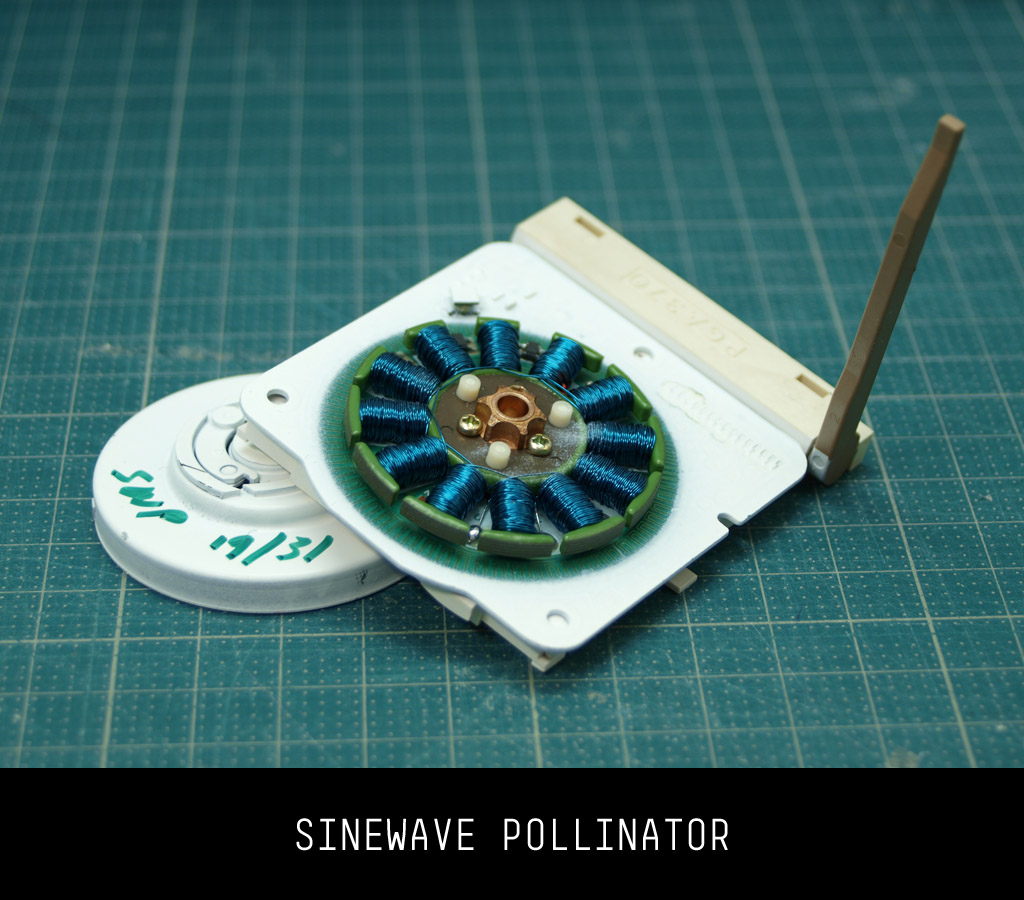
sinewave pollinator
PART SP-17

After bees became extinct in 2012 (the end of the Mayan Calendar), the future of flora has become uncertain. Many species have since become extinct, but other persist in labs through carefully monitored conditions and specialized nutrient diets.

Sinewaves of a very specific wavelength have been found to be an incredible pollinating alternative, but their effect on humans continues to be tested before the method receives approval.

Somehow some of these devices fell in our lap before approval. Be careful!

The Umeå Institute of Design, a top Swedish design school, recently held its Spring Summit 02009 on the theme Sensing And Sensuality. Students in the Interaction Design (IxD) graduate program there created some charming artifacts from the future as souvenirs for Summit speakers, which included such luminaries as Matt Jones and Adam Greenfield.

Kluged together from what look like pieces of decommissioned VCRs and other electronics, the wittily improbable stories accompanying these objects may tend to push them past design fiction, and towards what at first I mistook for design fantasy...

delayed molecular paralyzer (unboxed)
PART DMP-87

OLRs (Organic Living Robots) need maintenance too, but you well know they don’t like it.

Use a DMP to tranquilize them and stunt all cellular respiration momentarily so you can perform maintenance on them without being inflicted harm upon.

The Paralysis starts 3 minutes after exposure and lasts exactly 57 minutes. A more potent dosage unit is in the works.


blue interval skipper
PART BIS-003

The proliferation of Blue-Ray DVDs led to the Blue Ray Catastrophe of 2015. How amazing that we humans hadn’t figured out that blue light causes retinal cancer!

The blue light leaks that led to that event were a wakeup call. You think you are safe now with blue light filters in all public and private environments.

Surely if you are reading this, you are an explorer of outlying territories. For that you will need this device if you treasure your vision.

This batch comes from a commando of new-era Brazilian territory surveyors.


neutral gender propagator
PART NGP-9

Laboratory reproduction has rendered gender an unnecessary disturbance.

It’s well-known that gender-positive humans still roam the earth. Gender Neutralizers are to be used on their nature-induced newborns after capture and during incubation.

Not to be used on infants over 7 months of age.

But rather than design fantasy, or even critical design, for me these artifacts instead present as design parody.  Calling to mind the late science fiction author Arthur C. Clarke's maxim that "Any sufficiently advanced technology is indistinguishable from magic", these pieces joke about the mysterious, near-dysfunctional lack of legibility in advanced industrial design.

Being pieced together from found components, they also seem to deploy a 3d version of future-framing, because it's not their design per se that's at the heart of these objects, but the new mini-stories which accompany them. It's the refurbished backstory, the newly futurised context, the soul transplant via narrative, that brings them to life.

Related posts:
> Future-framing images
> The MacGuffin Library

(Thanks Jake!)