Showing posts with label publications. Show all posts

Tuesday, November 22, 2022

A new collection on Speculation in Design

The University of Pennsylvania's Weitzman School of Design has published the latest edition of its periodical LA+, an interdisciplinary journal dealing with landscape architecture –– and more, as the name hints.
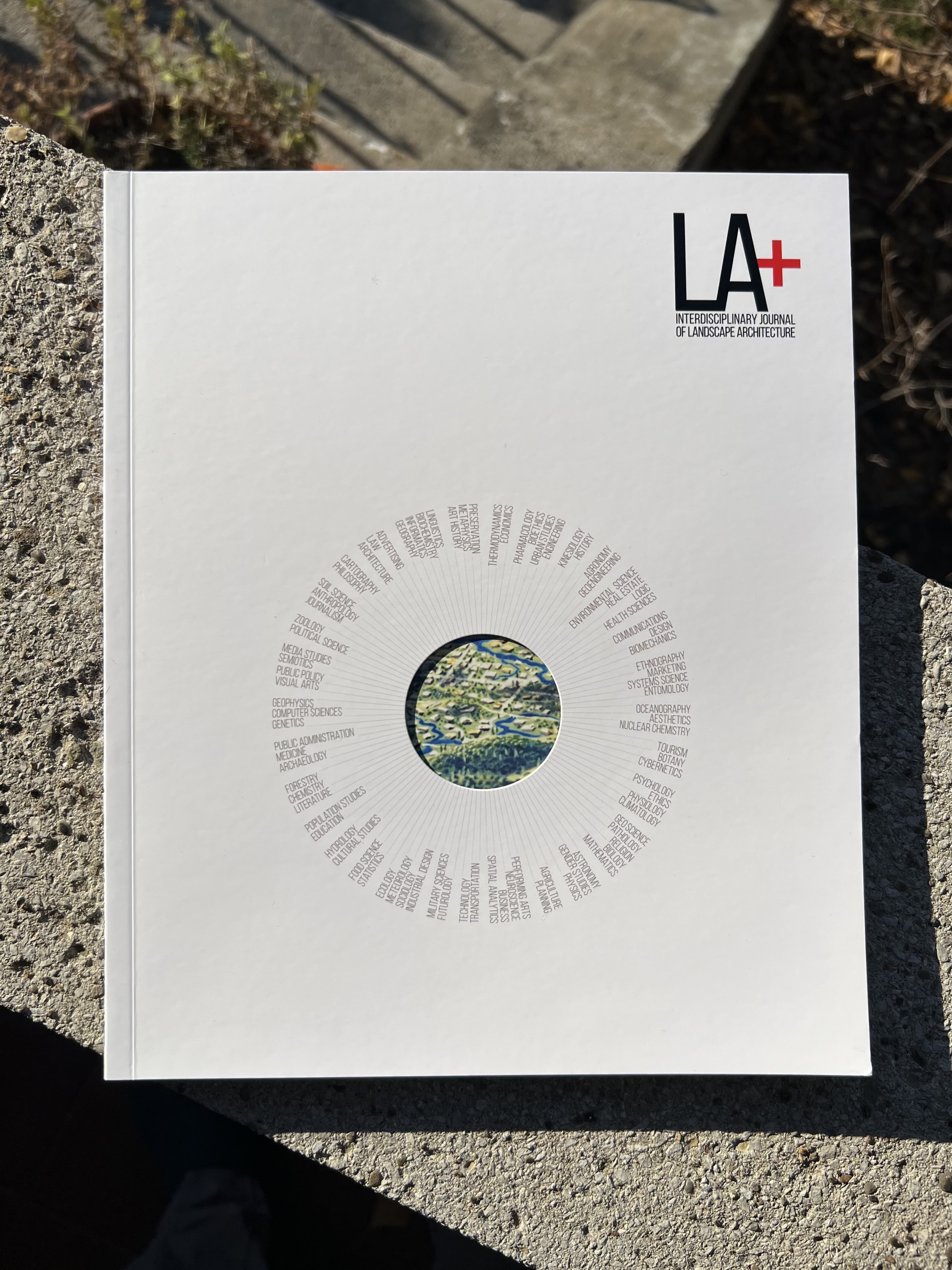
The topic and title this time out is SPECULATION, a multifarious and richly intersectional theme on which contributions appear from Alexandra Daisy Ginsberg, Javier Arpa Fernandéz, Min Kyung Lee, and Ytasha Womack, together with many others, all marshalled by the issue editor Christopher Marcinkoski and editor-in-chief Tatum Hands.

I had the pleasure of taking part in the project via a conversation with a wonderful transdisciplinary practitioner of landscape architecture and media arts, professor Aroussiak Gabrielian of University of Southern California's Architecture school. As a taste, below is one of my favourite questions posed by Aroussiak, and the thoughts it prompted.

***

AG: I’m wondering how you feel about the pitfalls in speculative design, given the criticism it has received for being speculation for speculation’s sake or that its focus has been very techno-scientific, or product driven – pushing forth the same capitalist system by inventing objects that we might consume in the future.

SC: Yeah, I think that those are definitely ways the work can fail to live up to its potential. Sometimes, especially early on, practitioners might find themselves using an excess of whimsy on one hand, or an excess of capitalist realism on the other. To me, both are ways of missing the mark, but I think it would be unfortunate if that were to lead some observers to think that the whole enterprise of using design and the arts to explore futures is without value. That would be a grand-scale throwing out of the baby with the bathwater. It’s possible to write bad poetry, too, but that doesn’t mean all poetry is bad.

I would say that some of the criticism drawn during the recent wave of speculation in design, while fair enough, is really responding to a sort of belated unleashing of creative energy that was previously stifled by a so-called human centered, but, let’s be honest, capital-centered, paradigm where the use of imagination is highly constrained, and aspirational only within tightly defined limits. You take those constraints off, and people go wild. That is actually kind of cool to watch, but is it the end state for the practice? I don’t think so. Once people have gotten some of that initial rambunctious energy out of their system, there is a sort of getting of wisdom in play. You can see this with [card game] The Thing from The Future. To start with, many players revel in the license to run free, be silly, and have fun. Then, after a while, they start to get a little bit more critical and search for ideas with more substance. The novelty of the very idea of something ostensibly coming “from the future,” perhaps exciting enough in itself to begin with, wears off, and players start to want to know more about what future it’s from, and how it might work, and how it’s different from what they’ve heard before, and whose interests it represents. This is part of why, having created the game, Jeff [Watson, cofounder of Situation Lab and professor at USC School of Cinematic Arts] and I kept adapting and modifying it, and using it with different groups to help push the general vogue for speculation past this initial flare-up of excitement and crappy ideas that we all tend to have when first invited to roam freely in the space of alternative futures.

To try to make the year 02050 matter right now is an important but difficult task. There’s no objective referent for a 02050 scenario – in contrast to trying to bridge into the shoes of someone historically or in the present, where you can at least partially ground-truth things. The inbuilt speculative challenge of futures is that they are not just epistemically but ontologically indeterminate. They are up for grabs. So we need to realize that when we’re making a hypothetical world specific enough to wrap our body-minds around, we’re making it artificially specific, just in order to be able to think and feel into it. We have to take the ability to inhabit this “what if” with a big grain of salt, because it’s not a question of getting it right or not, in a predictive sense; it’s a question of how rigorously and usefully we are deploying imagination to enable new perceptions and possibilities in the present.

***

If you're interested in the theme of speculation, as so many designers have been recently, check out the full piece (Futuring: A Conversation) and the collection as a whole (digital or print).


Related:
> Design and Futures (ebook and paperback)
> Critical activism: Anab Jain of Superflux
> I design worlds: Liam Young of SCI-Arc
> Using the future at NASA: David Delgado of NASA JPL
Gaming futures literacy: The Thing From The Future (pdf)
> An experiential futures interview 
> Designing futures: An interview
> Design is a team sport
> Killer imps: Bringing futures to designers at the Royal College of Art

Tuesday, October 18, 2022

Welcome to The Futures Bazaar

The Futures Bazaar: A Public Imagination Toolkit is published by Situation Lab & the British Broadcasting Corporation

(Update 20dec22: The Futures Bazaar has been named a Most Significant Futures Work of the year by the Association of Professional Futurists! Winners of the 02022 #IFAwards were announced here. Many thanks to APF for this recognition in the Inclusive Foresight category, and gratitude again to our BBC collaborators and all who contributed to the project, listed in this post and also in the kit itself.)

Picture a wild and wonderful place where all alternative future possibilities co-exist at once, and can be physically encountered in real life; a kind of multi-dimensional exchange, where tangible objects are put on offer from countless possible worlds.

This crazy setting is not just an idea, but somewhere I’ve visited — twice, actually. And you can, too.

The Futures Bazaar: A Public Imagination Toolkit, created and written together with my fantastic design futurist colleague Filippo Cuttica, has just been released by the British Broadcasting Corporation and Situation Lab. It’s available to download for free from the BBC here.

Thinking concretely about times to come is harder and rarer than it should be. That’s why this is an open access public imagination toolkit. It’s designed to help make such thinking a bit easier and more common.

The Futures Bazaar toolkit is basically a turnkey framework for setting up a co-creative gathering or design jam where participants transform everyday objects brought from home into unique things “from” alternative futures, to provoke, amuse, and inspire each other. Every participant helps imagine and produce these future artifacts, and every artifact tells a story.

You know, the toolkit is itself a sort of artifact, with a story of its own.

A few years ago, before the pandemic, we staged the first Futures Bazaar for the away day of the whole design side of the BBC.

It was great. There was zaniness. There was creativity in spades. At the end, there was even beer on tap. More about this wild experiment we did with BBC designers can be found here.


Other things equal, perhaps that would have been the end of it. But soon afterwards, I ran a second iteration in my required design futures course at Carnegie Mellon. (This time, no beer.) It seemed like an appropriate way to introduce a roomful of undergrad designers to the idea that any item can mobilise an array of associations and tell a range of stories. Playing with the signs and sensemaking of material artifacts in this way proved a neat on-ramp to broader vistas of experiential futures practice.

Both bazaars went so well that the process seemed to be crying out to be shared with a wider audience. Then Covid-19 struck, and everything went on hold.

However, as time passed, and the pandemic wore on, the widespread need that prompted this project in the first place — the need to support shared spaces of imaginative engagement — has become only more obvious, and more urgent.

In order to adapt and distill the Bazaar design into a toolkit, Filippo and I spent months working on how to make organising one of these events as intuitive as possible, without us being in the room. Our aim was to enable any motivated gathering, equipped with a basic projector setup, some printouts, and ordinary household objects, to imagine countless possible worlds and bring them to life on the spot. 

The Futures Bazaar can now be run by anyone, anywhere. It is for players of all ages, in all fields. It is intended for use in public and private organisations, government bodies, schools, and nonprofits alike.

It offers a chance to expand horizons, explore new ideas, and develop capacities for foresight, creativity, and storytelling, all in just a few hours. It can be set up as a stand-alone event such as a company away day, or within a larger workshop, course, or event series.

Conceived in the traditions of experiential futures and participatory design, it might be part of a journey — as at the BBC itself — towards building foresight capability, engaging alternative futures in more open and creative ways, or it can be used more for fun — teambuilding through worldbuilding.

The toolkit is made up of three elements: Manual, Slides, and Printouts. The Manual (a complete guide for use in hard copy or on a tablet) helps you plan your own event, the Slides (to display on any large screen or projector) help you run it, and the Printouts (ready to go in either colour or B&W) are for distributing to participants on the day. All this has been packaged into a single zipped folder containing the full set of PDF documents for download here.


This project has been able to take advantage of some of the experiments and learning at Situation Lab, the creative research unit that I’ve run for the last nine years. The toolkit incorporates elements from our award-winning game The Thing From The Future, and it also builds on the participatory design events that we at Sitlab carried out with Extrapolation Factory; the Futurematic design jam series, held in the mid-2010s in Toronto, New York and Los Angeles.

The kit’s acknowledgements section tips the hat to the many folks who made this publication possible, but above all, The Futures Bazaar toolkit is dedicated to the memory of my dearly missed friend and longtime collaborator Jeff Watson of the University of California’s School of Cinematic Arts, co-creator of The Thing From The Future and co-founder of Situation Lab. The invention of openly available, playfully framed, creatively enabling frameworks and designs was among his great gifts, and an inspiration throughout the project.

Filippo and I, with our talented collaborators at the BBC, are delighted to be sending this toolkit forth into the world, hoping it will travel, and be taken up far and wide. We can’t wait to find out what people get up to with it.

If The Futures Bazaar sounds like something you might like to run, you can go ahead and download version 1.0 of the kit right now. If there happen to be folks in your world who might enjoy it, please share this article or the project link with them. We plan to make additional guidance available for those interested, so following Sitlab, Filippo or me on Twitter would be a good way to keep up with the latest news and announcements.

The world can be a frightening and unpredictable place. This project is not going to solve all its problems. But we are in earnest when we say that we think the capacity to imagine is key to shaping the futures, and this kind of collective play is key to imagination.

So get playing… we look forward to seeing you at the #FuturesBazaar! ✨ 

The Futures Bazaar invites you to expand horizons, explore new ideas, and transform everyday objects into things from the future

***

This article previously posted on Medium. A variant appeared at Situation Lab.

Related:
Gaming Futures Literacy (article on The Thing From The Future)

Friday, July 31, 2020

Knowledge Base of Futures Studies


Just published this month is The Knowledge Base of Futures Studies 2020, the latest in an edited series collecting key works in foresight over time.

The original version of KBFS was released in 01996, the same year I first encountered the futures/foresight field; the most recent update came out in 02005, the year I went to study with Jim Dator at the University of Hawaii's 'Manoa School' of futures. So it's been a long while, and a huge amount has changed in the field over that period.

I'm excited to have two pieces in this collection, both coauthored with terrific colleagues –– Kelly Kornet and Peter Hayward. Both articles are adaptations of work previously published, and speak to aspects of how the field has evolved over the past decade and a half towards more participatory, playful, experiential and inclusive modes.

The Polak Game (aka "Where Do You Stand?"), written with Peter, is about a classic workshop and classroom game in the futures field, which Hayward invented, inspired by the remarkable work of Dutch sociologist and proto-futurist Fred Polak. The game offers a user-friendly structure for facilitating far-reaching conversation among foresight students and clients, introducing "images of the future" as a basic property of both cultures and individuals, thus helping pave the way to more advanced tools and frameworks. It first appeared in 02017 as a peer-reviewed article in the Journal of Futures Studies (JFS).

Ethnographic Experiential Futures (EXF), written with Kelly, introduces a framework for hybrid design/futures research and practice that is all about making images of the future more legible and concrete, and seeing what one can learn from doing so. The piece sets out a practical structure and set of prompts for devising projects and interventions, with a view to promoting the availability of a more diverse and deeper array of scenarios for consideration, in all sorts of contexts, ultimately in service of developing a social capacity for foresight. It first appeared in 02019 as a peer-reviewed article, Turning Foresight Inside Out, in the JFS special double issue on Design and Futures co-edited with Cher Potter.

Fifteen years is a long time, and to be fair not all of the changes that the futures/foresight field has seen are (or could be) reflected in a selection which, as this version's co-editor Andy Hines points out, was subject to real constraints. But there are over 500 pages of material from contributors around the world, and I'm looking forward to digging in! Meanwhile the next edition, we might hope, will appear sooner rather than later, and will also seize the opportunity to push even further in surfacing the tremendous diversity of views and approaches to futures research, scholarship and practice from all corners of a burgeoning and multifaceted global conversation.

Well done to the three dozen contributing authors, and to editors Richard Slaughter and Andy Hines, for this valuable contribution! While previous editions were sometimes hard to find, this new collection is electronically available directly from the publisher, the Association of Professional Futurists.

Related:
> Ethnographic Experiential Futures / full-text pdf from KBFS 2020
> The Polak Game / full-text pdf from KBFS 2020
> Design and Futures book release / full-text pdf
> Transforming the Future book release / full-text pdf
> Ghosts of futures past
> A History of Experiential Futures

Sunday, May 31, 2020

The Future Can't Wait

Photo by Matthew Abbott for the New York Times

I wrote this piece in the first week of January. It appears in the just-published Summer 2020 edition of Design Journal from the Smithsonian Design Museum, Cooper Hewitt, in New York. It’s hard to believe how long ago the start of this year feels, and how quaint my obliviousness, stuck in amber, to the string of crises that have unfolded since — the COVID-19 pandemic, oil market chaos, historic levels of unemployment, and in the past week, demonstrations across the United States. Our context has shifted again and again, but I think the argument is reinforced by all this change.

***

Eden is burning.

A small coastal town in Australia has become a household name in the past twenty-four hours, besieged by raging bushfires colouring land and sky a surreal martian red, and causing residents to flee for the ocean, the safest refuge in a world aflame.

Today, under unprecedented emergency orders from the Prime Minister, the navy arrives to help with evacuation. The fires in Eden and dozens of other places have already torn through an area the size of Switzerland.

This is all a few hundred miles northeast of where my wife and I, both Australian, are on our annual pilgrimage back from the United States. Right now our family group is standing on the deck of another navy vessel, a World War II minesweeper, long ago decommissioned and turned into a small maritime museum. Normally the backdrop would be a spectacular Melbourne skyline. Instead we see a grey curtain that looks like fog, but isn't. The smell of smoke is unmistakeable. The ongoing catastrophe is at once bodily present and utterly remote from our pleasant after-lunch walk.

A museum guide leads us to the crew quarters, pointing out a framed black-and-white photo of grinning sailors crammed into this space. I try to picture daily life during the war: dozens of servicemen eating, arguing, and playing Mahjong endlessly, spending their nights in hammocks strung from the low ceiling. The central purpose of the exhibit is of course to help visitors connect to this earlier time - but even standing here, surrounded by historical paraphernalia and listening to stories from our knowledgeable guide, one struggles to imagine the lived everyday reality of a vanished era.

As with the present-day experience of others, especially in circumstances very different or distant from our own, so too when it comes to history. Considering it from afar is one thing; really comprehending it is another.

Thinking about the future confronts this same problem, intensified. No one knows exactly what the future holds, so unlike the past or present we have no direct evidence to compare with what is in our minds.

Yet the collective task of properly engaging alternatives is among the most important we face. Fortunately we now have more effective ways to do it than ever before.


Prompted by the Second World War and the Cold War that followed, a pragmatic set of approaches for navigating large-scale change and uncertainty has arisen over the past few generations. The near-unthinkable stakes of nuclear conflict forced governments to develop big-picture "what if" scenarios, and investigate how they might influence events toward preferred futures, and away from nonpreferred ones.

In the 01970s, oil companies and other organisations started exploring the advantages of an institutional capacity to think ahead. Parallel to these developments in the corridors of power, a more grassroots and humanistic tradition of futures workshops and education was also emerging, studying the "images of the future" held by individuals and groups, and how to understand, critique, and create them.

"Future" singular became "futures" plural. A new transdisciplinary field was born, known variously as strategic foresight, futures studies, or simply "futures." Now, paying intellectual attention to possible futures is a positive step, but it does not in itself guarantee an appropriate impact on present-day decisions. The bushfires blazing in southeastern Australia are a case in point. They have captured global attention as a kind of postnatural disaster: something long foreseen, and shaped directly and indirectly by collective choices, but for years not taken seriously in a political sense. This long-fuse, seemingly far-fetched scenario, well outside of anyone's lived experience, has now burst forth and is wreaking havoc in real time.

How then can we connect to possible, probable, and preferred futures viscerally, such that they feel real enough to make a difference, now? This vital question has become a focus for a community of practice building on foresight's foundation. At conferences and festivals, in classrooms and city streets, we are learning and using whatever it takes to bring futures to life, from physical artifacts, photo illustrations, and videos to online games and simulations, street art, guerrilla interventions, immersive theatre, and live-action roleplaying. In recent years in the design world, speculative design and design fiction (an analogue to science fiction, but oriented to physical rather than literary creations) have surged to prominence.

This whole array of strategies is called experiential futures. If one wants to bring potential realities to life, and have them register with the body and make a dent in current choices, then all experiences that help achieve that are part of this design space. They can be used to explore any question or topic, bring any world to life. Here are a few examples of projects we've done on the themes at hand:

For the International Federation of Red Cross and Red Crescent Societies biennial strategy meetings, future artifacts dramatised a potentially changed landscape of humanitarian need. What if displaced coastal populations began to mobilise politically, across culture and language barriers, around their common plight?

For the World Bank's Climate Investment Funds, and Institute for the Future, we imagined far-reaching changes in the US federal response, creating a future advertising campaign around it. What if, in the late 02020s, climate inaction gave way to large-scale military mobilisation? Strange echoes now of the deployments just announced in Australia.

For the Hawaiian state legislature, to support public engagement with a sustainability planning process, we placed hundreds of policymakers and constituents in a quartet of parallel immersive scenarios for the islands, set in 02050. In one room, governance had been restructured around precolonial values and traditions; in another was a naturalisation ceremony for climate refugees. And so on.

These are not predictions, but "what ifs" in four dimensions, aimed at improving the quality, accessibility, and impact of futures conversation. Miscellaneous approaches are coalescing into a systematic set of ways for humans to play productively with possibilities, and ranging beyond the standard technological questions by bringing life to often neglected social, cultural, economic, and environmental dimensions.

Becoming common practice brings the opportunity for deep impact. As well as spending time in the imaginary worlds of comic book heroes, for instance, we might spend time in potential future realities. We might debate and decide less on the basis of ideology and slogans, and more on the basis of collectively explored pathways and policies designed to shape them.

The museum has emerged as an indispensable platform for helping these developments along. If you haven't already encountered a major hybrid design/futures exhibition, at an institution like the Museum of Modern Art, New York, or the Victoria and Albert Museum, London, chances are you soon will. New facilities - essentially cultural institutions of foresight - like the Museum of Tomorrow in Rio de Janeiro, the ArtScience Museum in Singapore, MOD in Adelaide, and the Museum of the Future under construction in Dubai, have lately been established to let visitors encounter what could come to be, as much as what has been.

Museums have always enabled the cultures they are embedded in to remember what matters; but memory and imagination are two sides of one coin. In a volatile era, we need all the help we can get to bring both into currency. What of the past should we hold on to - but also, how might things be otherwise, in better and wiser times to come, and what role can we each play in finding our way there? The rise of experiential futures is fueled by cultural need, and though the need is different everywhere it shows up, it shows up everywhere.

An important societal transition is just getting underway. Collections of speculative future artifacts are a promising start, but wider horizons of experiential futures - immersive, generative, participatory, and large-scale - remain to be explored, growing the collective capacity for foresight through our cultural institutions.

Today, Eden is burning. As the smoke clears, this moment will pass from headlines into history, a newly minted past to learn from to the best of our ability. Already apparent among its lessons to take to heart is our urgent need to get much better at thinking and feeling through what might lie ahead, too.

The good news is: we can.

***

A full-text PDF of the article can be downloaded here. This Design Journal issue also includes contributions from climate and science writer Tatiana Schlossberg, Native Renewables executive director Wahleah Johns, and atmospheric scientist Katharine Hayhoe, and it can be found in its entirety here. My thanks to Pamela Horn for the invitation to contribute.

Update 01june20: Top image changed and introductory note added to mirror the post on Medium.

Related:
> Always Tomorrow Now, an interview with the Curator of the Museum of Tomorrow, Brazil
Experiential futures in The Economist
> Ghosts of Futures Past
> Experiential Futures: A Brief Outline
Integrating Foresight at the World’s Largest Humanitarian Organisation, a forthcoming piece on experiential futures at the international Red Cross/Red Crescent; this project was also discussed in a recent interview for IFTF's Foresight Talks (video)

Sunday, December 29, 2019

Design and Futures ebook and paperback release


Good news, everyone! The Journal of Futures Studies special double issue on Design and Futures, appearing in back to back editions earlier this year, has just been re-released by JFS publishers Tamkang University Press (Taiwan) as a single-volume book.

The omnibus Design and Futures collects all 30 essays, manifestos, interviews and peer-reviewed articles from 49 contributors across 16 countries, preserving the content, layout and pagination of the original double issue.

There are pieces by Minority Report production designer Alex McDowell, Museum of Modern Art design curator Paola Antonelli, Hyperobjects author Timothy Morton, Superflux principal Anab Jain, NASA JPL visual strategist David Delgado, the Decolonising Design Collective, Service Innovation Handbook author Lucy Kimbell, Design as Politics author Tony Fry, and many more.

Towards enabling the widest possible access and helping move the practice and scholarship forward, Design and Futures is available both as a free ebook, and in paperback with no price markup.

Here's the complete table of contents.

***

DESIGN AND FUTURES, Volume I

Editors’ Introduction (Vol. I)
Stuart CANDY (Carnegie Mellon University, USA) and Cher POTTER (University of the Arts London; Victoria and Albert Museum, UK)

ARTICLES

Turning Foresight Inside Out: An Introduction to Ethnographic Experiential Futures
Stuart CANDY (CMU, USA) and Kelly KORNET (Kalypso, Canada)

Politics of Designing Visions of the Future
Ramia MAZÉ (Aalto University, Finland)

Crafting Spaces Between Design and Futures: The Case of the Agbogbloshie Makerspace Platform
Cher POTTER (UAL; V&A Museum, UK), DK OSSEO-ASARE (Pennsylvania State University, USA), and Mugendi K. M’RITHAA (Independent Designer-Researcher, Kenya)

Strategic Foresight Studio: A First-Hand Account of an Experiential Futures Course
Jake DUNAGAN (Institute for the Future, USA), Alida DRAUDT (Strategic Foresight Partners LLC, USA), JJ HADLEY (Slalom, USA), Ryan HOGAN (Mozilla, USA), Leticia MURRAY (Gensler, USA), Gregory STOCK (Firefly, USA), and Julia Rose WEST (Ancestry, USA)

Designing Futures From the Inside
Anne BURDICK (Art Center College of Design, USA; University of Technology Sydney, Australia)

ESSAYS AND INTERVIEWS

How the Future Happens
James AUGER and Julian HANNA (Madeira Interactive Technologies Institute, Portugal)

Critical Activism
Anab JAIN (Superflux, UK; University of Applied Arts, Austria) and Stuart Candy (CMU, USA)

Storytelling Shapes the Future
Alex MCDOWELL (University of Southern California, USA)

I Design Worlds
Liam YOUNG (SCI-Arc, USA) and Stuart CANDY (CMU, USA)

Anticipating Future System States
Jamer HUNT (The New School, USA)

A Manifesto for Decolonising Design
Decolonising Design Collective: Danah ABDULLA (Brunel University, UK), Ahmed ANSARI (CMU, USA), Ece CANLI (Independent Scholar, Portugal), Mahmoud KESHAVARZ (Uppsala University, Sweden), Matthew KIEM (Independent Scholar, Australia), Pedro OLIVEIRA (Heinrich-Heine Universität Düsseldorf, Germany), Luiza PRADO (MeetFactory, Czech Republic), and Tristan SCHULTZ (Griffith University, Australia)

DESIGN AND FUTURES, Volume II

Editors’ Introduction (Vol. II)
Stuart CANDY (CMU, USA) and Cher POTTER (UAL; V&A Museum, UK)

ARTICLES

Destinations for Polyamorous Futures and Their MAD Lovers
Maya VAN LEEMPUT (Erasmus University College, Belgium)

Worldbuilding in Science Fiction, Foresight and Design
Leah ZAIDI (Independent Scholar, Canada)

SPACECRAFT: A Southern Interventionist Art Project
Ralph BORLAND (Independent Artist and Curator, South Africa)

Are We (Really) Designing Futures? The Design of Tomorrow Program at CENTRO
Karla PANIAGUA (CENTRO Advanced Design Institute, Mexico)

A Futures-Design-Process Model for Participatory Futures
Stefanie A. OLLENBURG (Freie Universität Berlin, Germany)

Imagining 2060: A Cross-Cultural Comparison of University Students’ Perspectives
Jeanne HOFFMAN (Tamkang University, Taiwan)

Transforming Environmental Values for a Younger Generation in Taiwan: A Participatory Action Approach to Curriculum Design
Kuo-Hua CHEN (Tamkang University, Taiwan)

ESSAYS AND INTERVIEWS

You Never Know How the Past Will Turn Out
Timothy MORTON (Rice University, USA)

Design in the Future
Paola ANTONELLI (Museum of Modern Art, USA) and Cher POTTER (UAL; V&A Museum, UK)

Making Things Physical
Maja KUZMANOVIC (FoAM, Belgium), Tina AUER (Time’s Up, Austria), Nik Gaffney (FoAM, Belgium), and Tim BOYKETT (Time’s Up, Austria)

Napkin Futures: Fragments of Future Worlds
Nik BAERTEN (Pantopicon, Belgium)

Change the Model
Dan HILL (Vinnova, Sweden) and Stuart CANDY (CMU, USA)

What If There Were More Policy Futures Studios?
Lucy KIMBELL (UAL, UK)

Your Move: Lessons Learned at the Interstices of Design, Gaming, and Futures
Aaron ROSA (Fraunhofer Institute for Systems and Innovation Research, Germany) and John A. SWEENEY (Narxoz University, Kazakhstan)

Using the Future at NASA
David DELGADO (NASA Jet Propulsion Laboratory, USA) and Stuart CANDY (CMU, USA)

Post-Island Futures: Designing for Uncertainty in a Changing Climate
Lizzie YARINA (MIT Urban Risk Lab, USA)

Starting at the End: A Journey in Time
Tony FRY (University of Tasmania, Australia)

***

We're thrilled at the interest the project has attracted and delighted that the hard work of our writers has been finding an audience around the world.

If you'd like a single searchable-text pdf file for your reference, or a hard copy of this remarkable collection on your bookshelf...

Free downloadable pdf of Design and Futures
• Paperback at cost from amazon.com / .ca / .co.jp / .co.uk / .de / .es / .fr / .it

Please read, share and enjoy!

Related:
> Design and Futures: Intro to Vol. I (pdf)
> Design and Futures: Intro to Vol. II (pdf)
> Using the Future at NASA: An Interview with David Delgado (pdf)
> Critical Activism: An Interview with Anab Jain (pdf)
> I Design Worlds: An Interview with Liam Young (pdf)
> Change the Model: An Interview with Dan Hill (pdf)

Saturday, November 30, 2019

Using the Future at NASA

A poster from the future by The Studio, NASA JPL's visual strategy team

David Delgado is a Visual Strategist at the National Aeronautics and Space Administration’s Jet Propulsion Laboratory (NASA JPL), a U.S. federal research and development centre in Pasadena, California. Along with his longtime collaborator Dan Goods, we met last year at a symposium in Berlin geared towards exploring exhibition concepts for Dubai's Museum of the Future (which is currently under construction).

A conversation we began there has carried on since, including several site visits to JPL, around how experiential futures and worldbuilding can serve internally- and externally-facing communications alike, as well as both short- and long-term needs; spanning organisational culture and morale as well as imagination, strategy, and mission formulation.

David and his colleagues at NASA offer an inspiring and mind-expanding example of using experiential futures / design fiction in a space of simultaneous fantasy and real-world exploration; shaping our own now, and maybe someday, others too.

***

SC: Tell me about JPL’s series of posters from the future of space travel.

DD: A while back, a famous scientist was planning on coming to the Jet Propulsion Laboratory, and so the Exoplanet Exploration Office asked us to do something to celebrate the diversity of planets that were being discovered. There are thousands of them, and they have all kinds of crazy characteristics that are super interesting. Some rain molten glass, some have two suns, some are considered diamond planets, some are just big gassy giants. Naturally, we wondered what it would be like to go there, and we thought travel posters would be a fun way to showcase different planetary characteristics. So we went to the 1930s, ‘40s style of illustrated travel poster, and met with scientists to make sure that each one was based on a scientific foundation. But at the same time we wanted it to be joyful. We also wanted to kind of plant that seed: Maybe we can really go to these places.

SC: So where did this idea come from? There’s been a lot of activity at the intersection of design and futures over the last decade.

DD: Yeah! We sort of fell in love with the idea of imagining these futures, and we made the first few posters. And then Dan Goods and I spoke at the AIGA Conference, and after speaking we were killing some time, and went and saw this crazy futurist –– you, Stuart –– talking about this sort of experiential futures campaign to raise people’s attention. And there was also this cone of possibilities diagram that you showed on the screen, which really helped to crystallise the idea for us, and gave us a way to talk about it strategically and show other people. We may be at the very tip of that cone right now, and going to these future worlds is somewhere farther out in that flurry of many different dots, but the whole notion is to continue doing things that will get us closer to that. How we get there, we don’t know, but we know that we need to keep on progressing. And so it was really a catalyst to the way that we thought.

SC: That’s great to hear!

A cone of possibilities. Diagram and discussion in The Futures of Everyday Life

DD: And then, apparently, everybody liked it. There were 1,200,000 downloads in one week when we first released the whole set. It was kind of nuts.

SC: Amazing. And the details of the posters were based on the state of the science, what is known about these different planets.

DD: That’s right, and we focused on one special thing about each faraway planet, following the model of the original travel posters themselves. You’re going to be in a forest, or the desert. We allowed people’s imaginations to grow from there.

SC: How did it come about?

DD: It was internal. The design brief was to decorate a hallway –– that’s where these came from, the request to decorate a hallway.

SC: [laughs] I love that. Instead, you ended up decorating a million hallways.

DD: Right! What’s cool is that it grew organically. We had three posters, meant for internal use, and everybody started liking it, and the director of JPL fell in love with it. The director was on vacation at the Grand Canyon, and sent an email saying, “Look at this calendar – let’s do one for the posters!” We went from having three to doing another nine very quickly.

SC: So then you did stickers?

DD: Yes. The posters happened, then we had a change of director of JPL, and a huge workload going on at the time. There was a request for us to give a gift to the Laboratory itself, to all of the JPLers. It was kind of an effort to raise morale; at least, that was our approach.

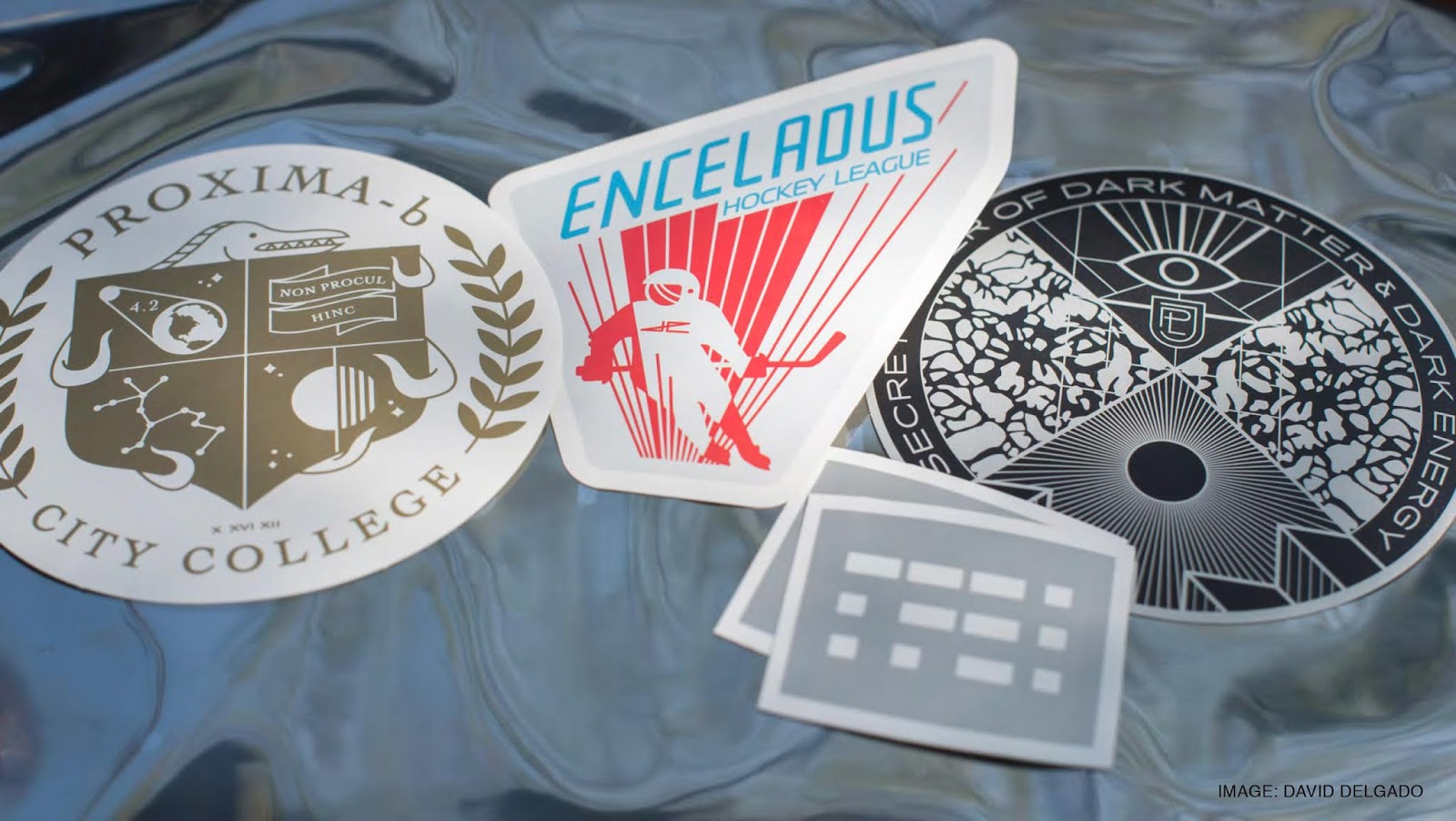
Given that a lot of people are working super hard on really amazing projects, we looked at each of those projects and imagined: what could this lead to? So we decided to create these stickers for clubs and societies from the future that you could join when interplanetary travel is possible, but representing what’s currently being worked on.

Each person at JPL got four sets of twelve different designs, like a swag pack that they could hand out to their friends and family, and that would give them a way to tell the story about what JPL is doing, and feel proud about their own work and contribution.

Strategically, the clubs are storytelling devices. At JPL you’ll see people put the stickers all over their computer, or people driving around with just an E, for Earth, like the European bumper stickers. When you’re travelling throughout the solar system, you need to represent where you’re from! It’s all done with a wink and a smile.

There’s the Secret Order of Dark Matter and Dark Energy.

There’s a big push to identify near-Earth asteroids and make sure that Earth stays safe from impact, so we created the Asteroid Patrol.

One was inspired by the 40th anniversary of the Golden Record, so we created the Proud to be Human Club. The Golden Record and Pioneer had all these things about Earth, so we merged them together. There’s a lot of reasons to be proud to be human, and let’s just celebrate that for a second.

Enceladus is a moon of Saturn. It’s also an ice covered planet that shoots out geysers of water. And so since it’s covered in ice, we have the Enceladus Hockey League.


Designs from the project Clubs for the Modern Explorer, an internal gift from the JPL Director to Lab employees; images courtesy of David Delgado

SC: These are great.

DD: We had to think about Earth in a different perspective too, as our original home, that we will always consider the first place. It’s this mothership that we are coming and going from; a Buckminster Fuller-inspired, “Spaceship Earth” idea.

SC: I bet they were a hit.

DD: Yeah, they were a huge hit. Everybody loved them

SC: So the clubs and associations thing actually came out of having done some worldbuilding already, and going, “Well, if this existed, then so would these...”

DD: Right. It came from one of the posters, actually, about Titan, a moon of Saturn. One of the great things about Titan is there’s these big seas of hydrocarbons –– think of like, liquid nitrogen, but it’s liquid methane. So the design was this beautiful image of the seas with Saturn in the background. This part never made it into the poster, but we were kind of imagining what the boat rental place would be, and the logo for it –– and that started us thinking, maybe we could look at logos as a device to communicate something. If that exists, travelling around between planets, what are some cool clubs that you could join in that world?

A space tourism poster from the series produced at NASA JPL

SC: That’s really interesting. So how would you describe the use of experiential scenarios or design fiction at JPL, what has it done for you?

DD: Well, for one thing it took the conversation out of the present, and allowed people’s imaginations to become involved, thinking about not only what kinds of things are happening now, but where they may lead in the future.

SC: That doesn’t happen regularly?

DD: It does happen regularly, but it’s usually positioned within the focus of creating new missions. It’s strategic in a different way.

The reason we really gravitated towards it is because it allowed us to create a motivational tool. For people at JPL it sort of reinforced the reason they started working there in the first place: they want to do something big, contribute to humanity, be at the cutting edge. Using the future to help motivate people became a powerful way to communicate internally. If you’re part of space exploration, you are part of a group building this continuous series of steps that will lead to something very special.

I think once the poster downloads happened, we realised that it was much bigger than communicating internally. There is this shared public dream of being up in space –– it has been in science fiction for a very long time –– but these places are real. These designs brought them one step closer, gave them more power.

It was this whole experiment in understanding the value of using the future as a tool for the imagination.

***

This piece was published earlier in the year as an article in the Journal of Futures Studies special issue on Design and Futures, Volume II. It can be downloaded here (pdf).

Thanks again Dave, and fellow travellers at JPL!

Related:
> Design and Futures Volume I & Volume II
> On getting started in experiential futures
> The School of Worldbuilding (pdf)
> I Design Worlds (pdf)
> Critical Activism (pdf)
> Design is Storytelling
> Gaming Futures Literacy (pdf)
> The Futures of Everyday Life (pdf)

Monday, September 30, 2019

The School of Worldbuilding


Bauhaus Futures is an edited collection just published by MIT Press to mark the 100th anniversary of a short lived but profoundly influential institution.

Founded by Walter Gropius in Weimar, Germany in 01919, the Bauhaus was an interdisciplinary and international school of design whose charismatic and encompassing vision has had a tremendous impact on design, architecture and art over the past century. As Tom Wolfe wrote, "“It was more than a school; it was a commune, a spiritual movement, a radical approach to art in all its forms, a philosophical center comparable to the Garden of Epicurus."

This new book's point of departure is a provocation, "What would keep the Bauhaus up at night if it were practising today?"

With my longtime Situation Lab collaborator Jeff Watson (USC School of Cinematic Arts), the point of departure for our own contribution is a kind of playfully manifesto-ish contemporisation of the Bauhaus, whereby "the school of building" becomes "the school of worldbuilding" and the motto "Art Into Industry" becomes "Art Into Reality", tying the ambitious reach of the original to emerging imagination-ramifying practices in transmedia storytelling, cinema and media production, game design (alternate reality games, larp, etc), activism, and experiential futures. A sample:

The School of Worldbuilding responds to the question, “how might we design a better world?” by turning it on its head: “how might we world a better design?”
. . .
The School of Worldbuilding is not as interested in what we can do in imaginary worlds as it is in what we might do with or through or occasionally in spite of them, in this world.

The School of Worldbuilding sees the role of the educator not as a purveyor of content, but as a certain kind of game master. It sees the role of the student not as a receptacle, but as a certain kind of player.
. . .
The School of Worldbuilding is political because the imagination itself is political. Power and authority contour and transform social imaginaries just as those imaginaries contour and transform power and authority. Indeed, domination and liberation alike depend on the imagination. What revolution ever started anywhere but in the imagining of a different world? And what tyranny ever lasted without mastery over imaginal resources?
. . .
The School of Worldbuilding confers no degree. To be a student of worldbuilding is to commit to exploration and experimentation as a way of life. Graduation is not only impossible: it is undesirable. To graduate from the School is to fail out of it.

(And so on.)

Edited by Laura Forlano (IIT Institute of Design), Molly Wright Steenson (just down the hall at CMU School of Design), and Mike Ananny (USC Annenberg School for Communication and Journalism), the book Bauhaus Futures includes contributions in a wide variety of formats from a fantastic lineup of writers.

The full text of The School of Worldbuilding can be found here.

The book is now available for order and is set to ship within the next couple of weeks!

Related:
> I Design Worlds (Interview with Liam Young)
> Reverse Archaeology / The Time Machine (Assignment)
Design is Storytelling
> How to Build a World (Video)
> The Thing From The Future

Sunday, July 07, 2019

The music of a community emerging

Volume II of the Journal of Futures Studies special issue on Design and Futures has been published!

A Conversation Piece installation by Agence Future in Belgium (02017) | Photo by Bram Goots

Co-edited over the past several years with Cher Potter from the V&A Museum and University of the Arts London, the first half of this major project came out a couple of months ago.

The second half is now out too: another dozen and a half contributions exploring futures and design's intersections. About fifty writers appear in this special issue overall, voices from around the world; Mexico to Portugal, Australia to Taiwan, Kenya to Kazakhstan.

We recognise this as just the start of a vibrant and fast-moving hybrid field of activity that barely existed a decade ago. We were sadly unable to incorporate every piece that we would have liked, but glad to offer a platform taking the design/futures conversation forward that includes some of the key figures in the field, alongside others brand new to it.

Below is our intro to Volume II (with contributor links added). In case you haven't looked at Volume I yet, you might like to start there, but the two halves of this collection can also be read independent of each other and in either order.


***

Introduction to the Special Issue: Design and Futures (Vol. II)

Volume I of this special double issue of the Journal of Futures Studies ‘Design and Futures’ – the largest themed project in the history of the journal – began by noting something that is increasingly self-evident to anyone paying attention: the fields of futures and design are merging in a process of dialogue, experimentation, and mutual discovery. Obvious perhaps, and yet this process and the practices and perspectives it engenders are nonetheless remarkable. They show no sign of abating.

The dialogue continues (note we do not say ‘concludes’) here in Volume II, with scholars and practitioners from across the two fields, and beyond, delving more deeply into the practical and philosophical issues at various intersections. Both established and emerging voices share generously of their case studies, lessons learned, and methodological questions. They traverse the worlds of media, design, curation, and strategic foresight; they propose research strategies that cross community perspectives and shift our geographical (and political) focus to different sites for design and futures. To adapt an observation from cultural geographer Denis Cosgrove, “position and context are centrally and inescapably implicated in all constructions of [design and futures] knowledge” (Cosgrove, 1999, p. 7).

This second volume of ‘Design and Futures’ opens with seven peer-reviewed articles from a constellation of contexts, spanning five continents: Maya van Leemput (Belgium) distils lessons from many years of relational work and play where futures meets media, art and design [upper image]. Leah Zaidi (Canada) illuminates the importance of worldbuilding as an emerging practice that intersects science fiction with real-life applications of design and foresight. Ralph Borland (South Africa) outlines a case study of interventionist art from the streets of Cape Town as an instance of guerrilla futures activism [lower image]. Karla Paniagua (Mexico) describes the first four years of running a postgraduate design/futures program in the highly energetic and fast-changing context of Latin American foresight practice (la prospectiva). Stefanie A. Ollenburg (Germany) offers a generic ‘research through design’ framework, inviting researchers to hybridise futures and design in participatory projects, early and often. And finally, a pair of case studies from Taiwan: Jeanne Hoffman investigates preferred future images about the environment in 2060 as held by a cross-cultural cohort of undergraduate students; and Kuo-Hua Chen considers the possibility of designing for increased environmental awareness among young Taiwanese through a suite of futures interventions in curriculum.

These are followed by a potent collection of shorter essays and interviews from philosopher Timothy Morton; Museum of Modern Art curator Paola Antonelli; transdisciplinary artists Maja Kuzmanovic, Tina Auer, Tim Boykett and Nik Gaffney; designers Nik Baerten, Dan Hill, and Lucy Kimbell; futurists Aaron Rosa and John Sweeney; NASA visual strategist David Delgado; architect Lizzie Yarina, and design theorist Tony Fry.

Taken in singularity, these voices are strikingly diverse, but when hearing them together, they begin to harmonise. It is the music of a community emerging.

Through this issue, we encounter contemporary questions around design and futures in the twenty-first century, as well as ageless questions about what it means to be human, and the nature of time itself. We’re excited to see what these may do to help deepen, enrich and catalyse further activity and exchange.

It seems fitting that this second volume starts and ends with articles about journeys. This project has been a remarkable journey for us as guest editors – with several years of work spanning multiple job changes, international relocations, and children being born – as well as tremendous changes in the context of design and futures themselves. In spite of expanding this themed publication to two volumes, the interest and contributions have far exceeded our expectations. It is gratifying that the relevance of this undertaking continues to grow apace.

We wish to express our gratitude to all authors who submitted proposals; our wonderful peer reviewers; our incredibly understanding partners on the home front; and not least José Ramos of the Journal of Futures Studies, without whose tireless support this project would not have been possible.

Stuart Candy and Cher Potter, Guest Editors

References:
Cosgrove, D. E. (1999). Mappings. London: Reaktion Books.


***

The whole of Design and Futures, Volume II is available in open access via JFS – please enjoy, share, and build on what you find.

Related:
> Design and Futures, Volume I
> From killer apps to killer imps
> Design is Storytelling
> Critical activism (Anab Jain in JFS)
> I Design Worlds (Liam Young in JFS)
> Ghosts of futures past

Monday, June 17, 2019

Critical activism

Anab Jain is a leading light of experiential futures practice. She is cofounder with Jon Ardern of the London-based "vanguard foresight and design organisation" Superflux, whose work has rightly earned attention and admiration far and wide, with projects like Mitigation of Shock (an installation), Instant Archetypes (a tarot deck), and Drone Aviary (a film, and more).

Image from Mitigation of Shock by Superflux, an installation at CCCB portraying a small London apartment adapted for climate change in 02050 (02017)

We first met in 02009, just a few years into our own first experiments with experiential futures, following a talk I gave on that topic at the Long Now meetup in London one evening during my time visiting 'Design Interactions' at the Royal College of Art. This was the highly influential MA program led for a decade by the wonderful Fiona Raby and Tony Dunne from which Anab had graduated back when it was still a degree in 'Interaction Design' –– prior to the 02008 landmark MoMA exhibition Design and the Elastic Mind, which contributed much to the visibility of the work of not only Dunne and Raby but also their mentees, in what they called at the time 'design for debate' and 'critical design', and well before 'speculative design' framing coalesced (as mentioned by Anab below), a development of the past five years or so.

Superflux got underway in 02009, a few months after we'd met in London, and Anab and Jon were among the first designers to set up shop in a way that engaged the tradition and practices of the futures field not just explicitly (using the language) but substantively too (really using the tools). For instance we recently collaborated on introducing foresight to International Federation of Red Cross and Red Crescent Societies (IFRC) via experiential scenarios deployed at IFRC's biennial strategy meetings.

This post is an abridged version of a conversation appearing in the recently published Journal of Futures Studies special issue Design and Futures, Volume I.

Anab's sense of the work as "slow critical activism" really resonates with me, and her candour here, talking about the behind-the-scenes challenges of maintaining a design/futures business that is both viable and principled, is super generous and helpful, I think, for the many newcomers eager to figure out how they can practically make this sort of thing a part of their work lives.

***

SC: How do you situate your practice in relation to futures and design?

AJ: I think we are situated somewhere in the middle. We have a two-pronged approach. We do foresight and horizon scanning – that big, meta-level stuff – but we simultaneously ground it with material explorations, ethnography, research, prototyping.

Obviously we come from a design/art background more than futures. Our schooling was often about what the implications of a certain technology on society might be. And over the years, we’ve studied the more traditional futures methods a bit, not quite as much as a futurist would.

SC: What are some projects or initiatives that you’ve been involved in that you consider exemplary of your approach?

AJ: Our approach has changed a lot. We often used to work around a technology, so we would pick something like quantum computing or optogenetics, and try and understand what its potential is, but also poetic implications that the scientists or the technologists might not have explored.

And we’ve moved from that to thinking more socially, politically. We’re very interested in the implications of living with climate change, so for a recent project, Mitigation of Shock, we really wanted to understand how to bring that future that is so abstract around climate change - especially in the Western part of the world - making it real and conceptually visceral, but also not dystopian.

SC: So you’ve been at it...

AJ: Nine years.

SC: I’m interested in how you imagine the work that you’re doing against the backdrop of an increasing number of people operating at this intersection. If there is a “you are here” point on a map of bigger activities going on, where do you locate yourself?

AJ: Oh, that’s a good question. We keep asking that ourselves.

'Speculative design' has become popular, the term; although we have never actively used that term so far. We are afraid of labelling the work we do within a specific discipline, because for us it’s changing all the time, and we want to have the freedom to change. So we just call ourselves designers, or artists even.

Where people are interested in our work, or want to commission us or hire us, they are not thinking about us as speculative designers or critical designers either. They’re thinking: "We need to think about the future, but we don’t know quite how to make it visceral enough to get people to understand the consequences."

Outside of the world of design, not so many people care whether we call what we do speculative design or not. Some people call us a think tank, some people call us a research unit, some people call us artists.

SC: What are you grappling with in relation to these practices at the moment?

AJ: Lots! We’ve gone from being tiny to growing quite a bit, and then, recently decided to consider more carefully where we go next, and stop just producing project after project after project. I think we are trying to understand what meaningful change looks like for us.

We keep getting emails from people, and we know that the work affects people and gets them to think differently, but how can we materialise it without using this language of evaluation and impact and measuring? Because these are not things that can be instantly measured. Something that you’ve done to provoke people could affect them and get them to think differently after years –– but how do we begin to surface that?

I see it as a form of slow critical activism. If our work becomes a catalysing force for people to imagine things they would not have been able to imagine otherwise, that’s powerful. But then what? We are at that stage right now.

Currently I think our work is moving in two directions: one, with people whose idea of the future we may not agree with personally, but who have a lot of power and influence to affect change at a large scale. Our work with them focuses on helping them consider broader, unintended consequences by enabling them to think differently and more broadly. Secondly, we work in the public sphere, triggering public imagination.

Organisations who have power and influence and can actually affect decisions around climate change or education, are so outcome driven, that their key question around any futures always seem to zoom in on: What are the outcomes we get, and what’s the impact, how will this affect our strategy?

SC: And what do you tell them?

AJ: We don’t really have a clear answer. We can say, okay, we did this with the UNDP, and that led to the opening of this completely new department where they’re thinking about alternative financing. Or we did this, where it affected a decision or policy change. Examples are few and far between where there is a clear, linear, obvious trajectory of 'impact'.

People want concrete stuff, and the thing is, there isn’t a concrete answer. There isn’t a concrete outcome, to be honest. The outcome is the process by which you will start shifting your thinking.

SC: What do you think are the most important things for people who are interested in this area of work to be aware of?

AJ: One of the questions I always get is, "How do you actually make money, and who are your clients?" and it’s like, it doesn’t seem plausible that we could even be doing work and be paid. We’re not set up to be making profit, but we are alright!

We could earlier this year have gone easily from eight to twenty people. But we realised that scaling in numbers is perhaps the wrong way of thinking about 'growth' for our studio, and the scale lies in the nature and ambition of each project, and the way it can influence a decision or change perception. The bespoke nature of our work means we cannot adopt a cookie cutter approach to our services. No brief is ever the same. And having a flexibility of staff and overheads to support such work is very important. We might have big ambitions, but it’s not dependent on the scale of our practice.

For a designer, it’s so tempting to have 20, 30, 40 employees, to become 'the office'. It is in the model. I am often asked: "How big are you? How many employees do you have?" And they will actually decide whether to give us work or not based on my answer. So yes, sometimes it’s tempting to scale because scale is a seen as a visible sign of success.

SC: I really like this unwillingness to settle for an inherited definition of success. Instead it’s striving for a certain quality of impact, or a certain kind of cultural presence.

AJ: We tried it, and we’re both not managers. Well, we do have to now, but we really enjoy the actual craft of storytelling, making, building, designing and all of that. So we want to find a way we can continue our practice.

SC: Have you ever done a futures process for your own organisation?

AJ: No! We should, shouldn’t we?

***

The full version of the conversation as published in JFS can be found here.

Thanks again Anab!

Related:
> Design and Futures, Volume I
> I Design Worlds (Liam Young in JFS)
> Experiential Futures: A brief outline
> On getting started in Experiential Futures
> An Experiential Futures interview
> Ghosts of futures past
> Killer imps (RCA Design Interactions)