Showing posts with label interviews. Show all posts

Tuesday, November 22, 2022

A new collection on Speculation in Design

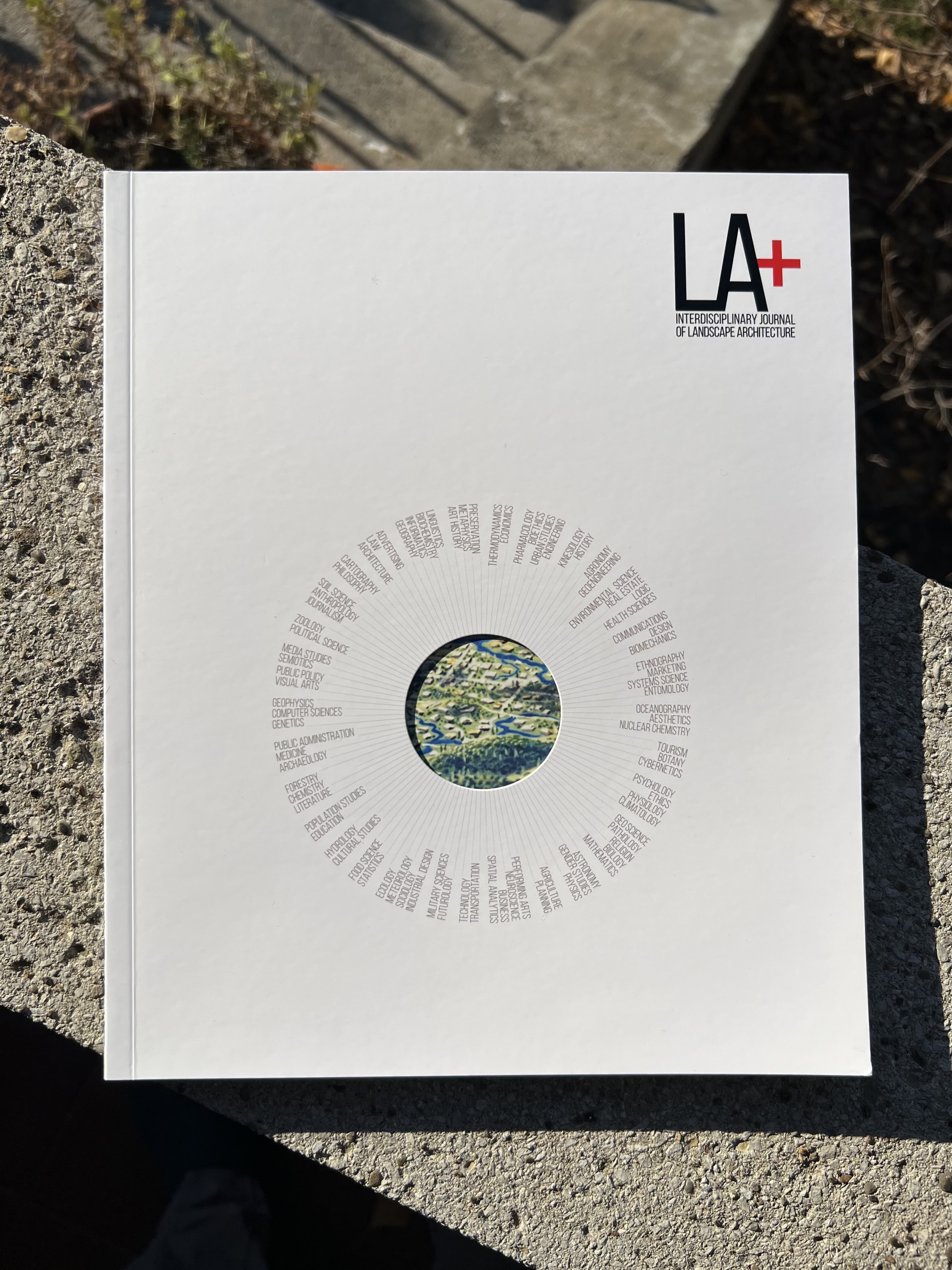
The University of Pennsylvania's Weitzman School of Design has published the latest edition of its periodical LA+, an interdisciplinary journal dealing with landscape architecture –– and more, as the name hints.

The topic and title this time out is SPECULATION, a multifarious and richly intersectional theme on which contributions appear from Alexandra Daisy Ginsberg, Javier Arpa Fernandéz, Min Kyung Lee, and Ytasha Womack, together with many others, all marshalled by the issue editor Christopher Marcinkoski and editor-in-chief Tatum Hands.

I had the pleasure of taking part in the project via a conversation with a wonderful transdisciplinary practitioner of landscape architecture and media arts, professor Aroussiak Gabrielian of University of Southern California's Architecture school. As a taste, below is one of my favourite questions posed by Aroussiak, and the thoughts it prompted.

***

AG: I’m wondering how you feel about the pitfalls in speculative design, given the criticism it has received for being speculation for speculation’s sake or that its focus has been very techno-scientific, or product driven – pushing forth the same capitalist system by inventing objects that we might consume in the future.

SC: Yeah, I think that those are definitely ways the work can fail to live up to its potential. Sometimes, especially early on, practitioners might find themselves using an excess of whimsy on one hand, or an excess of capitalist realism on the other. To me, both are ways of missing the mark, but I think it would be unfortunate if that were to lead some observers to think that the whole enterprise of using design and the arts to explore futures is without value. That would be a grand-scale throwing out of the baby with the bathwater. It’s possible to write bad poetry, too, but that doesn’t mean all poetry is bad.

I would say that some of the criticism drawn during the recent wave of speculation in design, while fair enough, is really responding to a sort of belated unleashing of creative energy that was previously stifled by a so-called human centered, but, let’s be honest, capital-centered, paradigm where the use of imagination is highly constrained, and aspirational only within tightly defined limits. You take those constraints off, and people go wild. That is actually kind of cool to watch, but is it the end state for the practice? I don’t think so. Once people have gotten some of that initial rambunctious energy out of their system, there is a sort of getting of wisdom in play. You can see this with [card game] The Thing from The Future. To start with, many players revel in the license to run free, be silly, and have fun. Then, after a while, they start to get a little bit more critical and search for ideas with more substance. The novelty of the very idea of something ostensibly coming “from the future,” perhaps exciting enough in itself to begin with, wears off, and players start to want to know more about what future it’s from, and how it might work, and how it’s different from what they’ve heard before, and whose interests it represents. This is part of why, having created the game, Jeff [Watson, cofounder of Situation Lab and professor at USC School of Cinematic Arts] and I kept adapting and modifying it, and using it with different groups to help push the general vogue for speculation past this initial flare-up of excitement and crappy ideas that we all tend to have when first invited to roam freely in the space of alternative futures.

To try to make the year 02050 matter right now is an important but difficult task. There’s no objective referent for a 02050 scenario – in contrast to trying to bridge into the shoes of someone historically or in the present, where you can at least partially ground-truth things. The inbuilt speculative challenge of futures is that they are not just epistemically but ontologically indeterminate. They are up for grabs. So we need to realize that when we’re making a hypothetical world specific enough to wrap our body-minds around, we’re making it artificially specific, just in order to be able to think and feel into it. We have to take the ability to inhabit this “what if” with a big grain of salt, because it’s not a question of getting it right or not, in a predictive sense; it’s a question of how rigorously and usefully we are deploying imagination to enable new perceptions and possibilities in the present.

***

If you're interested in the theme of speculation, as so many designers have been recently, check out the full piece (Futuring: A Conversation) and the collection as a whole (digital or print).


Related:
> Design and Futures (ebook and paperback)
> Critical activism: Anab Jain of Superflux
> I design worlds: Liam Young of SCI-Arc
> Using the future at NASA: David Delgado of NASA JPL
Gaming futures literacy: The Thing From The Future (pdf)
> An experiential futures interview 
> Designing futures: An interview
> Design is a team sport
> Killer imps: Bringing futures to designers at the Royal College of Art

Tuesday, November 30, 2021

What is the Value of Futures and Foresight?


The Experiential Futures Ladder. Diagram by author. See articles The Experiential Turn (02016) and Designing an Experiential Scenario (2017) co-written with Jake Dunagan

There has been a tremendous expansion in awareness of and interest in futures/foresight work recently, especially those approaches that intersect with the arts, media and design. Projects and publications, courses and conferences on these topics are flourishing like never before.

As Cher Potter and I wrote in our introduction to the collection Design and Futures in 2019:

Nobel Laureate Herbert Simon famously observed: “Everyone designs who devises courses of action aimed at changing existing situations into preferred ones”.

Designers and futurists, it turns out, have a great deal in common. This mutual recognition is reaching critical mass as each comes to appreciate how their respective traditions have much to offer to making urgent change in the world, and even more so, together.

It is increasingly acknowledged within the futures studies community that operating with a largely verbal and theoretical bent over the past half century has afforded too little impact on actual future-shaping behaviours. Meanwhile, those in the design community recognise a need to interrogate higher-level consequences — the futures, the worlds — that their products, systems and other outputs help produce.

Part of what bringing design and futures into sustained dialogue does is to allow each field to become more fluent in a second language which is the other’s native tongue.

This was published before the Covid-19 pandemic kicked in, but if anything, already established trends in practice have only continued to accelerate since.

In the past handful of years, diverse organisations — cultural ones like the BBC, multilateral ones like the United Nations Development Programme, scientific ones like NASA JPL, and humanitarian ones like the International Federation of Red Cross and Red Crescent Societies — have embraced experiential futures as part of the very different things that they do in the world. The largest futures event ever held, a Futures Literacy Summit hosted by UNESCO with over 8000 registered participants, took place online at the end of 2020. Also late last year, a collection of us spread around the planet launched the UNTITLED futures festival, likewise staged largely online thanks to the pandemic, but planned to iterate annually through 2030. This month, a show called The Great Imagination opened in Madrid, surveying the history of images of the future (and featuring our experiential scenario NurturePod), and a major exhibition by the Smithsonian Institution, FUTURES, for which I served on the advisory Working Group, just opened on the National Mall in Washington DC. In addition, since last year I’ve been collaborating with the World Economic Forum to help explore the integration of foresight approaches, and especially experiential futures, into their research work, as well as convenings such as the annual Global Technology Governance Summit, held for the first time in April.

It was also last year that the United Kingdom’s RSA (royal society for arts, manufactures and commerce) released a report about “realising the value of futures and foresight” called A Stitch in Time? The authors had reached out to me to ask questions on this topic, and I shared some thoughts in reply. Now, since these kinds of issues are arising more and more––and evaluation of foresight work is also a live topic of conversation among professional and academic futurists––here is the full Q&A.

***

RSA: What is the value / distinct offer that experiential / ethnographic futures brings? Are there particular settings they work well in, and how do such approaches land with clients, particularly policy-makers––is it helpful, or seen as wacky?

SC: There are a few threads in this first point. I’ll try to tease them out briefly.

The distinctive value of experiential futures practices comes from how they help people connect to potential realities in waiting as more than just as ideas or thought experiments. There’s a one-pager from The Economist here, a recent piece I wrote for the Cooper Hewitt (Smithsonian Design Museum) here, and for more background and nuance, a journal article from Futures, a deep dive into the design of a card game we created as a distillation of experiential futures ideation, and a book-length exploration describing a kind of foundation for these practices.

Ethnographic futures work is about researching how people actually perceive, think and feel about the landscape of possibilities. Ethnographic Experiential Futures (EXF) is a process for bringing the above two traditions together, so it’s really scaffolding for making people’s images of alternative futures (a) legible, and then (b) graspable using whatever means fit the context — immersive experiences, performance, physical futures artifacts displayed in a museum or sent through the mail, etc. There’s a journal article about EXF here, or an earlier blog post with I think more images.

These approaches are by no means intended solely for consumption by “clients” — they can also augment public conversation, with much wider or more open-ended audiences, which has since we started doing this ~15 years ago always been a priority.

The extent to which the interventions reflect or deepen, vs push back on or challenge, the thinking of the people encountering them varies enormously. I think it’s usefully regarded as one of the main design variables; that is, something you make choices about, not at all something preordained, automatic, or identical across projects.

How do you evaluate foresight work? Is it possible / needed / appropriate?

How you evaluate something depends entirely on what you are trying to do with it. I’ve suggested (in The Futures of Everyday Life) that education, exploration, evangelism (persuasion) and entertainment are among the diverse purposes that might attach to different experiential futures projects or interventions. Naturally you’d bring different evaluative lenses to bear on each.

One of the main evaluative questions that I think is too often overlooked is “how does it affect the people doing it?” as opposed to “how does it affect someone else?”

How does futures work (especially experiential futures) evolve in this “new normal” period when our experience of reality is so heightened and visceral?

One move is to create online experiences. For example, we’ve been staging experiential scenarios online based on published visions in the public domain. Recently we created an immersive experience of the world decades after the Green New Deal has passed into law, based on the book A Planet to Win by Kate Aronoff et al; and another experience inspired by CEO Kickstarter Yancey Strickler’s book This Could Be Our Future; one using Haraway’s Cyborg Manifesto as a starting point, and so on. This work hasn’t been written up as an article yet but you can see a bit more about it at the page for this event we ran back in April, The Time Machine: An Anthology of Visions (click “View details”).

I’ve also written a piece about lessons from directing a global online game for pandemic preparedness, called Coral Cross, funded by the CDC, a decade ago.

Is the field gaining traction as a result of Covid-19? What barriers do we need to overcome for its adoption as a valuable asset for decision-makers and planners? Do you see specific opportunities opening up?

Since Covid, people now seem to have less trouble coming to the premise that thinking about alternative futures might be useful for their organisation or context. So actually some of the main challenges I see at the moment are not necessarily “barriers to adoption” per se, because there’s a great deal of uptake and adoption — the demand side is healthy.

It’s the supply side that is bottlenecked, so in some ways it may be more a matter of “barriers to skilful implementation”. There are more people wanting to do this work, freshly trained or newly experimenting with it, than there are really good, experienced futurists to help guide them. This means there’s room for legitimate concern about insufficiently supported, under resourced, or hastily executed work delivered in or to organisations that have less experience — and the risk is less robust outcomes in the short term, followed by disappointment, and then some time will pass before they try again and, hopefully, do what they should have done in the first place!

Do you think there are valuable insights from aligning / working with other fields or disciplines?

Futures is by its nature a transdisciplinary field. It always involves engaging with a range of other fields and perspectives, and this is among its greatest and most distinctive strengths, I think, as well as an important part of what keeps it interesting.

Are you teaching this as a stand alone course, or a module for those taking other courses? And do you find that people with a particular mindset or personal attributes are better at this work or adopt it more easily?

In keeping with the point above: I think it’s useful to see futures/foresight as a set of competencies that anyone can learn and use over time, and that cut across and complement other fields. I see great value, and even a civilisational imperative, in distributing futures fluency or literacy more widely throughout our communities and culture, which is part of the long-run orientation that we sometimes speak about in terms of developing “social foresight”.

There’s certainly increasing demand for futures training in many quarters, yes, including students, and our evil plan to normalise or integrate futures thinking as a part of design has come along in leaps and bounds over the last decade. We also work with a real range of organisations in various capacities, from US Conference of Mayors, the BBC, Skoll World Forum, IDEO, and NASA Jet Propulsion Laboratory, to the Smithsonian Institution, UK National Lottery, Alaska’s Cook Inlet Tribal Council, and so on. Regarding aptitude, people with a cultural fluency or orientation tend to pick it up really quickly. I especially like working with museums and other cultural organisations, because I think they’re among the best avenues to social foresight — getting wisdom into the water supply, so to speak.

What might you wish for in the further development of this field?

Futures work is highly relational. It’s about not just when, but also who, and where you are. It’s not a compliance process you can just step through automatically, checking boxes; much less a product to buy and be done with it. It’s more like dancing. I expect to see more organisations realising they could use a few dancing lessons, and reaching out for help with that. They will have to be prepared to take risks and missteps, though, or how will they ever learn? And it might seem embarrassing at first, but the sooner they’ll do it, the faster they’ll learn and benefit, and maybe even have more fun. By the way, this seems to be happening quite a bit more quickly in the nonprofit and public sectors than in the business world. To generalise a bit, the former tend to be better equipped for, as my friend Michelle King puts it, “learning in public,” while the latter are often concerned about a commercial confidentiality that can really get in their own way. Over time, though, those two different stances, one more open and the other more closed, seem likely to yield the results they deserve.

We’re writing this short provocation report for a lay audience, the intellectually curious, who are unlikely to be experts in this space. Is it possible to identify the two or three things that you wish everyone knew about the field (or perhaps myths you’d love to bust)?

No one, including futurists, can tell you what the future will be. If someone tries to sell you that, don’t hire them.

Folks in the field generally refer to it, almost interchangeably, as futures (oriented around the subject matter) or foresight (oriented around the competency), not futurism or futurology. By and large that’s almost a litmus test of whether you’re dealing with someone who knows the field or not.

Futures is a container or meta-perspective that includes, classically, multiple modalities to address — and we can simplify a bit here, borrowing a classic typology — possible, probable and preferable futures. Each of these conversations inescapably involves engaging different kinds of knowledge, so the practice is bound to be part art (what could happen?), part science (what can the evidence tell us?), and part politics (what do we value; what should we do?) If that seems messy, just look at how messy the world is.

I would be most suspicious of any perspective that pretends complexity can be simply tamed. Futures or foresight offers the necessary structures and spaces to help integrate reality’s mess with the organisational dialogue. Among other things, it’s an orientation to constant learning. As my colleague Jake Dunagan (now at Institute for the Future) and I are fond of saying, “It’s better to be surprised by simulation than blindsided by reality.”

***

For further reading, here is the full RSA report: A Stitch in Time: Realising the Value of Futures and Foresight.

And finally, just published in the past week by the Copenhagen Institute for Futures Studies is a report looking at how arts and futures work intersect, including the rise of experiential futures practices: Futures Shaping Art / Art Shaping Futures.

Saturday, November 30, 2019

Using the Future at NASA

A poster from the future by The Studio, NASA JPL's visual strategy team

David Delgado is a Visual Strategist at the National Aeronautics and Space Administration’s Jet Propulsion Laboratory (NASA JPL), a U.S. federal research and development centre in Pasadena, California. Along with his longtime collaborator Dan Goods, we met last year at a symposium in Berlin geared towards exploring exhibition concepts for Dubai's Museum of the Future (which is currently under construction).

A conversation we began there has carried on since, including several site visits to JPL, around how experiential futures and worldbuilding can serve internally- and externally-facing communications alike, as well as both short- and long-term needs; spanning organisational culture and morale as well as imagination, strategy, and mission formulation.

David and his colleagues at NASA offer an inspiring and mind-expanding example of using experiential futures / design fiction in a space of simultaneous fantasy and real-world exploration; shaping our own now, and maybe someday, others too.

***

SC: Tell me about JPL’s series of posters from the future of space travel.

DD: A while back, a famous scientist was planning on coming to the Jet Propulsion Laboratory, and so the Exoplanet Exploration Office asked us to do something to celebrate the diversity of planets that were being discovered. There are thousands of them, and they have all kinds of crazy characteristics that are super interesting. Some rain molten glass, some have two suns, some are considered diamond planets, some are just big gassy giants. Naturally, we wondered what it would be like to go there, and we thought travel posters would be a fun way to showcase different planetary characteristics. So we went to the 1930s, ‘40s style of illustrated travel poster, and met with scientists to make sure that each one was based on a scientific foundation. But at the same time we wanted it to be joyful. We also wanted to kind of plant that seed: Maybe we can really go to these places.

SC: So where did this idea come from? There’s been a lot of activity at the intersection of design and futures over the last decade.

DD: Yeah! We sort of fell in love with the idea of imagining these futures, and we made the first few posters. And then Dan Goods and I spoke at the AIGA Conference, and after speaking we were killing some time, and went and saw this crazy futurist –– you, Stuart –– talking about this sort of experiential futures campaign to raise people’s attention. And there was also this cone of possibilities diagram that you showed on the screen, which really helped to crystallise the idea for us, and gave us a way to talk about it strategically and show other people. We may be at the very tip of that cone right now, and going to these future worlds is somewhere farther out in that flurry of many different dots, but the whole notion is to continue doing things that will get us closer to that. How we get there, we don’t know, but we know that we need to keep on progressing. And so it was really a catalyst to the way that we thought.

SC: That’s great to hear!

A cone of possibilities. Diagram and discussion in The Futures of Everyday Life

DD: And then, apparently, everybody liked it. There were 1,200,000 downloads in one week when we first released the whole set. It was kind of nuts.

SC: Amazing. And the details of the posters were based on the state of the science, what is known about these different planets.

DD: That’s right, and we focused on one special thing about each faraway planet, following the model of the original travel posters themselves. You’re going to be in a forest, or the desert. We allowed people’s imaginations to grow from there.

SC: How did it come about?

DD: It was internal. The design brief was to decorate a hallway –– that’s where these came from, the request to decorate a hallway.

SC: [laughs] I love that. Instead, you ended up decorating a million hallways.

DD: Right! What’s cool is that it grew organically. We had three posters, meant for internal use, and everybody started liking it, and the director of JPL fell in love with it. The director was on vacation at the Grand Canyon, and sent an email saying, “Look at this calendar – let’s do one for the posters!” We went from having three to doing another nine very quickly.

SC: So then you did stickers?

DD: Yes. The posters happened, then we had a change of director of JPL, and a huge workload going on at the time. There was a request for us to give a gift to the Laboratory itself, to all of the JPLers. It was kind of an effort to raise morale; at least, that was our approach.

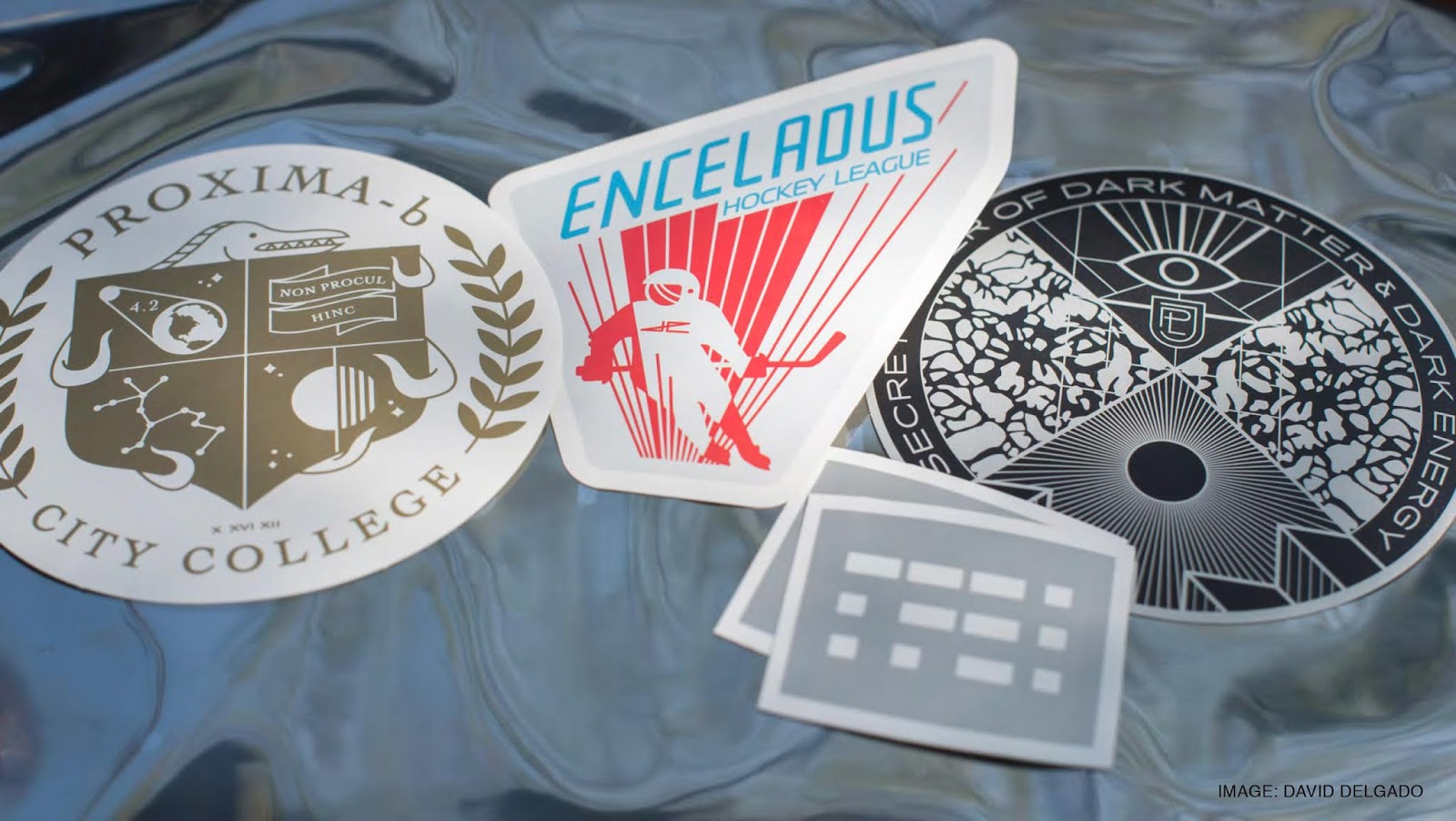
Given that a lot of people are working super hard on really amazing projects, we looked at each of those projects and imagined: what could this lead to? So we decided to create these stickers for clubs and societies from the future that you could join when interplanetary travel is possible, but representing what’s currently being worked on.

Each person at JPL got four sets of twelve different designs, like a swag pack that they could hand out to their friends and family, and that would give them a way to tell the story about what JPL is doing, and feel proud about their own work and contribution.

Strategically, the clubs are storytelling devices. At JPL you’ll see people put the stickers all over their computer, or people driving around with just an E, for Earth, like the European bumper stickers. When you’re travelling throughout the solar system, you need to represent where you’re from! It’s all done with a wink and a smile.

There’s the Secret Order of Dark Matter and Dark Energy.

There’s a big push to identify near-Earth asteroids and make sure that Earth stays safe from impact, so we created the Asteroid Patrol.

One was inspired by the 40th anniversary of the Golden Record, so we created the Proud to be Human Club. The Golden Record and Pioneer had all these things about Earth, so we merged them together. There’s a lot of reasons to be proud to be human, and let’s just celebrate that for a second.

Enceladus is a moon of Saturn. It’s also an ice covered planet that shoots out geysers of water. And so since it’s covered in ice, we have the Enceladus Hockey League.


Designs from the project Clubs for the Modern Explorer, an internal gift from the JPL Director to Lab employees; images courtesy of David Delgado

SC: These are great.

DD: We had to think about Earth in a different perspective too, as our original home, that we will always consider the first place. It’s this mothership that we are coming and going from; a Buckminster Fuller-inspired, “Spaceship Earth” idea.

SC: I bet they were a hit.

DD: Yeah, they were a huge hit. Everybody loved them

SC: So the clubs and associations thing actually came out of having done some worldbuilding already, and going, “Well, if this existed, then so would these...”

DD: Right. It came from one of the posters, actually, about Titan, a moon of Saturn. One of the great things about Titan is there’s these big seas of hydrocarbons –– think of like, liquid nitrogen, but it’s liquid methane. So the design was this beautiful image of the seas with Saturn in the background. This part never made it into the poster, but we were kind of imagining what the boat rental place would be, and the logo for it –– and that started us thinking, maybe we could look at logos as a device to communicate something. If that exists, travelling around between planets, what are some cool clubs that you could join in that world?

A space tourism poster from the series produced at NASA JPL

SC: That’s really interesting. So how would you describe the use of experiential scenarios or design fiction at JPL, what has it done for you?

DD: Well, for one thing it took the conversation out of the present, and allowed people’s imaginations to become involved, thinking about not only what kinds of things are happening now, but where they may lead in the future.

SC: That doesn’t happen regularly?

DD: It does happen regularly, but it’s usually positioned within the focus of creating new missions. It’s strategic in a different way.

The reason we really gravitated towards it is because it allowed us to create a motivational tool. For people at JPL it sort of reinforced the reason they started working there in the first place: they want to do something big, contribute to humanity, be at the cutting edge. Using the future to help motivate people became a powerful way to communicate internally. If you’re part of space exploration, you are part of a group building this continuous series of steps that will lead to something very special.

I think once the poster downloads happened, we realised that it was much bigger than communicating internally. There is this shared public dream of being up in space –– it has been in science fiction for a very long time –– but these places are real. These designs brought them one step closer, gave them more power.

It was this whole experiment in understanding the value of using the future as a tool for the imagination.

***

This piece was published earlier in the year as an article in the Journal of Futures Studies special issue on Design and Futures, Volume II. It can be downloaded here (pdf).

Thanks again Dave, and fellow travellers at JPL!

Related:
> Design and Futures Volume I & Volume II
> On getting started in experiential futures
> The School of Worldbuilding (pdf)
> I Design Worlds (pdf)
> Critical Activism (pdf)
> Design is Storytelling
> Gaming Futures Literacy (pdf)
> The Futures of Everyday Life (pdf)

Monday, June 17, 2019

Critical activism

Anab Jain is a leading light of experiential futures practice. She is cofounder with Jon Ardern of the London-based "vanguard foresight and design organisation" Superflux, whose work has rightly earned attention and admiration far and wide, with projects like Mitigation of Shock (an installation), Instant Archetypes (a tarot deck), and Drone Aviary (a film, and more).

Image from Mitigation of Shock by Superflux, an installation at CCCB portraying a small London apartment adapted for climate change in 02050 (02017)

We first met in 02009, just a few years into our own first experiments with experiential futures, following a talk I gave on that topic at the Long Now meetup in London one evening during my time visiting 'Design Interactions' at the Royal College of Art. This was the highly influential MA program led for a decade by the wonderful Fiona Raby and Tony Dunne from which Anab had graduated back when it was still a degree in 'Interaction Design' –– prior to the 02008 landmark MoMA exhibition Design and the Elastic Mind, which contributed much to the visibility of the work of not only Dunne and Raby but also their mentees, in what they called at the time 'design for debate' and 'critical design', and well before 'speculative design' framing coalesced (as mentioned by Anab below), a development of the past five years or so.

Superflux got underway in 02009, a few months after we'd met in London, and Anab and Jon were among the first designers to set up shop in a way that engaged the tradition and practices of the futures field not just explicitly (using the language) but substantively too (really using the tools). For instance we recently collaborated on introducing foresight to International Federation of Red Cross and Red Crescent Societies (IFRC) via experiential scenarios deployed at IFRC's biennial strategy meetings.

This post is an abridged version of a conversation appearing in the recently published Journal of Futures Studies special issue Design and Futures, Volume I.

Anab's sense of the work as "slow critical activism" really resonates with me, and her candour here, talking about the behind-the-scenes challenges of maintaining a design/futures business that is both viable and principled, is super generous and helpful, I think, for the many newcomers eager to figure out how they can practically make this sort of thing a part of their work lives.

***

SC: How do you situate your practice in relation to futures and design?

AJ: I think we are situated somewhere in the middle. We have a two-pronged approach. We do foresight and horizon scanning – that big, meta-level stuff – but we simultaneously ground it with material explorations, ethnography, research, prototyping.

Obviously we come from a design/art background more than futures. Our schooling was often about what the implications of a certain technology on society might be. And over the years, we’ve studied the more traditional futures methods a bit, not quite as much as a futurist would.

SC: What are some projects or initiatives that you’ve been involved in that you consider exemplary of your approach?

AJ: Our approach has changed a lot. We often used to work around a technology, so we would pick something like quantum computing or optogenetics, and try and understand what its potential is, but also poetic implications that the scientists or the technologists might not have explored.

And we’ve moved from that to thinking more socially, politically. We’re very interested in the implications of living with climate change, so for a recent project, Mitigation of Shock, we really wanted to understand how to bring that future that is so abstract around climate change - especially in the Western part of the world - making it real and conceptually visceral, but also not dystopian.

SC: So you’ve been at it...

AJ: Nine years.

SC: I’m interested in how you imagine the work that you’re doing against the backdrop of an increasing number of people operating at this intersection. If there is a “you are here” point on a map of bigger activities going on, where do you locate yourself?

AJ: Oh, that’s a good question. We keep asking that ourselves.

'Speculative design' has become popular, the term; although we have never actively used that term so far. We are afraid of labelling the work we do within a specific discipline, because for us it’s changing all the time, and we want to have the freedom to change. So we just call ourselves designers, or artists even.

Where people are interested in our work, or want to commission us or hire us, they are not thinking about us as speculative designers or critical designers either. They’re thinking: "We need to think about the future, but we don’t know quite how to make it visceral enough to get people to understand the consequences."

Outside of the world of design, not so many people care whether we call what we do speculative design or not. Some people call us a think tank, some people call us a research unit, some people call us artists.

SC: What are you grappling with in relation to these practices at the moment?

AJ: Lots! We’ve gone from being tiny to growing quite a bit, and then, recently decided to consider more carefully where we go next, and stop just producing project after project after project. I think we are trying to understand what meaningful change looks like for us.

We keep getting emails from people, and we know that the work affects people and gets them to think differently, but how can we materialise it without using this language of evaluation and impact and measuring? Because these are not things that can be instantly measured. Something that you’ve done to provoke people could affect them and get them to think differently after years –– but how do we begin to surface that?

I see it as a form of slow critical activism. If our work becomes a catalysing force for people to imagine things they would not have been able to imagine otherwise, that’s powerful. But then what? We are at that stage right now.

Currently I think our work is moving in two directions: one, with people whose idea of the future we may not agree with personally, but who have a lot of power and influence to affect change at a large scale. Our work with them focuses on helping them consider broader, unintended consequences by enabling them to think differently and more broadly. Secondly, we work in the public sphere, triggering public imagination.

Organisations who have power and influence and can actually affect decisions around climate change or education, are so outcome driven, that their key question around any futures always seem to zoom in on: What are the outcomes we get, and what’s the impact, how will this affect our strategy?

SC: And what do you tell them?

AJ: We don’t really have a clear answer. We can say, okay, we did this with the UNDP, and that led to the opening of this completely new department where they’re thinking about alternative financing. Or we did this, where it affected a decision or policy change. Examples are few and far between where there is a clear, linear, obvious trajectory of 'impact'.

People want concrete stuff, and the thing is, there isn’t a concrete answer. There isn’t a concrete outcome, to be honest. The outcome is the process by which you will start shifting your thinking.

SC: What do you think are the most important things for people who are interested in this area of work to be aware of?

AJ: One of the questions I always get is, "How do you actually make money, and who are your clients?" and it’s like, it doesn’t seem plausible that we could even be doing work and be paid. We’re not set up to be making profit, but we are alright!

We could earlier this year have gone easily from eight to twenty people. But we realised that scaling in numbers is perhaps the wrong way of thinking about 'growth' for our studio, and the scale lies in the nature and ambition of each project, and the way it can influence a decision or change perception. The bespoke nature of our work means we cannot adopt a cookie cutter approach to our services. No brief is ever the same. And having a flexibility of staff and overheads to support such work is very important. We might have big ambitions, but it’s not dependent on the scale of our practice.

For a designer, it’s so tempting to have 20, 30, 40 employees, to become 'the office'. It is in the model. I am often asked: "How big are you? How many employees do you have?" And they will actually decide whether to give us work or not based on my answer. So yes, sometimes it’s tempting to scale because scale is a seen as a visible sign of success.

SC: I really like this unwillingness to settle for an inherited definition of success. Instead it’s striving for a certain quality of impact, or a certain kind of cultural presence.

AJ: We tried it, and we’re both not managers. Well, we do have to now, but we really enjoy the actual craft of storytelling, making, building, designing and all of that. So we want to find a way we can continue our practice.

SC: Have you ever done a futures process for your own organisation?

AJ: No! We should, shouldn’t we?

***

The full version of the conversation as published in JFS can be found here.

Thanks again Anab!

Related:
> Design and Futures, Volume I
> I Design Worlds (Liam Young in JFS)
> Experiential Futures: A brief outline
> On getting started in Experiential Futures
> An Experiential Futures interview
> Ghosts of futures past
> Killer imps (RCA Design Interactions)

Friday, May 31, 2019

I Design Worlds

Architect-worldbuilder Liam Young currently runs the Master's program in Fiction and Entertainment at Southern California Institute of Architecture (SCI_Arc) in Los Angeles. He's an influential practitioner and articulate thinker from the design/futures ecotone, and I love how he adapts and exploits architectural logic to expand the array of strategies available for thinking and feeling through near-future possibilities.

Still from the short film Where the City Can't See (dir. Liam Young, 02016)

We first met almost a decade ago, although as it turns out, spent formative years in the same part of Australia and had mutual acquaintances in high school. We've had occasion to mind-meld periodically over the years; like the time I joined his and Kate Davies's nomadic Architecture Association studio, Unknown Fields, for a 02012 edition rumbling across in the Southwest of the US in a big yellow school bus, which concluded at the Burning Man festival in Nevada, where the two of us collaborated (together with orchestra conductor Daniel Stewart) to stage a mobile audio installation called Augury. In 02015, we were invited to present in an experimental public lecture series that paired speakers back-to-back, Shipping Architecture, at the University at Buffalo's School of Architecture and Planning. And more recently, we had a chance to catch up at the First Futurological Congress, hosted in Berlin by the Dubai Future Foundation, last summer.

Today's post comes from a conversation that we had there. It's an abridged version of an article just published in the Journal of Futures Studies special issue on Design and Futures, Volume I.

***

SC: How would you describe your practice in relation to the intersection of futures and design?

LY: I’m trained as an architect, so I am interested in the architectural, urban and global implications of emerging technologies. I don’t design buildings but rather I design, imagine, speculate, and construct worlds. The world is the medium in which I prototype futures. It’s a very spatial way of thinking about future narratives. I predominantly explore these worlds through the medium of film. For me films are a way of disseminating these worlds to audiences.

So that’s where my own practice sits in the context of design/futures practices. It differentiates itself by thinking about worlds as the medium of operating, as opposed to products, characters, buildings, and so on.

SC: How standard or non-standard is that, to be an architect thinking in terms of a world rather than a building?

LY: For the most part architects think in terms of buildings as singular objects on a site, but in many ways, we are trained to think through worlds. I think it’s the great disappointment of architecture that most architects waste their time just designing buildings.

SC: How would you situate your interests in the wider landscape of design and futures, this intersection much explored, and dabbled in, over the last decade?

LY: I’m interested in moving outside of that territory of the design-futures nexus, and in co-opting, not forms of design media, but forms of popular media, and encoding within them these critical questions about what the future means.

If we really value what we do in futures, and we think it’s important, we should be thinking much wider than the design futures market. For me, that was about working with popular mediums that we typically dismiss as being lowbrow or mainstream pulp, such as film, video games and TV.

It’s our duty, I think, generationally, to seed these cultural mediums with ideas that we think are important, so that people can start to engage with them. I think that’s a real critical role that the architect, speculative designer or futures thinker can play.

SC: A brief example of a project you’ve done that leans into this space you’re sketching out?

LY: Working with author Tim Maughan I made the short film Where the City Can’t See. It’s the first narrative film made entirely with LIDAR scanners, the surveillance system that driverless cars use to read and understand the world.

We are interested in what it means to literally have constructed a millimetre-precise virtual model of the entire world.

So we made a film as a vehicle to explore what it might mean to live and operate within the context of a city that can see everything. Where do the spaces of exception exist in this form of city? What is the equivalent of a warehouse rave, a wilderness zone, a site of transgression? What does it mean to be a member of a subculture in a city of ubiquitous surveillance? We developed a working prototype for a new kind of hoodie that disguises the body from these scans. It creates a form of digital camouflage or glitch that allows the wearer to disappear to the eyes of the machine. We worked with a choreographer to develop a vocabulary of dance movements that would disguise the proportions of the body to the systems of body detection algorithms. And these ideas aren’t just a story or a plot point, they are working prototypes that happen to be sited in the medium of film.

SC: You emphasise that this is something that works. How important is the feasibility of the prototyping?

LY: I’m interested in a level of believability, or realism, which makes the narrative, the story, the prop, feel urgent or visceral or inescapable.

SC: Believability is about perception. Making it seem real doesn’t require that it be real on closer inspection.

LY: True, but making it real-real is one reliable way of engendering that level of believability or empathy. For it to be plausible and create an emotional engagement, I think is the most important thing at the core of all this. But we like to work with the technology in very real ways because it gives us another way that we can disseminate the world we’ve designed.

A whole raft of press was produced around Where the City Can’t See totally independent from the nature of the film itself. We were on Gizmodo, on BBC, all these places, talking about digital camouflage. Then it hit the film festival circuit and had another kind of cycle, separate from the props within it, based on the storyline and the visuals. It just allows it to operate in a whole range of different contexts, and connect to a broad range of different audiences.

SC: Technological realism or feasibility is a higher bar of a sort, also limiting how speculative you can be. Tell me about that trade-off for you.

LY: I don’t want to go into the realms of fantasy. With my speculative work I want to be in that sweet spot between not here yet, but not far enough away that it can be dismissed as pure fantasy.

SC: Being on the crest of a wave that’s going to break no matter what is more powerful in some ways, but if worlds are the medium, and they are what’s at stake, we need enough lead time to make a sort of societal choice between those worlds. There are limits to the usefulness a speculation can provide when it’s on the verge of happening regardless of whether or not you do the project.

LY: Yeah, it’s not exclusively the space in the spectrum where I would operate, but it’s a place that I think personally I can contribute to the most because of my training. What architects can do quite well is synthesise technology and culture. It’s one of the very few disciplines where you have classes in engineering and coding, but you also have classes in philosophy and critical theory.

What we do with these types of projects is engage with the technology at the point where I think it’s most interesting, which is often the point where it becomes democratised or widely accessible. Tim and I talk about this great quote from science fiction author William Gibson, “The street finds its own uses for things.” Technology becomes interesting when it hits the street and moves outside the dominant discourse into a subcultural space. We like to take that leap and prototype the new forms of culture that these technologies produce.

It’s not exclusive. It’s not to say that this is the best space or only space where speculation works. It’s just that these technologies, before culture technologies as I describe them, have arrived before our cultural or ideological capacity to understand them. I think a film like Where the City Can’t See or one of our other projects In the Robot Skies are really important to make right now.

SC: I agree with you, and I think that need exists partly because the longer-range speculation hasn’t happened either. We’re talking about layers of under-served futures discourse.

LY: That’s exactly right. In the context of driverless cars, these things are happening. Ford, GM, all these companies are already billions of dollars in. Now we’re making films about driverless cars because we know they’re coming, and we want to be prototyping cultural and ideological positions around their imminent arrival. But I would have much preferred to have been in the room 20 years ago at Ford: “Let’s do some forecasting here, let’s prototype some stuff, let’s see if this is a good idea first.”

Now you can’t walk into an architecture school anywhere in the world without seeing a driverless car studio, where they’re thinking about what it means for urban life, what it means for the street. Architects should have been doing that 15 years ago.

SC: Architects, designers, policymakers...

LY: Everyone.

SC: You quoted Gibson a minute ago. He also famously said, “The future is already here, it’s just not evenly distributed.” The present, the future coming into being, is a process. There are stages; before the trend, the emerging issue; it’s over the horizon, and then little by little, becomes a kind of imminence. So there is a spectrum of places to intervene in the onrush of potential. What you’re doing is closer in, and that needs to happen. Meanwhile the futures field generally probes further-out possibilities and time horizons, which are traditionally underexamined even in areas like design and policy. I’m interested in how the whole range of design and media practices can make these things feel real enough to bother to have the discussion before you have to have the discussion. Because with longer lead times, larger world-shaping choices are available.

LY: Yeah, exactly. All these types of projects need to happen, basically.

SC: So for futurists interested in design, designers interested in futures, what lessons are there to be shared from the intersection?

LY: I think that in this space we have to be talking about audiences for the work.

To really think about where our projects land is fundamental to the act of producing them. Let’s not be design futurists, let’s operate as design futurists within policy, within government, within academia, within Hollywood, within the video game industry, within infrastructure. I think that’s a real key for me.

Design futures is a practice, not a discipline. Its greatest strength is not siloing it as a thing that’s legitimate in itself, but looking at it as a methodology that can find traction in a whole range of different disciplines outside of itself. And I think that’s where we’re at with it right now.

***

A longer version of the conversation with Liam, as published in the Journal of Futures Studies, can be downloaded here (pdf).

Related:
> Design and Futures, Vol. I
> Shipping Architecture (video)*
> Critical activism: An interview with Anab Jain (pdf)
> Experiential futures: A brief outline
How to Build a World (video)

(* Apparently this has been online for years – didn't know that until today. Unfortunately the audio isn't great.)

Tuesday, April 30, 2019

Participation design

I was revisiting earlier today a podcast conversation between two people I much admire –– an episode of Team Human recorded by writer and host Douglas Rushkoff with security and privacy architecture consultant Eleanor Saitta.

Rushkoff's first book Cyberia (01994), for me as a teenager in Australia, was a gateway to a whole lot of things I'd never heard of before. I've followed his work for about 25 years, and we've met a few times over the past decade. Saitta, whom I first met when we spoke on a conference panel in Singapore together in 02013, blew my mind over breakfast, in I think our first face to face conversation, by putting me on to Nordic Larp, a big topic to dig into more at some stage. She coedited the excellent Knutpunkt book The Foundation Stone of Nordic Larp (02014), a great entry point if that topic piques your interest.

So there's this exchange towards the end of their discussion that has come to mind more than once since I first heard it.

*** 

Douglas Rushkoff: [You have written about] our determination to maintain this illusion of individuality and selfhood in the face of an increasingly networked reality. In one of your essays, There is no Future, which is a way of saying that the future distracts us from the present that we're in, you say:

Our production of narratives runs very deep. We create the "self" as a distinct entity, different and separate from the world, and create a narrative about how that self has interacted with the world through its history. This, even, is where the problems start. We try to live in that narrative, instead of in the real world. The self we create doesn't really exist, and the narrative we create is more fiction than real.

Eleanor Saitta: And I should caveat that by saying: Creating and living in fiction can be an incredibly powerful tool for political change –– as long as you know what you're actually doing. As long as you you remember that you're doing this thing.

This is something that I've argued at a completely practical level. It's really interesting to look at the toolkits that people use to design, for instance, social networks. “Experience design” –– the experience that they're talking about there is the individual experience, and that is the thing that is designed.

DR: Right, UX/UI [user experience and user interface design] is the individual user. It's not community experience, collective experience.

ES: There is no practice of, the phrase that my friend Andie Nordgren uses is 'participation design'. And this is looking at a participation frame that says, yes, we have a set of personas, and they have their individual interests, but the participation actually happens between personas, and between different parts of the community, and that's the thing that we actually really care about designing.

It's useful to consider individual experiences, and certainly every system has interactions that are individualistic, but a lot of what is interesting [lies in between these].

If you've got the in-house wiki for some organisation, there's the person who always starts pages, there's the person who cleans up pages, there's the person who is really unlikely to start a page, but will absolutely go through and flesh out all the details and find the citations. And those are participatory roles that are happening between people, and you want to encourage and shape those interactions. And trolling and griefing and all of these things; these are also participatory roles that we want to discourage.

But there isn't a design discipline that focuses on those things, those interactions, those participations, as the first-class structures.

***

(Starts ~54 mins in.)

I've transcribed this to share here because it's interesting in its own right, and partly also as a bookmark: the fact it has come to mind multiple times seems to be tugging at some threads that are important and that I hope to tease out properly in another post. 

For now I'll just say that this idea of 'participation design' rhymes with approaches we've been working with around 'structures of participation' (Natalie Jeremijenko), 'designing for emergence', and 'situation design' (including, over the past five years, and thanks to Ella, live action roleplaying games).

Engendering circumstances in which we can usefully speculate and improvise, it turns out, is all about this design terrain made up of the spaces between people.

Related:
> Dreaming Together (pdf)

Monday, July 02, 2018

Imagining transitions

An interview by Transition Network founder Rob Hopkins for his upcoming book on imagination.

This yew tree in the grounds at Dartington in Devon, England, a stone's throw from where Rob Hopkins and I had our conversation, is thought to be around 2000 years old (Photo: Stuart Candy)

The week before last I was in Devon, England, to deliver the closing keynote for the Transition Together Symposium co-hosted by Schumacher College and Carnegie Mellon School of Design.

I was thrilled that the first evening's invited speaker was Rob Hopkins, founder of the Transition movement, which was well represented at the symposium. I'd first learned about transition towns many years earlier, attending the London premiere of a future documentary called The Age of Stupid where Rob's collaborator Shaun Chamberlin had launched a book about the movement. So I was well aware of Rob's work on transition towns, but he and I had never met before.

In his talk Rob had shared a few words about his exciting book in progress on the subject of imagination, and afterwards he asked if we could do an interview as part of that project. So the next morning, on a gorgeous summer's day at Dartington, we got together to explore our shared interest in the cultivation of public imagination.

The interview appears below, slightly abridged. A full transcript, together with the audio recording, can be found at Rob's website.

***

RH: What is a professional futurist?

SC: Someone who helps people think about things that haven’t happened yet. Usually on a longer timescale than tomorrow morning or next week or next year. More the systems that we’re embedded in, the industries, the organisations, the communities, the countries, the planet.

How would you evaluate the state of health of our collective ability to think positively and constructively about the future?

From my point of view, futures literacy is distressingly low. But the good news is that it’s learnable. The capacity to imagine, the capacity to narrate, and from there to live into alternatives, is actually very high.  Because we’re very plastic, humans are. But you have to put effort into it, and I don’t think that’s really what our institutions have been geared at. It’s not really what our schooling has been geared towards.

It’s not just in education. Our political conversations are paradoxically on the one hand very results oriented – like, “How do we know that this policy is working, or is going to work in order for us to want to pass it?” – then, on the other hand, extremely rhetorical, and gestural and not particularly evidence-based but more affinity-based. We tend to vote for the people who seem to be on our wavelength, rather than evaluating them on the quality of their ideas, or their ability to convincingly show us that those ideas might lead us in collective directions that we want to go. So, in short, there’s a lot of room for improvement!

[Related post: Quality in futures thinking]

One of the people that I interviewed was Henry Giroux, who uses the term, the ‘Trump dis-imagination machine’. He talks about the various ways from his perspective the Trump administration directly sets out to undermine and erode that sense of imagination. One of the ways he talks about it is about the past. He says that actually when you rewrite the past, and say well, the slaves all came here in pursuit of the American Dream, and you twist and change the past, you then change how we’re able to think about the future. What do you see that connection between the past and the future?

Orwell nailed it in 1984, that who controls the present controls the past, and who controls the past controls the future. That essentially the horizons that we’re able to imagine for ourselves in times to come correspond in a way to the ways that we read the present and the past that we’ve come from. So the manipulation of historical understandings, and the legislation, or the propagation of certain types of media who say, “there is no problem with racial inequality. That’s in the minds of the leftie malcontents.”

That has as a corollary a certain disdain – not just disdain, I need a stronger word than that – for progressive agendas that are looking to right past wrongs as a prelude to a future of equality and justice, and co-creative thriving.

[Related post: Foresight is a right]

If we want to bring a sense of the future as a delicious, nourishing, thriving, happy, connected, nurturing, beautiful possibility… If we want to give people a flavour of that in a world where that doesn’t even seem to be considered, certainly not in the mainstream media that people encounter… If we want to give people sips or a good drink or a feast of that …

A smorgasbord.

A smorgasbord of possibilities. From your thinking and research, where do we start?

The tradition I work in operates on the future as a plural space. So the fact that it hasn’t happened yet means that it could be many different things. And the opportunity that that affords us is the chance to imagine multiple alternative futures. Not just the delightful ones that you’ve referred to, but fearful ones, and concerning ones, and things we want to avoid as well.

But in a sense it’s a practice of mapping narrative alternatives in order to be able to navigate with them so that we have a vocabulary for the kinds of societal possibility that we seem to be moving towards or away from. So the way that this traditionally has been done is writing and discussing alternative scenarios. What kind of London, what kind of United States, might there be 20 or 50 years from now? And what are the kind of prospective historical logics, scenaric pathways that could unfold around us? And then in light in those alternatives, what can be done today to make more likely the things that we like, and less likely the things that we don’t?

The more recent addition to that perspective is the activation of the arts, of design, of theatre and performance, and in a way of materiality beyond the page in front of you, and the words on the page, to bring those futures to life.

So what my practice has been about, and the reason I’ve found my way to being a design professor, is bringing futures to life in the present, as a way of creating higher resolution mental models to think and feel with that inform our action today.

Could you give us a flavour of some of those?

This area of practice we call ‘experiential futures’ to highlight the addition of these dimensions of experience on top of the cognitive and intellectual engagement of a well-wrought thought experiment. One of the first projects that my colleagues and I did in this vein was for the state of Hawaii where I was a graduate student at the time. We put 550 people into four different versions of Hawaii in the year 2050.

[Related post: Ghosts of futures past]

So the rooms were created like a theatre set, almost?

That’s right. What I’ve been doing with my collaborators, and clients, and students for the last dozen years is designing and staging experiences of possible futures for all sorts of different contexts, and then also creating tools that help people do this for themselves, so that it isn’t just an expert undertaking. It’s democratising it.

[Related post: The Experiential Turn]

Once people had gone through the four scenarios, how did they then digest and reflect on what they’d experienced?

Great question, because the digestion and reflection part is as important as the experience itself. When one begins doing this type of thing it can be tempting to imagine that if you stage a sufficiently compelling and well thought out and polished and excitingly performed, etc., etc. immersion, that that somehow works its magic on people automatically and they’ll leave transformed.

And that’s not necessarily untrue. We’ve all been to plays or films where there isn’t a debriefing session afterwards but it still worked some kind of magic or some kind of change on us. Maybe we’ll process that with our friends or family members, or in the ambient cultural discussion around that cultural artefact later, but for these kinds of more localised interventions, where the people in the room – there may be 20 of them or there may be a couple of hundred – having a conversation which helps people process what’s just happened and notice some of the details that they missed and understand what was going on in the minds and in the bodies of the people next to them, as well as themselves, that becomes really important.

The project I describe was a prototype. In retrospect, it turns out to have been a prototype for a sort of modular design brief which I’ve been running with my students in various places around the world for the last six years or so, called ‘The Time Machine’. So the Time Machine is not a device. It’s a room that you turn into a future time. And the design task is to make the room feel like a seamless experience of the future that you’re trying to have a conversation about.

[Related post: A Time Traveller's Story]

So that’s just one single future?

One at a time, yeah, that’s right. You visit and spend time and immerse and, if you like, bathe in a particular future, and then you come back to the present and talk about it. So to answer your question about how do you debrief on this, half of the challenge is to create the experience that feels like you are time travelling, and then the other half is to have a high quality conversation about it where you surface the things that people were alarmed or excited by, where you ask them to cash out the lessons, whatever those might be, for action in the present.

That’s a facilitated conversation, and of course facilitating a quality conversation where you draw out the quiet ones and try not to have the loud ones dominate the room, that’s an art in itself but it’s a fairly well established art, whereas experiential futures are a bit more of a recent addition. But they pair well.

[Related post: NaturePod]

In the Transition movement it’s one of the things that really interests people, that question of how you bring the future out.  Is it something that requires extensive training or are there elements of it that actually anybody could do anywhere with a bit of thinking and a few people?

More the latter. Creating good immersive experiences does take a bit of practice, but it’s not necessarily expensive or that difficult. The first time we ran the Time Machine activity for a class was at the National University of Singapore. It was a week-long intensive course that I ran with some friends of mine, Aaron Maniam and Noah Raford, and we only had five days with the students and the first three days we spent orienting them in futures thinking and tools, including scenario creation, generating four alternative scenarios for whichever domain they were dealing with.

There were different groups. One dealt with the futures of love, sex and marriage in Singapore. One dealt with the futures of education. One dealt with the futures of – I want to say the judicial system – so they all had different domains, but we were providing the pedagogy, the underlying tools, and then the last day and a half, they had to take one of the stories they’d created during that week and turn it into an experience in the classroom. This is one of the reasons why the Time Machine, as a kind of modularisation, has been educational. Not just for the students doing it but for me and my co-instructors and so on, seeing dozens of these things being made, often in really short order.

[Related post: Introduction to Experiential Futures in The Economist]

They may have two or three weeks, if they’re lucky, of lead time, but if it’s a class, they’re only meeting once a week, and then however much they’re meeting outside of that, and then the scale of the experience is usually between twenty and thirty people. But what is interesting there is that twenty or thirty people multiplied by a couple of times a night … I’m jumping ahead a little bit here, but I want to tie this to the Transition discussion, I think basically in order to normalise the high resolution performance and materialisation of possible futures, we tend to think of doing this at multiplexes, or through cinema, but of course you can reach a lot of people through a theatrical mode.

If you have four or five Time Machines running simultaneously and people move from one to the next, then in an evening they’ve experienced four or five versions of their community. Let’s say they visit four or five versions of Totnes, set in 2040, and then they have a conversation about what this all means. In pretty short order you could get – particular at the scale of a place like Totnes – you could get a decent proportion of the population that has those as shared mental models. And they’re not drawing them from Hollywood or generic imaginaries that have been devised a long way away just for the purpose of entertaining them.

It’s rooted here.

Yeah, it’s rooted in those places based on the histories and cultures, and even the specific location where the Time Machine takes place. That’s the kind of futures thinking I think we need. So anyway, that’s a little bit of a glimpse of how I think something like this might scale, as a community based design practice.

[Related post: Ethnographic Experiential Futures]

But for a first step, well, I mentioned the projects that we work on that are about tools for others. So there’s a game that my colleague Jeff Watson at the University of Southern California and I designed a few years ago when we were both in Toronto, and it’s called ‘The Thing from the Future’. It’s a card game which is basically scaffolding for the imagination to enable and invite people to generate very diverse, but very specific ideas for things that could exist in possible futures. And they can tell stories about them, or if you have …

Objects?

Yes. Objects, or cultural fragments, actually. I’ll show you, I’ve got some cards here. But the first edition of the card deck was made as the ideation engine for a design jam, which we ran in Toronto for forty people or so. And for the first hour and a half they played a bunch of rounds of the game. Came up with hundreds of ideas for things from the future that could exist, and then spent the second chunk of time physically prototyping these things and then we filled up a vending machine with artefacts from the future all created in one day by the participants at this event. Some of whom had design backgrounds and many of whom did not.

So that’s a pointer towards a kind of practice that doesn’t have to be highly elaborate or resource intensive, but can lower the barrier to building a relationship. A non-fearful relationship with concrete alternative futures.

[Related post: The Thing From The Future, First Edition]

It’s a bit like what you do in improv.  There’s a lot of that sort of, ‘Yes, and’ about this.

Yeah, I heard a story recently about the jazz great Charles Mingus working on a film with psychonaut Timothy Leary. Mingus said, “You can’t improvise on nothing”. And this is an important point when we reflect on what our imaginations are doing, they are improvising on the materials that we feed them. And improvising often not particularly well on fairly worn and clichéd materials.

When we start to attend to imagination as something that can be cultivated and improved, like a muscle that we can get into shape by using it, that begins to suggest ways of working together, not just individually, to create more imaginative spaces, more imaginative conversations.

Limits are essential, and they’re always present even if we don’t realise they are. That’s where recognising that when we reach into our minds for an image of the future, particularly an image of the future that is different from what comes most readily, or what seems to be most likely, that we need to provide ourselves with the materials that let us create those images.

[Related article: Gaming Futures Literacy: The Thing From The Future]

A question I’ve asked everybody is if it had been you, and not the current incumbent who had been elected the President in the US a year and a half ago, and you had run on a platform of ‘Make America Imaginative Again’ and you had felt that actually what was needed was, rather than having an national innovation strategy, we needed a National Imagination Strategy, which said we need imagination to run through schools, through public life, through policy making, through everything, what might President Candy do in your first 100 days in the Oval office?

I think the instilling of imagination throughout a society doesn’t come from intervening in one spot. But the three main sites where things seem to be most lacking to me are in politics, media and education. Those are the three institutional areas of deficit. I think probably education is one of the most readily addressable because the whole point of education is to programme and prepare, instil in your emerging citizens the capabilities you think they’ll need.

I would probably start with an educational initiative that would put the ‘A’…  You will have heard of STEM, ‘Science, Technology, Engineering and Maths’, to STEAM, putting Arts in their rightful place right in the middle of that combination. But specifically, or more specifically than that, futures as a capability is learnable. I came across it myself first when I was 16 years old, in high school, and it wasn’t too late. But it would have been handy to have been exposed to it even earlier I think.

That is an education level intervention, requiring futures education, that could make a significant difference quite quickly. We’re doing it organically, on an opportunistic basis, at the moment. One of my jobs at Carnegie Mellon at the School of Design is to integrate futures into the design curriculum, with the underlying premise there being that if you’re going to be designing things, you should be capable of thinking well about the kinds of futures that you’re designing for, and against.

And those layers of temporal and systems context need to be fluidly navigable by a good designer at this moment in history, and perhaps in general. Maybe this is a sort of maturation. A growing into of the implications of our plasticity as a species as we realise that we are shaping the world around us, so let’s do it knowledgeably, and knowingly. That’s the first thing, the education.

Then the other two fronts, the media and politics, it might be tricky to do in the first 100 days, but requiring and encouraging – maybe modelling this – political candidates to demonstrate the futures that they are intending to bring about. Rather than hitting the campaign trail with just slogans and appealing to personality and identity, they have to create let’s say documentaries from the future that show how their policies would play out. That would be incredibly interesting and provide a much richer basis for evaluating the quality of the imagination and the systems thinking of the people who are appealing to us for our votes.

Then the media thing, well, that’s harder to intervene in and I’m not sure that legislating is the way to do that, but creating instances of the kind we were talking about earlier, the community level experiences of possible futures for the places where we live, that would be worth investing in. If it were the United States, the National Endowment for the Arts, which of course has been gutted and devalued systemically for quite a while. Investment in people’s ability to bring futures to life in the present to experience I think would be effort well spent.

[Related article: Dreaming Together: Experiential Futures as a Platform for Public Imagination]

Do you have any last thoughts around imagination and the future and anything you wanted to say on that that I haven’t asked you the question to set you off on?

My motivation is about encouraging and enabling a social capacity for foresight. I didn’t dream that up out of nowhere –– like I said, I work in a tradition that for over half a century has been specifically focused on how we can use the future, or use plural futures to make change more effectively. But also, I would add, more humanely and more justly, in a more enlightened fashion.

If we look at the terrain of intervention as being what Gregory Bateson called ‘a mental ecology’ – an ecology of mind – how do you create situations, which might be at a room scale, or might be at a city scale, how do you create situations that elevate people’s capacity and willingness and ability to be imaginative? And further, to deploy those towards imagining particular futures?  Alternative futures.

Not just the hopeful ones, because I don’t think we can live on a diet of hope alone. A healthy mental ecology, like other kinds of ecology, the index of that is its diversity. You need a diversity of alternative futures to be present and available to people as the materials with which to navigate their options. That’s a critical part of transforming governance in our lifetimes.

***

Thanks again to Rob Hopkins; and we'll be sure to keep up with news of the book as it progresses.

Rob's interview with another keynote speaker from the Transition Together Symposium, commons researcher and P2P Foundation founder Michel Bauwens, is here.

See also:
> The Futures of Everyday Life (PhD dissertation)
Syrian refugee girls imagine their futures
Designing Futures (Interview)
The technology of public imagination
Design is Storytelling
Death of a President (Essay on future documentary)
The act of imagination