Showing posts with label architecture. Show all posts

Tuesday, October 28, 2025

What happens when 200 architects visit the year 02099?

Spoiler alert: more music and dancing than I expected.

Mithun, an architecture firm known for beautiful, environmentally thoughtful design, turned 75 in 02024. They might easily have contented themselves with the most obvious way to mark the moment; looking back on three generations of proud achievements. There was, after all, plenty to celebrate in their past, including recently winning the AIA (American Institute of Architects) Award for Architecture Firm of the Year.

But as a dedicated community of systemic thinkers and creatives, they resolved to use the occasion to focus less on times gone by, and more on times to come. How might the celebrations be tilted 75 years forward instead of 75 years back?

That’s when they reached out.

I offered some initial ideas, and we soon landed on an approach. Summoning everyone from across the firm to their Seattle headquarters, we would spend a day thinking, feeling, and ultimately, physically making our way 75 years into the future. But we would not confine ourselves to a singular theory or vision of change; we would make room for the whole vast, messy possibility space of future pathways.

The result was an initiative, a gathering, a celebration, a collective hallucination – a time-travel party of sorts? – called Design 2099.

On a Thursday evening, a presentation by Leonard Forsman, Chairman of the Suquamish Tribe, set the stage, by providing a historical context delving into the deep time of First Nations lifeways in the region; followed by me introducing some of the foundations of foresight and experiential futures practice, and foreshadowing, just a little, what we were about to get up to.

As it turns out, even I wasn’t fully prepared for the glorious madness that would unfold next.

On Friday, we had most of the day. Supported by a great in-house project team, I led on the order of 200 folks through the process: scaffolding people playfully into experiential futures practices for concretely imagining; then forming small groups to dive deeper into particular “what ifs”. Each group received an envelope containing two divergent kinds of future, capsule scenarios to choose between; from a collection developed with the Mithun team which in aggregate spanned a terrific variety of worlds. (Sample: an ETHICAL A.I. future; a CARBON-NEGATIVE future; a MEGA-CITIES future; a PEDAL-POWERED future; a SURVEILLANCE STATE future; an ELDERLY-CENTRED future; a GRAVITY PLAYGROUND future; a WATER WARS future; a SPACE RENAISSANCE future; a CORPORATE future; a POST-GENDER future; a RADICALLY CREATIVE future; and on and on.)

Every group was then tasked to create a stall, a participatory encounter with their chosen scenario, by thinking through its implications and distilling these into an interaction, making use of any and all materials at hand, including junk brought in from home as well as other bits and pieces found lying around the office.

The result was a sort of worldbuilding extravaganza; an explosion – or collision – of what-ifs, comprising dozens of conceptually parallel yet physically co-present versions of 02099, dreamt up and manifested by each group of participants for others to step into.

In truth, the resulting experience is a bit challenging to describe, for the best possible reason: it was among the most joyously unhinged and surprising unleashings of human energy I’ve ever had the good fortune to witness in daylight.

With all hands on deck – architects, designers and staff from all three Mithun offices; Los Angeles, San Francisco, and Seattle – the gorgeous open-plan office space of historic Pier 56 on the Seattle waterfront was filled to bursting, with weird, wonderful, and unexpected future experiences from end to end.

Those of you familiar with past work shared here at The Sceptical Futuryst might sense a resemblance to what we did several years ago to introduce futures practices to designers across the British Broadcasting Corporation. If so, you’re right on track.

From my side “Design 2099” drew on experiences I’ve had co-designing processes for high-speed co-creation which include the trio of “Futurematic” events that we at Situation Lab ran with our friends from the Extrapolation Factory a decade ago (in Toronto, New York, and Los Angeles); supplemented with countless deployments of The Thing From The Future with imaginers from around the world; and not least, the wonderful Futures Bazaar project with the BBC, originating in collaboration with Filippo Cuttica and colleagues in Manchester, England, then adapted for Pittsburgh, Pennsylvania, and more recently, held in half a dozen cities across Mexico simultaneously.

I’m sharing this project now for two reasons.

First, what happened at Mithun HQ was one of the most narratively and experientially diverse explorations of alternative futures I’ve seen at this scale. By “narratively and experientially diverse”, I mean that the process design/brief was geared toward producing not only a wide array of future narratives, or ideas about what could happen by the end of the 21st century, but also an equally wide array of experiences, or vernaculars or genres of interaction that would make sense for a big face-to-face gathering, happening all at once within a single giant space.

The former dimension of narrative diversity is probably self-explanatory, but the latter, experiential diversity, might not be so intuitive. To put it another way; at a bazaar or market, filled with objects for sale, the commercial transaction is the coin of the realm. In this case though, rather than translating or funnelling each future premise into an object-oriented, satirically sales-based interaction, the brief was aimed at opening things up. The more encompassing format or metaphor of a “futures fair” was employed to invite as many types of face-to-face encounter as folks could conceive of. So the interpersonal aspects of the event, by design, were able to emerge as more central than the future artifacts.

The resulting interactions ran the gamut from fortune-telling booths to investment pitches, from educational institution showcases to community gatherings, and from product demos to dance lessons. Accordingly, the forms of social energy expressed in these interactions was just as diverse.

When we all had a debrief chat about everyone’s experience at the end of the day, the very first reflection that anyone offered was a remark on the impressive speed with which people had come up with ideas, and on how so many of the interactions produced had been “non-transactional”.

In terms of the Experiential Futures Ladder, you could say that participants wound up staging situations – containing but not confined to stuff – as diverse as the scenarios they were thinking about.

(The relationship between this sort of work and the nearly 100 immersive scenarios / situation designs or Time Machines that I’ve visited at this point, we’ll save to explore in due course. I also plan to share more at some point about other variants we’ve explored in the design space of participatory futures.)

Second, although I’ve been delayed in finding time to write about it, this remains a vivid, notable example of an organisation “using the future” – as my friend Riel Miller might say – in a really fun and inspiring way.

Mithun deserves to celebrate, and be celebrated for, their many years of contributions to architecture of course, but also for taking some of the effort and resources associated with that anniversary milestone, and doing more than just patting themselves on the back about it. By investing in imaginative capacity, they did something unusual and generative and worthwhile; something that ought to be normal, but isn’t yet.

My experience has been that even brief bursts of emancipation from our current everyday, via entertaining potential everydays-to-come (see the “mundane turn” in The Futures of Everyday Life p. 89), are a great way to expand an organization’s horizons of the imaginable. And they offer something essential in the present, too; a way of strengthening bonds of connection and community between participants. Making space for joyful co-imagining is a kind of prefigurative politics in its own right (see TFOEL p. 220), which I think we should want to see a lot more of in these fractured, often alarming times.

As I noted in relation to the BBC’s pioneering use of a co-imagining process that later spawned THE FUTURES BAZAAR toolkit:

Am I saying that this is “the right way” to introduce futures thinking into organisations? No. It was, however, a great way to do it here, partly because this specific organisation is full of creatives, makers, and storytellers. Also, the context of an away day made a bit of fun welcome, even essential. We understood that participatory, playful and hands-on elements needed to be foregrounded here, and so they were.

In a more corporate, bureaucratic, or self-serious context, such as strategic conversation for a government department, supranational outfit, or large business, other approaches might be more suitable. Less out-on-a-limb for the participants while still inviting their engagement with future possibilities physically, emotionally, and narratively.

For a different example, consider the World Energy Council’s embrace of experiential futures as part of its triennial Congress and 100th anniversary celebrations last year. To my mind, this channels a different version of the same delightful impetus.

Many thanks then to all at Mithun, and their bold and creative leadership, in particular President Dave Goldberg; as well as a wonderful support team drawn from across the firm’s staff, especially Annie Rummelhoff, Christian Runge, Nate Smith, and Naoe White. Much appreciation also to Danielle Engelman of The Long Now Foundation for joining the dots; and to my fellow event invitee, Chairman Leonard Forsman, for a beautiful welcome and orientation in both time and place, which provided the best possible portal to an open-hearted exploration of alternative futures. Last but not least, a grateful hat-tip to Sam Auster, whose excellent video documentation (my condensed re-edits of his footage above) somehow managed to bottle the lightning of the futures fair at Design 2099.

Related:
> Tomorrow’s Energy Today – for the World Energy Council (Medium)
> Dreaming Together – from the book Made Up: Design's Fictions (pdf version)
> Introducing experiential and participatory futures at the BBC
> THE FUTURES BAZAAR public imagination toolkit
> 1-888-FUTURES with Extrapolation Factory
> The School of Worldbuilding (pdf version)
> Using the Future at NASA (pdf version)
> On Getting Started with Experiential Futures – with The Omidyar Group
> What is the value of futures and foresight? – for the RSA
> The Futures of Everyday Life (pdf version)

Tuesday, November 22, 2022

A new collection on Speculation in Design

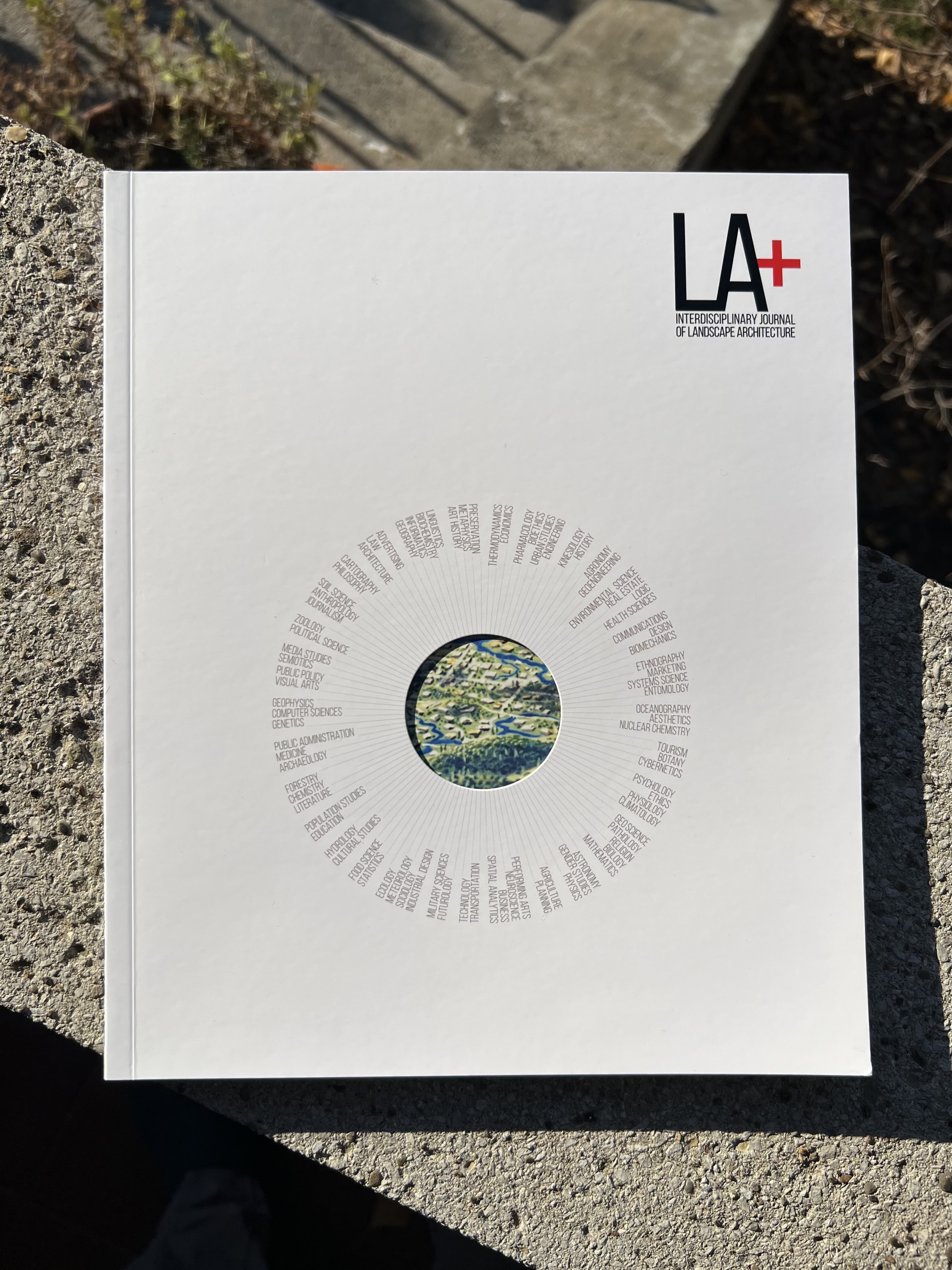
The University of Pennsylvania's Weitzman School of Design has published the latest edition of its periodical LA+, an interdisciplinary journal dealing with landscape architecture –– and more, as the name hints.

The topic and title this time out is SPECULATION, a multifarious and richly intersectional theme on which contributions appear from Alexandra Daisy Ginsberg, Javier Arpa Fernandéz, Min Kyung Lee, and Ytasha Womack, together with many others, all marshalled by the issue editor Christopher Marcinkoski and editor-in-chief Tatum Hands.

I had the pleasure of taking part in the project via a conversation with a wonderful transdisciplinary practitioner of landscape architecture and media arts, professor Aroussiak Gabrielian of University of Southern California's Architecture school. As a taste, below is one of my favourite questions posed by Aroussiak, and the thoughts it prompted.

***

AG: I’m wondering how you feel about the pitfalls in speculative design, given the criticism it has received for being speculation for speculation’s sake or that its focus has been very techno-scientific, or product driven – pushing forth the same capitalist system by inventing objects that we might consume in the future.

SC: Yeah, I think that those are definitely ways the work can fail to live up to its potential. Sometimes, especially early on, practitioners might find themselves using an excess of whimsy on one hand, or an excess of capitalist realism on the other. To me, both are ways of missing the mark, but I think it would be unfortunate if that were to lead some observers to think that the whole enterprise of using design and the arts to explore futures is without value. That would be a grand-scale throwing out of the baby with the bathwater. It’s possible to write bad poetry, too, but that doesn’t mean all poetry is bad.

I would say that some of the criticism drawn during the recent wave of speculation in design, while fair enough, is really responding to a sort of belated unleashing of creative energy that was previously stifled by a so-called human centered, but, let’s be honest, capital-centered, paradigm where the use of imagination is highly constrained, and aspirational only within tightly defined limits. You take those constraints off, and people go wild. That is actually kind of cool to watch, but is it the end state for the practice? I don’t think so. Once people have gotten some of that initial rambunctious energy out of their system, there is a sort of getting of wisdom in play. You can see this with [card game] The Thing from The Future. To start with, many players revel in the license to run free, be silly, and have fun. Then, after a while, they start to get a little bit more critical and search for ideas with more substance. The novelty of the very idea of something ostensibly coming “from the future,” perhaps exciting enough in itself to begin with, wears off, and players start to want to know more about what future it’s from, and how it might work, and how it’s different from what they’ve heard before, and whose interests it represents. This is part of why, having created the game, Jeff [Watson, cofounder of Situation Lab and professor at USC School of Cinematic Arts] and I kept adapting and modifying it, and using it with different groups to help push the general vogue for speculation past this initial flare-up of excitement and crappy ideas that we all tend to have when first invited to roam freely in the space of alternative futures.

To try to make the year 02050 matter right now is an important but difficult task. There’s no objective referent for a 02050 scenario – in contrast to trying to bridge into the shoes of someone historically or in the present, where you can at least partially ground-truth things. The inbuilt speculative challenge of futures is that they are not just epistemically but ontologically indeterminate. They are up for grabs. So we need to realize that when we’re making a hypothetical world specific enough to wrap our body-minds around, we’re making it artificially specific, just in order to be able to think and feel into it. We have to take the ability to inhabit this “what if” with a big grain of salt, because it’s not a question of getting it right or not, in a predictive sense; it’s a question of how rigorously and usefully we are deploying imagination to enable new perceptions and possibilities in the present.

***

If you're interested in the theme of speculation, as so many designers have been recently, check out the full piece (Futuring: A Conversation) and the collection as a whole (digital or print).


Related:
> Design and Futures (ebook and paperback)
> Critical activism: Anab Jain of Superflux
> I design worlds: Liam Young of SCI-Arc
> Using the future at NASA: David Delgado of NASA JPL
Gaming futures literacy: The Thing From The Future (pdf)
> An experiential futures interview 
> Designing futures: An interview
> Design is a team sport
> Killer imps: Bringing futures to designers at the Royal College of Art

Friday, May 31, 2019

I Design Worlds

Architect-worldbuilder Liam Young currently runs the Master's program in Fiction and Entertainment at Southern California Institute of Architecture (SCI_Arc) in Los Angeles. He's an influential practitioner and articulate thinker from the design/futures ecotone, and I love how he adapts and exploits architectural logic to expand the array of strategies available for thinking and feeling through near-future possibilities.

Still from the short film Where the City Can't See (dir. Liam Young, 02016)

We first met almost a decade ago, although as it turns out, spent formative years in the same part of Australia and had mutual acquaintances in high school. We've had occasion to mind-meld periodically over the years; like the time I joined his and Kate Davies's nomadic Architecture Association studio, Unknown Fields, for a 02012 edition rumbling across in the Southwest of the US in a big yellow school bus, which concluded at the Burning Man festival in Nevada, where the two of us collaborated (together with orchestra conductor Daniel Stewart) to stage a mobile audio installation called Augury. In 02015, we were invited to present in an experimental public lecture series that paired speakers back-to-back, Shipping Architecture, at the University at Buffalo's School of Architecture and Planning. And more recently, we had a chance to catch up at the First Futurological Congress, hosted in Berlin by the Dubai Future Foundation, last summer.

Today's post comes from a conversation that we had there. It's an abridged version of an article just published in the Journal of Futures Studies special issue on Design and Futures, Volume I.

***

SC: How would you describe your practice in relation to the intersection of futures and design?

LY: I’m trained as an architect, so I am interested in the architectural, urban and global implications of emerging technologies. I don’t design buildings but rather I design, imagine, speculate, and construct worlds. The world is the medium in which I prototype futures. It’s a very spatial way of thinking about future narratives. I predominantly explore these worlds through the medium of film. For me films are a way of disseminating these worlds to audiences.

So that’s where my own practice sits in the context of design/futures practices. It differentiates itself by thinking about worlds as the medium of operating, as opposed to products, characters, buildings, and so on.

SC: How standard or non-standard is that, to be an architect thinking in terms of a world rather than a building?

LY: For the most part architects think in terms of buildings as singular objects on a site, but in many ways, we are trained to think through worlds. I think it’s the great disappointment of architecture that most architects waste their time just designing buildings.

SC: How would you situate your interests in the wider landscape of design and futures, this intersection much explored, and dabbled in, over the last decade?

LY: I’m interested in moving outside of that territory of the design-futures nexus, and in co-opting, not forms of design media, but forms of popular media, and encoding within them these critical questions about what the future means.

If we really value what we do in futures, and we think it’s important, we should be thinking much wider than the design futures market. For me, that was about working with popular mediums that we typically dismiss as being lowbrow or mainstream pulp, such as film, video games and TV.

It’s our duty, I think, generationally, to seed these cultural mediums with ideas that we think are important, so that people can start to engage with them. I think that’s a real critical role that the architect, speculative designer or futures thinker can play.

SC: A brief example of a project you’ve done that leans into this space you’re sketching out?

LY: Working with author Tim Maughan I made the short film Where the City Can’t See. It’s the first narrative film made entirely with LIDAR scanners, the surveillance system that driverless cars use to read and understand the world.

We are interested in what it means to literally have constructed a millimetre-precise virtual model of the entire world.

So we made a film as a vehicle to explore what it might mean to live and operate within the context of a city that can see everything. Where do the spaces of exception exist in this form of city? What is the equivalent of a warehouse rave, a wilderness zone, a site of transgression? What does it mean to be a member of a subculture in a city of ubiquitous surveillance? We developed a working prototype for a new kind of hoodie that disguises the body from these scans. It creates a form of digital camouflage or glitch that allows the wearer to disappear to the eyes of the machine. We worked with a choreographer to develop a vocabulary of dance movements that would disguise the proportions of the body to the systems of body detection algorithms. And these ideas aren’t just a story or a plot point, they are working prototypes that happen to be sited in the medium of film.

SC: You emphasise that this is something that works. How important is the feasibility of the prototyping?

LY: I’m interested in a level of believability, or realism, which makes the narrative, the story, the prop, feel urgent or visceral or inescapable.

SC: Believability is about perception. Making it seem real doesn’t require that it be real on closer inspection.

LY: True, but making it real-real is one reliable way of engendering that level of believability or empathy. For it to be plausible and create an emotional engagement, I think is the most important thing at the core of all this. But we like to work with the technology in very real ways because it gives us another way that we can disseminate the world we’ve designed.

A whole raft of press was produced around Where the City Can’t See totally independent from the nature of the film itself. We were on Gizmodo, on BBC, all these places, talking about digital camouflage. Then it hit the film festival circuit and had another kind of cycle, separate from the props within it, based on the storyline and the visuals. It just allows it to operate in a whole range of different contexts, and connect to a broad range of different audiences.

SC: Technological realism or feasibility is a higher bar of a sort, also limiting how speculative you can be. Tell me about that trade-off for you.

LY: I don’t want to go into the realms of fantasy. With my speculative work I want to be in that sweet spot between not here yet, but not far enough away that it can be dismissed as pure fantasy.

SC: Being on the crest of a wave that’s going to break no matter what is more powerful in some ways, but if worlds are the medium, and they are what’s at stake, we need enough lead time to make a sort of societal choice between those worlds. There are limits to the usefulness a speculation can provide when it’s on the verge of happening regardless of whether or not you do the project.

LY: Yeah, it’s not exclusively the space in the spectrum where I would operate, but it’s a place that I think personally I can contribute to the most because of my training. What architects can do quite well is synthesise technology and culture. It’s one of the very few disciplines where you have classes in engineering and coding, but you also have classes in philosophy and critical theory.

What we do with these types of projects is engage with the technology at the point where I think it’s most interesting, which is often the point where it becomes democratised or widely accessible. Tim and I talk about this great quote from science fiction author William Gibson, “The street finds its own uses for things.” Technology becomes interesting when it hits the street and moves outside the dominant discourse into a subcultural space. We like to take that leap and prototype the new forms of culture that these technologies produce.

It’s not exclusive. It’s not to say that this is the best space or only space where speculation works. It’s just that these technologies, before culture technologies as I describe them, have arrived before our cultural or ideological capacity to understand them. I think a film like Where the City Can’t See or one of our other projects In the Robot Skies are really important to make right now.

SC: I agree with you, and I think that need exists partly because the longer-range speculation hasn’t happened either. We’re talking about layers of under-served futures discourse.

LY: That’s exactly right. In the context of driverless cars, these things are happening. Ford, GM, all these companies are already billions of dollars in. Now we’re making films about driverless cars because we know they’re coming, and we want to be prototyping cultural and ideological positions around their imminent arrival. But I would have much preferred to have been in the room 20 years ago at Ford: “Let’s do some forecasting here, let’s prototype some stuff, let’s see if this is a good idea first.”

Now you can’t walk into an architecture school anywhere in the world without seeing a driverless car studio, where they’re thinking about what it means for urban life, what it means for the street. Architects should have been doing that 15 years ago.

SC: Architects, designers, policymakers...

LY: Everyone.

SC: You quoted Gibson a minute ago. He also famously said, “The future is already here, it’s just not evenly distributed.” The present, the future coming into being, is a process. There are stages; before the trend, the emerging issue; it’s over the horizon, and then little by little, becomes a kind of imminence. So there is a spectrum of places to intervene in the onrush of potential. What you’re doing is closer in, and that needs to happen. Meanwhile the futures field generally probes further-out possibilities and time horizons, which are traditionally underexamined even in areas like design and policy. I’m interested in how the whole range of design and media practices can make these things feel real enough to bother to have the discussion before you have to have the discussion. Because with longer lead times, larger world-shaping choices are available.

LY: Yeah, exactly. All these types of projects need to happen, basically.

SC: So for futurists interested in design, designers interested in futures, what lessons are there to be shared from the intersection?

LY: I think that in this space we have to be talking about audiences for the work.

To really think about where our projects land is fundamental to the act of producing them. Let’s not be design futurists, let’s operate as design futurists within policy, within government, within academia, within Hollywood, within the video game industry, within infrastructure. I think that’s a real key for me.

Design futures is a practice, not a discipline. Its greatest strength is not siloing it as a thing that’s legitimate in itself, but looking at it as a methodology that can find traction in a whole range of different disciplines outside of itself. And I think that’s where we’re at with it right now.

***

A longer version of the conversation with Liam, as published in the Journal of Futures Studies, can be downloaded here (pdf).

Related:
> Design and Futures, Vol. I
> Shipping Architecture (video)*
> Critical activism: An interview with Anab Jain (pdf)
> Experiential futures: A brief outline
How to Build a World (video)

(* Apparently this has been online for years – didn't know that until today. Unfortunately the audio isn't great.)

Sunday, March 31, 2013

Grand designs

From Canberra to Currumbin, and beyond, Australia's spatial strategy for governance could be very different in the future from what it is today...


The year 02013 marks the 100th anniversary of Canberra, Australia's famously planned capital city. Its location, decided in 01908 (seven years after federation), was a compromise between perennial rivals Melbourne and Sydney. An international design competition for the layout of this seat of the newly minted nation was launched in 01911, and in 01913, the submission of Chicago-based husband and wife architect team Walter Burley Griffin and Marion Mahony Griffin was selected. The name Canberra, which comes from the word for "gathering place" in the local Aboriginal language, was given in a ceremony on 12 March that year.

A century later, an historically resonant element of the celebrations now underway consists in "a design ideas competition for a hypothetical Australian capital city", called CAPITheticAL (= hypothetical + capital). The comp was launched in 02011 and an exhibition of the top entries has just opened at Canberra's Gallery of Australian Design. I'm writing this because I was on a team which produced one of the exhibited designs.

Our team, "The Engagement Studio", was a diversely trained group of urbanists based in Melbourne, and practising internationally in fields including architecture, town planning, urban design, research, sustainability, and environmental consultancy.*

So, if an Australian capital were to be designed today, what should it be?

Since its purpose was to enable new perspectives rather than rehearse existing conventions, the competition put some big questions up for grabs: "Of what should our national capital consist? Would it be a city in the conventional sense or not? If not, what form might it take?"

In the spirit of designerly curiosity, our group wanted to venture upstream of the usual architectural and masterplanning preoccupations with built form and visual representation of space, focusing instead on a more provocative and, perhaps, futurohistorically potent proposition at the intersection of politics and design. Our idea was a nomadic seat of government, changing from one location in Australia to another every generation: a Roving Capital.

The essential notion is simple. Capitalhood can be decoupled from geography. It's not only that permanence need not be assumed, but impermanence can actually be embraced. Consider the Olympics, which is effectively a temporary sporting capital of the world for a fortnight every four years. Or look at the Burning Man festival, which emerges in the emptiness of the Nevada desert, for a week each year suddenly becoming one of the state's largest cities, before vanishing without a trace. The essential temporariness of these important community events manifesting tangibly in the built environment begins to point to a model for a capital that moves. The Olympics belong to the world, so they move around the world (the World Expo, ditto). Burning Man is notable not so much as an analog to capital function per se, but as a temporary city -- population circa 60,000 last year. It's a living rejoinder to the presumption of urban fixity.

The key to this idea is not mere novelty; it's evolvability. There's no such thing as a perfect, once-and-for-all political solution in a changing world. A polity not wedded forever to a single location within its geographic footprint gives itself more space, both to reflect diversity in the population and to adapt to rapid change. At the national level, such a proposition may be near unthinkable, at least for an old-world pillar like London or Paris. But Australia's geographic vastness and relative political youthfulness together make capital transience a surprisingly apt avenue to explore.

And so, from thousands of kilometres away in Melbourne, we had chosen, for argument's sake -- and somewhat whimsically -- the beachside town of Currumbin on the Gold Coast as the first port of call for our new nomadic capital. Inside the scenario we were weaving, this was the result of a democratic three-stage process for capital selection which we'd dreamed up.

Below you can find The Engagement Studio's first round submission. Wrapped around the usual visualisations (site plans, artist's impressions, etc), the Roving Capital idea was mediated primarily through a set of four newspaper articles from 02016, 02023, 02030, and 02040 -- a slim but evocative cross-section of primary documentary "evidence" from a hypothetical swath of future history.


The team's work was honoured by being shortlisted, which came with an invitation to provide a second round submission late in 02012. But simply to revisit and polish the same material didn't feel like quite enough. On reflection we had become intrigued by the real possibilities behind what had started out as simply a thought experiment. So the most interesting next step we could take with this design idea, we decided, was to "groundtruth" a notion that hitherto had been totally speculative.

We carved out a weekend and traipsed up from Melbourne together, to investigate the actual prospects for the seemingly outlandish premise of making Currumbin on the Gold Coast -- temporarily -- the next capital of Australia. And we made a video to tell the story of what happened:


Through meeting with representatives from the local authority (the Gold Coast City Council), with citizens, and with other designers, we discovered that despite reflex responses of bewilderment or trepidation, people soon began to suggest modifications which could help the idea work in reality.

Putting the hypothetical to the test in situ was a chance to tie the grand, schematic, conceptual layer of thinking down to the human scale and prosaic concerns of everyday reality. (How often does that happen in a design ideas comp? Probably not often enough.) For instance, we'd started out positing that, not unlike the experience of an Olympic city, a stint as capital would provide the basis for a generation-long infrastructural upgrade to the built environment -- the legacy of new public buildings and improved transportation, for example.

But in visiting Currumbin, we were attending to it as a real place, and particularly to the sorts of cultural dimensions which would otherwise have been all too easy to overlook from the remove of Melbourne; not to mention the conceptual distance of an abstract political design conversation. This meant learning some things that may not have come to our notice any other way.

First, we came to recognise more deeply that revolving the political apparatus and meshing the lives of representatives with those of their hosts and neighbours would entail a constant renewal of the democracy; a bottom-up counter to the top-down tendencies inherent in a representative system. Although our own visit was necessarily brief, each encounter with locals, occasioned by going there to groundtruth or reality-check the cencept, was in a sense a microcosm of that same process; a partial corrective to the risks of design and governance from afar.

Second, the charms of Currumbin itself, and the reluctance of residents to entertain its transformation into a bustling urban centre, drew out a version of our proposal which had been latent in the initial idea: rather than a capital city, the notion of the capital place came to the fore. It would not be necessary, and neither would the residents want, to compromise the natural beauty of their home by developing the crap out of it. Many of the functions of government could be well served by facilities elsewhere (and increasingly virtually of course); the essential symbolic and functional requirements of capitalness turn out to be more cultural than physical and technical. (I think my favourite moment was in the meeting with the Gold Coast City Council when we concluded an afternoon discussion by going around the room and brainstorming possible rituals on the beach befitting the inauguration of Currumbin's time as capital.)

Third, while our earlier thinking had emphasised the effects upon a given location of its turn as capital, we came to recognise that influence would, and should, flow the other way too. Legacy was reciprocal, not one-way, so the temporary capital's culture could be rubbing off on the country at large during its generation-long tenure as national gathering place.

Our second round submission also included a mocked up magazine article reflecting on the Roving Capital design and the learning process by which it had come together:


Not only was the concept less crazy on reflection than it may have appeared at first (even to us), but in fact even the seemingly far-fetched launchpad of Currumbin looked like it had legs. Certainly other places could equally have served as the Roving Capital's point of departure, but it was the specific contours of this place which came to offer the necessary grounding to both show and tell a new story about Australian governance.

It was also a pleasure to spend time with and learn from such a diverse and switched on group of collaborators, around a really thought provoking idea. (Ammon Beyerle and Michelle James especially deserve credit for an enormous amount of the work involved.) The content and especially the form of our contribution to this design conversation were fun and interesting to work on, and both the means of representation in round one (artifacts from the future) and research strategy for round two (ethnographic investigation) were, as far as I could see, unique among the entries.

The direct impact of our intervention was no doubt modest -- but for those who met the idea at our design meetings or in other conversations, there's also little doubt that it started them thinking about their home, and their place in Australia, in a different light.

And I suppose the key connection in all this to the ongoing themes here at The Sceptical Futuryst is that our efforts sought to map the plane of abstract novel ideas onto the plane of lived reality, and to expand people's sense of possibility through a participatory design process.

Although hypothetical, it was nonetheless real in all the ways that mattered.

* The Engagement Studio consisted of Ammon Beyerle and Michelle James from Here Studio; Kathryn Cuddihy, Tadgh Daly, Rupert Dance, David Klingberg and Amruta Pandhe from David Lock Associates; and Svenja Keele, Andrew Wisdom and myself from Arup. The wonderful video was shot and edited by filmmaker Natalie James.

CAPITheticAL is a Centenary of Canberra project supported by the Australian Government and the Australian Capital Territory (ACT) Government, together with the Australian Institute of Architects. The exhibition is on until 11 May -- winners and finalists are all on show, and there's some really nice work there -- worth checking out!


Related posts:
> Architectural time travel
> Why the language of design must enter law and politics
> White House Redux
> Evidence
> The Unthinkable and the Unimaginable

Wednesday, September 12, 2012

Design is a team sport

I was interviewed recently for Architecture Australia by editor Timothy Moore about the importance of collaboration in foresight and design for the built environment. The conversation grew out of an AA Roundtable we did on related themes in Canberra back in May.

Photo by Lisa McKelvie courtesy of Architecture Australia
From left: Hal Guida, Catherine Townsend, me wearing a slightly pugnacious expression for some reason, Ben Hewitt, Timothy Moore

Both exchanges highlighted for me the great extent to which my work as a futurist within Arup, a global design and engineering firm, consists in providing opportunities for people to share and negotiate disparate perspectives of futures possible, probable and preferable -- as opposed to simply cranking out supposedly futurogenic collateral. I keep thinking of my friend and fellow futurist Jamais Cascio's line, "With enough minds, all tomorrows are visible", a riff on the Open Source dictum known as Linus's Law. The kind of practice that these times call for, especially in the massively multiplayer game of the 21st century city, is built upon a fundamentally Open Source sensibility, a collaborative structure and intent: the meshing of many minds. That means not only that foresight itself should be treated as a team sport (the apt phrase of my former CCA teaching collaborator Jay Ogilvy), but also that for all sorts of design activity, be they explicitly foresight-themed or not, we need to enable significantly more participatory and bottom-up approaches than have traditionally been the norm.

An edited version of the interview appears in the current edition of AA (vol. 101, no. 5, Sept/Oct 2012, pp. 70-76), alongside related discussions with two other "strategic designers". I haven't ever used that label on myself, but it's a handy lasso bundling us together here. The others are Ben Hewitt, South Australia's Government Architect, and Rachel Smith, a transport planner at AECOM in Brisbane, who has also been a curator at the BMW Guggenheim Lab in Berlin. (The piece also runs opposite a great article on "multi-scalar thinking" in architecture by my colleague Michelle Tabet.)

Thanks to Timothy Moore for making both the original panel and follow-up interview happen. Below is the text as published, with some links I've taken the liberty of adding.

***

The future is coming - but there are several of them. As a leader in foresight at Arup Australasia, Stuart Candy's task is to enable people to make considered choices about these potential futures, in the face of the complexity of the environment around them and its rapidly changing context. While he cannot predict what will happen, Candy works out various scenarios for the future by bringing people - and all their anxieties and aspirations - together.

Timothy Moore As a part of Arup's Foresight and Innovation team, you identify and monitor the trends and issues likely to have a significant impact upon the built environment and society at large. You literally look into the future. How do you do this?

Stuart Candy The heart of this work is about serving as a catalyst to enable, encourage and exemplify different ways of looking at things. It is about inviting and at times seducing people into a certain way of thinking, rather than mandating it. As the pioneering corporate futurist Pierre Wack put it, foresight is "the gentle art of reperceiving" - looking at the present in terms of the alternative potentials that it contains, to inform wiser action today.

We set a process in motion whereby people can discover for themselves the choices they face, and the future implications of various paths that might be taken. It's a different philosophy from that of the guru who distributes pearls of wisdom. It's intrinsically collaborative.

An example of this approach in action is the Drivers of Change cards, which the Foresight and Innovation team created. Each set of twenty-five cards looks at a theme - ranging from climate change, to poverty, to oceans - and each card encapsulates a trend or issue that will have an impact on the built environment as change unfolds. The cards cover a huge range of social, technological, environmental, economic and political issues, and we use the cards both internally for our own research and externally to help our clients and partners. (The cards are also publicly available.)

TM How do you go about getting people to see possible futures in terms of making people realize that everyone plays a part in making architecture; that everyone is, in fact, building?

SC There's a 1958 essay, "I, Pencil," written from the pencil's point of view. The pencil says, "not a single person on the face of this earth knows how to make me." Now, a pencil seems a basic enough artefact, but this pencil has a point: there's far more to it than meets the eye, so no individual knows every detail. It's a complex synthesis of different skill sets and knowledge bases. If that's true of a pencil, its obviously the case for the scale and complexity of things produced by architects and engineers. Nobody can know everything about any project, so what matters is the process of bringing the elements and expertise together to make it possible anyway. We're co-creating these highly complex design outcomes.

And this is also true of the future overall. What we get is the product of everyone's actions, which is just one of many imaginable pathways.

TM By going into the future, there is more uncertainty because of the increasing number of unknown variables. The Long Now Foundation, of which you are a research fellow, looks ten thousand years into the future in order to encourage tong-term thinking.

SC The "long now" is an invitation to see the whole of human history, past and future, through a wide-angle lens. That time horizon comes from the approximate birthdate of agriculture, about ten thousand years ago. It's a seriously big-picture challenge, a time span three or four orders of magnitude longer than most of us are used to thinking, and a terrific provocation to the culture at large. But in most organizations, the relevant version of this challenge is to stretch our collective time horizon out even a decade or two. Certainly, multi-decadal time spans are directly relevant for the buildings, infrastructure and urban environments that we at Arup help to shape, but they are well beyond the typical attention span of most businesses, politics, media and even education.

One thing that a "long now" view makes clear is that different layers of change occur at different rates. For instance, you can't really see or say anything meaningful about climate change on the timescale of a few months or years, so you have to tune your attention in to different timespans, like different radio frequencies, in order to pick up the signals.

TM Do people mistake you as a prophet, because you are far-forward thinking?

SC I think there's a pretty deep atavistic impulse towards prophecy in our culture, which we're very slowly coming to outgrow. The fact that nobody can predict the future should be a clue to the fact that the future is not predictable. Still, some people want bold predictions to act on (or argue with), and hope against hope that you'll provide them. And some so-called futurists are happy to oblige. For now, it seems being a guru is easier to sell than being a thought partner or catalyst. The former is philosophically and politically dubious. The latter is a harder sell, but it has the advantage of being true.

The greater service is to help people towards their own deeper and more thoughtful understanding of change. We provide opportunities for them to become comfortable explicitly acknowledging the degree of ambiguity and uncertainty that's really in the system. And this is surprisingly empowering. Seen this way, the future is a landscape of potentials, and the result of thinking about futures in plural terms is that you can prepare for multiple outcomes and (within your domain of influence) act towards those possibilities you'd like to see happen. This is common sense, but we need to be reminded of it regularly.

TM How is this philosophy demonstrated in your work at Arup?

SC The first external project that I did with Arup in Australia (after moving from the US in late 2011) was for the CEO and executive team of the Sydney Opera House (the original design and build of which was the project that put Arup on the international map). This engagement was about considering some upcoming renovations in a broader context of change. They have three years worth of performances booked already. So when a facility like this wants to change any physical aspect; for example, if they want to do a renovation or a new build, they must factor in significant lead times, and it can take up to five years from planning to project completion. That's half a decade of rapid change, and for a cultural organization in the midst of a technological revolution in how people access and consume cultural artefacts - consider that the iPad didn't exist three years ago - this has big implications for how any renovation process might proceed.

Generally, we shouldn't simply plan for today's problems (and opportunities), because by the time we've solved those, there will be different ones. You can be sure that the people, businesses and places you're designing for will keep changing. Especially when you talk about a design with a life expectancy of decades or longer, down the track that design may be part of a world that's radically different from today. In this light, it suddenly becomes obvious that thinking systematically and creatively on these longer timeframes is not just a nice thing to do, it's crucial to doing good work.

Saturday, November 22, 2008

White House Redux

White House Redux Project 1342 by Brandon Shigeta (#2 in popular vote)
The presidential residence reimagined as a Disney theme park.

White House Redux, an international architecture competition, was launched in January this year by the Storefront for Art and Architecture and Control Group. The competition brief explains (the first page, mysteriously numbered p. 33, in the book):

Home of the world's most powerful individual. Universally recognized symbol of political authority. One of America's greatest tourist attractions. Nerve-center of the world's most complex communications system. The architectural embodiment of power.
...
The original White House design, by James Hoban, was the result of a competition held in 1792. ... What if, instead of in 1792, that competition were to be held today? What would a White House designed in 2008, year of election of the 44th President of the United States, look like?

An impressively miscellaneous set of responses was gathered, and made available via a project website, as well as an exhibition which concluded earlier this month at Storefront's space in New York City. From 487 projects submitted, with 42 countries represented, 123 of those concept designs (a quarter of all entries) have also found their way into a fascinating book, published in a limited run of 500 copies, which I learned about through BLDGBLOG. Mine arrived in the mail not long ago, and I had an opportunity to read it yesterday.

Physically, it's an odd specimen. About as thick as the O'ahu phone book, and alternating between sections of B&W printing and colour, it's printed on the flimsy stock that's characteristic of more ephemeral publications (comics, newspapers, telephone directories). The newsprint ink rubs off on your fingers, and thence, all too readily, back onto the shiny white paperback cover. This isn't your usual coffee-table art book.

Among the side-effects of having been assembled in what was obviously a bit of a hurry (shipping just over four months after the competition jury convened at the end of May) the book has no ISBN or edition notice, nor is there any sign of the advertised essay contribution of Storefront's Joseph Grima. The introductory 50-page photo essay, about the jury's day of deliberation in WTC Building 7, is unnecessarily long. However, to me it's interesting not only as a partial record of the production process -- which is nothing if not collaborative, all the way down -- but also, kicking off a 700-page tome, it is an example of the overall direction in which the work prefers to err, towards excess, low-rent generosity.

Indeed, content wise, this is an embarrassment of riches. The quality of entries may be uneven, but the eclecticism is astonishing.

There are aerial, submersible, floating, inflatable, and underground White Houses in the mix. Many envisage its functions as going mobile or being dispersed, however systematically or haphazardly (and in ways fanciful, pragmatic, or symbolic) around Washington D.C., the United States, and the world. At the mischievous behest of this architectural swarm, the Presidential residence is uprooted, launched, buried, destroyed, rebuilt, renovated, redistributed, and repainted. It's reimagined as mall, museum, battleship, space station, farm, coliseum, zeppelin, forest, and theme park, and transposed to such diverse environs as Antarctica, the Moon, and Lebanon (not in the Middle East, but a small town in Kansas identified as the geographic centre of the lower 48). One entry envisions a giant plant à la Jack and the Beanstalk, for some future President to both inhabit and nurture, in downtown Manhattan. Another gleefully proposes a global centre of ice cream distribution. There are hypothetical White Houses made from blasting a huge rock slab; delicate bubbles; edifices rhizomatic and spongiform; quivering bionic blobs; and monumental phalluses -- literally -- which lie flaccid during peacetime but engorge and stand menacingly at attention in times of war.

Project 1386 by Fernando Molina and Paola Zini
The White House as harvest farm, embodying knowledge, nourishment, and shelter

Project 236 by Tom Marble and Ariel Hsieh
An article, dated July 02009, for the fictitious magazine "Retropolis", about the incumbent President delivering on a promise to make the Executive Branch turn a profit, by redesigning the White House as a mixed use hotel/retail/office space.

White House 2.0 (Project 1369) by Wayne Congar, Arrielle Assouline-Lichten
The White House as an immersive, Open Source information display space and hub of global political conversation

Project 655 by Jorge Rocha Antunes (winner popular vote)
The White House enveloped in an enormous glob of biotic jelly

Project 1463 by Yoshi Ogawa
The concept starts from an intersecting arrangement of the 13 stripes of the American flag

12 Cautionary Tales for a New World Order (Project 1485)
by David Iseri, Jefferson Frost, Justin Kruse and Laura Sperry (Second place winner)
A tribute to architectural firm Superstudio, with 12 alternative possibilities for the White House, each based on different cultural, economic and environmental scenarios. They are presented as snapshots of a book, some including in-scenario artifacts. This one puts the White House in Las Vegas, the new U.S. capital after "the Malthusian catastrophe of 2012".

The White Wing (Project 1414) by Ralf Arno Schormann and Alex Schulz
A helium-powered zeppelin with on-board environmental research laboratory.

The White House Show® (Project 248) by Joachim Seyer
Seyer proposes to split the White House in half lengthwise, rendering it an open stage in two parts, on which political figures perform nightly at 8 p.m.
[While this project is featured in the book, this particular "artifact" image isn't.]

To devour the book in a single sitting, as I did yesterday morning, makes for a heady kind of aesthetic workout, an exercise in navigating the wilfully abundant alternative premises of some anarchic, multimedia short story collection; stumbling between the pieces of a bewildering collage of imaginative gambits. This may be the first politically themed collection of "architecture fiction" (a Sterlingism which applies perfectly here), and it's fully as invigorating, frustrating and engaging as, say, a half day spent at the Tate Modern; or an end-of-semester presentation marathon for a massive and wildly divergent design class.

Reaching for a more immediate comparison, actually it put me in mind of playing the collaborative forecasting game Superstruct -- just when I was at risk of starting to miss it. (As a Game Master/Community Leader on that project, for me it entailed a regular process of sifting hundreds of user-generated proposals for hypothetical, collaborative organisations, intended to reverse the world's flagging fortunes, which formed the centrepiece of game that just completed its sixth and final week.) I wonder whether the resonance of that game with this book's contents may come from an emergent, shared aesthetic wavelength -- the look-and-feel of collective imagining, lightly moderated, of the early 21st century.

In White House Redux there is of course a fair complement of half-baked ideas, but this is part of what makes it so stimulating; one is invited to sample an array of exploratory hors d'oeuvres -- earnest and satirical, critical and hopeful -- made according to any of 123 different recipes.

However, this great strength is also its great shortcoming: you don't get a full meal. The essay which brings the book to a close, written by ever-insightful BLDGBLOG curator Geoff Manaugh, runs less than a page. I found that after the whirlwind tour of visual and conceptual possibilities, I was hungry for more substance, insight, analysis. To drop the culinary metaphor for a literary one; the book read like a choose-your-own-adventure novel, with a superabundance of beginnings that all turn out to be loose ends, and nowhere to go from there. I wanted something to help me tie these disparate ideas together, to help connect original question ("What would a White House designed in 2008... look like?") to the startling multiplicity of orthogonal responses before me. Just what the hell is this revolution that seems to be going on in architecture, and giving rise to such a cornucopia? That query, or something like it, was what I had hoped a commentator more familiar with that subject than I am might address. Manaugh's all too brief gesture in that direction concludes as follows ("Speak Space to Power", p. 719):

How do we spatially respond or give shape to the political situation today? We can use architecture to diagnose and interpret the world -- risking the projection of our own fantasies upon such structures -- or we can use architecture to lay the foundations of future terrains no one anticipates.

By the end of the day, then, with nearly five hundred entries, White House Redux began to feel more like a genre in its own right, something between science fiction and political manifesto. But that is precisely the strength of architectural design today: it is literary and diagnostic; it speculates and narrates. Applied to icons of political power, architecture extends the imaginative reach of design into the realm of everyday possibility -- changing governments, minds, and nation-states alike.

I think he's making an important point. It does, very much, have the feel of a new genre, an experimental and potentially very fruitful type of work -- and play -- at the crossroads of futures, and politics and design (clearly not just "architecture" as strictly understood). "Architecture fiction" is part of it, as is "design fiction". Alternate reality gaming is getting close. What I call experiential futures is implicated here also.

The thing we're talking about here, the transdisciplinary theory-object at the centre of this developing conversation, is hybrid, serious-fun in tone, promiscuously multimedia, playfully transreality, and above all, potentially world-changing.

We saw another example recently in Bryan Boyer's speculative design for a new U.S. Capitol building. Although the crossroads we're looking at here is not always literally, institutionally political, it's always very political in the broader sense of having the potential to rearrange our perceptions.

Architecture of course does not have a monopoly on artistic licence, however, both as an academic discipline and a broader, cultural practice it certainly seems to promote fluency, or at least tolerance, across different modes of expression. (Spoken from the wistful vantage point of a doctoral student in a university department where much energy is expended deciphering and encoding theory.) As far as I can see, right alongside design, architecture is fast moving toward exploiting this more fully (here's another example). Back in July, I presented at a conference where design theorist Benjamin Bratton (one of whose architecture-related involvements is teaching at SCI_arc) pointed out that of the articles by Nicolai Oroussoff -- since 02004 the NY Times architecture critic -- half are about proposals rather than actual buildings. Architecture's comfort with the visual/experiential modes of exploration, coupled with its necessary familiarity with the speculative and the hypothetical, seems to position it ahead of a lot of futures practice for engaging a wider audience in the tricky enterprise of worldbuilding. What it doesn't seem to do so well, yet, is scenaric depth. Still, that can be learned.

In any event, the confluence of these practices seems to me to be edging towards making available not just an argument, but a visceral experience, of the malleability of reality itself. The essay title "Speak Space to Power" neglects the design strategy that is used arguably to greatest effect. Of course, architecture is a spatial practice, but that's not all it is, and that's not the dimension in which the contributors to White House Redux (or the kindred activities to which we've pointed) make their most important contribution.

It is what we might call alternativity -- a plurality of worlds, in terms not only of different futures but also of rewritten histories and presents -- that speaks to power in this work. Not space, but hyperspace; different universes, configurations of reality, possibilities. It brings them into our awareness here and now, not merely to say, but rather to manifest, with a panoply of visual, symbolic and rhetorical strategies: "Other worlds are possible. Now, here they are."

Related posts:
> Architectural time travel
> London after the rain
> Design fiction is a fact
> Dreaming the home of the future

Wednesday, October 22, 2008

The Afterlife of Buildings


Rondo1 (office building, Warsaw, completed 02006)
Photo: Nicolas Grospierre (lower) | Photomontage: Kobas Laksa (upper)

Give your fantasy free rein. After all, we know that nothing lasts forever. Everything is changing. The world is in a constant rush. Architecture will also be subject to modification. Each of the six grand edifices will have to surrender to the passage of time. ... These visions of the future are likely, though one can imagine alternative ones as well.
...
Isn't it strange that, although we all sense the inconstancy of the world and hear an increasingly persistent ticking of the clock, architecture pretends not to be concerned?

~The Afterlife of Buildings website / Welcome

The Polish Pavilion at the 11th Architecture Exhibition, now on in Venice, features a show called The Afterlife of Buildings. Six prominent structures erected in Poland over the last decade have been photographed by Nicolas Grospierre and then destroyed through the photomontage skills of Kobas Laksa.

What the curators appear to think of as brilliantly novel has to this future-watcher the air of faddish me-tooism. Artful photoillustrations of cityscapes falling into disrepair, however competently executed, have become a well-worn genre in their own right (there having been already a rash of them this year; see Related Posts below). There are in a couple of these images a glimmer of something more interesting -- a practice of architectural visualisation which specialises not in designing from scratch, but in ingenious repurposing (sort of a forward-looking counterpart to Stewart Brand's 01994 book How Buildings Learn: What Happens After They're Built). Indeed, to visualise one or two buildings' alternative futures -- evolving in several different ways, systematically adapting and branching off in different scenario directions -- would have been a much more interesting effort, in my view, than this series of contemporary buildings all trudging more or less the same downward spiral in parallel.

So the singular (supposedly "likely") scenario offered here, despite the creators' claim of being able to imagine "other ones", which comes off as idle, instead does both its creators and its audience a disservice, accomplishing something close to -- but fortunately not quite, with the waterslides and airport terminal-turned-farm -- another entry in our self-indulgent, early 21st-century collective catalogue of collapse.


The Metropolitan (office building, Warsaw)


Marina Mokotów (gated housing estate, Warsaw)


Warsaw University Library


Sanctuary of Our Lady of Sorrows (Licheń)


Terminal 2 (Fryderyk Chopin international airport, Warsaw)

[Photos by Nicolas Grospierre and photomontages by Kobas Laksa, all images via exhibition website]

(Thanks Bryan!)