Friday, August 08, 2008

Cheap prototypes, valuable insights

Ran across a very interesting pair of guest posts about "Prototyping on the cheap" by Sean Howard, at Experience Matters, the experience design blog of Calgary-based interactive marketing agency Critical Mass.

There are many stages in a development (and research) process where I believe prototypes are highly effective and powerful parts of our arsenal. However, more than one person has brought up the costs associated with building prototypes and that this cost can preclude their use.
...
Rather than focusing on prototyping the device or service directly, we can prototype a manual, quick start guide or even a magazine article about the product. Clients, stakeholders and even audience members can then use this to envision and grasp the final product without a prototype having ever been built.

~Sean Howard, "Prototyping on the cheap - Part I", Experience Matters, 20 May 02008.

This way of thinking about prototyping; simulation via a "second-order" representation that evokes a much larger reality than you can feasibly build, is very much in alignment with the "tip of the iceberg" principle of future artifact design that we've developed in the course of our various FoundFutures projects. It helps explains why, for example, in-scenario news reports are such a useful way of evoking a future scenario.

The more effective-yet-cheap a prototype can be, the more efficient and pared-down a model it is for the scenario in question.

Howard goes on to describe a number of approaches to low-cost, high-impact prototyping, including storyboards/comics, short video user scenarios, "re-enactments" (which would include wearable simulators like this), DIY construction, and software-enabled mockups (for example, using Axure RP).

I'm reminded of the day-long seminar I took last July in San Francisco with information design expert Edward Tufte. His mantra; "Whatever it takes". That is, be prepared to deploy all necessary communicative means to convey information clearly and accessibly. This formula, though he uses it in a somewhat different context, helped to crystallise my already ecumenical preference for using whatever it takes, media-wise, in communicating futures for the enhancement of foresight. I've lately gravitated towards "experience design" as a broad, medium-neutral substrate on which to build the practice of communicating scenarios ("experiential futures"). Many of us are still learning from Marshall McLuhan that the medium is the message, and therefore that any and all media are fair game. I don't mean to suggest that anything can be communicated in any old way, because budget, time, politics and aesthetic preferences together provide plenty of constraints.

It may be interesting, in light of this idea of futures communication as prototyping exercise, to revisit some of the posts appearing here over the past several months, at the intersection of concept design and future artifacts.

Related posts:
> Future watch
> Reality prototyping
> Design fiction is a fact
> Warning: This product might not actually exist
> Greener Gadgets
> Public service and self-promotion meet on the adaptive path
> Morphing art and design into advertising

Thursday, August 07, 2008

When money falls from the sky

Deals in commodities of the abstract sort
Buys them in bulk but then he sells it short
Talent, genius, love / even signs of affection
He floods the market / there's no price protection
And when his master plan is unfurled / there stands
A handsome bid / on the weather systems of the world

~Andrew Bird, "Banking on a Myth"
Mysterious Production of Eggs (02005)

A few months ago I saw on DVD the documentary Enron: The Smartest Guys in the Room, about the late U.S. energy company (dir. Alex Gibney, 02005; if you missed it there's an excellent review here). One of the strongest impressions it left was of the ingenuity of the company's financial schemes -- such as "mark to market" accounting -- perceptions of which may reasonably run the gamut from clever, through audacious, to downright fraudulent. (Since it includes some murky, moral territory, it isn't always easy to say where one category ends and the next begins.) Part of Enron's inventiveness was manifested in pioneering weather derivatives, which allow traders to reduce risks associated with the unpredictability of weather conditions. (Conceptually related is the recent emergence in financial markets of catastophe bonds, or "cat bonds" for short, which do not necessarily pertain to weather events, but certainly can -- such as the Thames river flood bond issued by German insurer Allianz in 02007; I wrote about it then at the Long Now blog.)

Today, I came across this report on a similar instrument available through an online provider; currently limited "to accredited investors with a minimum net worth of $1 million" but perhaps, in due course, to become available more widely.

As businesses contemplate losing massive amounts of money from events like droughts and hurricanes, WeatherBill hopes to carve out a market in the growing field of weather-related risk-management products, offering what are essentially weather futures contracts to companies with an internet-era twist. The contracts pay off automatically without any kind of claims process based on objective weather measurements like the inches of rain a given area receives.
[...]
"Our business has all sides of risk—we've got customers wanting rain, drought, heat waves, frost, no frost. We even have people who want hurricanes," says [founder David] Friedberg.

~Chris Colin, "Doing Something About the Weather, Financially at Least", Portfolio.com (at Wired.com), 7 August 02008

There's something terribly fascinating, I find, about the commodification of natural processes, this gaming of life's details via insurance and financial instruments. I don't know if Andrew Bird, author of the elegant lyric at the top, had former Enron CEO Jeff Skilling in mind when he penned "Banking on a Myth". But there's an air of dramatic, even mythic resonance here, in the cavalier exploitation of complex systems for short-term gain. As Lester Pimentel's insightful review of the Enron doco notes: "[Former Enron exec Ken] Lay and Skilling are classic tragic characters: incredibly intelligent men felled by their own hubris."

I'm just experimentally putting pieces together for consideration here, not mounting a fully ramified argument; but I'd be really interested to know what others think.

London after the rain


Ben Marzys is "a young London based designer with an academic background in architecture and motion design". He produced the above video in 02006 while a student in Nic Clear's Unit 15 at the Bartlett School of Architecture. BLDGBLOG's Geoff Manaugh explains in a profile of Clear for Dwell magazine (March 02008) how moving images are integrated into the curriculum:

Each film functions as an architectural proposal -- or as an avant-garde form of urban analysis, albeit of a decidedly futuristic kind. This suits Clear just fine.

"Film can be a much more appropriate way of training architects than the traditional reliance on orthographic representation," says Clear, who once also studied philosophy, "and the skills learned in film production are great for transferring to conventional architecture. Even at the most basic organizational level, film is all about the flow of information. A decision you make now can have enormous consequences later."
[...]
"This type of work opens up a whole new series of possibilities about what architecture is," Clear explains. "The availability of film tools fulfills a deep-seated need in architecture to communicate beyond an architectural audience. But for all my polemic about the spatial, immersive, experiential, and narrative qualities of film, the main reason I teach this way is because it is so much fun."

Amen.

The short came to my attention via the recent London Festival of Architecture (noted here earlier). On 12 July 02008 it was screened as part of onedotzero terrain 07: "distinctive visions and evocative interpretations of terrains and environments real and imagined, from built urban worlds to the shifting rural landscape and beyond". I was in the city at the time, but wasn't able to make it to the show. Still, even on a laptop screen, the tone of this short film (aptly described in in Manaugh's Dwell piece as "both Edenic and postapocalyptic") is arresting. The motion-collage and sudden context switches made me think of Röyksopp's music video "Eple", and the empty, yet somehow whimsical après-déluge imagery put me in mind of Mary Mattingly's series Second Nature, as well as Squint/Opera's series Flooded London 2090.

Other work by Marzys includes the somewhat jauntier and less polished 2012 (02006), and the more abstract, mood-driven Dystopian Dreams (02007); both videos exploring similar territory.

I'm interested to see where he goes with this work, and equally, look forward to seeing what else emanates from Unit 15. Certainly, their communicatively rich and broad conception of architecture is converging on the exploratory practice of experiential futures that keeps this blogger busy.

Related posts:
> Not drowning, thriving
> Second Nature

Wednesday, August 06, 2008

Introducing Space Collective

From the gallery at Space Collective
(AquaJelly by Festo)

Space Collective is, according to itself, "Where forward thinking terrestrials exchange ideas and information about the state of the species, their planet and the universe, living the lives of science fiction today."

Or, put another way, it's a designery, membership-based web portal for futuristic stuff, spiritually and aesthetically guided by three wise (albeit deceased) men: media maestro Marshall McLuhan, psychedelic prophet Timothy Leary, and astronomy star Carl Sagan.

The site, which is very sleek, highly eclectic, somewhat haphazard, and a little coy about giving you a clear idea up-front of what it's doing, is however explained elsewhere -- by its founder, filmmaker Rene Daalder, in a 02007 interview [rtf] for Volume magazine #10:

Our initial metaphor was to use the Internet to create updates of Carl Sagan’s time capsule on board of Voyager and by the end of each month beam them up into space.

Web designer Folkert Gorder adds:

Besides the episodes and the relating meta text, the additional contents of the monthly Payload are generated both by the site's registered members and Space Collective's writers, curators and designers, providing the front page with a blend of public and "native" content, feeding into the site's continuously updated information and entertainment digest, loosely inspired by Sagan’s time capsule.

It's an intriguing concept and, since being launched late last year, with quite a bit of content already, is great to poke around. The impression I get is of a highly literate (in the broadest sense of the term), technologically informed, future-oriented social network. Some nice examples of user-provided content:

> Wild dinners in 2019 (by Wildcat)
Five chow-time vignettes from 11 years into the future, written for IFTF's upcoming alternate reality game Superstruct.
> The world without us: Chernobyl (by A0013237932294)
Featuring some astonishing, unphotoshopped post-apocalypse photos from the still-deserted ex-Soviet nuclear reactor site.
> Summery Books Too Far Out For Johnny Depp (by wilfriedhoujebek):

[A] list of books I can wholeheartedly recommend you to dive into this summer. They are all completely bonkers and they all start from first principles. [...] Only two of them are fiction and this is no coincidence. [...] One can imagine only a few things, one can belief a whole lot more.

As for the site's "official" content, Daalder's monthly video dispatches, gathered under the modest title The Future of Everything, are rather sensationalistic, but have an ambitiously broad thematic sweep, by no means confined to space (so to speak). There are seven posted to date, but no permalink, so to find them visit the homepage, and under "The Future of Everything" click "View all chapters". (Incidentally, as these videos have been pieced together from existing footage, I really like the fact that the clips' sources are referenced in a sidebar at right -- it would be great to see this more often in documentary filmmaking.)

Daalder's bio states "He is currently lecturing at major universities and art schools in America and Europe about The Future of Everything." I'd love to find out more about these lectures, but multiple searches (Daalder + "future of everything" + lecture, lecturing, university, college, school) have yielded a paltry handful of hits, none of them pointing to any transcripts, recordings or even promotional fare. Oh well.

(Thanks Jesse!)

Tuesday, August 05, 2008

Post-apocalypse Tokyo

Shibuya Center-gai 3 | tokyogenso | via Pink Tentacle

Shibuya Center-gai 2 | tokyogenso | via Pink Tentacle

Shibuya Center-gai 1 | tokyogenso | via Pink Tentacle

Pre-apocalyptic Shibuya Center-gai
via Weekly Teinou 蜂 Woman (Geisha Asobi)

We've seen London, New York and even Lisbon each given their respective post-apocalyptic makeovers. Now, the Japanese capital joins our burgeoning gallery of Things Falling Apart, thanks to images from 東京幻想 (Tokyo Fantasy) by tokyogenso, drawn to the attention of English speakers by Pink Tentacle.

I find the images above, of Shibuya Center-gai (a narrow street in the city's famous shopping district) somewhat more interesting when viewed in "backcasting" mode -- reeling us back in from the imaginary frontier of the humanless far-future, to the mundane present.

Related posts:
> Immaculate extinction
> It's a small world, after all
> The go-to guys for post apocalyptic chaos and destruction
> Posthuman New York

(Thanks Jake!)

Monday, August 04, 2008

Future watch

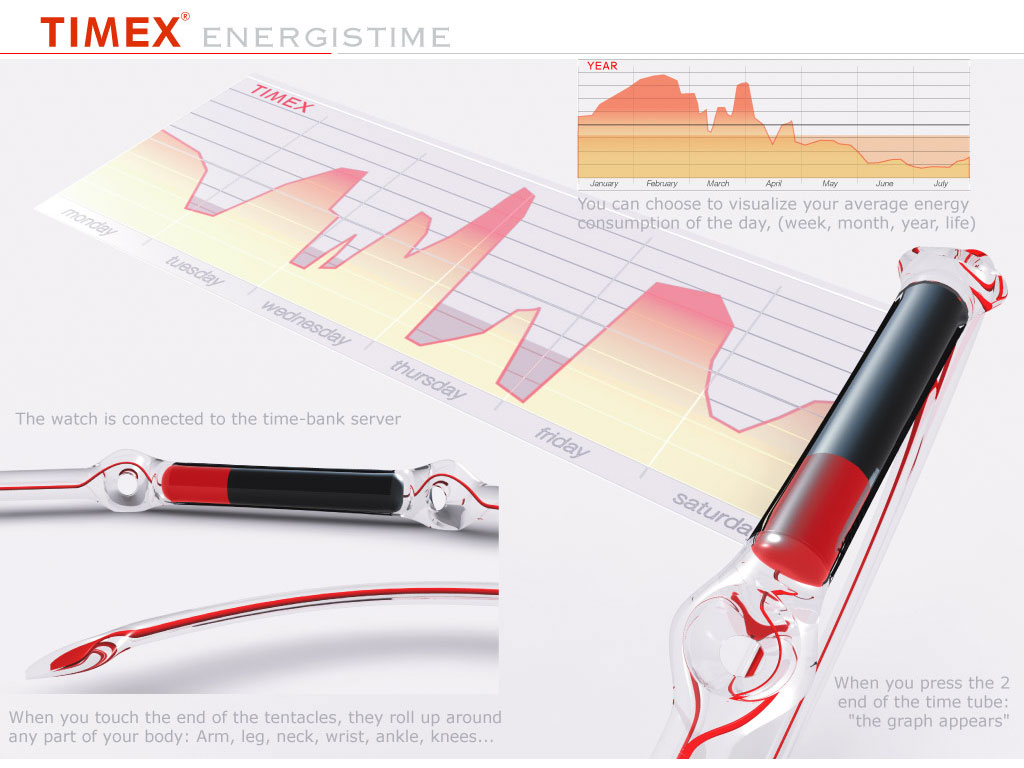
"Energistime" | Winner, Timex2154: conceptual category (02004)
Photo: the sceptical futuryst

"Energistime" | Design by Francois Gustin / Francois Laine / Nicolas Montabone
"In 2110 was voted [sic] a new law by every country: 'An ecological behaviour makes people earn free time.'"

In 02004, to mark its 150th anniversary, American watch manufacturer Timex partnered with industrial design magazine Core77 (previously mentioned here) to stage a global design competition, Timex2154, envisioning concepts for watches another 150 years hence.

From the competition's design brief:

The essence of time has many interpretations. Some revere time as a regulator, providing context to actions and order to schedules. Others deem it as a checkpoint device that invites accomplishments and permits life to be enjoyed to the fullest extent.

The capture of time is also ripe for investigation. Some people respond to the precision of the digital, while others welcome the tradition of the analog. Some are fascinated with the march of time, while others are liberated by its constant rhythms. Whether too much or too little, most are constantly referencing time's metric, and portioning out attention, energy and lives by its metronome.

Watches in the year 02154. As a basis for a design competition, it's an interesting combination of theoretical contemplation, on the one hand (uh, no pun intended) and commercial savvy on the other (get designers around the world to sketch out some long-range product development ideas, on the cheap). The panel of judges included, notably, Paola Antonelli, MoMA's curator of architecture and design, and the woman behind the exhibition SAFE: Design Takes on Risk (02005) as well as Design and the Elastic Mind (02008), the latter previously blogged here.

So when I learned last week that the company was founded in nearby Waterbury, Connecticut, and that the Timex Museum there (Timexpo) included an exhibition of the winning designs, I had to check it out, and was able to make the journey there Saturday afternoon.

The Timex Museum, Waterbury CT | Photo: the sceptical futuryst

Now, it's not necessary to visit Waterbury in order to see the designs, which have been available online for some time (e.g., blogged at We Make Money Not Art in October 02004). However, one thing that appeals to me is that the winning entries in each of the three categories (wrist-based, wearable and conceptual) have been prototyped in tangible form and are on display at the museum.

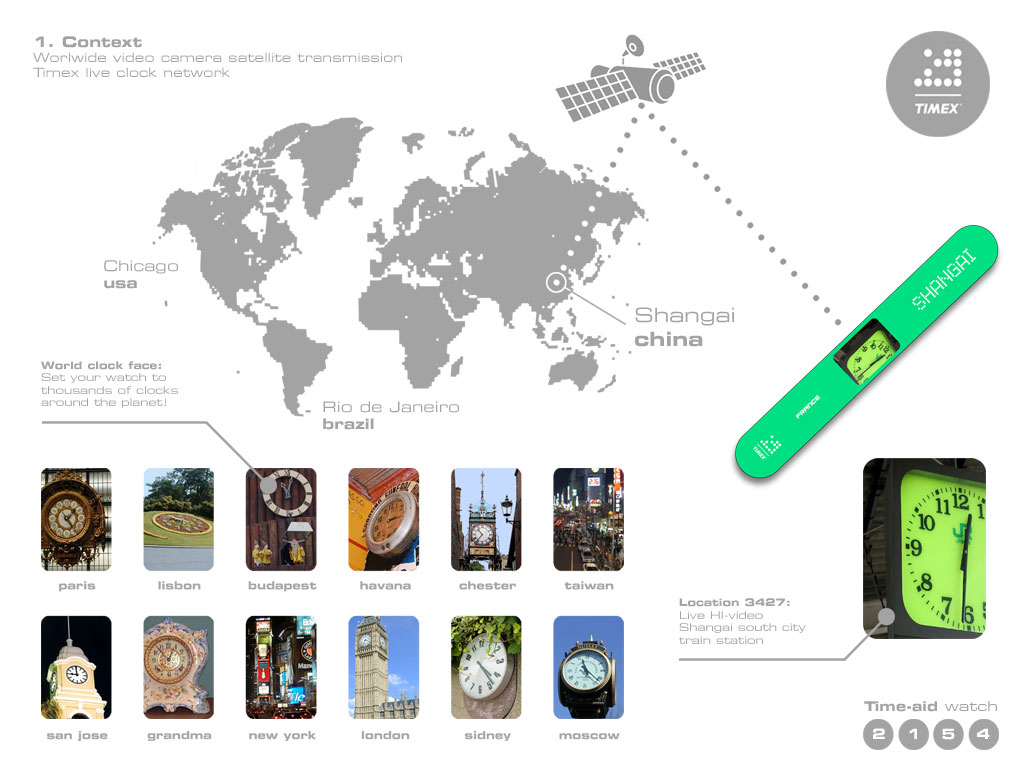
"Time-aid" | Winner, Timex2154: wrist-based category (02004)
Photo: the sceptical futuryst

"Time-aid" | Design by Christophe Koch / Lea Kobeli
"Intelligent watch to display all the clock faces around the world."

"Time-aid" | Photo: the sceptical futuryst

Timex2154 wearable category display | Photo: the sceptical futuryst

"Sticker Watch" | Winner, Timex2154: wearable category (02004)
Design by Alexey Koptev

"Sticker Watch" | Photo: the sceptical futuryst

"Notable entries" which didn't earn a place at the museum can be browsed online, and are also worth a look. A couple of examples:

"Krikos" | Timex2154: notable entries (02004)
Design by Breanna Guidotti
"The word Krikos is Greek for circle, a never ending path. [...] Krikos is a way for people to adopt a built in sense of time. As users grow accustomed to the cues Krikos gives them about time they will also take cues from their environment and will acquire the ability to feel time."

"Epidigital Patch" | Timex2154: notable entries (02004)
Design by One & Company Team
"The epidigital patch leaves the user with an animated topographic timekeeping image on his/her skin. [...] Composed entirely of organic matter, the nanobots dissolve after several days at which point a new patch can be applied."

There's much more to the museum than the Timex2154 entries -- indeed, most of it is history-oriented, but I found it illuminating to learn about the industrial past of the state of Connecticut, to see the home of the phenomenally popular (and ubiquitous even in my childhood) Mickey Mouse Watch [photo] and to find how photography and portable timepieces were used for ingenious cross-promotion in their early days [photo].

But, getting back to the futures: unsurprisingly, many of these concepts do not appear to be grounded in compelling society-level scenarios that would provide plausible in-world parameters. (For in fact the world as we find it shapes industrial design efforts in the present, providing key affordances and constraints that make a product not "plausible", but "useful".) To me, richer and more interesting than the technological marvels presumably enabled by a century and a half of time's passage -- and many of these ideas project, at best, a decade or two into the future, let alone fifteen -- are the possible social shifts which would be embedded and embodied in the artifacts of that distant era.

What would be really shocking is if most people needed or used (other than as a romantic, antique affectation) anything remotely like the quintessentially 20th-century watch in 150 years' time. Already, fewer and fewer of us wear them today, because of the ubiquity of other devices that tell time, and a whole lot else besides. Timex, and other watch manufacturers, must be concerned that their time is running out, and I find myself wondering if that's what prompted the comp in the first place.

At least they were astute enough to abstract from the concept of "watch"; "personal and portable" "timekeeping devices". (From the design brief: "**IMPORTANT** Regardless of category, all entries must embody two key criteria: Personal and Portable. Entries in this competition should examine ways to embody and communicate time on an individual level.") "Future of X" exercises are intrinsically hazardous because they take for granted the continuity of conceptual categories, objects, values and practices which are themselves bound to be subject to important historical shifts. Although I'm always interested in futures concepts which can be physically crafted and thus encountered, I also recognise that artifacts are only a poor proxy for the future -- like the past -- and there is a very great deal about our lifeworlds that simply cannot be conveyed in stuff.