Showing posts with label teaching. Show all posts

Thursday, October 09, 2025

Building Time Machines at California Institute of Technology

I haven’t posted here for ages – a story for another time.

Today, I’m writing to share something I’m focused on right now.

This weekend I’m starting a stint as Artist in Residence at Caltech Theater. This is tremendously exciting to me – a chance to bring experiential futures, worldbuilding, and high-speed co-creation to a remarkable and storied institution. For example, one of the spaces we’ll be working in is the Feynman Room, named for the legendary bongo-playing Caltech physicist and Nobel laureate who was active in the theatre community there.

Our first event coming up is called “Immersive Futures Jam” – IFjam for short.

With a select group of participants, including undergraduates, graduates, alumni and staff from Caltech, as well as folks from NASA Jet Propulsion Laboratory and the wider community, we’ll be embarking on an ambitious co-creative process; producing immersive, you-are-there experiences of various futures, at the scale of a room, over the span of a weekend.

In a hat-tip to H.G. Wells, I call such room-scale future immersions “Time Machines”. Without quite meaning to, we essentially piloted a highly adaptable format two decades ago in Hawaii, and I’ve since modularized and sharpened it through numerous iterations – in Canada, Mexico, the UK, Singapore, and various parts of the US – with hundreds of students, colleagues, and intrepid volunteer time travellers. This is the first time I’m running it in California.

The very possibility of this edition of IFjam comes down to the vision and will-to-experiment of the unique creative force that is Brian Brophy, Caltech’s long-serving director of Theater Arts. We got to know each other over the past few years while working together on the NASA JPL show Blended Worlds; JPL’s contribution to the most recent instance of Getty Museum’s once-a-decade initiative PST.

A fuller treatment of Time Machines is in the pipeline. But for a sense of how they can look and something of the underlying process, a few starting points: A Pecha Kucha talk given years ago in Chicago. A short piece from The Futurist (the periodical of the World Future Society, as was). And another one from The Economist.

Stay tuned.

Related:
> Experiential Futures for NASA JPL (Library of Possibilities)
> A Time Traveller's Story
> Experiential Futures in The Economist (pdf version)
> Time Machines in The Futurist (pdf)
> Bringing futures to Stanford d.School
> Futures for Bristol
> Ghosts of Futures Past (Hawaii 2050)
> Time Machine / Reverse Archaeology (pdf)
> Using the Future at NASA (pdf version)

Tuesday, April 06, 2021

Exploring Technology Governance Futures with the World Economic Forum

A snapshot from the Influence 2035 experiential scenario

This week, the World Economic Forum is hosting its first ever Global Technology Governance Summit (GTGS), convening some 3000 leading technologists, academics, businesspeople, policymakers and political representatives to discuss the sprawling array of fast-moving challenges in this space.

From privacy breach scandals to the Trumpian rise of batshit-crazy conspiracy thinking, the chaotic gaming of stock prices, to misinformation-fuelled mob lynchings, and the weaponisation of online platforms for campaigns of xenophobia or personal vengeance (the latter was the subject of today's feature story on the New York Times Daily podcast)... These are just some recent examples that spring to mind. The pattern is the point. Countless spot-fires, zoomed out, start to look more like a full-blown conflagration.

Anyone who has paid even the scantest attention to such developments might discern a phenomenon also noted long ago by a founding figure both in speculative fiction and in the futures/foresight field*, H.G. Wells, in a BBC radio broadcast from 01932:

“All these new things, these new inventions and new powers, come crowding along; every one is fraught with consequences, and yet it is only after something has hit us hard that we set about dealing with it.”

To shift from a reactive stance to a more proactive or anticipatory one requires changes that are not just political or institutional in nature, but cultural and psychological as well. This is no less true in relation to technology governance than any other topic. As Wells was arguing almost a century ago, collective forethought is essential –– but broadly, it is not a habit we seem to have cultivated with much care or success.

The GTGS event gets underway today, technically hosted from Japan, but taking place entirely online, thanks again of course to the continuing Covid pandemic.

As it does so, a group of graduate designers in our Experiential Futures (XF) class at Carnegie Mellon University have just launched a special set of digital experiential scenarios –– websites and media from the futures to shed light and open up horizons of the topic to explore.

Each site created by XF participants offers a playful rabbit-hole delving into how the world could look decades from now –– in the 02030s, 40s or 50s –– and a provocatively high-resolution glimpse of how some key issues in technology governance might play out.

The usual caveat bears repeating: experiential scenarios should not, unless they are actually offered as such, be treated as predictions or preferences, but instead approached as possibilities to think and feel with. What new questions, potentials, or vantage points can they help us consider?

The storylines and themes contained in these particular projects all build on and respond to the Technology Futures report published yesterday by the World Economic Forum and Deloitte, which was shared with us in draft last month.

***

Tech Tea
Tech Tea, a podcast hosted by AI-wrangler Willow and dark web journalist Melanin, focuses on the darker side of the metaverse. Join them as they dive into the recent controversy surrounding powerhouse Global Virtual School.

This podcast from the year 2050 expands on Maiah’s story from the education LEnS of the Technology Futures report.

by Alice Chen, Karen Escarcha, Amrita Khoshoo & Hannah Kim

Influence 2035
Influence 2035 is an event bringing together panelists to discuss the gig landscape. Join us for candid stories from full-time content creators to data providers and robot admins. Click “Attending” on our event to learn more.

This project explores the extreme trends of gig-economy and influencer work appearing in the story of Maple featured in the Technology Futures report.

by Jianzhe Gu, Sanika Sahasrabuddhe & Catherine Yochum

After-Math
After-Math is a global consultancy committed to helping individuals, teams, and organizations regain independence from virtual influence and data-toxicity in order to rediscover the world around us.

This website for a speculative consultancy in the 2040s synthesizes trends, personas, and artifacts from all four scenarios in the Technology Futures report.

by Adam Cowart & Russell Singer

Wikipolicy
Wikipolicy is the policy arm of Wikimedia. Our 2032 Year-in-Review Report shows how we manage accountability, transparency, and logics of care in algorithmic and participatory policymaking advancements.

Seeking to right past wrongs, in this future Wikipolicy is headed by Frank, a former technology executive and character featured in the Technology Futures report.

by Rachel Arredondo, Kylon Chiang, Esther Kang & Jack McClain

Outliers Data Talent
Every company is a data company. Outliers Data Talent connects yours with the data providers you need, from providers of biometrics to location history and more. Top providers are booking fast, so reserve your data talent today.

This hypothetical agency builds on the story of Maple / information LEnS scenario, where job-seekers provide a vast array of personal data around the clock to interested companies in exchange for pay.

by M Kuznetsov, Alex Polzin & Maddy Sides

***

Well done indeed to all these Experiential Futures students! Many thanks to the World Economic Forum's Ruth Hickin (Strategy Lead, Centre for the Fourth Industrial Revolution) for the opportunity to contribute to the conversation in this way. Finally, much appreciation to our recent guest respondents, Michelle King, Leah Zaidi and Jake Dunagan, for incisive and sensitive pre-launch project feedback. 

We hope these digital experiential scenarios will be of interest and value both to event attendees, and to many others invested in these important topics. If you find them useful, whether individually or as a set, please feel free to share.

***

Update 06apr21: I had mistakenly recalled the number of event participants as being around 1000; the Forum tells me that the correct number is closer to 3000.

* This is the same broadcast popularised by futurist Richard Slaughter as Wanted! Professors of Foresight.

Wednesday, September 30, 2020

Theatre in Pandemic

"Historically, pandemics have forced humans to break with the past and imagine their world anew. This one is no different. It is a portal, a gateway between one world and the next." — Arundhati Roy

***

A group of Theatre in Pandemic participants test out a new streaming platform


This summer, together with my colleague Nica Ross from Carnegie Mellon's School of Drama, we staged an experimental research course called Theatre in Pandemic.

It took place against the backdrop of not only the COVID-19 crisis but also a national and global effort to confront police violence and structural racism.

Both call for radically different approaches to theatre, but seem to pull in different directions. The former made working in the same physical space impossible. The second demanded heightened attention to questions of power and consent; the terms of co-creation between artists as well as the terms of encounter between artists and their publics. In other words, one set of conditions militated against building the strong connections and trusting relationships that are central to theatrical art-making, while the other brought the importance of those same connections and relationships into the sharpest possible focus.

The result of our grappling with that challenging contradiction was one of the most experimental and exciting classes I've ever taught.

The syllabus started as a skeleton that we deliberately left under-specified so as to enable adaptation and emergence in the fleshing out. It included Fluxus scores, online larp, ritual design, transmedia ideation, critical examinations of media and their enabling constraints, and a whole lot of play.

That is, we put aside the temptations (and hazards) of trying to replicate on Zoom any kind of theatre as we knew it before. Instead, we set out in search of new possibilities through experimentation and games, resulting in a set of design briefs and performances for a pandemic-prompted "playable theatre".

An outline of our six half-day sessions or 'episodes' perhaps gives a sense of the arc.

Episode 1: This is Theatre Now
• In-Class Action: Pass Around a Shared Object
• Weeklong Action: Create a Score

Episode 2: Building Worlds Together
• In-Class Action: Play a Live Action Roleplaying Game
• Weeklong Action: Design a Ritual

Episode 3: Mediums and Media
• In-class Action: Research and Experiment with online tech/art projects
• Weeklong Action: 60 Second Play

Episode 4: A Play and a Project
• In-Class Action: The Thing From The Future
• Project Launch: The Final Action

Episode 5: Studio Time

Episode 6: Final Action

Gratifyingly, and as hoped, the three projects produced by our dozen participants were wildly different from one another.

Queerantine 2020 by Lyam Gabel, Lenora Gant, and Petra Floyd
A user-navigated web-based archive with mixed media content, both contextualising and telling the story of a triad of people trying to navigate the criminal justice system, queerness, academia, and life in a pandemic.


PBC by Zeja Copes, Sean Leo, Maggie McGrann, and Carey Xu
A live-streaming, 360-degree cut-up play incorporating the words of James Baldwin, Michelle Tea, Hua Chunying, and CNN to create a conversation at the intersection of diverse lives, conflict and care.


S.99520 by Davine Byon, Major Curda, Rachel Kolb, and Cynthia Xu
An online larp (or live action online game, aka ‘laog’) in which United States Senators and industry lobbyists persuade, bribe and cajole each other in the closing minutes before the crucial vote on the Bill for the Green New Deal. Hosted on the web-based virtual space and conferencing platform gather.town that stylistically emulates an 8-bit video game, the participants navigate their way around the game space to find each other, activate video chat, and engage in high-stakes negotiations.


Thanks in part to the interest that folks showed in what we were doing when I tweeted about the course a few months ago, we've open-sourced the Theatre in Pandemic syllabus, complete with all reading and media resources, in-class and weekly 'actions' or assignments, plus additional links and commentary, as well as a demo reel of the participants' efforts (see below).

My experiential futures practice and classes have for many years drawn on theatrical modes, including immersive theatre, live action roleplaying, and guerrilla performance –– and as it happens my first ever pay cheques, at 13, came from being in a professional production of an Andrew Lloyd Webber musical. But this was the first chance I've had to collaborate with the School of Drama. It was a blast.

Our hope is that others might find some leads or inspiration in these documents of our struggle to connect, co-create, and reimagine collaborative art in a very challenging time.

Meanwhile, much gratitude to Nica and to all our participants.


Related:
> Theatre in Pandemic: An Experimental Syllabus at Medium
Impacting the Social [pdf]: A conversation with Candy Chang and Bryan Boyer
> The Time Machine [pdf]: Immersive futures assignment brief
Experiential Futures: Stepping into OCADU's Time Machine [pdf]
> Designing for Emergence / Why Christchurch Should Not Plan for the Future [pdf]
> The Long Now course at CMU
> Future Documentary course at SAIC
American Futures course at SAIC
> Adopt-a-Vision / Experiential Futures at OCAD
> The Futures School at NUS [video]
Strategic Foresight course at CCA
> Intro to Politics course incl. Guerrilla Futures at UH
> In Memoriam / Guerrilla Futures intervention at SXSW
Design is Storytelling
> When Reality Outruns Imagination
> Immersive scenarios for Hawaii 02050 in 02006 and revisited a decade later

Thursday, October 10, 2019

Teaching The Long Now


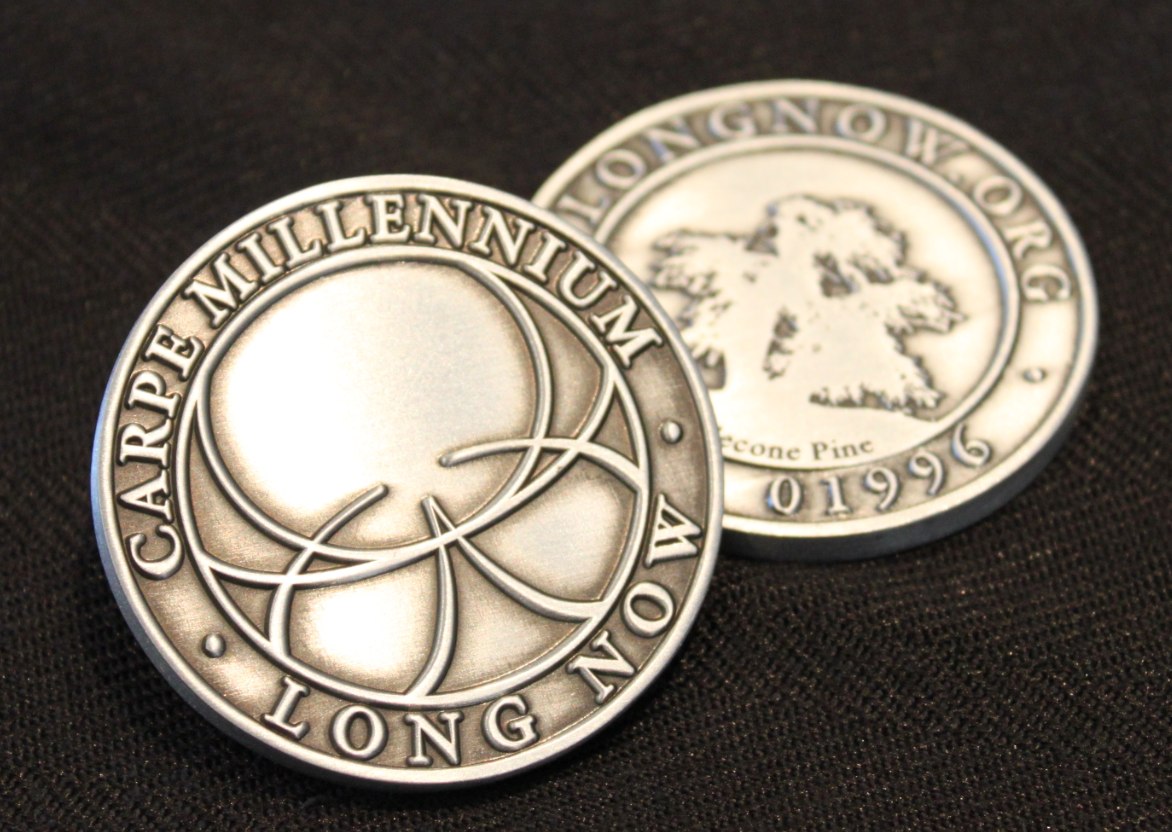
I've been involved with The Long Now Foundation, a nonprofit organisation dedicated to fostering long-term thinking and responsibility, since 02006. Then a year into grad school for futures, I spent a memorable summer at the office in San Francisco, working on various initiatives including Long Bets, as well as a proposal put together with my friend Camron Assadi for something we called Long Shorts; short films about long-term thinking (an idea subsequently adopted at the Foundation as a way of introducing many of its monthly public lectures). I suggested what has since become a Long Now motto, Carpe Millennium. And at the end of that first stint, executive director Alexander Rose invited me to become the Foundation's first Fellow, an association that continued happily over two more summer residencies, and onward through almost a decade and a half to date, spanning many developments in the organisation and its projects, and periodic collaborations.

As it turns out though, this semester, Fall 02019, marks the first chance I've had, after more than ten years of teaching futures, to put together a class on the topic of long-term thinking more broadly. How does it work in different domains? How can we render it accessible and useful? What difference does or should it make to designers? While just a prototype seven-week 'mini', a half-semester course at Carnegie Mellon School of Design, the topic has sparked lots of interest among folks I've discussed it with, so for this post I'm sharing our syllabus (shorn of admin and school policy bits and with links added where possible), in case others may get something out of it.

A few points of context:

• This is my personal and maybe idiosyncratic take on things, rather than an official Long Now Foundation course, but I've made use of some of the rich material the organisation has amassed over the years. For example, we've been using Stewart Brand's version of 'pace layers' (see the diagram below) as a structuring and sequencing heuristic for the curriculum, starting at the longest and slowest register of nature, with a deep time walk spanning the 4.5 billion years of Earth's history, and proceeding upward through the layers of culture, governance and infrastructure, so that by the end we're dealing with the kinds of faster-moving concerns the students are accustomed to thinking about day to day: a lot of design seems to operate on a rapid temporality somewhere near the top. The idea behind this order is to use that exposure to the longer-term early on, to help de-familiarise the familiar short-term, and re-perceive the mundane everyday, by the end.

• I call the classes 'episodes' and the segments within them 'acts', a format idea borrowed from the brilliant long-running public radio series This American Life. Signposting classes this way turns out to make the time easier to plan and pace out, and more legible to students and guests, while also adding a dash of theatricality to typically prosaic matters of course structure and lesson planning. We kick off each episode punctually with a selected 'long short', an intellectual and creative appetiser of sorts, and also partly an encouragement to people to arrive on time, which is helpful when you're scheduled for an 8:30am start in the fall, with days getting shorter and mornings colder. Each week's long short is a surprise beforehand and is added into the syllabus afterwards for reference.

• A monthly series of seminars about long-term thinking (SALT), curated by Brand, has been running since 02003. By this point, the SALT talks represent a large collection of thought-provoking explorations; hundreds of lectures, freely available online, dealing with topics from linguistics and politics to space travel, philosophy and geology. At the start of the course I asked each participant to pick one to add to the syllabus. This touch of curricular co-creation helped tilt the content towards their interests, better than my guesses would, and incorporated deeper involvement by having them run a discussion or activity around their chosen talk. (We have the good fortune in this case to have an intimate class size of eight students, mostly grads, from across the university; some elements would be set up quite differently if the group were much larger.) In case you haven't come across the SALT series before, you might start with the same one that our class did; geologist Marcia Bjornerud's remarkable talk from July this year, Timefulness.

***

The Long Now
Thinking, Storytelling and Designing with Long Timespans

School of Design, Carnegie Mellon University
Instructor: Stuart Candy, Ph.D. (he/him)
Fall 02019 // Fridays 8:30–11:20am
Course no. 51819 // Graduate level // 6 units // Aug 30–Oct 11

Description

“Civilizations with long nows look after things better. In those places you feel a very strong but flexible structure which is built to absorb shocks and in fact incorporate them.” –– Brian Eno

The Long Now is about what becomes possible when we engage with longer timespans. We will deal with experiential scenarios and time-based media to enable new perspectives on the anthropocene and beyond; drawing on diverse sources and views from history and foresight, geology, physics, cosmology, indigenous studies, and design – including the design of legal, political and economic systems. You'll never look at time the same way again.


Pace Layers by Stewart Brand (01999), The Clock of the Long Now, p. 37 | Diagram via.

Approach

This course takes inspiration from the work of the Long Now Foundation, a cultural organisation dedicated to fostering long-term thinking and responsibility, where the instructor, a professional futurist, has been affiliated for many years.

We examine territory seldom covered in other university courses due to the rarity of long-term thought in the wider culture, with the aim of offering intellectually adventurous students from diverse programs a set of interdisciplinary perspectives to challenge, deepen and enrich whatever else they may be doing.

Learning Outcomes

By the end of this course students should be able to:
• See further: Engage with diverse temporalities and patterns of perception at different scales
• Travel more widely: Research, understand and synthesise insights from disparate disciplines
• Be critical: Make the present strange, discerning key ethical, philosophical and cultural dimensions of our era and society
• Be constructive: Use various media to convey and elicit longer-term perspectives

Course Overview and Schedule

Here is an outline of the arc of the course and topics covered week by week.

1. Welcome to the Long Now
2. A Walk Through Deep Time
3. Seven Generations in the Anthropocene
4. Stories and Timespans
5. Design for the Long Run
6. Living in a Material World
7. Creation Crit

There are seven classes in this course, with 3+ weekly reflections, one SALT-based presentation / activity (student selections marked ∆ below), and a final project per student. Guests will be joining us most weeks, from a range of disciplinary and organisational perspectives.

Episode 1: Welcome to the Long Now
Activity: Intro to course
Reading & Media before class: N/A
Long Shorts:
• American Museum of Natural History, Human Population Through Time
• Charles Eames and Ray Eames, Powers of Ten

Episode 2: A Walk Through Deep Time
Class-led presentations begin (25%)
Activity: Field trip –– bring water bottles, comfortable shoes, and a snack
Guest: Professor Mark Baskinger, CMU School of Design & MoonArk
Long Short:
• Chris Stenner, Arvid Uibel and Heidi Wittlinger, Das Rad / The Wheel
Reading & Media (**optional):
• Brand, The Clock of the Long Now [pdf book excerpt]
• Walker, The Art of Noticing [pdf book excerpt]
• Sterling, Pace Layering [pdf chapter]
• Bjornerud, Timefulness ∆ [online audio/video]
• Bjornerud, Timefulness** [pdf book excerpt]

Episode 3: Seven Generations in the Anthropocene
Activity: Field trip –– bring water bottles and comfortable shoes
Guest: Dr. Nicole Heller, Carnegie Museum of Natural History
Long Short:
• Claire L. Evans, The Evolution Of Life in 60 Seconds
Reading & Media:
• Matza & Heller, Anthropocene in a Jar [pdf chapter]
• Nixon, The Anthropocene: The Promise and Pitfalls of an Epochal Idea [pdf chapter]
• Brannen, The Anthropocene is a Joke [online article]
• Davis, The Wayfinders ∆ [online audio/video]
• Pinker, A New Enlightenment ∆ [online audio/video]
Class-led presentations continue

Episode 4: Stories and Timespans
Final assignment launches (25%)
Guests: Acharya Adam Lobel, Point Park University; Michelle King, Learning Instigator
Long Shorts:
• Donolinio Studio, 100 Years in 10 Minutes
• Helixaeon Inc., Helix
Reading & Media:
• brown, Emergent Strategy [pdf book excerpt]
• Haraway, Staying With the Trouble [pdf book excerpt]
• Fallows, Civilization’s Infrastructure ∆ [online audio/video]
• Mahbubani, Has the West Lost It? Can Asia Save It? ∆ [online audio/video]
Activity: Meditations on the long now
Class-led presentations continue

Episode 5: Design for the Long Run
Guest: Professor Jo Guldi, Southern Methodist University, author of The History Manifesto
Long Shorts:
• Schich et al., Charting Culture
• Heal the Bay, The Majestic Plastic Bag
• Önduygu, The History of Philosophy [interactive web tool; explore in your own time]
Reading & Media:
• Brockman et al., Possible Minds ∆ [online audio/video]
• West, Why Cities Keep on Growing, Corporations Always Die, and Life Gets Faster ∆ [online audio/video]
• Guldi, The Designer’s Role [pdf]
• Guldi & Armitage, The History Manifesto [pdf book excerpt]
Activity: Co-creation in class
Class-led presentations continue

Episode 6: Living in a Material World
Guest: Professor Jonathan Chapman, CMU School of Design, author of Emotionally Durable Design
Long Shorts:
• Madsen, Into Eternity (Trailer)
• Kalina, Noah Takes a Photo of Himself Every Day for 12.5 Years
Reading & Media (**optional):
• 99% Invisible, Ten Thousand Years [podcast]
• Sandia National Laboratories, Expert Judgment on Markers to Deter Inadvertent Human Intrusion into the Waste Isolation Pilot Plant** [pdf report]
• Christian, Algorithms to Live By ∆ [online audio/video]
• Chapman, Emotionally Durable Design [podcast]
• Powers, The Overstory [pdf book excerpt]
• Urban, Your Life in Weeks [blog post]
Activity: ‘Mattering’ workshop
Class-led presentations conclude

Episode 7: Creation Crit
Activity: Reviews of final project submissions

A few billion years into deep time with Mark Baskinger | Photo: Stuart Candy

Assessment

25% Participation and engagement in class
25% Presentation and leading discussion
25% Weekly reflections (minimum three required; due the Monday after each class by 5pm)
25% Final project

Selected Bibliography

• Bjornerud, Marcia. (2018). Timefulness: How thinking like a geologist can help save the world. Princeton, NJ: Princeton University Press.
• Borrows, John (Kegedonce). (2010). Drawing out law: A spirit’s guide. Toronto: University of Toronto Press.
• Boulding, Elise. (1990). Building a global civic culture: Education for an interdependent world. Syracuse, NY: Syracuse University Press.
• Brand, Stewart. (1994). How buildings learn: What happens after they’re built. New York: Viking.
• Brand, Stewart. (1999). The clock of the long now: Time and responsibility. New York: Basic Books.
• Brannen, Peter. (2019, August 13). The Anthropocene is a Joke. The Atlantic.
• Brannen, Peter. (2019, October 11). What Made Me Reconsider the Anthropocene. The Atlantic.
• brown, adrienne maree. (2017). Emergent strategy: Shaping change, changing worlds. Chico, CA: AK Press.
• Carse, James. (1986). Finite and infinite games. New York: Free Press.
• Chapman, Jonathan (2015). Emotionally durable design: Objects, experiences and empathy (2nd ed.). London: Routledge.
• Chatwin, Bruce. (1987). The songlines. New York: Viking.
• Collins, Jim and Jerry I. Porras. (1994). Built to last: Successful habits of visionary companies. New York: HarperBusiness.
• Cullinan, Cormac. (2011). Wild law: A manifesto for earth justice (2nd ed). White River Junction, VT: Chelsea Green.
• Delanda, Manuel. (1997). A thousand years of nonlinear history. New York: Zone Books.
• Escobar, Arturo. (2018). Designs for the pluriverse: Radical interdependence, autonomy, and the making of worlds. Durham, NC: Duke University Press.
• Ghosh, Amitav. (2016). The great derangement: Climate change and the unthinkable. Haryana, India: Penguin Books.
• Gleick, James. (1999). Faster: The acceleration of just about everything. New York: Pantheon Books.
• Global Business Network. (2003). Looking Forward To Learn: Future Scenarios For TestingDifferent Approaches To Managing Used Nuclear Fuel In Canada. NWMO Background Papers 8–5. Toronto: Nuclear Waste Management Organization.
• Griffiths, Jay. (1999). Pip pip: A sideways look at time. London: Flamingo.
• Guldi, Jo and David Armitage. (2014). The history manifesto. Cambridge, England: Cambridge University Press.
• Haraway, Donna. (2016). Staying with the trouble: Making kin in the Chthulucene. Durham, NC: Duke University Press.
• Haskins, Caroline. (2019, May 6). AirPods Are a Tragedy. Vice.
• Hora, Stephen C., Detlof von Winterfeldt and Kathleen M. Trauth. (1991). Expert Judgment on Inadvertent Human Intrusion into the Waste Isolation Pilot Plant. Sandia Report SAND 90–3063. Albuquerque, NM: Sandia National Laboratories.
• Johnson, Steven. (2006, October 8). The Long Zoom. New York Times Magazine.
• Kohlstedt, Kurt. (2018, January 26). Beyond Biohazard: Why Danger Symbols Can’t Last Forever. 99% Invisible.
• Krznaric, Roman. (2019, March 19). Why We Need to Reinvent Democracy for the Long-term. BBC.
• Macleod, Joe (2017). Ends: Why we overlook endings for humans, products, services and digital. And why we shouldn’t. Closureexperiences.com.
• Manaugh, Geoff. (2019, April 18). Move Over, San Andreas: There’s an Ominous New Fault in Town. Wired.
• Matza, Tomas and Nicole Heller. (2018). Anthropocene in a jar. In: Gregg Mitman, Marco Armiero, and Robert S. Emmett (eds.). Future remains: A cabinet of curiosities for the anthropocene (pp. 21–28). Chicago: University of Chicago Press.
• Morin, Edgar and Anne Brigitte Kern. (1999). Homeland Earth: A manifesto for the new millennium (trans. Sean M. Kelly and Roger LaPointe). Cresskill, NJ: Hampton Press.
• Morton, Timothy. (2019). You never know how the past will turn out. Journal of Futures Studies, 23(4): 97–100. doi: 10.6531/JFS.201906_23(4).0009
• Nixon, Rob. (2018). The anthropocene: The promise and pitfalls of an epochal idea. In: Gregg Mitman, Marco Armiero, and Robert S. Emmett (eds.). Future remains: A cabinet of curiosities for the anthropocene (pp. 1–18). Chicago: University of Chicago Press.
• Ozeki, Ruth. (2013). A tale for the time being. Edinburgh: Canongate.
• Powers, Richard. (2018). The overstory: A novel. New York: W.W. Norton & Co.
• Rao, Venkatesh. (2011). Tempo: Timing, tactics and strategy in narrative decision-making. Ribbonfarm, Inc.
• Sardar, Ziauddin (ed.). (1999). Rescuing all our futures: The future of futures studies. Westport, CT: Praeger.
• Spier, Fred. (2015) Big history and the future of humanity (2nd ed.). Chichester, England: Wiley Blackwell.
• Stapledon, Olaf. (1930). Last and first men. London: Methuen.
• Stephenson, Neal. (2008). Anathem. New York: William Morrow.
• Sterling, Bruce. (2014). Pace Layers. In: Susan Yelavich & Barbara Adams (eds.). Design as future-making (pp. 214–224). London: Bloomsbury.
• Tabet, Michelle. (2013, January 22). The scale of tomorrow: Architects as agents of change. ArchitectureAU.
• Trauth, Kathleen M., Stephen C. Hora, and Robert V. Guzowski. (1993). Expert Judgment on Markers to Deter Inadvertent Human Intrusion into the Waste Isolation Pilot Plant. Sandia Report SAND 92–1382. Albuquerque, NM: Sandia National Laboratories.
• Walker, Rob. (2019). The art of noticing: 131 ways to spark creativity, find inspiration, and discover joy in the everyday. New York: Alfred A. Knopf.

Some Other Media and Resources

• Long Now Foundation, Seminars About Long-term Thinking (SALT) lecture series (audio and video)
• Godfrey Reggio, Koyaanisqatsi (documentary)
• Jonathan Blow, Braid (video game)
• Randall Munroe, xkcd (webcomic), various timelines
• Ben Robbins, Microscope (tabletop game)
• Lasse Lundin, A Trip Through Time Seen Through The Eyes of a Fir Tree (tabletop game)
• Thomas King, The Truth About Stories. The 2003 CBC Massey Lectures (audio)
• Situation Lab, The Thing From The Future (card game)
• Michael Madsen (dir.), Into Eternity: A Film for the Future (documentary)
• Ainscow, Rae, Woodward et al., Deep Time Walk (app)
• Brian Eno, The Microsoft Sound (composition): original; slowed 4000%; Q&A in SF Chronicle
• Dash Marshall, Very Slow Movie Player (video/design)

***

Much gratitude to my students, to our fabulous guest informants and colleagues, and to the Long Now Foundation for the inspiration.

Do get in touch with any questions, suggestions, or tales of experiments of your own that this may feed into.

Update 11oct19: Added to the bibliography Peter Brannen's piece published in the Atlantic today; revisiting and reconsidering his previous, sceptical discussion of the Anthropocene, maybe the most controversial reading covered in the class.

Related:
> Design is Storytelling (includes a kind of overview of a decade's teaching)
Bringing Futures to Stanford d.school
> American Futures (SAIC project)
> Future Documentary (SAIC course)
> Guerrilla Futures (OCAD course)
> Adopt-a-vision (OCAD project)
> Killer Imps (RCA visit)
> Future-Jamming 101 (UH Manoa project)
Some . early . posts .  written . while . at . Long . Now (02006–08)

Tuesday, February 13, 2018

Design is Storytelling

Design is many things: it's the giving of form, the shaping of experiences, and – oh, alright then – the solving of problems. In a broader sense, it is the distribution of ingenuity, translating ideas and intentions into realities. And in this light, design is also a matter of mapping and expanding possibility's horizons: telling new stories, and so conjuring paths to new worlds.

Design is Storytelling understands this. It's a new book by Ellen Lupton, senior curator of contemporary design at Cooper Hewitt (the Smithsonian Design Museum in New York), which is also the publisher of this slim and skilfully curated volume of ways to practice design in narrative mode.


At Situation Lab we're delighted that our imagination card game The Thing From The Future appears in the book as a key example of a design fiction tool. Design fiction is an object-oriented speculative idiom long developed and documented here as part of the wider transmedia landscape of experiential futures, which in turn deals with bringing future narratives to life by all means necessary.

In Lupton's words:
Many design projects are conceived as speculative proposals for the future. Exotic concept cars and lavishly art-directed videos for tech companies celebrate the wonders of growth and innovation. Other veins of design fiction are more critical. ...

The Thing from the Future, created by Stuart Candy and Jeff Watson, is a game that helps teams and individuals build stories about the future. ... The game can be played with groups of students or in community-based workshops as a co-creation activity.

[It] is a storytelling machine. Turning the design process backwards, it uses signals from a distant world to inspire new thinking. Candy calls this process reverse archaeology. [link] The results can be humorous or provocative as well as practical. The game stimulates serious conversations about social and environmental sustainability.

Design is Storytelling shares several examples of #FutureThing prompts, generated using the original four-suit edition, together with some witty sample responses that are playfully illustrated by Jennifer Tobias (see p. 51).


The book is filled with useful tools, and this game is not the only explicitly futures-related one: there's also the cone of plausibility (aka cone of possibility, aka cone of uncertainty; pp. 43-45), and the 2x2 matrix, a widely used process for scenario generation (pp. 46-47).

I want to acknowledge the relevance of Lupton's storytelling-centred collection to work that we've plotted here since 02006, and take the opportunity that the book presents to consider, from a personal vantage point, how I've seen design's self-understanding evolving to take advantage of the potential in the design/futures intersection which has been our focus throughout that time.

It's heartening to take stock of how things have changed.

When I first started teaching futures to design students, as a guest lecturer in Tony Dunne and Fiona Raby's Royal College of Art program early in 02009 (while completing a PhD on futures and design), there was precious little awareness of futures thinking or methods apparent in design education anywhere. Except for some pioneering hybrid practitioners, such as Lloyd Walker, Cindy Frewen, and Jason Tester, there seemed scant overlap between the two worlds (although no doubt precursors and parallels will keep coming to light). My introduction of foresight concepts and methods to design students at the RCA –– not least the cone of possibility itself* –– tapped a kind of latent energy on both sides that heavily influenced my decision to bring futures thinking more systematically to designers.

The next year, Nathan Shedroff asked me to create a foresight course in the Design MBA at California College of the Arts. Strategic Foresight is now a core part of the curriculum (the class is usually run by Jake Dunagan). The scenario-generation phase for that first time I ran the course was led by Jay Ogilvy, a former Yale philosopher professor and cofounder of Global Business Network, who at GBN had created a step-by-step process for teaching 2x2 scenario generation. Thanks to GBN's influence, and I believe in large part to Jay's pedagogy, this had become the most widely used way of creating scenarios for organisations around the world. It's gratifying to find Jay's methodological contribution recognised in Design is Storytelling (p. 47). Readers interested in the approach of a hybrid consulting futurist and philosopher should seek out his excellent book Creating Better Futures (OUP, 02002) and more recent journal article Facing the Fold (Foresight, 02011).

At the end of 02011 I delivered the closing keynote at AIGA's annual conference, a terrific platform for bringing futures-related ideas to wider attention in the design community. The talk was a little weird, but it helped opened up multiple continuing conversations and collaborations.

And meanwhile, OCAD University took the groundbreaking step of offering the first foresight-focused program in a design institution, the MDes in Strategic Foresight and Innovation (SFI). In 02013, OCAD U lured me away from Melbourne and a full-time consulting role at Arup, to Toronto, where I was the first external tenure-track SFI faculty hire, brought on as the program doubled in size to accommodate both full- and part-time cohorts. There, collaborating with wonderful colleagues Greg Van Alstyne and Suzanne Stein, I integrated experiential futures approaches (design fiction, live action roleplaying, etc) into the core curriculum, and led seven iterations of the Foresight Studio over three years. SFI is easily the largest graduate program at Canada's biggest art and design school, and it has by now unleashed well over 100 hybrid design/futures folks into organisations around the country and the world.

At the same time, Carnegie Mellon University's School of Design has been integrating a form of systems literacy throughout the curriculum, under the banner of transition design. This effort, initiated by Head of School Terry Irwin with Gideon Kossoff, Peter Scupelli and Cameron Tonkinwise (who is now at UNSW), has incorporated a futures perspective since its inception [pdf link]. It has been gradually rolled out across the CMU design curriculum, top to bottom, over the past several years. December wrapped up my first semester on faculty, where I taught the Senior Design Studio alongside Terry Irwin and Stacie Rohrbach, and we formally brought transition design ideas to undergrads for the first time.

Our students tackled a variety of wicked problems (food, water, gentrification, air quality, and so on), mapping their contours historically and in the present before using futures tools to examine alternative pathways for the coming decades, and generating stories (visions) for the year 02050 to inspire design interventions for the long term. Methods and heuristics we covered included the cone of possibilities, scenario generation, and design fiction / experiential futures (i.e., methodological staples that have found their way from futures to the pages of Design is Storytelling); as well as some others as yet less widely known in the design world, like environmental scanning and three horizons.

Currently, working with colleagues including Peter Scupelli (who has now taught futures at CMU for some five years), Dan Lockton, Molly Steenson, Terry Irwin, and many others, I'm working on braiding a foresight thread through the undergraduate design curriculum. The intention is for it to become part of the standard repertoire of competencies used by and expected of 21st century designers.

So it's nearly a decade that my colleagues and I have been working to deliberately infuse futures methods into design education; and there are of course many other strands in this bigger story alongside the ones I can recount from first-hand experience. But this is a personal story that reinforces Ellen Lupton's core insight: design's storytelling – and worldbuilding – potential, though always present, has lately been moving from marginal to something much more central.

There's a wealth of further fuel for that fire in Design is Storytelling, both futures-flavoured and not, and the book manages to be both highly attractive and, in the best sense, utilitarian, while documenting a moment in time where design's recognition of its narrative possibilities and responsibilities only continues to grow. Check it out.

Related:
> The Thing from the Future
> TFTF UNESCO French/English edition
> Reverse archaeology 02013 / 02008
> Object oriented futuring
> Strategic foresight and the Design MBA
> Introducing futures at the RCA 

Saturday, December 30, 2017

Where do you stand?

A crucial part of foresight work, whether it's in a corporate boardroom or an undergraduate classroom, is helping people surface and test their assumptions about the future.

The Polak Game offers a simple, powerful, and generative way of doing just that.

Introducing the Polak Game (with Jake Dunagan) at our first Design Futures Masterclass at CEDIM. Mexico City, 02015 (Photo: Jorge Camacho)

Named after the Dutch sociologist Fred Polak whose work inspired it, the game is also alternatively called "Where Do You Stand?" Aided by the facilitator, players are invited to use the physical space they are in to demonstrate their understandings of the future, in terms of expectations, on one hand, and their sense of personal agency to effect desired change, on the other.

The heart of the activity is a guided conversation aimed at understanding diverse perspectives across these dimensions, including the way that people's different views are grounded in their different experiences of the world. It helps us make explicit the importance of certain aspects of our thinking about futures that are always present, yet almost always invisible. The discussion can often become quite profound.

Playing the game as part of a course in the Media Design Practice program at ArtCenter College of Design. Los Angeles, 02016 (Photo: Stuart Candy)


Participants on a sound stage for a feature documentary film shoot, directed by Shannon Owen, about Australia's South Sudanese community. Melbourne, 02017 (Photo: Stuart Candy)

It is now over a dozen years since Peter Hayward (until recently the coordinator of Swinburne University of Technology’s futures program in Melbourne) ran the game for us in Honolulu, at the University of Hawaii at Manoa futures program. Since learning it from him there, I’ve staged it many times, for classes, workshops, and even a feature documentary shoot on a sound stage; with participants in different kinds of organisations, communities, cultures, and parts of the world. The game has also begun to spread, appearing in the toolkits of more and more practitioners, as useful tools do; changing as it goes.

People sometimes ask whether there are any published works to reference that describe and unpack the Polak Game. Until now, the answer has been no.

But we have just co-authored a piece aimed at filling this gap; precisely because "foresight craft genealogies often escape not only documentation, but even our explicit notice". For collective learning in the field there's a value to capturing how, where, and why these tools of the trade emerge and evolve. The same reason applies for sharing the work here in this post.

The article is in two parts. Hayward's deals with the "Origin and Orientation" of the game, and mine focuses on its "Exploration and Evolution" as it has played out in my experience over the past dozen years.

I'll finish this post with his conclusion:
It is when I have used it with groups trying to create a vision of a shared future that I think the power of the Polak Game has become most apparent. Humans construct narratives from their own experience and sense of the world. You could say that we stand on our individual ontology. What the game can reveal to players is that we each need to meet others where they are, and listen to their ontologies, before we have any chance of creating a shared one. During the game, it often becomes obvious who in a group feels that they have power and opportunity, and who does not; who has been treated fairly in the past, and who has not. By bringing these hidden dimensions to light, those with power may feel humbled by their privilege, and those with disadvantage can feel acknowledged and heard. And from there, an enduring sense of what "our" future could be starts to emerge.

The full article, including detailed instructions for facilitation of the game, appears in the December 02017 issue of the Journal of Futures Studies: The Polak Game, Or: Where Do You Stand?

Related:
Dreaming together
Brand runner / Colonising the future on film
> The technology of public imagination
> Design fiction is a fact

Thursday, November 30, 2017

Futures on film


A little while back I happened across my first published foresight paper, which I’d thought long lost.

Futures on film: Using movies to explore possible futures is exactly what it sounds like. It looks at using movies set in the future as a basis for futures-oriented dialogue, especially in the classroom.

The collection it appeared in, back in 02004, was paper-only and not in wide circulation, but the text turned up in a trove of files burned to CD-ROM over a decade ago, and recently consolidated on my current laptop.

The piece came out of a workshop I co-ran in Hungary in 02003 at the Budapest Futures Course, a graduate-level summer intensive introduction to the field, supported by the World Futures Studies Federation and UNESCO. My co-organiser of the session and co-author of the paper was Bernadett Szél, then an economics student in the futures program at Budapest University of Economic Sciences and Public Administration. (That university has since become Corvinus University of Budapest, and Dr. Szél has since become a member of parliament in Hungary’s National Assembly.)

My first futures conference was in 01997, and by this edition of the Budapest Futures Course I had some hunches about directions worth exploring in the field. I’d also finished as an undergrad the year before (in arts and law), and was living not too far from Budapest –– in the former Yugoslavia, supporting myself with savings from my first post-graduation job back in Australia. I was attempting to produce a feature documentary about Montenegro’s quixotic plan to become the world’s first "ecological state". It eventually dawned on me that this fascinating but ill-fated endeavour, the notion of an ecological state, was at heart a futures project, and that my also ill-fated (for different reasons) doco about it was a futures film project. But that's another story.

Perhaps it says something about the state of play in the field in 02003, its relationship to media other than text, that using movies as a basis for exploratory conversation seemed an experiment worth writing about. I'm sharing this modest article unearthed after so long because, despite its shortcomings, it gestures in a direction that would within just a few years lead on to some exciting new territory in futures.

The notion behind Szél's and my workshop, and this paper based on it –– that futures should engage with other media more fully –– is a precursor to the argument for developing what soon began to crystallise as a new frontier of practice, experiential futures.

The notion of a media-enriched mental ecology for higher-resolution futuring is here in seed form:

One rich set of materials which can be put to use in futures studies is found in the arts, where individual and collective fantasies, fears and hopes are explored. Such exploration arguably constitutes one of the crucial socio-cultural functions of art - and of course all fantasies, fears and hopes implicitly contain a future orientation. ...

Film stories, and film images, can be regarded as a sort of experience which all individual viewers can be seen to have in common, and to which all can therefore somehow relate. While this is true of any work of art available to the general public, there is an important distinction between the written word and the image. From reader to reader a book about or set in the future is sure to inspire very different mental images, but what we see in a film varies much less from viewer to viewer. The way we watch films in the cinema reinforces this point: stories on our screens 'transport' us to other places, offering the audience an experience to which it willingly yields. We pay to sit in a darkened room, to watch light and shadows on the wall, to block out superfluous sensory input, indeed to devote our full attention – one of the few contexts in which this is willingly given or even possible for individuals in developed societies – to a story which will not be interrupted, and in which we can therefore be immersed. We pay to be dwarfed by the larger-than-life figures and tales unfolding on a huge, elevated screen. 
This 'shared experience' can then be used as a starting point for discussion, so the individual adventure of watching a film can be transformed into a team activity. ... The experience offered by a film is of course in a sense vicarious, but as an educational experience it becomes anything but vicarious: it can be thought-provoking, participative, and engaging.

A descendant of this line of exploration can be found in recent work like this piece co-written with Jake Dunagan.

And we’ve continued to use film, on and off, in the years since. We made no-budget videos as "artifacts from the future" in Hawaii back in 02007 to try out some ideas for helping audiences time travel (Neural Rights ManagementAloha Tonight). More recently, the start of the NaturePod project video (02016) starts out with a diegetic commercial. Last spring, I devised and led a course called Future Documentary at the School of the Art Institute of Chicago, where students were challenged to create their own future film fragments, then put them out into the world. But even the first and simplest of film-based approaches to futures, scaffolding conversation using screenings of existing movies, still comes in handy. A few years ago, I chose Gattaca, Her, and Samsara to show as part of my Duke University TIP summer course for high school students from across the US.

Our experiential futures experiments have included not only film, and not only tangible future "artifacts" (which in the intervening years have often come to be referred to as design fiction, and then more recently speculative design), but also art museum and gallery exhibitsinteractive installationguerrilla interventionsalternate reality gamesimmersive theatre and live action roleplayingtrade show product demosmail art, and more.

Now over a decade old, experiential futures has come a long way. Its inspiration may in a sense have begun with film, but fortunately it did not end there.

There's something encouraging and apt about this trajectory, I like to think; this shift of focus from the consumption, appraisal and critique of Hollywood's images of the future, to the active, creative, and critical generation of our own, using every form we can think of to help bring futures more vividly to life. 

Related:
The technology of public imagination
> Brand runner / Colonising the future
Death of a President
> The Experiential Turn
> Experiential futures turns ten
> Future documentary
> Gaming alternative futures

Friday, June 23, 2017

Ethnographic Experiential Futures

We shape our images of the future, and meanwhile they shape us.

A Field Guide to Ethnographic Experiential Futures, version 1.1, June 02017 (pdf)


(Update 03june19: This post and framework have attracted quite a bit of interest over the past couple of years. We've now published a peer-reviewed academic article, in open access, laying out EXF in the Journal of Futures Studies special double issue on Design and Futures. That full piece is available in pdf here.)

***

At the Design Develop Transform conference in Belgium last week, design researcher/futurist Kelly Kornet and I presented this framework we've been developing on and off for a couple of years.

Ethnographic Experiential Futures, or EXF, is a design-driven, hybrid approach to foresight aimed at increasing the accessibility, variety and depth of available images of the future.

It puts together two modes of futures research and practice which have grown up separately, for the most part, but which have complementary goals, and turn out to pair quite well.

Ethnographic futures research, EFR, is a protocol for surfacing and documenting existing images of the future. (Our starting point was the late Stanford anthropologist Robert Textor's formal EFR interview process, an overlooked contribution to futures literature which should be much more widely used.) Experiential futures, XF, is a family of approaches for vivid multisensory, transmedia, and diegetic representations of images of the future (a focus of mine for the past decade).

Put another way, ethnographic futures is more descriptive; looking for what's present but often hidden in people's heads. Experiential futures is more creative; rendering these notional possibilities visible, tangible, immersive and interactive, externalising and concretising representations of them for closer inspection and deeper discussion.

EXF offers a way to take the invisible and make it senseable.


We've suggested a series of steps for an EXF process:
1. MAP: Inquire into and record people's actual or existing images of the future (e.g. possible; probable; preferred; a combination).
2. MULTIPLY: Generate alternative images (scenarios) to challenge or extend existing thinking (optional step, but recommended).
3. MEDIATE: Translate these ideas about the future/s into experiences: tangible, immersive, visual or interactive representations.†
4. MOUNT: Stage experiential scenario/s to encounter for the original subject/s, or others (or both).
5. MAP: Inquire into and record responses to the experiential scenario/s.

The Field Guide explains the logic and highlights some of the main design choices available at each juncture.

Instead of starting from theory, this step-by-step process has been derived from already completed projects, carried out over a number of years, which turned out to have much the same structure under the hood. In our conference presentation we reviewed four project precedents dating back to 02007. While demonstrating very different goals, outcomes and contexts, they basically describe the same research arc.

A full article is forthcoming, which will include more detail to situate this work in the landscape of futures ethnography and experiential practice, including related methods and projects. However, since the one-pager refers to the specific projects from which we distilled or abstracted this framework, for reference those are briefly outlined below:

Candy and Dunagan, Foundfutures: Chinatown, 02007.

About ten years ago, Jake Dunagan and I started experimenting with the deployment of experiential futures in unscripted environments. We would send postcards from the future to the home addresses of community leaders around Hawaii, and 'droplift' future artifacts in local shops for people to stumble across during their lunch break, for example. However our most ambitious early guerrilla futures project aimed to be more systematic; more rooted in place and history. In Honolulu's Chinatown neighbourhood, we interviewed a range of residents and business-owners, and then devised a culture- and site-specific scenario set, incorporating a combination of future possibilities as described to us, and new ones calculated to resonate with what we had heard. With collaborators we created a set of experiential scenarios, producing a cross-section of fragments from each hypothetical future history, and installing these in the streets. Responses were captured via direct observation, at a free community futures workshop, and in the press.

Artwork by Matthew Jensen / Photo by Stuart Candy

Artwork by Mark Guillermo / Photo by Matthew Stits

Kornet, Causing an Effect, 02015.

For Kelly Kornet's culminating research project at OCAD University (which design professor Helen Kerr and I supervised), she spoke to several lifelong environmental activists, living in heavily polluted industrial areas, about the future hopes and fears motivating their efforts. She generated written scenarios based on these (using Textor's EFR interview format), then created a physical exhibition comprising artifacts from the futures that the research participants had described, and subsequently spoke with them again to capture responses to how their own private imaginaries had been brought to life. The project, which won a student award from the Association of Professional Futurists, is available in pdf here.


Designs & photos by Kelly Kornet 

Situation Lab/Extrapolation Factory, 1-888-FUTURES, 02015.

Jeff Watson and I (Situation Lab), together with Elliott Montgomery and Chris Woebken (Extrapolation Factory) designed and staged a series of design jams in 02014-15 called 'Futurematic'. The third of these, held at the University of Southern California, invited anyone interested, across North America, to call a toll-free number and record their future dream in a voicemail. On the day of the event, we had participants retrieve these voicemails, then create a "future present" –– a tangible artifact distilling (or, as Chris would put it, 'tangibilising') each dream. The maker/s then recorded a video about their making process and the correspondence between the artifact and the dream that inspired it, and boxed up the future present to send to whatever postal address had been left with the original voicemail. Thereafter, on social media, recipients responded to the future presents they opened up. The project is detailed here, and was covered by Core77 and Business Insider among others. Artifact documentation and videos are archived at 1888futures.com.

Photo by Stuart Candy

Photo courtesy Extrapolation Factory & Situation Lab

Greyson, Making the Futures Present, 02017.

Designer and interactive narrative professor Maggie Greyson, for her final MDes project at OCAD, created a "personal experiential futures" process. (Social entrepreneur Sarah Schulman and I supervised.) Maggie interviewed research participants, using Textor/EFR, about a range of futures they could imagine facing on a 20-year time horizon –– positive, negative, expected, and also unexpected. The 'unexpected' future is not a usual part of EFR, which traditionally has a strict descriptive intent; this was a deliberate addition to expand participants' thinking (see Step 3, 'Multiply'). She then worked with them to co-create rapid prototypes of artifacts from those futures, and went on to develop higher-resolution artifacts as a basis for deeper conversation in the next session. The project can be found in pdf here.


Photos by Maggie Greyson

Whether your aim is to dive deeper into the images of the future in a culture to which you belong (even your own personal 'futurescape'), or to facilitate a process for a client organisation, or to partner with a community group historically marginalised from meaningful futures conversations, the framework is intended to be capable of being customised and put to diverse uses.

As we noted in the conference presentation, purposes of projects to date have spanned the educational, documentary, activist, personal, and playful; and could readily be extended or adapted to the organisational, governmental, and cultural.π

EXF may be applied at the scale of a short workshop or design jam, up to a multi-year large-scale process involving thousands of people or more. It may be used as scaffolding for a robust, imaginative strategic conversation within a company, or as the basis for a public, guerrilla futures intervention at election time, or as a quasi-therapeutic support structure for examining an individual's options in life.

Most futures research is not as disciplined as it could be in its inquiry into how people currently think about and conceptualise futures: Ethnographic futures research can help with that. Meanwhile, most communicative or scenario-sharing interventions are likely not sufficiently vibrant to change or expand how people think: Experiential futures practice can help with that.

Putting them together entails bridging the descriptive and the creative (and potentially, though not necessarily, the normative).

Our hope is to make this work a bit easier and more common, by providing a flexible framework that has served diverse purposes before and could be put to many other uses.

Also, we note that this arc of activities, which in the original projects may have appeared linear, can be usefully recognised and imagined instead as circular. The first and last steps are the same. In principle, then, EXF could be used, where appropriate, in an ongoing, cyclical fashion.§

We've received a number of requests for a pdf of the draft Field Guide to Ethnographic Experiential Futures: you can download it right here.

We invite you play with this structure and share your variations, innovations and results!

***

Notes:
[†] Those new to experiential futures may find this recent peer-reviewed article published in Futures journal useful. There's an abridged overview for the especially time-pressed (downloadable pdf). The Experiential Futures Ladder, to help carry out Step 3, Mediate, is described there too.
[π] The Adopt-a-vision experiential futures class project recently outlined at this blog could very easily be tweaked towards an EXF cycle –– and the resemblance is not pure coincidental; it emerges from some of the same thinking.
[§] The insight that an ethnographic, grounded-in-place futures process could be usefully developed as a generic method owes an enormous amount to over a decade of conversation and collaboration with Jake Dunagan (whose background includes an MA in visual anthropology). Early in 02016 we developed a project proposal called 'Nextloop', which aimed to offer "a next step in a much-needed renovation of the conditions for public imagination. We wish to use this opportunity to demonstrate how forward-looking design research, pairing ethnography with tangible speculation, can enrich individual and collective consideration of our social, cultural and technical choices. We intend to close certain loops too often left open – bringing potential downstream consequences powerfully and concretely into awareness today, and to bring in certain other loops – diverse public involvement in those same discussions – too often left out."


Related:
> Adopt-a-vision (report from a recent XF class)
1-888-FUTURES (speculative design jam event overview)
Foundfutures: Chinatown (XF /guerrilla futures project overview)
Build Your Own Time Machine (classroom activity instructions)
The Thing From The Future (card game)
The Futures of Everyday Life (doctoral dissertation)