Showing posts with label Elliott Montgomery. Show all posts

Saturday, September 19, 2015

1-888-FUTURES

"Dial a future, deliver a present."


Want to put systemic challenges on the radar of your local Congressman? Help a relative living on the opposite coast to prepare for climate change? Send a 30th anniversary gift to the couple just now celebrating their 10th? Share a dream for a brighter world with your kid?

1-888-FUTURES is a service that takes a future dream, vision or problem, renders it tangible as a "future present", and delivers it to a specific individual.

You, the visioner, call the hotline and place a request for delivery of a future present based on some image of the future that you describe in your message. Our dedicated staff retrieves the message, finds a way to make the dream into a specific artifact, boxes it up, and sends it to your chosen recipient.

The future present recipient – whether it's you the visioner, or someone else – may choose to keep the package as a mystery box until the stated opening date, or may instead open it sooner, and be duly delighted/horrified/provoked/touched/nonplussed by the contents. A transcript of the original dream recording will be posted together with the artifact inspired by it.


A lot of work in the design fiction / speculative design mould is created, it seems, for no one in particular. Even if produced only once (like an artwork), often in effect it's a mass consumption object rather than something made for one. So 1-888-FUTURES is a small experiment in making such future design more personal and personalised; a true gift, connecting the imagining and creation process to a named individual, an audience of one.

This is the third "Futurematic" design jam jointly run by Situation Lab (Jeff Watson and me) with New York-based design collective The Extrapolation Factory (Elliott Montgomery and Chris Woebken). Graciously hosting on this occasion is the University of Southern California's Visions and Voices series, with the priceless collaboration of Professor Jen Stein from USC's School of Cinematic Arts.

Futurematic events riff playfully on commercial and industrial making processes, while focusing on the very non-industrial, not-yet-massified design space of imaginary objects. At the first event, participants filled up a vending machine with future artifacts in a day last spring at OCAD U. For the second, last summer at NYU, people created and put future street merchandise on sale at Canal St and Broadway in Manhattan. Both those events used Situation Lab’s imagination-boosting card game The Thing From The Future as the creative engine. This time, the ideation engine is the public's imagination itself. With that as the driving force, workshop participants will send out as many "future presents" made to order as we can, from our temporary 1-888-FUTURES fulfilment center in Los Angeles to all over the country.

The whole thing is free: so long as the delivery address is in the U.S., callers from anywhere can participate by calling 1-888-FUTURES from skype.

But this offer is limited - so call now! The lines are open 24/7 until midnight on Saturday, September 19th.


Browse the catalogue of future presents, designed, sealed and delivered, at 1888FUTURES.com.

Thanks to Jen Stein, Jeff Watson, Danyel Copeland and Josh McVeigh-Schultz, and the rest of our hosts and helpers at USC. Thanks also to our Futurematic collaborators Chris and Elliott, aka The Extrapolation Factory, and not least to our wonderful workshop participants!


[Originally posted at the Situation Lab blog.]

Links:
> Project website: 1888FUTURES.com
> Feature at Core77
> Feature at Tech Insider
> Feature at Medium

Related posts here:
> Big shifts, small change
Participatory cli-fi
More found futures
> Design fiction, emerging
> Object-oriented futuring

Wednesday, December 11, 2013

Big shifts, small change

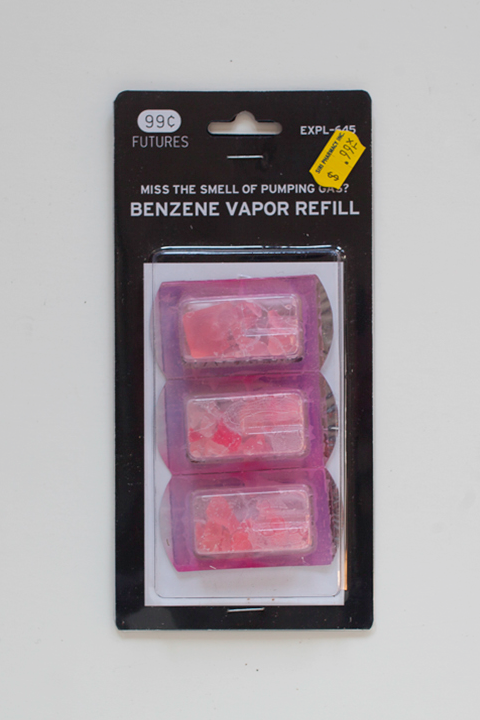
What kinds of artifacts might be found in the 99 cent store of the future?


All images from The Extrapolation Factory website.

So asks a nifty, crowdsourced experiential futures / design fiction project by The Extrapolation Factory, an award-winning initiative of Elliott Montgomery and Chris Woebken (both alumni of the RCA's Design Interactions program). "99 cent futures", executed in New York earlier this year, is now being exhibited in China, giving the project a new lease of attentional life.

Some months back, when this effort was in the pipeline, I spoke with them to help hammer out a participatory design framework which they created so that attendees at a workshop in NYC could playfully generate and make their own answers to the question. Then the pair installed the resulting artifacts in an actual 99¢ store in Brooklyn (calling to mind some of our early FoundFutures adventures in droplifting; e.g., speculative pharmaceuticalssouvenir magnets and postcards from the future).

I particularly like that they managed to include both a participatory design phase and a guerrilla futures phase -- two critical frontiers of design/futures work -- in the same process.


Today a report on 99¢ futures appeared on the CNN website; last weekend I did an interview by email for it.

Now, it's more or less axiomatic that something -- usually a pretty fundamental something -- gets messed up in reports on futures. In that regard this piece is better than most, although it seems to imply that "futuring" (the reporter's preferred term, I think borrowed from Chris and Elliott) is a new "movement" emanating from design, as opposed to a practice established over many decades and recently adopted and/or reinvented by some designers.

Apparently I did not make that relationship clear enough. Live and learn.

Still, it's a good article, and encouraging to see this work thoughtfully covered in mainstream press -- in the Style section, impressively enough; not a common place to find foresight news!

We'll dig into the Extrapolation Factory's projects and methods a bit more in another post.

Meanwhile, for those interested the whole of my email interview appears below. The questions were asked by CNN writer Sheena McKenzie.

***

Why was the 99c store such an interesting/significant project?

Two things make the 99 cent store interesting. First, it's a rare invitation to imagine the future's mundane side. Popular notions of the future often get stuck in a kind of glossy rut - gleaming buildings and whiz-bang inventions, and it's not often enough that we see the futures of everyday life brought into focus. Second, it's the result of a participatory process. Chris and Elliott didn't pre-imagine everything for a passive audience, they designed a way for people to develop and share their own ideas.

The project exemplifies a hybrid of design and futuring that we're sure to see more of as time goes on. My colleagues and I call this frontier of practice "experiential futures" or "design fiction". Design fiction focuses on objects, and experiential futures focus on immersive situations. Both aim to bring possible worlds to life in a way that enables a deeper kind of conversation about the future. They're more generative, participatory and tangible than much of what has come before. We need to cultivate ways of imagining the future together.

What is futuring and why is it important?

Futures or foresight practice (also sometimes called futuring) is about systematically and creatively exploring how change could unfold over the medium to long term. This is important because humans have an inbuilt psychological tendency to filter everything through the lens of a rather narrow experience of the present, which leads to decisions that are short-term, short-sighted and risky. With massive global challenges looming, like climate change, peak oil, and economic volatility, we need to develop a cultural capacity for thinking ahead and creating options, so we aren't just reacting to crisis after crisis. Good strategic foresight gives decision-making a longer runway, and experiential futures is one of the most promising ways of getting this kind of thinking wider exposure.

Many people think of the future simply in terms of technology. Yet this project was a slight tweeking [sic] of the world we already know -- does that make it more emotive?

The tendency for technology to dominate thinking about the future is a serious problem. A lot of change begins with technology, but it doesn't end there. The future conversation needs to include social and political dimensions. For example, it seems appropriate that the creators of the 99 cent store project have brought it from New York to Shanghai. This prompts us to think about the supply chains - in which China is a critical link - which currently make the phenomenon of 99 cent stores, and their cheap mass-produced contents, possible in the developed world.

This project's tweaking of the world we know through unsolicited urban installation of objects is a great example of what I call "guerrilla futures" - unexpectedly manifesting fragments of possible futures in the midst of people's everyday lives. This turns out to be an effective way of firing people's imaginations even if they haven't asked for it!

Why should we think about the future when designing products? And where do you see this trend heading?

The incorporation of futures thinking into the design world, which has picked up pace hugely since the mid-00s, shows no signs of slowing down: everything we make is part of the future we will get. So we need to think about the future when designing not just products, but anything. As a futurist, I now teach foresight at a design school, OCAD University in Toronto, because designers are at the forefront of shaping the world, whether they realise it or not -- and we'll all be on track to a better future the sooner and more deeply they realise it.


Related:
FoundFutures: Chinatown: Green Dragon (02007)
FoundFutures: Postcards from the future (02007)
More FoundFutures
> Future-jamming 101
> Wired's Found: Artifacts from the future