Showing posts with label participatory frameworks. Show all posts

Tuesday, March 31, 2020

21st century divination


This video was shot right after a workshop, devised and run with experimental philosopher Jonathon Keats, called New Divination Techniques for Generating Alternative Futures.

It was part of a large collective effort mounted by the international futures community late last year at UNESCO (United Nations Educational, Scientific and Cultural Organisation).

The Global Futures Literacy Design Forum took place at the organisation's headquarters in Paris and consisted of more than two dozen "learning-by-doing labs" curated, organised and facilitated by top futures researchers, teachers and practitioners from Oxford to Jamaica.

The event was open to the public –– I'm not sure of the final number of attendees, but some 600 folks registered –– and was explicitly aimed at demonstrating, celebrating, and extending futures literacy humanity’s capacity to imagine and use the future(s) in all sorts of contexts, for all sorts of purposes.

I was also involved in another session; Imagination and Creativity: Gaming the Future of Migration and Climate Change together with my fellow futurists John Sweeney (Qazaq Research Institute for Futures Studies), Anisah Abdullah (Strathclyde Business School), and Daniel Riveong (Futures Centre).

Thanks to the head of futures literacy at UNESCO, Riel Miller, I've collaborated with the organisation several times before, and I was excited when he approached me last year about the Forum.

Its key objectives were institutional on the one hand and disciplinary on the other: "One is to prepare the ground for a UNESCO Ministerial Summit on Futures Literacy in late 2020 by showcasing and refining a range of already proven techniques for integrating Futures Literacy into government activities. Two is to build awareness and networking related to the development and diffusion of Futures Literacy."

Here's the description of the our workshop on 21st century divination techniques that appeared in the event catalogue:

One of the greatest human foibles is our ability to find patterns in just about anything, imagining that random phenomena carry meaning. Might that trait, technically known as apophenia, also be one of our greatest gifts? In this experimental workshop – prototyped especially for this occasion by conceptual artist Jonathon Keats and experiential futurist Stuart Candy – participants are invited to re-visit ancient modes of divination and also to devise some new ones. Simultaneously playing with and against tradition, our aim will not be convergence and prediction, but to generate new and diverse possibilities for action by collectively exploring and exploiting some of our most powerful psychological quirks.

A note of personal context here: legitimate futures/foresight practice is at times misunderstood as or unfairly conflated with a kind of charlatanry. I've generally aimed to avoid adding any fuel to that fire by eschewing anything that smacks of soothsaying –– tarot, tasseomancy, astrology, and so on (well... except for this one time at Burning Man, when I agreed to play the Oracle... but that's another story).

The low level of futures literacy in the population at large often finds people projecting trope-riddled preconceptions and prejudices about what a futurist's job entails, and particularly assumptions revolving around a misplaced obsession with prediction, and it's already challenging enough getting people to engage seriously in thinking about possible futures without playing into their most unflattering assumptions.

However, I recognise that it's also possible to protest too much, and get trapped by personal policies that can become too rigid. So when Jonathon, a superb conceptual artist, experimental philosopher and writer whose work I've admired for years, proposed a collaboration around exploring the possibilities for 21st century divinatory practices, the spirit of his curiosity –– avoiding wild-eyed faith on one side or blanket disapproval on the other –– got me interested. I took a step towards getting over a long-ingrained aversion. As he pointed out to me in one of our pre-event design conversations, the air of suspicion, and even demonisation, that attaches to these practices in post-enlightenment Western culture might usefully be taken as a cue not to avoid, but to be curious about, what we're collectively avoiding or denying.

Jonathon and I are currently working to bring the process to other participants in other locations, so I won't say too much here in terms of workshop detail, but I think it's worth adding, as COVID-19 spreads around the world, that even those of us who have spent decades helping to prepare organisations for inevitable surprises, are challenged to reckon with the question of how effective, or otherwise, our efforts have been.

It seems about time for a dramatic, collective rethink of how we engage with future possibilities.


The full catalogue of UNESCO's Global Futures Literacy Design Forum is available in English and in French, and a range of additional videos describing other programs at the event can be found here.

Related:
> Barbershop Futures
> Transforming the Future
> La Chose du Futur à Paris
> Where Do You Stand?
> Using the Future at NASA
> When Reality Outruns Imagination (Coral Cross)
> On Playing the Oracle: Foresight 101 at TEDx (video)

Tuesday, August 02, 2016

The People Who Vanished


Update 01aug17: The journal article excerpted below, 'Designing an Experiential Scenario', has been named a 02017 Most Significant Futures Work at the annual Association of Professional Futurists (APF) Awards, in the Advancing Methods and Practice category. We are grateful to the APF and jury for this honour.

***

The People Who Vanished is a transmedia narrative project dealing with the prehistory of the Phoenix area, staged at the inaugural Emerge Festival hosted by Arizona State University in March 02012. Jake Dunagan and I designed and led a two-day workshop in which we produced an experiential scenario with 20 festival participants.

Although we had been doing Design Fiction and Experiential Futures for five or six years already by that time, we were excited about the challenges of co-creatively involving a group this size, and especially of the compressed production timeline, both highlighting the need for a shared mental model and clear framework for collaboration.

What follows in this post is a written snapshot of that design process. It's an excerpt from an article we recently published in the peer-reviewed journal Futures.† (File under: better late than never.) The article, or this lightly edited bit reproduced below, can certainly be read alone, although for a sense of the originally intended effect watch this video first; the tale as revealed to a live audience at Emerge (18 min).


† S. Candy, J. Dunagan, Designing an experiential scenario: The People Who Vanished, Futures (2016), http://dx.doi.org/10.1016/j.futures.2016.05.006.

***

The name Phoenix invokes the bird of Greek myth which would periodically burn up and rise again from its own ashes. It is a striking but little known fact that the city was so named precisely because it was built atop the ruins of a lost civilisation.

Beneath the streets and sidewalks of today’s Phoenix of four million inhabitants lie the remnants of the Hohokam, a society which flourished from around 0CE to 1400CE; “from Christ to Columbus”.

The Hohokam were expert canal engineers and irrigation agriculturalists. They built a thriving civilization in the desert lasting almost one and a half millennia. They farmed the land and channeled water through massive canals without any of the modern tools and equipment we have today. However, about a century before the arrival of Europeans in North America, they suddenly disappeared, for reasons that are unknown, and that are still debated by archaeologists.

The name Hohokam is an O’odham word meaning “the people who vanished”. Being an oral culture, it is unknown what they called themselves.


A question which we hoped to evoke for participants at Emerge became: “could the people of today’s Phoenix be the next to vanish from the valley?”

In order to push the boundaries of experiential futures, to do justice to the scope of the historical (and future) questions at hand, and to create a unique and fun learning experience for our workshop participants, we were drawn to the idea of executing a project at a monumental scale. We wanted to create something big; something that demanded attention; something that would appear suddenly and without warning — and that could carry deep meaning for the attendees. In our practice we and others often create hypothetical “artifacts from the future”, but in this case thought it could be interesting to create a fictional artifact from the past, in order to enable a reperception of present and future.

Throughout history, there have been breakthrough moments when we humans have been forced to confront our own ignorance and reimagine our collective story about who we are and where we came from. The unearthing of dinosaur fossils revealed a strange and diverse lifeworld on Earth long before human existence, overturning earlier thinking about natural history. Similarly disruptive were cultural discoveries such as the Dead Sea Scrolls, the Rosetta Stone, the city of Pompeii, and ancient technologies such as the Antikythera machine. The rediscovery of ancient philosophy, architecture, or artifacts from time to time has not simply added to a trove of curiosities from the past; but has heralded revolutionary change in society’s self-understanding. The Renaissance, the Enlightenment, and other epochal transitions have been initiated or accelerated by such archaeological moments.

There are always bound to be, this line of thinking suggests, possibility grenades beneath our feet, primed to explode our fragile certainties and platitudes about the story of our world. As U.S. President Harry Truman once said, “The only thing new in the world is the history you don’t know.” 

What could this “new” and transformative –– if hypothetical –– slice of history be for Phoenix?

Examining the map pieced together by 20th century archaeologists of the extensive network of ancient canals spanning the area... yielded what turned out to be an essential insight: in addition to their obvious practical uses, the Hohokam canals could have had some previously unsuspected symbolic functions.

An idea emerged: towards the end of their tenure, the Hohokam may somehow have manifested a distinctive symbol in the archaeological record – one also appearing in the pre-collapse periods of other cultures. … Now we could recount the fortuitous “discovery” of a transcultural, transhistorical symbol of impending civilisational collapse. It would not be necessary (and in the circumstances would also not be desirable) to try to explain the precise means by which this harbinger of disappearance had cropped up around the world throughout history; the sheer “fact” of apparently concrete evidence of the mystery itself could provide the desired archaeological moment.


We would tell the following story: In puzzling out the fate of the Hohokam, our group had spotted this curious anomaly on the map, and had then been inspired by the thought of a symbolic, and not merely functional, role for the canals. One of our number then had the idea to do a google image search for this pattern and see what turned up (still true –– sort of). Shockingly, this search showed up a range of other instances of the same ‘glyph’ in diverse archaeological records elsewhere: the Harappan of the Indus Valley, the Anasazi, the Nazca, the Polynesian peoples of Rapa Nui, aka Easter Island. All this part was of course completely simulated; photoshopped into found photographs from these places. We would also be able to show how the glyph had turned up subtly but unmistakeably, inscribed in the patterns on Hohokam pottery too. And the kicker: the sole common characteristic discernible across all these disparate cultures, from wildly different eras and geographies, was that they had all disappeared. They were all collapsed civilisations.


***

Bruce Sterling in Wired: "When one walked outside the auditorium afterward, there was a huge mystic glyph installed on the side of a local mountain."


***

Project Credits:
- The People Who Vanished were: Carlo Altamirano, Michael Baran, Rachel Bowditch, Chris Danowski, Tyler Eglen, Erik Fisher, Paul Higgins, Gordon Knox, Oscar Lopez, Blakely McConnell, Julie Rada, Matt Ragan, Reed Riner, Joya Scott, D.A. Therrien, Trish Yasolsky and Bobby Zokaites
- Special thanks: David Abbott, Tain Barzo, Joel Garreau, Jerry Howard (Arizona Museum of Natural History), and Cynthia Selin

See also:
Aisling Kelliher and Daragh Byrne (Carnegie Mellon University) in Futures journal
Cynthia Selin (Arizona State University), one of the organisers, situating this work in Futures
- A trove of documentation (still images and timelapse video) from our workshop, via Carnegie Mellon
- Post about the Emerge exhibition featuring The People Who Vanished and other projects at ASU Art Museum
- A terrific design fiction video created by a group led by Near Future Laboratory's Julian Bleecker and Nick Foster in another workshop taking place at the same time


***

The paper excerpted above goes on to describe a framework that we devised during the workshop and have kept developing and using since as a conceptual model for scaffolding experiential scenarios and design fiction; the Experiential Futures Ladder. Implications for the foresight field of this multi-scalar mode of thought, as well as of the experiential turn more broadly (towards design, media, games and performance) are outlined.

The full text of the article in press, "Designing an Experiential Scenario", can be found in pdf here.

The journal permalink is here.

Related:
The Experiential Turn
> On the eve of Emerge
> Dreaming together
A History of Experiential Futures 2006-2031
> Experiential scenarios on video

Saturday, September 19, 2015

1-888-FUTURES

"Dial a future, deliver a present."


Want to put systemic challenges on the radar of your local Congressman? Help a relative living on the opposite coast to prepare for climate change? Send a 30th anniversary gift to the couple just now celebrating their 10th? Share a dream for a brighter world with your kid?

1-888-FUTURES is a service that takes a future dream, vision or problem, renders it tangible as a "future present", and delivers it to a specific individual.

You, the visioner, call the hotline and place a request for delivery of a future present based on some image of the future that you describe in your message. Our dedicated staff retrieves the message, finds a way to make the dream into a specific artifact, boxes it up, and sends it to your chosen recipient.

The future present recipient – whether it's you the visioner, or someone else – may choose to keep the package as a mystery box until the stated opening date, or may instead open it sooner, and be duly delighted/horrified/provoked/touched/nonplussed by the contents. A transcript of the original dream recording will be posted together with the artifact inspired by it.


A lot of work in the design fiction / speculative design mould is created, it seems, for no one in particular. Even if produced only once (like an artwork), often in effect it's a mass consumption object rather than something made for one. So 1-888-FUTURES is a small experiment in making such future design more personal and personalised; a true gift, connecting the imagining and creation process to a named individual, an audience of one.

This is the third "Futurematic" design jam jointly run by Situation Lab (Jeff Watson and me) with New York-based design collective The Extrapolation Factory (Elliott Montgomery and Chris Woebken). Graciously hosting on this occasion is the University of Southern California's Visions and Voices series, with the priceless collaboration of Professor Jen Stein from USC's School of Cinematic Arts.

Futurematic events riff playfully on commercial and industrial making processes, while focusing on the very non-industrial, not-yet-massified design space of imaginary objects. At the first event, participants filled up a vending machine with future artifacts in a day last spring at OCAD U. For the second, last summer at NYU, people created and put future street merchandise on sale at Canal St and Broadway in Manhattan. Both those events used Situation Lab’s imagination-boosting card game The Thing From The Future as the creative engine. This time, the ideation engine is the public's imagination itself. With that as the driving force, workshop participants will send out as many "future presents" made to order as we can, from our temporary 1-888-FUTURES fulfilment center in Los Angeles to all over the country.

The whole thing is free: so long as the delivery address is in the U.S., callers from anywhere can participate by calling 1-888-FUTURES from skype.

But this offer is limited - so call now! The lines are open 24/7 until midnight on Saturday, September 19th.


Browse the catalogue of future presents, designed, sealed and delivered, at 1888FUTURES.com.

Thanks to Jen Stein, Jeff Watson, Danyel Copeland and Josh McVeigh-Schultz, and the rest of our hosts and helpers at USC. Thanks also to our Futurematic collaborators Chris and Elliott, aka The Extrapolation Factory, and not least to our wonderful workshop participants!


[Originally posted at the Situation Lab blog.]

Links:
> Project website: 1888FUTURES.com
> Feature at Core77
> Feature at Tech Insider
> Feature at Medium

Related posts here:
> Big shifts, small change
Participatory cli-fi
More found futures
> Design fiction, emerging
> Object-oriented futuring

Wednesday, February 12, 2014

Participatory cli-fi: the Making of FutureCoast

FutureCoast is an ambitious, just-launched collaborative cli-fi (climate fiction) storytelling game, created by the PoLAR Partnership at Columbia University and funded by the U.S. National Science Foundation (NSF).

IMG_9572

A central interest of ours at the Situation Lab* has to do with the design of participatory frameworks for storytelling at scale - also a central challenge for this project. So we asked the creative team behind FutureCoast, our friends Ken 'Writerguy' Eklund (World Without Oil) and Sara Thacher (The Jejune Institute), to tell us about what they have been learning from the making-of process. Here's what they said...

Stuart Candy: How do you describe the kind of work do you do, and what's the situation in that domain?

Ken Eklund: I am a creator of authentic fiction, by which I mean I create the attractive narrative vacuum that people fill up with their stories – playfully, yet with intention. I use game design behind the scenes, but often that's not apparent at all in the play itself. I help people find new ways to engage audiences, especially through collaboration. It's work that's more and more in demand, as old ways of communicating ideas and presenting issues lose ground to open, participatory experiences.

SC: What's the story behind FutureCoast? And the PoLAR Partnership?

KE: In fall 02008 the NSF convened a day-long symposium at The Exploratorium, in which innovative practitioners outside of science explained what they did to the NSF's advisory team. Afterward, Stephanie Pfirman, a chaired professor from Columbia, sought me out and we talked for two hours about game ideas set in the polar regions (her area of study). This is how my projects often begin...

Fast-forward to early 02011: Stephanie's back in touch. The NSF is calling for proposals for climate change education projects, and Stephanie thinks learning games are an exciting approach.

We learned we were chosen for funding in fall 02012; that's when the PoLAR Partnership was born.

The NSF has begun to focus on storytelling as a necessary part of climate change education, which maps exactly to how FutureCoast is played. So suddenly there's a lot of attention on our gameplay and methods.

SC: Some intriguing terms appear in the project description ("authentic fiction", ""de-abstractifies", and "veil of unreality") which seem to go to the heart of things. Where do these come from?

KE: Short answer: I made them all up.

As you know, I have trouble describing concisely what a game like World Without Oil is. After years of struggle I hit upon "authentic fiction" and like how it feels as a descriptor of my work. "Authentic" in this context means multi-authored, textured in the way only diverse minds can supply; but also reality-based, painting reality within a playfully fictional frame.

"De-abstractify" is my attempt to fill a hole in the language. There's a thing that happens with stories, when you stop observing the story and enter it. In real life, we say "the shit got real" but there's no equivalent in a storytelling context. Yet we all know there are those times when you're reading a book or watching a movie or, especially, playing a game, and the shit gets real and affective.

"Veil of unreality" comes from observation of the climate change discussion.

Sara Thacher: These are Ken's words. Words that I've also found very handy for discussing the project because they all touch on the personal nature of FutureCoast. The structure of a voicemail – one person calling another and leaving a message – is a hyperlocal thing. It's not a global phenomenon; it's about the connection between two individuals. Each of these words get at what happens when you start trying to think about climate change – something we generally hear about on a grand scale – on a much more individual level. It becomes something that's part of your neighborhood, something that impacts where you decide to buy a house, or the news you share with your parents.

 
IMG_9700

SC: The time horizon for players' voicemails from the future is 2020-2065. Can you walk us through the thinking there?

KE: Well, a software system in many of our futures has a leak in it. It's in the voicemail system, so voicemails are what's leaking through space-time. This software system comes online around the year 02020 in most futures, and they finally fix the leak around 02065. That's just what's happening, as near as we can tell anyway, so our thinking really doesn't enter into it.

Of course, this timeframe is probably a sweet spot, futurethinkingwise. It encompasses the lifespan of many people alive today and includes the adulthood of their possible children, so there's plenty of emotional engagement on offer.

SC: What comparable efforts have appeared before around climate change as a theme, and where does this project fit in? What challenges come with that territory?

KE: I don't know of any comparable approaches, but in a wider sense this project fits into the emerging genre of "cli-fi," climate fiction. Works of cli-fi tend to be single-authored stories about a single possible future, though; I don't know of any that are participatory or that explore the cloud of plausible futures.

The challenge with climate change as a subject is the polarized state of its discussion. It's made people wary of engaging with anything that has the global warming or climate change label. Less well recognized, it's also disefranchised people from the story – a scorched-earth war of talking points with no safe place left for the common person to venture hopes and fears or express what they know.

SC: As a "collaborative storytelling game" what precedents does FutureCoast build on? What perhaps has not been tried before (and why not)?

ST: Participatory storytelling happens around shared worlds – places where all of the participants generally know what the world is and then create their own space within that universe. These can happen with worlds that are anything from Harry Potter fanfic to people Tweeting as characters from The West Wing long after the show is over.

There are also participatory storytelling projects where the participatory part was explicitly planned for by the creators. Welcome to Sanditon let the fan community that had built up around their wildly successful web series, the Lizzie Bennett Diaries, have the opportunity to make their own characters in the fictional town of Sanditon (another Jane Austin adaptation).

What these projects and FutureCoast have in common is establishing a world that participants can share. Everyone participating agrees on two things: (1) the basic structure of the world – voicemails are appearing from the cloud of possible futures and (2) to the improv rule of "Yes, and . . ." where everyone's contribution is accepted as part of the world.

KE: This all very apt, and it made a connection for me that I've never made before:

I grew up in Arizona, in Phoenix, and my dad had this huge map of Arizona on our family room wall. On Friday nights we'd gather around that map and Dad would announce, "Well, we've never been HERE" and point to the map. (Some completely empty spot, like as not, as there are a lot of those in AZ.) And then on Saturday we'd pile some things into the family station wagon and go there.

Along those lines, as I grew up, as much as I admired Sherlock Holmes or Rivendell, I was even more captivated by Mycroft or Minhiriath – the unknown stories, the rabbit holes, curiouser and curiouser.

I think if you look at FutureCoast, World Without Oil etc. you can see there's an intention there to create as thin a narrative frame as possible, to make that "Yes, and..." as inclusionary as we can.

FutureCoast builds on the other works of authentic fiction I've done, most notably World Without Oil. It also builds on Sara's experience with The Jejune Institute and other geolocated experiences. But by design it's mostly experimental. I don't know of any other experience that uses in-game voicemails as the storytelling itself, or that embraces our level of multithreadedness, for example. We take a very positive approach, and that's noteworthy too, especially given the subject.

And it's rare to see game narratives that take their immersion as seriously as I do with mine.
 
IMG_2295-sm

SC: Tell us about the choice of media and other elements of structure you've created for players to plug into.

KE: The main media are the voicemails. We've really focused on that medium because:
  1. It's rich. It's the human voice; people are wired to glean meaning from it (both informational and emotional).
  2. It's familiar and accessible. People widely have experience with the vmail form itself and are comfortable with it.
  3. It's EZ Story. People use voicemails to tell and receive stories all the time. Very low barrier to entry!
Voicemails are compact. In voicemails, people get to the point. They are a breath of fresh air in the climate change discussion.

The main storytelling structure is: the voicemails leak out of the cloud of possible futures. What this means is: inclusiveness regarding the voicemails that people contribute. Your expression of the future is not only accepted, it's valuable and welcomed as such.

Structurally, there are two halves to FutureCoast: the immersive narrative centered on FutureCoast.org, and the behind-the-curtain participatory storymaking centered at FutureVoices.net. At FutureCoast.org, you play along with the game narrative, listening to voicemails from the future and collecting them into mixtapes ("TimeStreams"). At FutureVoices.net, you help create the game narrative: you call the FutureCoast hotline to record the voicemails that express your visions of the future. You also volunteer to geocache a chronofact, a secret mission to make it seem the chronofacts are mysteriously appearing from the future.

At FutureCoast.org, you interact with the game characters as though the fiction were real. At FutureVoices.net, you interact with the gamerunners to help move the game forward.

SC: What main lessons for practitioners (in transmedia, futures, or game design) have come from the "making of" process?

KE: One main lesson is about the power of storytelling to engage hearts and minds. From the time I proposed FutureCoast to now, I've watched it move steadily from a shot in the dark to the bullseye in terms of how to frame issues in a meaningful way.

Another corollary lesson is about making a narrative truly participatory. As a storyteller, as long as you keep it your story, your audience won't regard it as their story – and will be less affected by it. I think futures practitioners should be especially interested in this approach. In our playtests so far, we've seen the future take on a high level of reality for people, very quickly. We have a fascinating blend of seriousness and playfulness.

Last, this authentic fiction stuff is really hard. But do it anyway!

SC: What sorts of possibilities do you see for this kind of work in the medium to long term?

KE: The more analysis I read about the effects of an Everything Is Connected world, the more well-positioned this approach seems to be in terms of creating engagement engines for real-world issues. The challenge is to keep moving; today I murmured to myself, "I don't think I'm unlearning things fast enough".

ST: I think our perceptions around 'authorship' are going to continue to break down. The area for participatory storytelling that I'm most excited about is just how much our remix culture has changed what it means to participate. Appropriation is almost not the right word anymore, because there's already a feeling that stories/media belong to everyone. In this brave new world, the TV show 'Mean Girls' becomes an avenue for political commentary and The Hulk becomes an advocate for feminism. In the future ahead, I'm excited to see how this'll be applied as increasing numbers of storytellers realize that their creations are already participatory.

[Chronofact images courtesy of Ken Eklund and Sara Thacher. What's a Chronofact?]

*Originally posted at the Situation Lab blog.

More posts:
> Mapping c-change
Superstruct
Coral Cross
> A climate of regret

Wednesday, December 11, 2013

Big shifts, small change

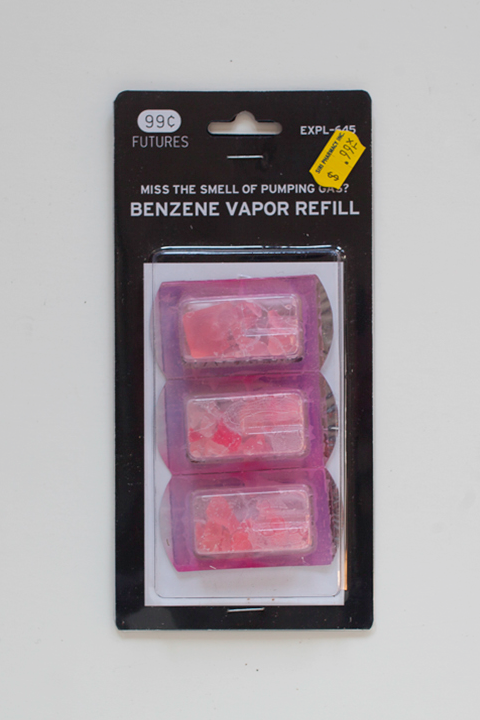
What kinds of artifacts might be found in the 99 cent store of the future?


All images from The Extrapolation Factory website.

So asks a nifty, crowdsourced experiential futures / design fiction project by The Extrapolation Factory, an award-winning initiative of Elliott Montgomery and Chris Woebken (both alumni of the RCA's Design Interactions program). "99 cent futures", executed in New York earlier this year, is now being exhibited in China, giving the project a new lease of attentional life.

Some months back, when this effort was in the pipeline, I spoke with them to help hammer out a participatory design framework which they created so that attendees at a workshop in NYC could playfully generate and make their own answers to the question. Then the pair installed the resulting artifacts in an actual 99¢ store in Brooklyn (calling to mind some of our early FoundFutures adventures in droplifting; e.g., speculative pharmaceuticalssouvenir magnets and postcards from the future).

I particularly like that they managed to include both a participatory design phase and a guerrilla futures phase -- two critical frontiers of design/futures work -- in the same process.


Today a report on 99¢ futures appeared on the CNN website; last weekend I did an interview by email for it.

Now, it's more or less axiomatic that something -- usually a pretty fundamental something -- gets messed up in reports on futures. In that regard this piece is better than most, although it seems to imply that "futuring" (the reporter's preferred term, I think borrowed from Chris and Elliott) is a new "movement" emanating from design, as opposed to a practice established over many decades and recently adopted and/or reinvented by some designers.

Apparently I did not make that relationship clear enough. Live and learn.

Still, it's a good article, and encouraging to see this work thoughtfully covered in mainstream press -- in the Style section, impressively enough; not a common place to find foresight news!

We'll dig into the Extrapolation Factory's projects and methods a bit more in another post.

Meanwhile, for those interested the whole of my email interview appears below. The questions were asked by CNN writer Sheena McKenzie.

***

Why was the 99c store such an interesting/significant project?

Two things make the 99 cent store interesting. First, it's a rare invitation to imagine the future's mundane side. Popular notions of the future often get stuck in a kind of glossy rut - gleaming buildings and whiz-bang inventions, and it's not often enough that we see the futures of everyday life brought into focus. Second, it's the result of a participatory process. Chris and Elliott didn't pre-imagine everything for a passive audience, they designed a way for people to develop and share their own ideas.

The project exemplifies a hybrid of design and futuring that we're sure to see more of as time goes on. My colleagues and I call this frontier of practice "experiential futures" or "design fiction". Design fiction focuses on objects, and experiential futures focus on immersive situations. Both aim to bring possible worlds to life in a way that enables a deeper kind of conversation about the future. They're more generative, participatory and tangible than much of what has come before. We need to cultivate ways of imagining the future together.

What is futuring and why is it important?

Futures or foresight practice (also sometimes called futuring) is about systematically and creatively exploring how change could unfold over the medium to long term. This is important because humans have an inbuilt psychological tendency to filter everything through the lens of a rather narrow experience of the present, which leads to decisions that are short-term, short-sighted and risky. With massive global challenges looming, like climate change, peak oil, and economic volatility, we need to develop a cultural capacity for thinking ahead and creating options, so we aren't just reacting to crisis after crisis. Good strategic foresight gives decision-making a longer runway, and experiential futures is one of the most promising ways of getting this kind of thinking wider exposure.

Many people think of the future simply in terms of technology. Yet this project was a slight tweeking [sic] of the world we already know -- does that make it more emotive?

The tendency for technology to dominate thinking about the future is a serious problem. A lot of change begins with technology, but it doesn't end there. The future conversation needs to include social and political dimensions. For example, it seems appropriate that the creators of the 99 cent store project have brought it from New York to Shanghai. This prompts us to think about the supply chains - in which China is a critical link - which currently make the phenomenon of 99 cent stores, and their cheap mass-produced contents, possible in the developed world.

This project's tweaking of the world we know through unsolicited urban installation of objects is a great example of what I call "guerrilla futures" - unexpectedly manifesting fragments of possible futures in the midst of people's everyday lives. This turns out to be an effective way of firing people's imaginations even if they haven't asked for it!

Why should we think about the future when designing products? And where do you see this trend heading?

The incorporation of futures thinking into the design world, which has picked up pace hugely since the mid-00s, shows no signs of slowing down: everything we make is part of the future we will get. So we need to think about the future when designing not just products, but anything. As a futurist, I now teach foresight at a design school, OCAD University in Toronto, because designers are at the forefront of shaping the world, whether they realise it or not -- and we'll all be on track to a better future the sooner and more deeply they realise it.


Related:
FoundFutures: Chinatown: Green Dragon (02007)
FoundFutures: Postcards from the future (02007)
More FoundFutures
> Future-jamming 101
> Wired's Found: Artifacts from the future