Showing posts with label news. Show all posts

Wednesday, May 22, 2024

Look out, Banksy

Hello, Bristol!


I’ve just arrived for a month in the UK, where I’m excited and honoured to be a Bristol Benjamin Meaker Distinguished Visiting Professor at the University of Bristol.

Within this hybrid role, crafted to be part visiting professorship and part artist residency, my project is called From Experiential Futures to Social Foresight.

It’s about working with colleagues to share and explore experiential futures (XF) practices to use design, media and the arts for grounding ideas about futures in everyday life – and thereby helping shift our organisations and public cultures towards deeper, more diversified, and wiser embodied engagement with alternative possibilities.

Activities here through mid-June include a Public Seminar hosted by the Pervasive Media Studio, an XF Masterclass for researchers at the ESRC Centre for Sociodigital Futures, and Advisory Sessions with individuals and groups from across the university and wider community.

Something a bit ambitious that we’re also doing is the Bristol Immersive Futures Jam – a live, face-to-face, weekend-long experiential & participatory foresight intensive, including a collective worldbuilding and making process, as well as a public activation with additional guests. Basically we'll be concretely imagining, physically staging, and having conversations about how life here could look decades or generations from now.

This builds on work I’ve done with groups in Singapore, Canada, Mexico, and various parts of the US – most recently through a wonderful artist residency late last year with the immersive theatre community in Denver, Colorado.

It's the first time we’ve offered the process in the UK.

The Bristol Immersive Futures Jam (Fri 31 May 5PM – Sun 2 June 5PM), which calls for a commitment to participate across three days, is fully booked up. But folks who may be interested in joining the waiting list for the whole event, or who wish to join only for the activation / time travel part on Sunday 2 June, can register their interest here.

The Public Seminar (Fri 31 May, 1–2PM BST) may be attended in person at the PM Studio / Watershed, or viewed live online here.

I’m most grateful to my University of Bristol hosts Dr Paul Clarke, Prof Keri Facer, and especially Prof Helen Manchester of the School of Education, and really looking forward to all the future-shaping we'll get to do together.

Related posts:
> Killer Imps – Bringing futures to the Royal College of Art (02009)
> Dreaming Together (02015)
> Introduction to Experiential Futures in The Economist – outlines some of our Time Machines / immersive scenarios (02015)

Hello Again, World!

Over a year has passed since our previous post, which is easily the longest hiatus at The Sceptical Futuryst since things got underway at this address, long long ago, in 02006. But the stately peace and quiet that may seem to have settled over this ageing blog, its layers of digital dust, belie the busy and productive times that have been speeding by since early 02023. The signs of life might be sparse, but don't be misled.

So with a ton to catch up on, stretching back to that date and beyond, and especially since Twitter's sad implosion into X, I've been experiencing a mounting writerly constipation that for me comes from doing too much work stuff without making the time to reflect and share. I need to get things out of my head and into the world. That process in itself, quite apart from whatever happens or doesn't in terms of audience response, helps me move on to new thoughts.

What I want to do is ramp things back up here, and alternate for the next little while between posts about collaborations and questions currently taking up my attention, and posts on some completed projects and associated learnings that have been quietly accumulating in the background. I might put some of those on Medium or elsewhere, too. The post right after this one, about spending a month with collaborators in Bristol, England, is in this category of what's happening at the moment. It comes from something I shared today in a largely similar form on LinkedIn. 

Blogs aren't exactly peaking right now, and I don't quite know yet how this platform best serves or makes sense for what I'm up to (let alone what you all out there are doing) in the year of our lord 02024 – and I want to emphasise that working that question out is a distant second in motivation for doing this to just getting some more stuff written – but I'm interested to learn, and grateful for your interest in joining me.

Saturday, December 31, 2022

Participatory futures for democracy

The White House just took a big step towards making futures thinking a more common practice.

As the year comes to a close, some great news for foresight and public imagination from the Biden-Harris Administration: the Fifth U.S. Open Government National Action Plan (NAP) was released this week, and it includes a move for participatory and inclusive futures engagement over the next two years.

The new plan, developed in a collaboration between the U.S. federal government and partners in civil society, has a cross-cutting theme of “advancing equity and inclusion for underserved communities”.

It sets out around 30 federal-level commitments that seek, among other things, to ensure public access to government data, information and research, to involve citizens in the work of government, and to transform service delivery. As the introduction notes, “While U.S. support for open government has always been crucial, it is especially vital today. . . . at a time when the principles of equality and democracy are threatened across the United States and around the world.”

There’s a lot more to the document, but of particular relevance to the foresight/futures community is a specific commitment to “pilot new forms of public engagement to inform policy and program implementation”, with a strategy for pursuing this in the form of a framework that “will engage diverse and inclusive public participation to better define and imagine emerging challenges, opportunities, and possibilities for our shared future”.

The effort is to be spearheaded by the General Services Administration (GSA), an independent agency of the U.S. government set up in 01949 “to help manage and support the basic functioning of federal agencies”.

In other words, the White House has just officially promised to engage the public in imagining alternative futures –– with a view to this feeding into national policy and implementation.

This is a very exciting development.

I have already noted at this blog the “tremendous expansion in awareness of and interest in futures/foresight work”, and remarked on mounting evidence that “the conditions for social foresight are ripening, with experiential and participatory futures approaches migrating and spreading across contexts –– from academia and activism, to arts and culture, to business, politics and governance.”

Futures/foresight as a field, or family of practices, continues to progress on institutional and cultural fronts alike. Some of the most promising steps, I think, come when the strategies of institutionalisation and acculturation coincide. (A hat tip here to my friend Honor Harger, a futures-oriented artist/curator, for helping me appreciate these as a complementary pair.) And as I've been saying for quite some time, the bigger story or context for foresight practitioners, whatever their practice and whoever their clients, collaborators or students happen to be, lies in finding ways to advance futures not solely through formal processes of organisations and governance, but through ordinary thinking and action –– the futures of everyday life.

In this U.S. government plan we find, at the very least, another encouraging signal of progress towards augmented participation, distribution, inclusivity and visibility for alternative futures.

But as the plan starts to be concretised and carried out in months to come, in the ideal, it might just prove to contain the seeds of greater things.

I’m pleased to have played, at the request of a colleague leading the charge at GSA, a modest part here by providing light advisement and enthusiastic encouragement to help get this commitment approved in black and white.

I also find it heartening to note the rationale for this aspect of the plan:

“Stories of possibility can provide opportunities to express emerging challenges and opportunities through creative and engaging narrative. At their best, stories can inform our collective imagination and create inclusive space for meaningful conversations — and then drive action to choose new possibilities.”

Hear, hear. Something long understood to be self-evident in futures circles, namely the central importance of images of the future to shaping the world we end up in, is coming to be more widely grasped.

In related news, a report called Imagining Better Futures for American Democracy, by Suzette Brooks Masters and Ruby Hernandez, was released just a few weeks ago by Democracy Funders Network. I found myself in excellent company as one of the interviewees for the project. And as it turns out, some of the steps now being prepared by the federal government appear very much in line with the key recommendations coming out of that research: to strengthen the positive visioning ecosystem by investing in infrastructure and relationships; model what’s possible and fund experimentation; and strengthen narrative systems and amplify positive, futures-oriented content.

Finally, and in a similar vein, my coauthor Filippo Cuttica and I were thrilled to learn this month that our work to help introduce foresight at the BBC, which culminated in the recent publication of a toolkit called The Futures Bazaar, seeking to bring these ways of thinking to wider publics around the world, has been recognised by the professional futurist community as a Most Significant Futures Work of the year – taking home the award for advancing Inclusive Foresight.

So as 02022 comes to an end, here's to a 02023 filled with inclusive co-creativity, narrative invention, public engagement, meaningful conversation, and concrete action towards the preferred possibilities that result!

***

The full text of the Fifth U.S. Open Government National Action Plan is available in html and pdf. Thanks and godspeed to the public servants responsible for making it happen.

Related:
> Foresight is a Right
> The Futures of Everyday Life
> What Is the Value of Futures and Foresight?
> Where Do You Stand? Or, The Polak Game
> Welcome to The Futures Bazaar
> Introducing Participatory and Experiential Futures at the BBC
> Exploring Technology Governance Futures with the World Economic Forum
> Using the Future at NASA
> UNTITLED: A Bold New Experiment in Public Imagination
> American Futures at the School of the Art Institute of Chicago
> Knowledge Base of Futures Studies

Thursday, January 31, 2019

The latest

Lots going on at the moment, and so I've posted a persistent /now page, to update every so often as a snapshot of what we're getting up to around here!

Obama Foundation Design Workshop, Hawaii, 6 January 02019
Photo courtesy of The Obama Foundation

Some recent highlights...
  • VERY EXCITINGLY we concluded a series of workshops for the Obama Foundation held in Honolulu, Hawaii in January, to help design and launch a new Foundation program supporting the efforts and initiatives of emerging leaders from across the Asia-Pacific region (pic above!!!)
  • Situation Lab has begun exploring with NASA Jet Propulsion Laboratory ways to support and enable the imaginative forays of folks that formulate new space missions (pic below!!!)
  • We've completed an experiential futures project on climate action with the World Bank Climate Investment Funds and Institute for the Future, and look forward to sharing more soon...
  • The long-gestating Journal of Futures Studies Special Issue on Design and Futures, co-edited by me and Cher Potter from the V&A Museum, is coming out in a bumper two volumes. We're thrilled at a lineup of contributors that includes philosopher Timothy Morton, curator Paola Antonelli, designers like Anab Jain, Dan Hill, the Decolonising Design collective, and a wide range of academic and practitioner contributors, both established and emerging.
  • Building on our collaboration with the United States Conference of Mayors –– together with Civic I/O and Governance Futures Lab at Institute for the Future: last year Jake Dunagan and I introduced futures thinking to mayors from across the USA at South by Southwest in Austin, Texas, and followed up at the 88th annual mayoral conference held in Boston, Massachusetts. This March we're back at SXSW to keep futurising American mayors. 
  • In the coming weeks and months I'm heading to invitational workshops at the Santa Fe Institute (New Mexico) and the Lorentz Centre (Leiden, Netherlands), and running engagements at the Skoll World Forum (University of Oxford), North Carolina State University, and Stanford d.School. With lots of exciting experiential futures action in the offing there are more details at /now –– and further news to follow. Stay tuned!

Situation Lab visit to the NASA Jet Propulsion Laboratory in Pasadena, 28 January 02019
(right, USC Sitlab Director Jeff Watson)

Monday, November 02, 2015

La Chose du Futur à Paris


A special edition of The Thing From The Future was distributed to 500 delegates at the UNESCO Youth Forum in Paris last week.

Since 01999 the Youth Forum has been the institutional mechanism for youth (which in the UN system means people aged 15 to 24) to make recommendations to the UNESCO General Conference.


This 9th edition of the Youth Forum incorporated, for the first time, a process aimed at improving participants'  futures literacy, developed by UNESCO's head of foresight Riel Miller. The Future Literacy Knowledge Lab, or FKL, is described in outline here and in detail here [pdf].

From my perspective as an advisor and senior facilitator for the Forum, among the most notable elements of the experience was the juxtaposition of this process, aimed at exploration and emergence, with the formality and fixity of international diplomacy's default settings. Ingenious workarounds were required in order for delegates to be able to converse and co-create in small groups given the geometrically pleasing, but collaboratively disabling, furniture arrangements. The literally nailed-down meeting room configurations reflected a firm expectation of centrally managed, as opposed to open or peer-to-peer, conversations.


How does such an architecture shape what happens, and what doesn't? An instructive contrast may be found in the opening and closing circles of Open Space, a meeting format which both symbolically bespeaks and practically enables something very different; a fluid and participant-driven flexibility (see, for example, Harrison Owen, Expanding Our Now, pp. 82-83). Maybe someone has already compiled a pattern language of meeting spaces. There's much to learn from such cases.

In any event –– despite its best efforts, here the furniture's expectations were not allowed to triumph! Far-reaching futures discussions were had, assumptions were surfaced and questioned, alternatives were articulated, expressive future artifacts and prototypes were created.


And at the end of the Youth Forum futures workshop, a special bilingual English / French The Thing From The Future / La Chose du Futur * was distributed to all attendees, a concrete expression of the intention to democratise and distribute futures thinking far and wide. Now these hundreds of delegates have made their way home to communities all around the world, cards in hand.


Thanks to UNESCO, to Youth Forum delegates –– and especially to Riel Miller and team for their efforts to open space for possible futures, not only in the proceedings themselves, but through providing an experience and a tool to use again in days and years to come.

Of course distributing cards and rearranging spaces are fine ways to begin; meanwhile I wonder about working with the deeper cultural currents in play. How may we make a habit of inviting fuller versions of ourselves to show up in these formal and ritualised settings? How might we offer better hospitality to the unusual, the creative, the crazy and playful and magical and wild and unborn in each of us?  For when it comes to "serious" conversations about the future, these voices too seldom find any place at the table.

Related:
> The Thing From The Future
> The technology of public imagination
> Whose future is this?

* Very special thanks to Cedric Flazinski of N O R M A L S design lab, and to Sandra Coulibaly Leroy of the Organisation internationale de la Francophonie (OIF) for their invaluable translation assistance. And on a semi-related note: bilingual Emglish/French Playsheets for the game are available via the UNESCO website [pdf, A4].

Saturday, September 19, 2015

1-888-FUTURES

"Dial a future, deliver a present."


Want to put systemic challenges on the radar of your local Congressman? Help a relative living on the opposite coast to prepare for climate change? Send a 30th anniversary gift to the couple just now celebrating their 10th? Share a dream for a brighter world with your kid?

1-888-FUTURES is a service that takes a future dream, vision or problem, renders it tangible as a "future present", and delivers it to a specific individual.

You, the visioner, call the hotline and place a request for delivery of a future present based on some image of the future that you describe in your message. Our dedicated staff retrieves the message, finds a way to make the dream into a specific artifact, boxes it up, and sends it to your chosen recipient.

The future present recipient – whether it's you the visioner, or someone else – may choose to keep the package as a mystery box until the stated opening date, or may instead open it sooner, and be duly delighted/horrified/provoked/touched/nonplussed by the contents. A transcript of the original dream recording will be posted together with the artifact inspired by it.


A lot of work in the design fiction / speculative design mould is created, it seems, for no one in particular. Even if produced only once (like an artwork), often in effect it's a mass consumption object rather than something made for one. So 1-888-FUTURES is a small experiment in making such future design more personal and personalised; a true gift, connecting the imagining and creation process to a named individual, an audience of one.

This is the third "Futurematic" design jam jointly run by Situation Lab (Jeff Watson and me) with New York-based design collective The Extrapolation Factory (Elliott Montgomery and Chris Woebken). Graciously hosting on this occasion is the University of Southern California's Visions and Voices series, with the priceless collaboration of Professor Jen Stein from USC's School of Cinematic Arts.

Futurematic events riff playfully on commercial and industrial making processes, while focusing on the very non-industrial, not-yet-massified design space of imaginary objects. At the first event, participants filled up a vending machine with future artifacts in a day last spring at OCAD U. For the second, last summer at NYU, people created and put future street merchandise on sale at Canal St and Broadway in Manhattan. Both those events used Situation Lab’s imagination-boosting card game The Thing From The Future as the creative engine. This time, the ideation engine is the public's imagination itself. With that as the driving force, workshop participants will send out as many "future presents" made to order as we can, from our temporary 1-888-FUTURES fulfilment center in Los Angeles to all over the country.

The whole thing is free: so long as the delivery address is in the U.S., callers from anywhere can participate by calling 1-888-FUTURES from skype.

But this offer is limited - so call now! The lines are open 24/7 until midnight on Saturday, September 19th.


Browse the catalogue of future presents, designed, sealed and delivered, at 1888FUTURES.com.

Thanks to Jen Stein, Jeff Watson, Danyel Copeland and Josh McVeigh-Schultz, and the rest of our hosts and helpers at USC. Thanks also to our Futurematic collaborators Chris and Elliott, aka The Extrapolation Factory, and not least to our wonderful workshop participants!


[Originally posted at the Situation Lab blog.]

Links:
> Project website: 1888FUTURES.com
> Feature at Core77
> Feature at Tech Insider
> Feature at Medium

Related posts here:
> Big shifts, small change
> Participatory cli-fi
> More found futures
> Design fiction, emerging
> Object-oriented futuring

Wednesday, December 11, 2013

Big shifts, small change

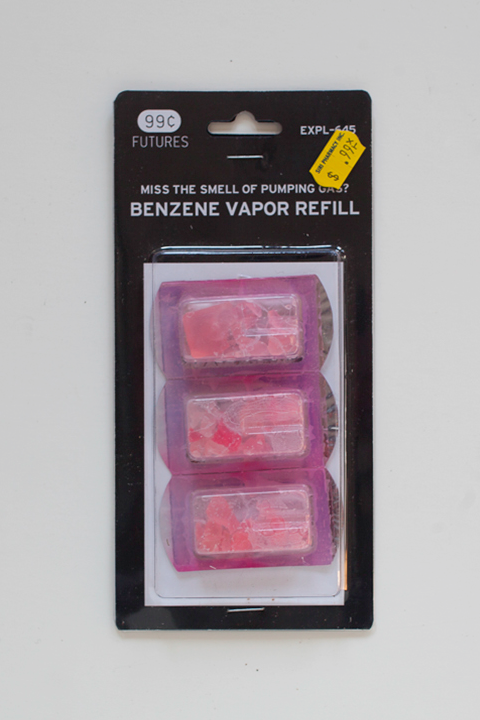
What kinds of artifacts might be found in the 99 cent store of the future?


All images from The Extrapolation Factory website.

So asks a nifty, crowdsourced experiential futures / design fiction project by The Extrapolation Factory, an award-winning initiative of Elliott Montgomery and Chris Woebken (both alumni of the RCA's Design Interactions program). "99 cent futures", executed in New York earlier this year, is now being exhibited in China, giving the project a new lease of attentional life.

Some months back, when this effort was in the pipeline, I spoke with them to help hammer out a participatory design framework which they created so that attendees at a workshop in NYC could playfully generate and make their own answers to the question. Then the pair installed the resulting artifacts in an actual 99¢ store in Brooklyn (calling to mind some of our early FoundFutures adventures in droplifting; e.g., speculative pharmaceuticals, souvenir magnets and postcards from the future).

I particularly like that they managed to include both a participatory design phase and a guerrilla futures phase -- two critical frontiers of design/futures work -- in the same process.


Today a report on 99¢ futures appeared on the CNN website; last weekend I did an interview by email for it.

Now, it's more or less axiomatic that something -- usually a pretty fundamental something -- gets messed up in reports on futures. In that regard this piece is better than most, although it seems to imply that "futuring" (the reporter's preferred term, I think borrowed from Chris and Elliott) is a new "movement" emanating from design, as opposed to a practice established over many decades and recently adopted and/or reinvented by some designers.

Apparently I did not make that relationship clear enough. Live and learn.

Still, it's a good article, and encouraging to see this work thoughtfully covered in mainstream press -- in the Style section, impressively enough; not a common place to find foresight news!

We'll dig into the Extrapolation Factory's projects and methods a bit more in another post.

Meanwhile, for those interested the whole of my email interview appears below. The questions were asked by CNN writer Sheena McKenzie.

***

Why was the 99c store such an interesting/significant project?

Two things make the 99 cent store interesting. First, it's a rare invitation to imagine the future's mundane side. Popular notions of the future often get stuck in a kind of glossy rut - gleaming buildings and whiz-bang inventions, and it's not often enough that we see the futures of everyday life brought into focus. Second, it's the result of a participatory process. Chris and Elliott didn't pre-imagine everything for a passive audience, they designed a way for people to develop and share their own ideas.

The project exemplifies a hybrid of design and futuring that we're sure to see more of as time goes on. My colleagues and I call this frontier of practice "experiential futures" or "design fiction". Design fiction focuses on objects, and experiential futures focus on immersive situations. Both aim to bring possible worlds to life in a way that enables a deeper kind of conversation about the future. They're more generative, participatory and tangible than much of what has come before. We need to cultivate ways of imagining the future together.

What is futuring and why is it important?

Futures or foresight practice (also sometimes called futuring) is about systematically and creatively exploring how change could unfold over the medium to long term. This is important because humans have an inbuilt psychological tendency to filter everything through the lens of a rather narrow experience of the present, which leads to decisions that are short-term, short-sighted and risky. With massive global challenges looming, like climate change, peak oil, and economic volatility, we need to develop a cultural capacity for thinking ahead and creating options, so we aren't just reacting to crisis after crisis. Good strategic foresight gives decision-making a longer runway, and experiential futures is one of the most promising ways of getting this kind of thinking wider exposure.

Many people think of the future simply in terms of technology. Yet this project was a slight tweeking [sic] of the world we already know -- does that make it more emotive?

The tendency for technology to dominate thinking about the future is a serious problem. A lot of change begins with technology, but it doesn't end there. The future conversation needs to include social and political dimensions. For example, it seems appropriate that the creators of the 99 cent store project have brought it from New York to Shanghai. This prompts us to think about the supply chains - in which China is a critical link - which currently make the phenomenon of 99 cent stores, and their cheap mass-produced contents, possible in the developed world.

This project's tweaking of the world we know through unsolicited urban installation of objects is a great example of what I call "guerrilla futures" - unexpectedly manifesting fragments of possible futures in the midst of people's everyday lives. This turns out to be an effective way of firing people's imaginations even if they haven't asked for it!

Why should we think about the future when designing products? And where do you see this trend heading?

The incorporation of futures thinking into the design world, which has picked up pace hugely since the mid-00s, shows no signs of slowing down: everything we make is part of the future we will get. So we need to think about the future when designing not just products, but anything. As a futurist, I now teach foresight at a design school, OCAD University in Toronto, because designers are at the forefront of shaping the world, whether they realise it or not -- and we'll all be on track to a better future the sooner and more deeply they realise it.


Related:
> FoundFutures: Chinatown: Green Dragon (02007)
> FoundFutures: Postcards from the future (02007)
> More FoundFutures
> Future-jamming 101
> Wired's Found: Artifacts from the future

Friday, April 01, 2011

An experiential scenario for post-revolution Tunisia

N.B. Not an April Fool's Day gag. Just, y'know, to be clear.


Image via Tuniscope

Overthrowing a dictatorial regime is a staggering feat of popular imagination and courage.

But what about the morning after the revolution? Everyday life is bound to be something of a let down.

Video via adland.tv*

After recent epochal events in Tunisia -- the so-called Jasmine Revolution (or the Sidi Bouzid Revolt, as it's known in the Arab world) in which President Zine El Abidine Ben Ali was ousted -- an astonishing but so far largely unknown coda was the galvanising role played by a transmedia experiential scenario campaign, spreading a near-term vision of a prosperous and democratic country worth getting back to work for.

This story comes from a local ad agency, Memac Ogilvy Label Tunisia, that has just won gold in the 'Integrated' (i.e. transmedia) campaign category of the Dubai Lynx Awards which recognise excellence in advertising in the Middle East and North Africa:

Tunis, January 14th 2011. Tunisians put an end to 23 years of brutal dictatorship. It was a moment of intense hope. But we were all too soon brought back to reality. The entire country went on strike and economic activity was soon left to a standstill. … We needed to find a way to encourage the people to get back to work and start rebuilding the country we had all fought for. … So we decided to show everyone how bright our future could be if we all started building it now. … During a whole day, the media acted as if it were June 16th 2014 and presented Tunisia as a prosperous, modern and democratic country. … The media content spread to social media via 16juin2014.com and people began to imagine wonderful futures and called everyone for action. #16juin2014 hashtag was n°1 top trend topic on Twitter all day long. At 6pm, the debate was everywhere on TV, radios, blogs… Getting back to work quickly became an act of resistance.

Digging into the details becomes slightly tricky if you don't understand French (I do, sorta) and Arabic (I don't), but elements of the '16 June 2014' campaign can be found online. For example, there's a downloadable four-page future-dated issue of La Presse de Tunisie, which invites comparisons to the wonderful New York Times Special Edition from a few years back.


La Presse de Tunisie, 14 June 02014
Image via Tuniscope


Political cartoon (front page, below the fold):
'Grandad, who is ben ali?'
'Oh, just a mistake of youth...'


Screenshot from news report on the intervention

Another example: at the moment, the 16 Juin 2014 website centrally features an in-scenario news report about a "Shopping Festival" (as I learned by auto-translating the video title from Arabic) in the west-central town of Kasserine, including what appear to be interviews with prestige fashion figures Giorgio Armani and Marc Ecko. Considering the chaos and brutality unfolding in that agricultural town just weeks before this campaign rolled out in mid-February, we can start to apprehend just how bold a notion this is. (I'm put in mind of the 'Darfur 2020' poster we've discussed here previously, which plays on a similar incongruity.)

I'm thoroughly impressed with the scope and vision of this campaign, which heavily underlines the world-shaping potential of the arts and technologies of narrative, applied prospectively.

While it could be said to raise some deep questions about the current reception as well as long-term viability (not only in Tunisia, but also elsewhere) of this particular genre of political and economic vision as an answer to the people's woes, I don't know remotely enough about Tunisia's current situation to comment cogently on the impacts and merits of these particular stories at the moment -- although I'm very curious to hear from anyone who does.

Meanwhile, those with ideological concerns about the character of this vision can take comfort from the fact that the campaign actively invites people to contribute to the conversation. The top banner on the website reads, 'Participate -- what are your ideas for the Tunisia of tomorrow?'

In any event, I am just delighted to find out about this. Conceptually it's among the grandest and most inspiring of imaginable applications for journalistic future artifacts, transcending conventional advertising to approach something I've been harping on here for years -- the possibility of a hybrid practice of politics, design and foresight, whereby we manifest for ourselves, in vivid detail, those scenarios diagnosed as most necessary to catalyse desired social change.

Related posts:
> Guerrilla futurists combat war on terror
> Dreampolitik
> The Darfur Olympics
> The currency of Burmese dissent
> Four future news clips from MIT
> Tomorrow's headlines

(* Broken video link fixed 11nov18 // Thanks @dabitch for the post over at adland.tv featuring the above video, and @justinpickard for passing the link along!)

Friday, January 22, 2010

Amusing anachronisms

After attending a 35th anniversary screening of Monty Python and the Holy Grail last night -- a movie which revels in outrageous anachronisms and (what some would call) thoroughly postmodern, meta-media commentary -- I'm moved to post below three videos, all comico-spiritual successors to the Python example, that have recently come to my attention. Each plays on film and TV conventions reflexively (and so often invisibly) deployed in relation to other historical times, to great comedic effect: the present treated as retro-future, the very recent past treated as distant past, and the present seen from distant future. They use their targeted tropes to distort a recognisable picture (past or present) which, being so familiar, makes the distortions themselves all the clearer. We could say more, but instead, let these astute satirical tidbits speak for themselves.


1: The Astounding World of the Future, dir. Scott Dikkers, 02001 (YouTube link).
(Thanks to Steve Duncombe.)
2: "Internet Archaeologists Find Ruins Of 'Friendster' Civilization", Onion News Network, 02010(?).
(Thanks to Kurt Bollacker.)
3: "Beatles 3000", dir. Scott Gairdner, 02009.
(Thanks to Jake Dunagan and Alexander Rose.)

(Update 4 Nov 02015: embedded videos fixed.)

Related posts:
> Comedy ahead of its time
> Guerrilla futurists combat war on terror
> Satire's layers

Saturday, January 31, 2009

A year in hindsight

Screenshot from New York Times Special Edition online version

The first month of 02009 is almost over and I haven't posted anything yet. What gives?

Well, folks, there are a few changes afoot here at the sceptical futuryst.

As I noted here almost exactly a year ago, "An interesting by-product of blogging regularly is that you find out what you care about, by seeing what patterns emerge in what you decide to post." At the time I was musing on the fact that this blog, which I started in 02006 with no particular theme in mind (beyond futures itself) , had begun to develop some distinct thematic preoccupations -- at the intersection of futures, design, media, and politics (in the broadest sense). Through writing here, seeing what I wrote, and then finding out what others had to say about it, I came to suspect that my dissertation should probably consider building on that terrain where my blog had apparently decided to camp.

Now, having defended my dissertation proposal in December, and with still more daunting steps in the PhD journey still ahead, I've discovered something else: just as blogging regularly can tell you something about your interests, not blogging can, as well. On the other side of the ritual hoop, energies that before had readily flowed toward curating distinct fragments of an emerging practice of experiential futures, now seem to be shifting to another register of concern, as I tussle with underlying themes, along with the prosaic logistics of chapter topics and such. All of this may make for acceptable blog fodder, too, in principle, but I'm still in the process of deciding how much of that thinking I want to do aloud, and how much to confine to the privacy of my own head.

Meanwhile, perhaps I should have done this a month ago, but taking my cue from Jamais "Open the Future" Cascio let's look back at 02008 to see what happened in these pages. The most visited individual posts were...

> Architectural time travel, thoughts on Bryan Boyer's bold speculative design for the U.S. Capitol building (catapulted to the the top of the list by Boing Boing)
> The compleat Wired future artifacts gallery, a set of posts making Wired magazine's playful monthly feature "Found" available -- at last -- back to its first appearance in 02002
> Posthuman New York, images inspired by Alan Weisman's wildly successful thought experiment in inverse anthropocentrism, The World Without Us
> *The value of hypothetical currency, an account of the controversy over Daniel Carr's "Amero" coins, a possible North American answer to the Euro
> The go-to guys for post apocalyptic chaos and destruction, more images from Mondolithic, the abundantly talented, if slightly grim, folks also responsible for the illustrations in "Posthuman New York"
> *Parables and horseshit, a short essay about the value of an undoubtedly apocryphal, but highly illuminating, anecdote about the limits of single-minded trend extrapolation
> *The Bird Cage, an illustrated account of an urban "exstallation" of future artifacts from an avian influenza outbreak scenario, part of our FoundFutures:Chinatown initiative
> World without oil photo essay, shots taken on a road trip in the American South; contemporary intimations of a post-oil future

These results, based on cumulative visits throughout the year, are skewed towards writing from early 02008 (while *these were posted late in 02007).

Some of my favourite subjects of the year appeared a little further down the list.

> Future-jamming 101, an outline of the project my undergraduate PoliSci students did, jointly with a digital imaging class, creating and publicly distributing artifacts from alternative futures, 30 years hence
> In memoriam, a recognition of the brave contribution made by former pornstar Dirk Diggler (01960-02025) to the copyfight movement
> Hawai'i: The Lost Years, an exhibition of never-before-seen relics from the mysterious tropical paradise which closed its doors to outside visitors for most of the 21st century
> A thin blue line, the first of three posts examining political art interventions that aim to map, with strategies semi-experiential and semi-symbolic, the effects of climate change on sea level

A highlight of 02008, not only for me, but I daresay for the enterprise of futures as a whole, was the web-based alternate reality game and collective forecasting engine, Superstruct. This bold experiment in distributed creativity was run by IFTF -- with Kathi Vian, Jane McGonigal and Jamais Cascio at the helm -- and I feel especially fortunate to have been involved as a Game Master. It was a deeply instructive experience in online collaboration, at a number of levels. However, it became clear to me after the dust had settled that during the intensive six weeks of gameplay, I hadn't actually said much about it here. Still, many lessons and insights acquired during that project are sure to find their way, however clearly or covertly, into my writing on experiential and collaborative modes of futuring.

For most of the year, in the futures artifact or image category, probably the piece of work I most admired (and the fate of which I found most troubling) would have been the Darfur Olympics ad, appearing in the Belgian press for the University of Ghent. Then, a while later, the (oddly symmetrical) pair of Burmese currency projects ventured to imagine and enshrine in the design of banknotes a brighter future for political prisoner Aung San Suu Kyi (the accessories of nationhood make for nice, potent future-artifact material). This prompted me to consider more closely the political stakes of embodying provocative possibilities in future artifacts, especially outside the West. But without question, my hands-down favourite intervention of the year was the New York Times Special Edition, the outstanding result of collaboration between the Yes Men, Steve Lambert, and a whole host of volunteers. While in New York earlier this month, Steve and I had the chance to meet and discuss the project, and I hope we'll be able to share a bit more of the background story here before long.

In 02008, I posted about three times the number of entries as in each of the preceding two years. Unless I figure out how to blog in my sleep, 02009 will see the intensity ease off a bit again, while I deal with first things first. However, as always, I'm interested to hear about any topics that deserve to be noted or revisited in future posts.

Wednesday, November 12, 2008

Guerrilla futurists combat war on terror

The Iraq War is over, Bush has been indicted on charges of high treason, the PATRIOT Act is to be repealed, the economy will be restructured, and public universities are now free.

Film at eleven.


Image via Gawker

I awoke this morning to emails from two New York colleagues about a marvellous and painstakingly planned guerrilla futures intervention today in the Big Apple.

A "special edition" of the New York Times has been produced, to convey, through a detailed set of carefully crafted articles and advertisements, a near-future scenario in which progressives' dreams for the United States have all come true. And 1.2 million copies of it have been distributed for free around the city by a network of volunteers.

Alongside the print edition, a counterpart website has been launched where all the stories are available in full. Both paper and electronic versions are rendered impeccably in the newspaper's signature style, and are dated 4 July 02009 (Independence Day next year).

In scale, this is certainly the most impressive guerrilla futures campaign I've heard of, and I heartily congratulate all those concerned for pulling it off. (It seems -- according to Gothamist, citing Gawker -- that the volunteers were assembled via becausewewantit.org and the effort is being attributed to the Yes Men, guerrilla performance artists supreme, whose astonishing Dow Chemical/Union Carbide interview on BBC World was previously featured here.)

Now, we can expect that some disgruntled newspaper recipients or onlookers may accuse the folks behind this terrific intervention of leading people, shall we say, up the garden path. Such accusations will be missing the point.

Adopting the Times dress is not about hoaxing people; it's a way of calling authority to the vision. As well as being a proprietary media business, its actual status in our media ecology as an authoritative source of news, an idea which belongs to everyone even if the newspaper itself does not, is recruited to lend verisimilitude and weight to the cause.

As Jake Dunagan and I were recently discussing in another context, one of the many devices which makes the Orson Welles classic Citizen Kane so successful is its intermittent cutting to newspaper headlines that help tell the story. (Now, like any novel and effective cinematic trope, this has since become cliche, but this original fictional biopic application, referencing newspaper's authority to help put a frame around plot points in the biography of a larger-than-life newspaper tycoon, makes perfect sense.)

No one addressing more than the most cursory scrap of attention to the actual content of the articles will fail to notice that they are fragments of an "impossible" dream, even if a profoundly noble one: the wholesale transformation of U.S. political culture. Post-election euphoria notwithstanding, the kinds of change described in the "special edition" don't tend to happen overnight, if at all. But the paper quite deliberately calls precisely that into question -- why not?

Similarly, Professor Steve Duncombe recently said in his presentation at HRCFS on Dreampolitik:

These impossible dreams open up a space for democratic participation in the process of imagining the future, which also offers the possibility of escaping the tyranny of the present... for people to imagine, 'why not?', and 'what if?'

This Dream Newspaper is, to use Duncombe's term, an "ethical spectacle" par excellence.

Here's an in-scenario video about the campaign, also from the Times SE site:


Again, kudos to those who orchestrated this highly thoughtful, lovingly detailed, and timely piece of future-jamming. The sceptical futuryst doffs his virtual hat to you all.

Update (19/11/08): On Monday, my own copy of the New York Times Special Edition arrived in the mail.

It brings me so much joy to hold in my hands that it's almost embarrassing.

The difference between hearing about or seeing images of an impossible object, and experiencing it tangibly, is immense.

There's a colour-printed cover; National, International, Business and New York sections; political cartoons; and reports announcing massive legislative and social change around topics ranging from bicycle lanes to corporate criminality. The details in content, graphics, and layout of the 14-page publication are thoroughly splendid -- starting with the slogan "All the News We Hope to Print" on the header. It is, in short, a beautifully wrought artifact of the near-future.

The Yes Men's hallmark "identity correction" strategy is everywhere in evidence: the U.S. government recall notice for all gas-powered cars; advertisements reflecting drastic changes of strategy (or heart?) by companies such as oil giant Exxon Mobil and diamond merchants De Beers; a contrite farewell from pro-invasion columnist Thomas Friedman; and a Corrections section addressing repeated editorial lapses of judgement on the part of the Times itself.

For those unfamiliar with the strategy I mean, the following comes from a book manuscript about the Yes Men's infamous WTO intervention [pdf]...

As many readers will know, "identity theft" has become a major problem on the internet: scoundrels intercept personal information like your date of birth, residence, and credit card numbers, then have all kinds of fun at your expense.

What we have done is the opposite: we have found people and institutions doing horrible things at everyone else's expense, and have assumed their identities to offer correctives. Instead of identity theft, identity correction.

~The Yes Men: The True Story of the End of the World Trade Organization, 02003, p. 6.

Their future newspaper manages to communicate sincere, blue-sky idealism not through earnest moralising or shrill propaganda, but through wit, irony, political satire, and the indisputable thereness of the physical medium whose mantle and idiom it borrows. A preferred future performed, with aplomb. Injected into everyday life, 1.2 million times over, for your consideration. This is one hell of a feat.

Even better, it strikes me as being part of something bigger, of which the Obama campaign and election was a more formal signal. That is, a coming of age, in terms of self-awareness and tactical savvy, of the American left. An answer to the call made in books like Don't Think of an Elephant and Dream.

But this particular effort deserves to be recognised as a landmark, an ingenious, street-level dissemination of one particular vision for American politics. It was a normative intervention more powerful, interesting, and just plain fun (why not, dammit?) than any number of pamphlets or TV advertisements; as outrageously ballsy as calculatedly logical. And one repaid handsomely in the true currency of human communication: attention. "The amount of media coverage the Fake New York Times stunt received was staggering. It spread to news outlets all over the globe like wildfire." (Urban Prankster, 14 November 02008)

It's true that these newspapers have been fetching quite a bit on eBay over the last week, but my copy is safely in the archive. One piece of a laudable future-jamming effort of unprecedented magnitude, which -- and I mean this in the most flattering possible way -- I hope will be outdone, many times over, as soon as possible.

I'm extremely grateful to Steve Duncombe for sending it (our man in NYC, who helped arrange the intervention). Thanks Steve!


Jim Dator catches up on next year's news

Related posts:
> Future news-flash: your vote counts
> Manifesting vision
> Tomorrow's headlines
> Dreampolitik
> Found futures

(Thanks Jason and Victor!)

Friday, October 24, 2008

Future news-flash: your vote counts

A last-minute push to remind U.S. voters, ahead of the 4 November Presidential election, that every vote counts, using a short video clip from eerily familiar news provider CNNBC, dated Friday 7 November.


This personalised "future artifact" comes from the nonprofit political advocacy group MoveOn.org, and I have to say, political leanings notwithstanding; it's brilliant.

Guilt is a much more useful emotion to elicit prospectively, don't you think?

Send your own here.

Sure, I may not be eligible to vote (which makes my video counterfactual to boot) but as we all know, American citizens are not the only ones with a stake in this contest.

Update (28/10/08): I've just received an email from "The CNNBC Team" which begins:

Dear CNNBC viewer,

Wow. Thanks to people like you, this nonvoter video has now been sent to over 6.3 million friends. It's going out to more than 30 new people per second.

Research shows that this kind of social "nudging" is extremely effective. So we're aiming to reach 10 million people before Election Day—only a few days away.

Impressive figures. The combination of timeliness and surprising personalisation seems to be striking a chord.

The message mentions the effects of "nudge" research. I'm curious to what extent the mechanism of future-scenario immersion (via a vivid, and presumably non preferred near-future narrative; one satirical in tone, if seriously intentioned) affects folks' plans to vote.

(Thanks Ginny and Jim!)

Tuesday, September 23, 2008

Comedy ahead of its time

Screenshot of The Onion, 22 June 02056

Parody newspaper The Onion has a sterling back-issue (fore-issue?) online dated 02056, satirising future tropes left and right. It came out (in June 02005) before this blog got started, but even if you've seen it before, it's worth revisiting [link]...

  • Democratic Middle Eastern Union Votes To Invade U.S.

  • Final Installment of Frogger Trilogy poised to sweep Oscars

  • Leather-Clad Nomads Seize Power In Australia

  • Remainder of Ross Ice Shelf Now in Smithsonian Freezer

  • Opinion™ - We Need A Fourth Law of Robotics: Stop Fingering My Wife

Priceless.

Related posts:
> Satire's layers
> I read the news today, oh boy
> Tomorrow's headlines

(via Noise Between Stations)

Thursday, May 22, 2008

Tomorrow's headlines

Speaking of future news, the Palo Alto-based futures consultancy Institute for the Future has a new project which playfully mounts hypothetical future newspaper headlines in a physical newsstand. Anyone can make a submission at the website The Daily Future, including a headline, subhead, lede, date, and image.

Early results were on display at the Bay Area Maker Faire at the start of May.

Image: Anthony Townsend, aGreatNotion's Flickr photostream

IFTF's Jason Tester, part of the team responsible for The Daily Future, has been among the key innovators in scenario communication strategy working at the intersection of futures and design for some years already (see, for instance, this Business Week article, and this post on "human-future interaction" from the IFTF blog).

Plans are afoot to add further functionality to the Daily Future website, including new headline formats and user voting. Meanwhile, those who can't make it to the Bay Area to see the newspaper box in person might content themselves with a visit instead to the Newspaper Clipping Generator (via Open the Future), which cranks out reasonably authentic-looking, if generic, images of future-news "artifacts" to order -- type in your newspaper title, headline, date, and story.


(Thanks Rosa!)

Near-future news: Hillary concedes

A columnist for the Wall Street Journal believes that it's time for Hillary Clinton to make a graceful exit from her long-running campaign against Barack Obama for the Democratic Party's presidential nomination in this year's election.

So he has written her concession speech for her, framing it as a news report from the near future.

The article begins:
For those who can't handle the suspense, we fast-forward the campaign to June 2, in Sioux Falls, South Dakota. A wire-service reporter, who has covered the Clinton campaign for 17 months, files this story:

Sen. Hillary Clinton of New York has decided to end her historic quest for the Democratic presidential nomination. The decision comes one day before the South Dakota and Montana primaries, and a day after she received an extraordinary petition from senior members of the Democratic Party.
[...]
A draft of Mrs. Clinton's concession speech was obtained from persons close to the campaign. It is to be delivered tomorrow evening in South Dakota at the Sheraton Sioux Falls convention center.

~Daniel Henninger, "Hillary's Concession Speech", Wall Street Journal, 22 May 02008.

This is a neat bit of punditry straddling legitimate journalistic activism and satire. It would be good to see more of these -- in-world projections of preferred scenarios -- in the media.

Tuesday, April 01, 2008

I read the news today, oh boy

This month, Wired magazine online includes a cute take on a newspaper of the future -- focusing on a U.S. election sixteen years hence -- dated 22 November 02024.

Screenshot of an interactive design by officevsoffice
From Wired 16.03 | Copy by Steve Bodow


It's an interactive Flash design, so you need to click through to the original to check it out properly...

It's cool, right?

Right?

Well, ok. I don't know why I'm not more enthusiastic about this: I'd really expect to like it more than I do. It's a future artifact, cleverly thought out, detailed, layered, with a lot of witty morsels to savour... So far, so good.

But as a futures artifact, maybe it tries to do too much. It's not that it isn't thoughtful, or clever, or satirically on-target -- it just, to my (undoubtedly hypercritical) mind, goes overboard. So densely packed is it, so thoroughly burdened with pop culture asides, news satire, tech-savvy smirks, and post-everything ironic wit that frankly it's a little tiresome.

An aspect of this density, clever and confusing at the same time, is the way it plays on multiple layers simultaneously. We're getting jokes about news content (including celebrities, journalists, international crises, American politics) as well as physical medium (the -- in 02008 -- newly minted wireless reading devices; platform convergence including the integration of CNN-like newsbar, and webpage elements like photo sets and vlogs); as well as the written form (quirks of the Wikipedia relating to its dubious contents; the ironic combination of user-produced content and the Wall Street Journal!) Ha! And presented on a later version of the Amazon Kindle -- clever! Ugggghhh. Et cetera. I give in. What's for dinner?

So much is going on here that I'm sure there's a bunch of jokes I simply missed. Which is fine. Much contemporary comedy, and The Simpsons really broke the mould here, relies on an abundance of layers to laugh at, from slapstick and sight gags through to highbrow political and historical references. But that kick-'em-while-they're-down strategy doesn't necessarily translate directly to webpages and flash animations. Unlike a medium with duration (such as video, or live performance) our attention seems to be assaulted all at once, not in sequence. And -- perhaps this is the laugh killer, or indeed the metajoke -- this flash design is a pain to navigate.

Now of course, I'm looking at this through my own biased, persnickety criteria. And this piece is, I concede, principally satire, not futures. Despite the resonance of those two that I thought about here not long ago, there may be a tension that I can't articulate yet between good satire and good futures work. You decide how well this particular example succeeds on each front. But I'll say one more thing about the futures aspect before the tirade subsides.

It's head writer of The Daily Show (a program I much admire) Steve Bodow who "lays out the scenario" here. But through all the clutter I have trouble discerning the scenario. It seems like almost everything that's happening today is still happening in this future, only more so. Which seems to amount to more noise than signal. I suppose that's its intention. Maybe it's too close to the apparently ubiquitous trend for comfort -- hypercomplexity and massively dense referentiality may ring too true to be really funny to me. I guess a simpler scenario would have been easier to follow, but funnier? I don't know.

With this, I betray my simplemindedness and raise a talking point for future future artifacts -- less can be more.