Showing posts with label projects. Show all posts

Tuesday, October 22, 2024

Library of Possibilities

“The most potent time-traveling technology we have is also the oldest technology we have: storytelling. The shelves of every library in the world brim with time machines.” – Anthony Doerr §

* * *

This is my latest experiential futures project: a series of books from the future, each inspired by the work and interests of a different NASA Jet Propulsion Laboratory scientist or engineer, made tangible, and smuggled on to public library shelves in Los Angeles for readers to discover.


It’s part of the newly opened exhibition Blended Worlds: Experiments in Interplanetary Imagination, assembled by a terrific, multi-talented JPL team led by David Delgado. (Regular readers here might recall encountering David’s outstanding work before.) In addition to serving as Curatorial Advisor over the past few years, I’m honoured to have had the chance to make my own unorthodox contribution to the show.


At a philosophical level, Library of Possibilities is an imaginary provocation: it’s the vast collection of all books that have not yet been published. Compare to Borges’ fantastic Library of Babel, which contains all possible books (even if most are nonsense, à la the proverbial typewriting-monkeys). At a more practical level, it’s a fraction of that mind-boggling catalogue; the dust jackets for six titles that might come out decades from now. A collection of hypothetical volumes.


Each one started with a deep-dive conversation with a JPL or NASA scientist or engineer about what they do, and imagining changes their work could help catalyse in generations to come. I also asked each interviewee to name a favourite work that has inspired them, to use as the underlying physical book, around which the book cover that they inspired is wrapped.

As a lifelong bibliophile I’ve had this idea of a series of future dust jackets in mind for years – but the stars finally aligned here, with NASA JPL, and the City of Glendale’s Library Arts and Culture department.

The first two future books have already appeared. When a reader finds one, they can take it up to the circulation desk to log their discovery officially. It then goes back into the collection for someone else to find.

With each new release, a copy is also added to the Blended Worlds exhibition at the Brand Library and Art Center, but for now, the only way to see all the details – front and back covers, blurbs, clips from press reviews of the imaginary works etc – is to track the physical books down at various Glendale Library branches.


I’ll share more when the project wraps up, including a full list of credits for the indispensable collaborators who helped make all this possible!

Meanwhile, to see announcements about each new book drop, follow Glendale LAC or me on social media.

If you’re able to get to the area, there’s already a future book somewhere in Glendale Central, and one in the Brand.

Blended Worlds: Experiments in Interplanetary Imagination runs through January 4th, 02025. It is part of the Getty Museum’s huge once-a-decade initiative PST ART, the theme for which this time is Art and Science Collide.

* * *

§ Doerr is a Pulitzer Prize-winning author of novels and short stories. This quote comes from his New York Times review of the book Time Travel: A History by science writer James Gleick.

Previously posted on LinkedIn. Blended Worlds image from NASA JPL. Photos by Stuart Candy, installation process photo by Ceda Verbakel.

Related:
What if we could sing better futures to life?
Adding dimensions to development futures with UNDP
Using the future at NASA
Ghosts of Futures Past
> What is the value of futures and foresight?

Wednesday, April 22, 2020

U.S. Earth Force

Introducing the sixth branch of the American military, founded in 02029.


What happens when the world's richest and most powerful country puts its full weight behind efforts to address climate disruption?

Earth Force is neither a prediction nor a preference, but a possibility, a way of asking how climate action might look if addressed seriously at a federal level.

A belated response to the crisis, when it comes, could be all the more pronounced; making up for lost time.


To date the United States has waged war on various things including poverty, drugs, and terror. A range of responses and a mix of feelings may arise about the idea of adding global warming to the list.

Making space to sort through these responses, and their implications, is a reason to consider such possibilities in advance.


Grand as some of our collective challenges and actions might be, they will also play out in the most ordinary of contexts.

If this really happened, it would show up in all sorts of encounters in everyday life: at airports, sporting events, shopping malls, and school campuses. It would leave visible and tangible traces across all media, from cinemas to recruitment stations, news reports, and social feeds.


The medium of billboard advertising may be mundane, but the kinds of questions it can pose are momentous.

With well over half a trillion dollars spent each year on American military capability, what is the possible scope and impact of climate action at such a scale?

How might the militarisation of governance proceed once systemic issues like this start to be approached seriously on a whole-of-society basis?

When and in what ways will military culture adapt to engage with an unprecedentedly diverse and globally-minded wave of younger citizens, the “March for Our Lives” values of Generation Z?


I took all these photos of billboard sites within minutes by foot or bicycle of our house in Pittsburgh.

The idea was to explore some potential macro-changes of historic significance by crafting a number of local, micro-glimpses of what that reality might entail on the ground.

I also wanted to look at some of the tensions between national-scale and planetary-scale affinities, logics, and symbols.


The project speaks to the notion of duty in at least two different registers.

Our duty to the future is to rectify the catastrophic, systematic errors that we have known for some time are causing global warming.

Our duty to ourselves is to widen the horizons of imagination, debate, and action today.


***

A word of background: this experiential scenario was supported by Institute for the Future (IFTF) and the World Bank's Climate Investment Funds (CIF), as part of a project also involving a number of other commissioned artists working in various media, called Artists Imagining the Future of Climate Action. At IFTF's invitation, I pitched the concept in April 02018.
This story is about activating and amplifying the latent and hugely significant potential of a wildly well-resourced aspect of American governance and infrastructure. In our scenario, the U.S. Earth Force is established in the mid 2020s (alongside the existing Army, Navy, Air Force, Marines and Coast Guard), with a view to gradually reducing and supplanting the need for conflict-based military forces by prioritizing global climate security. In terms of the RFP, this experiential scenario tells a ‘White Mirror’ story. It is a story about owning up to the most inconvenient of truths, and starting to turn the ship around.
As my research and thought process went along, the specific media, future artifacts and communications strategy for extruding the scenario morphed a bit, and the diegetic timeline pushed out to after the 02028 election. The central concept stayed the same. (Incidentally, a couple of months after getting the green light from IFTF, I began hearing about President Trump's plan to create a Space Force. Not that it matters particularly, but this project was not conceived or intended as a response to that idea.)

The resulting set of billboard images of the U.S. Earth Force recruitment campaign was completed in September 02018. A few weeks later, the IPCC Special Report on Global Warming of 1.5°C was released, decisively shifting the public conversation and ushering in over the following year a new phase of the climate movement that made Greta Thunberg and Extinction Rebellion household names. More recently, the covid-19 pandemic has of course altered the footing for climate action yet again.

This project was initially under wraps, to give its sponsors a chance to share the commissioned artworks first.

As the world marks the 50th anniversary of Earth Day, I'm sharing U.S. Earth Force with some hope that it may help in a modest way to enrich our collective capacity to imagine and initiate vital climate action in this decade.

***

Many thanks to branding consultant Devika Khowala and compositing consultant Matthew McGehee. For help with field visits and early design explorations, thanks to research assistants Helen Hu and Cathryn Ploehn from CMU Situation Lab. Special thanks for scenario and research advice to Michael DilaRosemarie ForsytheNils Gilman, Karen Grattan and Alex Steffen. Finally, gratitude to all at IFTF and World Bank CIF for vital support in the creation of this project.

This post was also published on Medium.

Related:
> Foresight is a right
> Ghosts of futures past
> A climate of regret
> Politicians discussing global warming
> Participatory cli-fi
> Mapping c-change
> Critical activism

Thursday, January 31, 2019

The latest

Lots going on at the moment, and so I've posted a persistent /now page, to update every so often as a snapshot of what we're getting up to around here!

Obama Foundation Design Workshop, Hawaii, 6 January 02019
Photo courtesy of The Obama Foundation

Some recent highlights...
  • VERY EXCITINGLY we concluded a series of workshops for the Obama Foundation held in Honolulu, Hawaii in January, to help design and launch a new Foundation program supporting the efforts and initiatives of emerging leaders from across the Asia-Pacific region (pic above!!!)
  • Situation Lab has begun exploring with NASA Jet Propulsion Laboratory ways to support and enable the imaginative forays of folks that formulate new space missions (pic below!!!)
  • We've completed an experiential futures project on climate action with the World Bank Climate Investment Funds and Institute for the Future, and look forward to sharing more soon...
  • The long-gestating Journal of Futures Studies Special Issue on Design and Futures, co-edited by me and Cher Potter from the V&A Museum, is coming out in a bumper two volumes. We're thrilled at a lineup of contributors that includes philosopher Timothy Morton, curator Paola Antonelli, designers like Anab Jain, Dan Hill, the Decolonising Design collective, and a wide range of academic and practitioner contributors, both established and emerging.
  • Building on our collaboration with the United States Conference of Mayors –– together with Civic I/O and Governance Futures Lab at Institute for the Future: last year Jake Dunagan and I introduced futures thinking to mayors from across the USA at South by Southwest in Austin, Texas, and followed up at the 88th annual mayoral conference held in Boston, Massachusetts. This March we're back at SXSW to keep futurising American mayors. 
  • In the coming weeks and months I'm heading to invitational workshops at the Santa Fe Institute (New Mexico) and the Lorentz Centre (Leiden, Netherlands), and running engagements at the Skoll World Forum (University of Oxford), North Carolina State University, and Stanford d.School. With lots of exciting experiential futures action in the offing there are more details at /now –– and further news to follow. Stay tuned!

Situation Lab visit to the NASA Jet Propulsion Laboratory in Pasadena, 28 January 02019
(right, USC Sitlab Director Jeff Watson)

Tuesday, July 04, 2017

Could this be the future of parenting?


NurturePod installation and photos by Stuart Candy

This experiential scenario from a not too distant future, my first "solo" art museum installation (really, all this work is highly collaborative), is now live at M HKA, the Museum of Contemporary Art in Antwerp, Belgium.

Futurist/journalist Andrew Curry and I recently had a chance to chat about the project for an upcoming issue of the Association of Professional Futurists quarterly, Compass. Many thanks to Andrew and APF for sharing the transcript below (edited for clarity and length).

***

Andrew Curry: What we have here is a very small baby –– not a real baby –– in a little pod surrounded by all sorts of digital stimulus looking after her or his needs. This is a "programmable para-parenting pod", which basically removes the need for parents to get involved, as far as I can tell. It's a bargain at €789, obviously. What was the brief, Stuart?

Stuart Candy: The brief for A Temporary Futures Institute was to create some kind of a design contribution corresponding to Dator's generic images of the future; grow, collapse, discipline or transform, and I was assigned "transform". I had this quite large space and could basically do anything that fit the budget and time. To get from those broad parameters to the final installation really started from the name. There was a prior project (which appeared in Compass) called NaturePod, a hypothetical product from a handful of years away, addressed to stressed-out office workers who may need to reduce their cortisol levels and increase productivity by spending time in nature, without leaving their cubicles. That was a provocative take on what happens when you marry supposedly biophilic interior design trends to virtual reality.

AC: So this is a kind of companion piece?

SC: Right. It came about in a conversation with my longtime collaborator, Jake Dunagan –– a lot of our work is based on wordplay and being silly –– and he said, "well, when you're done with NaturePod, you should do NurturePod, ha ha ha". He was joking, but I thought it was a brilliant idea. Then this opportunity came along, and I realised that, while this might not be my idea of a transformation, it does actually correspond to a popular notion about what immersion in virtual environments means.

AC: It comes with all this very nice packaging and sales material. Clearly something about the commercialisation of it engaged you.

SC: A lot of the experiential futures work I've done is about bringing encounters with futures into an everyday context. Hence guerrilla futures projects like NaturePod; we launched it at an architecture and design trade show, so the people who came across it thought it was real. The organisers of the trade show knew what we were up to, but the thousands of others attending didn't. I was interested in trying to import the lessons and techniques from creating encounters "in the wild" into the cube of a contemporary art museum. That's why this piece is not sitting on a white box; it's sitting on the kind of table you might find in an Apple Store.


AC: The NurturePod box has all the kind of labelling detail you would expect to see in a package. Is that part of the experience as well?

SC: I think the attention to detail that makes a hypothetical resemble the real is an important part of this practice. It is intended to invite, not a suspension of disbelief exactly, but more an investment of belief, a kind of willing desire on the part of the viewer to say okay, suppose that I did come across this in a few years' time. What do I think about that? What do I feel about that? I think the details provide added dimensions of engagement so they can dive deeper, if they want to. Most people are probably going to engage with the main image; a glanceable, instagrammable baby in a pod wearing a headset. But for those who take the time, there is more detail to enjoy, or be dismayed by, according to your taste.

AC: There's a little tag, "control baby's experience with the NurturePod App", and a kind of WiFi, Bluetooth-type logo suggesting I can download it. I haven't actually tried to do that; I'm guessing that bit might not be real?

SC: That's right, it does break at a certain point because it isn't real, but it's supposed to feel like it is. All of these messaging elements are scaffolded in detail on existing products, and existing idioms that we recognise subconsciously, being citizens of the early 21st century. We’re literate in ways we don’t even realise about the semiotics of marketing, and electronics in particular. This is using that language to get something across about a seemingly imminent possibility.

AC: One more thing that strikes me about this, about the languaging, is it's not just about marketing. There are a whole lot of cues about the idea of the new, the idea of the modern, and the classic ways in which technology companies make us feel inadequate and then sell us reassurance.

SC: I suppose using those tropes could be said to invite reflection on how embedded in the tropes we are, because we know this particular thing doesn't exist. But that's a bit of an intellectual angle. I find people's emotional responses interesting, from watching them interact with it and from what they've shared in conversation.

AC: What sort of things have they said?

SC: "I'm really drawn to this, and also repulsed by it." There's this sense of being torn, and that is quite satisfying to hear, because I think creating or inviting a complex emotional response is something that we should strive for in futures work. This is why design and film and performance and games are important –– the whole repertoire of approaches to experiential futures; like the proverbial toothbrush that reaches places regular ones can't. Hopefully we are on our way to a better futures toothbrush.


***

The NurturePod installation is just one part of A Temporary Futures Institute (ATFI), a boldly experimental M HKA exhibition which opened in April, curated by Anders Kreuger and Maya Van Leemput.

(M HKA was also the main venue for Design Develop Transform, where Kelly Kornet and I recently presented the Ethnographic Experiential Futures framework.)

There are some stellar artists featured in ATFI (including Michel Auder, Miriam Bäckström, Alexander Lee and Darius Žiūra), and the other futurists involved in the exhibition are Agence Future (Maya Van Leemput and Bram Goots, Belgium), The Centre for Postnormal Policy & Futures Studies (Ziauddin Sardar and John Sweeney, UK/US), and Mei Mei Song (Taiwan).

Show runs until 17 September –– so if you're within range of Antwerp, check it out!

Acknowledgements:
- Seth Keller and Kazuki Guzmán, Fabrication consultants
- Tarik El-Khateeb, Graphics consultant
- Special thanks: Maya Van Leemput and Anders Kreuger (for curating ATFI); Bram Goots (for crucial logistical help), Ceda Verbakel (for copywriting assistance); Giulia Bellinetti, Georges Uittenhout, and the rest of the team at M HKA (for essential technical support); Jake Dunagan (for inspiration); Jessica Charlesworth, Ilona Gaynor, the Toronto Uterati (for helpful conversations)

See also (last updated 16aug17):
- Features in VICE and Boing Boing
- Opinion piece in The Irish News on NurturePod and the future of parenting
- Bruce Sterling's repost of the interview above at Wired
- Article from Harpers Bazaar on what to see at A Temporary Futures Institute
- Video from ARTtube about ATFI (5 1/2 mins)
- Show summary from Belgian newspaper De Morgen (in Dutch)
- ATFI exhibition brochure (pdf)
- Two contemporary artists I greatly admire whose work has influenced this piece one way or another: Patricia Piccinini and Ron Mueck

Related:

Thursday, January 19, 2017

How to move to Canada*

*Without leaving home

A surprising guerrilla futures intervention speaks to the current political moment.

All photos by SAIC American Futures class

For many progressives in the United States, Canada conjures a wistful ideal of multicultural harmony and civility. After three years in Toronto, followed by six months of electoral madness back in the U.S., I can understand the romanticisation of our neighbour to the north. Indeed, the fact that the Canadian immigration website crashed on election night was interpreted by many as a sign of widespread alarm at the prospect of a Trump administration, an impending reality to which people around the world are now adjusting.

The grass may or may not actually be any greener in the land of moose and maple, but as things take a turn for the disturbing in America, the more utopian the idea of "Canada" becomes in contrast.

This post is about a project created by my students in "American Futures", a special one-off experiential futures course at the School of the Art Institute of Chicago. I designed the curriculum to use the unfolding 02016 U.S. presidential contest as fuel for our collective imagination, and with the election itself taking place a month before semester's end, the culminating efforts of the class were conceived and staged in response to the incoming president's shock victory.

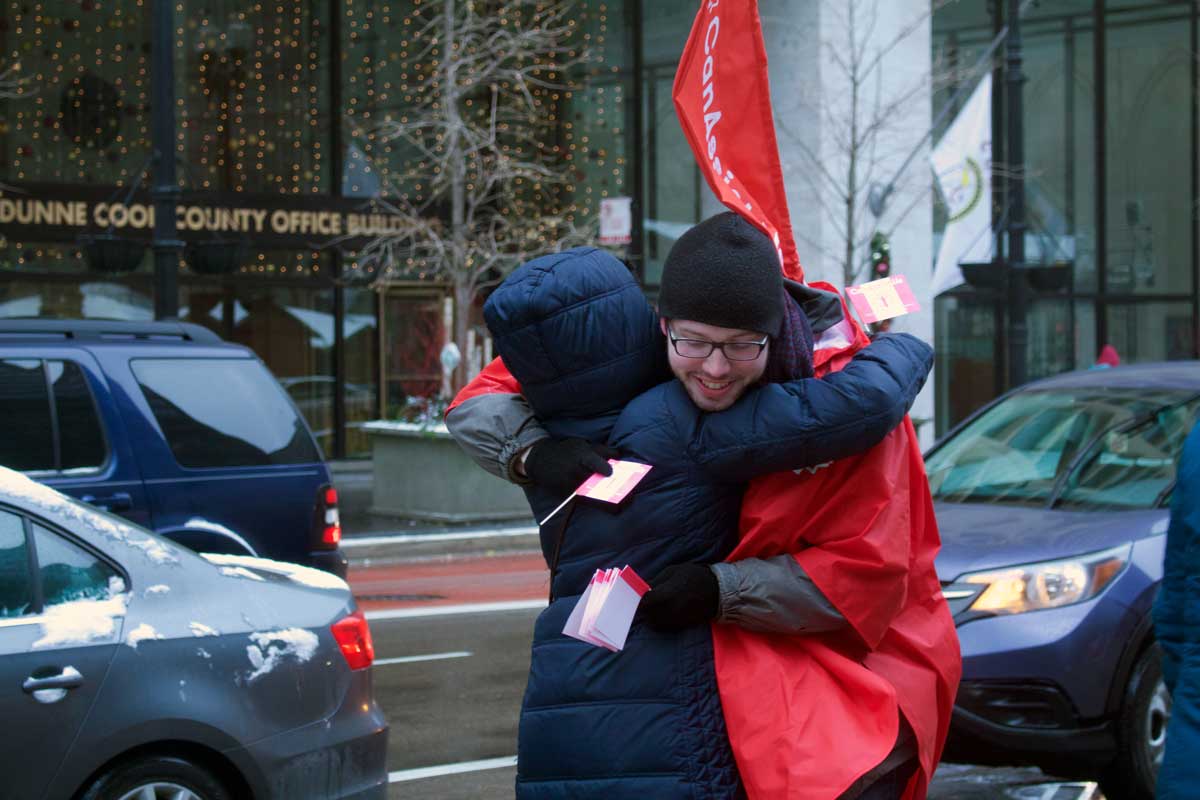
MFA student Cat Bluemke pitched this particular intervention, drawing on her Canadian background to imagine a near-future organisation called CanAssist.Us, and following her lead, the whole class worked together to bring it to life in the streets of Chicago. Below is an email interview with Cat (edited for length and clarity).

***

What is the premise of this project?

CanAssist.Us is a [hypothetical] private company that helps clients navigate the Canadian immigration system for Americans under President Trump. The project channels the anxieties driving this escapism into critical review of the individual’s responsibility within their community to challenge complacency in this reality.


What is the near-future situation you created for people to bring that scenario to life?

The initial ideas for the project were obvious once a few days had passed since the American presidential election results. CanAssist.Us is an absurd but potential reality from a near “post-truth” future (02018, perhaps). Using the familiar form of sidewalk canvassing, the performers offered the ultimate service to "get away from it all".

Once a member of the public engaged, the structure of this American future came into the picture: dehumanising "reform"; life-threatening retraction of health services; and destructive global relations; all promises of a Trump presidency.

[A short questionnaire quickly showed how simply quitting America might not be so straightforward; but to channel people's real concerns productively, and help them manifest the ideal of "Canada" locally,] suggestions for immediate action were presented as workshops the audience could take in their own communities. [These included Multicultural Awareness, Intersectionality, and Anger Management -- as well as popular intensive courses such as Poutine 101.]

How did the public react?

Satire is a great tool for starting a conversation, a united front can exist through a well-structured joke. Structuring that joke to include everyone -- consistent with our urge of a united, intersectional left -- was the difficult part. However, after establishing our position through humour, once we began working with the public, the conversations came easy. The reactions were overwhelmingly positive.


Where does this project sit in relation to other things you've seen that aim to deal with the emerging state of American politics and futures?

The Black Lives Matter movement deserves enormous credit for its accomplishments as a platform for multiple systemic injustices to enter public scrutiny.

CanAssist.Us was more explicitly influenced by artists like Eva and Franco Mattes or the Yes Men, whose public interventions disrupt the complacency that has become the norm.

Where does it sit with respect to projects that you personally have done before?

Both in concept and in execution, CanAssist.Us complements the project Tough Guy Mountain, a group project based out of Toronto, Canada; part art collective, part postcapitalist advertisement agency, and part fantasy table-top RPG.

How does the design of this intervention speak to and work with concerns of the present? How does it make use of the future?

CanAssist.Us uses experiential futures to demonstrate what realities could still be averted, and to encourage the will of the individual to unite under this goal. The situation of our American reality makes the future a particularly urgent tool to engage with.

What challenges did you discover working in a guerrilla futures mode?

I think the whole group could agree that next time, we’d rather guerrilla future on a sunny beach. Jokes aside, the participation of the group members was key in the project, and I’m so thankful that everyone shared in the passion. The kind of improvisation and confidence that is required of a guerrilla futures practitioner is really incredible, but this kind of dedication is desperately needed in order to create a future reality that benefits us all.


***

Many thanks to Cat and the whole of the American Futures class for all their creative contributions, and willingness to brave the Windy City winter to enliven public conversation with an experiential flash-forward.

I appreciate this ingenious effort to turn an understandable sense of alarm, and the potential impulse to flee or turn away, into constructive engagement with possibilities for action in our communities today, through exploring what it means to bring "Canada" (code for "a better place") to where we are.

Our thanks also to Jonathan Solomon, Helen Maria Nugent, and office staff in the design department (AIADO) at SAIC for wonderful assistance and support.

And best wishes to all concerned, as this troubling new chapter begins in the grand experiment that is the United States.

The class and project team comprised Cat Bluemke, Angie Gonzalez, Miiko He, Josh Leslie, Stella Shen, Clint Stayton, Alexander Wilson, and several other students who wish to remain anonymous.

Update 01aug17: This project has been recognised at the 02017 Association of Professional Futurists (APF) Student Awards, taking second place in the Alternative Formats category. Congratulations team!

Related:
> Impacting the Social
> Future documentary
Introduction to Strategic Foresight
> The weight of alternatives
> Stephen Duncombe on the Art of the Impossible

Tuesday, August 02, 2016

The People Who Vanished


Update 01aug17: The journal article excerpted below, 'Designing an Experiential Scenario', has been named a 02017 Most Significant Futures Work at the annual Association of Professional Futurists (APF) Awards, in the Advancing Methods and Practice category. We are grateful to the APF and jury for this honour.

***

The People Who Vanished is a transmedia narrative project dealing with the prehistory of the Phoenix area, staged at the inaugural Emerge Festival hosted by Arizona State University in March 02012. Jake Dunagan and I designed and led a two-day workshop in which we produced an experiential scenario with 20 festival participants.

Although we had been doing Design Fiction and Experiential Futures for five or six years already by that time, we were excited about the challenges of co-creatively involving a group this size, and especially of the compressed production timeline, both highlighting the need for a shared mental model and clear framework for collaboration.

What follows in this post is a written snapshot of that design process. It's an excerpt from an article we recently published in the peer-reviewed journal Futures.† (File under: better late than never.) The article, or this lightly edited bit reproduced below, can certainly be read alone, although for a sense of the originally intended effect watch this video first; the tale as revealed to a live audience at Emerge (18 min).


† S. Candy, J. Dunagan, Designing an experiential scenario: The People Who Vanished, Futures (2016), http://dx.doi.org/10.1016/j.futures.2016.05.006.

***

The name Phoenix invokes the bird of Greek myth which would periodically burn up and rise again from its own ashes. It is a striking but little known fact that the city was so named precisely because it was built atop the ruins of a lost civilisation.

Beneath the streets and sidewalks of today’s Phoenix of four million inhabitants lie the remnants of the Hohokam, a society which flourished from around 0CE to 1400CE; “from Christ to Columbus”.

The Hohokam were expert canal engineers and irrigation agriculturalists. They built a thriving civilization in the desert lasting almost one and a half millennia. They farmed the land and channeled water through massive canals without any of the modern tools and equipment we have today. However, about a century before the arrival of Europeans in North America, they suddenly disappeared, for reasons that are unknown, and that are still debated by archaeologists.

The name Hohokam is an O’odham word meaning “the people who vanished”. Being an oral culture, it is unknown what they called themselves.


A question which we hoped to evoke for participants at Emerge became: “could the people of today’s Phoenix be the next to vanish from the valley?”

In order to push the boundaries of experiential futures, to do justice to the scope of the historical (and future) questions at hand, and to create a unique and fun learning experience for our workshop participants, we were drawn to the idea of executing a project at a monumental scale. We wanted to create something big; something that demanded attention; something that would appear suddenly and without warning — and that could carry deep meaning for the attendees. In our practice we and others often create hypothetical “artifacts from the future”, but in this case thought it could be interesting to create a fictional artifact from the past, in order to enable a reperception of present and future.

Throughout history, there have been breakthrough moments when we humans have been forced to confront our own ignorance and reimagine our collective story about who we are and where we came from. The unearthing of dinosaur fossils revealed a strange and diverse lifeworld on Earth long before human existence, overturning earlier thinking about natural history. Similarly disruptive were cultural discoveries such as the Dead Sea Scrolls, the Rosetta Stone, the city of Pompeii, and ancient technologies such as the Antikythera machine. The rediscovery of ancient philosophy, architecture, or artifacts from time to time has not simply added to a trove of curiosities from the past; but has heralded revolutionary change in society’s self-understanding. The Renaissance, the Enlightenment, and other epochal transitions have been initiated or accelerated by such archaeological moments.

There are always bound to be, this line of thinking suggests, possibility grenades beneath our feet, primed to explode our fragile certainties and platitudes about the story of our world. As U.S. President Harry Truman once said, “The only thing new in the world is the history you don’t know.” 

What could this “new” and transformative –– if hypothetical –– slice of history be for Phoenix?

Examining the map pieced together by 20th century archaeologists of the extensive network of ancient canals spanning the area... yielded what turned out to be an essential insight: in addition to their obvious practical uses, the Hohokam canals could have had some previously unsuspected symbolic functions.

An idea emerged: towards the end of their tenure, the Hohokam may somehow have manifested a distinctive symbol in the archaeological record – one also appearing in the pre-collapse periods of other cultures. … Now we could recount the fortuitous “discovery” of a transcultural, transhistorical symbol of impending civilisational collapse. It would not be necessary (and in the circumstances would also not be desirable) to try to explain the precise means by which this harbinger of disappearance had cropped up around the world throughout history; the sheer “fact” of apparently concrete evidence of the mystery itself could provide the desired archaeological moment.


We would tell the following story: In puzzling out the fate of the Hohokam, our group had spotted this curious anomaly on the map, and had then been inspired by the thought of a symbolic, and not merely functional, role for the canals. One of our number then had the idea to do a google image search for this pattern and see what turned up (still true –– sort of). Shockingly, this search showed up a range of other instances of the same ‘glyph’ in diverse archaeological records elsewhere: the Harappan of the Indus Valley, the Anasazi, the Nazca, the Polynesian peoples of Rapa Nui, aka Easter Island. All this part was of course completely simulated; photoshopped into found photographs from these places. We would also be able to show how the glyph had turned up subtly but unmistakeably, inscribed in the patterns on Hohokam pottery too. And the kicker: the sole common characteristic discernible across all these disparate cultures, from wildly different eras and geographies, was that they had all disappeared. They were all collapsed civilisations.


***

Bruce Sterling in Wired: "When one walked outside the auditorium afterward, there was a huge mystic glyph installed on the side of a local mountain."


***

Project Credits:
- The People Who Vanished were: Carlo Altamirano, Michael Baran, Rachel Bowditch, Chris Danowski, Tyler Eglen, Erik Fisher, Paul Higgins, Gordon Knox, Oscar Lopez, Blakely McConnell, Julie Rada, Matt Ragan, Reed Riner, Joya Scott, D.A. Therrien, Trish Yasolsky and Bobby Zokaites
- Special thanks: David Abbott, Tain Barzo, Joel Garreau, Jerry Howard (Arizona Museum of Natural History), and Cynthia Selin

See also:
Aisling Kelliher and Daragh Byrne (Carnegie Mellon University) in Futures journal
Cynthia Selin (Arizona State University), one of the organisers, situating this work in Futures
- A trove of documentation (still images and timelapse video) from our workshop, via Carnegie Mellon
- Post about the Emerge exhibition featuring The People Who Vanished and other projects at ASU Art Museum
- A terrific design fiction video created by a group led by Near Future Laboratory's Julian Bleecker and Nick Foster in another workshop taking place at the same time


***

The paper excerpted above goes on to describe a framework that we devised during the workshop and have kept developing and using since as a conceptual model for scaffolding experiential scenarios and design fiction; the Experiential Futures Ladder. Implications for the foresight field of this multi-scalar mode of thought, as well as of the experiential turn more broadly (towards design, media, games and performance) are outlined.

The full text of the article in press, "Designing an Experiential Scenario", can be found in pdf here.

The journal permalink is here.

Related:
The Experiential Turn
> On the eve of Emerge
> Dreaming together
A History of Experiential Futures 2006-2031
> Experiential scenarios on video

Wednesday, May 11, 2016

NaturePod™


What if you could reap the health benefits of spending time in nature––for productivity, creativity, and stress relief––without even leaving your office?

All this is coming soon to a cubicle near you.

Canada's largest architecture and design trade show recently saw the global launch of a new product called NaturePod™.

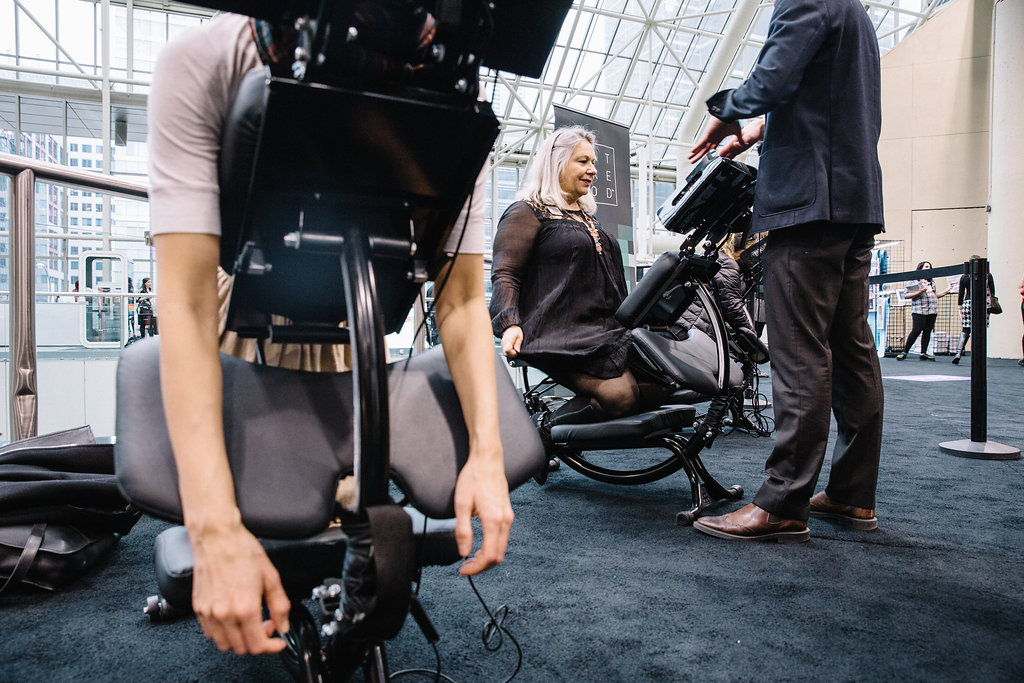
Each unit provides intensive personal exposure to sounds, imagery, and (selectively) smells of various natural environments. The system gently guides the user through its Natural Resonance Imaging® technology, which maps the brain's real time responses to specific stimuli. A helpful Relaxation Status Display appears in the field of view throughout.

Capitalising on the latest findings in environmental neuroscience, the product's Toronto-based creators claim that their patented personal wellness system brings restorative benefits equivalent to, or even greater than, nature in the raw.


At IIDEXCanada, all a new user had to do to get started was adjust the Pod Body to their particular dimensions, and calibrate the Pod Headset's stereoscopic display to their personal IPD (interpupillary distance), before immersing in one of three demo environments: a lush valley mid-summer, snow-covered mountains in winter, or a temperate forest in spring.

Of thousands in attendance at this annual design exhibition and conferences––which included summits on Healthcare, Wellness, and Accessibility in the built environment––many who got to try NaturePod™ first hand were immediately enchanted, and prepared to buy or lease the devices on the spot.

But frankly, reactions were mixed. A few declared their horror at the idea that anyone might try to substitute a new gadget for the experience of forest.

Even so, no one appeared to have any difficulty believing that this was a real product being offered to mitigate the chronic disconnect of modern urban dwellers from the experience of nature.

In fact NaturePod is design fiction––for now.

It's an experiential foresight project in the public interest; a scenario set five years into the future but brought to life today, created by a team of graduate students from OCAD University's Strategic Foresight and Innovation program, and led by me under Situation Lab auspices.

Neither a prediction nor a preference, but a provocation, we wanted to use design and performance to invite consideration of how our relationship to nature in cities is changing, and contribute to a dialogue about potential differences between our current direction, and what we might collectively want.

The people in the video above are responding to a direct experience, not to a hypothetical question.

***

"Powerful critical design does not present itself as critical design. Powerful design fiction does not present itself as fiction."
- Matt Manos

***


***

A few hints about the future setting were planted, including a full-page advertisement in the Show Catalogue announcing the release of the product in Fall 02021, but we were shooting for present-day realism in the encounter. The aim was to let folks come to their own genuine conclusions about the whole idea before the hypothetical status was revealed. The story told in the video has the same structure.

This unusual project grew out of a Time Machine, an Experiential Futures module that I created in 02013 and have taught each semester for the past three years at OCAD University.

That particular run of the Foresight Studio course, just over a year ago, was co-taught with the marvellous Suzanne Stein. One group of our students––Bergur Ebbi Benediktsson, Nourhan Hegazy, Jennifer McDougall, and Prateeksha Singh––spent the semester exploring the futures of humanity's relationship with the environment. When it came to the Time Machine, their response was ingenious; they created a "Nature Deficit Disorder Clinic" from 02040. In this experiential scenario set a generation from today, daily contact with nature is rare. The deficit is both ubiquitous and medicalised. People try to mitigate it with oxygen supplements and exposure to simulated forest, gauging their progress via brain scans.

A top Canadian environmental advocacy organisation, the David Suzuki Foundation, had served as this group's external partner throughout the class, and at their request we re-staged the NDD Clinic on Earth Day 02015 for the Foundation's employees and industry partners. Among the attendees was Canada's head of marketing for Interface, Inc.

Interface is a rather remarkable company. (You might know them from the documentary The Corporation, and especially the influential voice of their late founder Ray Anderson.) They're the world's leading carpet tile manufacturer, and also a global trailblazer in corporate sustainability. By no means is this a typical combination.

They engaged Situation Lab to create an experiential scenario to nudge their customers and others towards a deeper conversation about humanity's changing relationship to nature in the built environment. The same highly talented group of four graduate students came aboard to adapt the original concept for a totally different context: instead of a room-specific, 20-minute immersive installation for a captive audience of 20-30 members, we were to make this experiential scenario available to thousands of people over two full days at one of the largest expositions of its kind in North America.

Now, in the architecture and interior design world, it turns out that there is already lively discussion underway about (E.O. Wilson's term) "biophilia" in a design context, for instance in the 02015 report, Human Spaces: The Global Impact of Biophilic Design in the Workplace.

Biophilia refers to the "instinctive bond between human beings and other living systems"; a bond variously accommodated or cheerfully ignored by present urban and building designs. We designed NaturePod as an experiential contribution to both broaden and deepen the conversation. What are the implications for our wellbeing of trying to close the nature gap using increasingly sophisticated imitations? Where might that lead?

While evidently exercising a degree of creative licence to prototype possibilities from half a decade out, our imaginings were tied to real research. Readers curious about the current science behind these developments in nature simulation and related themes can find plenty of material for further investigation (for example: de Kort et al, 02006Kahn et al, 02008Kahn et al, 02009Kjellgren and Buhrkall, 02010;  Valtchanov, 02010; Valtchanov et al, 02010Valtchanov and Ellard, 02015).

What I love about the project is that this visionary company took such an unusual step, sponsoring a guerrilla futures intervention to urge industry and public engagement with issues that matter and affect everyone. (To the extent that corporate entities have engaged in experiential futures or speculative design previously, the results have tended toward the shamelessly commercial and trite, as Noah Raford has persuasively argued.)

NaturePod™ comes almost a decade after the first experiments in what we've come to think of as a special strand of publicly-oriented foresight work. Guerrilla futures combines strategic foresight and tactical media to produce unexpected encounters with possible worlds (see FoundFutures, for instance). Injecting possibilities into the present lets us think and feel new potentials, not "merely" hypothetical, in a mode of exploration squarely located where serious investigation meets play. (See Chapter 5 of The Futures of Everyday Life for more.)

This may be a first for corporate use of experiential futures / design fiction in guerrilla mode, and it is our hope that it provides a bracing contribution to design conversation far and wide.

Thanks and bravo to Interface, and to our marvellous design team: Berg, Jennie, Nour, and Prat! Huge thanks to all participants, assistants, volunteers and supporters; full project credits appear beneath the video.


Stills by Connie Tsang.
Videography by Filip Vukcevic.

Related:
Strategic Foresight meets Tactical Media
> The Futures of Everyday Life
> Guerrilla futures performance at South by Southwest
> FoundFutures: Chinatown