Showing posts with label Extrapolation Factory. Show all posts

Thursday, October 29, 2020

Introducing Experiential and Participatory Futures at the BBC

How do you develop foresight capacity inside an organisation, and experiential futures especially?

It's a question that comes up a lot. 

Recently I've spoken with government agencies from the UK, Denmark, and Australia, whose leaders all reached out for advice on growing their capability in these spaces.

The RSA (the Royal Society for Arts, Manufactures and Commerce) has just published a report on "Realising the Value of Futures and Foresight"; I was glad to contribute when the researchers got in touch a few months ago.

These are exciting signals that the conditions for social foresight are ripening, with experiential and participatory futures approaches migrating and spreading across contexts –– from academia and activism, to arts and culture, to business, politics and governance.

This post is about a fun project that also represents, I think, an exciting milestone in that journey.

A long, long time ago, in a pre-COVID otherworld –– last year, that is –– I had the privilege of collaborating with the British Broadcasting Corporation on an effort to bring futures thinking and practices into the design side of the organisation.

With the brilliant Filippo Cuttica leading the charge (Filo is BBC's UX Principal for Ethical Experiences; he is also part of art collective IOCOSE), and supported by a formidable in-house design posse, we devised a process for introducing around 200 people to the space of alternative futures.

Since our participants would mostly be designers of various kinds, we were resolved that these ideas should land with folks not just in theory, but in the most embodied way possible. So at an away day for the whole design side of the Beeb, hosted in Manchester's grand old Alfred Hall, I gave a keynote address to get some shared concepts and background into the collective mind, and then we transitioned to bringing alternative futures to life, on the spot.


Being quite excited about the event, I took a *lot* of pictures, including all the photos in this post
(except this one of me speaking, obviously... which was taken by Filippo Cuttica)

Everyone had been invited to bring in junk from home –– old shoes; defunct appliances; all sorts of things that they would otherwise have thrown out –– to serve as raw material. The group spent the afternoon in small teams, reinterpreting these "found" items using our card game The Thing From The Future as scaffolding for imagination, and then physically transforming them into a crazy array of artifacts from alternative futures. At that point they put their wares "on sale", across dozens of stalls set up in the style of a bazaar or flea market, complete with a special currency created for the occasion that let everyone ultimately "vote" on their favourite designs.

Lo and behold: the Futures Bazaar! A surprisingly coherent container for a mad hodgepodge of material ruminations. The video produced by the BBC team (at the top of this post) really captures the glorious chaos of the day. 


This co-created centrepiece, the Futures Bazaar itself, was complemented by a range of interactive demos organised onsite by BBC media tech unit Blue Room, including an adapted version (pictured below) of our experiential scenario from a few years back, NaturePod, featuring 3D video footage that the team had recently ventured out to a forest near Manchester to record.


It was exciting to build, in scope and ambition, on previous design jam deployments of The Thing From The Future. And turning household refuse into design fiction gold is an inherently satisfying form of creative alchemy, especially at scale. Scores of people, all playing and making their way into the futures together.

To revisit this work now, after more than half a year of working remotely, I find myself really missing the energy of co-creating in person. (It seems most of the time, I manage to avoid thinking about that; covid-coping reflex.)

But what makes a process like this tick, and how does it contribute to developing foresight capability?

I see two key factors driving it. The first is clear constraint. The second is permission to play. In a sense these pull in opposite directions, and that's the point. There's a productive tension in the middle, a sweet spot for creative, surprising generativity, neither too scripted nor too loose. Military drills have clear parameters, but also a tendency towards the predictable, this being of course among their main aims. On the other side, a young child's doodling may manifest a kind of pure play, but one scrawling sketch can look very much like another, and another, and another. Paradoxically, extremely open processes can produce results comparable in their unsurprisingness to extremely planned ones.

In jazz or theatrical improv, it's when the improvisers consciously adopt or, if they're really skilled, feel their way into a shared set of enabling constraints, "finding the game", that things start to click. The signal-to-noise ratio leaps. Pleasurable surprises appear. Embracing the convergent forces of constraint and the divergent forces of play in balance takes us somewhere interesting –– in this case, a gleefully absurdist and thoroughly engaging mode of co-creation.


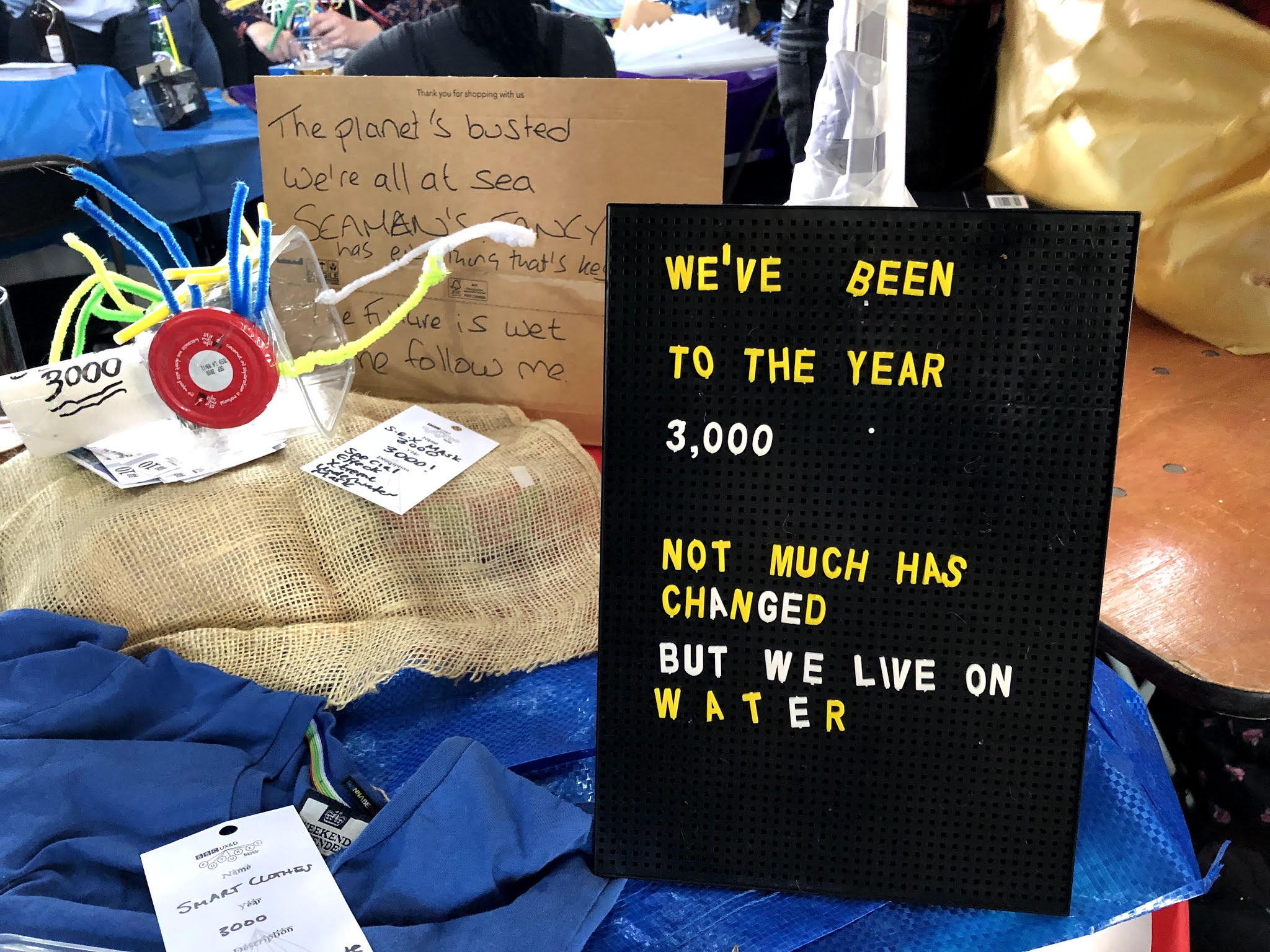
Several layers of productive constraints are operating here. These include, naturally, time itself; we broke a fairly complex set of tasks into distinct stages, which sharpened focus, brought urgency, and raised energy levels. Another is the overall premise, "make a future artifact with this thing", paired with the specific semiotic or interpretive potential of any given object: each item that participants had brought from home could plausibly be "cast" as many future things, but not as absolutely anything. More granularly, beneath the "future thing" umbrella, the structure of a Thing From The Future prompt offers a kind of future to consider, as well as a theme, a particular context of society or human endeavour, to help the imagination along. A player might incorporate a found object into a prompt something like the following:

"In a {REGIMENTED} future, there is a {pair of old slippers} related to {JUSTICE}. What is it?"

Which might end up generating something like this:


Okay, you might say. People seem to be enjoying themselves and being creative. But so what? How does this help with the development of an organisational foresight capability?

A general answer is that many, if not most, organisations need play more than they realise. Workplace cultures often implicitly devalue and sacrifice, intentionally or not, anything unusual, subversive, humorous or nonstandard. This makes for infertile contexts, inhospitable to new ideas, and perhaps to diversity on other dimensions too (cultures, backgrounds, values). In my experience it's common for organisations to be more brittle, blinkered, and reactive than they might think they are, and to that extent, more vulnerable to changes in their operating environment that they have not made room to consider.

Foresight practice, a conversation space that's deliberately much broader than forecasting (an important subset of it), requires some openness to the non-extrapolative and non-obvious –– viz. Dator's second law: "Any useful statement about the futures should at first appear to be ridiculous".

More specifically, this particular kind of play arguably helps lower the bar to having more serious, strategically load-bearing conversations about alternative futures. I've written elsewhere about how The Thing From The Future is designed to operate, so won't reiterate that here, but as the celebrated designers Charles and Ray Eames used to say, "Toys are not really as innocent as they look. Toys and games are the prelude to serious ideas."

Am I saying that this is "the right way" to introduce futures thinking into organisations? No. It was, however, a great way to do it here, partly because this specific organisation is full of creatives, makers, and storytellers. Also, the context of an away day made a bit of fun welcome, even essential. We understood that participatory, playful and hands-on elements needed to be foregrounded here, and so they were.

In a more corporate, bureaucratic, or self-serious context, such as strategic conversation for a government department, supranational outfit, or large business, other approaches might be more suitable. Less out-on-a-limb for the participants while still inviting their engagement with future possibilities physically, emotionally, and narratively.

The Future Is Now project, which we advised as well as helped implement at the International Federation of Red Cross and Red Crescent Societies (IFRC), the world's largest humanitarian network, mobilised experiential futures approaches in a number of important ways, in order to introduce, enable and integrate foresight throughout a vast organisation. It ended up fuelling an unprecedented level of futures awareness and activity, now shaping strategy at the global level, as well as within many national societies. (We can look at that case more in another post to come.)

Well, that all sounds very nice in principle, you may say, but we can't do most of these physical interventions or collaborations at the moment –– what about the pandemic?

So, part of the reason we called experiential futures "experiential futures", since first plotting out and arguing for this much-needed broadening of foresight practice a decade and a half ago, is that the relevant canvas is huge. It's not about a particular medium or context of deployment. As large as the space of "possible future artifacts" may be –– and I have argued that it has to be much larger than the set of "all human artifacts ever created in history"; if history has happened but futures have not, then the latter space is bound to be ontologically multiple, encompassing the aggregated contents not of just one historical timeline, but countless potential ones –– the point is that there's no reason, for our purposes, to be exclusively interested in objects, or even in physical, face-to-face encounters, important as those are. This is tied in with why the frames of "design fiction" and "speculative design", while both valuable vectors for popularising a subset of experiential futures' possibility space among designers and the design-curious, can sometimes get in their own way a little bit.

The relevant issue for organisations or cultures recognising a need to navigate change more effectively than they have in the past is not "how do we make objects that speak about futures?" It is also not, "how can speculative design or design fiction or help with our policy/strategy challenge?" Nor is it even "how can experiential futures help with x or y?", which reifies a constantly-evolving collection of practices that spring from and must continue to be fed by what seems to me to be the key underlying question: "what can we do to navigate change more effectively?" Any experience that helps people to grapple with possible futures and to take wiser action in the present is in scope. Experiential futures simply designates a possibility space where the challenge is ultimately to make better collective choices among all available options, and the means for realising these are whatever you can come up with.

On this view, the ongoing covid-19 pandemic and its limitations are just another set of enabling constraints. It doesn't much matter if you can't meet in person; do immersive future exhibits with social distancing, or for one person at a time. Send stuff through the post, or by email. Or create digital experiences, or audio ones with no screens in sight. We recently did a hybrid drama/design course on devising theatre in pandemic conditions, which included online live action roleplaying games. We've staged Zoom-native, as opposed to in-person, Time Machines (more on that soon, too). A bunch of us around the world just ran the first edition of a decade-long annual festival program of experiential futures, all created and carried out under covid-19 pandemic constraints. And so on.

People ought to be exploring alternative futures in the highest-impact ways available, especially with the devastating consequences of a conspicuous failure of effective foresight rippling, or rather ripping, through our daily lives, globally, right now.

Filo Cuttica says this in his excellent write-up of this foray into experiential futures:

If there’s one lesson to take away from the pandemic, it's the importance of looking ahead. And not just "looking ahead", but "feeling ahead". By imagining together in structured ways, and creating the experience of change before it happens, rather than while it's happening, we have a hope of planning, and even affecting our future. ...

The idea [of this event was] to introduce the team to a seemingly obvious, and yet hard to grapple with idea: that the future hasn’t happened yet, that we can play an active role in shaping, but that before we can collectively choose what should happen, we ought to explore what could happen.

As noted at the top; it's great that more and more institutions are realising how embedding an augmented futures capability might be valuable. At the BBC, with this effort an internationally significant organisation spanning cultural and governance sectors has taken some deceptively playful first steps down an important path, and I'm excited to see where it might go.

If this sounds like something that your community or institution should be exploring, but you aren't sure what to do next, try the links below for a start.

***


Thanks and congrats again to Filo, to his team and their network of wonderful colleagues, and not least, to their awesome bosses at the BBC for supporting these efforts. I also want to mention prior work that in some ways made this delightful experiment possible, especially the series of participatory futures events that Jeff Watson and I (Situation Lab) organised years ago with our good friends Elliott Montgomery and Chris Woebken (Extrapolation Factory); Futurematic Vending Machine at OCAD, Futurematic: Canal St at NYU, and 1-888-FUTURES at USC; as well as the Discoverability Media Jam for the Canadian Radio-television and Telecommunications Commission (CRTC) with Rich Lachman at Ryerson University, and the Posteridade design jam staged with Marcela Sabino and her team at the Museum of Tomorrow in Rio de Janeiro.

Related
> Dreaming Together | pdf from the book Made Up: Design's Fictions
> UNTITLED: A Bold New Experiment in Public Imagination | Medium
> On Getting Started in Experiential Futures
> Bringing Futures to Stanford d.School
> Using the Future at NASA | pdf
> Augmenting Cities with Niantic and Knight Foundation
> The Thing From the Future | pdf about the game design
> Time Machines 
> NaturePod
> Theatre in Pandemic | full syllabus on Medium
> 1-888-FUTURES with Extrapolation Factory

Friday, June 23, 2017

Ethnographic Experiential Futures

We shape our images of the future, and meanwhile they shape us.

A Field Guide to Ethnographic Experiential Futures, version 1.1, June 02017 (pdf)


(Update 03june19: This post and framework have attracted quite a bit of interest over the past couple of years. We've now published a peer-reviewed academic article, in open access, laying out EXF in the Journal of Futures Studies special double issue on Design and Futures. That full piece is available in pdf here.)

***

At the Design Develop Transform conference in Belgium last week, design researcher/futurist Kelly Kornet and I presented this framework we've been developing on and off for a couple of years.

Ethnographic Experiential Futures, or EXF, is a design-driven, hybrid approach to foresight aimed at increasing the accessibility, variety and depth of available images of the future.

It puts together two modes of futures research and practice which have grown up separately, for the most part, but which have complementary goals, and turn out to pair quite well.

Ethnographic futures research, EFR, is a protocol for surfacing and documenting existing images of the future. (Our starting point was the late Stanford anthropologist Robert Textor's formal EFR interview process, an overlooked contribution to futures literature which should be much more widely used.) Experiential futures, XF, is a family of approaches for vivid multisensory, transmedia, and diegetic representations of images of the future (a focus of mine for the past decade).

Put another way, ethnographic futures is more descriptive; looking for what's present but often hidden in people's heads. Experiential futures is more creative; rendering these notional possibilities visible, tangible, immersive and interactive, externalising and concretising representations of them for closer inspection and deeper discussion.

EXF offers a way to take the invisible and make it senseable.


We've suggested a series of steps for an EXF process:
1. MAP: Inquire into and record people's actual or existing images of the future (e.g. possible; probable; preferred; a combination).
2. MULTIPLY: Generate alternative images (scenarios) to challenge or extend existing thinking (optional step, but recommended).
3. MEDIATE: Translate these ideas about the future/s into experiences: tangible, immersive, visual or interactive representations.†
4. MOUNT: Stage experiential scenario/s to encounter for the original subject/s, or others (or both).
5. MAP: Inquire into and record responses to the experiential scenario/s.

The Field Guide explains the logic and highlights some of the main design choices available at each juncture.

Instead of starting from theory, this step-by-step process has been derived from already completed projects, carried out over a number of years, which turned out to have much the same structure under the hood. In our conference presentation we reviewed four project precedents dating back to 02007. While demonstrating very different goals, outcomes and contexts, they basically describe the same research arc.

A full article is forthcoming, which will include more detail to situate this work in the landscape of futures ethnography and experiential practice, including related methods and projects. However, since the one-pager refers to the specific projects from which we distilled or abstracted this framework, for reference those are briefly outlined below:

Candy and Dunagan, Foundfutures: Chinatown, 02007.

About ten years ago, Jake Dunagan and I started experimenting with the deployment of experiential futures in unscripted environments. We would send postcards from the future to the home addresses of community leaders around Hawaii, and 'droplift' future artifacts in local shops for people to stumble across during their lunch break, for example. However our most ambitious early guerrilla futures project aimed to be more systematic; more rooted in place and history. In Honolulu's Chinatown neighbourhood, we interviewed a range of residents and business-owners, and then devised a culture- and site-specific scenario set, incorporating a combination of future possibilities as described to us, and new ones calculated to resonate with what we had heard. With collaborators we created a set of experiential scenarios, producing a cross-section of fragments from each hypothetical future history, and installing these in the streets. Responses were captured via direct observation, at a free community futures workshop, and in the press.

Artwork by Matthew Jensen / Photo by Stuart Candy

Artwork by Mark Guillermo / Photo by Matthew Stits

Kornet, Causing an Effect, 02015.

For Kelly Kornet's culminating research project at OCAD University (which design professor Helen Kerr and I supervised), she spoke to several lifelong environmental activists, living in heavily polluted industrial areas, about the future hopes and fears motivating their efforts. She generated written scenarios based on these (using Textor's EFR interview format), then created a physical exhibition comprising artifacts from the futures that the research participants had described, and subsequently spoke with them again to capture responses to how their own private imaginaries had been brought to life. The project, which won a student award from the Association of Professional Futurists, is available in pdf here.


Designs & photos by Kelly Kornet 

Situation Lab/Extrapolation Factory, 1-888-FUTURES, 02015.

Jeff Watson and I (Situation Lab), together with Elliott Montgomery and Chris Woebken (Extrapolation Factory) designed and staged a series of design jams in 02014-15 called 'Futurematic'. The third of these, held at the University of Southern California, invited anyone interested, across North America, to call a toll-free number and record their future dream in a voicemail. On the day of the event, we had participants retrieve these voicemails, then create a "future present" –– a tangible artifact distilling (or, as Chris would put it, 'tangibilising') each dream. The maker/s then recorded a video about their making process and the correspondence between the artifact and the dream that inspired it, and boxed up the future present to send to whatever postal address had been left with the original voicemail. Thereafter, on social media, recipients responded to the future presents they opened up. The project is detailed here, and was covered by Core77 and Business Insider among others. Artifact documentation and videos are archived at 1888futures.com.

Photo by Stuart Candy

Photo courtesy Extrapolation Factory & Situation Lab

Greyson, Making the Futures Present, 02017.

Designer and interactive narrative professor Maggie Greyson, for her final MDes project at OCAD, created a "personal experiential futures" process. (Social entrepreneur Sarah Schulman and I supervised.) Maggie interviewed research participants, using Textor/EFR, about a range of futures they could imagine facing on a 20-year time horizon –– positive, negative, expected, and also unexpected. The 'unexpected' future is not a usual part of EFR, which traditionally has a strict descriptive intent; this was a deliberate addition to expand participants' thinking (see Step 3, 'Multiply'). She then worked with them to co-create rapid prototypes of artifacts from those futures, and went on to develop higher-resolution artifacts as a basis for deeper conversation in the next session. The project can be found in pdf here.


Photos by Maggie Greyson

Whether your aim is to dive deeper into the images of the future in a culture to which you belong (even your own personal 'futurescape'), or to facilitate a process for a client organisation, or to partner with a community group historically marginalised from meaningful futures conversations, the framework is intended to be capable of being customised and put to diverse uses.

As we noted in the conference presentation, purposes of projects to date have spanned the educational, documentary, activist, personal, and playful; and could readily be extended or adapted to the organisational, governmental, and cultural.π

EXF may be applied at the scale of a short workshop or design jam, up to a multi-year large-scale process involving thousands of people or more. It may be used as scaffolding for a robust, imaginative strategic conversation within a company, or as the basis for a public, guerrilla futures intervention at election time, or as a quasi-therapeutic support structure for examining an individual's options in life.

Most futures research is not as disciplined as it could be in its inquiry into how people currently think about and conceptualise futures: Ethnographic futures research can help with that. Meanwhile, most communicative or scenario-sharing interventions are likely not sufficiently vibrant to change or expand how people think: Experiential futures practice can help with that.

Putting them together entails bridging the descriptive and the creative (and potentially, though not necessarily, the normative).

Our hope is to make this work a bit easier and more common, by providing a flexible framework that has served diverse purposes before and could be put to many other uses.

Also, we note that this arc of activities, which in the original projects may have appeared linear, can be usefully recognised and imagined instead as circular. The first and last steps are the same. In principle, then, EXF could be used, where appropriate, in an ongoing, cyclical fashion.§

We've received a number of requests for a pdf of the draft Field Guide to Ethnographic Experiential Futures: you can download it right here.

We invite you play with this structure and share your variations, innovations and results!

***

Notes:
[†] Those new to experiential futures may find this recent peer-reviewed article published in Futures journal useful. There's an abridged overview for the especially time-pressed (downloadable pdf). The Experiential Futures Ladder, to help carry out Step 3, Mediate, is described there too.
[π] The Adopt-a-vision experiential futures class project recently outlined at this blog could very easily be tweaked towards an EXF cycle –– and the resemblance is not pure coincidental; it emerges from some of the same thinking.
[§] The insight that an ethnographic, grounded-in-place futures process could be usefully developed as a generic method owes an enormous amount to over a decade of conversation and collaboration with Jake Dunagan (whose background includes an MA in visual anthropology). Early in 02016 we developed a project proposal called 'Nextloop', which aimed to offer "a next step in a much-needed renovation of the conditions for public imagination. We wish to use this opportunity to demonstrate how forward-looking design research, pairing ethnography with tangible speculation, can enrich individual and collective consideration of our social, cultural and technical choices. We intend to close certain loops too often left open – bringing potential downstream consequences powerfully and concretely into awareness today, and to bring in certain other loops – diverse public involvement in those same discussions – too often left out."


Related:
> Adopt-a-vision (report from a recent XF class)
> 1-888-FUTURES (speculative design jam event overview)
> Foundfutures: Chinatown (XF /guerrilla futures project overview)
> Build Your Own Time Machine (classroom activity instructions)
> The Thing From The Future (card game)
> The Futures of Everyday Life (doctoral dissertation)

Saturday, September 19, 2015

1-888-FUTURES

"Dial a future, deliver a present."


Want to put systemic challenges on the radar of your local Congressman? Help a relative living on the opposite coast to prepare for climate change? Send a 30th anniversary gift to the couple just now celebrating their 10th? Share a dream for a brighter world with your kid?

1-888-FUTURES is a service that takes a future dream, vision or problem, renders it tangible as a "future present", and delivers it to a specific individual.

You, the visioner, call the hotline and place a request for delivery of a future present based on some image of the future that you describe in your message. Our dedicated staff retrieves the message, finds a way to make the dream into a specific artifact, boxes it up, and sends it to your chosen recipient.

The future present recipient – whether it's you the visioner, or someone else – may choose to keep the package as a mystery box until the stated opening date, or may instead open it sooner, and be duly delighted/horrified/provoked/touched/nonplussed by the contents. A transcript of the original dream recording will be posted together with the artifact inspired by it.


A lot of work in the design fiction / speculative design mould is created, it seems, for no one in particular. Even if produced only once (like an artwork), often in effect it's a mass consumption object rather than something made for one. So 1-888-FUTURES is a small experiment in making such future design more personal and personalised; a true gift, connecting the imagining and creation process to a named individual, an audience of one.

This is the third "Futurematic" design jam jointly run by Situation Lab (Jeff Watson and me) with New York-based design collective The Extrapolation Factory (Elliott Montgomery and Chris Woebken). Graciously hosting on this occasion is the University of Southern California's Visions and Voices series, with the priceless collaboration of Professor Jen Stein from USC's School of Cinematic Arts.

Futurematic events riff playfully on commercial and industrial making processes, while focusing on the very non-industrial, not-yet-massified design space of imaginary objects. At the first event, participants filled up a vending machine with future artifacts in a day last spring at OCAD U. For the second, last summer at NYU, people created and put future street merchandise on sale at Canal St and Broadway in Manhattan. Both those events used Situation Lab’s imagination-boosting card game The Thing From The Future as the creative engine. This time, the ideation engine is the public's imagination itself. With that as the driving force, workshop participants will send out as many "future presents" made to order as we can, from our temporary 1-888-FUTURES fulfilment center in Los Angeles to all over the country.

The whole thing is free: so long as the delivery address is in the U.S., callers from anywhere can participate by calling 1-888-FUTURES from skype.

But this offer is limited - so call now! The lines are open 24/7 until midnight on Saturday, September 19th.


Browse the catalogue of future presents, designed, sealed and delivered, at 1888FUTURES.com.

Thanks to Jen Stein, Jeff Watson, Danyel Copeland and Josh McVeigh-Schultz, and the rest of our hosts and helpers at USC. Thanks also to our Futurematic collaborators Chris and Elliott, aka The Extrapolation Factory, and not least to our wonderful workshop participants!


[Originally posted at the Situation Lab blog.]

Links:
> Project website: 1888FUTURES.com
> Feature at Core77
> Feature at Tech Insider
> Feature at Medium

Related posts here:
> Big shifts, small change
> Participatory cli-fi
> More found futures
> Design fiction, emerging
> Object-oriented futuring

Wednesday, December 11, 2013

Big shifts, small change

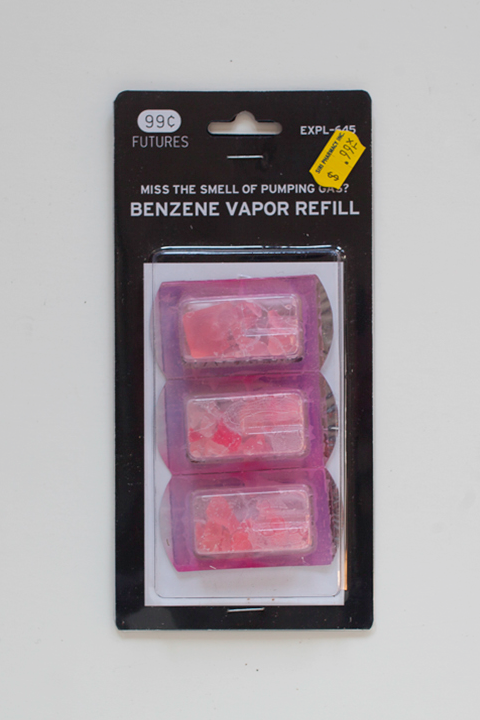
What kinds of artifacts might be found in the 99 cent store of the future?


All images from The Extrapolation Factory website.

So asks a nifty, crowdsourced experiential futures / design fiction project by The Extrapolation Factory, an award-winning initiative of Elliott Montgomery and Chris Woebken (both alumni of the RCA's Design Interactions program). "99 cent futures", executed in New York earlier this year, is now being exhibited in China, giving the project a new lease of attentional life.

Some months back, when this effort was in the pipeline, I spoke with them to help hammer out a participatory design framework which they created so that attendees at a workshop in NYC could playfully generate and make their own answers to the question. Then the pair installed the resulting artifacts in an actual 99¢ store in Brooklyn (calling to mind some of our early FoundFutures adventures in droplifting; e.g., speculative pharmaceuticals, souvenir magnets and postcards from the future).

I particularly like that they managed to include both a participatory design phase and a guerrilla futures phase -- two critical frontiers of design/futures work -- in the same process.


Today a report on 99¢ futures appeared on the CNN website; last weekend I did an interview by email for it.

Now, it's more or less axiomatic that something -- usually a pretty fundamental something -- gets messed up in reports on futures. In that regard this piece is better than most, although it seems to imply that "futuring" (the reporter's preferred term, I think borrowed from Chris and Elliott) is a new "movement" emanating from design, as opposed to a practice established over many decades and recently adopted and/or reinvented by some designers.

Apparently I did not make that relationship clear enough. Live and learn.

Still, it's a good article, and encouraging to see this work thoughtfully covered in mainstream press -- in the Style section, impressively enough; not a common place to find foresight news!

We'll dig into the Extrapolation Factory's projects and methods a bit more in another post.

Meanwhile, for those interested the whole of my email interview appears below. The questions were asked by CNN writer Sheena McKenzie.

***

Why was the 99c store such an interesting/significant project?

Two things make the 99 cent store interesting. First, it's a rare invitation to imagine the future's mundane side. Popular notions of the future often get stuck in a kind of glossy rut - gleaming buildings and whiz-bang inventions, and it's not often enough that we see the futures of everyday life brought into focus. Second, it's the result of a participatory process. Chris and Elliott didn't pre-imagine everything for a passive audience, they designed a way for people to develop and share their own ideas.

The project exemplifies a hybrid of design and futuring that we're sure to see more of as time goes on. My colleagues and I call this frontier of practice "experiential futures" or "design fiction". Design fiction focuses on objects, and experiential futures focus on immersive situations. Both aim to bring possible worlds to life in a way that enables a deeper kind of conversation about the future. They're more generative, participatory and tangible than much of what has come before. We need to cultivate ways of imagining the future together.

What is futuring and why is it important?

Futures or foresight practice (also sometimes called futuring) is about systematically and creatively exploring how change could unfold over the medium to long term. This is important because humans have an inbuilt psychological tendency to filter everything through the lens of a rather narrow experience of the present, which leads to decisions that are short-term, short-sighted and risky. With massive global challenges looming, like climate change, peak oil, and economic volatility, we need to develop a cultural capacity for thinking ahead and creating options, so we aren't just reacting to crisis after crisis. Good strategic foresight gives decision-making a longer runway, and experiential futures is one of the most promising ways of getting this kind of thinking wider exposure.

Many people think of the future simply in terms of technology. Yet this project was a slight tweeking [sic] of the world we already know -- does that make it more emotive?

The tendency for technology to dominate thinking about the future is a serious problem. A lot of change begins with technology, but it doesn't end there. The future conversation needs to include social and political dimensions. For example, it seems appropriate that the creators of the 99 cent store project have brought it from New York to Shanghai. This prompts us to think about the supply chains - in which China is a critical link - which currently make the phenomenon of 99 cent stores, and their cheap mass-produced contents, possible in the developed world.

This project's tweaking of the world we know through unsolicited urban installation of objects is a great example of what I call "guerrilla futures" - unexpectedly manifesting fragments of possible futures in the midst of people's everyday lives. This turns out to be an effective way of firing people's imaginations even if they haven't asked for it!

Why should we think about the future when designing products? And where do you see this trend heading?

The incorporation of futures thinking into the design world, which has picked up pace hugely since the mid-00s, shows no signs of slowing down: everything we make is part of the future we will get. So we need to think about the future when designing not just products, but anything. As a futurist, I now teach foresight at a design school, OCAD University in Toronto, because designers are at the forefront of shaping the world, whether they realise it or not -- and we'll all be on track to a better future the sooner and more deeply they realise it.


Related:
> FoundFutures: Chinatown: Green Dragon (02007)
> FoundFutures: Postcards from the future (02007)
> More FoundFutures
> Future-jamming 101
> Wired's Found: Artifacts from the future