Showing posts with label guerrilla futures. Show all posts

Tuesday, January 31, 2023

The Power of Utopia

One of my favourite engagements of the past year was a panel about The Power of Utopia with accomplished artistic activists Terry Marshall (co-instigator of Intelligent Mischief, a creative studio dedicated to “unleashing Black imagination to shape the future”), and Cory Doctorow (bestselling science fiction author and journalist whose work includes How to Destroy Surveillance Capitalism and Walkaway, among many other titles).

The Center for Artistic Activism (C4AA) hosted the event as part of its Revolutionizing Activism series, a brilliant resource for agents of change to practise infusing radical imagination into present action. Afterwards, the organisation shared some key takeaways from the event under the title How to strengthen the vision of your advocacy.

Video of the full conversation is embedded below.

Related:
> Imagination Is a Commons: An experiential futures project for UNDP (02021)
> Ethnographic Experiential Futures / EXF (02017)
> FoundFutures: Chinatown: Green Dragon (02007)
> Critical activism: An interview with Anab Jain (02019)
> The New York Times Special Edition (02008)
> Future documentary (02016)
> Guerrilla Futures: Strategic foresight meets tactical media (02014)
> Dreampolitik: On the political importance of impossible dreams (2008)
> The Tao of Steve (02011)
> Guerrilla Futures C4AA webinar (02017)
> The School of Worldbuilding (02019)

Tuesday, April 06, 2021

Exploring Technology Governance Futures with the World Economic Forum

A snapshot from the Influence 2035 experiential scenario

This week, the World Economic Forum is hosting its first ever Global Technology Governance Summit (GTGS), convening some 3000 leading technologists, academics, businesspeople, policymakers and political representatives to discuss the sprawling array of fast-moving challenges in this space.

From privacy breach scandals to the Trumpian rise of batshit-crazy conspiracy thinking, the chaotic gaming of stock prices, to misinformation-fuelled mob lynchings, and the weaponisation of online platforms for campaigns of xenophobia or personal vengeance (the latter was the subject of today's feature story on the New York Times Daily podcast)... These are just some recent examples that spring to mind. The pattern is the point. Countless spot-fires, zoomed out, start to look more like a full-blown conflagration.

Anyone who has paid even the scantest attention to such developments might discern a phenomenon also noted long ago by a founding figure both in speculative fiction and in the futures/foresight field*, H.G. Wells, in a BBC radio broadcast from 01932:

“All these new things, these new inventions and new powers, come crowding along; every one is fraught with consequences, and yet it is only after something has hit us hard that we set about dealing with it.”

To shift from a reactive stance to a more proactive or anticipatory one requires changes that are not just political or institutional in nature, but cultural and psychological as well. This is no less true in relation to technology governance than any other topic. As Wells was arguing almost a century ago, collective forethought is essential –– but broadly, it is not a habit we seem to have cultivated with much care or success.

The GTGS event gets underway today, technically hosted from Japan, but taking place entirely online, thanks again of course to the continuing Covid pandemic.

As it does so, a group of graduate designers in our Experiential Futures (XF) class at Carnegie Mellon University have just launched a special set of digital experiential scenarios –– websites and media from the futures to shed light and open up horizons of the topic to explore.

Each site created by XF participants offers a playful rabbit-hole delving into how the world could look decades from now –– in the 02030s, 40s or 50s –– and a provocatively high-resolution glimpse of how some key issues in technology governance might play out.

The usual caveat bears repeating: experiential scenarios should not, unless they are actually offered as such, be treated as predictions or preferences, but instead approached as possibilities to think and feel with. What new questions, potentials, or vantage points can they help us consider?

The storylines and themes contained in these particular projects all build on and respond to the Technology Futures report published yesterday by the World Economic Forum and Deloitte, which was shared with us in draft last month.

***

Tech Tea
Tech Tea, a podcast hosted by AI-wrangler Willow and dark web journalist Melanin, focuses on the darker side of the metaverse. Join them as they dive into the recent controversy surrounding powerhouse Global Virtual School.

This podcast from the year 2050 expands on Maiah’s story from the education LEnS of the Technology Futures report.

by Alice Chen, Karen Escarcha, Amrita Khoshoo & Hannah Kim

Influence 2035
Influence 2035 is an event bringing together panelists to discuss the gig landscape. Join us for candid stories from full-time content creators to data providers and robot admins. Click “Attending” on our event to learn more.

This project explores the extreme trends of gig-economy and influencer work appearing in the story of Maple featured in the Technology Futures report.

by Jianzhe Gu, Sanika Sahasrabuddhe & Catherine Yochum

After-Math
After-Math is a global consultancy committed to helping individuals, teams, and organizations regain independence from virtual influence and data-toxicity in order to rediscover the world around us.

This website for a speculative consultancy in the 2040s synthesizes trends, personas, and artifacts from all four scenarios in the Technology Futures report.

by Adam Cowart & Russell Singer

Wikipolicy
Wikipolicy is the policy arm of Wikimedia. Our 2032 Year-in-Review Report shows how we manage accountability, transparency, and logics of care in algorithmic and participatory policymaking advancements.

Seeking to right past wrongs, in this future Wikipolicy is headed by Frank, a former technology executive and character featured in the Technology Futures report.

by Rachel Arredondo, Kylon Chiang, Esther Kang & Jack McClain

Outliers Data Talent
Every company is a data company. Outliers Data Talent connects yours with the data providers you need, from providers of biometrics to location history and more. Top providers are booking fast, so reserve your data talent today.

This hypothetical agency builds on the story of Maple / information LEnS scenario, where job-seekers provide a vast array of personal data around the clock to interested companies in exchange for pay.

by M Kuznetsov, Alex Polzin & Maddy Sides

***

Well done indeed to all these Experiential Futures students! Many thanks to the World Economic Forum's Ruth Hickin (Strategy Lead, Centre for the Fourth Industrial Revolution) for the opportunity to contribute to the conversation in this way. Finally, much appreciation to our recent guest respondents, Michelle King, Leah Zaidi and Jake Dunagan, for incisive and sensitive pre-launch project feedback. 

We hope these digital experiential scenarios will be of interest and value both to event attendees, and to many others invested in these important topics. If you find them useful, whether individually or as a set, please feel free to share.

***

Update 06apr21: I had mistakenly recalled the number of event participants as being around 1000; the Forum tells me that the correct number is closer to 3000.

* This is the same broadcast popularised by futurist Richard Slaughter as Wanted! Professors of Foresight.

Wednesday, June 28, 2017

Syrian refugee girls imagine their futures

Today I want to share an experiential futures project cocreated with a group of individuals usually pushed to the margins in every way. Here they appear in the spotlight, with a call for their dreams to be recognised and their voices heard.

Hiba, aged 9. Vision: future paediatrician. "I have always wanted to help children. I am kind and loving, and therefore an excellent doctor that children can trust."
Photos and captions: Meredith Hutchison / International Rescue Committee [via IBT]

The premise of "Vision Not Victim", created by photographer Meredith Hutchison, is straightforward. The girls are asked about what they want to be when they grow up, and then they do a photo shoot where they dress up as if it has happened, and talk about how it came to be, speaking as their future selves.

Supported by the International Rescue Committee, a global humanitarian and aid organisation, this iteration of the program was carried out in Syrian refugee camps in Jordan (video), after being piloted in the Democratic Republic of Congo (video).

IRC explains:
Every girl designs and directs her own shoot where she poses as her future self — achieving a goal. Whenever possible, we try to do these shoots on location, in actual working environments, so girls can meet people in their envisioned field and truly step into their future. 
As empowering as the photo shoot experience itself may be, the outcomes don't stop there: "Perhaps the most moving and impactful part of the program is the moment when the girls share their photographs. They beam as they receive their images and run to show parents and friends."

An opportunity to see and do differently ripples outward from this bold declaration of possibility.

Haja, aged 12. Vision: future astronaut. "Ever since we studied the solar system in primary school, I have wanted to be an astronaut. I love being an astronaut because it lets me see the world from a new angle. In this society my path was not easy – many people told me a girl can’t become an astronaut. Now that I have achieved my goals, I would tell young girls with aspirations to not be afraid, to talk to their parents about what they want and why, to always be confident and know where you want to go."

Fatima, aged 16. Vision: future architect. "When I was young people told me that this is not something a woman could achieve, and they encouraged me to pursue a more 'feminine' profession. Now that I’ve reached my vision, I hope I am a model for other girls."

Fatima, aged 12. Vision: future teacher. "In this image, it is the early morning and I am waiting in my classroom for my students to arrive. I teach younger children to read and write Arabic."

Amani, aged 10. Vision: future pilot. "I love planes. I finished my studies and found a way to get to flight school. Now, not only do I get to live my dream, but I also get to help people travel, to see the world, and discover new places."

Muntaha, aged 12. Vision: future photographer. "As a professional photographer I use my images to inspire hope in others – to encourage love and understanding."


Notice how they speak from inside the future scenario, visualising and roleplaying their accomplishment; not "I want to..." but "I have..."

The import of this shift in imagination can be profound. Here's an example related by the photographer, reported by CNN:
Hutchison remembers one girl who was engaged to be married though she was younger than 13. (The photographer asked that the girl's name not be used to protect her identity.)

"I distinctly remember the moment when we showed her parents her vision images. Her mom was just ecstatic and her father ... was absolutely silent -- and smiling -- but silent, thumbing through the images.

"I think he was just in awe that this could be his daughter."

By the end of the program, the parents had called off their daughter's engagement and had committed to helping her finish her education.

That's the power of the photographs -- something unquantifiable happens to the girls, Hutchison says. 

I recently read Rebecca Solnit's book Hope in the Dark. which focuses especially on citizens and activists pursuing what may appear to be lost causes. It's an extraordinary work –– I wholeheartedly recommend Solnit's writing in general –– and her analysis of how hope functions manages to be simultaneously tough-minded, filled with compassion, and uplifting.
To hope is to give yourself to the future, and that commitment to the future makes the present inhabitable. [...] Despair demands less of us, it's more predictable, and in a sad way safer. Authentic hope requires clarity––seeing the troubles in the world––and imagination, seeing what might lie beyond these situations that are perhaps not inevitable and immutable.
In a similar spirit, it's elevating to find a project carried out in such desperate circumstances, contributing to the possibility of those circumstances being transformed.

And it brings us back to an issue we've noted before: foresight is a right. Everyone should be able to think about the future, but not everyone gets that chance.

Having attempted at various times to narrow that gap by bringing futures to life in unscripted environments (albeit so far in no setting as fraught with complexities as a Syrian refugee camp must be), I have great appreciation for what Meredith and her collaborators have done here.

We can readily grasp the transformative potential of a well-wrought experiential scenario –– that is, making a possible future vividly available to think and feel today –– whether at the scale of a country (as in Tunisia, during the Arab Spring, with the aspirational 16juin2014 campaign); a group (as in Hawaii 2050); or an individual (as in Derren Brown's apocalyptic wakeup call to one troubled English kid, which painstakingly simulated the end of the world exclusively for him). But examples as fully realised as these can be resource intensive.

Vision not Victim is based on a conceptually simple, apparently inexpensive, yet deeply personal intervention. It invites a young person to vividly articulate –– enact, actually –– a preferred future, and so enable a powerful reperceiving of potential awaiting activation in the present.

(More than a year after first hearing about this project, I've noticed that its structure appears to describe the same arc as the generic Ethnographic Experiential Futures process recently shared here: MAP [unearthing a preferred personal future, in this case] > MEDIATE [staging the photo shoot] > MOUNT [sharing the photos with the girls and their families] > MAP [capturing reactions].)

The opportunities and challenges around the right to foresight are, of course, not evenly distributed. This becomes particularly obvious when we think about it as an ongoing rather than a one-time need.

Consider the work of education designer and futurist Amy Satterthwaite, formerly a Toronto schoolteacher (and one of my teaching assistants at Duke University's TIP futures summer school a few years ago - video). She is now working to change schools through Ashoka Canada.

In her award-winning final MDes project at OCAD, Foresight for Every Kid, Amy's research highlights the fact that
low-SES students are more likely to be present-oriented, chiefly a consequence of the 'tunneling' that occurs due to scarcity. Middle-class, higher-SES students, on the other hand, are more inclined to think on the future as they are less burdened by unmet needs in the present. [...] Academically successful students... are those who can imagine fairly far into the future, set goals, and defer gratification in order to work toward them. In this system, our present-oriented students' perspectives are less likely to be acknowledged, honoured, and validated. ...Foresight for Every Kid suggests that educators must first shift their mindsets, tuning in to the time perspective bias in their practices, and adjusting accordingly.
In many respects of course, Syrian girls in a refugee camp in Jordan, on one hand, and low-SES public school children in Canada's largest city, on the other, are incredibly different groups and contexts.

Still, there are at least two key ways in which tracing connections across those differences might be useful.

First, to do so shows how the universally accepted right to education also entails the right to foresight. The chance to envision personally meaningful and motivational long-range outcomes is, at the individual level, a foundation on which the whole enterprise of education ultimately depends.

Since foresight is ultimately about making change in the present, enabling it is not just an "important" priority (aka worthy but perpetually deferrable), but one that needs to be recognised as urgent, too.

Second, it underlines that replacing "victim" with "vision" is really a widespread need, not confined to geopolitical hotspots.

A corollary of this understanding that yes, there is dark to be found everywhere, is the space for hope; the opportunity, in Solnit's words, to make a "commitment to the future [that] makes the present inhabitable".

Herein lies an opportunity for meaningful engagement and contributions from diverse concerned citizens –– educators, futurists, designers, artists, and the rest of us, too –– far and near.

Rama, aged 13. Vision: future doctor. "Walking down the street as a young girl in Syria or Jordan, I encountered many people suffering – sick or injured – and I always wanted to have the power and skills to help them. Now, as a great physician in my community, I have that ability."

Merwa, aged 13. Vision: future painter. "In this image, I am a popular painter, working on a landscape in oils. I have my own gallery where I sell my paintings and sculptures. My hope is that my artwork inspires peace in the world and encourages people to be kind to one another."

Malack, aged 16. Vision: future policewoman. "I’ve always wanted to be a policewoman because the police not only keep people safe, but they also create justice in society. I also work to inspire other young girls to become policewomen – supporting them to dream about their future and thinking about how they will overcome obstacles."

(Big thanks to Vanessa Timmer for the lead!)

Related:
> Foresight is a right
Ethnographic Experiential Futures
Wish you were now
The act of imagination
Where every day is career day
> Second nature
Apocalypse for one
Tunisia's national-scale Experiential Scenario

Tuesday, February 28, 2017

Adopt-a-vision: WikiLeaks edition

Could this be the future of WikiLeaks?


***

Many organisations claim some larger purpose, although not that many offer a specific vision for the future they wish to bring into existence. As it turns out, even fewer make explicit such visions as they purport to follow by actually showing how the world could look, feel or work differently if they succeeded.

One technique I've developed for teaching experiential futures practice in recent years is to have students identify and adopt an existing vision –– as publicly stated, when available, or inferred, when it's not –– of an organisation they deem worthy of closer attention. The students can then draw on the whole range of experiential futures approaches and their cognates (strategic foresight, transmedia storytelling, design fiction, live action roleplaying) to bring that vision to life in the present, while in a sense reflecting the organisation's aspirations and assumptions back to it in a more detailed form.*

This is a way to interrogate existing futures discourse with greater rigour, and to prepare to hold our own investigations to a deeper level of consideration. As a side effect, it can also produce materials that a wider audience may find useful.

Adopt-a-vision: think of it as a sort of guerrilla consulting engagement; a service to the public imaginary; a contribution to the future as a commons.

Last year, a team in my Experiential Futures course adopted a vision for WikiLeaks and devised a guerrilla futures project around it, set a generation from today.

Check out the project video (1 1/2 mins):


The group that made this comprised five graduate students hailing from the Inclusive Design and Strategic Foresight programs at OCAD: Abid Virani, Anna Colagrossi, Chad Lesch, Courtney Cooper and Laura Mills. They lay out the story below (edited statements from project documentation).

***

Where did the future scenario driving the project come from?

Our final challenge was to select a vision of the future to materialise and enact for unsuspecting passersby [in downtown Toronto]. We thought about topics from ethical supply chains to creative commons, open source to democracy and accountability.

We tried to articulate the vision of Anonymous, but it was challenging to nail down a vision for such a decentralised and varied group.

In the end, we settled on WikiLeaks because we share the belief that transparency can help the public make better decisions and hold organisations and governments accountable for their actions. We chose 02040 as our time horizon.

What future vision did you uncover for WikiLeaks?

In this preferred future, people expect transparency from their governments, corporations and NGOs. Technology is ubiquitous and the public is highly educated and informed. People realise the power of their spending habits and wield that power to stand up against corruption and exploitation.

How did you arrive at a concrete situation from there?

Once we had a clear scenario in mind, we scouted locations. We noticed many empty storefronts and were inspired by the DineSafe signs on all the restaurants, then brainstormed how the role of WikiLeaks could develop and how companies might signal their transparency in the future.

We imagined that a transparency agency might emerge that would issue a well-known certification similar to Organic or Free Trade. We decided to call this organisation WikiAudits.

For the live portion, we decided to film a WikiAudits representative being interviewed by a local news station. The scene started with a WikiAudits Representative hanging a closure notice on a storefront and a news crew arriving for an interview. Our hope was to spark the curiosity of bystanders and engage them in a conversation about transparency and corruption.

How did things go on the day?

The day of the intervention was much colder than expected. We met at 10am and set up our home base at Little Nicky’s [a café near campus]. We spent the majority of the day filming and performed the intervention three times.

The biggest challenge was attracting attention. The biggest takeaway was that creating an experience in an open setting requires very compelling signals to provoke participation. What can often be missed in an open setting is an activation (a prompt, if you will) that can transport the participant into your designated future.

Despite some of the setbacks, we feel we built a well thought out and executed experience.

***


***

I was recently in contact with the group's videographer, Abid Virani, who observes that the scenario they developed, six months before the U.S. presidential election, is eerily on track –– starting with the footage incorporated into their video of the Boston Globe's monitory "front page from the future" set in April 02017. (This was an unusually creative attempt on that newspaper's part to warn of the possible adverse consequences of a Trump win, published in April 02016.)

"The newspaper depiction of deportations from America, riots amongst increased policing and gold curtains all look plausible for Sunday, April 9th, 2017," says Abid. But it's not all grim: "The idea of WikiAudits was plausible to us as well and the entire project reflects what I now see as an optimistic outlook of the future."

Turning to the lessons of the project more broadly, he adds: "The mere act of considering a possible future and documenting it allows us to understand the present with greater nuance, and it can inform us of how to navigate forward."

"There is no shortage of possible futures, but I suspect there is a shortage of energy put towards imagining them."

***

In a sense, Adopt-a-vision is an effort to generate and channel some of that missing creative energy towards public imagination.

It also seems to be a relative of political activist duo The Yes Men's signature move, Identity correction, described by Yes Man Andy Bichlbaum as "exposing an entity’s inner workings to public scrutiny". A key property that Adopt-a-vision has in common with Identity correction is a kind of ventriloquism; a tactic of assuming the mantle of an organisation, speaking in its voice.

But there are differences too. Identity correction often (not always) draws its potency from statements being mistakenly identified as coming from the target organisation. For Adopt-a-vision, the target org's public persona and statements are just a starting point; the intervention need not be taken to be authoritative in order to resonate.

A form of culture jamming, Identity correction has a critical agenda at heart, being usually applied to "some entity running amok". This can be immensely valuable, and some of my favourite guerrilla projects do precisely that (the Yes Men's New York Times Special Edition is a beautiful, multifaceted example; and their Dow Chemical intervention on BBC World in 02004 is simply staggering).**

Adopt-a-vision is not necessarily critical in the sense of requiring an entity running amok, or jamming in the sense of subversive. The approach is flexible: you might choose an organisation that worries you, or one with an agenda you wholeheartedly share. The point is not necessarily to propagandise for or against, but rather to use designed objects, performance, and film to ramify that entity's preferred future into a more granular hypothetical to think and feel with. In this way, you can aim for even greater depth of exploration of a future vision than the organisation itself might offer.

None of this, of course, guarantees any particular outcome. The ingenious future fragment created by Abid and colleagues, portraying a WikiLeaks spinoff that works locally to make companies ethically transparent at street level, may or may not be a likely trajectory.

But whereas a tactic like Identity correction is about revealing what is true, Adopt-a-vision is about probing what is possible. It's not a matter of prediction –– it's a matter of thinking through the possibility space by generating more detailed reference points within it, to see where those in turn could lead.

***

My thanks to Abid, Anna, Chad, Courtney and Laura for their work on this, and courage to vision adopters and future explorers everywhere.

* For more on using experiential futures to "hand an audience's assumptions back to them", see The Futures of Everyday Life, p. 103, note 224.
** For more on culture jamming and guerrilla futures projects, see TFOEL Chapter 5.

Related:
Impacting the Social

Thursday, January 19, 2017

How to move to Canada*

*Without leaving home

A surprising guerrilla futures intervention speaks to the current political moment.

All photos by SAIC American Futures class

For many progressives in the United States, Canada conjures a wistful ideal of multicultural harmony and civility. After three years in Toronto, followed by six months of electoral madness back in the U.S., I can understand the romanticisation of our neighbour to the north. Indeed, the fact that the Canadian immigration website crashed on election night was interpreted by many as a sign of widespread alarm at the prospect of a Trump administration, an impending reality to which people around the world are now adjusting.

The grass may or may not actually be any greener in the land of moose and maple, but as things take a turn for the disturbing in America, the more utopian the idea of "Canada" becomes in contrast.

This post is about a project created by my students in "American Futures", a special one-off experiential futures course at the School of the Art Institute of Chicago. I designed the curriculum to use the unfolding 02016 U.S. presidential contest as fuel for our collective imagination, and with the election itself taking place a month before semester's end, the culminating efforts of the class were conceived and staged in response to the incoming president's shock victory.

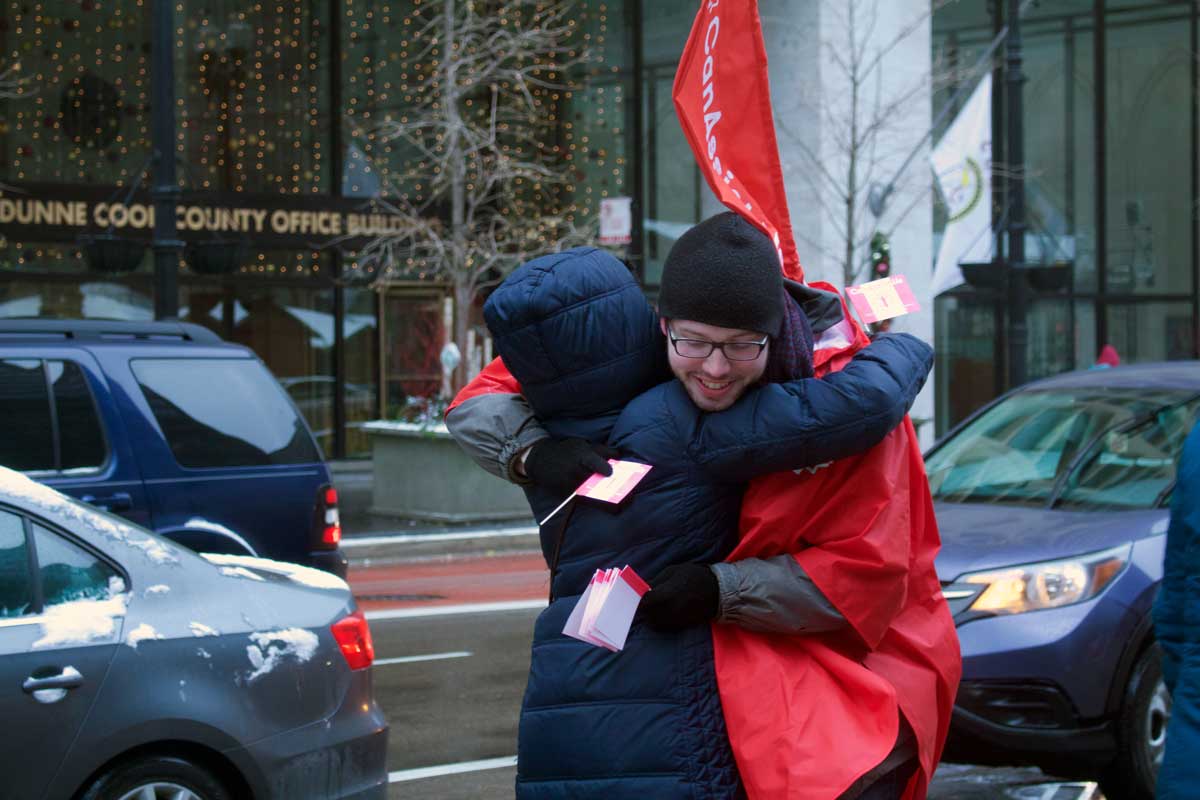
MFA student Cat Bluemke pitched this particular intervention, drawing on her Canadian background to imagine a near-future organisation called CanAssist.Us, and following her lead, the whole class worked together to bring it to life in the streets of Chicago. Below is an email interview with Cat (edited for length and clarity).

***

What is the premise of this project?

CanAssist.Us is a [hypothetical] private company that helps clients navigate the Canadian immigration system for Americans under President Trump. The project channels the anxieties driving this escapism into critical review of the individual’s responsibility within their community to challenge complacency in this reality.


What is the near-future situation you created for people to bring that scenario to life?

The initial ideas for the project were obvious once a few days had passed since the American presidential election results. CanAssist.Us is an absurd but potential reality from a near “post-truth” future (02018, perhaps). Using the familiar form of sidewalk canvassing, the performers offered the ultimate service to "get away from it all".

Once a member of the public engaged, the structure of this American future came into the picture: dehumanising "reform"; life-threatening retraction of health services; and destructive global relations; all promises of a Trump presidency.

[A short questionnaire quickly showed how simply quitting America might not be so straightforward; but to channel people's real concerns productively, and help them manifest the ideal of "Canada" locally,] suggestions for immediate action were presented as workshops the audience could take in their own communities. [These included Multicultural Awareness, Intersectionality, and Anger Management -- as well as popular intensive courses such as Poutine 101.]

How did the public react?

Satire is a great tool for starting a conversation, a united front can exist through a well-structured joke. Structuring that joke to include everyone -- consistent with our urge of a united, intersectional left -- was the difficult part. However, after establishing our position through humour, once we began working with the public, the conversations came easy. The reactions were overwhelmingly positive.


Where does this project sit in relation to other things you've seen that aim to deal with the emerging state of American politics and futures?

The Black Lives Matter movement deserves enormous credit for its accomplishments as a platform for multiple systemic injustices to enter public scrutiny.

CanAssist.Us was more explicitly influenced by artists like Eva and Franco Mattes or the Yes Men, whose public interventions disrupt the complacency that has become the norm.

Where does it sit with respect to projects that you personally have done before?

Both in concept and in execution, CanAssist.Us complements the project Tough Guy Mountain, a group project based out of Toronto, Canada; part art collective, part postcapitalist advertisement agency, and part fantasy table-top RPG.

How does the design of this intervention speak to and work with concerns of the present? How does it make use of the future?

CanAssist.Us uses experiential futures to demonstrate what realities could still be averted, and to encourage the will of the individual to unite under this goal. The situation of our American reality makes the future a particularly urgent tool to engage with.

What challenges did you discover working in a guerrilla futures mode?

I think the whole group could agree that next time, we’d rather guerrilla future on a sunny beach. Jokes aside, the participation of the group members was key in the project, and I’m so thankful that everyone shared in the passion. The kind of improvisation and confidence that is required of a guerrilla futures practitioner is really incredible, but this kind of dedication is desperately needed in order to create a future reality that benefits us all.


***

Many thanks to Cat and the whole of the American Futures class for all their creative contributions, and willingness to brave the Windy City winter to enliven public conversation with an experiential flash-forward.

I appreciate this ingenious effort to turn an understandable sense of alarm, and the potential impulse to flee or turn away, into constructive engagement with possibilities for action in our communities today, through exploring what it means to bring "Canada" (code for "a better place") to where we are.

Our thanks also to Jonathan Solomon, Helen Maria Nugent, and office staff in the design department (AIADO) at SAIC for wonderful assistance and support.

And best wishes to all concerned, as this troubling new chapter begins in the grand experiment that is the United States.

The class and project team comprised Cat Bluemke, Angie Gonzalez, Miiko He, Josh Leslie, Stella Shen, Clint Stayton, Alexander Wilson, and several other students who wish to remain anonymous.

Update 01aug17: This project has been recognised at the 02017 Association of Professional Futurists (APF) Student Awards, taking second place in the Alternative Formats category. Congratulations team!

Related:
> Impacting the Social
> Future documentary
Introduction to Strategic Foresight
> The weight of alternatives
> Stephen Duncombe on the Art of the Impossible

Monday, June 27, 2016

Impacting the Social


Images: Candy Chang, Before I Die, New Orleans, 02011.

***

Last month a remarkable book was published by Designmatters at ArtCenter College of Design –– LEAP Dialogues: Career Pathways in Design for Social Innovation.

In the preface, editor Mariana Amatullo states that the work is "a first-of-its kind resource" directly addressing "change[s] in how design is taught, practiced and integrated into organizations, why these changes are happening, what is needed to support these new practices, and how designers can pursue these new career pathways". With 84 contributors across many themes, it's an impressively wide-ranging, substantial, and I might add, beautifully designed volume.

I'm thrilled to have a piece in LEAP Dialogues in the form of a conversation with artist Candy Chang, moderated by designer Bryan Boyer, who is also one of the collection's co-editors.

Bryan Boyer's wonderful stuff has appeared here at The Sceptical Futuryst before; he has since spent years working on pathbreaking projects and approaches in strategic design (e.g., In Studio: Recipes for Systemic Change, 02011, pdf).

Candy Chang's work includes marvellous participatory public projects such as Before I Die and I Wish This Was, as well as contributions to the Hypothetical Development Organization, a collaboration with Rob Walker and others which I delightedly backed on Kickstarter years ago, and regularly feature in talks about guerrilla futures practice.

Our dialogue appears in the book under the title "Impacting the Social".

***

Bryan Boyer: You both do projects that are performed in the real world, in the city. Why is this important to you?

Stuart Candy: I work across settings and formats—museums, galleries, boardrooms, conferences, universities, city streets. Operating in diverse sites from project to project is more important to me than any one project by itself. To my mind, all contexts of deployment are “real world,” although each has its own affordances, limitations and publics. The same goes for different media—online game, workshop, installation, mailout, design jam, short film and so on. To riff off Marshall McLuhan, each medium is a different massage. These different contexts of encounter, and alternative ways of massaging those contexts, are not merely interchangeable aesthetic options but design parameters: how would you like to massage those you wish to engage?

Experiential futures practice is location and medium agnostic because it is more about enabling futures than using or advancing a particular mode of expression. Anything that you can cause to happen to, with and for someone is, in principle, fair game; the entirety of experience, the whole of the sensorium, is the canvas or design space. The term “experiential futures“ tries to convey this encompassing, transmedia idea of the range of options at our disposal. The corollary is that each intervention within the practice must be highly specific to topic, site, time, audience, etc.

What‘s interesting to me about urban settings is that they are less scripted. I find it important to be prepared to use unscripted places because most people, thoughts, decisions aren‘t necessarily happening where one has an invitation. When there is something that people should perhaps be considering, and they aren‘t aware of or able to enter the museum or workshop or boardroom or town hall where the conversation is officially convened, it can be useful to instead bring the conversation to them.

This is how our “guerrilla futures“ practice emerged. Formal, solicited projects often encounter roadblocks, and since you have to adapt to constraints in any project, it can be interesting to work with “found” challenges and opportunities instead.

Candy Chang: I’m interested in how places shape us. I studied urban planning and at the same time I made street art, which led me to think more deeply about public spaces. In a built environment where citizen’s flyers are illegal yet businesses can shout about their latest products on an increasing number of surfaces, we need to consider how public spaces can be better designed so that they’re not necessarily allocated to the highest bidder, but also reflect our needs as a community and as individuals. The places we share have a lot of potential to help us connect, reflect and make sense of our communities and our lives together. William Whyte’s The Social Life of Small Urban Spaces encouraged me to trust my real world experiences, and making street art gave me the moxie to just try things out and see what happens.

I’m an introvert, and the participatory public art projects start- ed out as a way to ask my neighbors things I was too shy to ask in person—or as a way for the quieter people to share just as much as the loud ones. Over time I realized these installa- tions had other benefits. They’re anonymous, so you can open up in ways you might not have otherwise. They allow people to easily participate on their own time. And they’re places where we can collectively reflect together. I think Stuart’s work does that well in his own way, and I admire his democratic approach to foresight work. I’ve been interested in creating safe spaces for honesty and vulnerability, and I like how Stuart is interested in making “safe spaces for dangerous conversations.”

SC: One doesn’t really get anywhere very interesting with futures until one starts to entertain possibilities that deeply challenge current ways of thinking. I’m invoking the spirit of philosopher Alfred North Whitehead here (“It is the business of the future to be dangerous”) as well as my mentor, Jim Dator (“Any useful statement about the future should at first appear to be ridiculous”). A company may be facing some change in the market that no one in it recognizes; a government may need help even to see, let alone respond to, unexpected shifts in the political landscape. In any case, the “dangerous conversation” confronts that which is uncomfortable and vulnerable, and therefore marginalized, but potentially transformative. Likewise for other kinds of community, and for individuals. Creating a safe space for that means first of all finding ways to suspend the very powerful reflex of avoiding such sensitive topics.

One of our earliest experiential futures projects was for the State of Hawaii, almost a decade ago, to kick off a sustainability planning process across the islands. Together with Jake Dunagan, and with the help of others at the Hawaii Research Center for Futures Studies, we immersed 550 people, ordinary citizens and elected representatives alike, in four alternative versions of the islands in the year 2050. One of the four was set in the wake of a global economic implosion in the 2040s, followed by an interval of chaos before the United States military intervened to maintain law and order. With the old economic and political regime discredited, they reinstated the monarchy that the U.S. had overthrown in 1893.

As an experiential scenario, then, participants entering the room found themselves cast as climate change refugees being naturalized as citizens of the so-called “Democratic Kingdom of Hawaii,” a military governance regime with a veneer of local culture. Here the experience provided a container in which some potentially discomfiting prospects could be engaged: you’re already in the scenario by the time the rational mind starts to mount intellectual or political objections. As we say, it’s better to be surprised by a simulation than blindsided by reality. Such a conversation may be difficult, but it can’t hurt you nearly as much as not having it can.At other times, offering hospitality to dangerous ideas can take the form of adopting processes designed to include people and elicit views that might otherwise (if often unintentionally) be left out. For many years I’ve used Open Space Technology, a participant-centered way of running meetings of almost any size, and organizations like the engineering firm Arup, as well as the Singaporean government, the leadership of Oxford University, and the team behind the regional Burning Man event in Australia were all able to overcome initial discomfort with the emergent character of the process to explore their potential contexts and choices more freely and more effectively than usual.

BB: Who are your projects for?

CC: They’re for everyone—or at the very least for me! They’re a way to satisfy my curiosity. My projects are more psychological now, but they started out very civic-minded. When I lived in New York City, I learned about Jane Jacobs and how she rallied her community to prevent the Lower Manhattan Expressway from being built in 1962. It still shocks me to think how different New York would be today if the Lower Manhattan Expressway happened, because the “slums” Robert Moses tried to clear out are now some of the greatest neighborhoods in the city. It made me think about all the cities that could have been, and how all the cities that we have today depend on who gets involved. When we make democracy more accessible, we make places that are more loved, more cared for and more meaningful to us for the rest of our lives. If we believe in greater democracy, our unbridled creativity is now required to design the situations in which this can happen.

That’s what I like about Stuart’s immersive, thought-provoking scenarios for residents to contemplate and kick around and challenge. It’s fun and engaging. There was a lot of talk in my urban planning classes about participatory planning as if we were holding the doors back to an excited, well-informed mob. In reality, there is no crowd on the other side of the door. Many people have an ambiguous understanding of civic processes, and many others are simply turned off by them. I’ve been to many community meetings that are so dreary, only the angry neighbors are excited enough to show up. There are a lot of opportunities to re-imagine civic engagement so that people are inspired to get involved in shaping the future of their community.

SC: A colleague asked recently whether thinking about the future is a privilege or a right. Unfortunately, it’s actually a luxury. Many may have the motive, but few have the means or the opportunity. But this is not how things ought to work. Normatively, thinking about futures is everyone’s right. My work is interested in making futures more available, accessible, habitual. It’s about urging people to claim their license to spend time and creative effort there. With this broad mission in mind, participation can look very different from one engagement to another.

I think this work is for people willing to ask questions and entertain new ideas about the future. That’s less a demographic than a psychographic—or better, a mindset—that you try to bring out among whoever comes along, by providing opportunities to think differently.

Another aspect of “who is this for,” is that currently I do a good deal of work in an education setting. OCAD U has the world’s first academic program in design and foresight, that’s what drew me there. It’s exciting to help spread this practiceto where practitioners are trained. This lets us access a higher leverage point in the system—how emerging designers are acculturated. You try things out by setting briefs and developing methods, then see how a range of different minds adapt and work the process through. The classroom becomes a lab, and students—bringing their own backgrounds and concerns, intentions and publics—extend experimentation into places one might not think or choose to go oneself. I find this a more generative way to work than just doing my own stuff all the time, and it also ultimately makes the work “for” a wider and more flexible constituency.

BB: Are your projects provocations, or something else?

CC: Each project is an experiment that challenges what our public spaces are fundamentally made of and how they might better reflect what we value as human beings. After I lost someone I loved, I went through a long period of depression.I made the Before I Die project as a way to make sense of my grief and find consolation with my neighbors. Their responses helped me more than they will ever know, and I’ve learned just how universal our struggles and desires are after reading responses from Before I Die walls in over 70 countries. I saw even more struggles in the Confessions project. From my experiences, people are yearning for safe spaces to be honest and vulnerable with the people around them. It’s cathartic and consoling. You’re not alone as you’re trying to make sense of your life. You’re not the only one who feels like they’re barely keeping it together.

During one of my gloomiest periods of existential confusion,I found a lot of comfort in a book called The Middle Passage by Jungian analyst James Hollis. He said, “In the end, we are only tiny frightened animals, doing our best to survive amid other tiny frightened animals.” This always consoles me. I returnto this sentence when I lose perspective, and it’s somethingI remember when I consider our communities. Our personal anxieties extend into our public life and many of the conflicts in our communities come from a lack of trust and understanding. There are a lot of barriers to opening up and while the barriers remain, it’s easy to forget the humanity in the people around us and become impersonal, and even adversarial. These personal, anonymous prompts offer a gentle first step towards honesty and vulnerability in public, which can lead to trust and under- standing. These are essential elements for a more compassionate society. They’re essential elements for social cohesion.

SC: A provocation can spur thought when it succeeds, but sometimes it generates rejection. There’s probably a need to invite or seduce as often as to provoke. I’m interested more and more in projects—and Candy has done many of these wonderfully—that enable people to generate their own ideas, as opposed to responding to ours.

The Thing From The Future, for instance, is a card game that my Situation Lab co-director Jeff Watson and I designed. People have used it as a tool for warming up to strategic conversation, for design ideation and prototyping, and as a party game played for fun. This combinatorial prompt generator, as you understand how it scaffolds imagination, becomes very adaptable and useful. We recently released the game under a Creative Commons license so players can customize it more easily to their local contexts and needs. I like projects that offer frameworks for participation and produce surprises. Instead of specifying an experience in every detail, they offer conditions that invite others to grow their own.

BB: What does the future mean to you? Is it a worry, an invitation, something else entirely?

SC: Ashis Nandy calls futures a “game of dissenting visions.” It’s a gift of sorts, a psychedelic playground where we can make new perceptions and actions possible, and incubate real and far-reaching change.

Another brilliant cultural commentator from India, Shiv Visvanathan, invites us to see the future as a commons. I love this idea. Public imagination is the ultimate renewable resource; we are still learning how to use it wisely.

CC: The future is something I’m excited to shape with others. I’m interested in the relationship between public space and mental health. The urban historian Lewis Mumford once wrote that the origin of society, the reason we came together in the first place, was not just for pure physical survival but also for “a more valuable and meaningful kind of life.” Some of the first gathering places were graves and sacred groves. We gathered to grieve together, worship together, console one another and wonder together. I think one of the greatest missions of modern cities is emotional communion. Not only does this serve fundamental needs of the human spirit, it cultivates compassion and trust, which are vital for civic respect and collaboration. I’d like to expose more of our interior world in public so attention to mental health becomes less stigmatized. I’m currently creating a public device for philosophical reflection that is inspired by the I Ching.

I’m also intrigued by how we deal and don’t deal with death. After anthropologist Ernest Becker wrote the book The Denial of Death in 1973, a theory emerged called terror management. In a nutshell, it argues that legitimate anxiety about our impending deaths was solved by creating cultures that provide comforting arrangements, including the hope for immortality. Immortality can be literal, as in heaven or reincarnation,or symbolic, as in publishing a book or having children. Our current cultures try to give us meaning and value, but they can also distract us and take us away from the deep encounter with ourselves. This helps to remind me that culture is man-made and we can change it.

***

LEAP Dialogues –– all 360 glorious pages of it –– is available to order here.

(Update 14jul16: pdf of the above interview can be found here.)

Related:
> Designing futures
> Architectural time travel
> Strategic foresight meets tactical media
Dreaming together

Wednesday, May 11, 2016

NaturePod™


What if you could reap the health benefits of spending time in nature––for productivity, creativity, and stress relief––without even leaving your office?

All this is coming soon to a cubicle near you.

Canada's largest architecture and design trade show recently saw the global launch of a new product called NaturePod™.

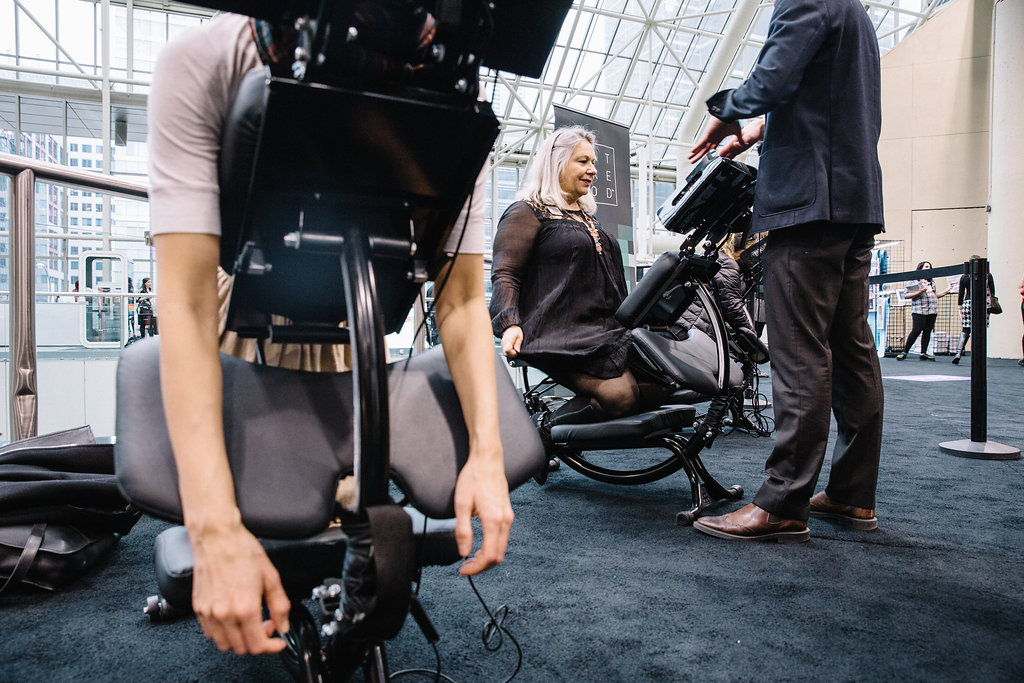
Each unit provides intensive personal exposure to sounds, imagery, and (selectively) smells of various natural environments. The system gently guides the user through its Natural Resonance Imaging® technology, which maps the brain's real time responses to specific stimuli. A helpful Relaxation Status Display appears in the field of view throughout.

Capitalising on the latest findings in environmental neuroscience, the product's Toronto-based creators claim that their patented personal wellness system brings restorative benefits equivalent to, or even greater than, nature in the raw.


At IIDEXCanada, all a new user had to do to get started was adjust the Pod Body to their particular dimensions, and calibrate the Pod Headset's stereoscopic display to their personal IPD (interpupillary distance), before immersing in one of three demo environments: a lush valley mid-summer, snow-covered mountains in winter, or a temperate forest in spring.

Of thousands in attendance at this annual design exhibition and conferences––which included summits on Healthcare, Wellness, and Accessibility in the built environment––many who got to try NaturePod™ first hand were immediately enchanted, and prepared to buy or lease the devices on the spot.

But frankly, reactions were mixed. A few declared their horror at the idea that anyone might try to substitute a new gadget for the experience of forest.

Even so, no one appeared to have any difficulty believing that this was a real product being offered to mitigate the chronic disconnect of modern urban dwellers from the experience of nature.

In fact NaturePod is design fiction––for now.

It's an experiential foresight project in the public interest; a scenario set five years into the future but brought to life today, created by a team of graduate students from OCAD University's Strategic Foresight and Innovation program, and led by me under Situation Lab auspices.

Neither a prediction nor a preference, but a provocation, we wanted to use design and performance to invite consideration of how our relationship to nature in cities is changing, and contribute to a dialogue about potential differences between our current direction, and what we might collectively want.

The people in the video above are responding to a direct experience, not to a hypothetical question.

***

"Powerful critical design does not present itself as critical design. Powerful design fiction does not present itself as fiction."
- Matt Manos

***


***

A few hints about the future setting were planted, including a full-page advertisement in the Show Catalogue announcing the release of the product in Fall 02021, but we were shooting for present-day realism in the encounter. The aim was to let folks come to their own genuine conclusions about the whole idea before the hypothetical status was revealed. The story told in the video has the same structure.

This unusual project grew out of a Time Machine, an Experiential Futures module that I created in 02013 and have taught each semester for the past three years at OCAD University.

That particular run of the Foresight Studio course, just over a year ago, was co-taught with the marvellous Suzanne Stein. One group of our students––Bergur Ebbi Benediktsson, Nourhan Hegazy, Jennifer McDougall, and Prateeksha Singh––spent the semester exploring the futures of humanity's relationship with the environment. When it came to the Time Machine, their response was ingenious; they created a "Nature Deficit Disorder Clinic" from 02040. In this experiential scenario set a generation from today, daily contact with nature is rare. The deficit is both ubiquitous and medicalised. People try to mitigate it with oxygen supplements and exposure to simulated forest, gauging their progress via brain scans.

A top Canadian environmental advocacy organisation, the David Suzuki Foundation, had served as this group's external partner throughout the class, and at their request we re-staged the NDD Clinic on Earth Day 02015 for the Foundation's employees and industry partners. Among the attendees was Canada's head of marketing for Interface, Inc.

Interface is a rather remarkable company. (You might know them from the documentary The Corporation, and especially the influential voice of their late founder Ray Anderson.) They're the world's leading carpet tile manufacturer, and also a global trailblazer in corporate sustainability. By no means is this a typical combination.

They engaged Situation Lab to create an experiential scenario to nudge their customers and others towards a deeper conversation about humanity's changing relationship to nature in the built environment. The same highly talented group of four graduate students came aboard to adapt the original concept for a totally different context: instead of a room-specific, 20-minute immersive installation for a captive audience of 20-30 members, we were to make this experiential scenario available to thousands of people over two full days at one of the largest expositions of its kind in North America.

Now, in the architecture and interior design world, it turns out that there is already lively discussion underway about (E.O. Wilson's term) "biophilia" in a design context, for instance in the 02015 report, Human Spaces: The Global Impact of Biophilic Design in the Workplace.

Biophilia refers to the "instinctive bond between human beings and other living systems"; a bond variously accommodated or cheerfully ignored by present urban and building designs. We designed NaturePod as an experiential contribution to both broaden and deepen the conversation. What are the implications for our wellbeing of trying to close the nature gap using increasingly sophisticated imitations? Where might that lead?

While evidently exercising a degree of creative licence to prototype possibilities from half a decade out, our imaginings were tied to real research. Readers curious about the current science behind these developments in nature simulation and related themes can find plenty of material for further investigation (for example: de Kort et al, 02006Kahn et al, 02008Kahn et al, 02009Kjellgren and Buhrkall, 02010;  Valtchanov, 02010; Valtchanov et al, 02010Valtchanov and Ellard, 02015).

What I love about the project is that this visionary company took such an unusual step, sponsoring a guerrilla futures intervention to urge industry and public engagement with issues that matter and affect everyone. (To the extent that corporate entities have engaged in experiential futures or speculative design previously, the results have tended toward the shamelessly commercial and trite, as Noah Raford has persuasively argued.)

NaturePod™ comes almost a decade after the first experiments in what we've come to think of as a special strand of publicly-oriented foresight work. Guerrilla futures combines strategic foresight and tactical media to produce unexpected encounters with possible worlds (see FoundFutures, for instance). Injecting possibilities into the present lets us think and feel new potentials, not "merely" hypothetical, in a mode of exploration squarely located where serious investigation meets play. (See Chapter 5 of The Futures of Everyday Life for more.)

This may be a first for corporate use of experiential futures / design fiction in guerrilla mode, and it is our hope that it provides a bracing contribution to design conversation far and wide.

Thanks and bravo to Interface, and to our marvellous design team: Berg, Jennie, Nour, and Prat! Huge thanks to all participants, assistants, volunteers and supporters; full project credits appear beneath the video.


Stills by Connie Tsang.
Videography by Filip Vukcevic.

Related:
Strategic Foresight meets Tactical Media
> The Futures of Everyday Life
> Guerrilla futures performance at South by Southwest
> FoundFutures: Chinatown