Showing posts with label VR. Show all posts

Tuesday, July 04, 2017

Could this be the future of parenting?


NurturePod installation and photos by Stuart Candy

This experiential scenario from a not too distant future, my first "solo" art museum installation (really, all this work is highly collaborative), is now live at M HKA, the Museum of Contemporary Art in Antwerp, Belgium.

Futurist/journalist Andrew Curry and I recently had a chance to chat about the project for an upcoming issue of the Association of Professional Futurists quarterly, Compass. Many thanks to Andrew and APF for sharing the transcript below (edited for clarity and length).

***

Andrew Curry: What we have here is a very small baby –– not a real baby –– in a little pod surrounded by all sorts of digital stimulus looking after her or his needs. This is a "programmable para-parenting pod", which basically removes the need for parents to get involved, as far as I can tell. It's a bargain at €789, obviously. What was the brief, Stuart?

Stuart Candy: The brief for A Temporary Futures Institute was to create some kind of a design contribution corresponding to Dator's generic images of the future; grow, collapse, discipline or transform, and I was assigned "transform". I had this quite large space and could basically do anything that fit the budget and time. To get from those broad parameters to the final installation really started from the name. There was a prior project (which appeared in Compass) called NaturePod, a hypothetical product from a handful of years away, addressed to stressed-out office workers who may need to reduce their cortisol levels and increase productivity by spending time in nature, without leaving their cubicles. That was a provocative take on what happens when you marry supposedly biophilic interior design trends to virtual reality.

AC: So this is a kind of companion piece?

SC: Right. It came about in a conversation with my longtime collaborator, Jake Dunagan –– a lot of our work is based on wordplay and being silly –– and he said, "well, when you're done with NaturePod, you should do NurturePod, ha ha ha". He was joking, but I thought it was a brilliant idea. Then this opportunity came along, and I realised that, while this might not be my idea of a transformation, it does actually correspond to a popular notion about what immersion in virtual environments means.

AC: It comes with all this very nice packaging and sales material. Clearly something about the commercialisation of it engaged you.

SC: A lot of the experiential futures work I've done is about bringing encounters with futures into an everyday context. Hence guerrilla futures projects like NaturePod; we launched it at an architecture and design trade show, so the people who came across it thought it was real. The organisers of the trade show knew what we were up to, but the thousands of others attending didn't. I was interested in trying to import the lessons and techniques from creating encounters "in the wild" into the cube of a contemporary art museum. That's why this piece is not sitting on a white box; it's sitting on the kind of table you might find in an Apple Store.


AC: The NurturePod box has all the kind of labelling detail you would expect to see in a package. Is that part of the experience as well?

SC: I think the attention to detail that makes a hypothetical resemble the real is an important part of this practice. It is intended to invite, not a suspension of disbelief exactly, but more an investment of belief, a kind of willing desire on the part of the viewer to say okay, suppose that I did come across this in a few years' time. What do I think about that? What do I feel about that? I think the details provide added dimensions of engagement so they can dive deeper, if they want to. Most people are probably going to engage with the main image; a glanceable, instagrammable baby in a pod wearing a headset. But for those who take the time, there is more detail to enjoy, or be dismayed by, according to your taste.

AC: There's a little tag, "control baby's experience with the NurturePod App", and a kind of WiFi, Bluetooth-type logo suggesting I can download it. I haven't actually tried to do that; I'm guessing that bit might not be real?

SC: That's right, it does break at a certain point because it isn't real, but it's supposed to feel like it is. All of these messaging elements are scaffolded in detail on existing products, and existing idioms that we recognise subconsciously, being citizens of the early 21st century. We’re literate in ways we don’t even realise about the semiotics of marketing, and electronics in particular. This is using that language to get something across about a seemingly imminent possibility.

AC: One more thing that strikes me about this, about the languaging, is it's not just about marketing. There are a whole lot of cues about the idea of the new, the idea of the modern, and the classic ways in which technology companies make us feel inadequate and then sell us reassurance.

SC: I suppose using those tropes could be said to invite reflection on how embedded in the tropes we are, because we know this particular thing doesn't exist. But that's a bit of an intellectual angle. I find people's emotional responses interesting, from watching them interact with it and from what they've shared in conversation.

AC: What sort of things have they said?

SC: "I'm really drawn to this, and also repulsed by it." There's this sense of being torn, and that is quite satisfying to hear, because I think creating or inviting a complex emotional response is something that we should strive for in futures work. This is why design and film and performance and games are important –– the whole repertoire of approaches to experiential futures; like the proverbial toothbrush that reaches places regular ones can't. Hopefully we are on our way to a better futures toothbrush.


***

The NurturePod installation is just one part of A Temporary Futures Institute (ATFI), a boldly experimental M HKA exhibition which opened in April, curated by Anders Kreuger and Maya Van Leemput.

(M HKA was also the main venue for Design Develop Transform, where Kelly Kornet and I recently presented the Ethnographic Experiential Futures framework.)

There are some stellar artists featured in ATFI (including Michel Auder, Miriam Bäckström, Alexander Lee and Darius Žiūra), and the other futurists involved in the exhibition are Agence Future (Maya Van Leemput and Bram Goots, Belgium), The Centre for Postnormal Policy & Futures Studies (Ziauddin Sardar and John Sweeney, UK/US), and Mei Mei Song (Taiwan).

Show runs until 17 September –– so if you're within range of Antwerp, check it out!

Acknowledgements:
- Seth Keller and Kazuki Guzmán, Fabrication consultants
- Tarik El-Khateeb, Graphics consultant
- Special thanks: Maya Van Leemput and Anders Kreuger (for curating ATFI); Bram Goots (for crucial logistical help), Ceda Verbakel (for copywriting assistance); Giulia Bellinetti, Georges Uittenhout, and the rest of the team at M HKA (for essential technical support); Jake Dunagan (for inspiration); Jessica Charlesworth, Ilona Gaynor, the Toronto Uterati (for helpful conversations)

See also (last updated 16aug17):
- Features in VICE and Boing Boing
- Opinion piece in The Irish News on NurturePod and the future of parenting
- Bruce Sterling's repost of the interview above at Wired
- Article from Harpers Bazaar on what to see at A Temporary Futures Institute
- Video from ARTtube about ATFI (5 1/2 mins)
- Show summary from Belgian newspaper De Morgen (in Dutch)
- ATFI exhibition brochure (pdf)
- Two contemporary artists I greatly admire whose work has influenced this piece one way or another: Patricia Piccinini and Ron Mueck

Related:

Wednesday, May 11, 2016

NaturePod™


What if you could reap the health benefits of spending time in nature––for productivity, creativity, and stress relief––without even leaving your office?

All this is coming soon to a cubicle near you.

Canada's largest architecture and design trade show recently saw the global launch of a new product called NaturePod™.

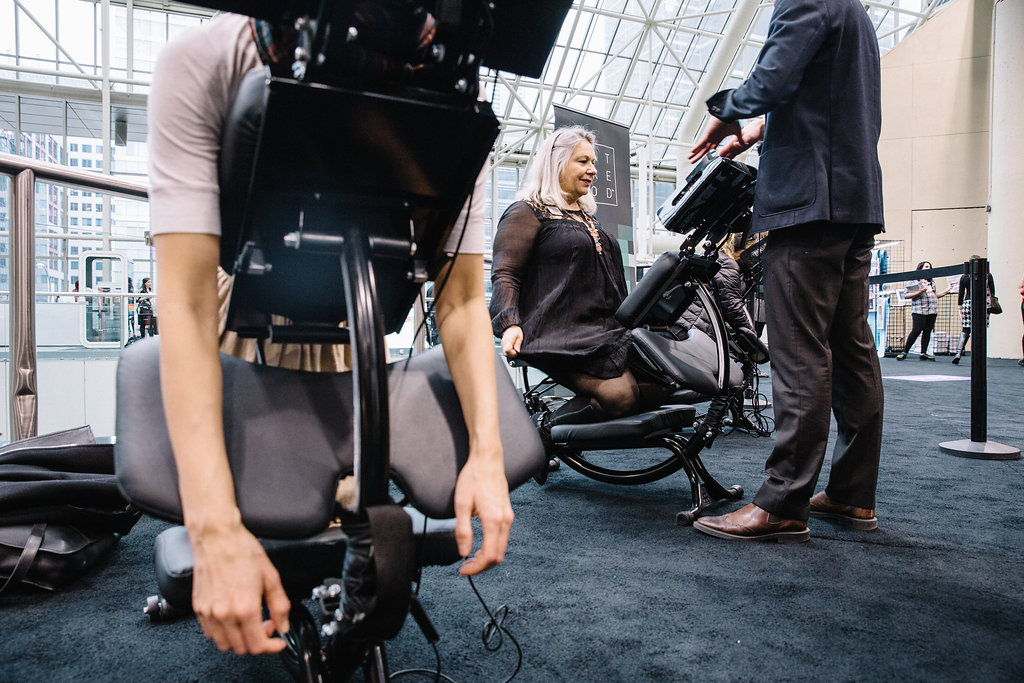
Each unit provides intensive personal exposure to sounds, imagery, and (selectively) smells of various natural environments. The system gently guides the user through its Natural Resonance Imaging® technology, which maps the brain's real time responses to specific stimuli. A helpful Relaxation Status Display appears in the field of view throughout.

Capitalising on the latest findings in environmental neuroscience, the product's Toronto-based creators claim that their patented personal wellness system brings restorative benefits equivalent to, or even greater than, nature in the raw.


At IIDEXCanada, all a new user had to do to get started was adjust the Pod Body to their particular dimensions, and calibrate the Pod Headset's stereoscopic display to their personal IPD (interpupillary distance), before immersing in one of three demo environments: a lush valley mid-summer, snow-covered mountains in winter, or a temperate forest in spring.

Of thousands in attendance at this annual design exhibition and conferences––which included summits on Healthcare, Wellness, and Accessibility in the built environment––many who got to try NaturePod™ first hand were immediately enchanted, and prepared to buy or lease the devices on the spot.

But frankly, reactions were mixed. A few declared their horror at the idea that anyone might try to substitute a new gadget for the experience of forest.

Even so, no one appeared to have any difficulty believing that this was a real product being offered to mitigate the chronic disconnect of modern urban dwellers from the experience of nature.

In fact NaturePod is design fiction––for now.

It's an experiential foresight project in the public interest; a scenario set five years into the future but brought to life today, created by a team of graduate students from OCAD University's Strategic Foresight and Innovation program, and led by me under Situation Lab auspices.

Neither a prediction nor a preference, but a provocation, we wanted to use design and performance to invite consideration of how our relationship to nature in cities is changing, and contribute to a dialogue about potential differences between our current direction, and what we might collectively want.

The people in the video above are responding to a direct experience, not to a hypothetical question.

***

"Powerful critical design does not present itself as critical design. Powerful design fiction does not present itself as fiction."
- Matt Manos

***


***

A few hints about the future setting were planted, including a full-page advertisement in the Show Catalogue announcing the release of the product in Fall 02021, but we were shooting for present-day realism in the encounter. The aim was to let folks come to their own genuine conclusions about the whole idea before the hypothetical status was revealed. The story told in the video has the same structure.

This unusual project grew out of a Time Machine, an Experiential Futures module that I created in 02013 and have taught each semester for the past three years at OCAD University.

That particular run of the Foresight Studio course, just over a year ago, was co-taught with the marvellous Suzanne Stein. One group of our students––Bergur Ebbi Benediktsson, Nourhan Hegazy, Jennifer McDougall, and Prateeksha Singh––spent the semester exploring the futures of humanity's relationship with the environment. When it came to the Time Machine, their response was ingenious; they created a "Nature Deficit Disorder Clinic" from 02040. In this experiential scenario set a generation from today, daily contact with nature is rare. The deficit is both ubiquitous and medicalised. People try to mitigate it with oxygen supplements and exposure to simulated forest, gauging their progress via brain scans.

A top Canadian environmental advocacy organisation, the David Suzuki Foundation, had served as this group's external partner throughout the class, and at their request we re-staged the NDD Clinic on Earth Day 02015 for the Foundation's employees and industry partners. Among the attendees was Canada's head of marketing for Interface, Inc.

Interface is a rather remarkable company. (You might know them from the documentary The Corporation, and especially the influential voice of their late founder Ray Anderson.) They're the world's leading carpet tile manufacturer, and also a global trailblazer in corporate sustainability. By no means is this a typical combination.

They engaged Situation Lab to create an experiential scenario to nudge their customers and others towards a deeper conversation about humanity's changing relationship to nature in the built environment. The same highly talented group of four graduate students came aboard to adapt the original concept for a totally different context: instead of a room-specific, 20-minute immersive installation for a captive audience of 20-30 members, we were to make this experiential scenario available to thousands of people over two full days at one of the largest expositions of its kind in North America.

Now, in the architecture and interior design world, it turns out that there is already lively discussion underway about (E.O. Wilson's term) "biophilia" in a design context, for instance in the 02015 report, Human Spaces: The Global Impact of Biophilic Design in the Workplace.

Biophilia refers to the "instinctive bond between human beings and other living systems"; a bond variously accommodated or cheerfully ignored by present urban and building designs. We designed NaturePod as an experiential contribution to both broaden and deepen the conversation. What are the implications for our wellbeing of trying to close the nature gap using increasingly sophisticated imitations? Where might that lead?

While evidently exercising a degree of creative licence to prototype possibilities from half a decade out, our imaginings were tied to real research. Readers curious about the current science behind these developments in nature simulation and related themes can find plenty of material for further investigation (for example: de Kort et al, 02006Kahn et al, 02008Kahn et al, 02009Kjellgren and Buhrkall, 02010;  Valtchanov, 02010; Valtchanov et al, 02010Valtchanov and Ellard, 02015).

What I love about the project is that this visionary company took such an unusual step, sponsoring a guerrilla futures intervention to urge industry and public engagement with issues that matter and affect everyone. (To the extent that corporate entities have engaged in experiential futures or speculative design previously, the results have tended toward the shamelessly commercial and trite, as Noah Raford has persuasively argued.)

NaturePod™ comes almost a decade after the first experiments in what we've come to think of as a special strand of publicly-oriented foresight work. Guerrilla futures combines strategic foresight and tactical media to produce unexpected encounters with possible worlds (see FoundFutures, for instance). Injecting possibilities into the present lets us think and feel new potentials, not "merely" hypothetical, in a mode of exploration squarely located where serious investigation meets play. (See Chapter 5 of The Futures of Everyday Life for more.)

This may be a first for corporate use of experiential futures / design fiction in guerrilla mode, and it is our hope that it provides a bracing contribution to design conversation far and wide.

Thanks and bravo to Interface, and to our marvellous design team: Berg, Jennie, Nour, and Prat! Huge thanks to all participants, assistants, volunteers and supporters; full project credits appear beneath the video.


Stills by Connie Tsang.
Videography by Filip Vukcevic.

Related:
Strategic Foresight meets Tactical Media
> The Futures of Everyday Life
> Guerrilla futures performance at South by Southwest
> FoundFutures: Chinatown

Wednesday, May 30, 2007

Found futures

...in your mailbox?


Last week, a cross-section of Hawaii's influential business, political and community leaders received a series of mysterious postcards in the mail -- no return address supplied -- from the year 02036.

On Monday, it was an official (non-diplomatic) invitation from the sovereign "Commonwealth of Hawai'i".

On Tuesday came a promotional flyer, in the form of a vintage Hawaiian postcard, from a virtual reality company advertising a trademarked, immersive electronic version of the mythical "Blue Hawaii" of the 01960s.

On Wednesday, a souvenir postcard appeared from the Two Seasons Underwater Hotel and Casino, adjacent to the East-West Maui Bridge in buzzing "Mauihattan".

Finally, Thursday brought a plea for help addressed to the United Nations, headquartered in China, on behalf of a beleaguered Hawaii suffering from mob rule and guerrilla warfare in the wake of Hurricane Cyrus.

The following Sunday, 27 May, the Honolulu Advertiser ran this article investigating the campaign. (You can see the front side of each postcard here.†) The cards were also distributed to be found by other unsuspecting members of the public, in places such as cafes and bookstores around Honolulu.

This was an experimental exercise in "ambient foresight" -- bringing alternative futures to the streets, and into people's lives in unexpected ways. The signs so far encourage us to think that this modest effort did indeed prompt a degree of reflection on the part of recipients, about the various directions Hawaii could take over the next generation or so.

FoundFutures is the name of the project, which is likely to manifest in other ways as time goes on. Many thanks to all those who helped Jake and I make this possible, most notably our exceptionally talented graphic designers, Yumi Vong (postcards) and Matt Jensen (website).

[Update 6 December 02007: replaced original -- dead -- link to Advertiser article with new -- permanent? -- one. Update 3 September 02016: fixed link to postcard image.†]