Showing posts with label Time Machines. Show all posts

Thursday, October 09, 2025

Building Time Machines at California Institute of Technology

I haven’t posted here for ages – a story for another time.

Today, I’m writing to share something I’m focused on right now.

This weekend I’m starting a stint as Artist in Residence at Caltech Theater. This is tremendously exciting to me – a chance to bring experiential futures, worldbuilding, and high-speed co-creation to a remarkable and storied institution. For example, one of the spaces we’ll be working in is the Feynman Room, named for the legendary bongo-playing Caltech physicist and Nobel laureate who was active in the theatre community there.

Our first event coming up is called “Immersive Futures Jam” – IFjam for short.

With a select group of participants, including undergraduates, graduates, alumni and staff from Caltech, as well as folks from NASA Jet Propulsion Laboratory and the wider community, we’ll be embarking on an ambitious co-creative process; producing immersive, you-are-there experiences of various futures, at the scale of a room, over the span of a weekend.

In a hat-tip to H.G. Wells, I call such room-scale future immersions “Time Machines”. Without quite meaning to, we essentially piloted a highly adaptable format two decades ago in Hawaii, and I’ve since modularized and sharpened it through numerous iterations – in Canada, Mexico, the UK, Singapore, and various parts of the US – with hundreds of students, colleagues, and intrepid volunteer time travellers. This is the first time I’m running it in California.

The very possibility of this edition of IFjam comes down to the vision and will-to-experiment of the unique creative force that is Brian Brophy, Caltech’s long-serving director of Theater Arts. We got to know each other over the past few years while working together on the NASA JPL show Blended Worlds; JPL’s contribution to the most recent instance of Getty Museum’s once-a-decade initiative PST.

A fuller treatment of Time Machines is in the pipeline. But for a sense of how they can look and something of the underlying process, a few starting points: A Pecha Kucha talk given years ago in Chicago. A short piece from The Futurist (the periodical of the World Future Society, as was). And another one from The Economist.

Stay tuned.

Related:
> Experiential Futures for NASA JPL (Library of Possibilities)
> A Time Traveller's Story
> Experiential Futures in The Economist (pdf version)
> Time Machines in The Futurist (pdf)
> Bringing futures to Stanford d.School
> Futures for Bristol
> Ghosts of Futures Past (Hawaii 2050)
> Time Machine / Reverse Archaeology (pdf)
> Using the Future at NASA (pdf version)

Wednesday, May 22, 2024

Look out, Banksy

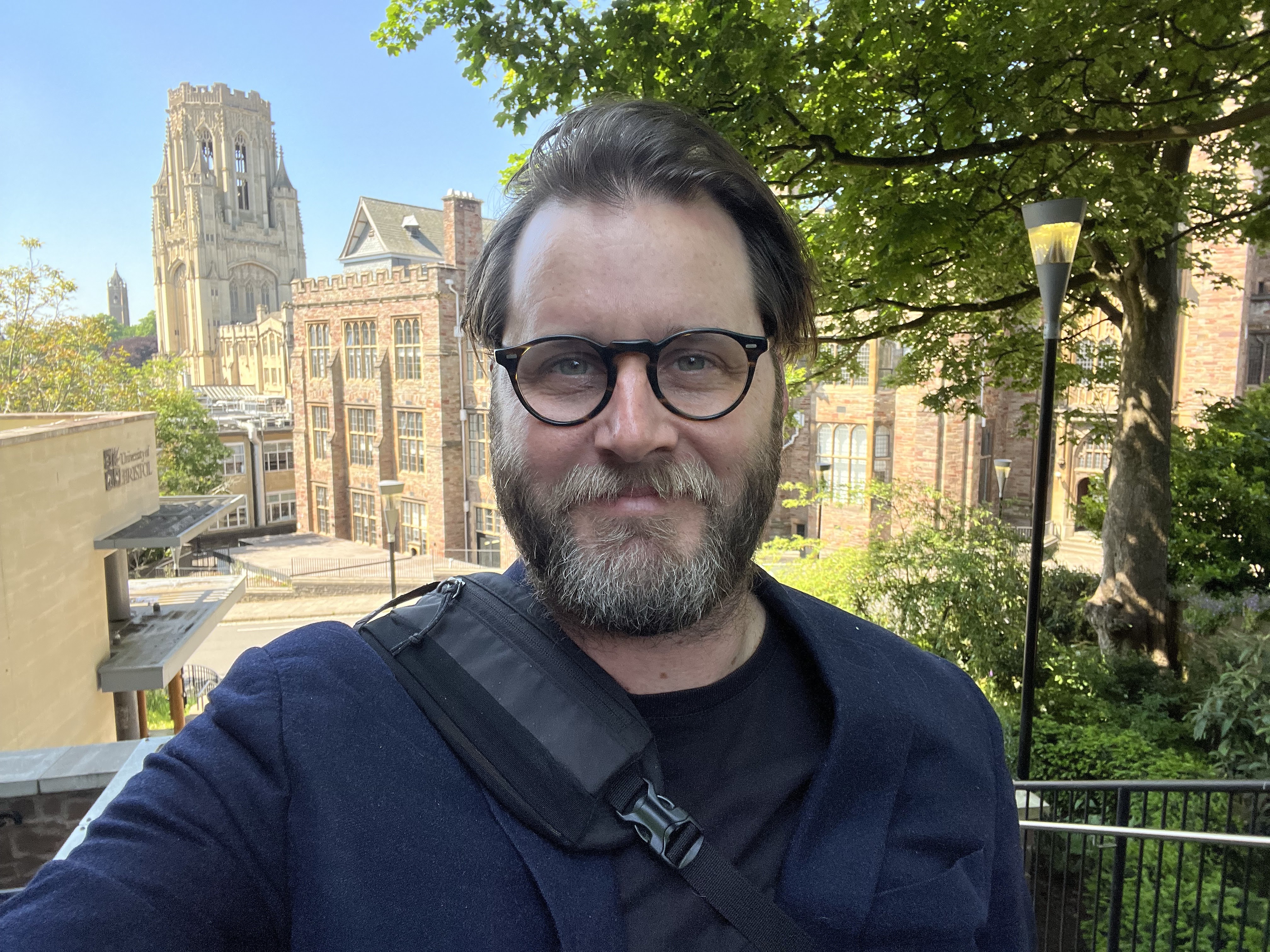
Hello, Bristol!


I’ve just arrived for a month in the UK, where I’m excited and honoured to be a Bristol Benjamin Meaker Distinguished Visiting Professor at the University of Bristol.

Within this hybrid role, crafted to be part visiting professorship and part artist residency, my project is called From Experiential Futures to Social Foresight.

It’s about working with colleagues to share and explore experiential futures (XF) practices to use design, media and the arts for grounding ideas about futures in everyday life – and thereby helping shift our organisations and public cultures towards deeper, more diversified, and wiser embodied engagement with alternative possibilities.

Activities here through mid-June include a Public Seminar hosted by the Pervasive Media Studio, an XF Masterclass for researchers at the ESRC Centre for Sociodigital Futures, and Advisory Sessions with individuals and groups from across the university and wider community.

Something a bit ambitious that we’re also doing is the Bristol Immersive Futures Jam – a live, face-to-face, weekend-long experiential & participatory foresight intensive, including a collective worldbuilding and making process, as well as a public activation with additional guests. Basically we'll be concretely imagining, physically staging, and having conversations about how life here could look decades or generations from now.

This builds on work I’ve done with groups in Singapore, Canada, Mexico, and various parts of the US – most recently through a wonderful artist residency late last year with the immersive theatre community in Denver, Colorado.

It's the first time we’ve offered the process in the UK.

The Bristol Immersive Futures Jam (Fri 31 May 5PM – Sun 2 June 5PM), which calls for a commitment to participate across three days, is fully booked up. But folks who may be interested in joining the waiting list for the whole event, or who wish to join only for the activation / time travel part on Sunday 2 June, can register their interest here.

The Public Seminar (Fri 31 May, 1–2PM BST) may be attended in person at the PM Studio / Watershed, or viewed live online here.

I’m most grateful to my University of Bristol hosts Dr Paul Clarke, Prof Keri Facer, and especially Prof Helen Manchester of the School of Education, and really looking forward to all the future-shaping we'll get to do together.

Related posts:
Killer Imps – Bringing futures to the Royal College of Art (02009)
> Dreaming Together (02015)
Introduction to Experiential Futures in The Economist – outlines some of our Time Machines / immersive scenarios (02015)

Wednesday, December 19, 2018

On Getting Started in Experiential Futures

The Omidyar Sessions, Part 2

This post concludes an edited transcript of a webinar I did recently for The Omidyar Group. The first part was about some of the strategic purposes and elements of foresight work; this second part deals with organisations venturing into experiential futures. Both represent my responses to practical questions posed by folks working for various impact philanthropy entities in a range of broadly intrapreneurial roles, but the key points may be applied to a wide range of contexts.

***

People are asking about the usefulness of immersive scenarios, and also about the creepiness of certain examples.

The first thing is to recall that “immersive” is not the only possible scale of this work. That’s important because making something immersive can be a pretty high bar, in terms of labour and time, and potentially other kinds of resources, like expenditure of political capital to try it for the first time in an organisation. So experiential futures is not only about immersive experiences where you inhabit a future, or a set of them, for a period of time: that's just one end of a spectrum. At the other end are things at a smaller scale, easier to produce; artifacts from the future. These are closer to the kinds of assets produced all the time within organisations to communicate ideas and fertilise conversations, but they come out of this approach of “how do we make something from the future?” All this falls under the design-space umbrella of experiential futures.

The other point to note is that creepiness is only one possible tone that an experiential scenario – object or immersion – might evoke. A project like NurturePod might be creepy to some people, but an intervention like the Tunisia 02014 scenario wasn't creepy at all; it was super aspirational, and even (against that backdrop of extreme turbulence) almost utopian. So again, in the same way that we should be careful not to overidentify the immersive end of the design spectrum with experiential futures more broadly, because there's a lot more options than that, we should also be careful not to overemphasise certain moods or genre conventions, because there’s certainly not just one flavour of future out there.

And I think that is part of the utility. As an experiential futures practitioner, someone who has been mapping and using it over the last dozen years, and coming to understand its potential, I operate from a recognition that there’s a vast amount of variation for us to work with. Any kind of future that you may want to have people think about, or to think about yourself, can in principle be mediated in any number of artifacts or situations. Whereas traditional futures practice has usually used a very narrow set of strategies.

My students recently completed an assignment at Carnegie Mellon, a class of 40 designers, where in teams of four or five, each team turns a classroom into an immersive scenario that that the entire class group steps into and spends 15 minutes in. We call these rooms Time Machines. (This is inspired by H.G. Wells, who was not just a founding figure in speculative storytelling, but a founding figure in futures. Wells invented the idea of the time machine in the late 19th century.) Our use of the term refers not to a device, but to a space designed to think and feel with. The students don't have a huge amount of time or resources to do this, so notwithstanding what I said before about immersiveness possibly being more demanding, it doesn't necessarily have to be. It really depends on what you're trying to do.

This mindset (experiential, transmedia) invites you to going through the process of figuring out who you are trying to reach, and what kind of vectors you have to them. Say that it's the leaders or founders of some large organisation, and that they are super busy people and you're lucky to get a 15 minute appointment. This tells you something about the kinds of ways that you may be able to engage, or the kind of impact that you will need to design for. In this case maybe one option would be to make something to send them or put under their office door. They could open an envelope and find this physical thing from the future. Then it's not a room they have to be physically transported to, which could be really hard to organise.

Part of the value of having the wide design space of “experiential futures” lies in actually thinking through the options, because it forces you to figure out what is important about the futures conversation that you want to have, with the people you want to engage, and how you hope to move the needle in that encounter. Is it to get them to take some problem more seriously? Or maybe the topic is something they obsessively discuss, but the longer-term thinking around how it could evolve is limited, because they lack high-quality hypotheticals to work from. So maybe that's a clue to the interventions you could be doing. Thinking through the design space is in itself a potential value, and the action that follows can be that much more tailored and intentional.

In the case of me and my colleagues, all this experimentation started with workshop or process design. So before we ever imagined the approach of creating hypothetical artifacts and bringing futures to life in a performative way, like many futurists we used to run workshops where the standard settings would be for people to read a scenario we'd written, and then respond to it based on the mental model that it conjured for them. And that can be quite effective in some ways, but it always relies on a certain level of what we might call systems imagination, which is not a ubiquitous skillset. To read something about how the world, or a community, could be wildly different 20 years from now, and be able to think and feel that through properly, is not a task that everybody finds easy. (In fact, it often doesn’t work at all, in terms of leading to the kind of strategic and operational changes that it is supposed to prompt.)

We realised that we needed to make a greater effort on our side, so that less effort would be required on the participant or audience side, in order to get to higher quality, more granular, more viscerally grounded conversations about alternatives. My dad used to say, “hard in the writing, easy in the reading,” and I think this is useful not only for writing, but for any kind of communication. You as a practitioner have to put the hard yards in on your end, particularly if you want to engage people who aren’t always thinking about this stuff, or who are time poor. Everybody's got reasons to put the futures conversation aside and deal with the urgent things in front of them. But by creating experiences that enliven the hypothetical, whether they be immersive, or tangible, or interactive like a game (these are all part of the same design landscape), you create different types of portal into strategic conversation and raise the chances of high quality engagement. This is part of the job.

Turning to the ethics question, which comes up especially around guerrilla futures and staging what-ifs that present as-if real, it's really a case by case matter. I don't think the extremes of “always” or “never” are useful. “It's never okay for people to feel for a moment like something is happening that is not happening” would prohibit even, say, surprise parties. And the “always ok” end isn’t right either. “It's just a hypothetical, what’s the worst that could happen?” Well, potentially a lot of harm. (This is why shouting fire in a crowded theatre is illegal.) And circumstances change. Just recently we had the 80th anniversary of the War of the Worlds broadcast from Orson Welles and the Mercury Theatre, an amazing moment in the history of media. This was a 1938 radio dramatisation of the H.G. Wells story about an alien invasion, which was taken seriously by some proportion of the population across the U.S., because it sounded just like it might have played out on radio at the time if there really had been an alien invasion, where your regular programming is interrupted and so on. This was a first, so they didn't necessarily know beforehand that it would create the kind of turmoil that it did. But when the same strategy was adapted for broadcast in Spanish in Ecuador in the 1970s, the people who did that couldn't say they didn't know, and I think somebody was killed in in the panic that ensued, and that's not defensible. It has to be a case by case thing, rather than always or never.

Somebody else has asked, if we were to apply experiential futures to our work, when and where would we use it?

You could tie it in to the strategy generation process discussed earlier, using engagement with alternative futures to generate options: have the people in the room take the scenario seriously enough to come up with ideas about what could be done either to make more likely the things that they’d like to see happen from that scenario, or make less likely the things that they wouldn't want. Using the experience and its emotional affordances as a way to create motivation to engage in that discussion over that longer time horizon, instead of it being like, “Oh, that's 20 years away, too far to worry about it.” That why immersive scenarios can be so striking: done right, they kind of collapse the distance, temporal and psychological. People in the room get angry, or excited, or sad about things being hypothesised as happening decades from now. And the time horizon for the scenarios, how far out you're inviting people to think, is also a really important and context-sensitive variable. If it's too close then you're not stretching into the variety of things you may need to deal with. If it’s too far out, there’s the risk of snapping the bonds of credibility, and you kind of check a box, “Okay, we talked about 2050, can we please come back to reality now?” Judging where the sweet spot is, between too far and too near, is part of the art of this work.

And then there’s a question here about opportunities to integrate futures and systems practice. Well, in some senses they are already integrated. Many practitioners, including me, see futures as the deployment of a systems mentality and way of thinking about change. Systems and futures are not these two completely separate things, “Oh, golly, how do we mesh them?” They actually have a lot of shared history. For example, The Limits to Growth report from 01972 is a landmark of systems literature and of futures literature, which is not a coincidence because they have some common roots. Still there’s lots of opportunity for continued integration.

One last thing about the variety of ways experiential futures can be deployed. I mentioned it as a prompt for discussion of possible strategies, or for testing existing strategies. It could be used as a way of exploring particular issues or points (what ifs) in the possibility space, on a more ad hoc basis, rather than a fully-fledged systematic one (multiple future rooms staged in parallel).

And experiential approaches can also be used as a way of bringing to life, for deeper scrutiny and discussion, the futures that are already in the room, or in the culture. There's a framework that a colleague of mine, Kelly Kornet, and I have developed called Ethnographic Experiential Futures (EXF). It begins with inquiring into the images of the future that a particular population or person has: What do they worry about? What do they hope for? What do they expect? This is called Ethnographic Futures Research (EFR), and it goes back to the 1970s. You draw them out on those things sufficiently to produce, or really co-create, a scenario; asking a bunch of questions to help structure the thinking. Then you “experientialise” it by taking these scenarios and turning them into artifacts or experiences. Then you might loop back and put artifacts from those futures in front of them, or put them in a space where those futures are dramatised. “Remember that conversation where you said these words about how the future might look, or what you're worried about, or hopeful for? How does it look now?” Or, it could be that you do the ethnographic interviews with the leadership of an organisation, manifest their imagined futures, and then put a wider constituency into these mental models brought to life, as a basis for deepening the conversation. So there are different ways that this stuff can be deployed for organisational strategic purposes, as well as for citizens.

I hope that these brief touchpoints we've had are starting to trigger some thinking that might be useful, and offer ways of amplifying what you’re trying to do, by adding experiential futures elements.

***

(Thanks again to TOG's S&C team, and everyone who contributed time, energy, and excellent questions during this phase of our collaboration.)

Related:
Experiential Futures: A brief outline
> The Experiential Turn (with Jake Dunagan)
> Dreaming Together
> The Original Time Machine Assignment
> Time Machines in The Futurist
Time Machines in The Economist
> Guerrilla futures ethics (The Futures of Everyday Life, Ch. 6)
> Ethnographic Experiential Futures (EXF)

Saturday, June 09, 2018

A Time Traveller's Story


This talk provides a short introduction to the experiential futures practice of designing and staging what I call Time Machines - immersive scenarios of possible worlds at 1:1 scale.

I've now run the Time Machine as an assignment with many groups in cities around the world – Singapore, Mexico City, and Toronto, among others. A short piece which appeared in The Economist describes several Time Machines created in experiential futures courses. A longer article from The Futurist provides a bit more background, although there have been four more years of experience and iteration since then.

Background to the talk: I spent last year as a visiting professor at the School of the Art Institute of Chicago, and this presentation was given at the 40th edition of the city's PechaKucha Nights in March 02017. (As some readers may know, PechaKucha is a format in which 20 slides are shown for 20 seconds each, advancing automatically, which keeps things nice and brisk.) Why am I blogging this now? I received this video months ago, but it had an audio issue that I finally had a chance to fix yesterday before posting.

Background to the topic: Time Machines have their roots in the four parallel experiential scenarios which we created for the Hawaii 2050 kickoff back in 02006. The process was subsequently modularised through teaching, first via a guerrilla futures experiment with undergrads at the University of Hawaii at Manoa in 02008, then projects in the Strategic Foresight course of the Design MBA at California College of the Arts in 02010 and 02011, and then a prototype assignment culminating the intensive futures course at National University of Singapore in 02012. In mid-02013, I contributed an assignment to a published collection about the cutting edge of art and design teaching, and first used the Time Machine framing there. Later that year, having started as a professor in OCAD University's Master of Design program in Strategic Foresight and Innovation, we introduced Time Machines as an end-of-semester studio project, where it became a staple. At SAIC last year, I ran two design/futures courses; one was on making documentary films from the future, and the other concluded with the 02016 election-related guerrilla futures project that's described in the talk (it went on to win an award from the Association of Professional Futurists last summer). I've had the privilege of being in something like 50 Time Machines to date, most recently at Carnegie Mellon School of Design during the academic year just ended.

A proper effort to capture the practical lessons from all this for design and futures is on the way.

Special thanks to PechaKucha Chicago organisers Peter Exley, Sharon Exley, and Thorsten Bösch. An alternative recording for the same talk, focusing on the slides, is at the official PechaKucha website. My previous PechaKucha talk, from 02012 in Melbourne, is posted here.

Related:
> Build your own Time Machine
> Time Machines in The Economist
> American Futures
> The Futures of Everyday Life
> Future documentary
> Travelling without moving

Thursday, September 01, 2016

A Question of Scale

Diagram by Daisy Ginsberg; original here.

How do you scale experiential futures?

If we're serious about infusing foresight into the culture at large, how can experiences of possible futures reach more people?

The Futures of Everyday Life concluded by connecting the promise of experiential futures to the prospect of social foresight, a distributed cultural capacity for thinking ahead.

This question of scale, then, has been a driver in much of my work over the past several years.

It is in the DNA of The Thing From The Future, a game we created to make concrete futures ideation (storytelling and design fiction) faster, easier and more widespread.

Itt's one of the main motivations behind the series of playful participatory design events that we -- Situation Lab and The Extrapolation Factory -- have run at OCAD [video], New York University [video] and the University of Southern California [post].

Scale via the classroom route has been at the heart of an experiential futures assignment I've developed over the past few years called The Time Machine, written up in 02013, then taught and iterated each semester since. (A Time Machine turns a room into an experiential scenario at 1:1 scale, immersing visitors in a possible future.)

And scale is also the central question I brought to the most recent Oxford Futures Forum, held at the University of Oxford a couple of years ago now. An abstract contributed for that event is reproduced below, by way of a prelude to sharing more here soon about experiential futures practice at scale.

In particular, we'll be taking a look at several dozen Time Machines created so far, as well as the Museum of the Future exhibition which I worked on for the World Government Summit held in Dubai earlier this year.

***

Scaling experiential scenarios 
In recent years a romance between foresight and design has blossomed, with much engaging and media-rich output emanating from the encounter (Antonelli 2008; Sterling 2009; Candy 2010; Haldenby 2013; Dunne and Raby 2013). Notably, hybrid practices such as "design fiction" and "experiential futures" have been entering common currency (Bleecker 2009; Raford 2012; Turney 2013).
I have collaboratively developed experiential futures (a broader term, encompassing design fiction) across wildly different contexts - public art installations, client workshops, massively multiplayer online games, and so on. Hybridising scenarios and design brings visceral engagement into a dry tradition that otherwise threatens to fall short of its culture- and history-catalyzing potential (Candy 2010). 
So what’s next? 
The task of putting design more impactfully in service of scenarios poses two complementary questions: 
* What kinds of scaled-up immersion are possible -- considering, for instance, a transmedia intervention during the Arab Spring whereby multiple Tunisian media - press, radio and TV - reported "from" 14 June 2014, three years into the future, for a whole day? (Candy 2011) 
* What structures of participation are most effective for scaffolding experiential futures design – e.g., what makes a successful brief for students translating textual scenario premises into tangible, immersive form? (Candy 2013, 2014; Candy and Dunagan forthcoming) 
Having been involved in the futures field since 1997 as (variously) a student, researcher, consultant, artist, and educator, my interest in these topics spans all these modes. The work has not always generated the expected results, but it has always been illuminating. 

References: 
• Antonelli, P. 2008. Design and the Elastic Mind. Museum of Modern Art, New York.
• Bleecker, Julian. 2009. Design Fiction: A Short Essay on Design Fact and Fiction. Near-Future Laboratory, Los Angeles. http://www.nearfuturelaboratory.com/2009/03/17/design-fiction-a-short-essay-on-designsciencefact-and-fiction/
• Candy, Stuart. 2010. The Futures of Everyday Life: Politics and the Design of Experiential Scenarios. Dissertation. Honolulu: University of Hawaii at Manoa Department of Political Science.
• Candy, Stuart. 2011. ‘An experiential scenario for post-revolution Tunisia.’ The Sceptical Futuryst. 1 April. http://futuryst.blogspot.ca/2011/04/experiential-scenario-for-post.html
• Candy, Stuart. 2013. ‘Time Machine / Reverse Archaeology: Create an experience or artifact from the future.’ In 72 Assignments: The Foundation Course in Art and Design Today. Chloe Briggs (ed.). PCA Press, Paris.
• Candy, Stuart. 2014. “Dreaming Together: Public Imagination and the Future of Governance”. In Made Up: Design's Fictions. Tim Durfee and Mimi Zeiger (eds.) JRP Ringier / Art Center Graduate Press, Zurich. Forthcoming.
• Candy, Stuart and Jake Dunagan. 2014. ‘The People Who Vanished: Co-creating an Experiential Scenario’. Futures. Forthcoming.
• Dunne, Anthony and Fiona Raby. 2013. Speculative Everything: Design, Fiction and Social Dreaming. MIT Press, Cambridge, MA.
• Haldenby, Trevor. 2013. Bringing the Future to Life: Pervasive Transmedia Scenarios and the World of Worlding. MDes Thesis. Strategic Foresight and Innovation Program, OCAD University, Toronto, ON.
• Raford, Noah. 2012. ‘From Design Fiction to Experiential Futures.’ In The Future of Futures. Andrew Curry (ed.) Association of Professional Futurists, Houston, TX.
• Sterling, Bruce. 2009. ‘Design Fiction.’ In Interactions 16, 3. http://interactions.acm.org/content/?p=1244
• Turney, Jon. 2013. Imagining Technology. Nesta Working Paper 13/06, March. www.nesta.org.uk/wp13-06


***

This contribution can be found in the full collection of abstracts from the Oxford Futures Forum, on this occasion dealing with the theme Design and Scenarios.

A recent special issue of the journal Futures guest edited by Thomas Chermack, Cynthia Selin, Rafael Ramirez and Yasser Bhatti features several articles arising from the Forum.

The edited collection called Made Up referenced above is officially no longer happening, unfortunately, but the piece I wrote for it has been posted here: Dreaming Together.

And the article co-authored with Jake Dunagan, listed as Forthcoming, appeared in Futures a few months ago under the title Designing an Experiential Scenario.

Related:
> Experiential Futures in The Economist
Dreaming Together
> An experiential scenario for post-revolution Tunisia
> The People Who Vanished
> 1-888-FUTURES
> The Futures of Everyday Life

Friday, August 19, 2016

Introduction to Experiential Futures in The Economist


This is a short article I published in The Economist's annual look at the year ahead, The World in 2016.

Part of a section called "Minds on the Future" included for the thirtieth edition of The World In, my contribution appears right between a piece by the chief economists of Google and IBM, Hal Varian and Martin Fleming, and another by Canadian science fiction novelist Margaret Atwood. That's good company for an introduction to Experiential Futures––in this case, outlined with reference to Time Machines developed with learners around the world, from Singapore to Mexico.

***

'Experiential Futures: Show and Tell'

Within a generation, those unable to afford time outside Toronto’s dense urban environment will resort to Nature Deficit Disorder Clinics, where they will get essential dietary supplements along with a virtual rainforest immersion and brain scan.‡

In Singapore, a popular museum exhibition will chart the startling social transformations over the previous few decades in romance, sex and marriage, including the introduction of state-subsidised love robots to maintain well-being across the population.

Mexico City will be subject to severe flooding, and a peer-to-peer emergency service called Operación 
Axolotl will emerge as citizens step up to meet each ­other’s basic needs.

By 2044, young people in North Carolina will face a critical choice at the age of 18: whether to let life’s slings and arrows take their natural course, or to accept the wonders of modern medical technology and become, in effect, immortal.

How can anyone possibly claim to predict all this, you may ask? Actually I’m not predicting that these things will happen—even though I witnessed them all first-hand.

As an experiential futurist my job is to create, and to help others create, transmedia situations where such possibilities can be thought, felt and used to make better decisions. In this practice, all media are fair game for bringing futures to life, from interactive performances to physical artifacts, from video to food: whatever enlivens a future scenario as a potential reality-in-waiting.

If Andy Clark, a cognitive scientist at the University of Edinburgh, is right, thought isn’t confined to the boundaries of our skulls. We think with our environments. The map or smartphone in your pocket is a deliberate extension of your thought processes.

We can design situations that help us understand possible futures by visiting them. How much more powerful this is than the white papers and slideshows that are the typical focus of future-gazing in boardrooms and at UN summits.

Driven by the irrepressible human urge to bring our inner worlds to life, the culture of public imagination is set to make a leap: in coming years we can expect to see more and more companies, governments, advocacy organisations and communities creating and sharing experiential futures. The sooner we learn to use and democratise collective imagination to dramatise our alternatives, the more powerful will be our capacity to shape change towards just and worthwhile ends.

***

The World in 2016 appears in print in 90 countries and was translated into more than 30 languages, with circulation of the English-language edition exceeding two million copies.

While approaching the tenth birthday of Experiential Futures, and half a decade after writing a doctoral dissertation on that topic, for this little description to reach such an audience feels like a valuable step towards public visibility and normalisation of a practice that I suspect is essential to the development of a collective cultural capacity for foresight.

Full text pdf is here.

‡ This Time Machine, created in the Foresight Studio at OCAD last year, eventually led to the NaturePod project for Interface Inc.

Related:
> Foresight is a right
> Build your own Time Machine
> Dissertation: The Futures of Everyday Life
NaturePod™
Dreaming together
> Journalism from the future

Wednesday, May 11, 2016

NaturePod™


What if you could reap the health benefits of spending time in nature––for productivity, creativity, and stress relief––without even leaving your office?

All this is coming soon to a cubicle near you.

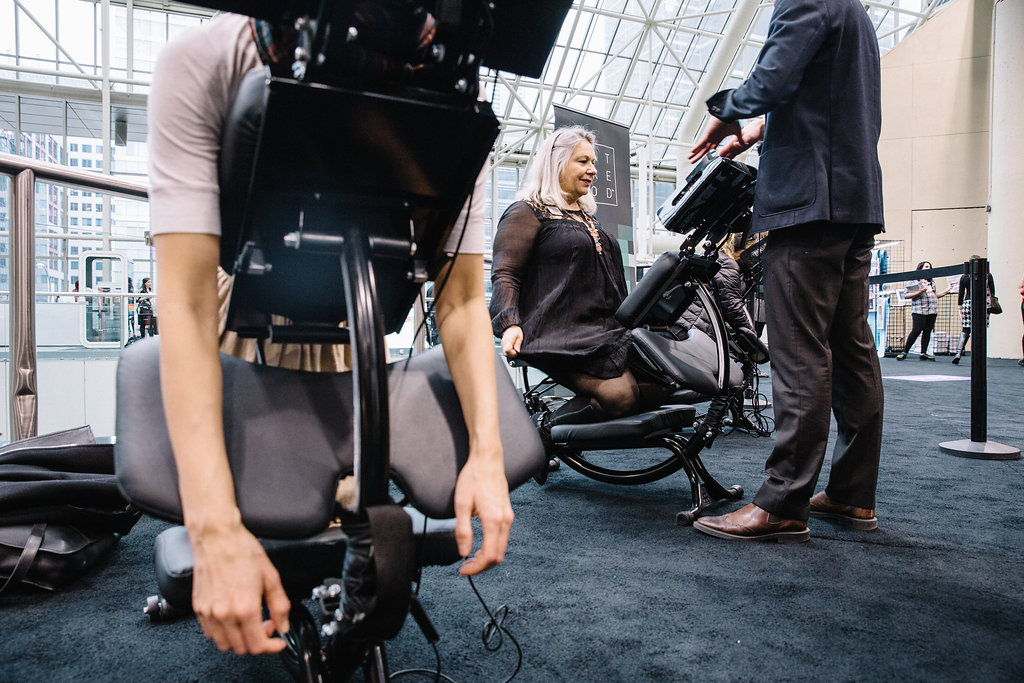
Canada's largest architecture and design trade show recently saw the global launch of a new product called NaturePod™.

Each unit provides intensive personal exposure to sounds, imagery, and (selectively) smells of various natural environments. The system gently guides the user through its Natural Resonance Imaging® technology, which maps the brain's real time responses to specific stimuli. A helpful Relaxation Status Display appears in the field of view throughout.

Capitalising on the latest findings in environmental neuroscience, the product's Toronto-based creators claim that their patented personal wellness system brings restorative benefits equivalent to, or even greater than, nature in the raw.


At IIDEXCanada, all a new user had to do to get started was adjust the Pod Body to their particular dimensions, and calibrate the Pod Headset's stereoscopic display to their personal IPD (interpupillary distance), before immersing in one of three demo environments: a lush valley mid-summer, snow-covered mountains in winter, or a temperate forest in spring.

Of thousands in attendance at this annual design exhibition and conferences––which included summits on Healthcare, Wellness, and Accessibility in the built environment––many who got to try NaturePod™ first hand were immediately enchanted, and prepared to buy or lease the devices on the spot.

But frankly, reactions were mixed. A few declared their horror at the idea that anyone might try to substitute a new gadget for the experience of forest.

Even so, no one appeared to have any difficulty believing that this was a real product being offered to mitigate the chronic disconnect of modern urban dwellers from the experience of nature.

In fact NaturePod is design fiction––for now.

It's an experiential foresight project in the public interest; a scenario set five years into the future but brought to life today, created by a team of graduate students from OCAD University's Strategic Foresight and Innovation program, and led by me under Situation Lab auspices.

Neither a prediction nor a preference, but a provocation, we wanted to use design and performance to invite consideration of how our relationship to nature in cities is changing, and contribute to a dialogue about potential differences between our current direction, and what we might collectively want.

The people in the video above are responding to a direct experience, not to a hypothetical question.

***

"Powerful critical design does not present itself as critical design. Powerful design fiction does not present itself as fiction."
- Matt Manos

***


***

A few hints about the future setting were planted, including a full-page advertisement in the Show Catalogue announcing the release of the product in Fall 02021, but we were shooting for present-day realism in the encounter. The aim was to let folks come to their own genuine conclusions about the whole idea before the hypothetical status was revealed. The story told in the video has the same structure.

This unusual project grew out of a Time Machine, an Experiential Futures module that I created in 02013 and have taught each semester for the past three years at OCAD University.

That particular run of the Foresight Studio course, just over a year ago, was co-taught with the marvellous Suzanne Stein. One group of our students––Bergur Ebbi Benediktsson, Nourhan Hegazy, Jennifer McDougall, and Prateeksha Singh––spent the semester exploring the futures of humanity's relationship with the environment. When it came to the Time Machine, their response was ingenious; they created a "Nature Deficit Disorder Clinic" from 02040. In this experiential scenario set a generation from today, daily contact with nature is rare. The deficit is both ubiquitous and medicalised. People try to mitigate it with oxygen supplements and exposure to simulated forest, gauging their progress via brain scans.

A top Canadian environmental advocacy organisation, the David Suzuki Foundation, had served as this group's external partner throughout the class, and at their request we re-staged the NDD Clinic on Earth Day 02015 for the Foundation's employees and industry partners. Among the attendees was Canada's head of marketing for Interface, Inc.

Interface is a rather remarkable company. (You might know them from the documentary The Corporation, and especially the influential voice of their late founder Ray Anderson.) They're the world's leading carpet tile manufacturer, and also a global trailblazer in corporate sustainability. By no means is this a typical combination.

They engaged Situation Lab to create an experiential scenario to nudge their customers and others towards a deeper conversation about humanity's changing relationship to nature in the built environment. The same highly talented group of four graduate students came aboard to adapt the original concept for a totally different context: instead of a room-specific, 20-minute immersive installation for a captive audience of 20-30 members, we were to make this experiential scenario available to thousands of people over two full days at one of the largest expositions of its kind in North America.

Now, in the architecture and interior design world, it turns out that there is already lively discussion underway about (E.O. Wilson's term) "biophilia" in a design context, for instance in the 02015 report, Human Spaces: The Global Impact of Biophilic Design in the Workplace.

Biophilia refers to the "instinctive bond between human beings and other living systems"; a bond variously accommodated or cheerfully ignored by present urban and building designs. We designed NaturePod as an experiential contribution to both broaden and deepen the conversation. What are the implications for our wellbeing of trying to close the nature gap using increasingly sophisticated imitations? Where might that lead?

While evidently exercising a degree of creative licence to prototype possibilities from half a decade out, our imaginings were tied to real research. Readers curious about the current science behind these developments in nature simulation and related themes can find plenty of material for further investigation (for example: de Kort et al, 02006Kahn et al, 02008Kahn et al, 02009Kjellgren and Buhrkall, 02010;  Valtchanov, 02010; Valtchanov et al, 02010Valtchanov and Ellard, 02015).

What I love about the project is that this visionary company took such an unusual step, sponsoring a guerrilla futures intervention to urge industry and public engagement with issues that matter and affect everyone. (To the extent that corporate entities have engaged in experiential futures or speculative design previously, the results have tended toward the shamelessly commercial and trite, as Noah Raford has persuasively argued.)

NaturePod™ comes almost a decade after the first experiments in what we've come to think of as a special strand of publicly-oriented foresight work. Guerrilla futures combines strategic foresight and tactical media to produce unexpected encounters with possible worlds (see FoundFutures, for instance). Injecting possibilities into the present lets us think and feel new potentials, not "merely" hypothetical, in a mode of exploration squarely located where serious investigation meets play. (See Chapter 5 of The Futures of Everyday Life for more.)

This may be a first for corporate use of experiential futures / design fiction in guerrilla mode, and it is our hope that it provides a bracing contribution to design conversation far and wide.

Thanks and bravo to Interface, and to our marvellous design team: Berg, Jennie, Nour, and Prat! Huge thanks to all participants, assistants, volunteers and supporters; full project credits appear beneath the video.


Stills by Connie Tsang.
Videography by Filip Vukcevic.

Related:
Strategic Foresight meets Tactical Media
> The Futures of Everyday Life
> Guerrilla futures performance at South by Southwest
> FoundFutures: Chinatown