Showing posts with label Maya Van Leemput. Show all posts

Tuesday, July 04, 2017

Could this be the future of parenting?


NurturePod installation and photos by Stuart Candy

This experiential scenario from a not too distant future, my first "solo" art museum installation (really, all this work is highly collaborative), is now live at M HKA, the Museum of Contemporary Art in Antwerp, Belgium.

Futurist/journalist Andrew Curry and I recently had a chance to chat about the project for an upcoming issue of the Association of Professional Futurists quarterly, Compass. Many thanks to Andrew and APF for sharing the transcript below (edited for clarity and length).

***

Andrew Curry: What we have here is a very small baby –– not a real baby –– in a little pod surrounded by all sorts of digital stimulus looking after her or his needs. This is a "programmable para-parenting pod", which basically removes the need for parents to get involved, as far as I can tell. It's a bargain at €789, obviously. What was the brief, Stuart?

Stuart Candy: The brief for A Temporary Futures Institute was to create some kind of a design contribution corresponding to Dator's generic images of the future; grow, collapse, discipline or transform, and I was assigned "transform". I had this quite large space and could basically do anything that fit the budget and time. To get from those broad parameters to the final installation really started from the name. There was a prior project (which appeared in Compass) called NaturePod, a hypothetical product from a handful of years away, addressed to stressed-out office workers who may need to reduce their cortisol levels and increase productivity by spending time in nature, without leaving their cubicles. That was a provocative take on what happens when you marry supposedly biophilic interior design trends to virtual reality.

AC: So this is a kind of companion piece?

SC: Right. It came about in a conversation with my longtime collaborator, Jake Dunagan –– a lot of our work is based on wordplay and being silly –– and he said, "well, when you're done with NaturePod, you should do NurturePod, ha ha ha". He was joking, but I thought it was a brilliant idea. Then this opportunity came along, and I realised that, while this might not be my idea of a transformation, it does actually correspond to a popular notion about what immersion in virtual environments means.

AC: It comes with all this very nice packaging and sales material. Clearly something about the commercialisation of it engaged you.

SC: A lot of the experiential futures work I've done is about bringing encounters with futures into an everyday context. Hence guerrilla futures projects like NaturePod; we launched it at an architecture and design trade show, so the people who came across it thought it was real. The organisers of the trade show knew what we were up to, but the thousands of others attending didn't. I was interested in trying to import the lessons and techniques from creating encounters "in the wild" into the cube of a contemporary art museum. That's why this piece is not sitting on a white box; it's sitting on the kind of table you might find in an Apple Store.


AC: The NurturePod box has all the kind of labelling detail you would expect to see in a package. Is that part of the experience as well?

SC: I think the attention to detail that makes a hypothetical resemble the real is an important part of this practice. It is intended to invite, not a suspension of disbelief exactly, but more an investment of belief, a kind of willing desire on the part of the viewer to say okay, suppose that I did come across this in a few years' time. What do I think about that? What do I feel about that? I think the details provide added dimensions of engagement so they can dive deeper, if they want to. Most people are probably going to engage with the main image; a glanceable, instagrammable baby in a pod wearing a headset. But for those who take the time, there is more detail to enjoy, or be dismayed by, according to your taste.

AC: There's a little tag, "control baby's experience with the NurturePod App", and a kind of WiFi, Bluetooth-type logo suggesting I can download it. I haven't actually tried to do that; I'm guessing that bit might not be real?

SC: That's right, it does break at a certain point because it isn't real, but it's supposed to feel like it is. All of these messaging elements are scaffolded in detail on existing products, and existing idioms that we recognise subconsciously, being citizens of the early 21st century. We’re literate in ways we don’t even realise about the semiotics of marketing, and electronics in particular. This is using that language to get something across about a seemingly imminent possibility.

AC: One more thing that strikes me about this, about the languaging, is it's not just about marketing. There are a whole lot of cues about the idea of the new, the idea of the modern, and the classic ways in which technology companies make us feel inadequate and then sell us reassurance.

SC: I suppose using those tropes could be said to invite reflection on how embedded in the tropes we are, because we know this particular thing doesn't exist. But that's a bit of an intellectual angle. I find people's emotional responses interesting, from watching them interact with it and from what they've shared in conversation.

AC: What sort of things have they said?

SC: "I'm really drawn to this, and also repulsed by it." There's this sense of being torn, and that is quite satisfying to hear, because I think creating or inviting a complex emotional response is something that we should strive for in futures work. This is why design and film and performance and games are important –– the whole repertoire of approaches to experiential futures; like the proverbial toothbrush that reaches places regular ones can't. Hopefully we are on our way to a better futures toothbrush.


***

The NurturePod installation is just one part of A Temporary Futures Institute (ATFI), a boldly experimental M HKA exhibition which opened in April, curated by Anders Kreuger and Maya Van Leemput.

(M HKA was also the main venue for Design Develop Transform, where Kelly Kornet and I recently presented the Ethnographic Experiential Futures framework.)

There are some stellar artists featured in ATFI (including Michel Auder, Miriam Bäckström, Alexander Lee and Darius Žiūra), and the other futurists involved in the exhibition are Agence Future (Maya Van Leemput and Bram Goots, Belgium), The Centre for Postnormal Policy & Futures Studies (Ziauddin Sardar and John Sweeney, UK/US), and Mei Mei Song (Taiwan).

Show runs until 17 September –– so if you're within range of Antwerp, check it out!

Acknowledgements:
- Seth Keller and Kazuki Guzmán, Fabrication consultants
- Tarik El-Khateeb, Graphics consultant
- Special thanks: Maya Van Leemput and Anders Kreuger (for curating ATFI); Bram Goots (for crucial logistical help), Ceda Verbakel (for copywriting assistance); Giulia Bellinetti, Georges Uittenhout, and the rest of the team at M HKA (for essential technical support); Jake Dunagan (for inspiration); Jessica Charlesworth, Ilona Gaynor, the Toronto Uterati (for helpful conversations)

See also (last updated 16aug17):
- Features in VICE and Boing Boing
- Opinion piece in The Irish News on NurturePod and the future of parenting
- Bruce Sterling's repost of the interview above at Wired
- Article from Harpers Bazaar on what to see at A Temporary Futures Institute
- Video from ARTtube about ATFI (5 1/2 mins)
- Show summary from Belgian newspaper De Morgen (in Dutch)
- ATFI exhibition brochure (pdf)
- Two contemporary artists I greatly admire whose work has influenced this piece one way or another: Patricia Piccinini and Ron Mueck

Related:

Saturday, March 15, 2008

The Darfur Olympics

Advertisement: Saatchi & Saatchi, Brussels | Photo: the sceptical futuryst

This newspaper advertisement, featuring a hypothetical "Darfur 2020" Olympic flag, has been at the centre of a recent controversy in Belgium. It's an ad for the University of Ghent, and the Flemish (Dutch) slogan "Durf Denken" means "Dare to Think".

The Darfur region in Western Sudan has been riven by conflict and humanitarian crisis for the past five years, so the incongruity of the ongoing tragedy with the presumably sunny prospect of Olympic candidacy not far in the future deliberately evokes a kind of cognitive dissonance in the reader in early 02008.

The International Olympic Committee requested that the university pull the ad on the grounds that the use of the trademarked olympic rings is forbidden. As yet, there seems to have been virtually no English-language coverage of the story, but here's one report from Radio Netherlands Worldwide; and one from weekly news magazine Flanders Today.

The Brussels office of advertising agency Saatchi & Saatchi, which produced the piece, defended itself at the company blog (posted March 5th):

We presented the ad above to the Communication committee of the university in the beginning of December 2007, after a check with the BOIC [Belgian Olympic Committee] who told us we would be allowed to use them in this context. The campaign never intended to be a political statement, but it sure is one way to view the ad.

For the record, that's what we've been trying to do with all the ads for the University of Ghent from the beginning: invite people to start thinking. In this case, the ad raises several questions: will the world be changed by 2020? how would you start organising such a thing? what is the role of sports in global politics?...
[...]
It is true that the whole commotion surrounding Steven Spielberg and the role of China (as the host country) in the african conflict became hot news at a certain point (culminating in the heading 'Breng de Olympische droom naar Darfur' -transl. bring the Olympic dream to Darfur- in De Morgen on the 15th of February). But as we did not see it grow into a bigger issue we decided to publish the campaign anyway.

And while we can understand the IOC's decision to ask the University to withdraw the campaign (even though we had permission from the BOIC), we don't agree with the allegations that we capitalise on a small political event to use in a campaign for a client which steadfastly allows us to make great work for a fantastic brand.

Radio Netherlands Worldwide reports:

University rector Paul Van Cauwenberghe insists: "It's all a big misunderstanding. We never intended to offend anyone ... All we wanted to do with our posters was to get students thinking ... And it looks like we achieved our objective."

For my part, I think it's a brilliant bit of artwork. Also, as a piece of advertising, I find it entirely appropriate to the client/subject -- a state university -- an institution which properly ought to engage its public in grappling with provocative ideas, continually. (A purely commercial entity could more understandably be accused of poor taste or political insensitivity.)

Now, clearly the ads are intended to be mildly disruptive or arresting. If they didn't contain any sort of edginess or risk, the phrase "Dare to Think" wouldn't mean anything.

But how disturbed should we find the Olympic Committee's choice to police its intellectual property in this manner? As my colleague Jake "Neurofutures" Dunagan might point out, patrolling IP in this context is effectively policing thought. Which is insidious enough in any form, but the stakes somehow come out in sharper relief when it comes to curtailing expressions of possible futures. It could be said that the IOC, in exercising its copyright-holders' veto, is literally curtailing the public's ability to imagine a future in which a now-conflicted region turns things around to the extent of becoming Olympics-ready. Regardless of what might be added about the probably feeble motives of the Committee in doing so, and whether or not permission had already been granted by the IOC's Belgian arm; the point stands. This situation is structured such that IP obstructs, rather than facilitates, the public interest in free expression.

One observer has argued, as reported here, that the University of Ghent's usage of the olympic rings logo in this case probably qualifies for the "fair use" exception to the copyright holder's dominion (and if this were to prove correct, the university could have insisted on its rights and refused to withdraw the ad). In any event, to my mind this situation really crystallises what's at stake in the distinction Lawrence Lessig draws between "permission culture" and "free culture". The withdrawal of the ad is a symptom of a permission culture, in which a public intellectual institution that is trying to encourage its constituents to think unusual thoughts is itself cowed into backing off from its own mandate.

To pull the ad is a direct negation of its message. Dare to Think, indeed.

Some of the other ads produced for the campaign (which has been running for several years), mentioned in the advertisers' blog above, have functioned very similarly to futures (or counterfactual) artifacts. Some of these visual thought experiments also -- again, appropriately, in my view -- press political buttons...


Some of these strike me as even less likely to pass muster in the United States than in Belgium. And yet: these are precisely the kinds of ridiculous thoughts which comprise the essence of useful, provocative futures thinking.

My hat goes off to Saatchi & Saatchi for this piece of work. It would be great to see the University of Ghent insist on its right to proceed with the campaign; but failing that, to hear the International Olympic Committee explain its trepidation about lending its logo to a region of the world whose futures desperately need to be reimagined.

(The ad was published in a Belgian daily newspaper, De Morgen, on 3 March, p. 7. It was spotted -- and thoughtfully delivered to me in person! -- by Belgian futurist Maya van Leemput, who just visited Hawaii. Dank u, Maya!)

Thursday, August 09, 2007

Futures found in Brussels


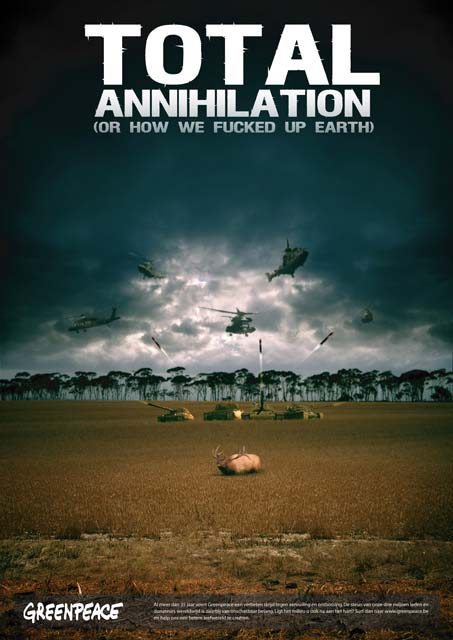
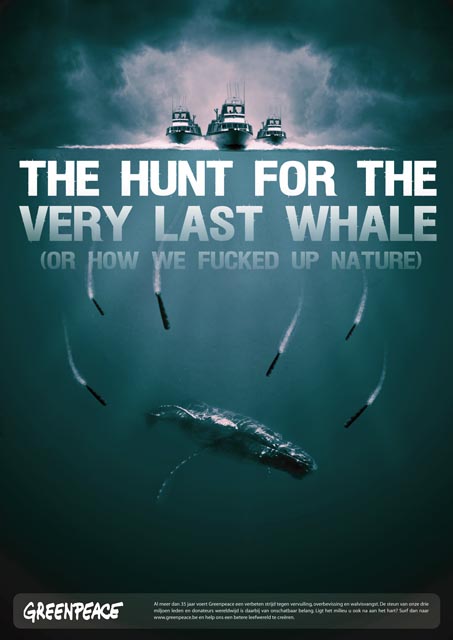
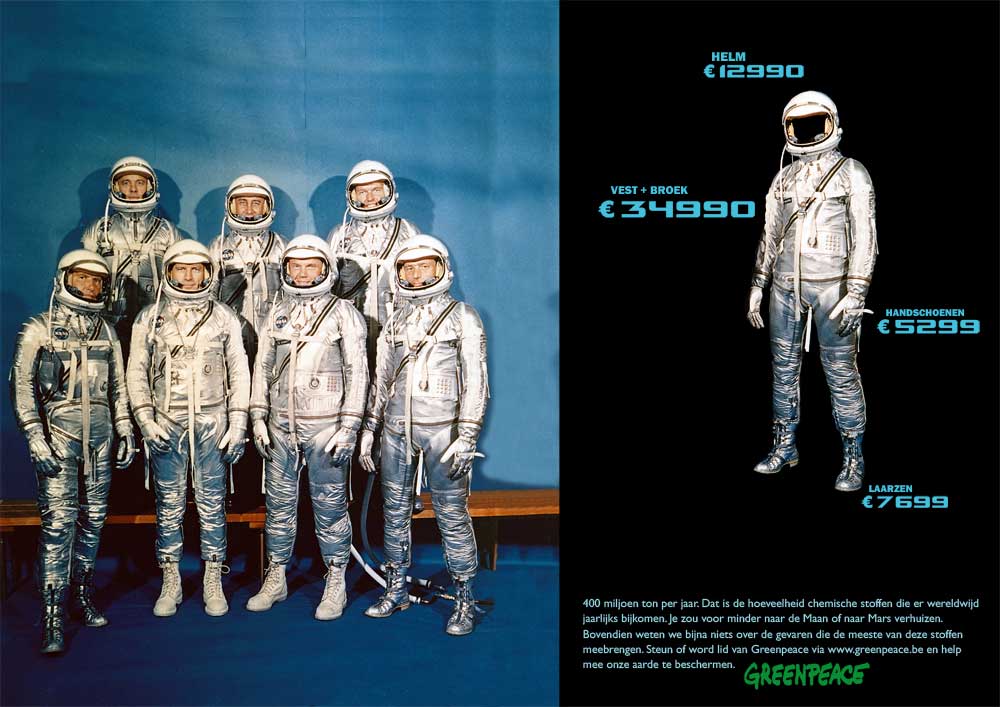
These images were produced by students in the advertising department at Sint-Lukas College [English site] in Brussels in the first term of 02006. Their assignment was create a visual awareness-raising campaign around Greenpeace themes, i.e., environmental activism. Many of the results are quite striking; and some highlights appear here with commentary [in italics] courtesy of Belgian futurist Maya van Leemput, who passed these along (regular readers of t.s.f. have met her before). Thanks, Maya!

Hello futures finders,

Found some futures for the collection.

"John-from-Ghent" is the name of seagull type bird, the obituary states:"With great sadness we announce the passing away of john-from-ghent. Seabird at the beach of Mar de Fora. Born in Sagres on May 25 1995 and suddenly deceased in Mar de Fora on November 21st 2002 following an oil spill. To testify your sympathy, you can transfer money to the accountnumber...."
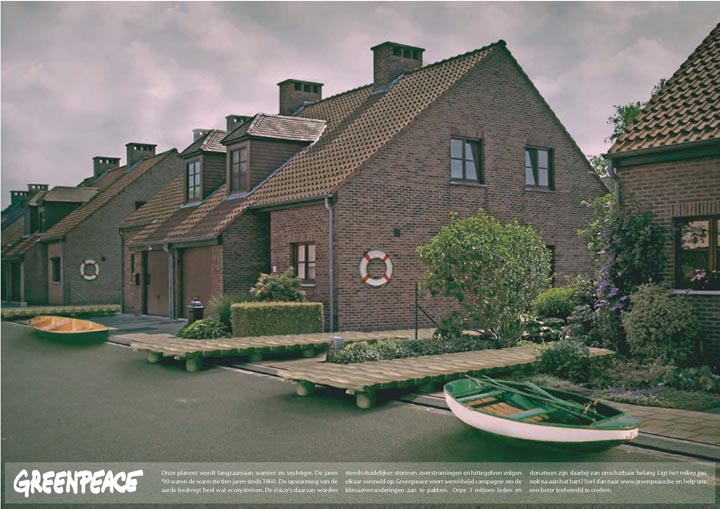
An ordinary residential street in Belgium, prepared for rising sea-levels:


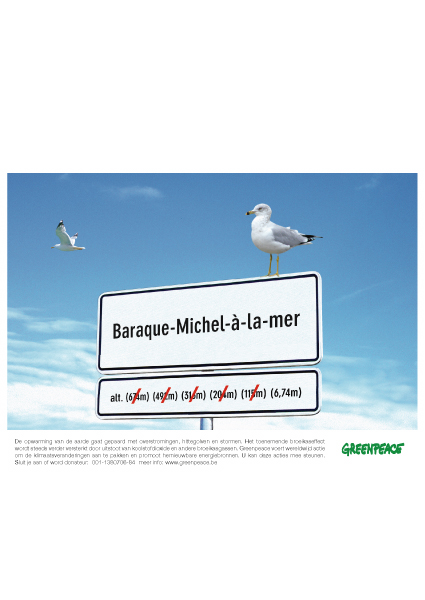
Two signs with the names of small towns in Belgium:
"Baraque Michel" is the highest point in our little low country.

"Kapellen-in-the-Wood" becomes "Kapellen-in-the-Wood-at-Sea".

The price of space-suits:

The text below says: "400 million tons a year, that is the amount of chemicals added globally every year. You would move to Mars or the Moon for less."

Most of [these are] just images, except for the first two which count as (film) posters (like a postcard is an object, something other than merely the actual image on its front). The death notice might count as an object also if it was presented and sent in an envelope or printed among the obituaries in the newspaper (which it wasn't). Anyway, some of the other images show objects that in 3-D would count as future artifacts, others just show images of what a future might be like.

The archive from which these images are drawn can be found here (N.B. text in Flemish).

So, a few thoughts. As Maya suggests, none of these function strictly as future artifacts. The "Greenpeace" branding immediately breaks the fourth wall, so to speak, in all these cases, and there is a certain lack of diegetic coherence -- e.g., even were it not for the brand name, the savage irony of the film posters belies their ostensible status as actual posters for future films, so the viewer is deprived of space to make the connection between the supposed artifact and the disturbing conclusion. The dots are, forcibly, joined up for us.

Still, features they could be said to have in common with such artifacts are: futures orientation expressed through an implicit future setting (except the obituary); evocation of some relevant issue or trend; and dissonance in the design (something impossible, unfamiliar, or futuristic that doesn't "fit" today).

The talented artists who produced these, I hasten to acknowledge, were briefed to make a visual campaign, not "artifacts from the future" per se, so lest these comments seem gratuitously critical, my aim is merely to think with these examples (and others of their ilk) about how best to use design to provoke futures thinking. Still, it's interesting, I think, that future artifacts of this sort are not uncommon as a strategy in environmental awareness-raising (compare with these previous examples). Both raising and acting on our awareness are things we need to get very good at -- the sooner, the better.

Thursday, November 02, 2006

Meditations on spam

I've been called many things in my life -- but never, until today, "Emmett I. Zoratoric". The origin of this novel appellation is none other than a spam attack that appears to have kicked in about 10pm last night, the first being an "automated delivery failure" message to Emmettizoratoric (who??) at futuryst.com. I'd say that ordinarily, a pretty small percentage of unwanted email makes it through to my actual inbox, but I counted over thirty messages that did so between yesterday evening and this afternoon -- like so many electronic wetbacks slipping across the digital Rio Grande -- and on closer inspection, found more than ten times that many again in my spambox, apprehended by the border guards of spam filtration. That makes close to 400 messages sent out illegitimately over about 14 hours, ostensibly from users of emails operated under my domain name; and those are just the ones I know about because of the automatic replies they generated.

For the last half day, phantom cyber-assholes have been taking liberties with the good name of futuryst.com and pestering people as far afield as Brazil, Japan, and somewhere Arabic-speaking. So, first things first: when I pester people, I do it under my own name. If any human being that is reading this happened to receive some message from Emmett I. Zoratoric, Elijah W. N. Tuneful, or anyone other than me claiming to be affiliated with this website, please delete and disregard. Someone's phishing and I personally have nothing to do with it. In any case, though, I'm sorry it happened. (Desculpe. Gomennasai. Aasef!)

It does make me wonder, though, what the hell is going on with spam. At whom are these messages really directed? Usually you can infer something about the target audience of, say, a TV show, from the sports cars, game consoles or incontinence treatments peddled in the ad breaks. Perhaps we can deduce something about the imagined recipients of spam messages from their content. Actual examples of typical subject headings currently residing in my email account include: "We cure any disease!"; "casino on net"; and "Permanent Male Enlarger + Bonus!!!" They conjure a picture of some kind of gambling-addicted, disease-ridden, financially distraught male wrestling with chronic insecurities about all things penis-related.

Clearly they've got me pegged (I wish I were kidding). But you, like me, would have to be mad, in addition to some or all of those other things, to instigate any kind of financial transaction on the strength of these unsolicited messages. And yet this is apparently the optimistic conclusion most of them are driving at. I do of course understand that, even if I don't bite at these remarkably stupid opportunities, the transaction costs are zero to send out millions of messages promoting this or that dubious product or service, so even a vanishingly small response rate from the most desperate or credulous recipients can make it worthwhile for the shadowy entrepreneurs behind the curtain. Even so, it's sometimes hard to believe that this is what real people do with the prodigious powers that technology puts at their disposal. Let me venture an alternative explanation. True artificial intelligence may still be decades away, but artificial stupidity is thriving: this is what self-aware computers with a juvenile sense of humour surreptitiously do with their spare processing power in 02006.

At any rate, believe it or not I do occasionally derive pleasure from the absurdity of some of these messages. Like the proverbial thousand monkeys at the thousand typewriters, from time to time there do emerge, if not Shakespearean masterpieces, fragments of poetry with a degree of offbeat literary appeal. Currently I find in my spam filter, for instance, no less than six separate exhortations to try "VkAGRA for LESS" (from my good friends Gittan Manos, Rhosyn Carmody, Buffy Seidell, Moriah Bruner, Agrafena Hagel, and of course Borghild Puglisi.) The body text of one is, I kid you not, an astonishing ode to Viagra itself (unintentionally, judging from the nonsense populating most others):

circulated about this particular planet.
Gentlemen-this way if you please

It's Viagra time -- roll up, roll up! Let's get the party on this particular planet started!

But the names are probably my favourite thing about spam. Here are a few harvested from my current crop:

Cadwalader Soller
Edvige Mapes
Jamaal Orozco
Happy Labrecque
Yaromira Scherer
Alaric Beaudreau
Isaac Alvarez
Haruko Weigel
Mattithyahu Samaniego
Keeleigh Legrand

I really don't know anything about the technology behind spam, and I doubt these are the names of real people (if they are, Cadwalader and co., please accept my apologies). Either way, there is, seen from a certain angle, a clue here about the burgeoning diversity in our world, the intermingling and recombination of cultures and ideas that is somehow emblematic of contemporary globalisation processes. Some of these names, given the cultural combinations they imply, would have been unthinkable a generation or two ago. Now, it's hard to tell whether they're real or not. It reminded me of anthropologist Grant McCracken's online work-in-progress, Plenitude 2.0: "The world will always fill with difference, no potentiality of being can remain unfulfilled, all that can be imagined must someday be. There is no box."

I'm no lover of spam. But, from a certain angle it affords an interesting window on what's going on in our culture -- a modest index of some of what's changing (modes of communication; increasing sophistication of automated processes; commercial opportunities everywhere and anywhere) and what's staying pretty much the same (worries about health, sex, and money).

It was reported yesterday that last month (October 02006), the size of the web surpassed the 100 million websites mark, compared to just 18,000 in August 01995 (one month after my own first encounter with the web, at the home of a family friend, on holiday in England). The number of people and machine participants in this global, hyperdimensional orgy of pointless communications continues to balloon. And with that comes exponentially increased potential for both highly productive and utterly stupid encounters between people; and between people and machines; and between machines themselves. Already, every day there must be literally billions of unnoticed interactions between automatically generated email messages and automatically activated spam filters. Our machines are talking to each other. And soon, inshallah, a whole lot more robots will be fighting each other on our behalf too! From a Guardian report last week: "By 2015, the US Department of Defense plans that one third of its fighting strength will be composed of robots, part of a $127bn (£68bn) project known as Future Combat Systems (FCS), a transformation that is part of the largest technology project in American history." (Sorry, this is simply too mindbogglingly stupid and depressing for me to comment further at the moment.)

As for the future of spam -- now there's a space to watch. As long as we're talking about people being responsible for the epidemic (rather than bored artilects), it's fervently to be hoped that an effective legislation regime could raise the spammers' risks to the point where they look for more traditional ways to irritate people. But TV advertising, billboards and garden variety spam look utterly benign in comparison to an idea Jamais Cascio wrote up last month:

The same logic could apply to molecular manufacturing spam, but MM-spam could take myriad new forms. Advertising messages etched into whatever objects get made by a nanofac. Code that tells the nanofac to use all available nanotoner to continuously print out small, mobile commercial-shouting bots. Hacks that instruct a nanofac to embed into the hardware of any new nanofac it makes commands to add commercials on whatever the new nanofac makes. I'm sure I'm only scratching the surface here, and that far more insidious and hard-to-root-out forms of nanospam are on the horizon.
...
Forget home-printed assault rifles and field-produced drones. Forget gray, green and red goo. The real danger we will face in the time of molecular manufacturing is spam.

From here on in, I think I'll stop complaining about my petty email troubles and start thinking harder about the insidious futures of spam. Go ahead, call me Emmett and spam me silly.