Tuesday, February 18, 2014

Build your own time machine

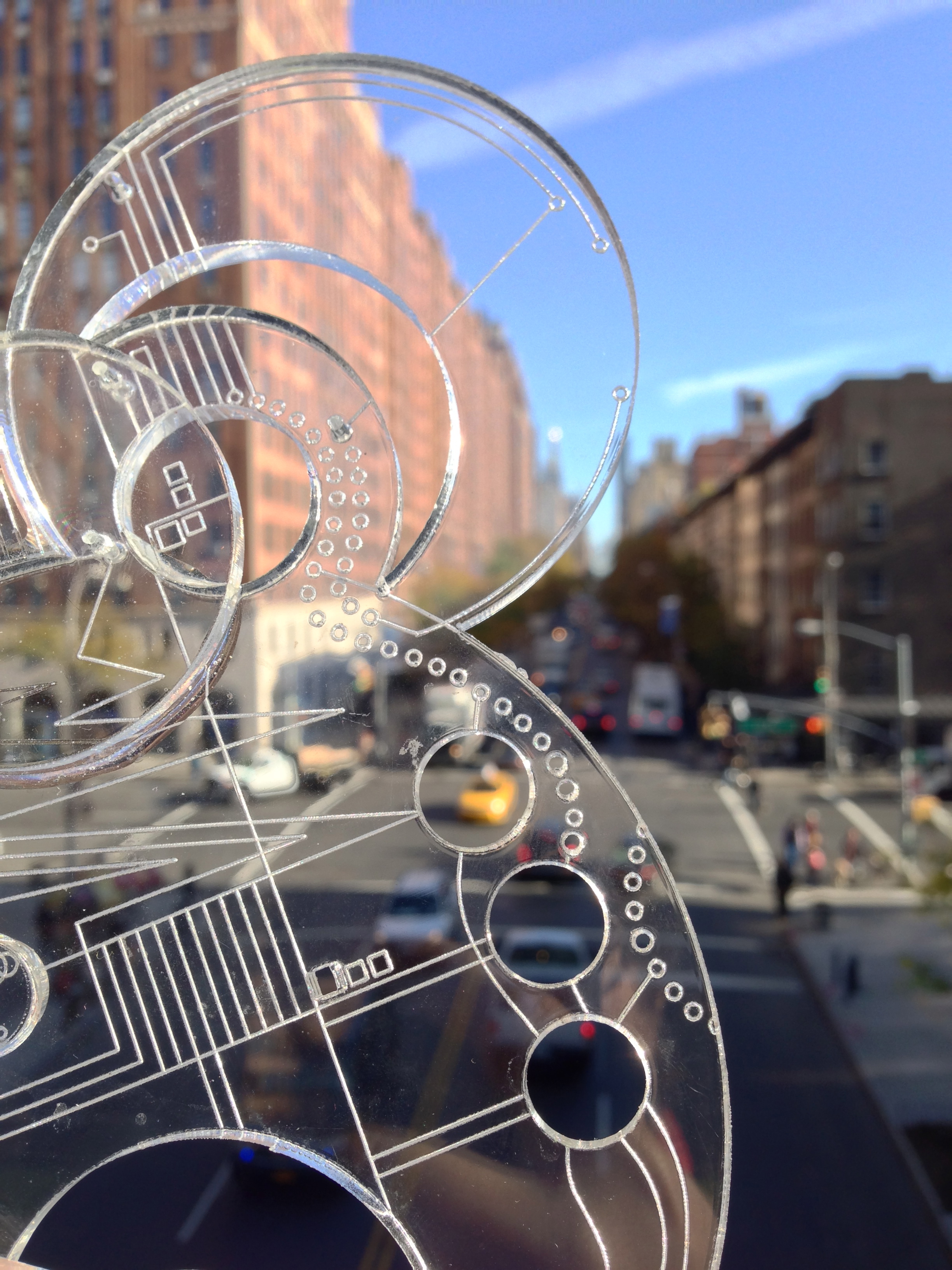
Newcomers to the design/futures party are often curious about bridging from abstract talk of possible futures into more tangible exploration -- but such interest doesn't automatically come with a sense of how to begin.

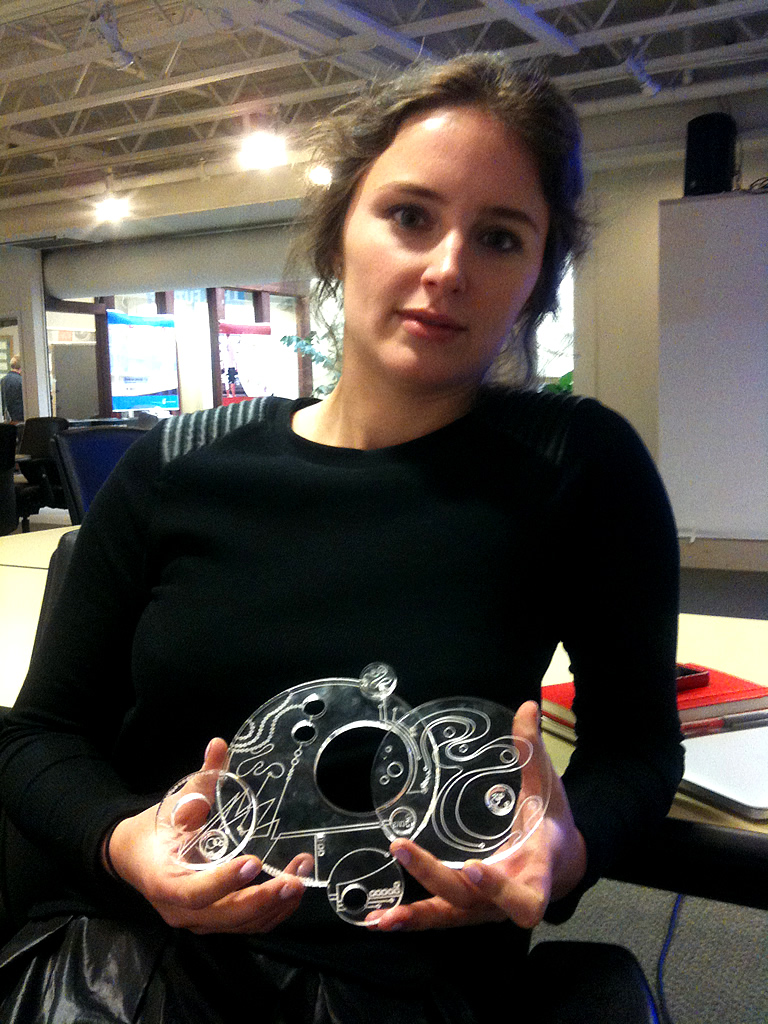
Last year I wrote a piece to provide a possible way to venture into this territory, for an anthology called 72 Assignments: The Foundation Course in Art and Science Today –– an assignment, Time Machine / Reverse Archaeology.

Published by the Paris College of Art, the collection's premise was to reimagine the Bauhaus Vorkurs ('foundation course'), almost a century after Johannes Itten introduced this landmark in arts education. (The book's working title was 100 Assignments: The Future of the Foundation Course in Art and Design.) Each assignment is meant to be doable within a three-hour window.

My piece was intended mainly as a first-timer's scaffolding for translating existing future scenarios into either physical prototypes or immersive situations. (You could tackle it alone, but in a group would be better. You could also do it in three hours, but longer might be easier.) The 'Reverse Archaeology' variant addresses the object-oriented concerns of design fiction. The 'Time Machine' variant exemplifies the more encompassing simulation/situation territory of experiential scenarios. Since publication in late 02013, both versions have given rise to some interesting results. More about those in posts to come.

It builds on similar assignments I've set for students at the University of Hawaii at Manoa (02008, with Scott Groeniger), at California College of the Arts (02011, with Jake Dunagan), and at the National University of Singapore (02012, with Aaron Maniam and Noah Raford). It also owes much to the alternative futures processes [pdf] that I learned from Professor Jim Dator and colleagues at the Hawaii Research Center for Futures Studies.

The whole idea of sharing materials like syllabi and assignments is bound up with a problem space I'm thinking about a fair bit lately: 'structures of participation' (a phrase borrowed from Natalie Jeremijenko) for designing experiential futures. This interest in structures of participation is about democratisation of the tools, in service of growing a more adept community of practice, in order ultimately to deploy experiential futures -- design fiction, experiential scenarios, etc -- at scale and to greater overall effect in the culture. To hone fluency in one's own practice is a fine thing, but it needs to be learnable in order to scale. And scaling our efforts towards 'social foresight' is the point, I think (see Chapter 7).

And so, to that question of democratisation, which might alternatively be framed as a matter of Open-Sourcing design/futures practice; it's nice to see the PCA Press collecting assignments, of all things. I'm now teaching graduate students full time. For three years before that I was consulting full time. A common feature to both areas of work, it seems to me, is that documentation isn't shared as much as it could be. A good deal of both teaching and consulting work seems to take place in bubbles, with no one quite knowing what's happening in others' bubbles. This is a paradox of practice-led discourse. You get practitioners so preoccupied with  learning-and-deploying in their own contexts that they don't, for whatever combination of reasons, share as fully as they could, thus depriving the commons of resources that would benefit all. We need quite deliberately and systematically to Open Source the work around which we seek to accelerate collective learning.

A disclaimer. The step-by-step process outlined in Time Machine / Reverse Archaeology is probably bleeding obvious in some ways and a bit opaque in others. One or two of the key steps from scenaric premise to concrete future artifact/situation may be reminiscent of the old Monty Python sketch about D.P. Gumby's School of Flower Arranging: "First, take your flowers. Then, arrange them in a vase!"

But perfection is not the first step. Getting involved is. To the extent that any how-to guide helps people cross the threshold to a first attempt, it has in an important sense already succeeded.

Do get in touch if you decide to try out #timemachine or #reversearchaeology assignments -- it'd be great to hear how you go.


[Thanks to Bruce Sterling for blogging this over at Beyond the Beyond -- the curiosity that piqued in various quarters helped prompt me to post here too.]

[Update 1apr2021: Replaced broken links. Unfortunately the Sterling/Wired post is not archived.] 

Related:
> Travelling without moving
> 99 cent futures project
> Strategic Foresight at CCA's Design MBA
> The first guerrilla futures class
> Why futures and design are getting married

Wednesday, February 12, 2014

Participatory cli-fi: the Making of FutureCoast

FutureCoast is an ambitious, just-launched collaborative cli-fi (climate fiction) storytelling game, created by the PoLAR Partnership at Columbia University and funded by the U.S. National Science Foundation (NSF).

IMG_9572

A central interest of ours at the Situation Lab* has to do with the design of participatory frameworks for storytelling at scale - also a central challenge for this project. So we asked the creative team behind FutureCoast, our friends Ken 'Writerguy' Eklund (World Without Oil) and Sara Thacher (The Jejune Institute), to tell us about what they have been learning from the making-of process. Here's what they said...

Stuart Candy: How do you describe the kind of work do you do, and what's the situation in that domain?

Ken Eklund: I am a creator of authentic fiction, by which I mean I create the attractive narrative vacuum that people fill up with their stories – playfully, yet with intention. I use game design behind the scenes, but often that's not apparent at all in the play itself. I help people find new ways to engage audiences, especially through collaboration. It's work that's more and more in demand, as old ways of communicating ideas and presenting issues lose ground to open, participatory experiences.

SC: What's the story behind FutureCoast? And the PoLAR Partnership?

KE: In fall 02008 the NSF convened a day-long symposium at The Exploratorium, in which innovative practitioners outside of science explained what they did to the NSF's advisory team. Afterward, Stephanie Pfirman, a chaired professor from Columbia, sought me out and we talked for two hours about game ideas set in the polar regions (her area of study). This is how my projects often begin...

Fast-forward to early 02011: Stephanie's back in touch. The NSF is calling for proposals for climate change education projects, and Stephanie thinks learning games are an exciting approach.

We learned we were chosen for funding in fall 02012; that's when the PoLAR Partnership was born.

The NSF has begun to focus on storytelling as a necessary part of climate change education, which maps exactly to how FutureCoast is played. So suddenly there's a lot of attention on our gameplay and methods.

SC: Some intriguing terms appear in the project description ("authentic fiction", ""de-abstractifies", and "veil of unreality") which seem to go to the heart of things. Where do these come from?

KE: Short answer: I made them all up.

As you know, I have trouble describing concisely what a game like World Without Oil is. After years of struggle I hit upon "authentic fiction" and like how it feels as a descriptor of my work. "Authentic" in this context means multi-authored, textured in the way only diverse minds can supply; but also reality-based, painting reality within a playfully fictional frame.

"De-abstractify" is my attempt to fill a hole in the language. There's a thing that happens with stories, when you stop observing the story and enter it. In real life, we say "the shit got real" but there's no equivalent in a storytelling context. Yet we all know there are those times when you're reading a book or watching a movie or, especially, playing a game, and the shit gets real and affective.

"Veil of unreality" comes from observation of the climate change discussion.

Sara Thacher: These are Ken's words. Words that I've also found very handy for discussing the project because they all touch on the personal nature of FutureCoast. The structure of a voicemail – one person calling another and leaving a message – is a hyperlocal thing. It's not a global phenomenon; it's about the connection between two individuals. Each of these words get at what happens when you start trying to think about climate change – something we generally hear about on a grand scale – on a much more individual level. It becomes something that's part of your neighborhood, something that impacts where you decide to buy a house, or the news you share with your parents.

 
IMG_9700

SC: The time horizon for players' voicemails from the future is 2020-2065. Can you walk us through the thinking there?

KE: Well, a software system in many of our futures has a leak in it. It's in the voicemail system, so voicemails are what's leaking through space-time. This software system comes online around the year 02020 in most futures, and they finally fix the leak around 02065. That's just what's happening, as near as we can tell anyway, so our thinking really doesn't enter into it.

Of course, this timeframe is probably a sweet spot, futurethinkingwise. It encompasses the lifespan of many people alive today and includes the adulthood of their possible children, so there's plenty of emotional engagement on offer.

SC: What comparable efforts have appeared before around climate change as a theme, and where does this project fit in? What challenges come with that territory?

KE: I don't know of any comparable approaches, but in a wider sense this project fits into the emerging genre of "cli-fi," climate fiction. Works of cli-fi tend to be single-authored stories about a single possible future, though; I don't know of any that are participatory or that explore the cloud of plausible futures.

The challenge with climate change as a subject is the polarized state of its discussion. It's made people wary of engaging with anything that has the global warming or climate change label. Less well recognized, it's also disefranchised people from the story – a scorched-earth war of talking points with no safe place left for the common person to venture hopes and fears or express what they know.

SC: As a "collaborative storytelling game" what precedents does FutureCoast build on? What perhaps has not been tried before (and why not)?

ST: Participatory storytelling happens around shared worlds – places where all of the participants generally know what the world is and then create their own space within that universe. These can happen with worlds that are anything from Harry Potter fanfic to people Tweeting as characters from The West Wing long after the show is over.

There are also participatory storytelling projects where the participatory part was explicitly planned for by the creators. Welcome to Sanditon let the fan community that had built up around their wildly successful web series, the Lizzie Bennett Diaries, have the opportunity to make their own characters in the fictional town of Sanditon (another Jane Austin adaptation).

What these projects and FutureCoast have in common is establishing a world that participants can share. Everyone participating agrees on two things: (1) the basic structure of the world – voicemails are appearing from the cloud of possible futures and (2) to the improv rule of "Yes, and . . ." where everyone's contribution is accepted as part of the world.

KE: This all very apt, and it made a connection for me that I've never made before:

I grew up in Arizona, in Phoenix, and my dad had this huge map of Arizona on our family room wall. On Friday nights we'd gather around that map and Dad would announce, "Well, we've never been HERE" and point to the map. (Some completely empty spot, like as not, as there are a lot of those in AZ.) And then on Saturday we'd pile some things into the family station wagon and go there.

Along those lines, as I grew up, as much as I admired Sherlock Holmes or Rivendell, I was even more captivated by Mycroft or Minhiriath – the unknown stories, the rabbit holes, curiouser and curiouser.

I think if you look at FutureCoast, World Without Oil etc. you can see there's an intention there to create as thin a narrative frame as possible, to make that "Yes, and..." as inclusionary as we can.

FutureCoast builds on the other works of authentic fiction I've done, most notably World Without Oil. It also builds on Sara's experience with The Jejune Institute and other geolocated experiences. But by design it's mostly experimental. I don't know of any other experience that uses in-game voicemails as the storytelling itself, or that embraces our level of multithreadedness, for example. We take a very positive approach, and that's noteworthy too, especially given the subject.

And it's rare to see game narratives that take their immersion as seriously as I do with mine.
 
IMG_2295-sm

SC: Tell us about the choice of media and other elements of structure you've created for players to plug into.

KE: The main media are the voicemails. We've really focused on that medium because:
  1. It's rich. It's the human voice; people are wired to glean meaning from it (both informational and emotional).
  2. It's familiar and accessible. People widely have experience with the vmail form itself and are comfortable with it.
  3. It's EZ Story. People use voicemails to tell and receive stories all the time. Very low barrier to entry!
Voicemails are compact. In voicemails, people get to the point. They are a breath of fresh air in the climate change discussion.

The main storytelling structure is: the voicemails leak out of the cloud of possible futures. What this means is: inclusiveness regarding the voicemails that people contribute. Your expression of the future is not only accepted, it's valuable and welcomed as such.

Structurally, there are two halves to FutureCoast: the immersive narrative centered on FutureCoast.org, and the behind-the-curtain participatory storymaking centered at FutureVoices.net. At FutureCoast.org, you play along with the game narrative, listening to voicemails from the future and collecting them into mixtapes ("TimeStreams"). At FutureVoices.net, you help create the game narrative: you call the FutureCoast hotline to record the voicemails that express your visions of the future. You also volunteer to geocache a chronofact, a secret mission to make it seem the chronofacts are mysteriously appearing from the future.

At FutureCoast.org, you interact with the game characters as though the fiction were real. At FutureVoices.net, you interact with the gamerunners to help move the game forward.

SC: What main lessons for practitioners (in transmedia, futures, or game design) have come from the "making of" process?

KE: One main lesson is about the power of storytelling to engage hearts and minds. From the time I proposed FutureCoast to now, I've watched it move steadily from a shot in the dark to the bullseye in terms of how to frame issues in a meaningful way.

Another corollary lesson is about making a narrative truly participatory. As a storyteller, as long as you keep it your story, your audience won't regard it as their story – and will be less affected by it. I think futures practitioners should be especially interested in this approach. In our playtests so far, we've seen the future take on a high level of reality for people, very quickly. We have a fascinating blend of seriousness and playfulness.

Last, this authentic fiction stuff is really hard. But do it anyway!

SC: What sorts of possibilities do you see for this kind of work in the medium to long term?

KE: The more analysis I read about the effects of an Everything Is Connected world, the more well-positioned this approach seems to be in terms of creating engagement engines for real-world issues. The challenge is to keep moving; today I murmured to myself, "I don't think I'm unlearning things fast enough".

ST: I think our perceptions around 'authorship' are going to continue to break down. The area for participatory storytelling that I'm most excited about is just how much our remix culture has changed what it means to participate. Appropriation is almost not the right word anymore, because there's already a feeling that stories/media belong to everyone. In this brave new world, the TV show 'Mean Girls' becomes an avenue for political commentary and The Hulk becomes an advocate for feminism. In the future ahead, I'm excited to see how this'll be applied as increasing numbers of storytellers realize that their creations are already participatory.

[Chronofact images courtesy of Ken Eklund and Sara Thacher. What's a Chronofact?]

*Originally posted at the Situation Lab blog.

More posts:
> Mapping c-change
> Superstruct
> Coral Cross
> A climate of regret

Friday, January 03, 2014

Happy new year

The astonishingly popular new year's folk song Auld Lang Syne comes from a poem penned by Scots literary hero Robbie Burns back in 01788 (which happens also to be the year that the first fleet of convict ships arrived to found the penal colony that would become Australia, where I was born not quite 200 years later).

The phrase auld lang syne means "long, long ago". The whole song's about looking back, an activity that is not without its merits, but one handsomely served by many other occasions, e.g., every anniversary of everything that has ever happened. For all sorts of reasons, a new year's song that instead looks forward seems to be in order.

***

For Future Time; or: Auld Lang Syne (aiglatson edition)

Should all our futures be ignored
And never brought to mind?
Let's cast a gaze to years ahead
For the sake of future time

For all of future time, my dear
For all of future time
Tonight, we toast posterity
And imagine future time!

Oh, auld lang syne is well and good
And nostalgia is fine
But every hope and dream depends
On the shape of future time

For all of future time, my dear
For all of future time
We'll dream together, you and I
Of our lives in future time


More posts:
> Tombstone and the future of history
> Designing futures
> How to make Stone Soup
> Parables and horseshit

Wednesday, December 11, 2013

Big shifts, small change

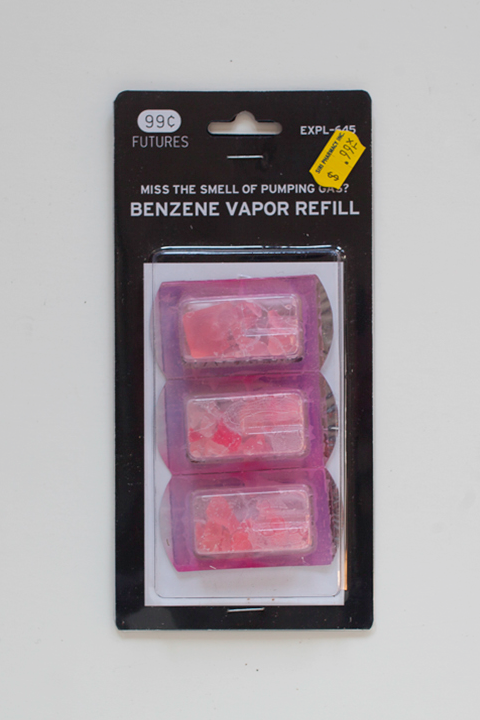
What kinds of artifacts might be found in the 99 cent store of the future?


All images from The Extrapolation Factory website.

So asks a nifty, crowdsourced experiential futures / design fiction project by The Extrapolation Factory, an award-winning initiative of Elliott Montgomery and Chris Woebken (both alumni of the RCA's Design Interactions program). "99 cent futures", executed in New York earlier this year, is now being exhibited in China, giving the project a new lease of attentional life.

Some months back, when this effort was in the pipeline, I spoke with them to help hammer out a participatory design framework which they created so that attendees at a workshop in NYC could playfully generate and make their own answers to the question. Then the pair installed the resulting artifacts in an actual 99¢ store in Brooklyn (calling to mind some of our early FoundFutures adventures in droplifting; e.g., speculative pharmaceuticals, souvenir magnets and postcards from the future).

I particularly like that they managed to include both a participatory design phase and a guerrilla futures phase -- two critical frontiers of design/futures work -- in the same process.


Today a report on 99¢ futures appeared on the CNN website; last weekend I did an interview by email for it.

Now, it's more or less axiomatic that something -- usually a pretty fundamental something -- gets messed up in reports on futures. In that regard this piece is better than most, although it seems to imply that "futuring" (the reporter's preferred term, I think borrowed from Chris and Elliott) is a new "movement" emanating from design, as opposed to a practice established over many decades and recently adopted and/or reinvented by some designers.

Apparently I did not make that relationship clear enough. Live and learn.

Still, it's a good article, and encouraging to see this work thoughtfully covered in mainstream press -- in the Style section, impressively enough; not a common place to find foresight news!

We'll dig into the Extrapolation Factory's projects and methods a bit more in another post.

Meanwhile, for those interested the whole of my email interview appears below. The questions were asked by CNN writer Sheena McKenzie.

***

Why was the 99c store such an interesting/significant project?

Two things make the 99 cent store interesting. First, it's a rare invitation to imagine the future's mundane side. Popular notions of the future often get stuck in a kind of glossy rut - gleaming buildings and whiz-bang inventions, and it's not often enough that we see the futures of everyday life brought into focus. Second, it's the result of a participatory process. Chris and Elliott didn't pre-imagine everything for a passive audience, they designed a way for people to develop and share their own ideas.

The project exemplifies a hybrid of design and futuring that we're sure to see more of as time goes on. My colleagues and I call this frontier of practice "experiential futures" or "design fiction". Design fiction focuses on objects, and experiential futures focus on immersive situations. Both aim to bring possible worlds to life in a way that enables a deeper kind of conversation about the future. They're more generative, participatory and tangible than much of what has come before. We need to cultivate ways of imagining the future together.

What is futuring and why is it important?

Futures or foresight practice (also sometimes called futuring) is about systematically and creatively exploring how change could unfold over the medium to long term. This is important because humans have an inbuilt psychological tendency to filter everything through the lens of a rather narrow experience of the present, which leads to decisions that are short-term, short-sighted and risky. With massive global challenges looming, like climate change, peak oil, and economic volatility, we need to develop a cultural capacity for thinking ahead and creating options, so we aren't just reacting to crisis after crisis. Good strategic foresight gives decision-making a longer runway, and experiential futures is one of the most promising ways of getting this kind of thinking wider exposure.

Many people think of the future simply in terms of technology. Yet this project was a slight tweeking [sic] of the world we already know -- does that make it more emotive?

The tendency for technology to dominate thinking about the future is a serious problem. A lot of change begins with technology, but it doesn't end there. The future conversation needs to include social and political dimensions. For example, it seems appropriate that the creators of the 99 cent store project have brought it from New York to Shanghai. This prompts us to think about the supply chains - in which China is a critical link - which currently make the phenomenon of 99 cent stores, and their cheap mass-produced contents, possible in the developed world.

This project's tweaking of the world we know through unsolicited urban installation of objects is a great example of what I call "guerrilla futures" - unexpectedly manifesting fragments of possible futures in the midst of people's everyday lives. This turns out to be an effective way of firing people's imaginations even if they haven't asked for it!

Why should we think about the future when designing products? And where do you see this trend heading?

The incorporation of futures thinking into the design world, which has picked up pace hugely since the mid-00s, shows no signs of slowing down: everything we make is part of the future we will get. So we need to think about the future when designing not just products, but anything. As a futurist, I now teach foresight at a design school, OCAD University in Toronto, because designers are at the forefront of shaping the world, whether they realise it or not -- and we'll all be on track to a better future the sooner and more deeply they realise it.


Related:
> FoundFutures: Chinatown: Green Dragon (02007)
> FoundFutures: Postcards from the future (02007)
> More FoundFutures
> Future-jamming 101
> Wired's Found: Artifacts from the future

Thursday, April 04, 2013

Designing Futures


I did the following interview for Desktop ("Australia’s most read monthly design culture magazine") late last year. The text appears below as it did in print, with a few hyperlinks added. Editor Heath Killen asked the questions.

***

What sparked your interest in the future?

I guess I've always had wide ranging interests, but the future is a curious generalist's playground - because it's everything that hasn't happened yet. It defies disciplinarity, inviting you to think in an especially integrative way. Analysis after the fact lets you isolate something and look at all the forces that acted on it. In contrast, looking at things prospectively requires appreciating the dynamic relationships between things (across disciplinary boundaries) and the various alternative ways that they could play out, because the future's contingent in a way that the past is not.

I discovered the actual field of futures studies - also known as foresight - indirectly, through my mother, who taught high school for many years. Her usual subjects were geography and economics, but at one point she was given an opportunity to teach portions of a pilot course in futures studies in Queensland. I was in year 11, at a different school, but came across the course reader at home one day and got really interested. A year later, the biennial conference of the World Futures Studies Federation happened to be taking place at the University of Queensland, so I got in touch to ask if I could attend, and they said yes. All of this meant I was exposed to a the work and community of scholarly futurists unusually early; well before I'd decided what to study at uni. So it had time to percolate, which I think was a great benefit. It's easier to integrate futures into your thinking before you get too socialised into the confines of disciplines. For that reason it’s really great to teach futures to younger students.

How would you define the role of a futurist to someone who has never heard of it before?

There's not an especially high degree of consistency across the futures field, so I can't presume to speak for all futurists. I usually describe the work simply as being to help people to think (and feel) about things that haven't happened yet . Edgar Degas said that "Art is not what you see, but what you make others see." Similarly, I regard professional foresight work as being about enabling the circumstances in which people can have their own insights. You're providing scaffolding for the exploration of possible worlds. On that basis, in whatever organisational or governmental or community setting, you can then start crafting and implementing appropriate anticipatory strategies, both to shape and to prepare for those scenarios.


CoMConnect (02012) | Image courtesy of Melissa Butters Photography

Your personal blog is titled “The Sceptical Futuryst”. What does that mean exactly?

That title comes from two things. My first degree was in the history and philosophy of science. Among the founding texts of the scientific era was Robert Boyle's The Sceptical Chymist, published in 1661. When I started my blog in 2006 I adopted the anachronistic spelling "futuryst" as a sort of reference to Boyle's book, which had a nice ring to it.

The more important reason is an attitude towards the work: I'm suspicious of people who claim to know what the future holds, and I like to encourage thoughtful engagement with futures in the plural. There's far too much sloppy thinking - including tolerance of baseless assertions and predictive nonsense primarily designed to position the speaker as a formidable-sounding authority - and I think we're well overdue as a culture to up our game around the quality of foresight.

Futures is about the rigorous application of history and imagination to inform wiser decisions today. Real futurists, I think, own up to the work being about having a considered impact, yet with enough humility to recognise the ever-present unknowns in the mix. I guess I'm sceptical about futures trying to legitimate itself according to scientific (enlightenment era) values, but then I'm also wary about science doing the same thing! The best scientists and the best futurists I suspect actually have very similar attitudes.

What drew you to working at Arup, and what’s involved in the average day of a futurist in a design studio?

I felt Arup would be one of the few places in the world where one can really work at the intersection of foresight and design on issues and projects at quite a large scale. While writing my doctorate about that foresight/design intersection, I came to believe that it was a direction seriously in need of further exploration in order to address the wider cultural need of more effective, embedded forethought. This is grounded in my view that foresight and design are actually the same process - one of creative and iterative optimisation within constraints - just at different scales of time/space. Foresight can help design by providing valuable context while design can serve foresight by making it more concrete.

My average day is not necessarily all that different from many of my engineering and design colleagues. There's always a mix of external consultation projects at various stages of completion, there are meetings and emails; always quite a lot of communications to maintain relationships, both internal and external. The substance of the projects can be bit different when dealing with longer-range possibilities, but we're a design organisation and as I've suggested, foresight can be seen as a context for (or big-picture instance of) design. Projects we've done in the past year range from working with the leadership of Arup in Australasia, or of our clients such as the Sydney Opera House; to helping the City of Melbourne crowdsource a digital strategy [video]; to testing the thinking behind the Singaporean government's national sustainability vision for 2030.

The actual relationship between the two fields of design and foresight has become especially interesting since about the mid-00s. Organisations like the Association of Professional Futurists and the World Future Society have emphasised design in the themes of recent gatherings. Meanwhile, the design community is getting quite interested in futures. Two examples of the latter from personal experience: in 2010, I was brought in to develop a Strategic Foresight course for the MBA in Design Strategy at California College of the Arts; and last year AIGA (American Institute of Graphic Arts) gave me the unexpected privilege of delivering the closing keynote at their annual conference [video]. Programs such as the Design Interactions department at the Royal College of Art, or the Masters in Strategic Foresight at Ontario College of Art and Design are hybridising the fields in very promising ways. There is much still to do in both directions, but in a nutshell, designers and futurists are tuning into and beginning to learn from each other. It’s quite an exciting process to be part of.

Has the way in which we think about the future changed in the 21st century? What forces do you think have changed our view of the future, and what implications do you think that has for progress, innovation and culture?

It depends who you mean by 'we'. The future looks different everywhere, which is an important reason why Arup has a Foresight presence in each region around the globe. And the variations around futures aren't geographic only. I've always been struck by the strange fact that you can be having the best day of your life while the person next to you might be having one of the worst. To grasp that properly is to reveal the nonsense of 'utopia' and 'dystopia', because it clarifies so starkly that those two terms are really ideal types or literary/narrative tropes, as opposed to really useful categories for understanding actual times and places, whether past or future. Real histories and real lives are always a complex mixture of positive and negative things. So we interpret 'utopia' and 'dystopia' literally, at our peril.

In Western public culture, or at any rate the Anglosphere, I agree with the starting premise of Stewart Brand and the Long Now Foundation, namely that it seems harder and harder to think well about the long-range future. The changing signal-to-noise ratio which many have observed in our 21st century all-you-can-eat information diets makes it, paradoxically, both more difficult and more important to think well about what could happen.

Progress is a hugely vexed term so I won't get into that here. To boil it down: Innovation without foresight is dangerous. Foresight without innovation is pointless. We get by unthinking increments to places we would never have chosen to go. Yet zooming out to take in bigger patterns on the longer view - the forest rather than the trees - affords insights that you can't get up close. Of course, what you really want is to be able to toggle at will between those zoom levels.

The word “future” itself comes loaded with connotations and expectations. At this point in time, what issues are the most pressing and important that we should be addressing when we think about the future - particularly when it comes to design?

At the risk of going seriously meta, I'd say designers need most of all to improve their futures literacy. Eliel Saarinen said many decades ago that it was important to design things for their next larger context ("a chair in a room, a room in a house, a house in an environment, an environment in a city plan"). That's a spatial argument, but the temporal counterpart to Saarinen's point is harder to get and to apply, because it involves engaging in nested layers of abstraction, which are more and more difficult to concretise or visualise the further out you go.

But if anyone can synthesise and prepare those layers of change-context for human consumption, the design community can. It's been my observation that, given the opportunity, designers immediately "get" and can put futures tools to practical use. However, in the absence of some systematic exposure to and experience with those tools, their intuitive or autodidactic approaches only take them so far. At this point there's half a century of sustained work in foresight as a field, both scholarly and applied, so reinventing the wheel - or worse, ignoring that it exists altogether - increasingly looks just plain silly. 

Some very promising ways to apply design in the service of shaping better worlds are emerging, as we prototype fragments of future scenarios to make them more immersive, imaginable and immediate. That's what my work on "experiential futures" has been about, and it's also what the emerging practice of "design fiction" aims to do. These are perhaps the most direct answers to the temporal version of Saarinen's challenge.


Plastic Century (02010) | Photo: Mike Estee

Where do you think designers are leading us into undesirable futures, and how can they themselves do better futures work?

Unreflectively serving those with the deepest pockets is an abrogation of an ethical duty to exercise our own best judgment about what worlds we really want to be part of and also to leave behind. Any assumption to the effect that mysterious forces will somehow make the product of thoughtless decisions into delightful collective outcomes is a delusion we can no longer afford.

Jim Dator wrote a wonderful piece quite a few years ago which included a list of qualities that would be desirable for doing good futures work; summed up in the term 'aiglatson', which is 'nostalgia' backwards, so it connotes a sort of yearning for the future. To my mind such yearning is not about disregarding or devaluing the present. It's about a certain way of being in the present which is always subtly oriented to the possibility of making something better.

In my view the 'product' of foresight done properly is what could be called (echoing Antonio Gramsci), optimism of the will. This can be contrasted with optimism of expectation. Doing futures work cultivates in oneself, and ideally in one's companions, an awareness of how things could be different, and with that, a sense of one's increment of responsibility. Candide travelled the world with his mentor Pangloss urging him to expect "everything for the best in this best of all possible worlds", and then he returned home, a little wiser, concluding "we must grow our own garden". You don't need Panglossian optimism to be engaged, and growing your own garden is - I like to think - about rendering a service to the wider world, not making a place in isolation from it.

What futures teaches you is, then, "gardening" change in the domains available to you. I think the best futurists help to activate the gardener in people.

***

‘Designing futures’, Interview by Heath Killen, Desktop, No. 289, Dec '12/Jan '13, pp. 22-24.

Thanks to Heath and his colleagues!

Related posts:
> Design is a team sport
> Dreampolitik
> The Unthinkable and the Unimaginable
> Travelling without moving

Wednesday, April 03, 2013

Travelling without moving

Time travel is basically about the way you look at things...


This talk was given in November 02012 as part of the City of Melbourne's arts initiative Going Nowhere.

It was a pleasure to be part of a great program [pdf] with the likes of climate scientist David Karoly, Greens Councillor Cathy Oke, arts prof Mick Douglas, and the brilliant musician Matt Wicking. This was my first attempt at the Pecha Kucha format (20 slides, 20 seconds each) and I really enjoyed the experience. Thanks to all the organisers, particularly Pecha Kucha Melbourne hosts Michelle James and Ammon Beyerle (with whom I collaborated on the CAPITheticAL project recently described here).

If you like the talk above, you might also enjoy this roughly PK-length excerpt from a longer presentation -- "Guerrilla Futures 101: Strategic Foresight meets Tactical Media"-- given at the Extreme Futurist Fest in Los Angeles in December 02011. It sets out an argument for engaging futures experientially. And a fuller exploration of that line of thought can be found in a lecture given at UC Berkeley earlier that year, "How to Build a World".

Related posts:
> The Futures of Everyday Life
> Grand designs
> The Unthinkable and the Unimaginable