Showing posts with label social foresight. Show all posts

Tuesday, July 09, 2024

What if we could sing better futures to life?

Notes from our collaboration with Brian Eno on using music to grow public imagination.


This post is about a new initiative in progress – something I’ve really enjoyed working on, and have great hopes for as it unfolds.

Sing Wild Seeds is a project about having musicians and audiences pre-enact preferred futures together.

Conceptually, it springs from a question along these lines: how might music-making be combined with experiential futures towards developing our collective ability to imagine and shape desired change?

Institutionally, it’s a collaboration between the Joseph Rowntree Foundation (JRF) and Earth/Percent, both independent UK-based social change organisations, dedicated respectively to accelerating the “transition to a more equitable and just future”, and “unleash[ing] the power of music in service of the planet”.

Also centrally involved is Earth/Percent founder Brian Eno, a celebrated musician, producer, and expert collaborator in multiple artforms, whose extensive experience facilitating individual and group creativity has helped form the foundation for this effort.

To say a bit more about the idea behind the experiment – or series of experiments, really, as I’ll explain – the focus is on harnessing the promise and pleasures of worldbuilding on one hand, and musical co-creation on the other, to help people not just think or imagine but play and perform their way into future possibilities. 

If this strikes you as different from the commonplace framing of futures in support of “strategy” or “decision-making”, you’re right. In a sense, this is upstream of those, aiming at some of the background or cultural context within which conscious decision-making occurs. And in a different sense, it’s downstream, in the detail of lived experience, a part of what I call the futures of everyday life.

This goes to a motivation that’s long been key to our practices of and arguments for experiential futures, towards developing a distributed cultural capacity, social foresight.

As I wrote in The Economist many years ago:

Driven by the irrepressible human urge to bring our inner worlds to life, the culture of public imagination is set to make a leap: in coming years we can expect to see more and more companies, governments, advocacy organisations and communities creating and sharing experiential futures. The sooner we learn to use and democratise collective imagination to dramatise our alternatives, the more powerful will be our capacity to shape change towards just and worthwhile ends.

Sing Wild Seeds could be seen at once as a datapoint exemplifying this forecast coming to pass, and as a conscious contribution to taking it further.

It’s a matter of what my collaborator Cassie Robinson of JRF, who initiated the project, has inspiringly framed as imagination infrastructures, a kind of “soil work”, gardening towards conditions favourable for certain kinds of things to grow. (I also find the cognate idea of acculturation a helpful rendering of this approach, and an important complement to organisational reflexes towards institutionalisation.)

We’ve worked together on several occasions over some years, but Cassie and I began talking about this particular project late in 02023, on the back of a series of conversations about social foresight and collective imagination.

We launched Sing Wild Seeds in March this year, with a hybrid online / in-person event in two parts: I gave an introductory presentation on foresight and experiential futures practices for a cohort of interested musicians, assembled from Brian’s network, then he and I had a conversation to begin exploring a bit more of what the possibilities might look like within our chosen design space.

Cultivating public imagination through music is an appealing creative prospect, and also a good practical challenge.

Our approach has been not simply to have musicians integrate richer or more deliberate futures imagining into their existing creative practices – because while helping professional music folks make “songs from the future” is super interesting, Sing Wild Seeds has a more ambitious and fundamentally more participatory notion at its heart.

The idea is to expose musicians to futures ideas and methods, and then to support them in devising site- and event-specific experiments where they in turn will engage live audiences in real time, co-creating and performing songs from the futures that they’d like to see (and hear) come to pass.

This comes with an inbuilt complexity; synthetic and nested.

Nested because the project has entailed devising and running a participatory process to help prepare the musicians in turn to devise and run their own participatory processes, particular to them, with later audiences elsewhere.

Synthetic because it has meant figuring out a way to mesh the musical gifts and creative preferences of a cast of songwriters / performers with two other sets of practices that in most cases are unfamiliar; one to do with the granular imagination and articulation of preferred futures, and the other to do with facilitation and process design.

Tackling this combination was an exciting prospect, and maybe just a little daunting, since not only were the particulars of the musicians’ own sensibilities and orientations impossible to plan for in advance – the ways artists write songs varies enormously – but the ultimate design parameters, practical elements of context in which they would eventually run something themselves (location, duration, format, audience size, cultural composition, etc), would not be found out until later either.

Last month, then, while I was in the UK, we held two in-person workshops at Brian’s studio in London, to try out some ways of helping folks navigate and identify the most promising sectors, for each of them, within the vast design space of potential project-experiments.

The wonderful designer Sarah Drummond was enlisted to co-facilitate, and to support the musicians going forward as they craft their experiments to carry out with festivals and other partners over the next few months. (Sarah is an exceptionally intuitive and adept facilitator; we’ve known each other for well over a decade but hadn’t a chance to work together directly before – and what a pleasure!)


I’d suggested that we offer this face-to-face project development workshop not once, but twice, on different dates, in order to reach a wider pool of potential collaborators, and also to enable a bit of reflection and iteration between runs. This structure worked well, allowing Sarah and me the chance to simplify and better integrate our process for take two.

It’s too early to start talking outcomes, but I doubt if it’s ever too early to start trying to learn from an ongoing process, so I’ll just remark briefly on a few aspects of the foresight part of the project.

I chose two contrasting points of departure for engaging our musician friends in futures imagination and songwriting ideation. One was quick, and deliberately time-pressured; a combinatorial prompting activity using The Thing From The Future card game (second edition). The other was more leisurely, taking the form of a guided meditation or daydreaming exercise; the sort of approach that my colleague Oliver Markley calls mental time travel.

The pair of contrasting tempos aimed to elicit different kinds of creative response: imagining fast and slow, you might say.

From the outset, in relation to the mental time travel exercise, I was specifically interested in going beyond guided visioning. The sense of sight often implicitly overrides all others when it comes to imagining alternative and preferred futures, so we invited guided listening, too – having folks attend especially to their auditory experience, along with other senses, during their inner journeys.

We used a time horizon of 30 years (02054) the first time, and 50 years (02074) the second. Although we were able to give the activity a bit more breathing room in workshop two, on both occasions, from the reams of notes that people took upon returning to the here-and-now and opening their eyes, and the animated conversations that followed, there was clearly much more to explore.

In relation to the card game, both meetings were highly generative, but the second provided an opportunity to fine-tune the prompting a bit.

With participants clustered in small groups of 2–3, one member was asked to select a card on behalf of their group, to indicate the type of preferred future or world that they would be creating a song from (e.g., a “fair” future, a “decolonised” future, and so on). The theme or aspect of that world which each person would focus on for their song was individually drawn from the deck at random (e.g. farming, the ocean, love, cities). And finally, I assigned to the musicians not just the generic output “song” as the future thing for them to create, but instead gave each one a particular kind of song to make from within their chosen future (e.g. anthem, show tune, folk song, etc).


(The Thing From The Future has been compared to, and at its inception over a decade ago was directly influenced by, Brian Eno’s own classic creativity-enabling card deck, Oblique Strategies, so there was a highly satisfying coming-full-circle quality in getting to deploy it with musicians in his studio!)

In addition, following one of Brian’s specific creative mandates that arose in workshop one, we ventured to insist on strict parameters: people had to finish a song corresponding to their personalised prompt within five minutes, then actually sing it.

While obviously the product of a highly compressed creative process, the resulting first-draft compositions from both gatherings truly exceeded expectations. They included a chanted exchange between different species seeking to peacefully inhabit the same planet, a future ballad about farming, a children’s song celebrating science, and a call-and-response performance recounting how humanity saved the oceans.


Modest as these beginnings are, there’s something potentially significant here as a kind of prefigurative politics (see TFOEL p. 220) in the use of music, not just as a social medium – which thankfully has been part of human society since time immemorial, and which has nothing necessarily to do with futures content per se – but on top of that, as a way into shared imagining of new possibilities.

We can make out a kind of double prefiguration: the desirable-in-itself investment in solidarity or community-making by creating and performing in a group, coupled with the roleplay-like composition and singing of lyrics deliberately formulated to bespeak, concretise, and summon the futures we hope to bring into being.

Politics is perhaps too small a word. If this doesn’t sound like a recipe for magic, I don't know what is.

The very first public deployment for Sing Wild Seeds has just taken place – at Britain’s legendary Glastonbury Festival, in an experiment led by the marvellous Genevieve Dawson (pictured at the top).

Many thanks are due to Cassie Robinson, Sepi Noohi and Magda Maculewicz from JRF, to Cathy Runciman and Becky Young from Earth/Percent, to my star of a process design and facilitation partner Sarah Drummond, to Brian Eno for generously hosting these gatherings, and to all our musical participants to date.

No doubt there will be more to say as these wild seeds take root.


Related:
Experiential Futures: A Brief Outline
Introduction to Experiential Futures in The Economist
> Dreaming Together (from the book Made Up: Design’s Fictions)
> What Is the Value of Futures and Foresight? (a Q&A with the RSA)
> Imagining Transitions (interview by Rob Hopkins)
> The Futures of Everyday Life
> Inside a bold new experiment in public imagination (on UNTITLED Festival)
> Participatory Futures for Democracy (see “acculturation”)
> Gaming Futures Literacy (PDF – from the book Transforming the Future)
> The Thing From The Future (see also Situation Lab website)
Anything but Text (post anticipating XF from 02006)
Historical pre-enactment

Note 1: All photos by the author. Note 2: A bookmark: to write up an assignment I once set for my (non-musician) graduate students at KAIST – creating and performing songs from various futures for Korea.

(Update 08aug2024: This post was also published on Medium.) 

Wednesday, May 22, 2024

Look out, Banksy

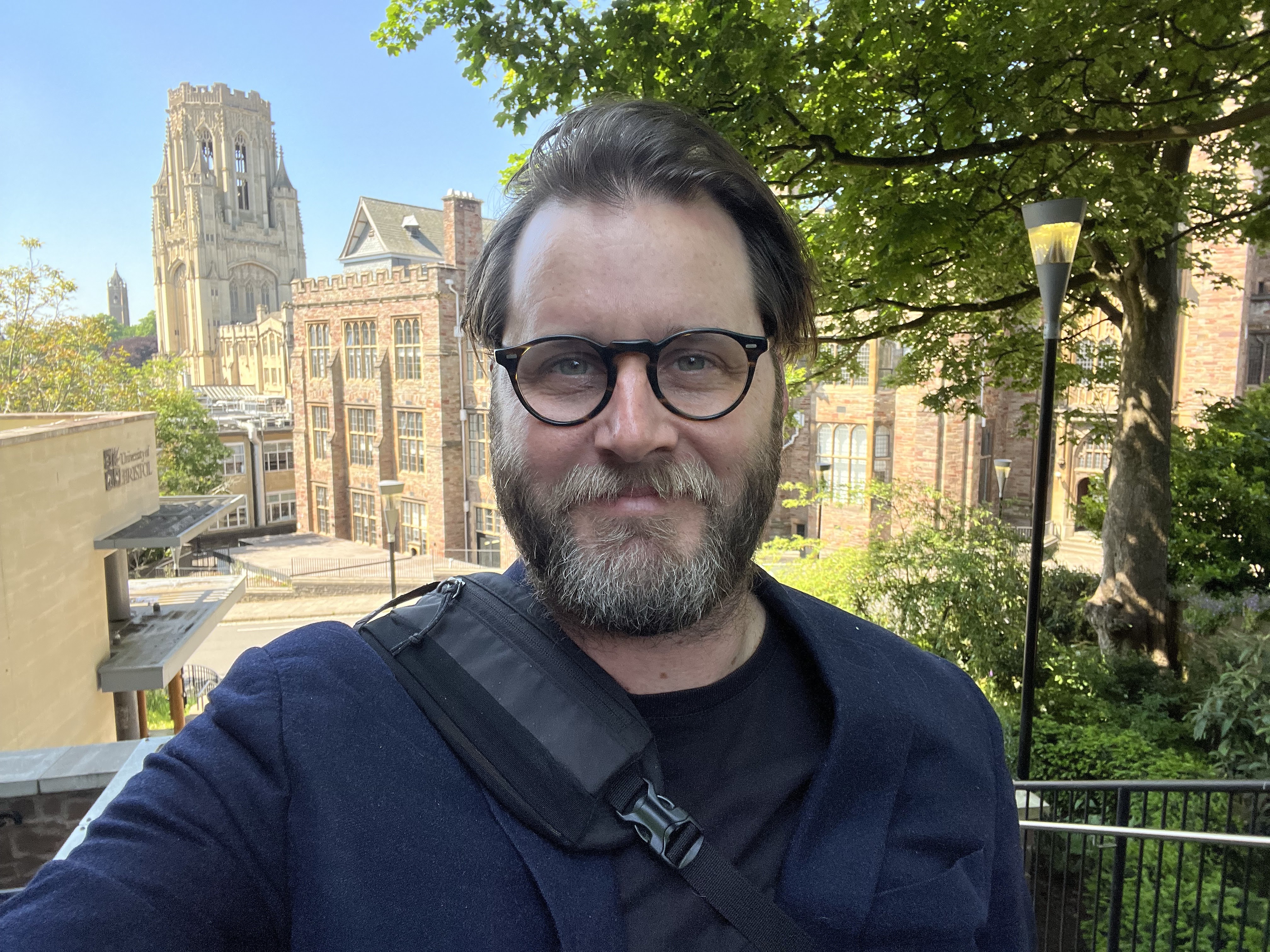
Hello, Bristol!


I’ve just arrived for a month in the UK, where I’m excited and honoured to be a Bristol Benjamin Meaker Distinguished Visiting Professor at the University of Bristol.

Within this hybrid role, crafted to be part visiting professorship and part artist residency, my project is called From Experiential Futures to Social Foresight.

It’s about working with colleagues to share and explore experiential futures (XF) practices to use design, media and the arts for grounding ideas about futures in everyday life – and thereby helping shift our organisations and public cultures towards deeper, more diversified, and wiser embodied engagement with alternative possibilities.

Activities here through mid-June include a Public Seminar hosted by the Pervasive Media Studio, an XF Masterclass for researchers at the ESRC Centre for Sociodigital Futures, and Advisory Sessions with individuals and groups from across the university and wider community.

Something a bit ambitious that we’re also doing is the Bristol Immersive Futures Jam – a live, face-to-face, weekend-long experiential & participatory foresight intensive, including a collective worldbuilding and making process, as well as a public activation with additional guests. Basically we'll be concretely imagining, physically staging, and having conversations about how life here could look decades or generations from now.

This builds on work I’ve done with groups in Singapore, Canada, Mexico, and various parts of the US – most recently through a wonderful artist residency late last year with the immersive theatre community in Denver, Colorado.

It's the first time we’ve offered the process in the UK.

The Bristol Immersive Futures Jam (Fri 31 May 5PM – Sun 2 June 5PM), which calls for a commitment to participate across three days, is fully booked up. But folks who may be interested in joining the waiting list for the whole event, or who wish to join only for the activation / time travel part on Sunday 2 June, can register their interest here.

The Public Seminar (Fri 31 May, 1–2PM BST) may be attended in person at the PM Studio / Watershed, or viewed live online here.

I’m most grateful to my University of Bristol hosts Dr Paul Clarke, Prof Keri Facer, and especially Prof Helen Manchester of the School of Education, and really looking forward to all the future-shaping we'll get to do together.

Related posts:
Killer Imps – Bringing futures to the Royal College of Art (02009)
> Dreaming Together (02015)
Introduction to Experiential Futures in The Economist – outlines some of our Time Machines / immersive scenarios (02015)

Saturday, December 31, 2022

Participatory futures for democracy

The White House just took a big step towards making futures thinking a more common practice.

As the year comes to a close, some great news for foresight and public imagination from the Biden-Harris Administration: the Fifth U.S. Open Government National Action Plan (NAP) was released this week, and it includes a move for participatory and inclusive futures engagement over the next two years.

The new plan, developed in a collaboration between the U.S. federal government and partners in civil society, has a cross-cutting theme of “advancing equity and inclusion for underserved communities”.

It sets out around 30 federal-level commitments that seek, among other things, to ensure public access to government data, information and research, to involve citizens in the work of government, and to transform service delivery. As the introduction notes, “While U.S. support for open government has always been crucial, it is especially vital today. . . . at a time when the principles of equality and democracy are threatened across the United States and around the world.”

There’s a lot more to the document, but of particular relevance to the foresight/futures community is a specific commitment to “pilot new forms of public engagement to inform policy and program implementation”, with a strategy for pursuing this in the form of a framework that “will engage diverse and inclusive public participation to better define and imagine emerging challenges, opportunities, and possibilities for our shared future”.

The effort is to be spearheaded by the General Services Administration (GSA), an independent agency of the U.S. government set up in 01949 “to help manage and support the basic functioning of federal agencies”.

In other words, the White House has just officially promised to engage the public in imagining alternative futures –– with a view to this feeding into national policy and implementation.

This is a very exciting development.

I have already noted at this blog the “tremendous expansion in awareness of and interest in futures/foresight work”, and remarked on mounting evidence that “the conditions for social foresight are ripening, with experiential and participatory futures approaches migrating and spreading across contexts –– from academia and activism, to arts and culture, to business, politics and governance.”

Futures/foresight as a field, or family of practices, continues to progress on institutional and cultural fronts alike. Some of the most promising steps, I think, come when the strategies of institutionalisation and acculturation coincide. (A hat tip here to my friend Honor Harger, a futures-oriented artist/curator, for helping me appreciate these as a complementary pair.) And as I've been saying for quite some time, the bigger story or context for foresight practitioners, whatever their practice and whoever their clients, collaborators or students happen to be, lies in finding ways to advance futures not solely through formal processes of organisations and governance, but through ordinary thinking and action –– the futures of everyday life.

In this U.S. government plan we find, at the very least, another encouraging signal of progress towards augmented participation, distribution, inclusivity and visibility for alternative futures.

But as the plan starts to be concretised and carried out in months to come, in the ideal, it might just prove to contain the seeds of greater things.

I’m pleased to have played, at the request of a colleague leading the charge at GSA, a modest part here by providing light advisement and enthusiastic encouragement to help get this commitment approved in black and white.

I also find it heartening to note the rationale for this aspect of the plan:

“Stories of possibility can provide opportunities to express emerging challenges and opportunities through creative and engaging narrative. At their best, stories can inform our collective imagination and create inclusive space for meaningful conversations — and then drive action to choose new possibilities.”

Hear, hear. Something long understood to be self-evident in futures circles, namely the central importance of images of the future to shaping the world we end up in, is coming to be more widely grasped.

In related news, a report called Imagining Better Futures for American Democracy, by Suzette Brooks Masters and Ruby Hernandez, was released just a few weeks ago by Democracy Funders Network. I found myself in excellent company as one of the interviewees for the project. And as it turns out, some of the steps now being prepared by the federal government appear very much in line with the key recommendations coming out of that research: to strengthen the positive visioning ecosystem by investing in infrastructure and relationships; model what’s possible and fund experimentation; and strengthen narrative systems and amplify positive, futures-oriented content.

Finally, and in a similar vein, my coauthor Filippo Cuttica and I were thrilled to learn this month that our work to help introduce foresight at the BBC, which culminated in the recent publication of a toolkit called The Futures Bazaar, seeking to bring these ways of thinking to wider publics around the world, has been recognised by the professional futurist community as a Most Significant Futures Work of the year – taking home the award for advancing Inclusive Foresight.

So as 02022 comes to an end, here's to a 02023 filled with inclusive co-creativity, narrative invention, public engagement, meaningful conversation, and concrete action towards the preferred possibilities that result!

***

The full text of the Fifth U.S. Open Government National Action Plan is available in html and pdf. Thanks and godspeed to the public servants responsible for making it happen.

Related:
> Foresight is a Right
The Futures of Everyday Life
What Is the Value of Futures and Foresight?
> Where Do You Stand? Or, The Polak Game
> Welcome to The Futures Bazaar
> Introducing Participatory and Experiential Futures at the BBC
> Exploring Technology Governance Futures with the World Economic Forum
> Using the Future at NASA
> UNTITLED: A Bold New Experiment in Public Imagination
> American Futures at the School of the Art Institute of Chicago
> Knowledge Base of Futures Studies

Thursday, August 18, 2022

The Crystal Ball Game

Futurists, stop me if you’ve heard this one before.

A journalist contacts you. They’re reporting on topic X (sure!) and how it could change over the coming years or decades (great!) and would like to speak to a futurist (sounds good!)

Then comes the big question: “What do you predict for the future of X?”

To offer a more pluralistic response, describing alternative futures based on different sets of assumptions, often spells the beginning of the end of that conversation. This is too complicated for the story they want to tell. No sooner have you suggested it than the inquirer is already moving on, questing for someone else, a more innocent (or more jaded) colleague of yours perhaps; one willing to play the crystal ball game.

In futures practice this vignette is wearyingly familiar, and the tendency in popular media towards linear, predictive, and binary treatment of “the future”, singular, is pervasive; enough so that to call it merely a journalistic preference or a pattern is too mild. Pathology would be closer to the mark.

But when journalists insist on simplistic coverage of “the future”, this is not just a problem for futurists trying to practise more thoughtfully. It’s a problem for journalism, too, and for the audience it is meant to be serving.

Whether, in any given case, the reason is cynicism or ignorance, does not much matter. Suppose on one hand, they know deep down that they could do better than the crystal ball game, but blame the constraints of story length, or readers’ attention spans. Or suppose on the other hand, they are themselves trapped in limiting philosophical assumptions that they don’t realise they are making. The result is the same either way. Systematic public exploration of alternative futures is woefully under-served by journalism.

Thankfully, the seductiveness of reductiveness doesn’t afflict all journalism equally, and pockets of real plurality, criticality, and quality are vital bright spots to seek out and build on.

For the past year I’ve been working with Matt Thompson, editor at The New York Times, on the new initiative he leads there, Headway, to investigate global and national challenges through the lens of progress. Matt and his team at the Times have an implicitly forward-looking remit, and in the course of our collaboration, we’ve also been exploring questions around how to support journalism and journalists to become more skilful and responsible in dealing with futures in the plural.

A few months ago we had a public conversation on this topic hosted by the USC Annenberg Innovation Lab. And for the next edition of South by Southwest, we’re looking to take it a step further. You can find the description for our proposed session How to Cover Futures, and a short video we made about it, here.

The challenges are more multifaceted than what I’ve sketched above, and the opportunities to work on them are manifold. This post doesn’t get into all that, but we hope the session will.

We’re aware of colleagues with much to offer on this topic — journalists with futures in their work, and futurists with journalism in their background — and we are keen to widen the exchange in both directions.

This proposed session is just a next step in progressing a bigger dialogue over the long term. For the stakes seem clear enough, and they are high: any society where thinking ahead is properly embraced, distributed and embedded would necessarily have normalised foresightful practices in media and journalism. Put another way, it’s hard to imagine a more sustainable, wise, or foresightful culture coming about, in any form, without society’s purveyors of news and commentary getting a lot more sophisticated in this area than they are today.

In the near term, then, we’d appreciate you sharing this with anyone you think might find it interesting, and voting at the link below by this Sunday [21aug22], to help improve the chances of it happening next March in Austin. 👇🎸✨🌱🤞

And we hope to see you there!

***

Adding here at TSF, for the record, our session description for How to Cover Futures:

Journalism is often described as the first draft of history. But it strives to frame the future. Journalists deal in a constant stream of predictions, promises, and forecasts, yet often address times to come in damaging ways: extrapolating linearly from current events, without much attempt to understand the full range of possibilities; outsourcing statements about the future to pundits and experts with little accountability for or follow-up on claims that turn out to be false; and giving far more weight to past events than to future possibilities in coverage. So what might a journalism look like that took the future seriously –– and playfully? How might we embrace both rigor and imagination as part of our responsibilities? In short, how do we cover the future?

***

This post previously appeared on Medium and LinkedIn.

Related:
> A TSF post from 02006 that makes basically the same point as above
> In Memoriam (on the bizarre experiential scenario we staged at SXSW in 02008)
> Design Fiction (recording of a panel with Bruce Sterling, Jake Dunagan, Jennifer Leonard, Julian Bleecker, and our late colleague Sacha Pohflepp at SXSW in 02010; the Internet Archive is awesome)
> Journalism from the Future (on efforts to report "from" various futures)
> The New York Times Special Edition (The Yes Men & Steve Lambert's guerrilla futures project)
> US Presidential Election 02024 (from 02008)
> Christchurch, New Zealand in 02031 (from 02014)
Transforming the Future (a book about futures literacy)
> For further reading offsite, check out Jamais Cascio’s classic 02006 post Twelve Things Journalists Need to Know to Be Good Futurist/Foresight Reporters

Wednesday, March 31, 2021

Adding Dimensions to Development Futures with UNDP

(Update 28jun22: It was announced today that this project has won at the 02022 Core77 Design Awards in the Speculative Design category! Ceda and I are grateful to Core77 and want to give thanks again to our indispensable collaborators, listed below.)

***

Last week I helped to launch the United Nations Development Programme's annual innovation event, Istanbul Innovation Days (IID), using an experiential futures process and format created for the occasion.

Back in January, they had come to me with a challenge: how might experiential futures practice be brought to bear for the event's Opening Session? Due to Covid everything was to be run online this year; this kickoff was planned as a panel conversation about global development's futures, live in video chat, with the head of UNDP and invited speakers around the world.

Mission accepted: I proposed to interview all the panelists in advance, one on one, then design and send an artifact from the future to each, to arrive at their homes by the week before the event. After more than a year on Zoom, thanks to the pandemic, my hope was to breathe some dimensionality into our talking-head squares.

Each artifact would draw inspiration from ideas about the future shared with me by the speaker in our pre-conversation, and would try to picture a far-reaching shift in relationships and power, manifested institutionally, affecting whatever we mean when we say ‘development’.

So, what happened? 

Sophie Howe, Welsh Commissioner for Future Generations, the first person in the world to hold that remarkable cross-cutting role, emphasised the critical need for a “holistic view” in governance. I wondered: how might next-level holistic, inclusive decision-making look?

Sophie received a bilingual Welsh/English mailer from Wales’ Parliament of All Beings in 02056, notifying her that animal wellbeing data indicated consent to move to the next phase of Rewilding in her neighbourhood in Cardiff.


Nanjira Sambuli, a powerhouse tech justice advocate from Kenya, when we spoke registered the absurdity of a few Silicon Valley tech bros ruling platforms that mediate our relationships all around the world, noting “the dream to democratise, decentralise” and “take on the giants”.

At home in Nairobi, she received a letter written to her as a Board Member for RECODE Africa (REclaim community, COoperativise platforms, DEvolve governance), with a T-shirt for its 3rd Annual Festival in 02030, after Twitter ownership has been taken over by users & workers.


Roman Krznaric, author of The Good Ancestor, told me about the importance of “political innovation” dealing with the “decision making structures” underpinning development at all levels. So what might such transformational change look like on the ground?

Based in Oxford, Roman received a thank you for serving in the 02032 Oxfordshire Ancestors’ Assembly (modelled on Japan’s current “Future Design” process), and a robe as ritually worn by participants when deliberating the potential impacts of their decisions on future generations.


Marcela Sabino, Head of Innovation at Brazil’s Museu do Amanha (Museum of Tomorrow), evoked a scenario in which we relate to corporate entities as legal persons very differently: “Companies have to be held accountable for what they're doing.” The question becomes –– how?

In Rio de Janeiro, Marcela received a screenprinted poster, one in Portuguese and one in English, advertising the public execution/dissolution of a corporation that in 02036 has been convicted of ecocide by the International Criminal Court.

Achim Steiner, head of UNDP, observed that by the later 21st century what we currently know as the United Nations “will have to be significantly different. . . . But the fact that we will need a governance platform on which to come together is absolutely essential.”

At home in New York, he received a hand-calligraphed copy of “The Words Spoken Before All Others”, aka the Haudenosaunee Thanksgiving Address, adopted in a ceremony at Onondaga Lake as the Opening Invocation for the General Assembly of the United Peoples, on 22 April 02070.


When the day of the panel itself arrived, I had the pleasure of moderating the conversation, with Luciana Mermet, UNDP Resident Representative in Bolivia. The speakers didn't know yet what the others had received, so we had everyone use their future artifact as a portal through which to introduce themselves and their ideas to the conversation.

The Deputy Foreign Minister of the Republic of Turkey, Faruk Kaymakci, also joined the session, as a distinguished “Future Steward”, sharing remarks on and helping draw connections among the perspectives offered.

It’s a minor miracle how it all came together. The future artifacts arrived in multiple locations around the world, our Internet connections held up, and almost 700 people joined in to listen, chat and ask questions. If you're interested, the Opening Session is available to watch in its entirety here:

This was an exciting piece of a much bigger conversation, about decolonising and reimagining development for the 02021 edition of IID. It was also an encouraging way for a new experiential futures* format to add both a third dimension (physicality) and a fourth (direct engagement with time) to a 2D medium. I half-jokingly dubbed the format a "4D Panel", and it would certainly work as a replicable structure –– if anyone decides to give it a go, please get in touch.

The other thing to mention about the format is that it is scaffolded using Ethnographic Experiential Futures (EXF) –– a framework that my colleague Kelly Kornet and I derived from a set of precedents for exactly this sort of purpose –– to make it easier to generate customised projects that pair culturally-specific futures research with design-led experiential outcomes. There's more research in the pipeline, so stay tuned.

This post is a quick one based on a thread shared on Twitter earlier today, and I plan to include more details of the project in a proper write-up in due course. For now, though, much gratitude to the many amazing folks who made this possible.

* * *

UNDP Objects of the Future (4D Panel) –– #IID2021 Opening Session –– Project Credits and Acknowledgments

Co-designer and lead artist:
Ceda Verbakel

Robe co-design and construction:
Lindsay Goranson

Calligraphy:
Catherine Marsceau

Welsh translation:
Angharad Withers
Sarah Elizabeth Siân Withers

Portuguese translation:
Jacques Barcia

Screenprinting:
Max Emiliano Gonzales

Documentation photography:
Matt Geiger

Special thanks to the following research informants, advisors and sounding boards:
Jacques Barcia
Ginny Battson
Cennydd Bowles
Jonathan Chapman
Jake Dunagan
Jasper Grosskurth
Jonathon Keats
Michelle King
Peter MacLeod
Sheila Ochugboju
Ollie Palmer
Hannah Muthoni Ryder
Ella Saitta
Wendy Schultz
Sian Sheu
Danny Spitzberg (@BuyThisPlatform)
Maya van Leemput

None of these fine people are responsible for my misunderstandings, errors or other sins

Thanks for generous logistical assistance:
Leonard Kinyanjui (Nairobi)
Sheila Ochugboju (Nairobi)
Siri Krznaric (Oxford)
Kate Raworth (Oxford)
Nina Barbuto (Pittsburgh)
Rich Pell (Pittsburgh)

Thanks also to Jill Chisnell, Trebor Scholz, Brad Towell, and Cameron Tonkinwise

Thanks for additional design explorations to Myrna Rosen and Amrita Khoshoo

Framing by Carol Whitehead
T-shirt production (PIT) by Clockwise.io
T-shirt production (NBO) by Mattel Printing
Shipping by FedEx East Liberty & Monroeville PA

4D Panel members and artifact inspirers:
Sophie Howe
Roman Krznaric
Marcela Sabino
Nanjira Sambuli
Achim Steiner

4D Panel Future steward:
Faruk Kaymakcı

UNDP Innovation liaison:
Milica Begovic

Thank you to Kelly Kornet for co-authoring the Ethnographic Experiential Futures (EXF) framework which scaffolded this project

Thank you to Robin Wall Kimmerer for inspiring the artifact for Achim through her brilliant book Braiding Sweetgrass (see “The Sacred and the Superfund”)

Thank you to John Stokes for kind permission to use the text of the Haudenosaunee Thanksgiving Address. © 1993 Six Nations Indian Museum and The Tracking Project. ISBN 0-9643214-0-8

Extra special thanks to Ceda Verbakel, wonderful partner, fellow traveller, and problem-solver-in-chief

* * *

* Or design fiction, speculative design, etc –– call it whatever you like really –– but know that experiential futures, more recently dubbed design futures in some quarters, has its own genealogy and contours grounded in decades of futures work; lots to dig into for the curious!


Related:
Foresight is a Right
> Dreaming together
The Spirit and the Letter
> Design is storytelling
1-888-FUTURES
Introducing experiential futures at the BBC
> Ethnographic Experiential Futures article / KBFS / original post
> Syrian refugee girls imagine their futures
> Using the future at NASA
> Bringing futures to Stanford d.school
> Wanted: 25,000 Miles of crime scene tape
Design and Futures open access book / intro to Vol. I

Thursday, October 29, 2020

Introducing Experiential and Participatory Futures at the BBC

How do you develop foresight capacity inside an organisation, and experiential futures especially?

It's a question that comes up a lot. 

Recently I've spoken with government agencies from the UK, Denmark, and Australia, whose leaders all reached out for advice on growing their capability in these spaces.

The RSA (the Royal Society for Arts, Manufactures and Commerce) has just published a report on "Realising the Value of Futures and Foresight"; I was glad to contribute when the researchers got in touch a few months ago.

These are exciting signals that the conditions for social foresight are ripening, with experiential and participatory futures approaches migrating and spreading across contexts –– from academia and activism, to arts and culture, to business, politics and governance.

This post is about a fun project that also represents, I think, an exciting milestone in that journey.

A long, long time ago, in a pre-COVID otherworld –– last year, that is –– I had the privilege of collaborating with the British Broadcasting Corporation on an effort to bring futures thinking and practices into the design side of the organisation.

With the brilliant Filippo Cuttica leading the charge (Filo is BBC's UX Principal for Ethical Experiences; he is also part of art collective IOCOSE), and supported by a formidable in-house design posse, we devised a process for introducing around 200 people to the space of alternative futures.

Since our participants would mostly be designers of various kinds, we were resolved that these ideas should land with folks not just in theory, but in the most embodied way possible. So at an away day for the whole design side of the Beeb, hosted in Manchester's grand old Alfred Hall, I gave a keynote address to get some shared concepts and background into the collective mind, and then we transitioned to bringing alternative futures to life, on the spot.


Being quite excited about the event, I took a *lot* of pictures, including all the photos in this post
(except this one of me speaking, obviously... which was taken by Filippo Cuttica)

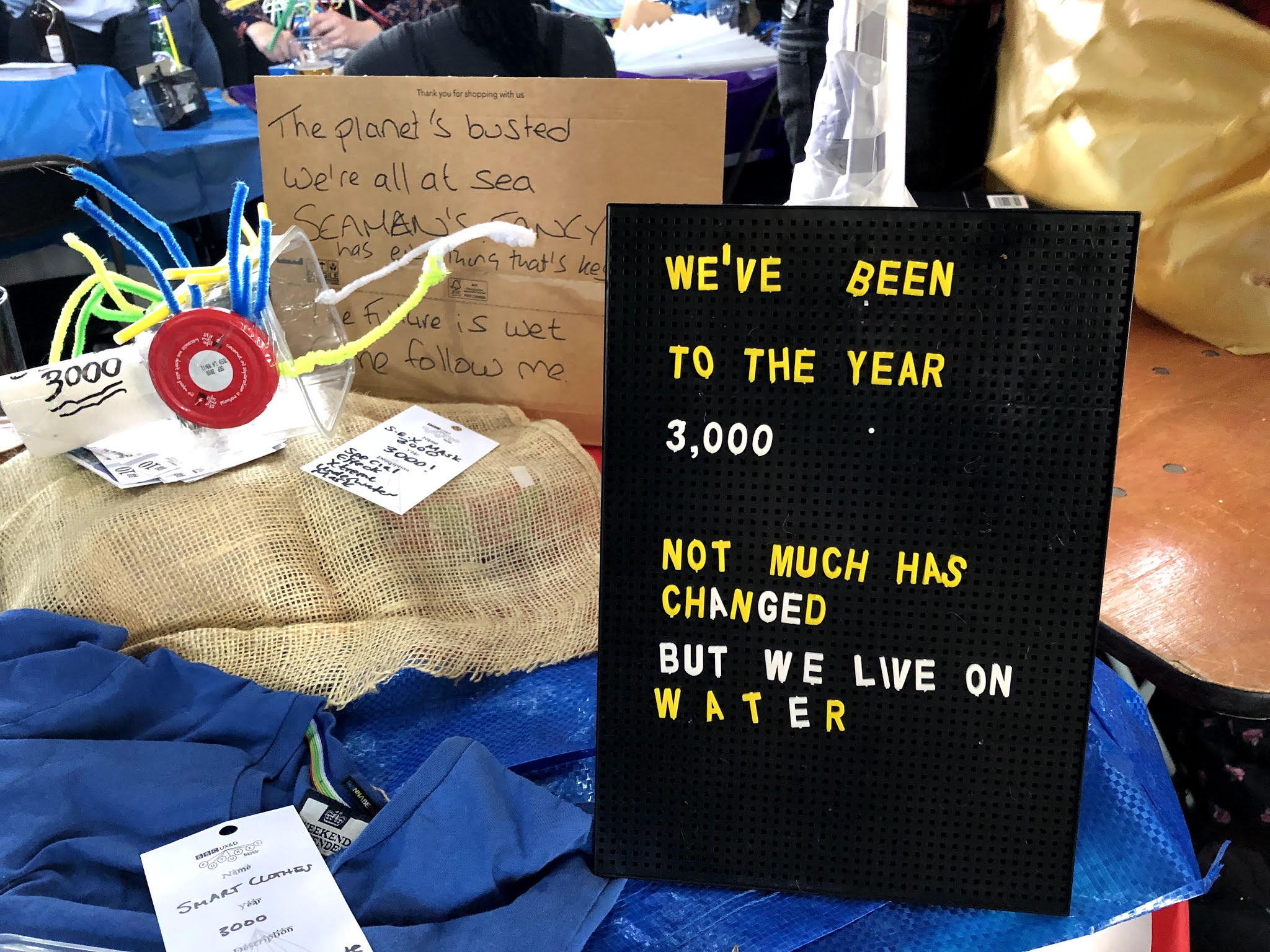
Everyone had been invited to bring in junk from home –– old shoes; defunct appliances; all sorts of things that they would otherwise have thrown out –– to serve as raw material. The group spent the afternoon in small teams, reinterpreting these "found" items using our card game The Thing From The Future as scaffolding for imagination, and then physically transforming them into a crazy array of artifacts from alternative futures. At that point they put their wares "on sale", across dozens of stalls set up in the style of a bazaar or flea market, complete with a special currency created for the occasion that let everyone ultimately "vote" on their favourite designs.

Lo and behold: the Futures Bazaar! A surprisingly coherent container for a mad hodgepodge of material ruminations. The video produced by the BBC team (at the top of this post) really captures the glorious chaos of the day. 


This co-created centrepiece, the Futures Bazaar itself, was complemented by a range of interactive demos organised onsite by BBC media tech unit Blue Room, including an adapted version (pictured below) of our experiential scenario from a few years back, NaturePod, featuring 3D video footage that the team had recently ventured out to a forest near Manchester to record.


It was exciting to build, in scope and ambition, on previous design jam deployments of The Thing From The Future. And turning household refuse into design fiction gold is an inherently satisfying form of creative alchemy, especially at scale. Scores of people, all playing and making their way into the futures together.

To revisit this work now, after more than half a year of working remotely, I find myself really missing the energy of co-creating in person. (It seems most of the time, I manage to avoid thinking about that; covid-coping reflex.)

But what makes a process like this tick, and how does it contribute to developing foresight capability?

I see two key factors driving it. The first is clear constraint. The second is permission to play. In a sense these pull in opposite directions, and that's the point. There's a productive tension in the middle, a sweet spot for creative, surprising generativity, neither too scripted nor too loose. Military drills have clear parameters, but also a tendency towards the predictable, this being of course among their main aims. On the other side, a young child's doodling may manifest a kind of pure play, but one scrawling sketch can look very much like another, and another, and another. Paradoxically, extremely open processes can produce results comparable in their unsurprisingness to extremely planned ones.

In jazz or theatrical improv, it's when the improvisers consciously adopt or, if they're really skilled, feel their way into a shared set of enabling constraints, "finding the game", that things start to click. The signal-to-noise ratio leaps. Pleasurable surprises appear. Embracing the convergent forces of constraint and the divergent forces of play in balance takes us somewhere interesting –– in this case, a gleefully absurdist and thoroughly engaging mode of co-creation.


Several layers of productive constraints are operating here. These include, naturally, time itself; we broke a fairly complex set of tasks into distinct stages, which sharpened focus, brought urgency, and raised energy levels. Another is the overall premise, "make a future artifact with this thing", paired with the specific semiotic or interpretive potential of any given object: each item that participants had brought from home could plausibly be "cast" as many future things, but not as absolutely anything. More granularly, beneath the "future thing" umbrella, the structure of a Thing From The Future prompt offers a kind of future to consider, as well as a theme, a particular context of society or human endeavour, to help the imagination along. A player might incorporate a found object into a prompt something like the following:

"In a {REGIMENTED} future, there is a {pair of old slippers} related to {JUSTICE}. What is it?"

Which might end up generating something like this:


Okay, you might say. People seem to be enjoying themselves and being creative. But so what? How does this help with the development of an organisational foresight capability?

A general answer is that many, if not most, organisations need play more than they realise. Workplace cultures often implicitly devalue and sacrifice, intentionally or not, anything unusual, subversive, humorous or nonstandard. This makes for infertile contexts, inhospitable to new ideas, and perhaps to diversity on other dimensions too (cultures, backgrounds, values). In my experience it's common for organisations to be more brittle, blinkered, and reactive than they might think they are, and to that extent, more vulnerable to changes in their operating environment that they have not made room to consider.

Foresight practice, a conversation space that's deliberately much broader than forecasting (an important subset of it), requires some openness to the non-extrapolative and non-obvious –– viz. Dator's second law: "Any useful statement about the futures should at first appear to be ridiculous".

More specifically, this particular kind of play arguably helps lower the bar to having more serious, strategically load-bearing conversations about alternative futures. I've written elsewhere about how The Thing From The Future is designed to operate, so won't reiterate that here, but as the celebrated designers Charles and Ray Eames used to say, "Toys are not really as innocent as they look. Toys and games are the prelude to serious ideas."

Am I saying that this is "the right way" to introduce futures thinking into organisations? No. It was, however, a great way to do it here, partly because this specific organisation is full of creatives, makers, and storytellers. Also, the context of an away day made a bit of fun welcome, even essential. We understood that participatory, playful and hands-on elements needed to be foregrounded here, and so they were.

In a more corporate, bureaucratic, or self-serious context, such as strategic conversation for a government department, supranational outfit, or large business, other approaches might be more suitable. Less out-on-a-limb for the participants while still inviting their engagement with future possibilities physically, emotionally, and narratively.

The Future Is Now project, which we advised as well as helped implement at the International Federation of Red Cross and Red Crescent Societies (IFRC), the world's largest humanitarian network, mobilised experiential futures approaches in a number of important ways, in order to introduce, enable and integrate foresight throughout a vast organisation. It ended up fuelling an unprecedented level of futures awareness and activity, now shaping strategy at the global level, as well as within many national societies. (We can look at that case more in another post to come.)

Well, that all sounds very nice in principle, you may say, but we can't do most of these physical interventions or collaborations at the moment –– what about the pandemic?

So, part of the reason we called experiential futures "experiential futures", since first plotting out and arguing for this much-needed broadening of foresight practice a decade and a half ago, is that the relevant canvas is huge. It's not about a particular medium or context of deployment. As large as the space of "possible future artifacts" may be –– and I have argued that it has to be much larger than the set of "all human artifacts ever created in history"; if history has happened but futures have not, then the latter space is bound to be ontologically multiple, encompassing the aggregated contents not of just one historical timeline, but countless potential ones –– the point is that there's no reason, for our purposes, to be exclusively interested in objects, or even in physical, face-to-face encounters, important as those are. This is tied in with why the frames of "design fiction" and "speculative design", while both valuable vectors for popularising a subset of experiential futures' possibility space among designers and the design-curious, can sometimes get in their own way a little bit.

The relevant issue for organisations or cultures recognising a need to navigate change more effectively than they have in the past is not "how do we make objects that speak about futures?" It is also not, "how can speculative design or design fiction or help with our policy/strategy challenge?" Nor is it even "how can experiential futures help with x or y?", which reifies a constantly-evolving collection of practices that spring from and must continue to be fed by what seems to me to be the key underlying question: "what can we do to navigate change more effectively?" Any experience that helps people to grapple with possible futures and to take wiser action in the present is in scope. Experiential futures simply designates a possibility space where the challenge is ultimately to make better collective choices among all available options, and the means for realising these are whatever you can come up with.

On this view, the ongoing covid-19 pandemic and its limitations are just another set of enabling constraints. It doesn't much matter if you can't meet in person; do immersive future exhibits with social distancing, or for one person at a time. Send stuff through the post, or by email. Or create digital experiences, or audio ones with no screens in sight. We recently did a hybrid drama/design course on devising theatre in pandemic conditions, which included online live action roleplaying games. We've staged Zoom-native, as opposed to in-person, Time Machines (more on that soon, too). A bunch of us around the world just ran the first edition of a decade-long annual festival program of experiential futures, all created and carried out under covid-19 pandemic constraints. And so on.

People ought to be exploring alternative futures in the highest-impact ways available, especially with the devastating consequences of a conspicuous failure of effective foresight rippling, or rather ripping, through our daily lives, globally, right now.

Filo Cuttica says this in his excellent write-up of this foray into experiential futures:

If there’s one lesson to take away from the pandemic, it's the importance of looking ahead. And not just "looking ahead", but "feeling ahead". By imagining together in structured ways, and creating the experience of change before it happens, rather than while it's happening, we have a hope of planning, and even affecting our future. ...

The idea [of this event was] to introduce the team to a seemingly obvious, and yet hard to grapple with idea: that the future hasn’t happened yet, that we can play an active role in shaping, but that before we can collectively choose what should happen, we ought to explore what could happen.

As noted at the top; it's great that more and more institutions are realising how embedding an augmented futures capability might be valuable. At the BBC, with this effort an internationally significant organisation spanning cultural and governance sectors has taken some deceptively playful first steps down an important path, and I'm excited to see where it might go.

If this sounds like something that your community or institution should be exploring, but you aren't sure what to do next, try the links below for a start.

***


Thanks and congrats again to Filo, to his team and their network of wonderful colleagues, and not least, to their awesome bosses at the BBC for supporting these efforts. I also want to mention prior work that in some ways made this delightful experiment possible, especially the series of participatory futures events that Jeff Watson and I (Situation Lab) organised years ago with our good friends Elliott Montgomery and Chris Woebken (Extrapolation Factory); Futurematic Vending Machine at OCAD, Futurematic: Canal St at NYU, and 1-888-FUTURES at USC; as well as the Discoverability Media Jam for the Canadian Radio-television and Telecommunications Commission (CRTC) with Rich Lachman at Ryerson University, and the Posteridade design jam staged with Marcela Sabino and her team at the Museum of Tomorrow in Rio de Janeiro.

Related
Dreaming Together | pdf from the book Made Up: Design's Fictions
UNTITLED: A Bold New Experiment in Public Imagination | Medium
> On Getting Started in Experiential Futures
Bringing Futures to Stanford d.School
Using the Future at NASA | pdf
Augmenting Cities with Niantic and Knight Foundation
> The Thing From the Future | pdf about the game design
Time Machines 
> NaturePod
> Theatre in Pandemic | full syllabus on Medium
1-888-FUTURES with Extrapolation Factory