Showing posts with label future-shock therapy. Show all posts

Tuesday, September 23, 2008

Your destiny is no longer in question


Above, two videos from NEXTgencode, "the industry leader in personal genetic life enhancement" [link > About Us].

These ads, and the website to which they point, were part of a promotional campaign for sci-fi writer Michael Crichton's 02006 novel Next.

A Wall Street Journal article at that time examined the hazards of hoax-like advertising material that manifests, so to speak, fragments of the in-scenario universe.

Fake videos are part of a broader trend in marketing involving the creation of pseudo events or phony organizations aimed at sparking buzz among fans. Among big marketers to take similar steps are Volkswagen AG's Audi brand and Walt Disney Co.'s ABC TV network.
...
ABC is still studying in the impact of its fake-marketing campaign [for TV series Lost].
...
Such efforts are known as "alternate reality games." They tantalize consumers with a mysterious story line, then ask them to explore more deeply.

To gauge the success of these marketing ploys, advertisers will typically examine consumer posts on blogs and elsewhere on the Web and see if they sound positive or negative, according to David Cohen, an executive at Interpublic Group of Cos.' Universal McCann.

~Jeffrey Trachtenberg and Brian Steinberg, "Believe It or Not, Fake Biotech Firm Is Key Marketing Ploy for Crichton Novel", Wall Street Journal, 16 November 02006

Online videos may still be relatively new, but Crichton has long used material of (if I may put it this way) ambiguous facticity to prop up the conceits of his science fiction. The first novel he published under his own name (The Andromeda Strain, 01969) was garnished with plausible, yet fabricated, scientific-looking footnotes. Back in high school, the first book of his I read (Jurassic Park, 01990) strove for and, I think, achieved terrific verisimilitude in the same way; using the false document technique.

So, I read Next sometime in the last year. The characters are thin, and the plot is less than convincing; it's certainly not his best work. I do, however, really like this playful use of quasi-documentary material to draw potential readers into a story which, like much of Crichton's fiction, although set in the present day, is predicated on the idea that cutting-edge technology is considerably more potent than you realise. In other words, the promotional medium matches the message, which is, as the book's blurb puts it, "The future is closer than you think." The brief moment when one is taken in by the video(s) or website -- if it happens this way for you -- thereby entertaining the reality of the fictitious premise, may be accompanied by a minor shock that such a thing could be possible, or already here (future-shock therapy).

Now, from a foresight communication perspective, there's a tricky balance to be struck in all this, which we face in designing experiential or immersive scenarios. The depiction of a near-term future may come across as more urgent, more frightening (for example), and more likely to be mistaken for actual fact, while being less responsive to intervention (since there's less time to do something about it); whereas a further-out scenario, in terms of timeline and plausibility, may allow more scope for action (i.e., avoid or pursue), yet could be less likely to seem salient, and hence to find or engage an audience. This dilemma may be of little concern where the primary goal is to entertain, but it's important for a futurist attempting to generate present-day traction for real problems and opportunities on (or over) the horizon. Only once have I been involved in experientially manifesting a scenario that could on closer inspection still be regarded as plausibly happening at that moment, as opposed to decades into the future; it gained attention, but as much for the strategy itself as for the issues it raised [link]. I've also seen scenaric possibilities that would be far more impactful in reality being dismissed or ignored altogether, where they are understood from the beginning as "art", or a mere "exercise".

In-scenario communication elements can draw criticism for their supposed deceptive qualities, even though often, as with this particular example, the dislocation isn't meant to last, and it's not at all difficult to debunk. From the WSJ article:

HarperCollins says the approach reflects Mr. Crichton's innovative style and is intended to be provocative and mysterious. "It's not about fooling people," says Kathy Schneider, associate publisher of the HarperCollins imprint. "It's about creating a playful add-on to the book."

Well, I guess the publisher would have to say that, even if it weren't the case. Another view, from Steve Bryant of The Hollywood Reporter [original; subscription required]:

Don't call HarperCollins' plan a hoax, though. That's ascribing too much narrative depth to a transparent scheme that isn't intended to fool the doggedly curious but to coddle the easily bemused. Rather, HarperCollins' plan is more of a "faux hoax," a mystery that winks at you. Subtle enough to be interesting and transparent enough to be followed, the videos gin up interest and eventual sales.

It all depends on how it's done; but such campaigns raise questions about to what degree, or for how long, an audience is "deceived", and also what ethical (or legal) consequences may flow from this. Jake Dunagan and I maintain that, in many cases, "it makes more sense to be surprised by a simulation than blindsided by reality" [see comments]. Still, both the "boy who cried wolf" syndrome (where people become inured to false alarms), and people's justifiably adverse reactions to the sense of having someone try to fool them, are hazards of working in this space.

The tagline "Your destiny is no longer in question", at the top of this post, is a semi-sinister figment of NEXTgencode's fictitious in-scenario website. It's one of several elements about the videos and site that satirically represent the intrusion of genetic science into our lives (with what combination of serious and jocular intent, it's hard to tell). And it's arguably more interesting for these -- what are they; future? alternate-reality? however you cut it, ambiguous -- artifacts to occupy a grey zone than to profess an earnest black-or-white adherence to either ideology or comedy. Not that they're brilliant, but from a public discourse perspective they are probably more effective and interesting (though much less profitable) than the book. Bryant again:

A clever Web hoax is the kind of ancillary content that can be even more useful and engaging than the original content itself.

Indeed.

The irony here is that Crichton, a veteran of these epistemological borderlands, has publicly emphasised the importance of being able to separate the two in the midst of our info-glutted media environment. In a 02003 speech which made an impression on me when I came across it online several years ago, he says:

The greatest challenge facing mankind is the challenge of distinguishing reality from fantasy, truth from propaganda. Perceiving the truth has always been a challenge to mankind, but in the information age (or as I think of it, the disinformation age) it takes on a special urgency and importance.

The original context has to do with certain claims of environmentalists which he characterises as ideologically driven and overblown (while others make much the same argument about his sceptical stance on climate change), but the epistemic challenge he points out remains valid and troubling.

Still, I disagree that it is the most important issue we face. Arguably its equal is the transformative power of our socio-technical process, coupled with our collective unwillingness to take responsibility for its possible outcomes. The melding of fact and fiction, the rigorous exercise of the imagination, the practise of futures studies, have much to offer here. And as alternate reality games, and massively multiplayer forecasting, continue to come into their own, I wonder if more of us will see some value in the deliberate -- not mischievous or pranksterish, but deliberate and temporary -- dimming of the too-bright border between fact and fiction. Where our "destiny" is always in question.

This is where the future lives.

[NEXTgencode videos and website]

Related posts:
> Don't break the universe
> Behold: a disturbing hole!

(Thanks for reminding me about this one, Matt.)

Monday, April 14, 2008

Choose your instincts wisely

A day or two ago I stumbled across this fascinating project, the Alertness Enhancing Device by Susanna Hertrich, an MA student in Design Interactions at the Royal College of Art, London.


Before/after | Image: Susanna Hertrich

Writes Hertrich:

This project picks on how much today's people have detached themselves from their original animal inheritance. Which of our lost animal abilities do we miss and how would we try to regain them?

It is said that no other generation before has been as anxious and risk aware as ours. Other than animals, we aren't equipped for the challenges of contemporary living. We don't have the abilities to identify the real dangers in a surplus of potential threats and horror scenarios offered to us by mass media. We don't have the right instincts to tell threat from panicmongering.

This device is meant as a physical prosthesis for a lost or missing natural instinct for the real fears and dangers that threaten us – as opposed to perceived risks that often cause a public outrage.
[...]
The device stimulates goosebumps and shivers that go down your spine through microcurrents resulting in your neck hair standing up. You will be more alert and ready for the real dangers in life.

A chart at Hertrich's website illustrates the tremendous disproportionality between statistical risks (below the line) and the issues that actually cause us to worry (above it):


This is a marvellously clear portrayal of that disjuncture. (I'd like to dig into the data behind each of these misshapen risk-snowmen -- but details notwithstanding, it makes intuitive a rather tricky point, with a whole lot of examples.*) And the Alertness Enhancing Device is a splendidly provocative route toward narrowing that gap.

Adds Régine "we-make-money-not-art" Debatty:

While we consciously know what are the things that really threatens us, we tend to dedicate much more of attention to spectacular disasters with many deaths.

That's when the Alertness Enhancing Device comes in. If you feel dispassionate and bored when reading news stories about another environmental pollution scandal, it's probably time to turn the dial of the device on.

~"Prosthesis for a lost instinct", 21 February 02008

I'm excited about this project, but not on account of the recovery of "lost animal abilities" angle so much. That frame conceals, I think, what's rather more novel here. No animal -- including humanity -- has developed properly calibrated survival strategies, let alone instincts, for such challenges as traffic accidents, cancer, and pollution. These threats (in their present forms) play little or no part in the wilds of the jungle or savannah. They are not the problems we evolved to deal with, even though they have become some of the most pressing risks we now face.

This approach reunites the assertion of animality (if we insist on understanding our embodiedness that way), with highly subtle collective cognitive operation -- in effect, guiding evolution, which is of course what technocultural change is all about (McLuhan: "We shape our tools, and thereafter our tools shape us"). What's interesting to me is that the recruitment of the body enables (more) direct feedback loops, expressed in somatic language, which bypasses (or, better yet, compresses into instantaneously "comprehensible" form) the complex conjecture of risk assessment. It also makes available a new take on both future-shock therapy and ambient foresight -- perhaps indeed a counterpart idea; embodied foresight -- concerning the engagement of new risks, in old forms. It's a programmable, strap-on judgment heuristic. Or, if you prefer, prosthetic intuition.

Taking the hypothetical proposed by this device a step further, I should add right away that we ought to be mindful of some of the risks (more risks!) associated with the implementation of such a system. Who wears it, and with what effects, and with what actrivation thresholds, and for what purposes -- all are politically charged questions raised even at the hypothetical level by an intervention of this form. Maybe my hackles are too quick to go up, but there are spectres here of Pavlov's dogs, of psychiatric treatments such as shock therapy, and more broadly speaking, other bodily and neural policing strategies (about which my colleagues Sean Smith and Jake Dunagan, among others, will be able to comment far more intelligently). Still, this activation and fine-tuning of instinctive responses for the purposes of presenting complex risks that provides great food for thought. Perhaps later versions could include specialised and nuanced bodily responses tailored specifically to the issue (so, for instance, riding in an SUV could cause your skin to crawl in a really unique way -- in case it doesn't already).

Commenting on Daniel Gilbert's observations about why climate change is such a tough issue for us to wrap our primate heads around, it was noted here a couple of months ago that...
without a mechanism for manifesting the outcome of long-slow processes here and now, a mechanism for rendering visible the risks and opportunities that are otherwise invisible, we will have no choice but to keep stumbling on happiness and catastrophe alike.

This is a really cool project, I think, because it asks us to rethink and perhaps redesign the coupling of our thoughts and feelings, the unmooring of which have put at serious risk not just our bodies, but entire ecosystems. It suggests how we might choose to render available otherwise abstract and distant thought processes, both immediately and profoundly. So, prosthetic intuition about risk scenarios, both wearable and distributed elsewhere in our informational environments, will now figure more prominently in my ruminations about how we might feel (v. tr.) tomorrow.
* Incidentally, here's a comparable graphic from the National Safety Council (U.S.), of positively Tuftean clarity and elegance, posted by Bruce "Schneier on Security" Schneier:

Thursday, January 31, 2008

Bad reviews of future news


Since the post at this blog in mid-January about a viral video set in the future of an inundated New York City, two more supposedly viral videos have joined it online to promote National Geographic Channel's upcoming program, Six Degrees Could Change the World.

The first clip suggests a dust storm in Dallas in 02034. Like the New York underwater clip, there are no people in sight -- it doesn't carry the visceral impact it was clearly after. (And, sorry to say, but again with the shoddy CG animation!)
The second clip is a bit more interesting, from my point of view. Eschewing the (aesthetically unsuccessful) imitation of big-budget establishing shots, it provides a far more subtle, and in a sense relatable (is that really a word?) scenario; a water crisis in Southern California. The footage shows water trickling from a tap, and guys moving around boxes of water-bottles -- exactly the type of mundane stuff a news report would use to represent a story of this kind. So this, as a way of communicating the water crisis scenario, is a metonymic strategy not unlike the present-day still shots I put online this week suggesting a world without oil.

It's unfortunate that they opted for plodding consistency in framing this set of viral videos, foregoing the chance to say anything interesting about how the world -- including news reportage -- might change over the period described (beyond the focal issue of climate). The news screens are shown as interlaced video, which is beginning to look old-fashioned even now, in early 02008, as HD-TV becomes standard. Worse, the hypothetical "CNC News", for some odd reason, uses exactly the same visual style and format (logos, bugs, the headline crawl) in 02026, 02034, and 02051. Was this important to their message? I don't see how, considering the teasers all conclude by sending the viewer, a little didactically, to the same non-diegetic website, which breaks the scenarios' universe right away.

Call me critical (or better yet, sceptical), but I'm disappointed by the wasted potential here.

Could this have anything to do with the slow response of cyberspace? The dust storm was uploaded on 18 January and is showing, as I write, only 83 views. The water shortage clip was posted 25 January and has been viewed 23 times.

(Thanks to John Maus for pointing me to the water clip.)

World without oil photo essay (part three)

I-55 and Route 61, near Holland, Missouri.
31 December 020XX.


(Thanks to Natron for doing the driving that day. Let the record show that you powered through that Memphis hangover like a champ.)

[Back to part one | part two]

Wednesday, January 30, 2008

World without oil photo essay (part two)

U.S. Route 71 near Arkansas state line, Louisiana.
30 December 020XX.


[Back to part one | on to part three]

Tuesday, January 29, 2008

World without oil photo essay

New Summerfield, Texas.
29 December 020XX.


During my road trip in The American South with Mr Matt Jensen -- pretty good driver, really good designer -- at the end of December 02007, we passed this defunct gas station in tiny New Summerfield, Texas (pop. 998). Which gave me an idea for a photo essay exploring the experience of a World Without Oil (a bit like the alternate reality game blogged here recently).

The five shots above are unretouched, and in that sense as close to documentary (vs photoshopped hypotheticals) as photos get. They're plain little snaps -- I took them on a 6.0MP camera set to capture at 3.0MP -- and in the hands of a better photographer there'd be more artistry to them -- but the point that's interesting to me here is the possibility of present-day photographs evoking future scenarios.

In the context of a discussion about a post-oil America, they take on an air of foreboding; begging the question, in tones perhaps more subtle than most future artifacts seen in this space, "Is this our future?"

As I write it occurs to me that these images (and perhaps future artifacts in general) might be considered visual metonyms. Metonymy is a term from linguistics denoting expressions where a part stands in for the whole. (For example, "Check out my new wheels". Here, the word "wheels" stands in for an electric car, wisely selected by its proud owner in anticipation of an imminent oil crisis.)

However far I may appear to stray from it, my point is that such photos, like other futures artifacts, perhaps, serves as a stand-in -- an icon, a tip-of-the-iceberg -- for a much larger, more far-reaching social scenario.

Also, they highlight the fact that images of possible futures, including of post-peak oil scenarios, need not be technologically "futuristic" in the usual way in order to serve as fuel (pardon the pun) for deepening the conversation.

I sense some promise here, in this less labour-intensive approach to futures imagery, which I'm looking forward to exploring as we go along.

More shots to follow...

[On to part two | part three]

Wednesday, January 16, 2008

Good news for people who love bad news


This video, a short news clip ostensibly from an inundated New York City in 02051, has just appeared online, and is now taking off as a viral tidbit (posted just yesterday, and 5430 views already).

The clip appears at video hosting site (and YouTube competitor) Dailymotion, marked as "official content", and (in an effort by the makers, it seems, to stay in-scenario a fraction longer) was posted in the name of the supposed news company behind the future artifact, CNC News. The video blurb reads:

A helicopter crew from CNC News captured this shocking view of Manhattan under 25 feet of water. Is this our future?

Catchy! But somehow the change of tense here, situating us one moment as witnesses to a future in progress, and the very next -- all too soon! -- plonking us back in a freshly minted 02008 talking about "our future", jars with me. A missed opportunity to extend the suspension of disbelief, I suppose. A URL comes up at the end of the clip, but that's as far as the "future news" conceit extends, because IsThisOurFuture.com redirects to an ordinary page of the National Geographic Channel website, promoting an upcoming documentary. Six Degrees Could Change the World, screening this February, will examine the potential consequences of global warming, degree by degree. The (conventional) trailer currently showing at that page (complete with a voiceover that must be Alec Baldwin, in his most dramatic role in years) promises many more alarming visualisations of the potential devastation wrought by global warming, in a high production-value narrated documentary format.

Further evidence, then, that every conceivable variation of the destruction of New York is aesthetically irresistible and bound to crop up sooner or later. But this time, in the form of a disappointingly shallow (and -- so long as I'm complaining -- unconvincingly animated) future artifact. It's not bad; but it's not really groundbreaking either.

I don't want to jump the gun here -- maybe there's a more complex puzzle from NatGeo whose other scattered pieces I just haven't come across yet -- but I'm now officially on the lookout for a diegetically multi-layered evocation of the possible future consequences, and experiences, of global warming that can't be ignored by dint of either hyperbole or dullness. I fear that, with this show, we may be looking at a trumped up documentary-by-numbers, to shelve alongside such other favourite global-warming visual genres as mindless entertainment, self-satire, and clinical data.

Meanwhile, however, this clip is sure to succeed in getting many more people to tune in. And if nothing else, that's good marketing.

(via Gothamist.com)

Saturday, January 12, 2008

The future of driving, today. Not.

A conversation with a client this afternoon about driverless cars reminded me of a striking, full-page BMW advertisement I'd seen back in 02005, in a British broadsheet newspaper. I managed to track it down online (click for enlargement)...


Bear in mind that the Brits drive on the left side of the road, continental Europeans on the right. The text begins:

By the end of 2007 you will not be allowed to use a right-hand drive car on the roads of mainland Europe.

It's a ruling BMW has vigorously opposed but our lawyers were eventually routed and it was left to our engineers to fight a rearguard action.

Their riposte was one of startling élan: hands-free steering.

It uses a combination of sensors and VAT (Voice Activated Technology) and does away with the steering wheel altogether.

All the dials and controls are mounted in the centre of the dash on a pivoting section which can be angled towards either of the front seats.

I remember, at first, being taken in by the ad, which on closer inspection turned out to be an April Fool's Day prank. What I didn't realise until today is that this spoof ad was part of an annual tradition at BMW (in the UK, anyway). Says the company website:

Each year WCRS (BMW's advertising agency) produces a tactical April Fool's day advert which appears in the broadsheet press on April 1st only.

The April Fool's day concepts are designed to teeter on the verge of credibility, therefore taking in scores of slightly less vigilant readers. The concepts tend to focus on a new and revolutionary piece of technology from BMW, yet push the idea just beyond the plausible.

The tongue-in-cheek adverts take exactly the same format as all non-spoof BMW adverts, hence it is down to the reader to notice the difference between the plausible and the non-plausible.

April Fool's day adverts have become a BMW tradition primarily aimed at BMW drivers as a once-a-year opportunity for them to drop their guard and have a laugh at themselves. They have all the wit generic to many of BMW's brand adverts and allow the intelligent owner to feel part of the BMW tradition.

The ideas in the past have covered a range of themes and ideas to test the credulous and humour the knowing:
  • The new in-cabin Klimatabeiter Climate Control System (KCCS), which - supposedly - can recreate any of the world's 23 registered climates inside your BMW and comes as standard in BMW 7 Series models.

  • The 'Toot and Calm Horn' (T.C.H.) system, which creates a noise that manages to calm, rather than aggravate the other driver so reducing the risk of road rage.

  • Other ideas have included remote control gadgets worthy of James Bond, with windscreen wipers on the esteemed BMW badge and insect-repellent windscreens!

Some of the concepts are more self-evidently whimsical prank material than others. I realise, on reflection, that steering-wheel free cars and driverless cars aren't at all the same thing. But this ad's concept, the former, neatly plays into the long-anticipated science fiction image of the latter.

An encounter with an ad such as this, in a credible context (British broadsheets, on days other than April 1, are pretty stern) can pull off the trick of having a presumably possible future technology take you by surprise. It thereby achieves a response we like to aim for with some of our future artifacts: a minor hoax, or simulation, of a possible future insinuated into the present; a sense of the future arriving early. The subject matter of this example is a little too benign to qualify as future-shock therapy, but it's a nice, playful bit of future-forward design (and self-parody) nonetheless.

I do very much like the ad company's concept brief for this series, which "tend[s] to focus on a new and revolutionary piece of technology ... yet push[ing] the idea just beyond the plausible." (I'm also highly amused by idea of pretentious BMW-driving jerks enjoying a "once-a-year opportunity ... to drop their guard and have a laugh at themselves".)

My favourites from among the other mock ads:


I also learned today that Spanish car manufacturer SEAT announced "the ultimate in 21st Century motor racing – the driverless touring car" -- on 1 April 02007 (report at Autoblog). Another hoax, it turns out, but one that strikes me more as a witless publicity ploy than a revealing and amusing play on future expectations (sure, I'll cut a clever publicity ploy a lot more slack).

Still, just this week, automotive giant GM announced -- apparently serious -- plans to develop a driverless car (report at The Australian).

Funny the way the line between absurd, science-fiction fantasy and prototype is constantly in motion. Dator's second law strikes again.

Tuesday, January 08, 2008

Human Lust Inducing Virus

I just got back from two weeks on the mainland United States, including my first real exposure to The South.

It was a terrific trip.

But more on that later. For this, my first post of 02008, we might as well pick up where we left off last year -- with Howard Rheingold in Honolulu, and close encounters of the oddly futuristic kind.

There was what I half-remembered as a future artifact anecdote, about which I couldn't quite recall enough to muster a coherent question over dinner on Rheingold's last night in town, in his 01988 work Excursions to the Far Side of the Mind: A Book of Memes. It's out of print and not digitised yet (sigh) so I had to wait for a hard copy from the library to refresh my memory.

Today I found it, in the article titled "Saturday Night with the Technarchists", Rheingold's eyewitness account of a characteristically earth-shaking show by the pyrotechnicians at Survival Research Laboratories. But the bit I'd wanted to follow up wasn't about SRL. His story concludes thus (pp. 45-46):

As soon as I unpried my fingers from their grip on the chainlink fence and turned to leave, someone whose face I didn't see handed me a small matchbox-sized container. I shook it. Nothing rattled. I looked at it, noted that it was a clever kind of flyer of some kind, and put it in my pocket.

The next day, when I reached in my pocket, looking for something else, I pulled out an unexpected object. It was a matchbox, made of flimsy cardboard, covered by a photocopy of a scanning electron photomicrographic image of a gang of viruses. Printed notices covered four sides.

I held the box up to the light and took a close look at one of the two broader sides, which said: "HLIV -- Human Lust Inducing Virus -- developed by OK GENETIC ENGINEERING to solve an important world problem -- what to do when he/she just wants to be friends. IMPORTANT -- OK GENETIC ENGINEERING has no idea how this product will effect [sic] the ecological balance in Northern California. DO NOT OPEN THIS BOX without reading the warning on the back!"

I turned it over. The proclamation on the other side said: "WARNING -- OK GENETIC ENGINEERING has not received permission to release this organism from NIH. We used a Stanford patent without paying the license fee, and we do not know how to file an Environmental Impact Statement. We are distributing HLIV free. Please make your own decision whether or not to release these organisms."

I read the message on one of the narrow sides, where the match-striker would be, and it said: "This box contains at least 220 HLIV virions in culture." On the other narrow side: "OK GENETIC ENGINEERING -- J.P. Malloy, Pres. -- 'Quality Clones Since 1984.'" I opened it. Inside, a neatly typed label, glued to the bottom of the matchbox, said: "uh-oh." It was like getting a message from an apollonian evangelist on the way home from a dionysian rapture.

I keep the box on a shelf, near the coach where guests sit down in my living room, and use it as an observational instrument. Not one person has failed to open it.

Feeling intrepid, I googled "human lust inducing virus" and got six hits, which led me to the website of Judy Malloy (J.P. Malloy, Pres.), "a magic realist who works at the conjunction of poetry, hypernarrative, and information art" -- and the person responsible for the boxes of "HLIV". Her 01988 article in Leonardo about this work requires a subscription I don't have, but a version on a currently inactive page of her website is available via an Internet Archive copy dated 3 June 02001. (Isn't the web great?)

To gather the information for the projects discussed in this paper, I formed my own research and development companies. Not only was it easier to acquire vendor information as President of OK Research, OK Genetic Engineering, and Bad information, but also, by becoming a part of the subject myself, I was able to look at and describe it as an insider. In the way court painters became a part of the court, I have tried to become a part of the technical community.

Such was her ingeniously subversive starting point, described in the introduction. The following comes from her description of the OK Genetic Engineering project -- quoted verbatim; only the ellipses are mine. (For the record, a brief outline of this project in more or less the same terms also appeared in the Winter 01987 edition of Whole Earth Review.)
As President of OK Genetic Engineering (1983-1985), I collected information about genetic engineering research and development. I used that information to make a series of reports and products -- small reproducible combinations of words and images that were distributed as free handouts or by mail.
[...]
In the first months, as publicity for the project and to find out how people feel about genetic engineering, I drove a company car [...] with "OK Genetic Engineering - Quality Clones Since 1984" painted on its side panels. [note that it was actually 1983 when the car took to the streets of Berkeley] Typical reactions were: "Can they really do that?", "What's that stuff you do that begins with a 'C'?" "Do you have any jobs?"
[...]
OKGE put out three products and five reports. The products were HLIV (Human Lust Inducing Virus), SH gene (Shrinkage Hormone Gene) and NFD bacteria (Nuclear Fuel Devouring Bacteria). the five reports dealt with various aspects of the biotechnology industry. Some used slogans from the information. Others were based on my personal experience as president of OKGE.
[...]
I distributed over 400 [handmade] boxes of Human Lust Inducing Virus and had quite a few favorable reports about its efficacy. It appears that most people do not worry about disturbing the ecological balance when it concerns a product they feel they really need. I know of only two people who choose not to open the box. One, a rock musician, was motivated by environmental concerns. The other, a gentleman in his eighties, said that he was old enough to know when he had enough of a good thing.

A marvellous bit of interactive art that seems suitably ahead of its time, in topic and approach alike, for 01983. It also has an air of future-shock therapy about it -- and raises an ethical dimension that I haven't yet discussed much here at this blog, but which does require further attention. Malloy reflected on this aspect of the HLIV experiment some years later, during a 01997 interview on the WELL:

[I stood] on the street corners in San Francisco in appropriate/inapproriate outfits and hand[ed] out containers of "Human Lust Inducing Virus". Lots of people wouldn't think it was art, but nevertheless might be interested in the concept of whether or not to open a container that clearly stated it could be harmful to the environment but contained something you might want.

It really doesn't matter whether the recipients of the HLIV thought it was art or not. What matters is the hopefully the work stimulated them to think about how far they would go in the use of a genetically engineered product. However, it was also clear - whether they thought it was art or not - that it was a performance of some kind.

If instead, I had choosen to address the subject of lust by hiring actors to go into bars and make dates with people they met and then behave in certain ways. I could have designed an interesting experiment. I could even have put people in a similar position as the HLIV did, but the HLIV was hypothetical - stimulating people to *thought*. If I did the work in real life, I could trigger behavior that I would have no way of predicting and - unless it was made clear to the participants *in advance* - I might be effecting other people's lives in ways that could have serious repercussions, ways that I might not be able to envision.

I can see that someone might think this was art. That's the problem I think we all need to look at as our work begins to cross these boundaries. There is an uncomfortable similarity between work that is designed to interfere with someone's life without that person's knowledge and the thinking behind Nazi genetic experiments.
[...]
In my hypothetical HLIV bar situation, it might be ok to do this if I talked to the participants before hand and explained exactly what I was doing even though I'm aware that this could slant the results. Otherwise, even if they guessed that it was a work of art because the theatrical nature was apparent, they might misunderstand its intent or be sensitive in some way I couldn't foresee to this alteration of their environment.

Now, the extent to which ethics figures in the manifestation of disturbing futures does depend, I think, on the extent to which people could reasonably mistake them for facts. In FoundFutures:Chinatown, for instance, we were careful to label all the most prominent bird flu artifacts with future dates -- a decade away, in order to "stimulate people to thought" (to paraphrase Malloy), yet without inviting panic (witness the Boston bomb scare in 02007), or unflattering comparisons to Nazi genetic experiments.

Rheingold's loungeroom guests, like Malloy's other subjects exposed to Human Lust Inducing Virus, may have been unperturbed by the "warnings" perhaps because the matchboxes spoke with an artistic or satirical voice, a parody of the presumably stentorian tones of virus distributors. (But what do I know, I've only read about them.)

In all, I do find myself wondering how to gauge responses to future artifacts more systematically, aspiring as I do to an understanding grounded in something more solid than speculation as to how encounters with embodied futures really affect what people think. This, coupled with the ethical issue, makes for a pretty lumpy methodological soup.

I also wonder how the experiment with "Human Lust Inducing Virus" would fare these days.

And I wonder where I can get some.

You might think of it as paradise, but Hawaii can be such a lonely place.

Saturday, December 22, 2007

Mars Products

The three shops opened their doors to the public at ten A.M., on the tenth of March -- in local time and day. In New York, the letters spelling out MARS PRODUCTS had been displayed for eight days, and a good deal of curiosity had been aroused, both among the public and the press. But until actual opening, no information had been offered.

During those days, four objects had been on display in the shop windows. No doubt the reader of this précis has seen or examined these objects, each of which stood upon a small crystal display-stand, framed in black velvet, for all the world like precious jewels, which in a sense they were. The display consisted of a clock, an adding machine, an outboard motor and a music box...
[...]
This advertisement was hardly the first word in the press concerning the Martian shops. Already, every columnist had carried an item or two about what was, without question one of the most imaginative and novel publicity schemes of the space age.


Futurist colleague Howard Rheingold, in Honolulu with his family last week, drew to our attention a 01959 science fiction short story by Howard Fast (01914-02003) called "The Martian Shop".

Fast, a versatile, prolific, and politically conscientious writer, was at one time a member of the American Communist Party and was blacklisted by the House Un-American Activities Committee. He may be known to movie buffs for Spartacus, a novel which he started writing while serving three months in prison for contempt of Congress, and on which the Stanley Kubrick film was based.

Anyway, the work we've been doing with public installations of future artifacts reminded Rheingold of the story, a nifty account of the intriguing, sudden appearance of luxury stores showcasing Martian technology in Tokyo, Paris and New York. Fiction, yes, but a tale of proto-future-shock therapy nonetheless (or so I'd like to think).

The full text of "The Martian Shop" can be found here. It's well worth a read.

Thanks, Howards!

Wednesday, December 12, 2007

The value of hypothetical currency


The science of money -- numismatics -- is not typically the bread and butter of futures discourse. But I'm impressed by coin designer Daniel Carr's hypothetical currency for a North American Union -- the "Amero".
Bruce Sterling's Beyond the Beyond blog picked up the story via World Net Daily (WND), which reported that:
Parody coin designer Daniel Carr has launched production of an "amero" coin which he is marketing to coin dealers and collectors.
[...]
"Like any artist I have to survive by selling my work," Carr said. "I have been reading about the amero and I started asking myself what I would come up with if I was in charge of minting the amero coin for the North American Union."
[...]
He is also known among collectors of privately minted coins for his parody state quarters.
[...]
Carr's calling card is a one dollar brass coin celebrating his anticipated election as the 45th president of the United States, designated as serving a term from 2017 to 2021.

Like the Amero, this tongue-in-cheek exercise in self-promotion is also a future artifact:


(From Carr's website: "Obverse self-portrait by Daniel Carr. 45th President, 2017-2021. To comply with US regulations, the reverse is marked 'S1' rather than '$1'.")

The WND article links to an organisation called the Unrecognised States Numismatic Society (USNS), "the first and only group catering to numismatists whose collecting interests largely focus on coins minted by groups purporting, pretending or appearing to be sovereign states, but which are not recognised as such by established governments."

This territory can be controversial. Mr Carr's website, in addition to selling these and various other designs, links to an exhaustive catalogue of micro-national and fantasy coins, maintained by numismatist Eric McCrea (USNS member #002). Writes McCrea of Carr's Amero designs:

Just days after the first pieces had been produced, members of at least one online numismatic forum were already suggesting, with some very hostile words, that Mr. Carr may be part of a conspiracy to replace the dollar under a global dictatorship. Mr. Carr, a member of that forum, replied: "Wow, I really stirred up a hornet's nest here...I guess the nest was just waiting all along and I just happened to be the one to stir it up."
[...]
We must bear in mind that Mr. Carr is an artist and he has to earn a living by selling his work. Amidst all the fuss, he reminded everyone that "The goal of any art work is to provoke some sort of thought or emotion."
[...]
In order to fully appreciate Mr. Carr’s Ameros, we must place them in the context of the North American Monetary Union (or North American Currency Union), a speculative entity in which the main countries of North America (Canada, the United States, and Mexico) would share a single/common currency. This idea, which has existed for many years, is based on the common European Union currency, the Euro. The hypothetical currency is sometimes referred to as the "amero", but I have also seen it referred to as the NAMU (North American Monetary Unit).

On the front page of Carr's website is a disclaimer, explaining further:

I have received numerous inquiries as to my personal stand on the North American Union (NAU) issue.

My goal with these coins is not to endorse a Union of North America or a common "Amero" currency. I fully support the United States Constitution, and I would not welcome (in any form) a diminishment of its provisions. I expect that these coins will help make more people aware of the issue and the possible ramifications. I leave it up to others to decide if they are in favor of, or against a North American Union. And I encourage citizens to voice their approval or disapproval of government plans that impact them.

It seems that Carr's "Amero" design has, perhaps unwittingly, administered a dose of future-shock therapy to parts of his audience.

So, a couple of quick remarks:

First, the symbolic importance and weight -- literally -- of coins (and objects struck in metal generally) make this a nice example of a simple, yet provocative, future artifact in 3D; standing out against a landscape where so much is done in 2D imagery. (The bronze memorial plaque for FoundFutures:Chinatown's "Bird Cage" scenario, our single most expensive artifact, drew part of its impact from that same sense of physical permanence or tangibility.) USNS again:

As well as fulfilling their basic fiscal function, coins have been used for several thousand years to advertise the legitimacy of the regimes that create them. Because they are seen as an important symbol of sovereign power, and because they are easily distributed, groups who aspire to, or who maintain pretensions to independence outside or in competition with established political structures - or who wish to promote some other agenda, be it commercial, cultural or social, frequently produce coins as useful tools of propaganda.

Currency is at once tangible, symbolic, and socially embedded. It's an icon with practical applications; with genuine social purchase (pun intended), and also carrying associations of identity and deep-seated commitment, similar to those borne by national flag and anthem. Which accounts for the hints of hysteria and ideology that seem to have attached to this phenomenon like a bad smell:
Fantasy coin my ass! Is this a government-sponsored disinformation site? Eat Sh*t
~Featured comment at the Amero Currency discussion website
Second, despite the oddly esoteric air and disreputable conspiracy-theory connotations around this topic (see Wikipedia's North American currency union article, editing of which was restricted at the time of writing this, owing to vandalism of the page); I think this is a particularly interesting example of a future artifact -- precisely because of its political charge.

As an outsider, one can only guess at whether this is a calculated bit of muckraking or a genuinely accidental foray into a "hornet's nest"; the other point is of course that what is "effective" (for getting attention) is at the same time ripe for misinterpretation. For me, the perennial question this raises is as follows: how can one bring to public attention genuinely difficult or sensitive issues (using futures artifacts or not) without being dismissed as wantonly provocative, irresponsible, or ideologically biased? That is, how should we be effectively radical? Says Carr: "The goal of any art work is to provoke some sort of thought or emotion." But how to draw the line between useful provocation and counterproductive pot-stirring?
I don't propose to answer that question here. But fantasy coin expert McCrea may shed a little light on the situation:
I believe that the existence of the Union of North America coinage is a very historic event, numismatically. Once in a blue moon, the line between "fantasy" coins and "real-world" coins becomes blurred. These Ameros truly reflect a realistic modern-day geo-political scenario, and I think they are definitely "crossover" pieces that will have major implications in our community that go far beyond the usual impact made by a typical privately minted coin.

However far the conversation gets this time, I think in principle he's already right.

When hypothetical artifacts assert a tangible presence in the world, there's an epistemologically ambiguous, yet politically important, moment in which we're called upon to grapple with their sudden thereness. We need to negotiate their meaning internally, and may discover with unexpected clarity what we really think about the possibilities they portend. A future artifact, erupting ahead of schedule into our consciousness, commands the type of attention normally reserved for a fait accompli. Therein lies its power.

Friday, November 30, 2007

How future-shock therapy works


I've been thinking a lot about why we're doing the type of work we've been doing over the past couple of years, manifesting alternative futures in the form of immersive experiences and tangible artifacts (postcards, products, props). This question is central to my doctoral dissertation topic that's been gestating throughout the semester, but I find it hard to write about -- there's a tangle of related ideas that don't seem to want to let go of each other, so pulling at one thread seems to disturb the whole clump.

But here goes.

There are three points I want to make, and I'll spread them over several posts. First I want to say something about the concept of future shock and how it gives rise to the idea of future-shock therapy. Next I'll talk about the "therapy" aspect of it, the immersive or experiential role of arts and design in this effort. Finally, we'll examine the relationship between scenarios, simulations, and hoaxes.

/Part One/

Although there may be many things about Alvin Toffler's famous 01970 book Future Shock that are intellectually questionable (see for instance Richard Slaughter's reappraisal in this 02002 article), I think the underlying thesis remains valid, and the challenge he describes there is even more pressing today. I recently went back to "The Future as a Way of Life", the article published in Horizon magazine in 01965 which introduced the concept. (It was republished in the 01971 book Society as It Is: A Reader, which is how I got a hold of it. I quote at length here because it's interesting reading but hard to come by -- although the full text of the book version, which makes the same basic points with a lot of extra fluff that most readers can do without this many years later, can be found online.) Anyway, Toffler writes (pp. 450-451):


Culture shock is the effect that immersion in a strange culture has on the unprepared visitor.
...
It is what happens when all the familiar psychological cues that help an individual to function in society are suddenly withdrawn and replaced by new ones that are strange or incomprehensible.
...
Yet culture shock is relatively mild in comparison with a much more serious malady that might be called "future shock." Future shock is the dizzying disorientation brought on by the premature arrival of the future. It may well be the most important disease of tomorrow.
...
Future shock is a time phenomenon, a product of the greatly accelerated rate of change in society. It arises from the super-imposition of a new culture on an old one. It is culture shock in one's own society.
...
This is the prospect that man now faces as a consequence of accelerated change -- the prospect of dislocation far more subtle, complex, and continuous than any we have known. Change is avalanching down upon our heads and most people are utterly unprepared to cope with it.

He briefly describes a whole range of areas in which accelerating change can be discerned -- including energy, information, agriculture, work, urbanisation, biology, and the brain --then elaborates on the nature of the challenge as he sees it (pp. 457-458):


The commanding point is that we can anticipate volcanic dislocations, twists and reversals, not merely in our social structure, but also in our hierarchy of values and in the way individuals perceive and conceive reality. Such massive changes, coming with increasing velocity, will disorient, bewilder, and crush many people.

We think of ourselves as sophisticated and well educated, but how well prepared are we, as a society, to cope with the sudden new sensations, pains, intellectual turnabouts, eruptions, and shifts in perception that are likely to confront us as we speed forward into a culture in which computers can learn, and can improve upon their own performance, in which man is no longer the only manifestation of high-level intelligence on the face of the earth, and in which, in fact, he may come crash up against the realization that his globe is not the only inhabited parcel of real estate in the universe?
...
For the current upbringing of most people, and the subtly inculcated sense of time that comes with it, are both inimical to adaptability.
...
The fact is -- and simple observation of one's own friends and associates will confirm it -- that even the most educated people today operate on the assumption that society is relatively static. At best they attempt to plan by making simple straight-line projections of present-day trends. The result is unreadiness to meet the future when it arrives. In short, future shock.

As Slaughter notes, Toffler's prescription for education is, broadly, right on (pp. 458-459):

What, if anything, can be done to lessen this shock and the disorientation and disability that come with it? Society has many built-in time spanners that help to link the present generation with the past.
...
No such time spanners enhance our sense of the future. We have no objects, no friends, no relatives, no works of art, no music or literature, that originate in the future. We have, as it were, no heritage of the future.

Despite this, there are ways to send the human mind arching forward as well as backward. We need to begin by creating a stronger future-consciousness on the part of the public, and not just by means of Buck Rogers comic strips and articles about the marvels of space travel or medical research. These make a contribution, but what is needed is a concentrated focus on the social and personal implications of the future, not merely on its technological characteristics.
...
We offer our children courses in history; why not also make a course in "Future" a prerequisite for every student, a course in which the possibilities and probabilities of the future are systematically explored, exactly as we now explore the social system of the Romans or the rise of the feudal manor?

We train our Peace Corps volunteers by attempting to give them advance knowledge about the conditions and culture of the country to which they are assigned. Why not devise an education designed to minimize future shock?

The emergence of the academic field of futures studies during the second half of the twentieth century can be seen as a response to this challenge. It is exactly what Toffler calls for --- an attempt to devise an education designed to minimise future shock.

But it has, I think, failed to have the mainstream impact that it should have.

As regular readers of this blog will be aware, like other futurists I frequently find myself in conversations with people who have never heard of futures, are incredulous that it exists (because of their assumptions about what it entails), and who accordingly think there is something wrong with me because I study it. (This misunderstanding occurs with monotonous regularity in the press, too, most recently in this abysmally lazy piece in The Economist -- among the suitably appalled futurist responses so far: Michele Bowman, Jamais Cascio, and Maree Conway).

Even if we're doing good work, the what-futures-is-not conversation that ensues in nine out of ten first meetings with anyone of even moderate intellectual curiosity suggests strongly to me that the formal study of futures is not having the impact it should be having on popular discourse about "the future".

One of the reasons is that the idea of making the study of the future intellectually respectable tends to be conflated with the hope of doing so on a scientific, empirical basis. The big mistake Toffler makes, I think, is his insistence on a singular conception of the future (pp. 459-460):
We must kill, once and for all, the popular myth that the future is "unknowable."
...
Every day brings improvement in man's ability to peer into the darkness ahead, and this is true in the social as well as the "hard" sciences.

He does acknowledge that "the future" is constantly in flux (p. 461):

[W]e might consider creating a great national or international institute staffed with top-caliber men and women from all the sciences and social sciences, the purpose of which would be to collect and systematically integrate the predictive reports that are generated by scholars and imaginative thinkers in all the intellectual disciplines all over the world. Of course, those working in such an institute would know that they could never create a single, static diagram of the future. Instead, the product of their effort would be a constantly changing geography of the future, a continually recreated overarching image based on the best predictive work available.


Yet at the same time it can be seen how he holds fast to the assumption that a singular -- albeit evolving -- idea of The Future is sufficient. "If the contemporary individual is going to have to cope with the equivalent of millenniums of change within the compressed span of a single lifetime, he must carry within his skull a reasonably accurate (even if gross) image of the future." (p. 458)

Our notion of future-shock therapy takes seriously the challenge of anticipatory, immersive experience -- educating to mitigate future shock, as it were. But it's integrated with the plurality of alternative scenarios which we believe to be essential; faithful to the radical contingency and unpredictability which increasingly mark the accelerating historical process. In contrast to Toffler's advocacy of a probabilistic single best-guess, our prescription for future shock involves entertaining a multiplicity of images of the future, based on differing emphases, interpretations, aspirations, and concerns -- each with their own logic and legitimacy.


/To be continued.../

Friday, November 16, 2007

It was the pest of times...

During the Bird Cage installation for FoundFutures:Chinatown, we ran into some difficulty finding a property owner willing to have our bird flu memorial plaque mounted on their building. After the controversial reception of McChinatown, one party who had agreed earlier changed her mind, citing concerns about the impact that being associated with even a hypothetical disease could have on business.

Shortly before our deadline, we were referred to Oren Schlieman, a local graphic designer and owner of the company Info Grafik. Not only was Oren highly encouraging, but he saved the day by allowing us to install the plaque on his Chinatown building (as seen here). He also noted that the "artifacts from the future" and hypothetical products design memes, though increasingly visible as the decade wears on, have been around a while. So saying, he referred to a public awareness campaign for Hawaii's CGAPS (Coordinating Group on Alien Pest Species) produced by Info Grafik a decade ago, employing a similar approach.

CGAPS was created in 01995 (as explained in this pdf), and its public awareness effort, Silent Invasion, launched two years later (love those old time websites!). The images below are scanned from the print version of that campaign.


Invasive species is an issue of particular concern to ecologists in the Hawaiian islands, and in recent years its importance has been increasingly recognised in political decision-making. Says the website of the state government's Hawaii Invasive Species Council:
The legislature finds that the silent invasion of Hawaii by insects, disease-bearing organisms, snakes, weeds, and other pests is the single greatest threat to Hawaii's economy and natural environment and to the health and lifestyle of Hawaii's people.

So what's the role of these quasi-futures artifacts in all this?

They aim to elevate concern for and visibility of the invasive species issue to an appropriate level, by embodying an undesirable, near-term future (note the 01999 use-by date on the malaria pills), implicitly seeking to arouse and galvanise the concerned reader around this risk. They serve to warn of the adverse impact of invasive species, by exemplfying them -- envisaging the aesthetic and ecological costs thereof. The postcard below employs a familiar strategy...


...very similar to the Sierra Nevada mountains campaign blogged here earlier.

Now, a few weeks ago the President of the Hawaii chapter of the Sierra Club, Jeff Mikulina, presented a seminar at the East-West Center (sponsors of my doctoral studies here at the University of Hawai'i). Jeff has been trained by Al Gore to give the Inconvenient Truth presentation on climate change, but one of the additions he made was to point out that risks which tend to receive attention are "soon, salient, and certain" (quoting Helen Ingram, a University of California-Irvine professor of planning, policy and design.) The point was that difficulty meeting these criteria (and hence motivating an appropriate response) is inherent in the nature of climate change -- a slow, distributed and ambiguous process, albeit one with massive risk implications.

We can surmise that the human brain developed risk management criteria along the lines Ingram suggests as a sort of prioritisation heuristic. Clearly, though, that filter might not serve us so well in facing less visible/immediate, and more distributed/long-term risks.

So it seems to me that one of the functions of monitory artifacts (and images of artifacts) from the future, such as the above, is to assert a claim on our attention that cuts the mustard on Ingram's scale. By manifesting a feared future now, tangibly or visually, we are forced to take account of a risk that might otherwise be dismissed as remote, irrelevant, or improbable.

Like invasive species. Or bird flu. Or earthquakes.

Thursday, August 09, 2007

Futures found in Brussels


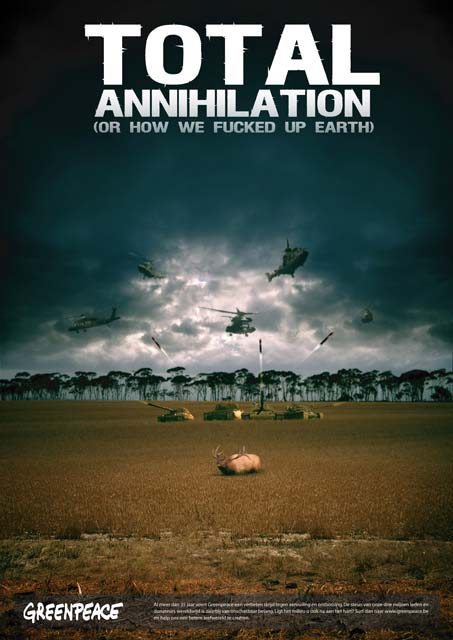
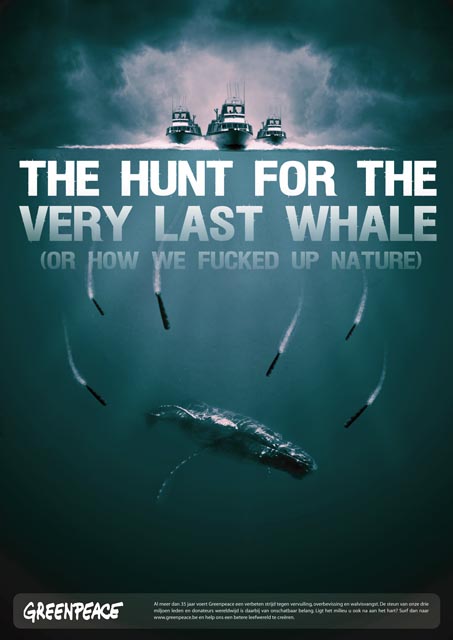
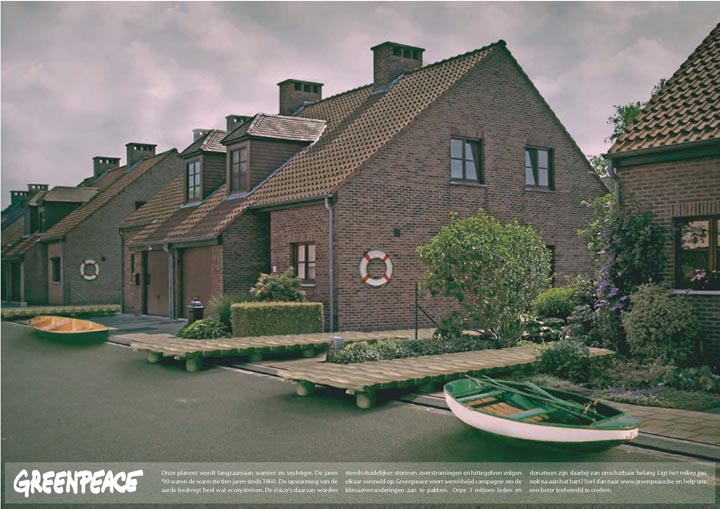
These images were produced by students in the advertising department at Sint-Lukas College [English site] in Brussels in the first term of 02006. Their assignment was create a visual awareness-raising campaign around Greenpeace themes, i.e., environmental activism. Many of the results are quite striking; and some highlights appear here with commentary [in italics] courtesy of Belgian futurist Maya van Leemput, who passed these along (regular readers of t.s.f. have met her before). Thanks, Maya!

Hello futures finders,

Found some futures for the collection.

"John-from-Ghent" is the name of seagull type bird, the obituary states:"With great sadness we announce the passing away of john-from-ghent. Seabird at the beach of Mar de Fora. Born in Sagres on May 25 1995 and suddenly deceased in Mar de Fora on November 21st 2002 following an oil spill. To testify your sympathy, you can transfer money to the accountnumber...."
An ordinary residential street in Belgium, prepared for rising sea-levels:


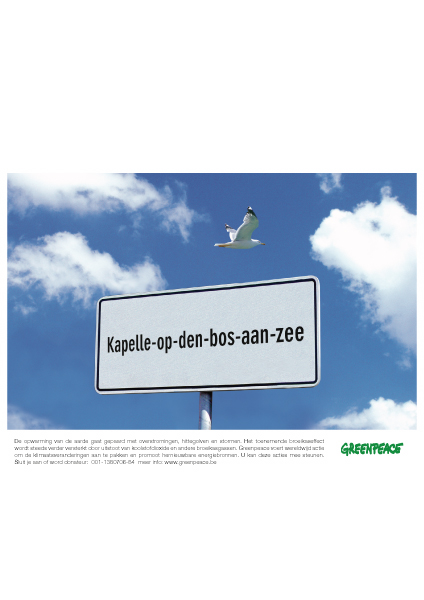
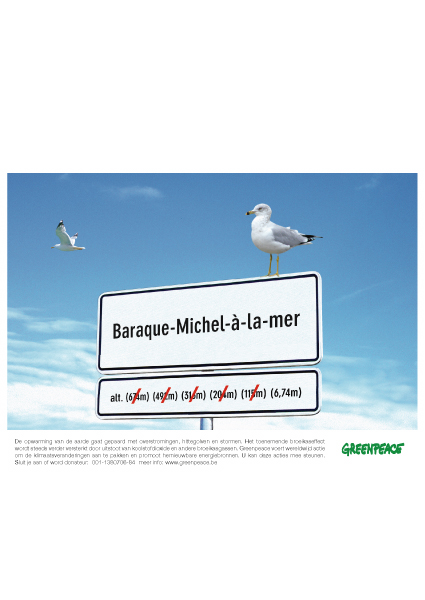
Two signs with the names of small towns in Belgium:
"Baraque Michel" is the highest point in our little low country.

"Kapellen-in-the-Wood" becomes "Kapellen-in-the-Wood-at-Sea".

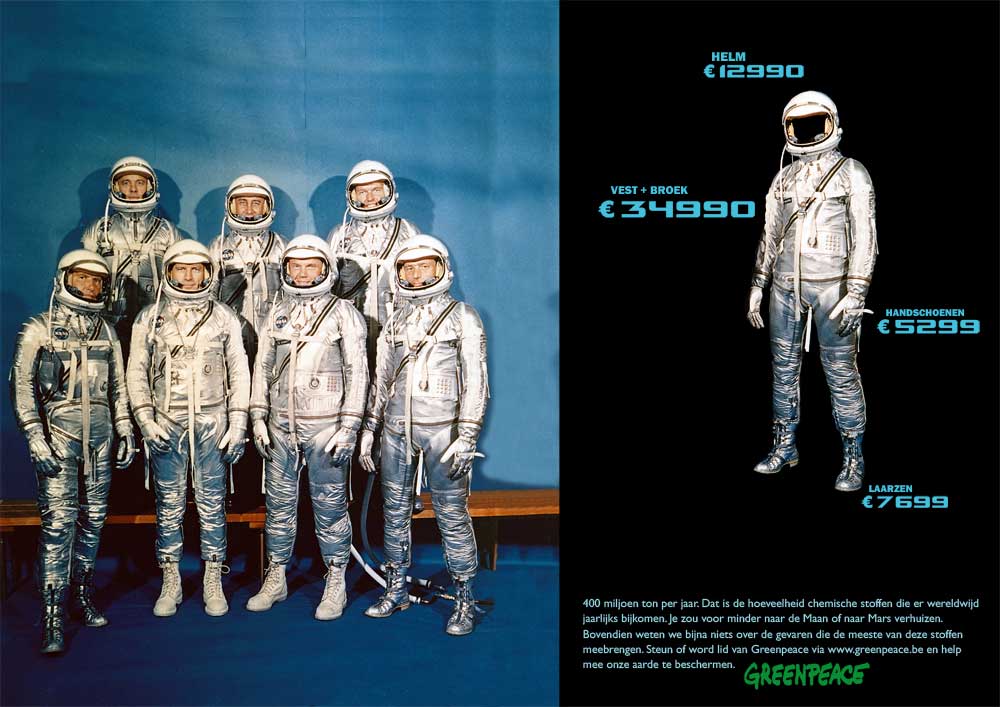
The price of space-suits:

The text below says: "400 million tons a year, that is the amount of chemicals added globally every year. You would move to Mars or the Moon for less."

Most of [these are] just images, except for the first two which count as (film) posters (like a postcard is an object, something other than merely the actual image on its front). The death notice might count as an object also if it was presented and sent in an envelope or printed among the obituaries in the newspaper (which it wasn't). Anyway, some of the other images show objects that in 3-D would count as future artifacts, others just show images of what a future might be like.

The archive from which these images are drawn can be found here (N.B. text in Flemish).

So, a few thoughts. As Maya suggests, none of these function strictly as future artifacts. The "Greenpeace" branding immediately breaks the fourth wall, so to speak, in all these cases, and there is a certain lack of diegetic coherence -- e.g., even were it not for the brand name, the savage irony of the film posters belies their ostensible status as actual posters for future films, so the viewer is deprived of space to make the connection between the supposed artifact and the disturbing conclusion. The dots are, forcibly, joined up for us.

Still, features they could be said to have in common with such artifacts are: futures orientation expressed through an implicit future setting (except the obituary); evocation of some relevant issue or trend; and dissonance in the design (something impossible, unfamiliar, or futuristic that doesn't "fit" today).

The talented artists who produced these, I hasten to acknowledge, were briefed to make a visual campaign, not "artifacts from the future" per se, so lest these comments seem gratuitously critical, my aim is merely to think with these examples (and others of their ilk) about how best to use design to provoke futures thinking. Still, it's interesting, I think, that future artifacts of this sort are not uncommon as a strategy in environmental awareness-raising (compare with these previous examples). Both raising and acting on our awareness are things we need to get very good at -- the sooner, the better.