Showing posts with label politics. Show all posts

Tuesday, December 11, 2018

An artifact from Australia's future

The apology to the Nauru Generation, November 02068.


It may not always be obvious in the writing here –– apart from my favoured spelling –– but I was born and grew up in Australia, and despite spending most of my adult life outside the country, have never lost the accent.

In my view there are two great and lamentable stains on the Australian polity, a pair of relationships between the official centres of power in the settler society, and their Others.

The first is the foundational and ongoing dispossession and genocide of the country's indigenous peoples. The second is the callous and inhumane treatment of undocumented immigrant arrivals by boat.

These tragedies have in common a disregard of the basic interests and humanity of both groups. They are symmetrical horrors, but any resemblance is not purely coincidental. The two are joined at the root.

Any country founded on colonial imposition harbours at some level unaddressed and sublimated guilt on the part of settlers, especially the "first" white ones, starting with the very fact of their/our presence and carrying through a monstrous historical litany. Policies today punishing people who want in, but don't look like us, can be seen as an ugly and pernicious case of referred pain in the body politic, or as the vernacular has it, kicking the cat.

Australia is not the only country in the world with this kind of baggage. But perhaps it is becoming more obvious there, or more publicly so, how these pathologies are related.

At the start of last month a performer named Sammy J released a short video through the website of the national broadcaster, ABC. Although he is best known as a comedian, this three-minute clip was not in any sense comical. It showed him taking the role of a future Australian Prime Minister, and apologising in Parliament in the year 02068 to the victims of the (longstanding, since 02001) zero-tolerance policies towards asylum seekers arriving by boat, and the offshore detention facilities established to hold them on the island of Nauru, in the South Pacific.

Just about any Australian citizen or semi-interested observer is bound to recognise right away the analog in recent history to this imagined future event. The 'Nauru Generation' mentioned here is heard as a parallel to the indigenous Stolen Generations of all-too-recent Australian history, and the premise of a belated official apology unmistakeably points back to the long-awaited apology to indigenous peoples delivered in Parliament in 02008 by then Prime Minister Kevin Rudd.

We've previously seen here at The Sceptical Futuryst many cases of future documentary fragments, and for that matter feature-length treatments of political prospects. We've come across near-future newspapers making near-utopian developments tantalisingly tangible; and also the specific strategy of using future artifacts to dramatise potential regret in an effort to prompt world leaders to take effective climate action at the COP 15 summit in Copenhagen in 02009 (apparently it didn't work, though the Paris Accord has since taken steps in the right direction). We've even seen change at the scale of a whole country spurred by an transmedia experiential scenario, bringing an aspirational possibility to life, in Tunisia's Arab Spring campaign #16juin2014 (which seemed to succeed, up to a point). And we've looked at artwork imagining an Australian Aboriginal monarch on the national currency.

I don't recall previously seeing this particular approach; a stand-alone video fragment of the political process (if you're in the U.S., think C-SPAN) to comment on present controversies.

People often ask about whether hope or fear, preferred or perilous, is the more strategic and effective type of future to dramatise or discuss.

I don't think there is a one-size-fits-all answer. Speaking generally, for one thing it isn't always clear whether a certain eventuality is positive or negative. Those describing or portraying it may feel one way, and find that others see it in an altogether different light.

Actually, for any posited changes there might be a range of responses. (This was deliberately the case for the changes explored via our recent experiential scenarios NaturePod and NurturePod, for example.) Embedded ambivalence can be a useful approach when using the lenses of possible futures to look at people's various present-day perceptions and values around changes unfolding now. Whether expected or not, divergent reactions to a scenario, experiential or otherwise, may be instructive.

Leaving aside the question of what happens to trigger it in any given case, one might still ask which of the two responses as elicited is the more effective; is hope (and similar) or fear (and similar) the more useful emotional territory? This is a slightly sharper question, but again, I find it more fruitful to see different moods as a palette of conversational or deliberative affordances, than to try categorising certain registers as better or worse overall on some universal yardstick.

I've written this partly to sort out some of my own thinking, without having looked at any commentary on the video, so I don't know how it has been received. However the version posted here has logged over 850,000 views to date (and it's not the only one online), which for Australian political commentary suggests a decent level of resonance and virality.

What I had already seen and read of Australia's offshore detention centres left me aghast, and for readers unfamiliar with the backstory here, the New York Times reported just yesterday that a lawsuit has been filed against the Australian federal government, claiming that the migrant detention camps amount to a crime against humanity.

But I think the perspective offered in this future video artifact might conceivably be useful regardless of where one sits on this issue, or on the political spectrum.

An official apology from the year 02068 invites viewers today to consider how future people, two generations from now, might regard the policies of the present. Asking this type of question could be a helpful reflex in relation to many current cultures and policies, wherever and whenever you may be in the world; not only in Australia, not only on this issue, and not only at this moment.

I want to add that fifty years seems a much longer period than we need in order to reasonably picture political regrets coming home to roost in this case, although I expect the choice of a distant temporal vantage point was likely meant to underline how slowly the current (conservative) government is catching on to the moral and historical import of these policies.

Still, especially with that generous time horizon, it's disappointing that the incidental glimpse of Australia's Parliament in half a century is noticeably less diverse than today's (a white bloke again at the helm, but no visible minorities in view), and nothing else in the scene seems to hint at changes in the national political landscape. Even if this were meant as a broader comment on institutional inertia and how infuriatingly slow to change the governance layer can be, this seems a missed opportunity. (My guess is that it's just a standard instance of Cascio's first rule for how not to write scenarios: change only one variable.)

But to return to the question of specific emotional charge: part of what is interesting to me about this future video is that, as someone who wants to see the harms of these policies acknowledged, stopped, and remedied without delay, this particular scenario comes as a complex mix of awful and hopeful.

It portrays the right thing being done, but after waiting far too long.

(Many thanks to Eddie Harran for the tip.)

Related:
> Dreaming together (external website)
> On the money
A Climate of Regret
> Foresight is a Right
> Future documentary
Guerrilla futurists combat war on terror
> An experiential scenario for post-revolution Tunisia 

Thursday, January 19, 2017

How to move to Canada*

*Without leaving home

A surprising guerrilla futures intervention speaks to the current political moment.

All photos by SAIC American Futures class

For many progressives in the United States, Canada conjures a wistful ideal of multicultural harmony and civility. After three years in Toronto, followed by six months of electoral madness back in the U.S., I can understand the romanticisation of our neighbour to the north. Indeed, the fact that the Canadian immigration website crashed on election night was interpreted by many as a sign of widespread alarm at the prospect of a Trump administration, an impending reality to which people around the world are now adjusting.

The grass may or may not actually be any greener in the land of moose and maple, but as things take a turn for the disturbing in America, the more utopian the idea of "Canada" becomes in contrast.

This post is about a project created by my students in "American Futures", a special one-off experiential futures course at the School of the Art Institute of Chicago. I designed the curriculum to use the unfolding 02016 U.S. presidential contest as fuel for our collective imagination, and with the election itself taking place a month before semester's end, the culminating efforts of the class were conceived and staged in response to the incoming president's shock victory.

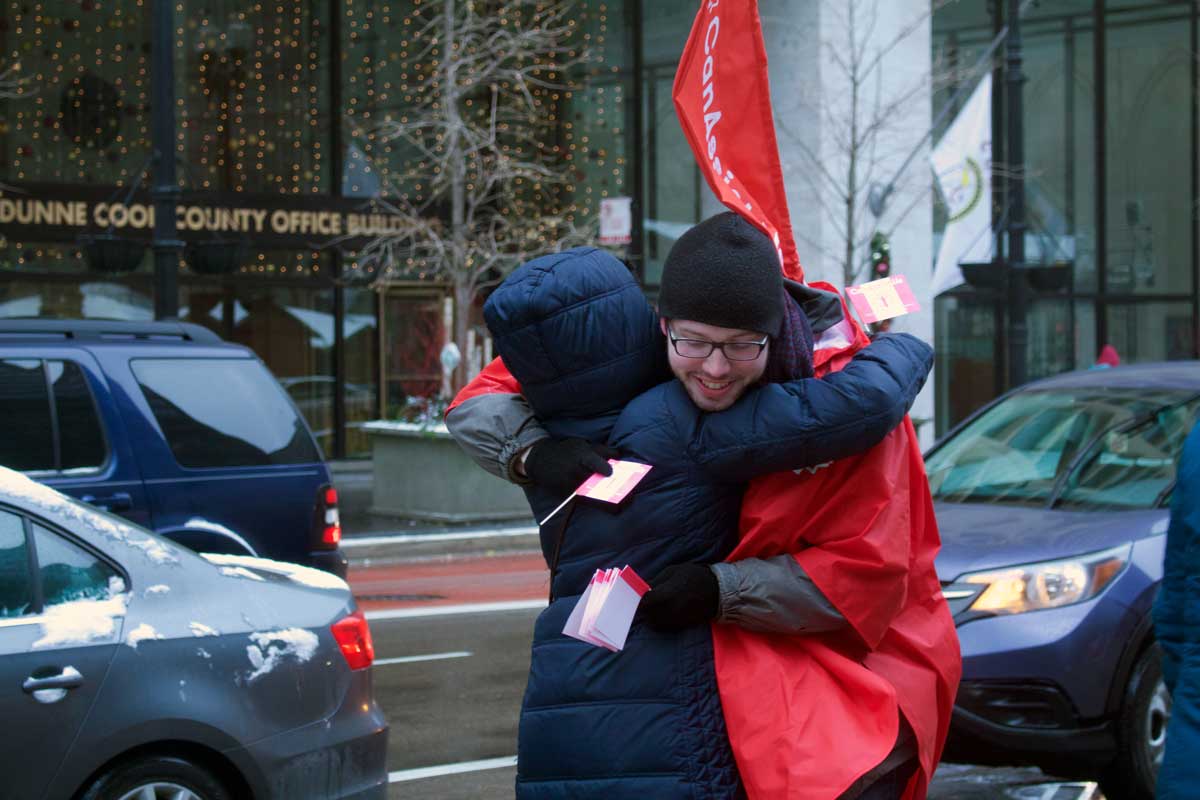
MFA student Cat Bluemke pitched this particular intervention, drawing on her Canadian background to imagine a near-future organisation called CanAssist.Us, and following her lead, the whole class worked together to bring it to life in the streets of Chicago. Below is an email interview with Cat (edited for length and clarity).

***

What is the premise of this project?

CanAssist.Us is a [hypothetical] private company that helps clients navigate the Canadian immigration system for Americans under President Trump. The project channels the anxieties driving this escapism into critical review of the individual’s responsibility within their community to challenge complacency in this reality.


What is the near-future situation you created for people to bring that scenario to life?

The initial ideas for the project were obvious once a few days had passed since the American presidential election results. CanAssist.Us is an absurd but potential reality from a near “post-truth” future (02018, perhaps). Using the familiar form of sidewalk canvassing, the performers offered the ultimate service to "get away from it all".

Once a member of the public engaged, the structure of this American future came into the picture: dehumanising "reform"; life-threatening retraction of health services; and destructive global relations; all promises of a Trump presidency.

[A short questionnaire quickly showed how simply quitting America might not be so straightforward; but to channel people's real concerns productively, and help them manifest the ideal of "Canada" locally,] suggestions for immediate action were presented as workshops the audience could take in their own communities. [These included Multicultural Awareness, Intersectionality, and Anger Management -- as well as popular intensive courses such as Poutine 101.]

How did the public react?

Satire is a great tool for starting a conversation, a united front can exist through a well-structured joke. Structuring that joke to include everyone -- consistent with our urge of a united, intersectional left -- was the difficult part. However, after establishing our position through humour, once we began working with the public, the conversations came easy. The reactions were overwhelmingly positive.


Where does this project sit in relation to other things you've seen that aim to deal with the emerging state of American politics and futures?

The Black Lives Matter movement deserves enormous credit for its accomplishments as a platform for multiple systemic injustices to enter public scrutiny.

CanAssist.Us was more explicitly influenced by artists like Eva and Franco Mattes or the Yes Men, whose public interventions disrupt the complacency that has become the norm.

Where does it sit with respect to projects that you personally have done before?

Both in concept and in execution, CanAssist.Us complements the project Tough Guy Mountain, a group project based out of Toronto, Canada; part art collective, part postcapitalist advertisement agency, and part fantasy table-top RPG.

How does the design of this intervention speak to and work with concerns of the present? How does it make use of the future?

CanAssist.Us uses experiential futures to demonstrate what realities could still be averted, and to encourage the will of the individual to unite under this goal. The situation of our American reality makes the future a particularly urgent tool to engage with.

What challenges did you discover working in a guerrilla futures mode?

I think the whole group could agree that next time, we’d rather guerrilla future on a sunny beach. Jokes aside, the participation of the group members was key in the project, and I’m so thankful that everyone shared in the passion. The kind of improvisation and confidence that is required of a guerrilla futures practitioner is really incredible, but this kind of dedication is desperately needed in order to create a future reality that benefits us all.


***

Many thanks to Cat and the whole of the American Futures class for all their creative contributions, and willingness to brave the Windy City winter to enliven public conversation with an experiential flash-forward.

I appreciate this ingenious effort to turn an understandable sense of alarm, and the potential impulse to flee or turn away, into constructive engagement with possibilities for action in our communities today, through exploring what it means to bring "Canada" (code for "a better place") to where we are.

Our thanks also to Jonathan Solomon, Helen Maria Nugent, and office staff in the design department (AIADO) at SAIC for wonderful assistance and support.

And best wishes to all concerned, as this troubling new chapter begins in the grand experiment that is the United States.

The class and project team comprised Cat Bluemke, Angie Gonzalez, Miiko He, Josh Leslie, Stella Shen, Clint Stayton, Alexander Wilson, and several other students who wish to remain anonymous.

Update 01aug17: This project has been recognised at the 02017 Association of Professional Futurists (APF) Student Awards, taking second place in the Alternative Formats category. Congratulations team!

Related:
> Impacting the Social
> Future documentary
Introduction to Strategic Foresight
> The weight of alternatives
> Stephen Duncombe on the Art of the Impossible

Monday, October 31, 2016

The weight of alternatives

Image via.

"History has not reached a stagnant end, nor is it triumphantly marching towards the radiant future. It is being catapulted into an unknown adventure."

***

As the conclusion of the current U.S. election bears down on us, I find myself thinking about an aspect of foresight that doesn't seem to get a lot of attention: the weight of alternatives.

I'm not referring to something exotic about the futures profession, but something much more mundane and widespread, the experience we all have of facing uncertainty in life.

Keeping futures alive means a certain overhead or psychic cost, a subsistence level of care-and-feeding. If you have ever struggled to maintain a connection to the sense of a possibility associated with a job you've applied for, while institutional gears have creaked along for weeks or months, then you know what I am talking about.

Indeed, anyone who has striven to maintain hope in difficult circumstances is familiar with the burden. The greater the felt imperative that a future stay viable, the more it weighs.

This seems a bit different, somehow, from uncertainty's run-of-the-mill spiritual tax. It goes to the costs paid individually in activating or warding off particular critical possibilities.

The mental image this brings to me is a kind of archetypal fantasy-movie climax. It's the vision of some wizard exerting a herculean effort, fluorescent lightning fizzing from the fingertips, to keep open a portal to another dimension until the last critical moment, when the wave collapses and the hero, hopefully, makes good her escape/rescue/restoration of cosmic balance (or whatever).

That's pretty much exactly what it feels like to bear the weight of alternative futures. It comes into focus at some times more than others, but always takes significant human energy to escape the gravity of default settings. The further one's desires depart from the path of least resistance, the more psychic lightning one has to expend.

No doubt investment in imagination can pay off, but it is not without its costs, which may be unglamorous and unpleasant: sleeplessness, stress, depression.

As a case in point, for many at this moment; the internal battle to ward off the Trumpian dystopia threatening to bring tyranny to the United States and grim instability to the wider world (a probability put, at the time of writing, around 25%).

So I do wonder at times if our well-meaning professional arguments for pluralising the future take the human weight of alternatives seriously enough. In this light, declining to take on the burden of alternatives, as many seem to do by insisting on just one possible future, may be an understandable strategy of avoidance.

Keeping possibilities alive within us requires sustained and sometimes heroic effort.

It calls also for self-care, a regard to the personal and internal costs of waging battle with cosmic forces. Even wizards need time to recharge.

Related:
Investment in imagination (Toward a Preemptive Social Enterprise)
Journalism from the future
If women ruled the world
Questioning hyperopia
Think about it
The act of imagination
Stumbling on foresight

Tuesday, August 16, 2016

Always Tomorrow Now


Logo via MuseumNext / photo via The Rio Times.

***

I recently spent a month as an artist in residence at the newly opened Museu do Amanhã (Museum of Tomorrow) in Rio de Janeiro.

Housed in a spectacular building from Spanish neofuturistic architect Santiago Calatrava, the Museum attracted half a million visitors within six months of opening in December 02015.

As we'll see, this institution has a resonant rationale and an intriguing approach to what a museum can be.

It's an honour to have been selected earlier this year as the Museum's inaugural Fellow.

Back in 02011 I'd been invited to a gathering in Rio to help generate exhibition concepts, but couldn't make it. So it was a source of delight and curiosity to spend several weeks in situ this June and July, and learn all about how this noble experiment in engaging diverse publics in diverse futures has unfolded so far.

There's more to say in a later post about the project I did while in residence, hosted by the Museum's wonderfully energetic Laboratory team.

But today I want to share a conversation with Luiz Alberto Oliveira, a physicist with a PhD in cosmology, a former lecturer in the history and philosophy of science, and the Chief Curator of Museu do Amanhã.

The following is an edited transcript of a conversation we had in Rio on July 6th. I am grateful to the Museum for hosting me, and of course to Dr Oliveira for taking the time to speak.

***

Stuart Candy: What attracted you to this project?

Luiz Alberto Oliveira: It was daring. It had none of the usual boundaries or limitations, and it could have very important consequences for the practice or diffusion of science in Brazil.

We wanted to develop something from scratch, to discuss how a new kind of science museum could be devised.

We wanted to bring to the Museum of Tomorrow a different concept of time: the idea that in the present, you prepare, you make a different path to different possible futures. It’s not a river in the sense that you have one source and one end. You have, in fact, a delta of possibilities.

This is the main concept of the Museum, that tomorrow is not a date on the calendar, tomorrow is not a place where you will arrive. Tomorrow is a construction. Tomorrow is open to be built.

Image via MuseumNext.

SC: And how does the organisation of the Museum impart this concept to visitors?

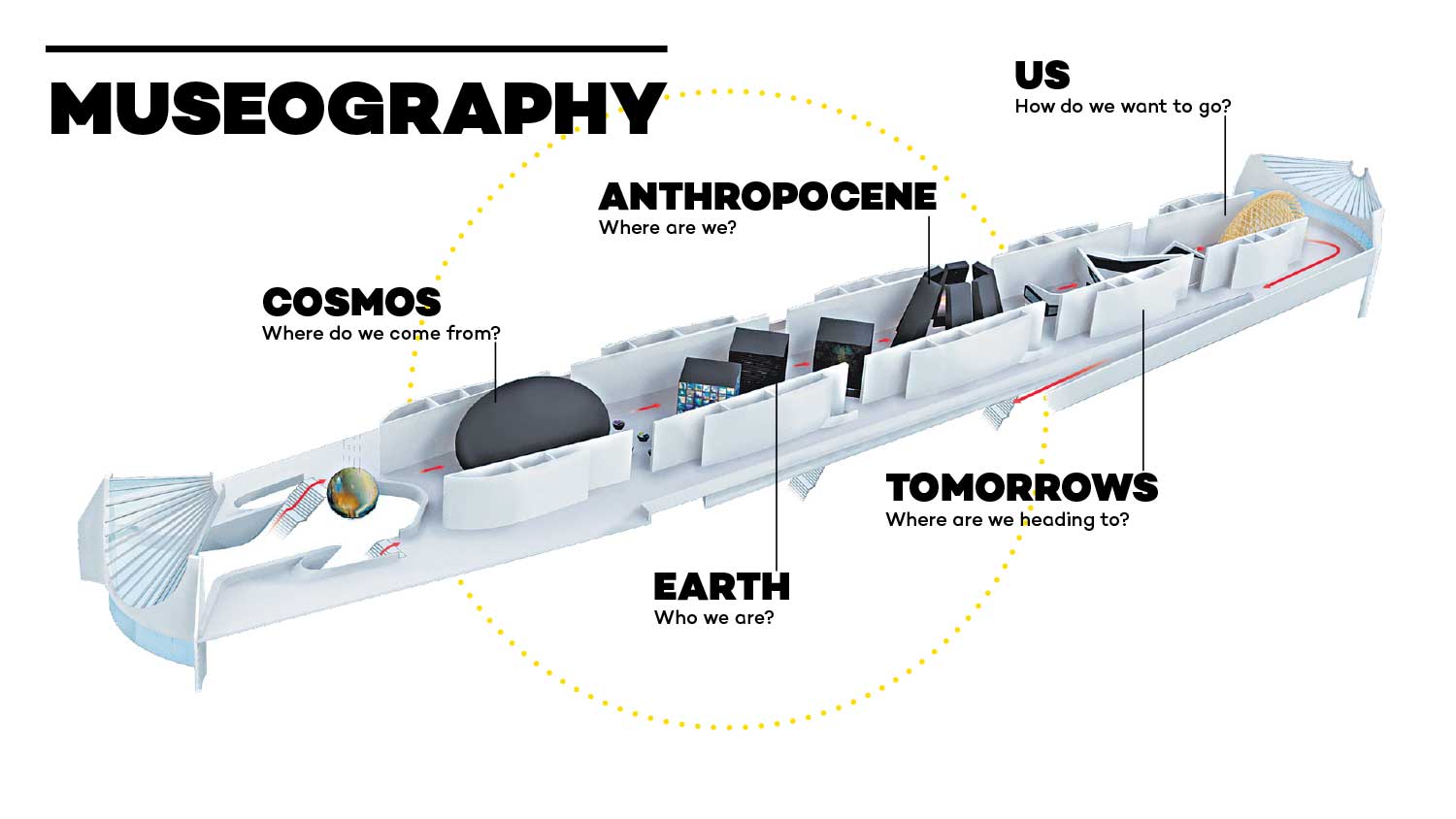
LAO: We settled on telling a story organised in five great areas. Why five? It is a dialogue with the architecture. Calatrava provides us with five roof undulations that roughly define the areas in which we set our museography.

So we came to the idea that the story should be made up of a sequence of great questions that mankind has always asked itself, so we could say in a very real sense that our content is questions.

Where do we come from?
Who are we?
Where are we?
Where are we heading?
How do we want to go; which values do we want to convey to the future?

This is the spinal column of the museum.

We use science content to illustrate these great questions, and the idea is that people come to realise that the future is not done, the future is in the making. It is in their hands, at least in part –– to collaborate in this future-building.

Image via MuseumNext.

SC: This idea of a museum that isn’t about the past but is about the future, about choice, about ethics, does it have any precedents or parallels elsewhere in the museum world?

LAO: As far as we know, no, it doesn’t.*

SC: You made a very deliberate choice in naming this institution, “The Museum of Tomorrow”. Can you speak to that?

LAO: In the common sense, the future is far away.

But tomorrow is always here. Somewhere, at this precise moment, the sun is rising in the east. All the time, it is tomorrow somewhere.

This idea that tomorrow is always inside every now was what convinced us that it’s a “museum of tomorrow”, not a “museum of the future”.

SC: A museum about things that haven’t happened yet faces certain challenges. What are those challenges from a curator’s standpoint?

LAO: We established some trends which will shape the future some decades ahead: what science tells us about the possible scenarios for the climate, the changing of biodiversity, the growth of the population, the number and complexity of cities.

From all these you can forecast some reasonable scenario. But what about the unexpected that this cannot and will not take into account?

We did not want to become a museum of prophecy. That was the greatest challenge, the greatest danger, because people would come here and say, “Well, you’re telling us that the future will be this.” That’s not what we want to do. We want you to understand that the present is this, and the future? Well, there are many. This is the point; the futures are plural.

SC: A museum of questions rather than a museum of answers.

LAO: Yes, yes, precisely.


Image via MuseumNext.

SC: When you talk about wanting to have a certain emotional impact on visitors, what’s the goal? 

LAO: You want to take people away from their everyday perspective so they can understand that the world in which we live is much more complex, varied, surprising, full of wonderment, than everyday life which uses you, trains you, and tames you to become a useful citizen, a working citizen.

We want to provide a sort of entertainment; entertaining in the sense that it distracts you from your usual ways of thinking. To have different ideas, different perspectives. They just cannot become indifferent! If they leave the museum just as they came into it, we have failed completely. But if they are disturbed, well, that’s okay.

SC: What about the Brazilian context, and Rio in particular? Are there any special challenges or affordances for this project?

LAO: First, perhaps the fact that we are a museum open to the future, but we are sitting in the very heart of Rio de Janeiro’s history. You can see all the landmarks of centuries around us. This heart of the city was abandoned for decades. So we are in a way a flagship of this new moment, of this new period of the city’s story.

I think the Cariocas, the people of Rio, understood that. They took possession of the renewed plaza, because you know, it’s theirs.

On the other hand, we have the very difficult condition of the country at the moment. The legitimate government was overthrown by a parliamentary coup, and a bunch of gangsters took power for themselves. So we are in a struggle for democracy itself, the very core of democracy, which is election.

But many people tell us that the museum is a counterpoint to this situation. This is something inspiring. We wanted to inspire people––but I did not know that it would be in this sense, that we became a symbol of a better future for the country.


Image via MuseumNext.

SC: The invitation to regard the future as shapable and as plural is a deeply political position.

LAO: Certainly. You cannot deal with conviviality, with living together, without politics. It’s impossible. So in fact, we are a political museum. We cannot say that as a slogan of the museum, because people would not understand in that sense. They would think that we are engaging in this or that political party, which is not our intention.

SC: I see vast potential not just in this institution, but in this category of institution, a kind of museum that is needed everywhere. There is a need for effective invitations to people, to draw out their vision for how things could be different.

LAO: I understand and I agree completely, because I think this is a path for renewing democracy itself.

* We'll revisit the question of the Museum of Tomorrow's conceptual cousins in posts to come.

Related:
> Dreaming together
Whose future is this?
The technology of public imagination

Sunday, March 31, 2013

Grand designs

From Canberra to Currumbin, and beyond, Australia's spatial strategy for governance could be very different in the future from what it is today...


The year 02013 marks the 100th anniversary of Canberra, Australia's famously planned capital city. Its location, decided in 01908 (seven years after federation), was a compromise between perennial rivals Melbourne and Sydney. An international design competition for the layout of this seat of the newly minted nation was launched in 01911, and in 01913, the submission of Chicago-based husband and wife architect team Walter Burley Griffin and Marion Mahony Griffin was selected. The name Canberra, which comes from the word for "gathering place" in the local Aboriginal language, was given in a ceremony on 12 March that year.

A century later, an historically resonant element of the celebrations now underway consists in "a design ideas competition for a hypothetical Australian capital city", called CAPITheticAL (= hypothetical + capital). The comp was launched in 02011 and an exhibition of the top entries has just opened at Canberra's Gallery of Australian Design. I'm writing this because I was on a team which produced one of the exhibited designs.

Our team, "The Engagement Studio", was a diversely trained group of urbanists based in Melbourne, and practising internationally in fields including architecture, town planning, urban design, research, sustainability, and environmental consultancy.*

So, if an Australian capital were to be designed today, what should it be?

Since its purpose was to enable new perspectives rather than rehearse existing conventions, the competition put some big questions up for grabs: "Of what should our national capital consist? Would it be a city in the conventional sense or not? If not, what form might it take?"

In the spirit of designerly curiosity, our group wanted to venture upstream of the usual architectural and masterplanning preoccupations with built form and visual representation of space, focusing instead on a more provocative and, perhaps, futurohistorically potent proposition at the intersection of politics and design. Our idea was a nomadic seat of government, changing from one location in Australia to another every generation: a Roving Capital.

The essential notion is simple. Capitalhood can be decoupled from geography. It's not only that permanence need not be assumed, but impermanence can actually be embraced. Consider the Olympics, which is effectively a temporary sporting capital of the world for a fortnight every four years. Or look at the Burning Man festival, which emerges in the emptiness of the Nevada desert, for a week each year suddenly becoming one of the state's largest cities, before vanishing without a trace. The essential temporariness of these important community events manifesting tangibly in the built environment begins to point to a model for a capital that moves. The Olympics belong to the world, so they move around the world (the World Expo, ditto). Burning Man is notable not so much as an analog to capital function per se, but as a temporary city -- population circa 60,000 last year. It's a living rejoinder to the presumption of urban fixity.

The key to this idea is not mere novelty; it's evolvability. There's no such thing as a perfect, once-and-for-all political solution in a changing world. A polity not wedded forever to a single location within its geographic footprint gives itself more space, both to reflect diversity in the population and to adapt to rapid change. At the national level, such a proposition may be near unthinkable, at least for an old-world pillar like London or Paris. But Australia's geographic vastness and relative political youthfulness together make capital transience a surprisingly apt avenue to explore.

And so, from thousands of kilometres away in Melbourne, we had chosen, for argument's sake -- and somewhat whimsically -- the beachside town of Currumbin on the Gold Coast as the first port of call for our new nomadic capital. Inside the scenario we were weaving, this was the result of a democratic three-stage process for capital selection which we'd dreamed up.

Below you can find The Engagement Studio's first round submission. Wrapped around the usual visualisations (site plans, artist's impressions, etc), the Roving Capital idea was mediated primarily through a set of four newspaper articles from 02016, 02023, 02030, and 02040 -- a slim but evocative cross-section of primary documentary "evidence" from a hypothetical swath of future history.


The team's work was honoured by being shortlisted, which came with an invitation to provide a second round submission late in 02012. But simply to revisit and polish the same material didn't feel like quite enough. On reflection we had become intrigued by the real possibilities behind what had started out as simply a thought experiment. So the most interesting next step we could take with this design idea, we decided, was to "groundtruth" a notion that hitherto had been totally speculative.

We carved out a weekend and traipsed up from Melbourne together, to investigate the actual prospects for the seemingly outlandish premise of making Currumbin on the Gold Coast -- temporarily -- the next capital of Australia. And we made a video to tell the story of what happened:


Through meeting with representatives from the local authority (the Gold Coast City Council), with citizens, and with other designers, we discovered that despite reflex responses of bewilderment or trepidation, people soon began to suggest modifications which could help the idea work in reality.

Putting the hypothetical to the test in situ was a chance to tie the grand, schematic, conceptual layer of thinking down to the human scale and prosaic concerns of everyday reality. (How often does that happen in a design ideas comp? Probably not often enough.) For instance, we'd started out positing that, not unlike the experience of an Olympic city, a stint as capital would provide the basis for a generation-long infrastructural upgrade to the built environment -- the legacy of new public buildings and improved transportation, for example.

But in visiting Currumbin, we were attending to it as a real place, and particularly to the sorts of cultural dimensions which would otherwise have been all too easy to overlook from the remove of Melbourne; not to mention the conceptual distance of an abstract political design conversation. This meant learning some things that may not have come to our notice any other way.

First, we came to recognise more deeply that revolving the political apparatus and meshing the lives of representatives with those of their hosts and neighbours would entail a constant renewal of the democracy; a bottom-up counter to the top-down tendencies inherent in a representative system. Although our own visit was necessarily brief, each encounter with locals, occasioned by going there to groundtruth or reality-check the cencept, was in a sense a microcosm of that same process; a partial corrective to the risks of design and governance from afar.

Second, the charms of Currumbin itself, and the reluctance of residents to entertain its transformation into a bustling urban centre, drew out a version of our proposal which had been latent in the initial idea: rather than a capital city, the notion of the capital place came to the fore. It would not be necessary, and neither would the residents want, to compromise the natural beauty of their home by developing the crap out of it. Many of the functions of government could be well served by facilities elsewhere (and increasingly virtually of course); the essential symbolic and functional requirements of capitalness turn out to be more cultural than physical and technical. (I think my favourite moment was in the meeting with the Gold Coast City Council when we concluded an afternoon discussion by going around the room and brainstorming possible rituals on the beach befitting the inauguration of Currumbin's time as capital.)

Third, while our earlier thinking had emphasised the effects upon a given location of its turn as capital, we came to recognise that influence would, and should, flow the other way too. Legacy was reciprocal, not one-way, so the temporary capital's culture could be rubbing off on the country at large during its generation-long tenure as national gathering place.

Our second round submission also included a mocked up magazine article reflecting on the Roving Capital design and the learning process by which it had come together:


Not only was the concept less crazy on reflection than it may have appeared at first (even to us), but in fact even the seemingly far-fetched launchpad of Currumbin looked like it had legs. Certainly other places could equally have served as the Roving Capital's point of departure, but it was the specific contours of this place which came to offer the necessary grounding to both show and tell a new story about Australian governance.

It was also a pleasure to spend time with and learn from such a diverse and switched on group of collaborators, around a really thought provoking idea. (Ammon Beyerle and Michelle James especially deserve credit for an enormous amount of the work involved.) The content and especially the form of our contribution to this design conversation were fun and interesting to work on, and both the means of representation in round one (artifacts from the future) and research strategy for round two (ethnographic investigation) were, as far as I could see, unique among the entries.

The direct impact of our intervention was no doubt modest -- but for those who met the idea at our design meetings or in other conversations, there's also little doubt that it started them thinking about their home, and their place in Australia, in a different light.

And I suppose the key connection in all this to the ongoing themes here at The Sceptical Futuryst is that our efforts sought to map the plane of abstract novel ideas onto the plane of lived reality, and to expand people's sense of possibility through a participatory design process.

Although hypothetical, it was nonetheless real in all the ways that mattered.

* The Engagement Studio consisted of Ammon Beyerle and Michelle James from Here Studio; Kathryn Cuddihy, Tadgh Daly, Rupert Dance, David Klingberg and Amruta Pandhe from David Lock Associates; and Svenja Keele, Andrew Wisdom and myself from Arup. The wonderful video was shot and edited by filmmaker Natalie James.

CAPITheticAL is a Centenary of Canberra project supported by the Australian Government and the Australian Capital Territory (ACT) Government, together with the Australian Institute of Architects. The exhibition is on until 11 May -- winners and finalists are all on show, and there's some really nice work there -- worth checking out!


Related posts:
> Architectural time travel
> Why the language of design must enter law and politics
> White House Redux
> Evidence
> The Unthinkable and the Unimaginable

Friday, April 01, 2011

An experiential scenario for post-revolution Tunisia

N.B. Not an April Fool's Day gag. Just, y'know, to be clear.


Image via Tuniscope

Overthrowing a dictatorial regime is a staggering feat of popular imagination and courage.

But what about the morning after the revolution? Everyday life is bound to be something of a let down.

Video via adland.tv*

After recent epochal events in Tunisia -- the so-called Jasmine Revolution (or the Sidi Bouzid Revolt, as it's known in the Arab world) in which President Zine El Abidine Ben Ali was ousted -- an astonishing but so far largely unknown coda was the galvanising role played by a transmedia experiential scenario campaign, spreading a near-term vision of a prosperous and democratic country worth getting back to work for.

This story comes from a local ad agency, Memac Ogilvy Label Tunisia, that has just won gold in the 'Integrated' (i.e. transmedia) campaign category of the Dubai Lynx Awards which recognise excellence in advertising in the Middle East and North Africa:

Tunis, January 14th 2011. Tunisians put an end to 23 years of brutal dictatorship. It was a moment of intense hope. But we were all too soon brought back to reality. The entire country went on strike and economic activity was soon left to a standstill. … We needed to find a way to encourage the people to get back to work and start rebuilding the country we had all fought for. … So we decided to show everyone how bright our future could be if we all started building it now. … During a whole day, the media acted as if it were June 16th 2014 and presented Tunisia as a prosperous, modern and democratic country. … The media content spread to social media via 16juin2014.com and people began to imagine wonderful futures and called everyone for action. #16juin2014 hashtag was n°1 top trend topic on Twitter all day long. At 6pm, the debate was everywhere on TV, radios, blogs… Getting back to work quickly became an act of resistance.

Digging into the details becomes slightly tricky if you don't understand French (I do, sorta) and Arabic (I don't), but elements of the '16 June 2014' campaign can be found online. For example, there's a downloadable four-page future-dated issue of La Presse de Tunisie, which invites comparisons to the wonderful New York Times Special Edition from a few years back.


La Presse de Tunisie, 14 June 02014
Image via Tuniscope


Political cartoon (front page, below the fold):
'Grandad, who is ben ali?'
'Oh, just a mistake of youth...'


Screenshot from news report on the intervention

Another example: at the moment, the 16 Juin 2014 website centrally features an in-scenario news report about a "Shopping Festival" (as I learned by auto-translating the video title from Arabic) in the west-central town of Kasserine, including what appear to be interviews with prestige fashion figures Giorgio Armani and Marc Ecko. Considering the chaos and brutality unfolding in that agricultural town just weeks before this campaign rolled out in mid-February, we can start to apprehend just how bold a notion this is. (I'm put in mind of the 'Darfur 2020' poster we've discussed here previously, which plays on a similar incongruity.)

I'm thoroughly impressed with the scope and vision of this campaign, which heavily underlines the world-shaping potential of the arts and technologies of narrative, applied prospectively.

While it could be said to raise some deep questions about the current reception as well as long-term viability (not only in Tunisia, but also elsewhere) of this particular genre of political and economic vision as an answer to the people's woes, I don't know remotely enough about Tunisia's current situation to comment cogently on the impacts and merits of these particular stories at the moment -- although I'm very curious to hear from anyone who does.

Meanwhile, those with ideological concerns about the character of this vision can take comfort from the fact that the campaign actively invites people to contribute to the conversation. The top banner on the website reads, 'Participate -- what are your ideas for the Tunisia of tomorrow?'

In any event, I am just delighted to find out about this. Conceptually it's among the grandest and most inspiring of imaginable applications for journalistic future artifacts, transcending conventional advertising to approach something I've been harping on here for years -- the possibility of a hybrid practice of politics, design and foresight, whereby we manifest for ourselves, in vivid detail, those scenarios diagnosed as most necessary to catalyse desired social change.

Related posts:
> Guerrilla futurists combat war on terror
> Dreampolitik
> The Darfur Olympics
> The currency of Burmese dissent
> Four future news clips from MIT
> Tomorrow's headlines

(* Broken video link fixed 11nov18 // Thanks @dabitch for the post over at adland.tv featuring the above video, and @justinpickard for passing the link along!)

Tuesday, June 01, 2010

The Futures of Everyday Life

Artwork by Sky Kiyabu for FoundFutures, August 02006
Poster used in Hawaii 2050 Blue Room

(Update 31jan12: The full dissertation is available for download as a pdf here.)
(Update 12aug16: Previous link amended to point to DOI.)


In Honolulu last Thursday morning, 27 May, I defended my completed doctoral dissertation. The five committee members accepted the document as submitted, without requiring any changes. To say that this comes as a relief hardly begins to describe the feeling.

I owe a debt of gratitude to a lot of people -- family, friends, and colleagues -- for incalculable moral and intellectual support. You know who you are: thank you. But I want to acknowledge here the key contributions of two people in particular: Jim Dator, my committee chair and mentor, truly the futurist's futurist, and the reason for my going to Hawaii to begin with; and Jake Dunagan, my long time collaborator and friend, with whom much of both the practice and theory of experiential scenarios, as described in the dissertation, were developed. To be able to work with such fine people as these makes an otherwise arduous process totally worthwhile.

The rhythm of everyday life around here is going to change now that the long PhD writing process is behind me... Time at last to take a few deep breaths.

The Futures of Everyday Life: Politics and the Design of Experiential Scenarios

Abstract

The great existential challenges facing the human species can be traced, in part, to the fact that we have underdeveloped discursive practices for thinking possible worlds ‘out loud’, performatively and materially, in the register of experience. That needs to change. In this dissertation, a methodology for ‘experiential scenarios’, covering a range of interventions and media from immersive performance to stand-alone ‘artifacts from the future’, is offered as a partial corrective. The beginnings of aesthetic, political and ethical frameworks for ‘experiential futures’ are proposed, drawing on alternative futures methodology, the emerging anti-mediumist practice of ‘experience design’, and the theoretical perspective of a Rancièrian ‘politics of aesthetics’. The relationships between these three domains -- futures, design, and politics -- are explored to show how and why they are coming together, and what each has to offer the others. The upshot is that our apparent binary choice between unthinkable dystopia and unimaginable utopia is a false dilemma, because in fact, we can and should imagine ‘possibility space’ hyperdimensionally, and seek to flesh out worlds hitherto supposed unimaginable or unthinkable on a daily basis. Developed from early deployments across a range of settings in everyday life, from urban guerrilla-style activism to corporate consulting, experiential scenarios do not offer definitive answers as to how the future will look, or even how it should look, but they can contribute to a mental ecology within which these questions may be posed and discussed more effectively than ever before.

Monday, December 07, 2009

A climate of regret

An older, sadder Barack Obama looks back on the Copenhagen climate conference

Today marks the beginning of the United Nations climate conference in Copenhagen, COP 15. As delegates and media converge on the Danish capital, they are being greeted at the airport by a strange sight: environmental advocacy groups Greenpeace and TckTckTck have created a series of billboards depicting various world leaders ruefully looking back from the year 02020, having not seized their opportunity in 02009 to commit to decisive cuts in greenhouse gas emissions.

Old, sad French President Nicolas Sarkozy

Sad and old German Chancellor Angela Merkel

British Prime Minister Gordon Brown. Only older. And sadder.

Each is emblazoned with the same message. "I'm sorry. We could have stopped catastrophic climate change. We didn't."

In case you haven't been following the news (say, you're writing a doctoral dissertation or something), Planet Green has posted a helpful, brief overview of what's at stake in Copenhagen. Meanwhile, Greenpeace Climate Rescue Weblog explains this last-minute campaign to engage the emotions of decision-makers:

We're hoping these ads predict the wrong future -- the one where world leaders look back with a "coulda, shoulda, woulda" attitude at a Copenhagen climate summit which failed. There's still time to change the future. Our recipe for world leader regret-avoidance is simple: agree a fair, ambitious, and legally binding deal to save the climate.

(Er, save the climate?)

Anyway. While it is not clear to me whether the busy itineraries of all or any of the high-profile individuals concerned will afford them a glimpse of their future selves -- which would make this really interesting -- over 15,000 people are expected to attend (source: CNN), and no doubt many of those will be passing through Copenhagen Airport.

So it's an ingenious and valiant attempt to make the climate message personal; here's hoping it makes some difference.


[[All images from Greenpeace, via Osocio; see also COP 15 set at Greenpeace's Flickr photostream. Sad, old versions of the leaders of Russia, Poland, Brazil, Spain, and Canada are also part of the set.]]

Related posts:
> Ignore global warming (an acerbic climate-themed campaign by the World Wildlife Fund)
> Future shock hits San Francisco (an outdoor site-specific billboard that gave Market Street an earthquake makeover)
> Climate change for fun and profit (Diesel's commerce-friendly take on rising seas)
> Facing future (evidence that artificial aging is hit and miss)
> Future news-flash: your vote counts (pre-'08 election videos activating anticipatory remorse for U.S. non-voters)

(Thanks, Dad.)

Wednesday, November 12, 2008

Guerrilla futurists combat war on terror

The Iraq War is over, Bush has been indicted on charges of high treason, the PATRIOT Act is to be repealed, the economy will be restructured, and public universities are now free.

Film at eleven.


Image via Gawker

I awoke this morning to emails from two New York colleagues about a marvellous and painstakingly planned guerrilla futures intervention today in the Big Apple.

A "special edition" of the New York Times has been produced, to convey, through a detailed set of carefully crafted articles and advertisements, a near-future scenario in which progressives' dreams for the United States have all come true. And 1.2 million copies of it have been distributed for free around the city by a network of volunteers.

Alongside the print edition, a counterpart website has been launched where all the stories are available in full. Both paper and electronic versions are rendered impeccably in the newspaper's signature style, and are dated 4 July 02009 (Independence Day next year).

In scale, this is certainly the most impressive guerrilla futures campaign I've heard of, and I heartily congratulate all those concerned for pulling it off. (It seems -- according to Gothamist, citing Gawker -- that the volunteers were assembled via becausewewantit.org and the effort is being attributed to the Yes Men, guerrilla performance artists supreme, whose astonishing Dow Chemical/Union Carbide interview on BBC World was previously featured here.)

Now, we can expect that some disgruntled newspaper recipients or onlookers may accuse the folks behind this terrific intervention of leading people, shall we say, up the garden path. Such accusations will be missing the point.

Adopting the Times dress is not about hoaxing people; it's a way of calling authority to the vision. As well as being a proprietary media business, its actual status in our media ecology as an authoritative source of news, an idea which belongs to everyone even if the newspaper itself does not, is recruited to lend verisimilitude and weight to the cause.

As Jake Dunagan and I were recently discussing in another context, one of the many devices which makes the Orson Welles classic Citizen Kane so successful is its intermittent cutting to newspaper headlines that help tell the story. (Now, like any novel and effective cinematic trope, this has since become cliche, but this original fictional biopic application, referencing newspaper's authority to help put a frame around plot points in the biography of a larger-than-life newspaper tycoon, makes perfect sense.)

No one addressing more than the most cursory scrap of attention to the actual content of the articles will fail to notice that they are fragments of an "impossible" dream, even if a profoundly noble one: the wholesale transformation of U.S. political culture. Post-election euphoria notwithstanding, the kinds of change described in the "special edition" don't tend to happen overnight, if at all. But the paper quite deliberately calls precisely that into question -- why not?

Similarly, Professor Steve Duncombe recently said in his presentation at HRCFS on Dreampolitik:

These impossible dreams open up a space for democratic participation in the process of imagining the future, which also offers the possibility of escaping the tyranny of the present... for people to imagine, 'why not?', and 'what if?'

This Dream Newspaper is, to use Duncombe's term, an "ethical spectacle" par excellence.

Here's an in-scenario video about the campaign, also from the Times SE site:


Again, kudos to those who orchestrated this highly thoughtful, lovingly detailed, and timely piece of future-jamming. The sceptical futuryst doffs his virtual hat to you all.

Update (19/11/08): On Monday, my own copy of the New York Times Special Edition arrived in the mail.

It brings me so much joy to hold in my hands that it's almost embarrassing.

The difference between hearing about or seeing images of an impossible object, and experiencing it tangibly, is immense.

There's a colour-printed cover; National, International, Business and New York sections; political cartoons; and reports announcing massive legislative and social change around topics ranging from bicycle lanes to corporate criminality. The details in content, graphics, and layout of the 14-page publication are thoroughly splendid -- starting with the slogan "All the News We Hope to Print" on the header. It is, in short, a beautifully wrought artifact of the near-future.

The Yes Men's hallmark "identity correction" strategy is everywhere in evidence: the U.S. government recall notice for all gas-powered cars; advertisements reflecting drastic changes of strategy (or heart?) by companies such as oil giant Exxon Mobil and diamond merchants De Beers; a contrite farewell from pro-invasion columnist Thomas Friedman; and a Corrections section addressing repeated editorial lapses of judgement on the part of the Times itself.

For those unfamiliar with the strategy I mean, the following comes from a book manuscript about the Yes Men's infamous WTO intervention [pdf]...

As many readers will know, "identity theft" has become a major problem on the internet: scoundrels intercept personal information like your date of birth, residence, and credit card numbers, then have all kinds of fun at your expense.

What we have done is the opposite: we have found people and institutions doing horrible things at everyone else's expense, and have assumed their identities to offer correctives. Instead of identity theft, identity correction.

~The Yes Men: The True Story of the End of the World Trade Organization, 02003, p. 6.

Their future newspaper manages to communicate sincere, blue-sky idealism not through earnest moralising or shrill propaganda, but through wit, irony, political satire, and the indisputable thereness of the physical medium whose mantle and idiom it borrows. A preferred future performed, with aplomb. Injected into everyday life, 1.2 million times over, for your consideration. This is one hell of a feat.

Even better, it strikes me as being part of something bigger, of which the Obama campaign and election was a more formal signal. That is, a coming of age, in terms of self-awareness and tactical savvy, of the American left. An answer to the call made in books like Don't Think of an Elephant and Dream.

But this particular effort deserves to be recognised as a landmark, an ingenious, street-level dissemination of one particular vision for American politics. It was a normative intervention more powerful, interesting, and just plain fun (why not, dammit?) than any number of pamphlets or TV advertisements; as outrageously ballsy as calculatedly logical. And one repaid handsomely in the true currency of human communication: attention. "The amount of media coverage the Fake New York Times stunt received was staggering. It spread to news outlets all over the globe like wildfire." (Urban Prankster, 14 November 02008)

It's true that these newspapers have been fetching quite a bit on eBay over the last week, but my copy is safely in the archive. One piece of a laudable future-jamming effort of unprecedented magnitude, which -- and I mean this in the most flattering possible way -- I hope will be outdone, many times over, as soon as possible.

I'm extremely grateful to Steve Duncombe for sending it (our man in NYC, who helped arrange the intervention). Thanks Steve!


Jim Dator catches up on next year's news

Related posts:
> Future news-flash: your vote counts
> Manifesting vision
> Tomorrow's headlines
> Dreampolitik
> Found futures

(Thanks Jason and Victor!)

Monday, November 03, 2008

Think about it

Today, a possible future to consider on the eve of the U.S. Presidential election.

a FoundFutures meme | artwork: Matt Jensen
concept: Jesse Arneson and Stuart Candy

Update (05/11/08): Yesterday morning, before the vote counting had begun, and perhaps to do his part to restore some political (or karmic?) balance to the McCain future shown above, Matt forwarded to me an unusual future artifact in the form of a "Letter from 2012 in Obama's America", produced by Focus on the Family Action. This is an evangelical Christian organisation that I'd never heard of, but apparently it's quite the operation, with radio broadcasts reaching some 220 million listeners daily in 160 countries.

The letter deploys a strategy elsewhere used for purposes more thoughtful than wildly emotive (e.g., in James Fallows' 02016 memo to the incoming U.S. President, published in the Atlantic Monthly in 02005). But this 02012 piece of apocalyptica is an unabashed right-wing propaganda item, warning of a frankly Orwellian transformation of the U.S., within just four years of an Obama Administration. The piece is as impressively inventive as it is hysterical in the detail and scope of its vision. A USA Today report on 28 October sums it up:

Terrorist strikes on four American cities. Russia rolling into Eastern Europe. Israel hit by a nuclear bomb. Gay marriage in every state. The end of the Boy Scouts.
...
The imagined look into the future is part of an escalation in rhetoric from Christian right activists who are trying to paint Obama in the worst possible terms as the campaign heads into the final stretch and polls show the Democrat ahead.

Although hard-edge attacks are common late in campaigns, the tenor of the strikes against Obama illustrate just how worried conservative Christian activists are about what should happen to their causes and influence if Democrats seize control of both Congress and the White House.

The 16-page polemic culminates in a fully-fledged anticipatory guilt-trip for anyone considering straying from the Republican flock:*

When did all this start? Christians share a lot of the blame. In 2008, many evangelicals thought Senator Obama was an opportunity for a "change," and they voted for him. They did not realize Obama's far-Left agenda would take away many of our freedoms, perhaps permanently.

The 02012 future-letter affords a morbidly fascinating view of an extreme species of supposedly religious ideology that seems to have enjoyed considerable high-level influence in America in recent years, but is still so far removed from my own generally reasonable experience of everyday life in the U.S. that -- as for many both inside and outside this country -- its viability and appeal remain a source of puzzlement.

Enough said; interested parties may peruse the document in full here [pdf].

By the way, Obama won.

Related posts:
> Future news-flash: your vote counts [*The hell-on-earth scenario above compares interestingly to the playful guilt-inducing gambit in this pro-Obama mailout from MoveOn.]
> Death of an ex-President
> Found futures

(Thanks Jesse and Matt!)

Friday, October 24, 2008

Future news-flash: your vote counts

A last-minute push to remind U.S. voters, ahead of the 4 November Presidential election, that every vote counts, using a short video clip from eerily familiar news provider CNNBC, dated Friday 7 November.


This personalised "future artifact" comes from the nonprofit political advocacy group MoveOn.org, and I have to say, political leanings notwithstanding; it's brilliant.

Guilt is a much more useful emotion to elicit prospectively, don't you think?

Send your own here.

Sure, I may not be eligible to vote (which makes my video counterfactual to boot) but as we all know, American citizens are not the only ones with a stake in this contest.

Update (28/10/08): I've just received an email from "The CNNBC Team" which begins:

Dear CNNBC viewer,

Wow. Thanks to people like you, this nonvoter video has now been sent to over 6.3 million friends. It's going out to more than 30 new people per second.

Research shows that this kind of social "nudging" is extremely effective. So we're aiming to reach 10 million people before Election Day—only a few days away.

Impressive figures. The combination of timeliness and surprising personalisation seems to be striking a chord.

The message mentions the effects of "nudge" research. I'm curious to what extent the mechanism of future-scenario immersion (via a vivid, and presumably non preferred near-future narrative; one satirical in tone, if seriously intentioned) affects folks' plans to vote.

(Thanks Ginny and Jim!)