We shape our images of the future, and meanwhile they shape us.

(Update 03june19: This post and framework have attracted quite a bit of interest over the past couple of years. We've now published a peer-reviewed academic article, in open access, laying out EXF in the Journal of Futures Studies special double issue on Design and Futures. That full piece is available in pdf here.)
At the Design Develop Transform conference in Belgium last week, design researcher/futurist Kelly Kornet and I presented this framework we've been developing on and off for a couple of years.
It puts together two modes of futures research and practice which have grown up separately, for the most part, but which have complementary goals, and turn out to pair quite well.
Ethnographic futures research, EFR, is a protocol for surfacing and documenting existing images of the future. (Our starting point was the late Stanford anthropologist Robert Textor's formal EFR interview process, an overlooked contribution to futures literature which should be much more widely used.) Experiential futures, XF, is a family of approaches for vivid multisensory, transmedia, and diegetic representations of images of the future (a focus of mine for the past decade).
Put another way, ethnographic futures is more descriptive; looking for what's present but often hidden in people's heads. Experiential futures is more creative; rendering these notional possibilities visible, tangible, immersive and interactive, externalising and concretising representations of them for closer inspection and deeper discussion.
EXF offers a way to take the invisible and make it senseable.

We've suggested a series of steps for an EXF process:
The Field Guide explains the logic and highlights some of the main design choices available at each juncture.
Instead of starting from theory, this step-by-step process has been derived from already completed projects, carried out over a number of years, which turned out to have much the same structure under the hood. In our conference presentation we reviewed four project precedents dating back to 02007. While demonstrating very different goals, outcomes and contexts, they basically describe the same research arc.
A full article is forthcoming, which will include more detail to situate this work in the landscape of futures ethnography and experiential practice, including related methods and projects. However, since the one-pager refers to the specific projects from which we distilled or abstracted this framework, for reference those are briefly outlined below:
Candy and Dunagan, Foundfutures: Chinatown, 02007.
About ten years ago, Jake Dunagan and I started experimenting with the deployment of experiential futures in unscripted environments. We would send postcards from the future to the home addresses of community leaders around Hawaii, and 'droplift' future artifacts in local shops for people to stumble across during their lunch break, for example. However our most ambitious early guerrilla futures project aimed to be more systematic; more rooted in place and history. In Honolulu's Chinatown neighbourhood, we interviewed a range of residents and business-owners, and then devised a culture- and site-specific scenario set, incorporating a combination of future possibilities as described to us, and new ones calculated to resonate with what we had heard. With collaborators we created a set of experiential scenarios, producing a cross-section of fragments from each hypothetical future history, and installing these in the streets. Responses were captured via direct observation, at a free community futures workshop, and in the press.


Kornet, Causing an Effect, 02015.
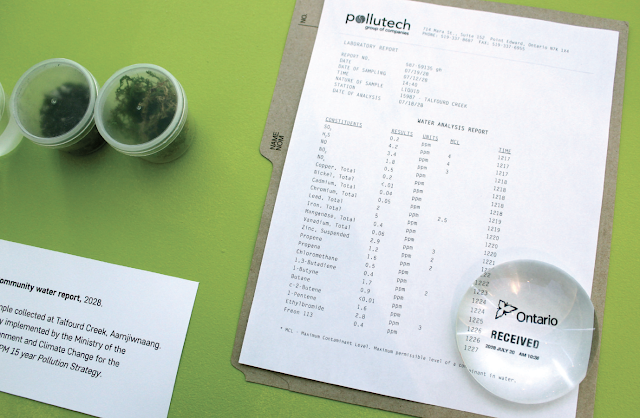
For Kelly Kornet's culminating research project at OCAD University (which design professor Helen Kerr and I supervised), she spoke to several lifelong environmental activists, living in heavily polluted industrial areas, about the future hopes and fears motivating their efforts. She generated written scenarios based on these (using Textor's EFR interview format), then created a physical exhibition comprising artifacts from the futures that the research participants had described, and subsequently spoke with them again to capture responses to how their own private imaginaries had been brought to life. The project, which won a student award from the Association of Professional Futurists, is available in pdf here.

Situation Lab/Extrapolation Factory, 1-888-FUTURES, 02015.
Jeff Watson and I (Situation Lab), together with Elliott Montgomery and Chris Woebken (Extrapolation Factory) designed and staged a series of design jams in 02014-15 called 'Futurematic'. The third of these, held at the University of Southern California, invited anyone interested, across North America, to call a toll-free number and record their future dream in a voicemail. On the day of the event, we had participants retrieve these voicemails, then create a "future present" –– a tangible artifact distilling (or, as Chris would put it, 'tangibilising') each dream. The maker/s then recorded a video about their making process and the correspondence between the artifact and the dream that inspired it, and boxed up the future present to send to whatever postal address had been left with the original voicemail. Thereafter, on social media, recipients responded to the future presents they opened up. The project is detailed here, and was covered by Core77 and Business Insider among others. Artifact documentation and videos are archived at 1888futures.com.


Greyson, Making the Futures Present, 02017.
Designer and interactive narrative professor Maggie Greyson, for her final MDes project at OCAD, created a "personal experiential futures" process. (Social entrepreneur Sarah Schulman and I supervised.) Maggie interviewed research participants, using Textor/EFR, about a range of futures they could imagine facing on a 20-year time horizon –– positive, negative, expected, and also unexpected. The 'unexpected' future is not a usual part of EFR, which traditionally has a strict descriptive intent; this was a deliberate addition to expand participants' thinking (see Step 3, 'Multiply'). She then worked with them to co-create rapid prototypes of artifacts from those futures, and went on to develop higher-resolution artifacts as a basis for deeper conversation in the next session. The project can be found in pdf here.


Notes:
[†] Those new to experiential futures may find this recent peer-reviewed article published in Futures journal useful. There's an abridged overview for the especially time-pressed (downloadable pdf). The Experiential Futures Ladder, to help carry out Step 3, Mediate, is described there too.
[π] The Adopt-a-vision experiential futures class project recently outlined at this blog could very easily be tweaked towards an EXF cycle –– and the resemblance is not pure coincidental; it emerges from some of the same thinking.
[§] The insight that an ethnographic, grounded-in-place futures process could be usefully developed as a generic method owes an enormous amount to over a decade of conversation and collaboration with Jake Dunagan (whose background includes an MA in visual anthropology). Early in 02016 we developed a project proposal called 'Nextloop', which aimed to offer "a next step in a much-needed renovation of the conditions for public imagination. We wish to use this opportunity to demonstrate how forward-looking design research, pairing ethnography with tangible speculation, can enrich individual and collective consideration of our social, cultural and technical choices. We intend to close certain loops too often left open – bringing potential downstream consequences powerfully and concretely into awareness today, and to bring in certain other loops – diverse public involvement in those same discussions – too often left out."
Related:
> Adopt-a-vision (report from a recent XF class)
> 1-888-FUTURES (speculative design jam event overview)
> Foundfutures: Chinatown (XF /guerrilla futures project overview)
> The Futures of Everyday Life (doctoral dissertation)

(Update 03june19: This post and framework have attracted quite a bit of interest over the past couple of years. We've now published a peer-reviewed academic article, in open access, laying out EXF in the Journal of Futures Studies special double issue on Design and Futures. That full piece is available in pdf here.)
***
At the Design Develop Transform conference in Belgium last week, design researcher/futurist Kelly Kornet and I presented this framework we've been developing on and off for a couple of years.
Ethnographic Experiential Futures, or EXF, is a design-driven, hybrid approach to foresight aimed at increasing the accessibility, variety and depth of available images of the future.
It puts together two modes of futures research and practice which have grown up separately, for the most part, but which have complementary goals, and turn out to pair quite well.
Ethnographic futures research, EFR, is a protocol for surfacing and documenting existing images of the future. (Our starting point was the late Stanford anthropologist Robert Textor's formal EFR interview process, an overlooked contribution to futures literature which should be much more widely used.) Experiential futures, XF, is a family of approaches for vivid multisensory, transmedia, and diegetic representations of images of the future (a focus of mine for the past decade).
Put another way, ethnographic futures is more descriptive; looking for what's present but often hidden in people's heads. Experiential futures is more creative; rendering these notional possibilities visible, tangible, immersive and interactive, externalising and concretising representations of them for closer inspection and deeper discussion.
EXF offers a way to take the invisible and make it senseable.

We've suggested a series of steps for an EXF process:
1. MAP: Inquire into and record people's actual or existing images of the future (e.g. possible; probable; preferred; a combination).
2. MULTIPLY: Generate alternative images (scenarios) to challenge or extend existing thinking (optional step, but recommended).
3. MEDIATE: Translate these ideas about the future/s into experiences: tangible, immersive, visual or interactive representations.†
4. MOUNT: Stage experiential scenario/s to encounter for the original subject/s, or others (or both).
5. MAP: Inquire into and record responses to the experiential scenario/s.
The Field Guide explains the logic and highlights some of the main design choices available at each juncture.
Instead of starting from theory, this step-by-step process has been derived from already completed projects, carried out over a number of years, which turned out to have much the same structure under the hood. In our conference presentation we reviewed four project precedents dating back to 02007. While demonstrating very different goals, outcomes and contexts, they basically describe the same research arc.
A full article is forthcoming, which will include more detail to situate this work in the landscape of futures ethnography and experiential practice, including related methods and projects. However, since the one-pager refers to the specific projects from which we distilled or abstracted this framework, for reference those are briefly outlined below:
About ten years ago, Jake Dunagan and I started experimenting with the deployment of experiential futures in unscripted environments. We would send postcards from the future to the home addresses of community leaders around Hawaii, and 'droplift' future artifacts in local shops for people to stumble across during their lunch break, for example. However our most ambitious early guerrilla futures project aimed to be more systematic; more rooted in place and history. In Honolulu's Chinatown neighbourhood, we interviewed a range of residents and business-owners, and then devised a culture- and site-specific scenario set, incorporating a combination of future possibilities as described to us, and new ones calculated to resonate with what we had heard. With collaborators we created a set of experiential scenarios, producing a cross-section of fragments from each hypothetical future history, and installing these in the streets. Responses were captured via direct observation, at a free community futures workshop, and in the press.

Artwork by Matthew Jensen / Photo by Stuart Candy

Artwork by Mark Guillermo / Photo by Matthew Stits
For Kelly Kornet's culminating research project at OCAD University (which design professor Helen Kerr and I supervised), she spoke to several lifelong environmental activists, living in heavily polluted industrial areas, about the future hopes and fears motivating their efforts. She generated written scenarios based on these (using Textor's EFR interview format), then created a physical exhibition comprising artifacts from the futures that the research participants had described, and subsequently spoke with them again to capture responses to how their own private imaginaries had been brought to life. The project, which won a student award from the Association of Professional Futurists, is available in pdf here.


Designs & photos by Kelly Kornet
Situation Lab/Extrapolation Factory, 1-888-FUTURES, 02015.
Jeff Watson and I (Situation Lab), together with Elliott Montgomery and Chris Woebken (Extrapolation Factory) designed and staged a series of design jams in 02014-15 called 'Futurematic'. The third of these, held at the University of Southern California, invited anyone interested, across North America, to call a toll-free number and record their future dream in a voicemail. On the day of the event, we had participants retrieve these voicemails, then create a "future present" –– a tangible artifact distilling (or, as Chris would put it, 'tangibilising') each dream. The maker/s then recorded a video about their making process and the correspondence between the artifact and the dream that inspired it, and boxed up the future present to send to whatever postal address had been left with the original voicemail. Thereafter, on social media, recipients responded to the future presents they opened up. The project is detailed here, and was covered by Core77 and Business Insider among others. Artifact documentation and videos are archived at 1888futures.com.

Photo by Stuart Candy

Photo courtesy Extrapolation Factory & Situation Lab
Greyson, Making the Futures Present, 02017.
Designer and interactive narrative professor Maggie Greyson, for her final MDes project at OCAD, created a "personal experiential futures" process. (Social entrepreneur Sarah Schulman and I supervised.) Maggie interviewed research participants, using Textor/EFR, about a range of futures they could imagine facing on a 20-year time horizon –– positive, negative, expected, and also unexpected. The 'unexpected' future is not a usual part of EFR, which traditionally has a strict descriptive intent; this was a deliberate addition to expand participants' thinking (see Step 3, 'Multiply'). She then worked with them to co-create rapid prototypes of artifacts from those futures, and went on to develop higher-resolution artifacts as a basis for deeper conversation in the next session. The project can be found in pdf here.


Photos by Maggie Greyson
Whether your aim is to dive deeper into the images of the future in a culture to which you belong (even your own personal 'futurescape'), or to facilitate a process for a client organisation, or to partner with a community group historically marginalised from meaningful futures conversations, the framework is intended to be capable of being customised and put to diverse uses.
As we noted in the conference presentation, purposes of projects to date have spanned the educational, documentary, activist, personal, and playful; and could readily be extended or adapted to the organisational, governmental, and cultural.π
EXF may be applied at the scale of a short workshop or design jam, up to a multi-year large-scale process involving thousands of people or more. It may be used as scaffolding for a robust, imaginative strategic conversation within a company, or as the basis for a public, guerrilla futures intervention at election time, or as a quasi-therapeutic support structure for examining an individual's options in life.
Most futures research is not as disciplined as it could be in its inquiry into how people currently think about and conceptualise futures: Ethnographic futures research can help with that. Meanwhile, most communicative or scenario-sharing interventions are likely not sufficiently vibrant to change or expand how people think: Experiential futures practice can help with that.
Putting them together entails bridging the descriptive and the creative (and potentially, though not necessarily, the normative).
As we noted in the conference presentation, purposes of projects to date have spanned the educational, documentary, activist, personal, and playful; and could readily be extended or adapted to the organisational, governmental, and cultural.π
EXF may be applied at the scale of a short workshop or design jam, up to a multi-year large-scale process involving thousands of people or more. It may be used as scaffolding for a robust, imaginative strategic conversation within a company, or as the basis for a public, guerrilla futures intervention at election time, or as a quasi-therapeutic support structure for examining an individual's options in life.
Most futures research is not as disciplined as it could be in its inquiry into how people currently think about and conceptualise futures: Ethnographic futures research can help with that. Meanwhile, most communicative or scenario-sharing interventions are likely not sufficiently vibrant to change or expand how people think: Experiential futures practice can help with that.
Putting them together entails bridging the descriptive and the creative (and potentially, though not necessarily, the normative).
Our hope is to make this work a bit easier and more common, by providing a flexible framework that has served diverse purposes before and could be put to many other uses.
Also, we note that this arc of activities, which in the original projects may have appeared linear, can be usefully recognised and imagined instead as circular. The first and last steps are the same. In principle, then, EXF could be used, where appropriate, in an ongoing, cyclical fashion.§
We've received a number of requests for a pdf of the draft Field Guide to Ethnographic Experiential Futures: you can download it right here.
We invite you play with this structure and share your variations, innovations and results!
Also, we note that this arc of activities, which in the original projects may have appeared linear, can be usefully recognised and imagined instead as circular. The first and last steps are the same. In principle, then, EXF could be used, where appropriate, in an ongoing, cyclical fashion.§
We've received a number of requests for a pdf of the draft Field Guide to Ethnographic Experiential Futures: you can download it right here.
We invite you play with this structure and share your variations, innovations and results!
***
[†] Those new to experiential futures may find this recent peer-reviewed article published in Futures journal useful. There's an abridged overview for the especially time-pressed (downloadable pdf). The Experiential Futures Ladder, to help carry out Step 3, Mediate, is described there too.
[π] The Adopt-a-vision experiential futures class project recently outlined at this blog could very easily be tweaked towards an EXF cycle –– and the resemblance is not pure coincidental; it emerges from some of the same thinking.
[§] The insight that an ethnographic, grounded-in-place futures process could be usefully developed as a generic method owes an enormous amount to over a decade of conversation and collaboration with Jake Dunagan (whose background includes an MA in visual anthropology). Early in 02016 we developed a project proposal called 'Nextloop', which aimed to offer "a next step in a much-needed renovation of the conditions for public imagination. We wish to use this opportunity to demonstrate how forward-looking design research, pairing ethnography with tangible speculation, can enrich individual and collective consideration of our social, cultural and technical choices. We intend to close certain loops too often left open – bringing potential downstream consequences powerfully and concretely into awareness today, and to bring in certain other loops – diverse public involvement in those same discussions – too often left out."
Related:
> Adopt-a-vision (report from a recent XF class)
> 1-888-FUTURES (speculative design jam event overview)
> Foundfutures: Chinatown (XF /guerrilla futures project overview)
> Build Your Own Time Machine (classroom activity instructions)
> The Thing From The Future (card game)> The Futures of Everyday Life (doctoral dissertation)


