Tuesday, August 02, 2016

The People Who Vanished


Update 01aug17: The journal article excerpted below, 'Designing an Experiential Scenario', has been named a 02017 Most Significant Futures Work at the annual Association of Professional Futurists (APF) Awards, in the Advancing Methods and Practice category. We are grateful to the APF and jury for this honour.

***

The People Who Vanished is a transmedia narrative project dealing with the prehistory of the Phoenix area, staged at the inaugural Emerge Festival hosted by Arizona State University in March 02012. Jake Dunagan and I designed and led a two-day workshop in which we produced an experiential scenario with 20 festival participants.

Although we had been doing Design Fiction and Experiential Futures for five or six years already by that time, we were excited about the challenges of co-creatively involving a group this size, and especially of the compressed production timeline, both highlighting the need for a shared mental model and clear framework for collaboration.

What follows in this post is a written snapshot of that design process. It's an excerpt from an article we recently published in the peer-reviewed journal Futures.† (File under: better late than never.) The article, or this lightly edited bit reproduced below, can certainly be read alone, although for a sense of the originally intended effect watch this video first; the tale as revealed to a live audience at Emerge (18 min).


† S. Candy, J. Dunagan, Designing an experiential scenario: The People Who Vanished, Futures (2016), http://dx.doi.org/10.1016/j.futures.2016.05.006.

***

The name Phoenix invokes the bird of Greek myth which would periodically burn up and rise again from its own ashes. It is a striking but little known fact that the city was so named precisely because it was built atop the ruins of a lost civilisation.

Beneath the streets and sidewalks of today’s Phoenix of four million inhabitants lie the remnants of the Hohokam, a society which flourished from around 0CE to 1400CE; “from Christ to Columbus”.

The Hohokam were expert canal engineers and irrigation agriculturalists. They built a thriving civilization in the desert lasting almost one and a half millennia. They farmed the land and channeled water through massive canals without any of the modern tools and equipment we have today. However, about a century before the arrival of Europeans in North America, they suddenly disappeared, for reasons that are unknown, and that are still debated by archaeologists.

The name Hohokam is an O’odham word meaning “the people who vanished”. Being an oral culture, it is unknown what they called themselves.


A question which we hoped to evoke for participants at Emerge became: “could the people of today’s Phoenix be the next to vanish from the valley?”

In order to push the boundaries of experiential futures, to do justice to the scope of the historical (and future) questions at hand, and to create a unique and fun learning experience for our workshop participants, we were drawn to the idea of executing a project at a monumental scale. We wanted to create something big; something that demanded attention; something that would appear suddenly and without warning — and that could carry deep meaning for the attendees. In our practice we and others often create hypothetical “artifacts from the future”, but in this case thought it could be interesting to create a fictional artifact from the past, in order to enable a reperception of present and future.

Throughout history, there have been breakthrough moments when we humans have been forced to confront our own ignorance and reimagine our collective story about who we are and where we came from. The unearthing of dinosaur fossils revealed a strange and diverse lifeworld on Earth long before human existence, overturning earlier thinking about natural history. Similarly disruptive were cultural discoveries such as the Dead Sea Scrolls, the Rosetta Stone, the city of Pompeii, and ancient technologies such as the Antikythera machine. The rediscovery of ancient philosophy, architecture, or artifacts from time to time has not simply added to a trove of curiosities from the past; but has heralded revolutionary change in society’s self-understanding. The Renaissance, the Enlightenment, and other epochal transitions have been initiated or accelerated by such archaeological moments.

There are always bound to be, this line of thinking suggests, possibility grenades beneath our feet, primed to explode our fragile certainties and platitudes about the story of our world. As U.S. President Harry Truman once said, “The only thing new in the world is the history you don’t know.” 

What could this “new” and transformative –– if hypothetical –– slice of history be for Phoenix?

Examining the map pieced together by 20th century archaeologists of the extensive network of ancient canals spanning the area... yielded what turned out to be an essential insight: in addition to their obvious practical uses, the Hohokam canals could have had some previously unsuspected symbolic functions.

An idea emerged: towards the end of their tenure, the Hohokam may somehow have manifested a distinctive symbol in the archaeological record – one also appearing in the pre-collapse periods of other cultures. … Now we could recount the fortuitous “discovery” of a transcultural, transhistorical symbol of impending civilisational collapse. It would not be necessary (and in the circumstances would also not be desirable) to try to explain the precise means by which this harbinger of disappearance had cropped up around the world throughout history; the sheer “fact” of apparently concrete evidence of the mystery itself could provide the desired archaeological moment.


We would tell the following story: In puzzling out the fate of the Hohokam, our group had spotted this curious anomaly on the map, and had then been inspired by the thought of a symbolic, and not merely functional, role for the canals. One of our number then had the idea to do a google image search for this pattern and see what turned up (still true –– sort of). Shockingly, this search showed up a range of other instances of the same ‘glyph’ in diverse archaeological records elsewhere: the Harappan of the Indus Valley, the Anasazi, the Nazca, the Polynesian peoples of Rapa Nui, aka Easter Island. All this part was of course completely simulated; photoshopped into found photographs from these places. We would also be able to show how the glyph had turned up subtly but unmistakeably, inscribed in the patterns on Hohokam pottery too. And the kicker: the sole common characteristic discernible across all these disparate cultures, from wildly different eras and geographies, was that they had all disappeared. They were all collapsed civilisations.


***

Bruce Sterling in Wired: "When one walked outside the auditorium afterward, there was a huge mystic glyph installed on the side of a local mountain."


***

Project Credits:
- The People Who Vanished were: Carlo Altamirano, Michael Baran, Rachel Bowditch, Chris Danowski, Tyler Eglen, Erik Fisher, Paul Higgins, Gordon Knox, Oscar Lopez, Blakely McConnell, Julie Rada, Matt Ragan, Reed Riner, Joya Scott, D.A. Therrien, Trish Yasolsky and Bobby Zokaites
- Special thanks: David Abbott, Tain Barzo, Joel Garreau, Jerry Howard (Arizona Museum of Natural History), and Cynthia Selin

See also:
Aisling Kelliher and Daragh Byrne (Carnegie Mellon University) in Futures journal
Cynthia Selin (Arizona State University), one of the organisers, situating this work in Futures
- A trove of documentation (still images and timelapse video) from our workshop, via Carnegie Mellon
- Post about the Emerge exhibition featuring The People Who Vanished and other projects at ASU Art Museum
- A terrific design fiction video created by a group led by Near Future Laboratory's Julian Bleecker and Nick Foster in another workshop taking place at the same time


***

The paper excerpted above goes on to describe a framework that we devised during the workshop and have kept developing and using since as a conceptual model for scaffolding experiential scenarios and design fiction; the Experiential Futures Ladder. Implications for the foresight field of this multi-scalar mode of thought, as well as of the experiential turn more broadly (towards design, media, games and performance) are outlined.

The full text of the article in press, "Designing an Experiential Scenario", can be found in pdf here.

The journal permalink is here.

Related:
The Experiential Turn
> On the eve of Emerge
> Dreaming together
A History of Experiential Futures 2006-2031
> Experiential scenarios on video

Sunday, July 31, 2016

Toward a Preemptive Social Enterprise


Verynice is a social enterprise design firm based in Los Angeles, with the groundbreaking business model of giving away half their work for free. To date they have gifted over USD 5 million in design services to worthy causes.

Having worked at the cutting edge of social enterprise for almost a decade, the Founder and Managing Director of verynice, Matthew Manos, is releasing a book about what he believes the next generation of this work calls for from entrepreneurs.

I'm honoured to provide the Foreword for Toward a Preemptive Social Enterprise, which features a cast of contributors including futurist Jake Dunagan, designer Nathan Shedroff, and science fiction author Bruce Sterling.

The book's worldwide digital release is tomorrow, 1 August 02016, with hard copies available in mid-September.

***

FOREWORD to Toward a Preemptive Social Enterprise.


Business as a category of human activity has traditionally aimed to maximise certain outcomes at the expense of others. Other communities, other species, other places, and future generations.

Take the oil industry for example. Like the endlessly ingenious tools of the extractive trade themselves, profit-first business morphs to fit the contours of the lucrative niche. I locate a rich deposit, I work out access to it by hook or by crook, and voilà: I drink your milkshake. Other impacts are someone else’s problem.

Traditional business is a badly broken finite game.

Yet it is possible to flip the premise. Here is the quietly revolutionary but increasingly obvious alternative: morph the enterprise to generate desired impacts, and reverse engineer a business model to make it economically viable.

This change-making path is often called social enterprise, and the figure animating that change and beating that path is the social entrepreneur.

Social entrepreneurship comes from the overdue recognition that business is an engine of change –– nay, a powerhouse. More and more of us see that to harness its institutional potential to worthwhile ends could be hugely influential, generating outcomes as deliberate and positive as the outcomes generated by legacy means have been accidental and destructive.

As Matt Manos explains in these pages, "A social entrepreneur is a designer of business whose intentions are not in capital gain, but instead in the advancement of the greater good of society." The central formula is, then, approximately: business + design + ethics (greater good) = social enterprise.

When one surveys today's fast-changing "ecology of commerce", in Paul Hawken's resonant phrase, we find a wide range of creatures from different evolutionary eras living side by side. There seem to be many recent, small initiatives nobly attuned to the full spectrum of their impacts. Generally these are nimble little Darwinian upstarts, yet to prove their fitness over generations. Such hopeful mutants co-exist alongside others, bigger and older, but catching on to the emerging rules of the infinite game, and if nothing else keen to be thought of as doing the right thing. Alongside these in turn can be found still others – some of the biggest, most formidable, and lumbering beasts in the landscape –– that show zero indication of giving any shits at all about the greater good.

Thus we find ourselves in a strange transitional era for business.

Consider entrepreneur Tony Hsieh's recent memoir Delivering Happiness, which documents the heroic efforts at his company Zappos to establish a viable niche as a service-oriented online shoe retailer. This story elicits a paradoxical kind of wonder. On the one hand, we can admire the way the organisation has promoted passion, purpose, and positive experiences for those in its immediate orbit. On the other hand, we may be simultaneously baffled by a lack of attention to the happiness of the invisible yet essential legions of workers further up the supply chain; those who actually stitch and glue together the shoes at the heart of each all-smiling transaction.

This integration of ethics into business, then, the "sociality" of social enterprise, is patchy, with even some of the good guys having serious blindspots, To misquote William Gibson, social enterprise may already be here, but it's by no means evenly distributed.

Still, there is no mistaking the direction in which the global connectivity, transparency, and systemic awareness are pushing. Some people, reporting right from the cutting edge, are perfectly positioned to help the rest of us understand where social enterprise, and ultimately business in general, need to go. Matthew Manos is such a person.

"The entire premise of social enterprise relies on reaction," he writes. The default setup is "post-traumatic innovation", but waiting until something has gone wrong––treating disaster as the trigger for action––is irresponsible.

It turns out that thoughtfully engaged and ethically motivated business can still be stuck in the past, solving one set of problems while leaving others untouched, or even making them worse.

It is therefore the aim of the book you are reading to show that a crucial ingredient is missing from the social enterprise formula: foresight.

The next generation of social entrepreneur must be "preemptive", less problem-ameliorating and more visionary, attending not only to traumas in need of remedy, but also to opportunities of shaping positive change, based in coherent, plural perspectives on how the whole system could evolve.

Social entrepreneurs should also be futurists.

Now, this is a big idea, and dealing with big ideas is hazardous, especially when it comes to value shifts. The more basic, load-bearing, and "self-evident" the assumptions at issue, the more readily attempts to address them risk being dismissed as irrelevant (incompatible with current settings) or redundant (since, once absorbed, previously unfamiliar settings become normal again).

However, someone has to take on the big ideas, and in business, “normal” needs major renovations. So regardless of whether you already share its view, or disagree vehemently, you should read this book.

To be slightly pre-emptive myself for a moment, it may be that some readers find this argument for foresight to make a poor accompaniment to a fond belief that the market already and automatically incorporates whatever information about the future it needs to.

You are invited to consider that the invisible hand mediating market participants works only with information in the system, and since there are no future facts, the hand can contribute no more foresight than the parties themselves bring to the situation. If we want markets to take the future into account, the people in them need to do it.

Then again, there may be some entrepreneurs sceptical about the value of designated “foresight” tools, since they already are creating the future, thank you very much. This resembles claims I have heard from some designers I’ve met over the last ten years.

They are partly right, of course. But it is a truism to claim that business, or design, is creating the future. As Kenneth Boulding has pointed out, all decisions are about the future. Merely existing helps to create the future, and inactions can have an effect just as surely as actions do. Neither the claim nor the fact that one is already "shaping the future" puts that activity beyond the possibility of improvement.

The good news is that designers and entrepreneurs alike are perfectly positioned to use strategic foresight approaches, such as horizon scanning, scenario generation, and experiential futures; the inherent future-shaping properties of design and business make these valuable places to integrate such a futures literacy.

Part of what Manos and his collaborators seek to do in this book, very successfully I think, is show that entrepreneurs and designers must take it upon themselves to be more systematic, deliberate and detailed in articulating which futures are at issue; which scenarios their efforts mean to help avoid and, more importantly, which ones they intend to help realise.

Preemptive social enterprise, therefore, ties our initial recognition of institutional capacity ("business is a powerful category of actor") to the capacity for individual action ("what can I do?"), and turns a personal ethical problem ("how can I as an individual exert meaningful influence?") into a collective design invitation ("what can I start, or help to grow, that may have the outcomes I wish to see?").

But let’s be clear about the depth and reach of what is being suggested here. We are not talking about a one-time goal shift, but about the development and integration of a permanent and self-renewing orientation. Not merely a new direction, but a new way to navigate.

One way to appreciate the significance of the argument is to call to mind the generic taxonomy of "places to intervene in a system" offered by Limits to Growth lead author and pioneering systems thinker Donella Meadows. What Manos is inviting social entrepreneurs to do, in effect, is move some of their effort and attention upstream where greater influence can be had. He would not merely have us put business in service of different, even if more worthwhile, "goals of the system" (number two on Meadows's list). The case for preemptive social enterprise is directly affects "the mindset or paradigm" out of which the goals themselves arise. This is leverage point number one, which implicitly impacts goals, and everything else.

Why does this matter? The cultivation of a capacity for strategic foresight entails a rigorous, informed, creative, generative, and always updating view of the world's and of one's own possibilities. Integrating it represents a change with ongoing and ever-evolving implications for organisational and individual activity.

In earlier work, echoed and amplified here, Manos has set about addressing how entrepreneurship is done, carefully documenting all existing business models in order to work out where underexplored potential lies. So the perspective of this book is –– bear with me now –– meta-entrepreneurial. It is being entrepreneurial with regard to entrepreneurship itself; not only using existing tools to put the changemaking powerhouse of enterprise in service of "better goals", but seeking to make it self-improving. Retooling the toolkit.

As Stewart Brand, another important social innovator, and a futurist too, has pointed out: “Nobody can save the world, but any of us can help set in motion a self-saving world." Foresightful, anticipatory, or to use Manos's chosen word, preemptive social enterprise may well be a critical, organic ingredient of a self-saving world; more flexible and resilient, more apt to adjust and to learn.

Preemptive social enterprise is a bid for business to embrace an iterative, anticipatory learning function, and for this to face outwardly and inwardly at the same time: "The design of scenarios, and, most importantly, the design of ourselves within those scenarios allows for a deep understanding of our potential, preferred, probable, or plausible futures."

“The design of ourselves” seems an important phrase. What might this entail?

I suspect that the answer may rest in a central, and highly valuable idea explored in this book. If you wish to realise a changed world, it is important to invest in imagination.

Now, one reason why I think Matt Manos is so effective as a designer, as an entrepreneur, and as a person is that he doesn't take conventional dichotomies at face value. He does not, for example, seem to see invention as being somehow elevated over or opposed to the legwork of researching that which already exists. This attitude lets him do the due diligence of assembling a near-exhaustive catalogue of business models, as well as adding his own––not only in theory but in ever-iterating, ever-improving practice. Nor does he snap-to-grid with an assumption that many others seem to live by, that imagining and implementing are somehow opposites. Instead, he treats the two, rightly I think, as equal, necessary and complementary facets of the same changemaking work. This lets him try out more ideas in a single project than a lot of people could be proud to have initiated over a span of years.

Even the seemingly foundational opposites of fact and fiction, when it comes to navigating change towards preferred futures, are unhelpful signposts. For what is a dream that one means to manifest if not both fiction and fact at once? Or rather, fiction that aspires to fact, and thereby creates it?

So one of the conventional dichotomies that this work refuses, critically, is the putative "realism" of business vs the "indulgence" of imagination.

Again: Imagination is an investment.

Over the past decade, designers have turned to futures practice, and futurists to design, out of a mutual need to integrate speculative and material registers. A flowering of hybrid practices – experiential futures, design fiction, speculative design – has been the result. All sorts of tangible artifacts and immersive experiences that make futures more easily shareable, thinkable and feelable. A few years ago, fellow traveller Bruce Sterling proposed this definition of design fiction, “the deliberate use of diegetic prototypes to suspend disbelief about change”. However, as digital media professor Janet Murray has observed, "When we enter a fictional world, we do not merely 'suspend' a critical faculty; we also exercise a creative faculty. We do not suspend disbelief so much as we actively create belief." Similarly, interactive performance specialist Jeff Wirth points out that his artform "does not rely on the 'suspension of disbelief'", but rather "calls for an 'investment of belief.'"

After a decade of working at this intersection of design and futures, I think it may be time to retire our long-term loan of Samuel Taylor Coleridge’s wonderful but too-limited notion of "suspension of disbelief", in favour of this idea that we really invest belief in our imaginings, in order to see where they may take us. Suspension implies an interim state, with nothing much changing once the thing suspended is reinstated. But one invests with a view to a return.

Peter Lunenfeld's "return on vision" cited by Manos is right on point: we should invest in imagination, and seek our return in the new options and pathways that thereby become available.

Why so? People are extraordinarily plastic, and versatile, as testified by the massive (if lately endangered) diversity of human cultures built atop a more or less identical biological substrate. I've suggested this before, mashing up media ecologist Marshall McLuhan and sociologist-futurist Fred Polak: we shape our images of the future, and meanwhile they shape us.

Therefore, if design has given to business some tools with which to be more creative and intentional, and futures has offered business a vocabulary of long-range outcomes, then perhaps here we have a hint as to how business can return the favour to both. The framing and language of investment, unshackled from its bloodless, numerical bottom-line connotations, but retaining the impulse to clear-eyed evaluation of what one really values, and how much difference one’s actions are really making, could prove an important loan for designers and futurists alike.

This book calls for bringing futures and foresight work into the repertoire of the social innovator or entrepreneur. We have touched on why, and also also, broadly, how, by investing time and effort in experimental belief structures, the imagination of alternative worlds. If you're as pragmatic and results oriented as I hope you might be, then at this point you'll be itching for more concrete details. But WHAT does this mean, specifically, on Monday morning?

Good, good. Read on!

The ultimate test of these ideas does not consist in what they do for you on the page, but in your search for ways to take them on in your life. The truest and fullest response is one for you –– for all of us, a community –– to find in the doing, and share.

I know, and suspect you know too, that business is changing, and that it needs to change, dramatically so, in order at last to fit the contours of the infinite game that makes all of this possible.

I believe that if you follow along a little ways in the direction this book is pointing, towards the preemptive social enterprise, your practice may become more imaginative, your convictions more grounded, your perceptions more trenchant, your action more effective, and the world incrementally more just.

And I hope you will agree that it is well worth a try.


Stuart Candy
Museu do Amanhã, Rio de Janeiro, July 02016

***

Toward a Preemptive Social Enterprise is available in full on a Pay-What-You-Want basis via futureimpact.co.

The Foreword above can be found in pdf here.

Related:
> The act of imagination
> LEAP Dialogues: Impacting the Social
> Foresight is a right
> Design is a team sport
Strategic Foresight and the Design MBA

Monday, June 27, 2016

Impacting the Social


Images: Candy Chang, Before I Die, New Orleans, 02011.

***

Last month a remarkable book was published by Designmatters at ArtCenter College of Design –– LEAP Dialogues: Career Pathways in Design for Social Innovation.

In the preface, editor Mariana Amatullo states that the work is "a first-of-its kind resource" directly addressing "change[s] in how design is taught, practiced and integrated into organizations, why these changes are happening, what is needed to support these new practices, and how designers can pursue these new career pathways". With 84 contributors across many themes, it's an impressively wide-ranging, substantial, and I might add, beautifully designed volume.

I'm thrilled to have a piece in LEAP Dialogues in the form of a conversation with artist Candy Chang, moderated by designer Bryan Boyer, who is also one of the collection's co-editors.

Bryan Boyer's wonderful stuff has appeared here at The Sceptical Futuryst before; he has since spent years working on pathbreaking projects and approaches in strategic design (e.g., In Studio: Recipes for Systemic Change, 02011, pdf).

Candy Chang's work includes marvellous participatory public projects such as Before I Die and I Wish This Was, as well as contributions to the Hypothetical Development Organization, a collaboration with Rob Walker and others which I delightedly backed on Kickstarter years ago, and regularly feature in talks about guerrilla futures practice.

Our dialogue appears in the book under the title "Impacting the Social".

***

Bryan Boyer: You both do projects that are performed in the real world, in the city. Why is this important to you?

Stuart Candy: I work across settings and formats—museums, galleries, boardrooms, conferences, universities, city streets. Operating in diverse sites from project to project is more important to me than any one project by itself. To my mind, all contexts of deployment are “real world,” although each has its own affordances, limitations and publics. The same goes for different media—online game, workshop, installation, mailout, design jam, short film and so on. To riff off Marshall McLuhan, each medium is a different massage. These different contexts of encounter, and alternative ways of massaging those contexts, are not merely interchangeable aesthetic options but design parameters: how would you like to massage those you wish to engage?

Experiential futures practice is location and medium agnostic because it is more about enabling futures than using or advancing a particular mode of expression. Anything that you can cause to happen to, with and for someone is, in principle, fair game; the entirety of experience, the whole of the sensorium, is the canvas or design space. The term “experiential futures“ tries to convey this encompassing, transmedia idea of the range of options at our disposal. The corollary is that each intervention within the practice must be highly specific to topic, site, time, audience, etc.

What‘s interesting to me about urban settings is that they are less scripted. I find it important to be prepared to use unscripted places because most people, thoughts, decisions aren‘t necessarily happening where one has an invitation. When there is something that people should perhaps be considering, and they aren‘t aware of or able to enter the museum or workshop or boardroom or town hall where the conversation is officially convened, it can be useful to instead bring the conversation to them.

This is how our “guerrilla futures“ practice emerged. Formal, solicited projects often encounter roadblocks, and since you have to adapt to constraints in any project, it can be interesting to work with “found” challenges and opportunities instead.

Candy Chang: I’m interested in how places shape us. I studied urban planning and at the same time I made street art, which led me to think more deeply about public spaces. In a built environment where citizen’s flyers are illegal yet businesses can shout about their latest products on an increasing number of surfaces, we need to consider how public spaces can be better designed so that they’re not necessarily allocated to the highest bidder, but also reflect our needs as a community and as individuals. The places we share have a lot of potential to help us connect, reflect and make sense of our communities and our lives together. William Whyte’s The Social Life of Small Urban Spaces encouraged me to trust my real world experiences, and making street art gave me the moxie to just try things out and see what happens.

I’m an introvert, and the participatory public art projects start- ed out as a way to ask my neighbors things I was too shy to ask in person—or as a way for the quieter people to share just as much as the loud ones. Over time I realized these installa- tions had other benefits. They’re anonymous, so you can open up in ways you might not have otherwise. They allow people to easily participate on their own time. And they’re places where we can collectively reflect together. I think Stuart’s work does that well in his own way, and I admire his democratic approach to foresight work. I’ve been interested in creating safe spaces for honesty and vulnerability, and I like how Stuart is interested in making “safe spaces for dangerous conversations.”

SC: One doesn’t really get anywhere very interesting with futures until one starts to entertain possibilities that deeply challenge current ways of thinking. I’m invoking the spirit of philosopher Alfred North Whitehead here (“It is the business of the future to be dangerous”) as well as my mentor, Jim Dator (“Any useful statement about the future should at first appear to be ridiculous”). A company may be facing some change in the market that no one in it recognizes; a government may need help even to see, let alone respond to, unexpected shifts in the political landscape. In any case, the “dangerous conversation” confronts that which is uncomfortable and vulnerable, and therefore marginalized, but potentially transformative. Likewise for other kinds of community, and for individuals. Creating a safe space for that means first of all finding ways to suspend the very powerful reflex of avoiding such sensitive topics.

One of our earliest experiential futures projects was for the State of Hawaii, almost a decade ago, to kick off a sustainability planning process across the islands. Together with Jake Dunagan, and with the help of others at the Hawaii Research Center for Futures Studies, we immersed 550 people, ordinary citizens and elected representatives alike, in four alternative versions of the islands in the year 2050. One of the four was set in the wake of a global economic implosion in the 2040s, followed by an interval of chaos before the United States military intervened to maintain law and order. With the old economic and political regime discredited, they reinstated the monarchy that the U.S. had overthrown in 1893.

As an experiential scenario, then, participants entering the room found themselves cast as climate change refugees being naturalized as citizens of the so-called “Democratic Kingdom of Hawaii,” a military governance regime with a veneer of local culture. Here the experience provided a container in which some potentially discomfiting prospects could be engaged: you’re already in the scenario by the time the rational mind starts to mount intellectual or political objections. As we say, it’s better to be surprised by a simulation than blindsided by reality. Such a conversation may be difficult, but it can’t hurt you nearly as much as not having it can.At other times, offering hospitality to dangerous ideas can take the form of adopting processes designed to include people and elicit views that might otherwise (if often unintentionally) be left out. For many years I’ve used Open Space Technology, a participant-centered way of running meetings of almost any size, and organizations like the engineering firm Arup, as well as the Singaporean government, the leadership of Oxford University, and the team behind the regional Burning Man event in Australia were all able to overcome initial discomfort with the emergent character of the process to explore their potential contexts and choices more freely and more effectively than usual.

BB: Who are your projects for?

CC: They’re for everyone—or at the very least for me! They’re a way to satisfy my curiosity. My projects are more psychological now, but they started out very civic-minded. When I lived in New York City, I learned about Jane Jacobs and how she rallied her community to prevent the Lower Manhattan Expressway from being built in 1962. It still shocks me to think how different New York would be today if the Lower Manhattan Expressway happened, because the “slums” Robert Moses tried to clear out are now some of the greatest neighborhoods in the city. It made me think about all the cities that could have been, and how all the cities that we have today depend on who gets involved. When we make democracy more accessible, we make places that are more loved, more cared for and more meaningful to us for the rest of our lives. If we believe in greater democracy, our unbridled creativity is now required to design the situations in which this can happen.

That’s what I like about Stuart’s immersive, thought-provoking scenarios for residents to contemplate and kick around and challenge. It’s fun and engaging. There was a lot of talk in my urban planning classes about participatory planning as if we were holding the doors back to an excited, well-informed mob. In reality, there is no crowd on the other side of the door. Many people have an ambiguous understanding of civic processes, and many others are simply turned off by them. I’ve been to many community meetings that are so dreary, only the angry neighbors are excited enough to show up. There are a lot of opportunities to re-imagine civic engagement so that people are inspired to get involved in shaping the future of their community.

SC: A colleague asked recently whether thinking about the future is a privilege or a right. Unfortunately, it’s actually a luxury. Many may have the motive, but few have the means or the opportunity. But this is not how things ought to work. Normatively, thinking about futures is everyone’s right. My work is interested in making futures more available, accessible, habitual. It’s about urging people to claim their license to spend time and creative effort there. With this broad mission in mind, participation can look very different from one engagement to another.

I think this work is for people willing to ask questions and entertain new ideas about the future. That’s less a demographic than a psychographic—or better, a mindset—that you try to bring out among whoever comes along, by providing opportunities to think differently.

Another aspect of “who is this for,” is that currently I do a good deal of work in an education setting. OCAD U has the world’s first academic program in design and foresight, that’s what drew me there. It’s exciting to help spread this practiceto where practitioners are trained. This lets us access a higher leverage point in the system—how emerging designers are acculturated. You try things out by setting briefs and developing methods, then see how a range of different minds adapt and work the process through. The classroom becomes a lab, and students—bringing their own backgrounds and concerns, intentions and publics—extend experimentation into places one might not think or choose to go oneself. I find this a more generative way to work than just doing my own stuff all the time, and it also ultimately makes the work “for” a wider and more flexible constituency.

BB: Are your projects provocations, or something else?

CC: Each project is an experiment that challenges what our public spaces are fundamentally made of and how they might better reflect what we value as human beings. After I lost someone I loved, I went through a long period of depression.I made the Before I Die project as a way to make sense of my grief and find consolation with my neighbors. Their responses helped me more than they will ever know, and I’ve learned just how universal our struggles and desires are after reading responses from Before I Die walls in over 70 countries. I saw even more struggles in the Confessions project. From my experiences, people are yearning for safe spaces to be honest and vulnerable with the people around them. It’s cathartic and consoling. You’re not alone as you’re trying to make sense of your life. You’re not the only one who feels like they’re barely keeping it together.

During one of my gloomiest periods of existential confusion,I found a lot of comfort in a book called The Middle Passage by Jungian analyst James Hollis. He said, “In the end, we are only tiny frightened animals, doing our best to survive amid other tiny frightened animals.” This always consoles me. I returnto this sentence when I lose perspective, and it’s somethingI remember when I consider our communities. Our personal anxieties extend into our public life and many of the conflicts in our communities come from a lack of trust and understanding. There are a lot of barriers to opening up and while the barriers remain, it’s easy to forget the humanity in the people around us and become impersonal, and even adversarial. These personal, anonymous prompts offer a gentle first step towards honesty and vulnerability in public, which can lead to trust and under- standing. These are essential elements for a more compassionate society. They’re essential elements for social cohesion.

SC: A provocation can spur thought when it succeeds, but sometimes it generates rejection. There’s probably a need to invite or seduce as often as to provoke. I’m interested more and more in projects—and Candy has done many of these wonderfully—that enable people to generate their own ideas, as opposed to responding to ours.

The Thing From The Future, for instance, is a card game that my Situation Lab co-director Jeff Watson and I designed. People have used it as a tool for warming up to strategic conversation, for design ideation and prototyping, and as a party game played for fun. This combinatorial prompt generator, as you understand how it scaffolds imagination, becomes very adaptable and useful. We recently released the game under a Creative Commons license so players can customize it more easily to their local contexts and needs. I like projects that offer frameworks for participation and produce surprises. Instead of specifying an experience in every detail, they offer conditions that invite others to grow their own.

BB: What does the future mean to you? Is it a worry, an invitation, something else entirely?

SC: Ashis Nandy calls futures a “game of dissenting visions.” It’s a gift of sorts, a psychedelic playground where we can make new perceptions and actions possible, and incubate real and far-reaching change.

Another brilliant cultural commentator from India, Shiv Visvanathan, invites us to see the future as a commons. I love this idea. Public imagination is the ultimate renewable resource; we are still learning how to use it wisely.

CC: The future is something I’m excited to shape with others. I’m interested in the relationship between public space and mental health. The urban historian Lewis Mumford once wrote that the origin of society, the reason we came together in the first place, was not just for pure physical survival but also for “a more valuable and meaningful kind of life.” Some of the first gathering places were graves and sacred groves. We gathered to grieve together, worship together, console one another and wonder together. I think one of the greatest missions of modern cities is emotional communion. Not only does this serve fundamental needs of the human spirit, it cultivates compassion and trust, which are vital for civic respect and collaboration. I’d like to expose more of our interior world in public so attention to mental health becomes less stigmatized. I’m currently creating a public device for philosophical reflection that is inspired by the I Ching.

I’m also intrigued by how we deal and don’t deal with death. After anthropologist Ernest Becker wrote the book The Denial of Death in 1973, a theory emerged called terror management. In a nutshell, it argues that legitimate anxiety about our impending deaths was solved by creating cultures that provide comforting arrangements, including the hope for immortality. Immortality can be literal, as in heaven or reincarnation,or symbolic, as in publishing a book or having children. Our current cultures try to give us meaning and value, but they can also distract us and take us away from the deep encounter with ourselves. This helps to remind me that culture is man-made and we can change it.

***

LEAP Dialogues –– all 360 glorious pages of it –– is available to order here.

(Update 14jul16: pdf of the above interview can be found here.)

Related:
> Designing futures
> Architectural time travel
> Strategic foresight meets tactical media
Dreaming together

Wednesday, May 11, 2016

NaturePod™


What if you could reap the health benefits of spending time in nature––for productivity, creativity, and stress relief––without even leaving your office?

All this is coming soon to a cubicle near you.

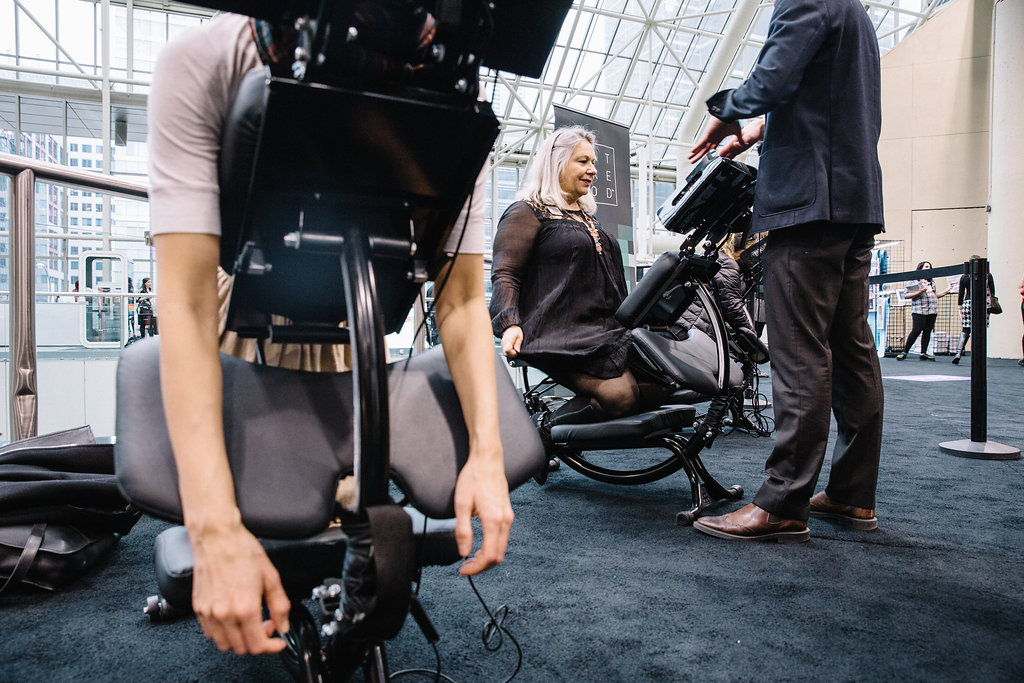
Canada's largest architecture and design trade show recently saw the global launch of a new product called NaturePod™.

Each unit provides intensive personal exposure to sounds, imagery, and (selectively) smells of various natural environments. The system gently guides the user through its Natural Resonance Imaging® technology, which maps the brain's real time responses to specific stimuli. A helpful Relaxation Status Display appears in the field of view throughout.

Capitalising on the latest findings in environmental neuroscience, the product's Toronto-based creators claim that their patented personal wellness system brings restorative benefits equivalent to, or even greater than, nature in the raw.


At IIDEXCanada, all a new user had to do to get started was adjust the Pod Body to their particular dimensions, and calibrate the Pod Headset's stereoscopic display to their personal IPD (interpupillary distance), before immersing in one of three demo environments: a lush valley mid-summer, snow-covered mountains in winter, or a temperate forest in spring.

Of thousands in attendance at this annual design exhibition and conferences––which included summits on Healthcare, Wellness, and Accessibility in the built environment––many who got to try NaturePod™ first hand were immediately enchanted, and prepared to buy or lease the devices on the spot.

But frankly, reactions were mixed. A few declared their horror at the idea that anyone might try to substitute a new gadget for the experience of forest.

Even so, no one appeared to have any difficulty believing that this was a real product being offered to mitigate the chronic disconnect of modern urban dwellers from the experience of nature.

In fact NaturePod is design fiction––for now.

It's an experiential foresight project in the public interest; a scenario set five years into the future but brought to life today, created by a team of graduate students from OCAD University's Strategic Foresight and Innovation program, and led by me under Situation Lab auspices.

Neither a prediction nor a preference, but a provocation, we wanted to use design and performance to invite consideration of how our relationship to nature in cities is changing, and contribute to a dialogue about potential differences between our current direction, and what we might collectively want.

The people in the video above are responding to a direct experience, not to a hypothetical question.

***

"Powerful critical design does not present itself as critical design. Powerful design fiction does not present itself as fiction."
- Matt Manos

***


***

A few hints about the future setting were planted, including a full-page advertisement in the Show Catalogue announcing the release of the product in Fall 02021, but we were shooting for present-day realism in the encounter. The aim was to let folks come to their own genuine conclusions about the whole idea before the hypothetical status was revealed. The story told in the video has the same structure.

This unusual project grew out of a Time Machine, an Experiential Futures module that I created in 02013 and have taught each semester for the past three years at OCAD University.

That particular run of the Foresight Studio course, just over a year ago, was co-taught with the marvellous Suzanne Stein. One group of our students––Bergur Ebbi Benediktsson, Nourhan Hegazy, Jennifer McDougall, and Prateeksha Singh––spent the semester exploring the futures of humanity's relationship with the environment. When it came to the Time Machine, their response was ingenious; they created a "Nature Deficit Disorder Clinic" from 02040. In this experiential scenario set a generation from today, daily contact with nature is rare. The deficit is both ubiquitous and medicalised. People try to mitigate it with oxygen supplements and exposure to simulated forest, gauging their progress via brain scans.

A top Canadian environmental advocacy organisation, the David Suzuki Foundation, had served as this group's external partner throughout the class, and at their request we re-staged the NDD Clinic on Earth Day 02015 for the Foundation's employees and industry partners. Among the attendees was Canada's head of marketing for Interface, Inc.

Interface is a rather remarkable company. (You might know them from the documentary The Corporation, and especially the influential voice of their late founder Ray Anderson.) They're the world's leading carpet tile manufacturer, and also a global trailblazer in corporate sustainability. By no means is this a typical combination.

They engaged Situation Lab to create an experiential scenario to nudge their customers and others towards a deeper conversation about humanity's changing relationship to nature in the built environment. The same highly talented group of four graduate students came aboard to adapt the original concept for a totally different context: instead of a room-specific, 20-minute immersive installation for a captive audience of 20-30 members, we were to make this experiential scenario available to thousands of people over two full days at one of the largest expositions of its kind in North America.

Now, in the architecture and interior design world, it turns out that there is already lively discussion underway about (E.O. Wilson's term) "biophilia" in a design context, for instance in the 02015 report, Human Spaces: The Global Impact of Biophilic Design in the Workplace.

Biophilia refers to the "instinctive bond between human beings and other living systems"; a bond variously accommodated or cheerfully ignored by present urban and building designs. We designed NaturePod as an experiential contribution to both broaden and deepen the conversation. What are the implications for our wellbeing of trying to close the nature gap using increasingly sophisticated imitations? Where might that lead?

While evidently exercising a degree of creative licence to prototype possibilities from half a decade out, our imaginings were tied to real research. Readers curious about the current science behind these developments in nature simulation and related themes can find plenty of material for further investigation (for example: de Kort et al, 02006Kahn et al, 02008Kahn et al, 02009Kjellgren and Buhrkall, 02010;  Valtchanov, 02010; Valtchanov et al, 02010Valtchanov and Ellard, 02015).

What I love about the project is that this visionary company took such an unusual step, sponsoring a guerrilla futures intervention to urge industry and public engagement with issues that matter and affect everyone. (To the extent that corporate entities have engaged in experiential futures or speculative design previously, the results have tended toward the shamelessly commercial and trite, as Noah Raford has persuasively argued.)

NaturePod™ comes almost a decade after the first experiments in what we've come to think of as a special strand of publicly-oriented foresight work. Guerrilla futures combines strategic foresight and tactical media to produce unexpected encounters with possible worlds (see FoundFutures, for instance). Injecting possibilities into the present lets us think and feel new potentials, not "merely" hypothetical, in a mode of exploration squarely located where serious investigation meets play. (See Chapter 5 of The Futures of Everyday Life for more.)

This may be a first for corporate use of experiential futures / design fiction in guerrilla mode, and it is our hope that it provides a bracing contribution to design conversation far and wide.

Thanks and bravo to Interface, and to our marvellous design team: Berg, Jennie, Nour, and Prat! Huge thanks to all participants, assistants, volunteers and supporters; full project credits appear beneath the video.


Stills by Connie Tsang.
Videography by Filip Vukcevic.

Related:
Strategic Foresight meets Tactical Media
> The Futures of Everyday Life
> Guerrilla futures performance at South by Southwest
> FoundFutures: Chinatown

Saturday, April 30, 2016

Foresight is a right

Artwork: Mural by the Community Qolla Ayllu Cutimuy of Villa Elisa, La Plata, Buenos Aires[source].

***

A while back, a futures student posted on one of our community email lists a question that I've kept coming back to in my mind.

Is thinking about the future a right or a privilege?

This is interesting because it gets at a central paradox that one inhabits as a futurist. On the one hand, it's clearly a right. As human beings, whatever our physical limitations may be, we enjoy – as we must – a capacity to roam freely in the imagination. To hope, to dream, to explore. What could be more basic? (Zia Sardar's splendid 01999 collection, Rescuing All Our Futures, acknowledges and builds on this notion, looking at it primarily though a critical cultural and decolonial lens.) Consider too our historical situation: enmeshed in a fast-changing world, being able to think ahead is apparently a prerequisite for successfully navigating that change as individuals and as communities. So, yeah: foresight is a right.

On the other hand, foresight is evidently a privilege. Many people are so overwhelmed with the concerns and pressures of the day-to-day that the idea of spending time engaged with the longer term outside of the occasional daydream is a barely imaginable luxury. People are unaccustomed to thinking futures and tend to discount them: it was this recognition that prompted our first steps ten years ago towards what became Experiential Futures practice. Also, professional futurists are still a rare species, numbering in the hundreds worldwide. A majority of companies, universities, and governments lack proper mechanisms for incorporating foresight into their work. Similarly in the realm of education; despite basic education itself now being a global norm, few students even get to find out that the foresight field exists, let alone study it. Foresight is also a privilege.

A paradox then: normatively foresight is a right, descriptively it's a luxury. It's something everyone should be able to do, but in reality few have the opportunity. We need to close this gap, and there are some encouraging signs that things may be moving in the right direction.

There's Teach The Future, a project of long time futures educator Peter Bishop, "to establish futures thinking as a natural component of secondary, post-secondary and professional education". This wonderful initiative builds on a half century-old pedagogical tradition in futures studies, seeking to make it available to all.

There's the proposal by strategic consultant Jeff De Cagna that a Duty of Foresight be embraced by association boards alongside their existing legally established duties of care, loyalty and obedience. Law being part of my background, I find this very interesting: a legal obligation to think ahead more methodically could be quite a powerful measure.

This month (April 02016), there was a promising court decision where a federal US judge found in favour of a group of young people, aged between 8 and 19, seeking to sue the United States government for inaction on climate change, in light of harm to both their own interests and those of future generations.

And there are also assorted experiments with formal mechanisms embedding foresight in state governance. Some years ago Bolivia passed the Ley de Derechos de la Madre Tierra (Cormac Cullinan's wonderful book Wild Law covers this earth-centric legal territory very well). Sweden now has a Minister of Future Issues; her name is Kristina Persson. Finnish Parliament has a standing permanent Committee for the Future. In just the past week, my colleague Noah Raford shared the news that the Dubai Future Foundation has been established through a waqf, or perpetual charitable trust, "to shape the future of the strategic sectors in cooperation with the government and private sector".  Many jurisdictions have seen proposals or undertaken efforts towards various institutions of foresight – which, covered properly, would be a much longer post.

Admittedly this is all a bit impressionistic. We could stand to be rather more systematic about tracking signals towards what Richard Slaughter usefully described twenty years ago as social foresight; a collective capacity to engage the long term [full text].

It is more than a decade since Andy Hines, now head of the futures program at University of Houston, proposed an "audit for organisational futurists" [full text pdf] to implement and monitor progress within organisations. Perhaps the time has come for the field to take steps towards a larger-scale foresight audit – a Foresight Census, to monitor the shape of these activities and spread of capacities around the world.

Foresight is indeed a right, it seems to me. But we are extraordinarily fortunate to be part of an era in which it is also, Inshallah, becoming a norm.

Related:
> Dreaming together
Crimes against future generations
> Questioning hyperopia
Generational change
> Politicians discussing global warming

Thursday, December 31, 2015

Journalism from the future


(List below last updated 04may21)

***

I recently joined the advisory board of a startup called Scout, a crowdfunded project out of Seattle that's "accelerating the creation of a better future through stories, conversations, and prototypes". In other words, the initiative is about developing a platform combining journalism and science fiction. A discussion with Scout's co-founders Berit Anderson and Brett Horvath about how those two traditions come together reminded me of something I've been meaning to share here.

Every now and then, there surfaces a piece of writing that uses the formats and tropes of nonfiction reportage to explore a future scenario diegetically. Such writing can dramatise a point of view on the future(s) to great effect. To say it's diegetic means that it's framed "from" or "within" the hypothetical, as opposed to the more common, and literal-minded, mode of explicit speculation about what could or "will" happen from the vantage point of today.

Conventional prospective or speculative journalism holds the future at arm's length, pontificating. Diegetic reporting actually goes there. It's journalism's version of the "artifact from the future".

Now, scenario writing for formal foresight processes often uses a similar communicative gambit. Still, I find it refreshing when real journos and writers use their skillsets and bully pulpits around the mediascape to tackle this territory. Not to denigrate the efforts of *cough* well-meaning futures types, but when a writer has mastery of those forms and genres which authoritatively mediate developments in the wider world (or seem to), it gives an enormous boost to their readers' capacity to entertain a hypothetical context.  This can range from breaking-news reports to long form historical analysis. In any event, part of what makes future journalism tick is the same thing that can make asserting possibilities in materiality so effective: it brings the future to life.

Another vector to this post comes from The Economist, which a few months ago launched The World If..., a welcome (nay, overdue) effort from a mainstream media brand to systematise some kind of imaginative engagement with possibilities. But in selecting the format they missed a big opportunity. Instead of using their own journalistic idiom to perform future events and analysis, compellingly demonstrating to readers the cultural, commercial, political and strategic implications of each "what if", the articles peer at the possibilities from an armchair planted firmly in the present.

So for those occasions when scenarios are best communicated in writing, we should seek to get a better handle on what works, and why. Below is a starter list of diegetic "journalism from the future" articles. What could be called "future longreads" are starred. *

By the way, let us distinguish what's covered here from a cloud of related approaches which deserve examination elsewhere:
Newspapers from the future: a classic, even clichéd way to mediate a future scenario, but with good reason. Cases range from the Yes Men's brilliant 02008 real-world intervention The New York Times Special Edition, to Near Future Laboratory's recent paper about the future of football, to the famous prop in Back to the Future Part II [as per the pic at the top of this post; and while it's true that this isn't exactly an example of what this post is about, BTTF Day was just recently – so there we are].
Scenarios: Stories produced by futurists specifically for strategic conversation-prodding purposes often incorporate diegetic, and frequently first-person, accounts of future events. Like this.
Future headlines: These are a staple of shorthand scenario-writing (see Ogilvy and Schwartz, Plotting Your Scenarios, p. 9).
Video/audio news reports: there are a lot of these around, the main lesson of which to date appears to be that they are super hard to do well. The best might still be Orson Welles's brilliant 01938 War of the Worlds radio broadcast, which is very nearly an experiential scenario (it's discussed at length in terms of its effectiveness and ethical calculus here, pp. 272 ff).
Diegetic future documentary: see here.
Entire books framed as documents of a future or alternative present: a favourite example, offhand, is Michael Crichton's Andromeda Strain, the verisimilitude and plausibility of which are bolstered with in-story textual artifacts such as scientific journal references. Five centuries earlier, Thomas More's Utopia did something similar (see here pp. 266-267).

***

Kate Aronoff, The Intercept
With a Green New Deal, Here’s What the World Could Look Like for the Next Generation
Set in 02043 (published 02018)

† Note: This piece illustrates a fairly common halfway measure, starting with a future vignette then reverting to present-day analysis. (Frum's article below is similarly structured.) This particular example is notable because it went on to inspire a widely-viewed "video from the future", narrated in the first person by Congresswoman Alexandria Ocasio-Cortez.

Todd L. Burns, Music Journalism Insider (Substack)
See contributions by Dan Ozzi and Luke O'Neil; the rest are non-diegetic

Alan S. Drake, The Oil Drum
USA 2034: A Look Back at the 25th Anniversary Year, 02034 (02007)

Stephen Eisenman, Newcity (Chicago)
Pussy Hat Project, Black Lives Matter and the Brady Campaign Demand Repeal of Gun Control Laws, 02018 (02017)

Mohamed A. El-Erian, Bloomberg
Imagining the U.K. and the EU Three Years After Brexit, 02019 (02016)

James Fallows, The Atlantic
Countdown to a Meltdown, 02016 (02005)

Niall Ferguson, Time
The Nation That Fell To Earth, 02031 (02006)

David Frum, The Atlantic
How to Build an Autocracy, 02021 (02017)

Jeff Goodell, Rolling Stone
Goodbye, Miami, 02030 (02013)

Daniel Henninger, Wall Street Journal
Hillary's Concession Speech, June 02008 (May 02008)

Damon Linker, The Week
After Trump loses: An ominous American future imagined, 02019 (02016)

New York Times Op-eds From The Future (Series)
Ted Chiang, It’s 2059, and the Rich Kids Are Still Winning, 02059 (02019)
Hannu Rajaniemi, Keep Your Augmented Reality. Give Me a Secret Garden., Unstated (02019)

Jonathan Rauch, The Atlantic
How American Politics Went Insane, 02020 (02016)

Michael Rogers, NBC News
Synthetic actors: an interview from the future, 02022 (02005)
What is the worth of words? 02025 (02006)

Rebecca Solnit, TomDispatch.com
The Age of Mammals: Looking Back on the First Quarter of the Twenty-First Century, 02026 (02006)

Alex Steffen, TheNearlyNow.com (Series)
This Earthly Sphere, 02026 (02017)
California's Heroic Future, 02027 (02017)
* In San Patricio, a community struggles with transformation, 02025 (02017)

Bruce Sterling, Wired
Dispatches from the Hyperlocal Future, 02017 (02007)

David Wasserman, FiveThirtyEight
You’ll Likely Be Reading One Of These 5 Articles The Day After The Election, November 02016 (October 02016)

***

This is a stub; no doubt there are many more instances around. I'd be happy to add (and credit) suggestions that readers may share.

***

Updates:
> 04may21: added Burns's Music Journalism Insider special edition featuring diegetic future dispatches from Ozzi and O'Neil
> 03jun19: added NY Times Op-eds From the Future as well as the Aronoff piece
> 03mar17: added Eisenman article on gun control and third Steffen piece
> 03feb17: added Frum article on Trump's authoritarianism; opens with a future vignette
> 31jan17: added Henninger piece; also blogged here at the time of publication in 02008
> 28jan17: added two Steffen articles; the first entries in an anticipatory journalism series
> 04nov16: added Wasserman article on the US election
> 19oct16: added Linker article on Trump; thanks to Jake Dunagan
> 12aug16: added Rauch article on American politics; only a partial example
> 30jun16: added El-Erian article on Brexit

Related:
A history of experiential futures
Death of a President
The New York Times Special Edition
> Video reports from the future
Four future news clips from MIT
Humans have 23 years to go
> The Future of Church
> Foresight is a right