Showing posts with label 2050. Show all posts

Saturday, August 27, 2016

Ghosts of futures past

Experiential Futures turns ten.


It is exactly ten years and one day since an event that turns out to have been something of a milestone in the foresight work documented at this blog.

"Hawaii 2050" was an initiative of the state legislature to engage the public in addressing the islands' sustainability, over a commendably farsighted time horizon, nearly two generations out. At the time the project began, in late 02005, more than three decades had passed since the last comparable process. A big-picture re-examination of Hawaiian prospects was overdue.

At that time I was a graduate student in University of Hawaii's "Manoa School" of futures studies, founded and run by Professor Jim Dator, who had taught the first futures course in the United States in 01967, at Virginia Tech, and then became closely involved in "Hawaii 2000" in 01970-71. He was also founding director of the Hawaii Research Center for Futures Studies (HRCFS), an agency the state had established at the end of that process, and which it then engaged more than thirty years later for a 02050-oriented effort.

To help bring the fullest possible consideration of alternative futures to the "2050" Kickoff on Saturday 26 August 02006, staged at the charmingly shabby ballrooms in the former Dole pineapple cannery, my HRCFS colleague Jake Dunagan and I put 550 or so people into four rooms.

We had designed and staged these rooms, with the priceless involvement of two improv theatre troupes, as well as a gaggle of wonderful colleagues and friends orbiting the Futures Center, to embody alternative possible Hawaiis set in the year 02050; a quartet of radically different social, economic, and governance outcomes.

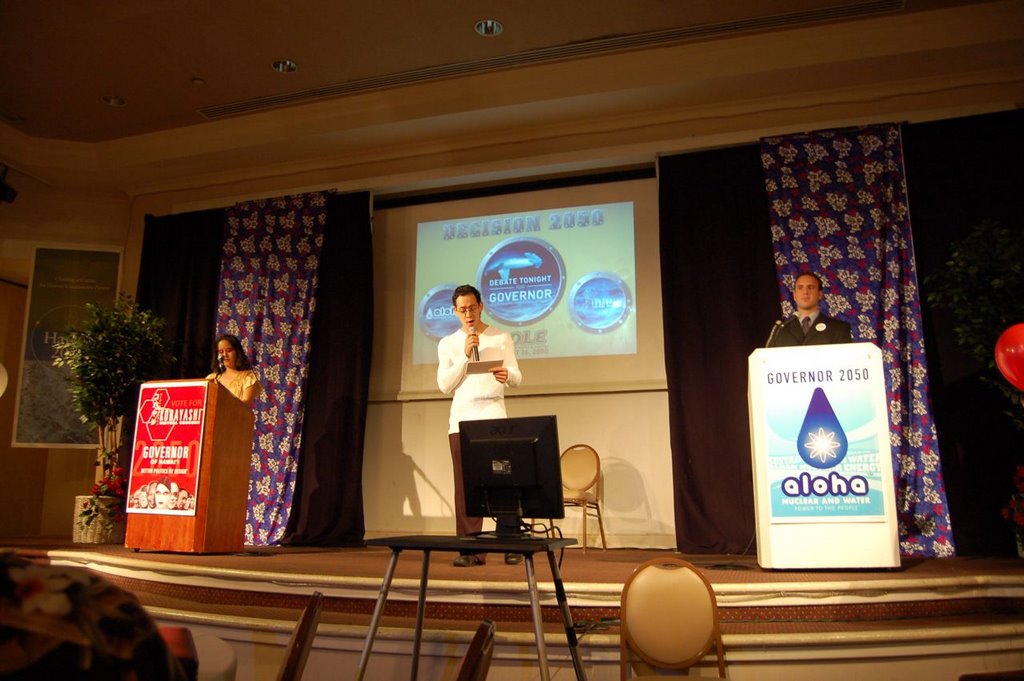
In one (code-named "Orange"), the islands had found a way to continue a growth trajectory, dramatised via an election in which candidates were not individuals but corporations.


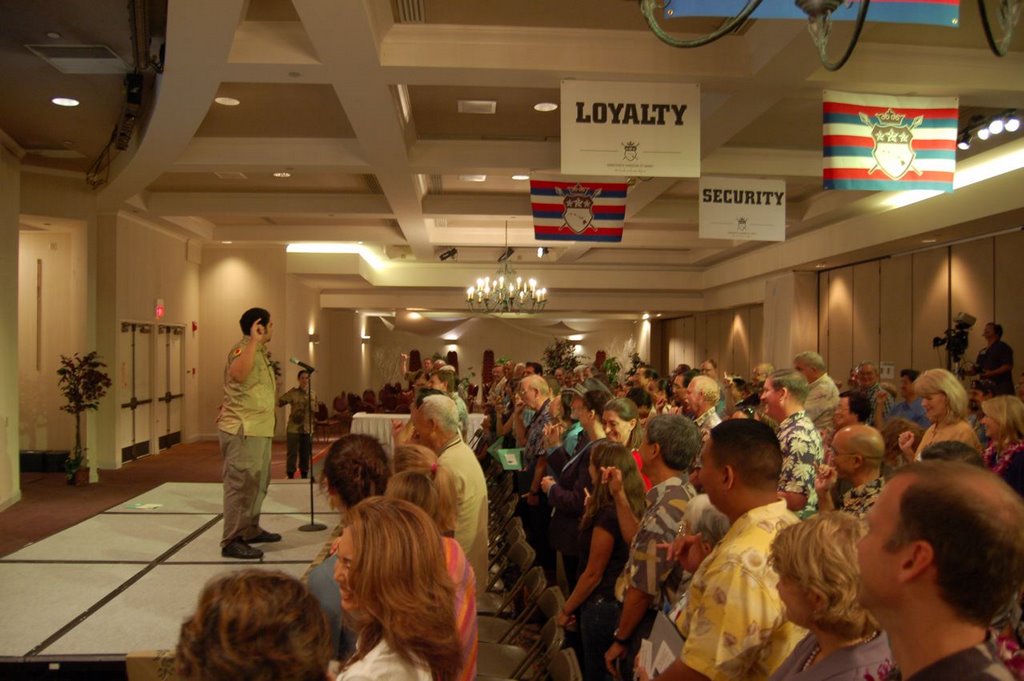
In the second ("Silver"), global economic meltdown had led to a tentative, militarised reassertion of the islands' independence from a presumably beleaguered U.S., the so-called "Democratic Kingdom of Hawaii".


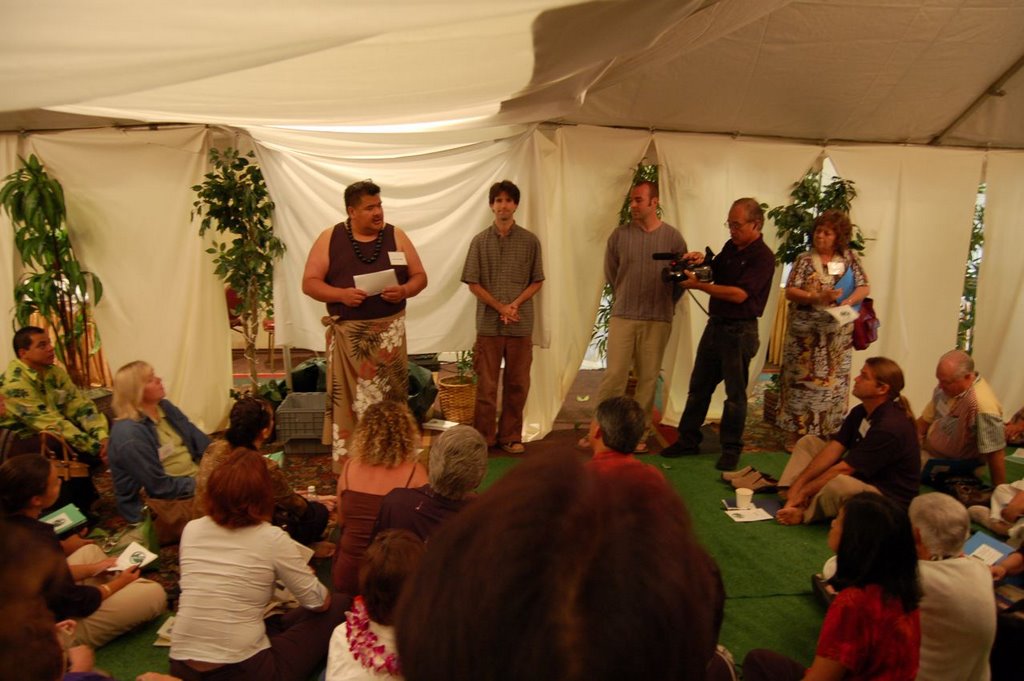
In future number three ("Maroon"), a concerted effort had been made to realign political and environmental priorities, though the adoption of Hawaii's pre-colonial, watershed-based ahupua'a governance structure, combined with "bright green" environmentally friendly technology.


The fourth experience ("Blue") was of a future where not only society but the very definition of humanity had transformed, with the World Council seeking to bring the Pacific Islands' underprivileged premods––regular, unaugmented people––up to par.


Our intention was to give people a chance not just to contemplate these potential realities as intellectual hypotheticals, but to visit physically and invest emotionally in them. Thus this set of brief yet provocative immersions, instantiating highly contrasting assumptions and theories of change, as a fast-track to higher quality, more richly imaginative mental models and civic conversations.

The original notion for this experiential approach to the Kickoff, which I'd proposed in hopes of avoiding the uninspiring albeit reliable standby workshop formats, was to expose people to the scenarios via a series of tangible artifacts physically set out on parallel (or rather, diverging) timelines. Following that approach would have meant creating a sort of popup museum of alternative future histories, or a real-life gallery counterpart to Wired magazine's back-page feature Found: Artifacts from the Future, as I thought of it at the time (this was before design fiction). But we soon realised that the interest of maximising narrative engagement and comprehension, as well as the sheer practicalities of moving hundreds of bodies through multiple rooms on a tight schedule, militated for scenarios unfolding over time, as performances, with built-in roleplaying opportunities for attendees.

A retrofitted shorthand for this difference in approaches:


(For more on this, see our recent article Designing an Experiential Scenario: The People Who Vanished.)

The "Hawaii 2050" scenario rooms were therefore immersive and experiential not only literally, with participants surrounded by performers and designed media (set dressing, props, soundscapes, etc), but also narratively, with each room devised as a coherent scene that would place attendees in medias res, and invite in them a sense of being transported in time. We aimed to ensure that people would not only witness these futures first hand, but interact with and within them: hence, four situations from alternative futures: a pre-election speech night; a naturalisation ceremony for climate change refugees; a government-mandated sustainability class; and an information session at a posthuman wellbeing facility.

None were supposed to feel like tendentious "best" or "worst" outcomes. Instead we wanted to offer qualitatively differentiated stories, in the classic Manoa School mould. To mirror some of the complexity of real history, we hoped people would find both good and bad things in each world they visited; genuinely "alternative futures" as opposed to mildly different flavours of the same idea, as scenario generation processes sometimes yield. Building on this divergent futuring tradition, we reasoned that more vivid and sensorily engaging food for thought could help support wiser decision making in the aggregate.

Below is a two-minute video of the fourth room described above, the high-tech transformation scenario. (Please forgive the low resolution, and note that on the day these ran for 20-30 minutes, so these edits convey only a fraction of the experience.)


(All four videos can be found here.)


Following a year of meetings with state legislators and public administration collaborators; after weeks of intensive work and long days that summer, of Jake and I making thousands of directorial decisions large and small, of generating dozens of artifact concepts and iterating their execution with our astoundingly resilient graphic design helpers, of writing and rewriting scripts and workshopping them with actors, of eking out our shoestring budget to make every room as fully realised and detailed as possible, of criss-crossing the island doing everything from taking venue measurements to sourcing fabrics for future military outfits: somehow, impossibly, the futures arrived at last.

And on that Saturday morning ten years ago, as the time for the first round of experiences approached, taking place in four rooms simultaneously, I have a memory of walking through the ballroom lobby in a daze, emotionally addled, exhilarated, exhausted, halfway between tears and laughter.

For us this was the mother of all proofs of concept. It was of course bound to be a big deal, in our minds, if for no other reason than the amount of work involved, and the responsibility of delivering all we had promised––without a clear precedent that we knew of––to state senators and other community leaders, not to mention our colleagues and collaborators.

The fruits of our collective labour soon began to emerge. One participant was so disturbed by the cynical appropriation of Hawaiian culture depicted in the post-collapse room that he started breaking the scene to argue about it. We could not have been more delighted: real feelings about our hypothetical narrative! The four experiences elicited various responses from laughter to discomfort, bemusement, and also genuine passion.

The post-immersion dialogue in all rooms was unusually energetic. The exchange of values, hopes, concerns, ideas, and intentions was meaningful and earnest. The verdict was in: our first trial of what we soon came to call experiential futures had worked.


The project didn't immediately generate a lot of media attention, and this was all a couple of years before social media took off –– although our guest Jamais Cascio from Institute for the Future did a great write-up. And, in years afterward, the event has cropped up here and there in design literature, for instance in Parsons/ex-RCA professors Tony Dunne and Fiona Raby's Speculative Everything, and more recently in Umeå University prof Håkan Gulliksson's Pervasive Design For Sustainability.

But what about the impact on the islands themselves? In case it had not been clear from reactions plainly visible on the day, some 94% of respondents to a Kickoff exit survey indicated that the experiences had impacted their thinking and desire to take action accordingly (see The Futures of Everyday Life p. 105 for details). But for reasons reaching well past the scope of our modest involvement –– Hawaii 2050 was a big undertaking, not confined to the futures-oriented kickoff events described here –– both the immediate political outcomes of the Kickoff and the "Sustainability Plan" published in 02008 were, in my view, underwhelming (see earlier account in TFOEL pp. 8-13).

I moved away a few years later, and others are better placed to gauge how the influences of "2050" and our part in it, if any, have played out since. Although I did take heart from the news, reported one year ago, nine years to the day after the event, that Hawaii's governor was committing to dump fossil fuels for 100% renewables by 02045.

In any case the significance of this project –– or rather, the story I am trying to tell here –– is personal.

Looking back after a decade, "Hawaii 2050" was a point of departure, breaking our futures work open to a much wider world of collaborations, creative possibilities, media and settings.

Jake and I had always meant for it to enjoy an active afterlife; many of the individual artifacts we had designed were soon repurposed for the first guerrilla futures interventions in our (ongoing, periodically) transmedia public art collaboration FoundFutures. We went on to explore and map experiential futures practice as fully as we could, systematically experimenting in as many contexts and media as possible: in the streets of Honolulu's Chinatown and at the University of Oxford, at South by Southwest, and California Academy of Sciences. We did projects in magazines, mailouts, games both online and offline, and short videos; projects for festivals, galleries, universities, national governments and the United Nations; commercial clients and random members of the public. On the academic front, I wrote my dissertation on the topic, and we've also developed Experiential Futures methods in classrooms all over the place, which is a story for another time, although there's a glimpse of it in this recent piece for The Economist's World in 2016.

Today I find myself regularly thinking of, and occasionally borrowing from, ideas tucked into the details of the scenarios, or elements from among the dozens of costumes, badges, posters and other items produced for "2050". Situation Lab's first Futurematic design jam with The Extrapolation Factory, which filled a vending machine with future artifacts made in one day in 02014, was a benign conceptual cannibalisation of the vending machine full of future artifacts which had sat largely unnoticed in the corner of the Blue room ("InstaSleep" pills - eight hours in eight minutes; "Inhale" - health enhancing cigarettes featuring anti-cancer nanoclouds; "Ahoy" - enhanced chocolate bars for replenishing essential vitamins lost during space travel).

Having spent my undergraduate years training in mostly hyper-intellectual and unimaginative ways of thought, in class at least, I never really had a way to relate to art as something I could do. I spent a year trying (and failing) to make a documentary on my own dime, in the former Yugoslavia, and then another half year starting a business (also failing) in Canada. But it was in that first year in Hawaii, collaborating with my dear friend Jake Dunagan, that this project helped to unlock a door that has only continued to open wider.

I still have a box full of these future artifacts, and packing them up to move house last week stirred a lot of recollections.

See, when you make stories, images, artifacts, interactions and experiences from the future for a living, they are constantly circling back to play with you.

In this work, we are not just creating experiences, or even memories.

We are designing ghosts.

Experiential futures is about the design of ghosts of a special sort –– not the remainders of things dead, but the advance traces of things waiting to be born. Ghosts of what is yet to come. Ghosts of the possible.

I have come to suspect this is one of the primary purposes of art. We create it to haunt ourselves. When it stays with us, that is how we know it is working.

***


Above: Jim Dator speaking at the "Hawaii 2050" kickoff on August 26, 02006

Here are the original scenarios for 02050 written by Dator, Dunagan and me, on which the four futures rooms were based.

For a fuller look at the development of experiential futures practice, see this peer-reviewed article that Dunagan and I recently published about our project The People Who Vanished.

All the photos in this post were taken by Cyrus Camp; most have not been seen until now.

Finally, I want to register my appreciation again to everyone involved in bringing futures to life at "Hawaii 2050". Ten years later your contributions continue to haunt me, for which I am most grateful.

Related:
> Immersive Futures for Hawaii 2050
> Experiential scenarios on video
> The Futures of Everyday Life
> A film from the future
> Build your own Time Machine
> History of experiential futures

Tuesday, August 12, 2008

Don't "save it for 2050"

Following the collapse of U.S. Senator Hillary Clinton's bid for the Democratic party's presidential nomination -- don't forget folks, you heard it here first -- last night The Atlantic published online an article from its September issue describing how it went down, replete with extracts from strategic memos and bitchy emails between her support staff.

It's not remarkable so much for the candid glimpse of Machiavellian scheming that we all know perennially animates -- and sometimes undermines, as in this case -- political endeavour, as it is for demonstrating how investigative journalism, as an example of the flow of information more broadly, has recently transformed. Astonishing how quickly this piece was put together, with the era of electronic communications enabling a rapid campaign post-mortem from materials that once could have taken years to assemble.

I was intrigued by one item in particular; the March 02007 memo (here in full) by Clinton's former chief strategist Mark Penn, which has been highlighted in the last day or two (NY Times, Washington Post, CNN, Politico, and more) for recommending that the Clinton campaign portray Democratic rival Barack Obama as un-American:

All of these articles about his boyhood in Indonesia and his life in Hawaii are geared towards showing his background is diverse, multicultural and putting that in a new light.

Save it for 2050.

It also exposes a very strong weakness for him—his roots to basic American values and culture are at best limited. I cannot imagine America electing a president during a time of war who is not at his center fundamentally American in his thinking and in his values.

~Mark Penn, quoted in Joshua Green, "The Front-Runner's Fall", The Atlantic, September 02008.

Race, in this still stubbornly divided country, has inevitably emerged as a key issue in the current election. Penn's is a strategic comment -- he's speaking to what he believes will fly with American voters, as opposed to expressing his own preferences -- about the undesirability of claims to multicultural connection, in contrast to good old "fundamentally American" thinking and values. Whatever those are.

While others can say more profound things than I about the politics of identity in this presidential, er, race, I'm intrigued by the words "Save it for 2050". A member at MyDD, a group blog on progressive politics in the U.S. ("DD" stands for "direct democracy"), comments, "Its meaning is very clear, very clear", and provides links to several sources highlighting the demographic changes forecast over the next half-century (e.g., Angela D. Johnson, "In 2050, Half of U.S. Will Be People of Color", DiversityInc, 11 October 02006).

Penn knows which way the wind is blowing. A veteran pollster, public relations specialist and trendwatcher, in his 02007 book Microtrends: The Small Forces Behind Tomorrow's Big Changes, he says (pp. 63-64):

In the future, it seems, race will be less divisive than it was.
...
[A]part from needing our respect and support, interracial families of all sorts are owed our attention, because very quietly they are eroding the assumptions that have guided America's race-related policies, customs, and habits for decades.
...
One big theme of this book is that America is no longer a melting-pot -- that, rather, small groups are now defining themselves in sharper, starker distinction than ever before. To some degree, interracial families are an exception. For hundreds of years, this country had significant racial divisions, and now those divisions appear to be easing in some very significant ways. But at the same time, people can now express and choose their individuality not predetermined by race or creed or date of birth, but rather as an expression of their life experiences and beliefs. And Americans are learning how to be different and accept differences in new ways. Perhaps what makes interracial marriages such a good sign is that it shows how even old divisions can become unifying forces over time.

(He also notes, interestingly I think, that the first poll he ever made, at age 13, was on race relations [p. 61].)

Now, just to be up-front here, since this is a topic that's sensitive for many people (with good reason), my aim here is not to weigh in on the question of whether Mark Penn is racist or not. If that's your interest, please have at it. I just want to point out the tension between the race-indifferent future toward which he gestures in his book, and the dismissal of that same future in the cut and thrust of competition for the Democratic party's presidential nomination.

When he says "Save it for 2050", Penn is at once both acknowledging and dismissing the changes afoot in the United States. With his political realist hat on, he can simultaneously grant the intergenerational demographic shift towards a more complex idea of what "American" means, and assert its insufficiency to determine the Clinton-Obama contest in the latter's favour.

Well, so far he's been wrong on outcome, although sadly the tactic he recommended, namely playing on voters' past and present unease with difference, was not at all unusual.

Still, I'd like to see a political contest (or indeed, system) in which the anticipated shape of the country (or more broadly, polity) one or two or more generations hence was deemed essential to the success of the candidates.

This is not that contest, and the United States in 02008 is not that country. But we don't need Mark Penn to tell us that it will not always be thus: things are changing.

Let's not wait for 02050 to blow the meaning of "American" open: it is happening, and should happen, now.

The very best of luck to you, Senator Obama.

Update (13/08/08): CNN reports this evening on the latest evidence of demographic shift in America:

By 2050, minorities will be the majority in America, and the number of residents older than 65 will more than double, according to projections released Thursday by the U.S. Census Bureau.
...
Minority children are projected to reach that milestone even sooner. By 2023 [i.e., fifteen years from now], the bureau said, more than half of all children will be minorities.
...
Obviously, the projections will have "very strong policy implications," [Dave Waddington, chief of the Census Bureau's population projection branch] said -- medical care for an increasingly elderly population, for instance, educational needs for increasing numbers of minority children and economic effects for the labor force."

Tuesday, July 08, 2008

Wanted: 25,000 miles of crime scene tape


Wanted poster, International Criminal Court: Future Generations Division
FoundFutures artifact produced for "Hawaii 2050" kickoff (Silver Room)
Layout and logo by Steve Kiyabu,
August 02006

Distinguished climate scientist James Hansen has called for the chief executives of fossil fuel companies to be tried for high crimes against humanity and nature.

Hansen appeared before U.S. Congress on 23 June 02008, the 20th anniversary of his historic speech in the same forum expressing 99% certainty on evidence of the greenhouse gas effect. This time, he urged swift and far-reaching action by the next American president and Congress to bring the level of CO2 in the atmosphere down from the current 385 parts per million (and rising 2ppm annually) to 350ppm.

The Real News Network, an emerging user-funded news and documentary service I hadn't heard of before, released this report:


In an interview with The Guardian newspaper, Hansen added: "When you are in that kind of position, as the CEO of one the [sic] primary players who have been putting out misinformation even via organisations that affect what gets into school textbooks, then I think that's a crime." (Ed Pilkington, "Put oil firm chiefs on trial, says leading climate change scientist", The Guardian, 23 June 02008 [print edition: "Sue fuel firm CEOs, urges climate change pioneer", p. 10]. A written statement by Hansen to accompany the speech is available at the Huffington Post and The Guardian.)

This is a bold call to arms on Hansen's part. Leaving aside whether or not you agree with it (which is bound to depend on how bought in you are on the risks associated with climate change), let's note a couple of points.

First, naturally he has been greeted with a mixed reception, variously pleased or disgusted with his sentiments. No surprise there. What does surprise me is that it appears to have been left mainly to the blogosphere to respond. As I write, more than two weeks after the event, a google search ["James Hansen" crimes] returns the Guardian piece (top hit) and a Telegraph article, both quality British newspapers, in the top ten. The top 100 hits, all relating to this story, are dominated by blogs, environmentally or politically themed sites, and news aggregators. American newspapers are barely represented -- exceptions being a critical editorial in the Washington Times, a Washington Post blog post on the story, and a NY Times blog addressing the speech and the coal industry's retort. To some extent, this reflects the shift afoot in how news breaks and circulates, away from traditional newspapers: witness this recently adjudicated Long Bet. Still, I find this curious -- it sounds like silence, from mainstream U.S. media -- given the prominence of both the audience (the House Select Committee On Energy Independence And Global Warming) and the speaker (among other things, he heads the NASA Goddard Institute for Space Studies in New York City, and serves as Al Gore's science advisor).

Second, the idea of trying corporate CEOs for serious crimes, regardless of whether we like it or not, is an intriguing meme. For the state legislature's Hawaii 2050 kickoff, we at HRCFS staged four immersive scenarios to get attendees thinking more deeply about the variety of alternative futures which could eventuate over that period. One of them, the Silver Room (a "collapse" scenario, in contrast to continuation, discipline, and transformation scenarios) posited an energy crisis, followed by the military taking over to ration resources and maintain order [video]. The poster above was one decor item we installed as a clue to the mentality of this post-collapse society: in the wake of a crisis, prosperity is rewritten as prologue to disaster. Let the blame games begin!

Meanwhile, punitive responses to corporate behaviour are already sought in some circles. I came across this picture today at the Rainforest Action Network, documenting an activist intervention in Washington D.C. last November to highlight the notion of global warming as a crime scene.


So, Hansen's call is provocative, there is no doubt about that. But it's an idea that is unlikely to go away, I think, due to broad trends around (a) increasing comprehension of the way systemic risks and harms are distributed across space and time, and (b) increasing focus on corporate social responsibility.

We may not get a "Future Generations Division" of the International Criminal Court (as suggested by our poster) just yet, but people do seem to be awakening to the incremental, emergent consequences of habitual behaviours -- like smoking tobacco, which has recently been outlawed in many public buildings in Europe, North America and Australia. (There's an interesting analogy between tobacco and fossil fuel industries. Hansen: "Instead of moving heavily into renewable energies, fossil companies choose to spread doubt about global warming, as tobacco companies discredited the smoking-cancer link.") If the worst happens, and some of the more dire forecasts of climate change materialise, the environmental, economic, humanitarian and security consequences (distributed harms par excellence) could well see corporations, and their main representatives, called to account in ways that apparently seem ridiculous to many at the moment.

Monday, October 01, 2007

Waikiki, Waterworld

It is just over one year ago that the kickoff was held for the Hawaii state legislature's effort to engage people in an evaluation of its ecological, economic and social sustainability. Last weekend, on 22 September, the "Hawaii 2050" draft plan was unveiled -- in no less aupicious a setting than Hilton Hawaiian Village resort's opulent Coral Ballroom.


The image shown above comes not from that occasion (which consisted largely of a procession of well-meaning pep talks) but from a Honolulu Star-Bulletin article on climate change, titled "The drowning of Hawaii", which appeared -- whether by coincidence or design, I don't know -- the day after the "2050" show. It's a map of Hawaii's iconic tourist magnet, Waikiki beach, projected 100 years hence, with 39 inches (one metre for non-imperialists) of sea level rise added by researchers at UH-Manoa's School of Ocean and Earth Science and Technology. I've added in the location of the "2050" venue on the map, which you can click to enlarge. Here, the Hilton's lavish conference centre becomes an island.

For comparison, Waikiki today looks like this (captured from Google Maps):


Now, I don't recommend taking simple extrapolations at face value. Doing so is assuredly one of the deadly sins of futures thinking; and the warmer, wetter Waikiki assumes no preventive or mitigatory measures (such as sandbagging, levee construction, or strategic retreat from an advancing coastline) which we might reasonably expect to crop up over a century of slowly rising seas. That is, supposing the scientists' projected sea level rise were to prove entirely accurate, even then, their visual forecast would not be correct. However, the correctness of the image is not its point here. Rather, it's a heuristic device for bringing attention to a risky situation, a changing circumstance, that needs to be thought about and managed. It could also have been a relevant topic to address before an audience of almost 1000 citizens (who were sufficiently concerned to spend $20.50 a head and a Saturday morning) attending a public meeting officially culminating an 18-month long consultation about the long-term challenges facing the Hawaiian islands.

This species of Inconvenient Truth-like climate change visualisation is an increasingly familiar -- yet, we may hope, no less sobering for that -- harbinger of the sort of major change which we may well face in the coming decades. But to the futures-minded observer, it is also the type of discomfiting possibility the discussion of which was conspicuously absent from the event.

/To be continued.../

Thursday, March 08, 2007

Experiential scenarios on video

These four short video clips are from the experiential scenarios designed and staged by HRCFS staff for the Hawaii 2050 kickoff on 26 August 02006. Each one is about two minutes long.


"Orange" Hawaii in 2050 is a result of continued economic growth.


The "Silver" alternative suggests possible conditions in 2050 some years after a socio-economic collapse.


The "Maroon" future exemplifies a disciplined or self-restrained society.


"Blue" depicts a society that has undergone a high-tech transformation.

Each of these clips is pared down from experiences lasting about 20 minutes, that ran concurrently in four rooms at the Dole Ballrooms in Honolulu. The 530-or-so attendees were split up and given no clues as to what kind of future they would be entering, but facilitated discussions were held afterwards to draw out people's views about the possible, probable and preferable elements of each scenario.

Some technical challenges delayed their release until now, but at HRCFS it's our hope that these clips can serve as conversation fodder in the futures community, encouraging further improvement in the emerging practice of experiential scenarios (and "immersive futures" more broadly). Feedback from participants at the August kickoff was overwhelmingly positive and has encouraged us to continue developing other ways to communicate and provoke the consideration of alternative futures... I'd be interested to hear from anyone who has undertaken, or knows about, comparable efforts.

(A longer version of this article has been posted at the Hawaii Futures blog.)

Update 4may2011: The link to the Hawaii Futures blog may be dead, but the Internet Archive's Wayback Machine comes to the rescue.
Update 12march2012: Video re-embedded with original aspect ratio.

Tuesday, August 29, 2006

"Hawaii 2050" kicks off

Last Saturday, 26 August saw the kickoff event for the state's futures-oriented public discussion process, "Hawaii 2050", at the Dole Ballrooms, Honolulu. About 530 participants from across the islands were in attendance. I am still recovering from the monster effort involved in staging four "futures rooms", which allowed participants to experience, about 130 at a time, two of the four scenes (from among countless possible futures), as a catalyst to further discussion about the possible, probable, and preferable paths that change could take in Hawaii between now and 02050. See this earlier post for more background. In each case, a colour name was attributed for logistical reasons (to put on people's nametags and room signage), not to imply anything about the contents of the scenarios, which were kept secret from participants until they stepped in the door. The photos below, taken by HRCFS graduate student Cyrus Camp, provide a little of the flavour of each.

In the "Orange" version of Hawaii circa 02050, two corporations -- "Aloha Nuclear and Water", and "Kobayashi Virtual Concern", vie for the Hawaiian Governorship in a political debate staged at the Dole Underwater Hotel and Casino.

For "Maroon" Hawaii, participants are cast as attendees at a compulsory -- like jury duty -- civic education program, in the Honolulu ahupua'a. At this "introductory session", presentations are made about the abundant and versatile hemp crop grown in this future Hawaii, and about the role of do-it-yourself biofuel in a renewable energy portfolio.

In the "Silver" scenario, a post-"peak oil" global economic collapse has led to the rise of a military-run society, overlaid with a puppet Hawaiian monarchy. Participants entering this scene are cast as refugees from smaller Pacific islands disappearing under rising oceans, and inducted as citizens and subjects of the so-called Democratic Kingdom of Hawai'i.

"Blue" Hawaii posits a sort of technological Singularity, after which the meaning and status of ordinary humanity is transformed. Here participants are a group of "premods" (PSEs -- persons sans enhancements; homo ludditis; naturals) being addressed by staff at MBED, the "Mind Body Enhancement Depot". They are offered a free technological upgrade paid for by the World Council in order to raise the GHI, or Global Happiness Index.

Now, none of these was intended to be taken as either advocating or predicting a particular path; the aim was instead to promote a broadened sense of what the possibilities could be. From that perspective, this part of the event seems to have succeeded. People were highly engaged by the exercise, and responded energetically and thoughtfully to the ideas presented therein.

This article from Sunday's Honolulu Advertiser says some more about Saturday's program, and this piece by futurist Jamais Cascio (our guest presenter at last week's futures salon) provides a highly thoughtful response to the whole "Hawaii 2050" effort, as well as the Immersive Futures themselves. Details of the scenarios can be found here. All feedback on any aspect of this event, or the broader endeavour of which it is part, would be most welcome.

I will be out of action for the next few days, attending Burning Man for the first time, in Nevada, but there will be more on "Hawaii 2050" -- as well as Burning Man -- in postings to come. Thanks to all those who volunteered their time both in the leadup and on the day to make this event possible, but mahalo especially to my futures colleagues Jim Dator and Jake Dunagan for being absolutely terrific to work with on this ambitious experiment in making futures thinking more real.

Related posts:
> Immersive futures for Hawaii 2050
Experiential scenarios on video
The Futures of Everyday Life
> A history of experiential futures
> The Bird Cage

Friday, August 25, 2006

Honolulu Futures Salon: Jamais Cascio

This evening, HRCFS ran its sixth Futures Salon, hosted by Jackie Ward at the fabulous Ward's Rafters in Honolulu, with guest Jamais Cascio. Jamais, a futurist and scenario specialist based in the San Francisco Bay Area, presented and went on to lead a great discussion about the historical development of the scenario methodology in futures, the current state of play, and emerging varieties of immersive scenarios, including "artifacts from the future". Their crucial role in improving futures thinking, he suggested, lay in offering "provocation and evocation": encouraging us to think more deeply and creatively about our options. Rather than trying to predict the most likely future, they instead (at their best) describe plausible, compelling, internally coherent visions of, and stories leading from the present into, potential future worlds in which we could find ourselves. He offered some excellent insights into the "democratisation of futures", which is what he sees as the gradual supplanting (or supplementing) of broadcast-model "genius forecasting" with collaborative exploration.

An interesting method Jamais used to illustrate the useful application of this collaborative approach was a "futures mash-up", in which we each wrote down, on separate post-it notes, a trio of the next decade's possible trends, or events in the social, environmental, economic, political -- and yes, technological -- realms, then partnered with another participant to brainstorm on a fourth piece of paper some interesting possible consequences of matching any random pair. The future, he pointed out, is both exhilarating and frightening to consider, but, like the exercise, is best seen as a synthesis -- the result of what we do together.

All this is, not coincidentally, highly relevant to the "Hawaii 2050" kickoff happening in Honolulu on Saturday 26 August, where HRCFS is staging four alternative immersive futures, reflecting divergent possible paths for change in Hawaii, out to the year 02050, for participants to use as a basis for more meaningful discussion about decisions in the present day. At this event, Jamais (together with 500 of our closest friends) will have an opportunity to witness a Hawaiian take on the cutting edge of immersive future scenarios, as a provocation aimed at improving our collective futures conversation. More on this to come, but for now, mahalo nui loa to Jamais for joining us in Hawaii to share his ideas.

Wednesday, August 09, 2006

Immersive futures for "Hawaii 2050"

My opportunities to post to The Sceptical Futuryst have lately become few and far between, in the labour-intensive lead up to the "Hawaii 2050" event in Honolulu on August 26th. This day-long summit, initiated by a committee of the Hawaii State Legislature, the "Hawaii 2050 Sustainability Task Force", is to launch a public consultation process revolving around the question of how to make Hawaii sustainable; ecologically, socially, and economically. It is planned as a kickoff for a series of community discussions about what I and my futures colleagues describe as possible, probable and preferable futures for the islands, all of which should culminate in A Sustainability Plan for Hawaii. (Woody Allen: "If you want to make God laugh, tell him your plans." Couldn't resist.)

A recent article from the Honolulu Advertiser puts the event in context, and this response by an alumnus of the futures program highlights some of the challenges and limitations of using "sustainability" as a concept. My own views on sustainability lead me to wonder if an "alternative futures" frame isn't perhaps a better starting point for productive conversation around potentially massive social change than a straight-up "green" one. I have no quibble with the honourable intentions informing the language of sustainability, but for the most part it already has its ideological adherents and detractors, whereas a discussion of futures more broadly may be better able to transcend predefined political divisions, more accommodating of different perspectives.

Anyway, the Hawaii Research Center for Futures Studies is part of a University of Hawaii team that has been contracted by the Task Force to organise this event. Although there will be a dose of speech-giving and other ceremonial malarkey, the HRCFS team's role is to bring a futures twist to the discussion.

I don't want to give too much away at this point, as a degree of secrecy will help maximise the impact for those in attendance, but what we are contributing is the staging of four rooms -- Immersive Futures Workshops -- in which participants will get a taste of four radically different versions of Hawaii, nominally set in the year 02050. This project is, then, part of our Center's effort to concretise usefully and interestingly the various conceptions of the future that people might have, through the use of design thinking, artifacts from the future, and an experiential version of scenaric storytelling.

Our divergent "future scenes" have been elaborated using (HRCFS Director) Jim Dator's four generic images of the future -- each one being a different shape of change, based on different assumptions about how the historical process could play out. The four are continued growth, collapse, discipline, and transformation, and we're preparing spaces at the Dole Cannery Ballroom for actors and presenters to populate in what amounts to a kind of parallel theatrical presentation, where each group of summit participants is also cast in a future role when they walk through the door.

Stay tuned for more -- this promises to be very exciting!