Saturday, August 27, 2016

Ghosts of futures past

Experiential Futures turns ten.


It is exactly ten years and one day since an event that turns out to have been something of a milestone in the foresight work documented at this blog.

"Hawaii 2050" was an initiative of the state legislature to engage the public in addressing the islands' sustainability, over a commendably farsighted time horizon, nearly two generations out. At the time the project began, in late 02005, more than three decades had passed since the last comparable process. A big-picture re-examination of Hawaiian prospects was overdue.

At that time I was a graduate student in University of Hawaii's "Manoa School" of futures studies, founded and run by Professor Jim Dator, who had taught the first futures course in the United States in 01967, at Virginia Tech, and then became closely involved in "Hawaii 2000" in 01970-71. He was also founding director of the Hawaii Research Center for Futures Studies (HRCFS), an agency the state had established at the end of that process, and which it then engaged more than thirty years later for a 02050-oriented effort.

To help bring the fullest possible consideration of alternative futures to the "2050" Kickoff on Saturday 26 August 02006, staged at the charmingly shabby ballrooms in the former Dole pineapple cannery, my HRCFS colleague Jake Dunagan and I put 550 or so people into four rooms.

We had designed and staged these rooms, with the priceless involvement of two improv theatre troupes, as well as a gaggle of wonderful colleagues and friends orbiting the Futures Center, to embody alternative possible Hawaiis set in the year 02050; a quartet of radically different social, economic, and governance outcomes.

In one (code-named "Orange"), the islands had found a way to continue a growth trajectory, dramatised via an election in which candidates were not individuals but corporations.


In the second ("Silver"), global economic meltdown had led to a tentative, militarised reassertion of the islands' independence from a presumably beleaguered U.S., the so-called "Democratic Kingdom of Hawaii".


In future number three ("Maroon"), a concerted effort had been made to realign political and environmental priorities, though the adoption of Hawaii's pre-colonial, watershed-based ahupua'a governance structure, combined with "bright green" environmentally friendly technology.


The fourth experience ("Blue") was of a future where not only society but the very definition of humanity had transformed, with the World Council seeking to bring the Pacific Islands' underprivileged premods––regular, unaugmented people––up to par.


Our intention was to give people a chance not just to contemplate these potential realities as intellectual hypotheticals, but to visit physically and invest emotionally in them. Thus this set of brief yet provocative immersions, instantiating highly contrasting assumptions and theories of change, as a fast-track to higher quality, more richly imaginative mental models and civic conversations.

The original notion for this experiential approach to the Kickoff, which I'd proposed in hopes of avoiding the uninspiring albeit reliable standby workshop formats, was to expose people to the scenarios via a series of tangible artifacts physically set out on parallel (or rather, diverging) timelines. Following that approach would have meant creating a sort of popup museum of alternative future histories, or a real-life gallery counterpart to Wired magazine's back-page feature Found: Artifacts from the Future, as I thought of it at the time (this was before design fiction). But we soon realised that the interest of maximising narrative engagement and comprehension, as well as the sheer practicalities of moving hundreds of bodies through multiple rooms on a tight schedule, militated for scenarios unfolding over time, as performances, with built-in roleplaying opportunities for attendees.

A retrofitted shorthand for this difference in approaches:


(For more on this, see our recent article Designing an Experiential Scenario: The People Who Vanished.)

The "Hawaii 2050" scenario rooms were therefore immersive and experiential not only literally, with participants surrounded by performers and designed media (set dressing, props, soundscapes, etc), but also narratively, with each room devised as a coherent scene that would place attendees in medias res, and invite in them a sense of being transported in time. We aimed to ensure that people would not only witness these futures first hand, but interact with and within them: hence, four situations from alternative futures: a pre-election speech night; a naturalisation ceremony for climate change refugees; a government-mandated sustainability class; and an information session at a posthuman wellbeing facility.

None were supposed to feel like tendentious "best" or "worst" outcomes. Instead we wanted to offer qualitatively differentiated stories, in the classic Manoa School mould. To mirror some of the complexity of real history, we hoped people would find both good and bad things in each world they visited; genuinely "alternative futures" as opposed to mildly different flavours of the same idea, as scenario generation processes sometimes yield. Building on this divergent futuring tradition, we reasoned that more vivid and sensorily engaging food for thought could help support wiser decision making in the aggregate.

Below is a two-minute video of the fourth room described above, the high-tech transformation scenario. (Please forgive the low resolution, and note that on the day these ran for 20-30 minutes, so these edits convey only a fraction of the experience.)


(All four videos can be found here.)


Following a year of meetings with state legislators and public administration collaborators; after weeks of intensive work and long days that summer, of Jake and I making thousands of directorial decisions large and small, of generating dozens of artifact concepts and iterating their execution with our astoundingly resilient graphic design helpers, of writing and rewriting scripts and workshopping them with actors, of eking out our shoestring budget to make every room as fully realised and detailed as possible, of criss-crossing the island doing everything from taking venue measurements to sourcing fabrics for future military outfits: somehow, impossibly, the futures arrived at last.

And on that Saturday morning ten years ago, as the time for the first round of experiences approached, taking place in four rooms simultaneously, I have a memory of walking through the ballroom lobby in a daze, emotionally addled, exhilarated, exhausted, halfway between tears and laughter.

For us this was the mother of all proofs of concept. It was of course bound to be a big deal, in our minds, if for no other reason than the amount of work involved, and the responsibility of delivering all we had promised––without a clear precedent that we knew of––to state senators and other community leaders, not to mention our colleagues and collaborators.

The fruits of our collective labour soon began to emerge. One participant was so disturbed by the cynical appropriation of Hawaiian culture depicted in the post-collapse room that he started breaking the scene to argue about it. We could not have been more delighted: real feelings about our hypothetical narrative! The four experiences elicited various responses from laughter to discomfort, bemusement, and also genuine passion.

The post-immersion dialogue in all rooms was unusually energetic. The exchange of values, hopes, concerns, ideas, and intentions was meaningful and earnest. The verdict was in: our first trial of what we soon came to call experiential futures had worked.


The project didn't immediately generate a lot of media attention, and this was all a couple of years before social media took off –– although our guest Jamais Cascio from Institute for the Future did a great write-up. And, in years afterward, the event has cropped up here and there in design literature, for instance in Parsons/ex-RCA professors Tony Dunne and Fiona Raby's Speculative Everything, and more recently in Umeå University prof Håkan Gulliksson's Pervasive Design For Sustainability.

But what about the impact on the islands themselves? In case it had not been clear from reactions plainly visible on the day, some 94% of respondents to a Kickoff exit survey indicated that the experiences had impacted their thinking and desire to take action accordingly (see The Futures of Everyday Life p. 105 for details). But for reasons reaching well past the scope of our modest involvement –– Hawaii 2050 was a big undertaking, not confined to the futures-oriented kickoff events described here –– both the immediate political outcomes of the Kickoff and the "Sustainability Plan" published in 02008 were, in my view, underwhelming (see earlier account in TFOEL pp. 8-13).

I moved away a few years later, and others are better placed to gauge how the influences of "2050" and our part in it, if any, have played out since. Although I did take heart from the news, reported one year ago, nine years to the day after the event, that Hawaii's governor was committing to dump fossil fuels for 100% renewables by 02045.

In any case the significance of this project –– or rather, the story I am trying to tell here –– is personal.

Looking back after a decade, "Hawaii 2050" was a point of departure, breaking our futures work open to a much wider world of collaborations, creative possibilities, media and settings.

Jake and I had always meant for it to enjoy an active afterlife; many of the individual artifacts we had designed were soon repurposed for the first guerrilla futures interventions in our (ongoing, periodically) transmedia public art collaboration FoundFutures. We went on to explore and map experiential futures practice as fully as we could, systematically experimenting in as many contexts and media as possible: in the streets of Honolulu's Chinatown and at the University of Oxford, at South by Southwest, and California Academy of Sciences. We did projects in magazines, mailouts, games both online and offline, and short videos; projects for festivals, galleries, universities, national governments and the United Nations; commercial clients and random members of the public. On the academic front, I wrote my dissertation on the topic, and we've also developed Experiential Futures methods in classrooms all over the place, which is a story for another time, although there's a glimpse of it in this recent piece for The Economist's World in 2016.

Today I find myself regularly thinking of, and occasionally borrowing from, ideas tucked into the details of the scenarios, or elements from among the dozens of costumes, badges, posters and other items produced for "2050". Situation Lab's first Futurematic design jam with The Extrapolation Factory, which filled a vending machine with future artifacts made in one day in 02014, was a benign conceptual cannibalisation of the vending machine full of future artifacts which had sat largely unnoticed in the corner of the Blue room ("InstaSleep" pills - eight hours in eight minutes; "Inhale" - health enhancing cigarettes featuring anti-cancer nanoclouds; "Ahoy" - enhanced chocolate bars for replenishing essential vitamins lost during space travel).

Having spent my undergraduate years training in mostly hyper-intellectual and unimaginative ways of thought, in class at least, I never really had a way to relate to art as something I could do. I spent a year trying (and failing) to make a documentary on my own dime, in the former Yugoslavia, and then another half year starting a business (also failing) in Canada. But it was in that first year in Hawaii, collaborating with my dear friend Jake Dunagan, that this project helped to unlock a door that has only continued to open wider.

I still have a box full of these future artifacts, and packing them up to move house last week stirred a lot of recollections.

See, when you make stories, images, artifacts, interactions and experiences from the future for a living, they are constantly circling back to play with you.

In this work, we are not just creating experiences, or even memories.

We are designing ghosts.

Experiential futures is about the design of ghosts of a special sort –– not the remainders of things dead, but the advance traces of things waiting to be born. Ghosts of what is yet to come. Ghosts of the possible.

I have come to suspect this is one of the primary purposes of art. We create it to haunt ourselves. When it stays with us, that is how we know it is working.

***


Above: Jim Dator speaking at the "Hawaii 2050" kickoff on August 26, 02006

Here are the original scenarios for 02050 written by Dator, Dunagan and me, on which the four futures rooms were based.

For a fuller look at the development of experiential futures practice, see this peer-reviewed article that Dunagan and I recently published about our project The People Who Vanished.

All the photos in this post were taken by Cyrus Camp; most have not been seen until now.

Finally, I want to register my appreciation again to everyone involved in bringing futures to life at "Hawaii 2050". Ten years later your contributions continue to haunt me, for which I am most grateful.

Related:
> Immersive Futures for Hawaii 2050
> Experiential scenarios on video
> The Futures of Everyday Life
> A film from the future
> Build your own Time Machine
> History of experiential futures

Friday, August 19, 2016

Introduction to Experiential Futures in The Economist


This is a short article I published in The Economist's annual look at the year ahead, The World in 2016.

Part of a section called "Minds on the Future" included for the thirtieth edition of The World In, my contribution appears right between a piece by the chief economists of Google and IBM, Hal Varian and Martin Fleming, and another by Canadian science fiction novelist Margaret Atwood. That's good company for an introduction to Experiential Futures––in this case, outlined with reference to Time Machines developed with learners around the world, from Singapore to Mexico.

***

'Experiential Futures: Show and Tell'

Within a generation, those unable to afford time outside Toronto’s dense urban environment will resort to Nature Deficit Disorder Clinics, where they will get essential dietary supplements along with a virtual rainforest immersion and brain scan.‡

In Singapore, a popular museum exhibition will chart the startling social transformations over the previous few decades in romance, sex and marriage, including the introduction of state-subsidised love robots to maintain well-being across the population.

Mexico City will be subject to severe flooding, and a peer-to-peer emergency service called Operación 
Axolotl will emerge as citizens step up to meet each ­other’s basic needs.

By 2044, young people in North Carolina will face a critical choice at the age of 18: whether to let life’s slings and arrows take their natural course, or to accept the wonders of modern medical technology and become, in effect, immortal.

How can anyone possibly claim to predict all this, you may ask? Actually I’m not predicting that these things will happen—even though I witnessed them all first-hand.

As an experiential futurist my job is to create, and to help others create, transmedia situations where such possibilities can be thought, felt and used to make better decisions. In this practice, all media are fair game for bringing futures to life, from interactive performances to physical artifacts, from video to food: whatever enlivens a future scenario as a potential reality-in-waiting.

If Andy Clark, a cognitive scientist at the University of Edinburgh, is right, thought isn’t confined to the boundaries of our skulls. We think with our environments. The map or smartphone in your pocket is a deliberate extension of your thought processes.

We can design situations that help us understand possible futures by visiting them. How much more powerful this is than the white papers and slideshows that are the typical focus of future-gazing in boardrooms and at UN summits.

Driven by the irrepressible human urge to bring our inner worlds to life, the culture of public imagination is set to make a leap: in coming years we can expect to see more and more companies, governments, advocacy organisations and communities creating and sharing experiential futures. The sooner we learn to use and democratise collective imagination to dramatise our alternatives, the more powerful will be our capacity to shape change towards just and worthwhile ends.

***

The World in 2016 appears in print in 90 countries and was translated into more than 30 languages, with circulation of the English-language edition exceeding two million copies.

While approaching the tenth birthday of Experiential Futures, and half a decade after writing a doctoral dissertation on that topic, for this little description to reach such an audience feels like a valuable step towards public visibility and normalisation of a practice that I suspect is essential to the development of a collective cultural capacity for foresight.

Full text pdf is here.

‡ This Time Machine, created in the Foresight Studio at OCAD last year, eventually led to the NaturePod project for Interface Inc.

Related:
> Foresight is a right
> Build your own Time Machine
> Dissertation: The Futures of Everyday Life
NaturePod™
Dreaming together
> Journalism from the future

Tuesday, August 16, 2016

Always Tomorrow Now


Logo via MuseumNext / photo via The Rio Times.

***

I recently spent a month as an artist in residence at the newly opened Museu do Amanhã (Museum of Tomorrow) in Rio de Janeiro.

Housed in a spectacular building from Spanish neofuturistic architect Santiago Calatrava, the Museum attracted half a million visitors within six months of opening in December 02015.

As we'll see, this institution has a resonant rationale and an intriguing approach to what a museum can be.

It's an honour to have been selected earlier this year as the Museum's inaugural Fellow.

Back in 02011 I'd been invited to a gathering in Rio to help generate exhibition concepts, but couldn't make it. So it was a source of delight and curiosity to spend several weeks in situ this June and July, and learn all about how this noble experiment in engaging diverse publics in diverse futures has unfolded so far.

There's more to say in a later post about the project I did while in residence, hosted by the Museum's wonderfully energetic Laboratory team.

But today I want to share a conversation with Luiz Alberto Oliveira, a physicist with a PhD in cosmology, a former lecturer in the history and philosophy of science, and the Chief Curator of Museu do Amanhã.

The following is an edited transcript of a conversation we had in Rio on July 6th. I am grateful to the Museum for hosting me, and of course to Dr Oliveira for taking the time to speak.

***

Stuart Candy: What attracted you to this project?

Luiz Alberto Oliveira: It was daring. It had none of the usual boundaries or limitations, and it could have very important consequences for the practice or diffusion of science in Brazil.

We wanted to develop something from scratch, to discuss how a new kind of science museum could be devised.

We wanted to bring to the Museum of Tomorrow a different concept of time: the idea that in the present, you prepare, you make a different path to different possible futures. It’s not a river in the sense that you have one source and one end. You have, in fact, a delta of possibilities.

This is the main concept of the Museum, that tomorrow is not a date on the calendar, tomorrow is not a place where you will arrive. Tomorrow is a construction. Tomorrow is open to be built.

Image via MuseumNext.

SC: And how does the organisation of the Museum impart this concept to visitors?

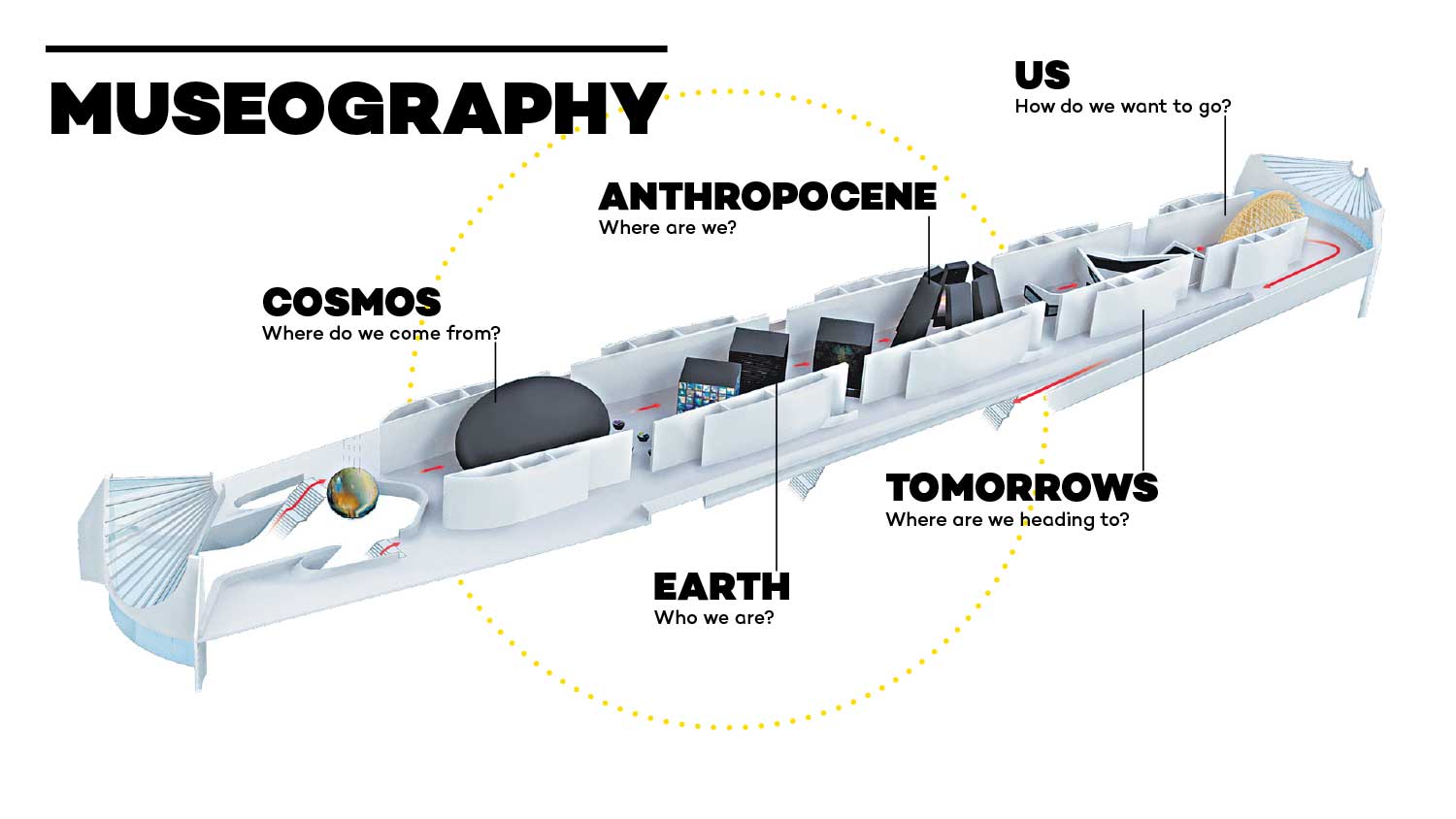
LAO: We settled on telling a story organised in five great areas. Why five? It is a dialogue with the architecture. Calatrava provides us with five roof undulations that roughly define the areas in which we set our museography.

So we came to the idea that the story should be made up of a sequence of great questions that mankind has always asked itself, so we could say in a very real sense that our content is questions.

Where do we come from?
Who are we?
Where are we?
Where are we heading?
How do we want to go; which values do we want to convey to the future?

This is the spinal column of the museum.

We use science content to illustrate these great questions, and the idea is that people come to realise that the future is not done, the future is in the making. It is in their hands, at least in part –– to collaborate in this future-building.

Image via MuseumNext.

SC: This idea of a museum that isn’t about the past but is about the future, about choice, about ethics, does it have any precedents or parallels elsewhere in the museum world?

LAO: As far as we know, no, it doesn’t.*

SC: You made a very deliberate choice in naming this institution, “The Museum of Tomorrow”. Can you speak to that?

LAO: In the common sense, the future is far away.

But tomorrow is always here. Somewhere, at this precise moment, the sun is rising in the east. All the time, it is tomorrow somewhere.

This idea that tomorrow is always inside every now was what convinced us that it’s a “museum of tomorrow”, not a “museum of the future”.

SC: A museum about things that haven’t happened yet faces certain challenges. What are those challenges from a curator’s standpoint?

LAO: We established some trends which will shape the future some decades ahead: what science tells us about the possible scenarios for the climate, the changing of biodiversity, the growth of the population, the number and complexity of cities.

From all these you can forecast some reasonable scenario. But what about the unexpected that this cannot and will not take into account?

We did not want to become a museum of prophecy. That was the greatest challenge, the greatest danger, because people would come here and say, “Well, you’re telling us that the future will be this.” That’s not what we want to do. We want you to understand that the present is this, and the future? Well, there are many. This is the point; the futures are plural.

SC: A museum of questions rather than a museum of answers.

LAO: Yes, yes, precisely.


Image via MuseumNext.

SC: When you talk about wanting to have a certain emotional impact on visitors, what’s the goal? 

LAO: You want to take people away from their everyday perspective so they can understand that the world in which we live is much more complex, varied, surprising, full of wonderment, than everyday life which uses you, trains you, and tames you to become a useful citizen, a working citizen.

We want to provide a sort of entertainment; entertaining in the sense that it distracts you from your usual ways of thinking. To have different ideas, different perspectives. They just cannot become indifferent! If they leave the museum just as they came into it, we have failed completely. But if they are disturbed, well, that’s okay.

SC: What about the Brazilian context, and Rio in particular? Are there any special challenges or affordances for this project?

LAO: First, perhaps the fact that we are a museum open to the future, but we are sitting in the very heart of Rio de Janeiro’s history. You can see all the landmarks of centuries around us. This heart of the city was abandoned for decades. So we are in a way a flagship of this new moment, of this new period of the city’s story.

I think the Cariocas, the people of Rio, understood that. They took possession of the renewed plaza, because you know, it’s theirs.

On the other hand, we have the very difficult condition of the country at the moment. The legitimate government was overthrown by a parliamentary coup, and a bunch of gangsters took power for themselves. So we are in a struggle for democracy itself, the very core of democracy, which is election.

But many people tell us that the museum is a counterpoint to this situation. This is something inspiring. We wanted to inspire people––but I did not know that it would be in this sense, that we became a symbol of a better future for the country.


Image via MuseumNext.

SC: The invitation to regard the future as shapable and as plural is a deeply political position.

LAO: Certainly. You cannot deal with conviviality, with living together, without politics. It’s impossible. So in fact, we are a political museum. We cannot say that as a slogan of the museum, because people would not understand in that sense. They would think that we are engaging in this or that political party, which is not our intention.

SC: I see vast potential not just in this institution, but in this category of institution, a kind of museum that is needed everywhere. There is a need for effective invitations to people, to draw out their vision for how things could be different.

LAO: I understand and I agree completely, because I think this is a path for renewing democracy itself.

* We'll revisit the question of the Museum of Tomorrow's conceptual cousins in posts to come.

Related:
> Dreaming together
Whose future is this?
The technology of public imagination

Tuesday, August 02, 2016

The People Who Vanished


Update 01aug17: The journal article excerpted below, 'Designing an Experiential Scenario', has been named a 02017 Most Significant Futures Work at the annual Association of Professional Futurists (APF) Awards, in the Advancing Methods and Practice category. We are grateful to the APF and jury for this honour.

***

The People Who Vanished is a transmedia narrative project dealing with the prehistory of the Phoenix area, staged at the inaugural Emerge Festival hosted by Arizona State University in March 02012. Jake Dunagan and I designed and led a two-day workshop in which we produced an experiential scenario with 20 festival participants.

Although we had been doing Design Fiction and Experiential Futures for five or six years already by that time, we were excited about the challenges of co-creatively involving a group this size, and especially of the compressed production timeline, both highlighting the need for a shared mental model and clear framework for collaboration.

What follows in this post is a written snapshot of that design process. It's an excerpt from an article we recently published in the peer-reviewed journal Futures.† (File under: better late than never.) The article, or this lightly edited bit reproduced below, can certainly be read alone, although for a sense of the originally intended effect watch this video first; the tale as revealed to a live audience at Emerge (18 min).


† S. Candy, J. Dunagan, Designing an experiential scenario: The People Who Vanished, Futures (2016), http://dx.doi.org/10.1016/j.futures.2016.05.006.

***

The name Phoenix invokes the bird of Greek myth which would periodically burn up and rise again from its own ashes. It is a striking but little known fact that the city was so named precisely because it was built atop the ruins of a lost civilisation.

Beneath the streets and sidewalks of today’s Phoenix of four million inhabitants lie the remnants of the Hohokam, a society which flourished from around 0CE to 1400CE; “from Christ to Columbus”.

The Hohokam were expert canal engineers and irrigation agriculturalists. They built a thriving civilization in the desert lasting almost one and a half millennia. They farmed the land and channeled water through massive canals without any of the modern tools and equipment we have today. However, about a century before the arrival of Europeans in North America, they suddenly disappeared, for reasons that are unknown, and that are still debated by archaeologists.

The name Hohokam is an O’odham word meaning “the people who vanished”. Being an oral culture, it is unknown what they called themselves.


A question which we hoped to evoke for participants at Emerge became: “could the people of today’s Phoenix be the next to vanish from the valley?”

In order to push the boundaries of experiential futures, to do justice to the scope of the historical (and future) questions at hand, and to create a unique and fun learning experience for our workshop participants, we were drawn to the idea of executing a project at a monumental scale. We wanted to create something big; something that demanded attention; something that would appear suddenly and without warning — and that could carry deep meaning for the attendees. In our practice we and others often create hypothetical “artifacts from the future”, but in this case thought it could be interesting to create a fictional artifact from the past, in order to enable a reperception of present and future.

Throughout history, there have been breakthrough moments when we humans have been forced to confront our own ignorance and reimagine our collective story about who we are and where we came from. The unearthing of dinosaur fossils revealed a strange and diverse lifeworld on Earth long before human existence, overturning earlier thinking about natural history. Similarly disruptive were cultural discoveries such as the Dead Sea Scrolls, the Rosetta Stone, the city of Pompeii, and ancient technologies such as the Antikythera machine. The rediscovery of ancient philosophy, architecture, or artifacts from time to time has not simply added to a trove of curiosities from the past; but has heralded revolutionary change in society’s self-understanding. The Renaissance, the Enlightenment, and other epochal transitions have been initiated or accelerated by such archaeological moments.

There are always bound to be, this line of thinking suggests, possibility grenades beneath our feet, primed to explode our fragile certainties and platitudes about the story of our world. As U.S. President Harry Truman once said, “The only thing new in the world is the history you don’t know.” 

What could this “new” and transformative –– if hypothetical –– slice of history be for Phoenix?

Examining the map pieced together by 20th century archaeologists of the extensive network of ancient canals spanning the area... yielded what turned out to be an essential insight: in addition to their obvious practical uses, the Hohokam canals could have had some previously unsuspected symbolic functions.

An idea emerged: towards the end of their tenure, the Hohokam may somehow have manifested a distinctive symbol in the archaeological record – one also appearing in the pre-collapse periods of other cultures. … Now we could recount the fortuitous “discovery” of a transcultural, transhistorical symbol of impending civilisational collapse. It would not be necessary (and in the circumstances would also not be desirable) to try to explain the precise means by which this harbinger of disappearance had cropped up around the world throughout history; the sheer “fact” of apparently concrete evidence of the mystery itself could provide the desired archaeological moment.


We would tell the following story: In puzzling out the fate of the Hohokam, our group had spotted this curious anomaly on the map, and had then been inspired by the thought of a symbolic, and not merely functional, role for the canals. One of our number then had the idea to do a google image search for this pattern and see what turned up (still true –– sort of). Shockingly, this search showed up a range of other instances of the same ‘glyph’ in diverse archaeological records elsewhere: the Harappan of the Indus Valley, the Anasazi, the Nazca, the Polynesian peoples of Rapa Nui, aka Easter Island. All this part was of course completely simulated; photoshopped into found photographs from these places. We would also be able to show how the glyph had turned up subtly but unmistakeably, inscribed in the patterns on Hohokam pottery too. And the kicker: the sole common characteristic discernible across all these disparate cultures, from wildly different eras and geographies, was that they had all disappeared. They were all collapsed civilisations.


***

Bruce Sterling in Wired: "When one walked outside the auditorium afterward, there was a huge mystic glyph installed on the side of a local mountain."


***

Project Credits:
- The People Who Vanished were: Carlo Altamirano, Michael Baran, Rachel Bowditch, Chris Danowski, Tyler Eglen, Erik Fisher, Paul Higgins, Gordon Knox, Oscar Lopez, Blakely McConnell, Julie Rada, Matt Ragan, Reed Riner, Joya Scott, D.A. Therrien, Trish Yasolsky and Bobby Zokaites
- Special thanks: David Abbott, Tain Barzo, Joel Garreau, Jerry Howard (Arizona Museum of Natural History), and Cynthia Selin

See also:
Aisling Kelliher and Daragh Byrne (Carnegie Mellon University) in Futures journal
Cynthia Selin (Arizona State University), one of the organisers, situating this work in Futures
- A trove of documentation (still images and timelapse video) from our workshop, via Carnegie Mellon
- Post about the Emerge exhibition featuring The People Who Vanished and other projects at ASU Art Museum
- A terrific design fiction video created by a group led by Near Future Laboratory's Julian Bleecker and Nick Foster in another workshop taking place at the same time


***

The paper excerpted above goes on to describe a framework that we devised during the workshop and have kept developing and using since as a conceptual model for scaffolding experiential scenarios and design fiction; the Experiential Futures Ladder. Implications for the foresight field of this multi-scalar mode of thought, as well as of the experiential turn more broadly (towards design, media, games and performance) are outlined.

The full text of the article in press, "Designing an Experiential Scenario", can be found in pdf here.

The journal permalink is here.

Related:
The Experiential Turn
> On the eve of Emerge
> Dreaming together
A History of Experiential Futures 2006-2031
> Experiential scenarios on video

Sunday, July 31, 2016

Toward a Preemptive Social Enterprise


Verynice is a social enterprise design firm based in Los Angeles, with the groundbreaking business model of giving away half their work for free. To date they have gifted over USD 5 million in design services to worthy causes.

Having worked at the cutting edge of social enterprise for almost a decade, the Founder and Managing Director of verynice, Matthew Manos, is releasing a book about what he believes the next generation of this work calls for from entrepreneurs.

I'm honoured to provide the Foreword for Toward a Preemptive Social Enterprise, which features a cast of contributors including futurist Jake Dunagan, designer Nathan Shedroff, and science fiction author Bruce Sterling.

The book's worldwide digital release is tomorrow, 1 August 02016, with hard copies available in mid-September.

***

FOREWORD to Toward a Preemptive Social Enterprise.


Business as a category of human activity has traditionally aimed to maximise certain outcomes at the expense of others. Other communities, other species, other places, and future generations.

Take the oil industry for example. Like the endlessly ingenious tools of the extractive trade themselves, profit-first business morphs to fit the contours of the lucrative niche. I locate a rich deposit, I work out access to it by hook or by crook, and voilà: I drink your milkshake. Other impacts are someone else’s problem.

Traditional business is a badly broken finite game.

Yet it is possible to flip the premise. Here is the quietly revolutionary but increasingly obvious alternative: morph the enterprise to generate desired impacts, and reverse engineer a business model to make it economically viable.

This change-making path is often called social enterprise, and the figure animating that change and beating that path is the social entrepreneur.

Social entrepreneurship comes from the overdue recognition that business is an engine of change –– nay, a powerhouse. More and more of us see that to harness its institutional potential to worthwhile ends could be hugely influential, generating outcomes as deliberate and positive as the outcomes generated by legacy means have been accidental and destructive.

As Matt Manos explains in these pages, "A social entrepreneur is a designer of business whose intentions are not in capital gain, but instead in the advancement of the greater good of society." The central formula is, then, approximately: business + design + ethics (greater good) = social enterprise.

When one surveys today's fast-changing "ecology of commerce", in Paul Hawken's resonant phrase, we find a wide range of creatures from different evolutionary eras living side by side. There seem to be many recent, small initiatives nobly attuned to the full spectrum of their impacts. Generally these are nimble little Darwinian upstarts, yet to prove their fitness over generations. Such hopeful mutants co-exist alongside others, bigger and older, but catching on to the emerging rules of the infinite game, and if nothing else keen to be thought of as doing the right thing. Alongside these in turn can be found still others – some of the biggest, most formidable, and lumbering beasts in the landscape –– that show zero indication of giving any shits at all about the greater good.

Thus we find ourselves in a strange transitional era for business.

Consider entrepreneur Tony Hsieh's recent memoir Delivering Happiness, which documents the heroic efforts at his company Zappos to establish a viable niche as a service-oriented online shoe retailer. This story elicits a paradoxical kind of wonder. On the one hand, we can admire the way the organisation has promoted passion, purpose, and positive experiences for those in its immediate orbit. On the other hand, we may be simultaneously baffled by a lack of attention to the happiness of the invisible yet essential legions of workers further up the supply chain; those who actually stitch and glue together the shoes at the heart of each all-smiling transaction.

This integration of ethics into business, then, the "sociality" of social enterprise, is patchy, with even some of the good guys having serious blindspots, To misquote William Gibson, social enterprise may already be here, but it's by no means evenly distributed.

Still, there is no mistaking the direction in which the global connectivity, transparency, and systemic awareness are pushing. Some people, reporting right from the cutting edge, are perfectly positioned to help the rest of us understand where social enterprise, and ultimately business in general, need to go. Matthew Manos is such a person.

"The entire premise of social enterprise relies on reaction," he writes. The default setup is "post-traumatic innovation", but waiting until something has gone wrong––treating disaster as the trigger for action––is irresponsible.

It turns out that thoughtfully engaged and ethically motivated business can still be stuck in the past, solving one set of problems while leaving others untouched, or even making them worse.

It is therefore the aim of the book you are reading to show that a crucial ingredient is missing from the social enterprise formula: foresight.

The next generation of social entrepreneur must be "preemptive", less problem-ameliorating and more visionary, attending not only to traumas in need of remedy, but also to opportunities of shaping positive change, based in coherent, plural perspectives on how the whole system could evolve.

Social entrepreneurs should also be futurists.

Now, this is a big idea, and dealing with big ideas is hazardous, especially when it comes to value shifts. The more basic, load-bearing, and "self-evident" the assumptions at issue, the more readily attempts to address them risk being dismissed as irrelevant (incompatible with current settings) or redundant (since, once absorbed, previously unfamiliar settings become normal again).

However, someone has to take on the big ideas, and in business, “normal” needs major renovations. So regardless of whether you already share its view, or disagree vehemently, you should read this book.

To be slightly pre-emptive myself for a moment, it may be that some readers find this argument for foresight to make a poor accompaniment to a fond belief that the market already and automatically incorporates whatever information about the future it needs to.

You are invited to consider that the invisible hand mediating market participants works only with information in the system, and since there are no future facts, the hand can contribute no more foresight than the parties themselves bring to the situation. If we want markets to take the future into account, the people in them need to do it.

Then again, there may be some entrepreneurs sceptical about the value of designated “foresight” tools, since they already are creating the future, thank you very much. This resembles claims I have heard from some designers I’ve met over the last ten years.

They are partly right, of course. But it is a truism to claim that business, or design, is creating the future. As Kenneth Boulding has pointed out, all decisions are about the future. Merely existing helps to create the future, and inactions can have an effect just as surely as actions do. Neither the claim nor the fact that one is already "shaping the future" puts that activity beyond the possibility of improvement.

The good news is that designers and entrepreneurs alike are perfectly positioned to use strategic foresight approaches, such as horizon scanning, scenario generation, and experiential futures; the inherent future-shaping properties of design and business make these valuable places to integrate such a futures literacy.

Part of what Manos and his collaborators seek to do in this book, very successfully I think, is show that entrepreneurs and designers must take it upon themselves to be more systematic, deliberate and detailed in articulating which futures are at issue; which scenarios their efforts mean to help avoid and, more importantly, which ones they intend to help realise.

Preemptive social enterprise, therefore, ties our initial recognition of institutional capacity ("business is a powerful category of actor") to the capacity for individual action ("what can I do?"), and turns a personal ethical problem ("how can I as an individual exert meaningful influence?") into a collective design invitation ("what can I start, or help to grow, that may have the outcomes I wish to see?").

But let’s be clear about the depth and reach of what is being suggested here. We are not talking about a one-time goal shift, but about the development and integration of a permanent and self-renewing orientation. Not merely a new direction, but a new way to navigate.

One way to appreciate the significance of the argument is to call to mind the generic taxonomy of "places to intervene in a system" offered by Limits to Growth lead author and pioneering systems thinker Donella Meadows. What Manos is inviting social entrepreneurs to do, in effect, is move some of their effort and attention upstream where greater influence can be had. He would not merely have us put business in service of different, even if more worthwhile, "goals of the system" (number two on Meadows's list). The case for preemptive social enterprise is directly affects "the mindset or paradigm" out of which the goals themselves arise. This is leverage point number one, which implicitly impacts goals, and everything else.

Why does this matter? The cultivation of a capacity for strategic foresight entails a rigorous, informed, creative, generative, and always updating view of the world's and of one's own possibilities. Integrating it represents a change with ongoing and ever-evolving implications for organisational and individual activity.

In earlier work, echoed and amplified here, Manos has set about addressing how entrepreneurship is done, carefully documenting all existing business models in order to work out where underexplored potential lies. So the perspective of this book is –– bear with me now –– meta-entrepreneurial. It is being entrepreneurial with regard to entrepreneurship itself; not only using existing tools to put the changemaking powerhouse of enterprise in service of "better goals", but seeking to make it self-improving. Retooling the toolkit.

As Stewart Brand, another important social innovator, and a futurist too, has pointed out: “Nobody can save the world, but any of us can help set in motion a self-saving world." Foresightful, anticipatory, or to use Manos's chosen word, preemptive social enterprise may well be a critical, organic ingredient of a self-saving world; more flexible and resilient, more apt to adjust and to learn.

Preemptive social enterprise is a bid for business to embrace an iterative, anticipatory learning function, and for this to face outwardly and inwardly at the same time: "The design of scenarios, and, most importantly, the design of ourselves within those scenarios allows for a deep understanding of our potential, preferred, probable, or plausible futures."

“The design of ourselves” seems an important phrase. What might this entail?

I suspect that the answer may rest in a central, and highly valuable idea explored in this book. If you wish to realise a changed world, it is important to invest in imagination.

Now, one reason why I think Matt Manos is so effective as a designer, as an entrepreneur, and as a person is that he doesn't take conventional dichotomies at face value. He does not, for example, seem to see invention as being somehow elevated over or opposed to the legwork of researching that which already exists. This attitude lets him do the due diligence of assembling a near-exhaustive catalogue of business models, as well as adding his own––not only in theory but in ever-iterating, ever-improving practice. Nor does he snap-to-grid with an assumption that many others seem to live by, that imagining and implementing are somehow opposites. Instead, he treats the two, rightly I think, as equal, necessary and complementary facets of the same changemaking work. This lets him try out more ideas in a single project than a lot of people could be proud to have initiated over a span of years.

Even the seemingly foundational opposites of fact and fiction, when it comes to navigating change towards preferred futures, are unhelpful signposts. For what is a dream that one means to manifest if not both fiction and fact at once? Or rather, fiction that aspires to fact, and thereby creates it?

So one of the conventional dichotomies that this work refuses, critically, is the putative "realism" of business vs the "indulgence" of imagination.

Again: Imagination is an investment.

Over the past decade, designers have turned to futures practice, and futurists to design, out of a mutual need to integrate speculative and material registers. A flowering of hybrid practices – experiential futures, design fiction, speculative design – has been the result. All sorts of tangible artifacts and immersive experiences that make futures more easily shareable, thinkable and feelable. A few years ago, fellow traveller Bruce Sterling proposed this definition of design fiction, “the deliberate use of diegetic prototypes to suspend disbelief about change”. However, as digital media professor Janet Murray has observed, "When we enter a fictional world, we do not merely 'suspend' a critical faculty; we also exercise a creative faculty. We do not suspend disbelief so much as we actively create belief." Similarly, interactive performance specialist Jeff Wirth points out that his artform "does not rely on the 'suspension of disbelief'", but rather "calls for an 'investment of belief.'"

After a decade of working at this intersection of design and futures, I think it may be time to retire our long-term loan of Samuel Taylor Coleridge’s wonderful but too-limited notion of "suspension of disbelief", in favour of this idea that we really invest belief in our imaginings, in order to see where they may take us. Suspension implies an interim state, with nothing much changing once the thing suspended is reinstated. But one invests with a view to a return.

Peter Lunenfeld's "return on vision" cited by Manos is right on point: we should invest in imagination, and seek our return in the new options and pathways that thereby become available.

Why so? People are extraordinarily plastic, and versatile, as testified by the massive (if lately endangered) diversity of human cultures built atop a more or less identical biological substrate. I've suggested this before, mashing up media ecologist Marshall McLuhan and sociologist-futurist Fred Polak: we shape our images of the future, and meanwhile they shape us.

Therefore, if design has given to business some tools with which to be more creative and intentional, and futures has offered business a vocabulary of long-range outcomes, then perhaps here we have a hint as to how business can return the favour to both. The framing and language of investment, unshackled from its bloodless, numerical bottom-line connotations, but retaining the impulse to clear-eyed evaluation of what one really values, and how much difference one’s actions are really making, could prove an important loan for designers and futurists alike.

This book calls for bringing futures and foresight work into the repertoire of the social innovator or entrepreneur. We have touched on why, and also also, broadly, how, by investing time and effort in experimental belief structures, the imagination of alternative worlds. If you're as pragmatic and results oriented as I hope you might be, then at this point you'll be itching for more concrete details. But WHAT does this mean, specifically, on Monday morning?

Good, good. Read on!

The ultimate test of these ideas does not consist in what they do for you on the page, but in your search for ways to take them on in your life. The truest and fullest response is one for you –– for all of us, a community –– to find in the doing, and share.

I know, and suspect you know too, that business is changing, and that it needs to change, dramatically so, in order at last to fit the contours of the infinite game that makes all of this possible.

I believe that if you follow along a little ways in the direction this book is pointing, towards the preemptive social enterprise, your practice may become more imaginative, your convictions more grounded, your perceptions more trenchant, your action more effective, and the world incrementally more just.

And I hope you will agree that it is well worth a try.


Stuart Candy
Museu do Amanhã, Rio de Janeiro, July 02016

***

Toward a Preemptive Social Enterprise is available in full on a Pay-What-You-Want basis via futureimpact.co.

The Foreword above can be found in pdf here.

Related:
> The act of imagination
> LEAP Dialogues: Impacting the Social
> Foresight is a right
> Design is a team sport
Strategic Foresight and the Design MBA

Monday, June 27, 2016

Impacting the Social


Images: Candy Chang, Before I Die, New Orleans, 02011.

***

Last month a remarkable book was published by Designmatters at ArtCenter College of Design –– LEAP Dialogues: Career Pathways in Design for Social Innovation.

In the preface, editor Mariana Amatullo states that the work is "a first-of-its kind resource" directly addressing "change[s] in how design is taught, practiced and integrated into organizations, why these changes are happening, what is needed to support these new practices, and how designers can pursue these new career pathways". With 84 contributors across many themes, it's an impressively wide-ranging, substantial, and I might add, beautifully designed volume.

I'm thrilled to have a piece in LEAP Dialogues in the form of a conversation with artist Candy Chang, moderated by designer Bryan Boyer, who is also one of the collection's co-editors.

Bryan Boyer's wonderful stuff has appeared here at The Sceptical Futuryst before; he has since spent years working on pathbreaking projects and approaches in strategic design (e.g., In Studio: Recipes for Systemic Change, 02011, pdf).

Candy Chang's work includes marvellous participatory public projects such as Before I Die and I Wish This Was, as well as contributions to the Hypothetical Development Organization, a collaboration with Rob Walker and others which I delightedly backed on Kickstarter years ago, and regularly feature in talks about guerrilla futures practice.

Our dialogue appears in the book under the title "Impacting the Social".

***

Bryan Boyer: You both do projects that are performed in the real world, in the city. Why is this important to you?

Stuart Candy: I work across settings and formats—museums, galleries, boardrooms, conferences, universities, city streets. Operating in diverse sites from project to project is more important to me than any one project by itself. To my mind, all contexts of deployment are “real world,” although each has its own affordances, limitations and publics. The same goes for different media—online game, workshop, installation, mailout, design jam, short film and so on. To riff off Marshall McLuhan, each medium is a different massage. These different contexts of encounter, and alternative ways of massaging those contexts, are not merely interchangeable aesthetic options but design parameters: how would you like to massage those you wish to engage?

Experiential futures practice is location and medium agnostic because it is more about enabling futures than using or advancing a particular mode of expression. Anything that you can cause to happen to, with and for someone is, in principle, fair game; the entirety of experience, the whole of the sensorium, is the canvas or design space. The term “experiential futures“ tries to convey this encompassing, transmedia idea of the range of options at our disposal. The corollary is that each intervention within the practice must be highly specific to topic, site, time, audience, etc.

What‘s interesting to me about urban settings is that they are less scripted. I find it important to be prepared to use unscripted places because most people, thoughts, decisions aren‘t necessarily happening where one has an invitation. When there is something that people should perhaps be considering, and they aren‘t aware of or able to enter the museum or workshop or boardroom or town hall where the conversation is officially convened, it can be useful to instead bring the conversation to them.

This is how our “guerrilla futures“ practice emerged. Formal, solicited projects often encounter roadblocks, and since you have to adapt to constraints in any project, it can be interesting to work with “found” challenges and opportunities instead.

Candy Chang: I’m interested in how places shape us. I studied urban planning and at the same time I made street art, which led me to think more deeply about public spaces. In a built environment where citizen’s flyers are illegal yet businesses can shout about their latest products on an increasing number of surfaces, we need to consider how public spaces can be better designed so that they’re not necessarily allocated to the highest bidder, but also reflect our needs as a community and as individuals. The places we share have a lot of potential to help us connect, reflect and make sense of our communities and our lives together. William Whyte’s The Social Life of Small Urban Spaces encouraged me to trust my real world experiences, and making street art gave me the moxie to just try things out and see what happens.

I’m an introvert, and the participatory public art projects start- ed out as a way to ask my neighbors things I was too shy to ask in person—or as a way for the quieter people to share just as much as the loud ones. Over time I realized these installa- tions had other benefits. They’re anonymous, so you can open up in ways you might not have otherwise. They allow people to easily participate on their own time. And they’re places where we can collectively reflect together. I think Stuart’s work does that well in his own way, and I admire his democratic approach to foresight work. I’ve been interested in creating safe spaces for honesty and vulnerability, and I like how Stuart is interested in making “safe spaces for dangerous conversations.”

SC: One doesn’t really get anywhere very interesting with futures until one starts to entertain possibilities that deeply challenge current ways of thinking. I’m invoking the spirit of philosopher Alfred North Whitehead here (“It is the business of the future to be dangerous”) as well as my mentor, Jim Dator (“Any useful statement about the future should at first appear to be ridiculous”). A company may be facing some change in the market that no one in it recognizes; a government may need help even to see, let alone respond to, unexpected shifts in the political landscape. In any case, the “dangerous conversation” confronts that which is uncomfortable and vulnerable, and therefore marginalized, but potentially transformative. Likewise for other kinds of community, and for individuals. Creating a safe space for that means first of all finding ways to suspend the very powerful reflex of avoiding such sensitive topics.

One of our earliest experiential futures projects was for the State of Hawaii, almost a decade ago, to kick off a sustainability planning process across the islands. Together with Jake Dunagan, and with the help of others at the Hawaii Research Center for Futures Studies, we immersed 550 people, ordinary citizens and elected representatives alike, in four alternative versions of the islands in the year 2050. One of the four was set in the wake of a global economic implosion in the 2040s, followed by an interval of chaos before the United States military intervened to maintain law and order. With the old economic and political regime discredited, they reinstated the monarchy that the U.S. had overthrown in 1893.

As an experiential scenario, then, participants entering the room found themselves cast as climate change refugees being naturalized as citizens of the so-called “Democratic Kingdom of Hawaii,” a military governance regime with a veneer of local culture. Here the experience provided a container in which some potentially discomfiting prospects could be engaged: you’re already in the scenario by the time the rational mind starts to mount intellectual or political objections. As we say, it’s better to be surprised by a simulation than blindsided by reality. Such a conversation may be difficult, but it can’t hurt you nearly as much as not having it can.At other times, offering hospitality to dangerous ideas can take the form of adopting processes designed to include people and elicit views that might otherwise (if often unintentionally) be left out. For many years I’ve used Open Space Technology, a participant-centered way of running meetings of almost any size, and organizations like the engineering firm Arup, as well as the Singaporean government, the leadership of Oxford University, and the team behind the regional Burning Man event in Australia were all able to overcome initial discomfort with the emergent character of the process to explore their potential contexts and choices more freely and more effectively than usual.

BB: Who are your projects for?

CC: They’re for everyone—or at the very least for me! They’re a way to satisfy my curiosity. My projects are more psychological now, but they started out very civic-minded. When I lived in New York City, I learned about Jane Jacobs and how she rallied her community to prevent the Lower Manhattan Expressway from being built in 1962. It still shocks me to think how different New York would be today if the Lower Manhattan Expressway happened, because the “slums” Robert Moses tried to clear out are now some of the greatest neighborhoods in the city. It made me think about all the cities that could have been, and how all the cities that we have today depend on who gets involved. When we make democracy more accessible, we make places that are more loved, more cared for and more meaningful to us for the rest of our lives. If we believe in greater democracy, our unbridled creativity is now required to design the situations in which this can happen.

That’s what I like about Stuart’s immersive, thought-provoking scenarios for residents to contemplate and kick around and challenge. It’s fun and engaging. There was a lot of talk in my urban planning classes about participatory planning as if we were holding the doors back to an excited, well-informed mob. In reality, there is no crowd on the other side of the door. Many people have an ambiguous understanding of civic processes, and many others are simply turned off by them. I’ve been to many community meetings that are so dreary, only the angry neighbors are excited enough to show up. There are a lot of opportunities to re-imagine civic engagement so that people are inspired to get involved in shaping the future of their community.

SC: A colleague asked recently whether thinking about the future is a privilege or a right. Unfortunately, it’s actually a luxury. Many may have the motive, but few have the means or the opportunity. But this is not how things ought to work. Normatively, thinking about futures is everyone’s right. My work is interested in making futures more available, accessible, habitual. It’s about urging people to claim their license to spend time and creative effort there. With this broad mission in mind, participation can look very different from one engagement to another.

I think this work is for people willing to ask questions and entertain new ideas about the future. That’s less a demographic than a psychographic—or better, a mindset—that you try to bring out among whoever comes along, by providing opportunities to think differently.

Another aspect of “who is this for,” is that currently I do a good deal of work in an education setting. OCAD U has the world’s first academic program in design and foresight, that’s what drew me there. It’s exciting to help spread this practiceto where practitioners are trained. This lets us access a higher leverage point in the system—how emerging designers are acculturated. You try things out by setting briefs and developing methods, then see how a range of different minds adapt and work the process through. The classroom becomes a lab, and students—bringing their own backgrounds and concerns, intentions and publics—extend experimentation into places one might not think or choose to go oneself. I find this a more generative way to work than just doing my own stuff all the time, and it also ultimately makes the work “for” a wider and more flexible constituency.

BB: Are your projects provocations, or something else?

CC: Each project is an experiment that challenges what our public spaces are fundamentally made of and how they might better reflect what we value as human beings. After I lost someone I loved, I went through a long period of depression.I made the Before I Die project as a way to make sense of my grief and find consolation with my neighbors. Their responses helped me more than they will ever know, and I’ve learned just how universal our struggles and desires are after reading responses from Before I Die walls in over 70 countries. I saw even more struggles in the Confessions project. From my experiences, people are yearning for safe spaces to be honest and vulnerable with the people around them. It’s cathartic and consoling. You’re not alone as you’re trying to make sense of your life. You’re not the only one who feels like they’re barely keeping it together.

During one of my gloomiest periods of existential confusion,I found a lot of comfort in a book called The Middle Passage by Jungian analyst James Hollis. He said, “In the end, we are only tiny frightened animals, doing our best to survive amid other tiny frightened animals.” This always consoles me. I returnto this sentence when I lose perspective, and it’s somethingI remember when I consider our communities. Our personal anxieties extend into our public life and many of the conflicts in our communities come from a lack of trust and understanding. There are a lot of barriers to opening up and while the barriers remain, it’s easy to forget the humanity in the people around us and become impersonal, and even adversarial. These personal, anonymous prompts offer a gentle first step towards honesty and vulnerability in public, which can lead to trust and under- standing. These are essential elements for a more compassionate society. They’re essential elements for social cohesion.

SC: A provocation can spur thought when it succeeds, but sometimes it generates rejection. There’s probably a need to invite or seduce as often as to provoke. I’m interested more and more in projects—and Candy has done many of these wonderfully—that enable people to generate their own ideas, as opposed to responding to ours.

The Thing From The Future, for instance, is a card game that my Situation Lab co-director Jeff Watson and I designed. People have used it as a tool for warming up to strategic conversation, for design ideation and prototyping, and as a party game played for fun. This combinatorial prompt generator, as you understand how it scaffolds imagination, becomes very adaptable and useful. We recently released the game under a Creative Commons license so players can customize it more easily to their local contexts and needs. I like projects that offer frameworks for participation and produce surprises. Instead of specifying an experience in every detail, they offer conditions that invite others to grow their own.

BB: What does the future mean to you? Is it a worry, an invitation, something else entirely?

SC: Ashis Nandy calls futures a “game of dissenting visions.” It’s a gift of sorts, a psychedelic playground where we can make new perceptions and actions possible, and incubate real and far-reaching change.

Another brilliant cultural commentator from India, Shiv Visvanathan, invites us to see the future as a commons. I love this idea. Public imagination is the ultimate renewable resource; we are still learning how to use it wisely.

CC: The future is something I’m excited to shape with others. I’m interested in the relationship between public space and mental health. The urban historian Lewis Mumford once wrote that the origin of society, the reason we came together in the first place, was not just for pure physical survival but also for “a more valuable and meaningful kind of life.” Some of the first gathering places were graves and sacred groves. We gathered to grieve together, worship together, console one another and wonder together. I think one of the greatest missions of modern cities is emotional communion. Not only does this serve fundamental needs of the human spirit, it cultivates compassion and trust, which are vital for civic respect and collaboration. I’d like to expose more of our interior world in public so attention to mental health becomes less stigmatized. I’m currently creating a public device for philosophical reflection that is inspired by the I Ching.

I’m also intrigued by how we deal and don’t deal with death. After anthropologist Ernest Becker wrote the book The Denial of Death in 1973, a theory emerged called terror management. In a nutshell, it argues that legitimate anxiety about our impending deaths was solved by creating cultures that provide comforting arrangements, including the hope for immortality. Immortality can be literal, as in heaven or reincarnation,or symbolic, as in publishing a book or having children. Our current cultures try to give us meaning and value, but they can also distract us and take us away from the deep encounter with ourselves. This helps to remind me that culture is man-made and we can change it.

***

LEAP Dialogues –– all 360 glorious pages of it –– is available to order here.

(Update 14jul16: pdf of the above interview can be found here.)

Related:
> Designing futures
> Architectural time travel
> Strategic foresight meets tactical media
Dreaming together